This guide is independent and contains no paid placement. If affiliate links are added later, they will be clearly marked and will not change our editorial checks.
A campsite earns the "dog friendly" label when the pitch, the lead rules and the facilities fit your particular dog — a grass pitch with a nearby exercise field suits some dogs, while a hardstanding pitch near the water point suits others. Check the dog fee, the lead rule, the dog wash and the night-time noise policy before you pay, and pick the pitch for the dog you actually have.
What "dog friendly" really means at a campsite
The phrase "dog friendly" on a campsite listing can mean several quite different things, and the gap between them is where most camping trips with dogs go wrong. At one end of the scale, a site may simply tolerate dogs: they are allowed on the pitch, on a lead, and nowhere else. At the other end, a site may have a fenced exercise field, a warm dog wash, drinking water points on every row, poo bag dispensers at the gate, and a warden who knows the nearest vet by name. Both sites can advertise themselves with the same two words, so the label alone tells you almost nothing. The useful question is never "are dogs allowed" but "what exactly can my dog do here, and where".
Start with the pitch itself. Some campsites accept dogs only on certain pitches — usually the grass touring pitches at the edge of the field, away from the children's play area and the glamping units. Others accept dogs everywhere except the serviced pitches nearest reception. A few sites split the field into a dog section and a no-dog section, which sounds tidy until you realise the dog section sits beside the main road or the bin store. Ask which pitches are open to dogs and why those ones were chosen. If the answer is that the dog pitches are simply the ones nobody else wants, that tells you a lot about how the site thinks about its canine guests.
Numbers and breeds matter too. Many campsites cap the number of dogs per pitch at two, and some allow only one. Larger groups travelling with three or four dogs often need to book two pitches or ask for a special arrangement in advance, and turning up with an undeclared third dog can mean being turned away at the gate. Breed conditions are common as well: some sites exclude breeds listed under the Dangerous Dogs Act 1991, others ask for muzzling in shared areas, and a few apply size limits that rule out very large dogs on small pitches. Declare your dog's breed honestly at booking rather than hoping nobody asks. Assistance dogs are treated separately under equality law and should not count against pet limits or incur pet fees; if a site tries to charge for an assistance dog, check the official guidance before you travel.
Then look beyond the pitch. Can the dog come into reception, the camp shop or the site cafe, or must someone always stay outside with them? Is there a dog exercise field, and is it actually fenced, or is it a rough corner of the site with a gap in the hedge? Does the site allow dogs on the terrace of the bar but not inside? These details shape the trip far more than the headline price. A site where the dog can sit with you at breakfast is a different holiday from one where the dog waits alone in the tent every morning while you queue for the shower block.
Seasonal restrictions are the last piece of the label. Some campsites welcome dogs all year, while others restrict them during school holidays or ban them from certain fields in peak season. A site that is wonderfully relaxed in October can be a different place in August, when the field is full, the play area is busy and the wardens are stretched. Always check the dog policy for your exact dates, not just the general policy on the website, and get the answer in writing with your booking confirmation.
Pitch types compared: grass, hardstanding, glamping
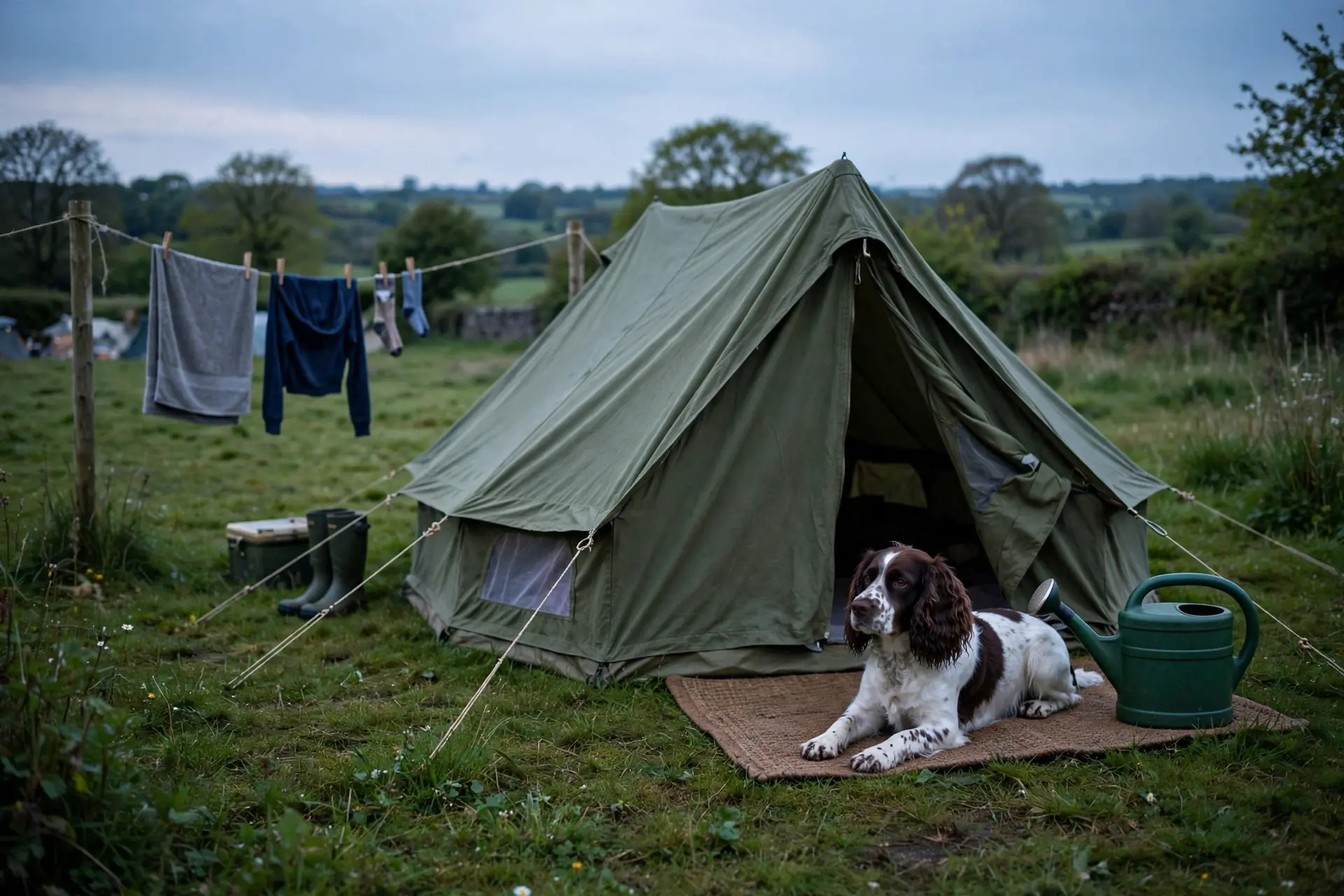
Grass pitches are the classic camping choice, and for many dogs they are the best one. Soft ground is kind to paws and joints, tent pegs go in easily, and a dog can settle on a mat without the heat or hardness of gravel. The trade-off is weather. After a day of rain, a grass pitch can turn into a churned patch of mud, especially around the tent door where the dog goes in and out a dozen times a day. Ask about drainage before you book: pitches on a gentle slope dry faster than pitches in a hollow, and a site with sandy soil will cope with rain far better than one on heavy clay. If the forecast looks wet, pack a groundsheet for the dog's area outside the tent door and a second mat for inside the porch, so mud stops at the threshold instead of travelling into the sleeping area.
Hardstanding pitches — gravel, concrete or paved bays, usually with an electric hook-up — suit a different kind of trip. They stay firm and usable after rain, which matters if your dog is older, arthritic or unsteady on soft ground, and they make levelling a caravan or motorhome far simpler. The downsides are specific to dogs. Standard tent pegs will not hold in gravel or concrete, so you need rock pegs or heavy-duty screw pegs, and a groundsheet alone will not protect a dog's paws from sharp stones. In summer, dark gravel and concrete absorb heat and can burn paws by midday, so test the surface with the back of your hand before letting the dog settle on it. Hardstanding pitches also tend to sit closer together, which means more neighbouring dogs, more passing foot traffic and more noise at night — worth weighing against the dry-ground advantage.
Glamping changes the deal again. Bell tents, safari tents, pods and yurts offer a real bed, solid walls and often a wood burner, which sounds ideal for a first camping trip with a dog. The catch is that dogs are usually allowed only in units the site has specifically designated as dog-friendly, and those units may be fewer, further from the facilities and booked out earliest. Check the flooring: hard flooring is easy to clean after a muddy walk, while fitted carpet in a bell tent will show every paw print and may attract a cleaning charge. Ask whether the unit has a deck or a fenced area outside where the dog can be tethered safely, whether the dog is allowed on the bed, and what happens if the dog is left alone in the unit while you use the shower block — many glamping sites forbid this outright. Our guide to dog-friendly holiday parks in the UK covers the same designated-unit problem in more detail, and the checks there apply just as well to a glamping pod.
Electric hook-up deserves a thought of its own. A 10-amp or 16-amp hook-up lets you run a small heater, charge phones and keep a kettle going, but the cable run from the bollard to the tent is a trip hazard for dogs and a chewing risk for puppies. Route the cable along the edge of the pitch, peg it down or cover it with a cable ramp, and never let the dog's tether cross it. If you are camping without hook-up, plan your power around a charged power bank and a head torch, and remember that a dog's water bowl and food bowls need a flat, sheltered spot whether or not you have electricity.
Whichever pitch you choose, ask for the practical details that never appear on the booking page: how far is the nearest drinking water point, where is the nearest dog toilet area, how wide is the pitch, and can the car park beside it? A wide pitch on the edge of the field with a short walk to the water point beats a cramped central pitch every time, even if the central one costs less.
On-lead and off-lead rules
Most British campsites require dogs to be on a lead at all times while on site. This is the single most common rule in the camping world, and it catches first-timers by surprise because the field looks so open and inviting. The reason is practical rather than unfriendly: a site full of tents, guy ropes, barbecues, small children and other dogs is not a safe place for a loose dog, however well trained. A dog that bolts across a pitch can trip over a guy rope, knock a barbecue, chase a child or start a fight with a tethered neighbour's dog. The lead rule protects your dog as much as anyone else's.
What counts as a lead varies from site to site. Some wardens accept any lead; others specify a short lead of around two metres in shared areas and allow a longer line only on your own pitch. A long line is genuinely useful on a campsite because it lets the dog move around the pitch, sniff and settle without you holding the handle all day, but it must be managed: a ten-metre line trailing across the pitch will tangle in guy ropes, wrap around table legs and trip passers-by. Set the line up deliberately, with a clear run and no slack crossing the walkway, and check it every time you move the chairs.
Tethering is where many campers get into trouble. Most sites allow a dog to be tethered on its own pitch, usually to a screw-in ground stake or a purpose-made tether point, but few allow tethering to a tree, a fence post or a guy rope. Never tie a dog to a guy rope: a sudden pull can collapse a tent or bring a pole down. Never tether a dog where it can reach a neighbouring pitch, a barbecue or the road. And never leave a tethered dog unattended for long — a dog that gets tangled, frightened or overheated while tied up is in real danger, and several sites now limit tethering to short periods when the owner is present on the pitch.
Off-lead time usually happens in one place only: the dog exercise field, if the site has one. These range from a properly fenced paddock with a gate that latches, to a rough patch of grass with a sign and a hope. Before you let the dog off, walk the boundary yourself. Look for gaps in the fence, gates that do not close, holes under the hedge and any neighbouring livestock. Check the surface too: a field full of rabbit holes is a sprained-leg risk, and a field beside a road with a broken fence is not an exercise area at all. If the site has no exercise field, plan your off-lead time off site — a nearby beach, woodland or open access land where dogs are allowed off the lead — and treat the campsite itself as a strictly on-lead zone.
Shared areas have their own etiquette. Keep the dog on a short lead near the shower block, the reception, the children's play area and the washing-up area, where people carry hot water and sharp objects. Give other dogs a wide berth at the water point, where two dogs drinking at once can turn tense. And remember that the lead rule usually extends to the dog's first and last outings of the day: the 11pm toilet trip is still on site, still on a lead, and still needs a torch.
Dog wash, water and waste
A proper dog wash is the difference between a muddy dog and a muddy tent, and it is worth asking about before you book rather than discovering its absence at 9pm after a wet walk. The best campsites have a dedicated dog wash station: a raised or walk-in shower tray, warm water, a non-slip surface and a drain that actually drains. The next best is an outdoor cold tap with a hose and a concrete apron, which does the job in summer but is a miserable prospect in October. The worst arrangement is no tap at all, which means carrying bowls of water from the drinking water point and washing the dog on the grass. Ask specifically: is there a dog wash, is the water warm, is it free or coin-operated, and how far is it from the dog pitches? A wash station beside reception is little use if your pitch is at the far end of a large field.
Drinking water is a separate question. Most sites have drinking water points dotted around the field, usually marked on the site map, but the distance from your pitch can vary from twenty metres to two hundred. A dog that drinks a lot after a long walk needs water close at hand, so ask for a pitch near a water point and carry a collapsible water container as a backup. Never let the dog drink from a grey water disposal point, a chemical toilet emptying point or a standpipe marked as non-drinking water; these are not the same as the drinking water taps, and the signs are there for a reason. If the site's water comes from a borehole or a private supply, check the official guidance before you travel if your dog has a sensitive stomach.
Waste is the part of camping nobody photographs, and campsites are strict about it for good reason. Pick up after your dog everywhere on site, including your own pitch, the exercise field and the walk to the gate. Most sites provide poo bag dispensers near the entrance and the exercise field, but supplies run out, so bring your own bags and a sealed container for used ones — a lidded tub with a clip lid works well and keeps smells inside the tent porch rather than in the car. Dog waste goes in the general waste bins or the dedicated dog waste bins, never in the recycling, never in the chemical toilet disposal point and never left in a bag hanging from a fence. Sites that find bagged waste left around the field quickly tighten their dog rules, so this is one of those small habits that protects every dog camper who comes after you.
Grey water — the washing-up water, shower run-off and dog-wash water from your pitch — has its own disposal point, usually a drain or a soakaway marked on the site map. Do not tip it onto the grass beside your tent, where it attracts insects and leaves a sour smell, and never tip it near a drinking water point. Food waste should go in the general waste bin, not in the fire pit and not scattered for wildlife. A tidy pitch is not just good manners on a campsite; it is what keeps foxes and badgers from visiting at night, which brings us to the next section.
Finally, think about drying. A wet dog in a tent is a damp tent, and damp tents grow mildew. Two drying coats, rotated so one is always dry, work better than a stack of towels because they keep the dog warm while they dry and can be hung on the washing line overnight. A microfibre towel for paws, a waterproof mat under the food and water bowls, and a spare set of bedding for the dog's bed will save the trip more than once. If the site has a launderette, check whether it accepts pet bedding — some do, some do not, and the answer is worth knowing before the dog's blanket is soaked through on day two.
Night-time: noise, wildlife and tents
Night is when camping with a dog gets hardest, because everything that is easy in daylight becomes a negotiation in the dark. Sound carries a long way between tents, and a dog that barks at a fox, a passing torch or a neighbour unzipping a tent can wake a whole row. The first step is pitch choice: ask for a pitch away from the main footpath, the shower block and the children's play area, where foot traffic is lowest after dark. Edge pitches are usually quieter, though you should check what lies beyond the boundary — a pitch beside a sheep field or a woodland edge will have more wildlife noise than one beside the car park.
Wildlife is a real part of British camping. Foxes patrol most rural sites at night, badgers follow regular routes through hedgerows, and deer move through woodland edges at dawn. A dog that has never met a fox will often bark at the smell alone, and a dog that has met one may want to chase. Keep the dog inside the tent at night, with the inner tent zipped, rather than in the porch or the awning where it can see and smell everything that passes. If your dog sleeps in a crate, set the crate up inside the tent exactly as it is at home, with the same blanket and the same door position — familiarity is what settles a dog in a strange place. Check the official guidance before you travel if the site is near farmland with livestock, because sheep and cattle in neighbouring fields change the rules about leads and noise at night.
Temperature drops sharply in a tent after midnight, even in summer. A dog that sleeps happily on a kitchen floor at home may shiver on a thin groundsheet at 3am, especially an older dog, a short-coated breed or a puppy. Pack a proper dog bed with insulation from the ground, a blanket, and for cold nights a dog coat or a sleeping bag liner the dog can burrow into. Ventilation matters too: a tent sealed tight against the cold will fill with condensation by morning, and a wet dog plus condensation equals a damp, cold start. Crack a vent at the top of the tent and keep the dog's bed away from the tent wall where condensation collects.
The night-time toilet trip deserves planning. Know where the nearest dog toilet area is before dark, and walk the route once in daylight so you are not finding your way with a torch and a dog on a lead at midnight. Take a head torch rather than a hand torch so both hands are free, wear shoes you can slip on quickly, and keep the lead and a poo bag by the tent door. Keep the trip short and boring: out, toilet, back, no playing, no exploring. Dogs learn the routine fast, and a predictable last outing is what lets everyone sleep.
Fireworks season, roughly late October to early November, deserves a special mention. Many campsites sit near villages that host displays, and a dog that is fine with thunder can still panic at fireworks. If you are camping around Bonfire Night, ask the site whether nearby displays are planned and whether the site itself hosts one. A pitch far from the village, a familiar bed, a chew and a radio left on low can all help, but a severely noise-phobic dog may be better off at home for that particular weekend. Our guide to dog-friendly holiday parks in Cornwall discusses seasonal noise and fireworks in a coastal setting, and the same questions apply to a campsite pitch.
Booking questions to ask before you pay
Campsite booking pages rarely show the dog rules in full. The price you see is usually the pitch price for two adults, and the dog details hide in a separate policy page, a booking form tick box or a confirmation email. Before you pay, ask the questions below directly — by email or phone — and keep the reply with your confirmation. A site that answers clearly and quickly is usually a site that has thought about dogs properly; a site that cannot answer is telling you something too.
- Which pitches accept dogs, and is there a dog fee per night? Get the per-night figure for each dog, the maximum number of dogs per pitch, and whether the fee is charged for the whole stay or per night.
- Is there a fenced dog exercise field, and where is it? Ask about the fence height, the gate, the surface and whether it is shared with other dogs at the same time.
- What are the lead rules, and where do they apply? Confirm whether the lead rule covers the whole site, including the walk to the shower block and the water point.
- Is there a dog wash, and is the water warm? Ask whether it is free, coin-operated or charged, and how far it is from the dog pitches.
- Where is the nearest vet, and what are its opening hours? Rural practices can be twenty minutes away and close early; save the number before you travel.
- What are the check-in and check-out times? Arriving in daylight matters: a 3pm or 4pm check-in gives you time to pitch the tent, walk the boundary and settle the dog before dark.
- Is there a minimum stay, and what are the cancellation terms? Bank holiday weekends often carry a three-night minimum, and the deposit — typically 25 to 30 percent — may be non-refundable.
- Can the car park beside the pitch? Unloading a nervous dog across a busy field at dusk is a poor start, and a car beside the pitch doubles as a safe waiting place.
- Are fires, fire pits and barbecues allowed, and where? Some sites ban open fires entirely, others provide communal fire pits, and a few allow raised fire bowls on your own pitch — but never near a tethered dog.
- What happens if my dog barks and a neighbour complains? Ask for the written complaints procedure, not a reassurance. A warning and a pitch move is very different from being asked to leave with no refund.
Judge the answers by their specificity. "We love dogs here" is marketing; "two dogs maximum, three pounds per dog per night, dogs on a lead at all times, fenced exercise field at the far end of the field, warm dog wash beside the shower block, nearest vet eight miles away in the village" is information you can plan around. If the site cannot tell you where the dog wash is or how many dogs are allowed per pitch, the booking is not ready to pay for yet.
Packing for a camping dog
Packing for a camping dog is not the same as packing for a dog at home, because everything the dog needs must survive mud, rain, a small tent and a car boot full of camping kit. Start with the lead system: a short lead for shared areas, a long line for the pitch, a spare lead in case one gets chewed or lost, and a screw-in ground stake with a swivel so the tether does not twist. Add a harness as well as a collar — a harness gives you control without pressure on the neck when the dog lunges at a passing rabbit, and it is far safer for tethering than a collar, which can slip or choke.
Sleeping kit comes next. A proper dog bed with a raised, insulated base keeps the dog off cold, damp ground, and a familiar blanket from home does more for settling than any new purchase. In a tent, the dog's bed should sit beside yours, not in the porch where draughts and wildlife sounds are strongest. If the dog uses a crate, bring the crate and set it up exactly as at home; if the dog does not use a crate, a pop-up dog pen can mark out a safe area inside a large tent or awning. Pack a spare blanket and a spare bed cover, because one will get wet — it always does.
Feeding on a campsite needs its own system. Bring the dog's usual food in sealed, airtight containers, measured out per meal, because an open bag of kibble in a tent attracts mice, and a spilled bag on grass is gone for good. Use heavy, non-tip bowls or bowls that sit in a stand, and place them on a waterproof mat inside the tent porch rather than on bare grass. Store food in the car overnight rather than in the tent, especially on rural sites where foxes and badgers patrol. Bring more food than you think you need — a wet, cold dog burns more energy, and the nearest shop may be miles away.
Health and hygiene kit is the part most people under-pack. A tick remover and tweezers, a small first aid kit with saline, bandages and a muzzle for emergency handling, any regular medication with a day to spare, and the dog's vaccination record on your phone. Pack a tick hook because grass pitches, woodland edges and long grass are prime tick habitat from spring to autumn, and check the dog every evening. Add ear cleaner for spaniels and other floppy-eared breeds after swimming, paw balm for cracked pads on gravel hardstandings, and a bottle of dog shampoo for the dog wash — most site washes provide water only, not shampoo.
Finally, the small things that save the trip: a head torch for night outings, a roll of poo bags plus a sealed container for used ones, two drying coats, three microfibre towels, a familiar chew or long-lasting treat for settling at night, a favourite toy, and a recent photo of the dog on your phone in case the dog runs off. Weigh the dog's bag before you leave — a wet tent, wet towels and wet dog bedding add kilos fast, and the car will be fuller on the way home than it was on the way there.
If it rains for three days
Three days of rain is the real test of a camping trip with a dog, and it is the scenario most first-timers do not plan for. The first thing to fail is usually the pitch itself: grass turns to mud at the tent door, the groundsheet starts to let water through at the seams, and the dog tracks mud into the sleeping area with every trip outside. The fix is a system, not a single item. Lay a groundsheet outside the tent door and a second mat inside the porch, so the dog crosses two barriers before reaching the sleeping area. Keep a towel by the door for paws, and change the dog's drying coat after every walk so a wet coat is never the one the dog sleeps in.
Drying becomes a daily routine rather than an afterthought. Hang wet coats, towels and bedding on the washing line under the awning or in the porch, and ventilate the tent even in the rain — crack a top vent and open the porch door briefly after each drying session, because a sealed tent full of wet dog and wet kit will be dripping with condensation by morning. If the site has a launderette, use it on day two rather than waiting until everything is soaked; a dry set of bedding halfway through a wet trip is worth the walk. Rotate the dog's bed cover daily, and keep a spare dry blanket sealed in a dry bag as your emergency reserve.
Walks need rethinking too. Woodland paths on clay soil, riverside meadows and unpaved farm tracks can become impassable after days of rain, and a dog that slips on a muddy bank can injure a leg far from the car. Ask the warden which local walks hold up best in wet weather — forestry tracks, surfaced coastal paths and park trails usually stay usable, and staff give this advice constantly. Shorten walks rather than skipping them: three short outings with a dry-off in between beat one long soaking walk that leaves the dog cold and the tent wet. Avoid flooded fields and fast-flowing streams, and check the dog's paws after every walk for cuts from hidden stones and debris.
Boredom is the hidden problem of a rainy camping trip. A dog that spends three days in a tent with nothing to do will invent its own entertainment, usually involving chewing, barking or digging at the groundsheet. Pack enrichment that works in a small space: a stuffed chew toy, a snuffle mat, a long-lasting chew, and a few training games you can play inside the tent. Scatter feeding — hiding kibble in a towel or a snuffle mat — tires a dog out without needing space. Keep sessions short and calm, and settle the dog with a chew before bed so the tent stays quiet.
Know when to call it. If the pitch is flooding, the tent is leaking at the seams, or the dog is shivering despite a coat and a dry bed, the right decision is to pack up early or move to a hardstanding pitch or a nearby dog-friendly pub with rooms. There is no prize for enduring a miserable trip, and a dog that associates camping with cold and wet will be harder to settle next time. Check the forecast before you book as well as before you leave, and consider a site with hardstanding pitches as your wet-weather backup — a gravel pitch in the rain is a far better holiday than a grass pitch under water.
Practical questions
Before you go
Can dogs stay off the lead anywhere on a campsite?
Only where the site says so, and usually only inside a fenced dog exercise field. Most campsites require dogs on a lead everywhere else on site, including the walk to the shower block and the route to the car. Never assume a quiet corner of the field counts as an off-lead area; ask at reception and check the site map for the marked exercise zone.
Do campsites charge extra for dogs?
Many do, typically between 2 and 5 pounds per dog per night, though some sites include one dog in the pitch price and a few charge nothing at all. The fee often rises for a second dog and some sites cap the total at two dogs per pitch. Ask for the all-in figure per night before you pay, and check whether the fee covers the dog wash or whether that is charged separately.
What if my dog barks at night in a tent?
Sound carries a long way between tents, so a barking dog can disturb a whole field. Ask for a pitch away from the main footpath and the children's play area, keep the dog's bed close to yours inside the tent, and settle them with a chew before bed. If barking continues, speak to the warden early rather than waiting for a complaint; most sites will help you move pitches or will ask you to leave if the noise does not stop.
Can I leave my dog alone in the tent while I use the shower block?
Most campsites discourage or forbid leaving a dog unattended in a tent, even for a short shower, because a distressed dog can chew through canvas, slip a zip or bark the whole time you are gone. Plan around it: shower in turns if you are travelling as a pair, or ask at reception whether the site has any arrangement for short absences. A dog that cannot settle alone in a tent needs a different plan, such as a hardstanding pitch where the dog can wait in the vehicle.
Are dogs allowed in glamping pods and bell tents?
Some are, but only in units the site has specifically designated as dog-friendly, and the rules are usually stricter than on a grass pitch. Expect a pet fee, a limit of one or two dogs, and conditions such as dogs not being allowed on the bed or left alone in the unit. Ask whether the unit has hard flooring that is easy to clean, whether there is a fenced area outside, and what the cleaning charge is if the dog makes a mess.
What should I do if my dog runs off on a campsite?
Tell the warden or reception straight away so they can alert other campers and check the site boundaries, then walk the most likely routes calmly rather than chasing. Most run-offs head for the dog exercise field, the water point or the neighbouring field, so check those first. Make sure your dog's tag and microchip details are up to date before you travel, and carry a recent photo on your phone so staff can recognise the dog.