This guide is independent and contains no paid placement. If affiliate links are added later, they will be clearly marked and will not change our editorial checks.
Pet dogs do not go inside Canterbury Cathedral and are generally not admitted to the controlled precincts, so plan a split visit there — then enjoy a city that otherwise suits dogs well: medieval lanes, a walkable city wall, the Stour river gardens, the Great Stour Way toward Chartham, and pubs used to muddy boots. Check the official site before you go for the current precinct arrangements.
The cathedral precincts: where the line runs
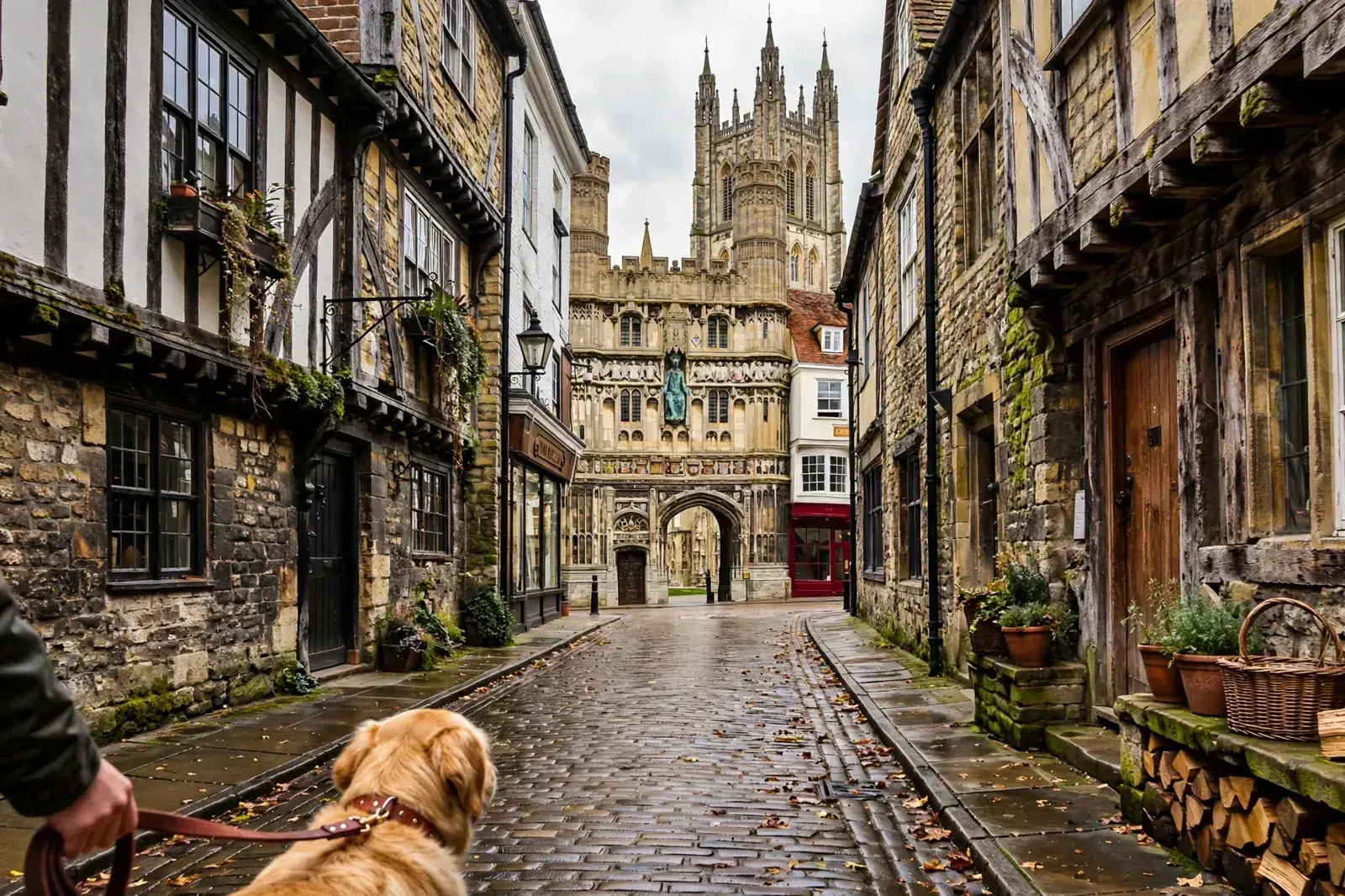
Canterbury Cathedral sits inside a walled precinct quarter in the north-east of the old city, entered through gates including the ornate Christ Church Gate on the Buttermarket. This boundary is the organising fact of a dog visit. Pet dogs are not admitted to the cathedral itself, and entry to the precincts is controlled, with pet dogs generally not allowed inside; assistance dogs are welcome throughout. Policies for the precincts and visitor facilities have been adjusted in recent years, so treat any guide — including this one — as a prompt to check the official site before you go, not as the final word.
None of that makes the cathedral a write-off. The exterior is one of the great sights of England and is fully visible from the streets and lanes outside the gates: the view through Christ Church Gate from the Buttermarket is the city's postcard, and the walk around the precinct walls, along Burgate and through the lanes behind the cathedral, gives a dog a good lead walk and its owners most of the architecture. For the interior itself, the split visit is painless here because the precinct quarter is surrounded on all sides by the most dog-suitable parts of the city — river gardens to the west, lanes and shops in every direction — so the person outside with the dog is exploring, not waiting.
Allow the tour proper time, because the cathedral is large and the precinct contains the cloisters, chapter house and the martyrdom site; ninety minutes to two hours is a realistic single visit, and timed or advance arrangements can apply at busy times. Reunite outside the gate and trade roles if you both want the interior, or let the second person's visit happen the following morning while the dog gets its long Stour walk. Solo travellers should book the interior for a morning, with the dog settled only if their accommodation genuinely permits solo leaving, or arrange local care — tying a dog outside a precinct gate is neither allowed nor kind.
The other great churches follow a gentler pattern worth knowing. St Augustine's Abbey, the ruined first cathedral of Anglo-Saxon England across the city, is an open-air English Heritage site where the rules for dogs on leads in the grounds have historically been more welcoming than a roofed interior; our English Heritage dogs guide explains the general pattern, and the same check-the-official-site rule applies on the day. St Martin's Church, the oldest church in continuous use in England, sits in a peaceful churchyard on the same side of the city and makes a calm lead walk joined to the abbey visit.
Medieval lanes and the city wall walk
Beyond the gate, Canterbury's gift to dogs is its scale. The old city inside the walls is small enough to cross in fifteen minutes, threaded with lanes that carry more dogs than cars: Palace Street with its leaning bookshop front and independent shops, the Kings Mile running north through some of the city's best small cafes and delis, Mercery Lane narrowing toward the Buttermarket, and the quiet residential streets around the Marlowe and the churches. Dogs on leads are simply part of the street life here, and most independent shops will tell you their own policy at the door — ask, and accept the answer with good grace either way.
The city wall itself provides the structure. Much of Canterbury's medieval wall survives, and the walkway and the streets along it — from Westgate along the wall past the towers to the Dane John and beyond — make a natural circuit for a morning or evening lead walk, with the wall on one side and gardens on the other. The Westgate Towers, the largest surviving city gate in England, anchor the western end where the river gardens begin. Sections of the circuit pass close to the ring road, so the southern stretch is a functional walk rather than a scenic one, but as a dog routine from a central hotel it is hard to beat: history overhead, grass underfoot, and the whole thing done in under an hour.
Crowd judgement matters on the High Street and around the Buttermarket on Saturdays, at graduation times for the city's universities, and through the Christmas market season, when the centre fills shoulder to shoulder. Dogs cope better on the Kings Mile, the lanes north of the High Street and the river side of the city; treat the High Street at peak hour as a route to cross, not a place to browse. Early mornings in Canterbury are the local secret — deliveries, mist on the Stour, students not yet up, and lanes that feel medieval again.
The River Stour and its gardens
The Great Stour threads the city from west to east, splitting around the centre, and its banks hold Canterbury's best everyday dog walking. Westgate Gardens, just inside the Westgate Towers, run along the river in a series of lawns, flower beds and mature trees — a lead-walking garden in practice, busy with families in summer, and one of the prettiest short walks in Kent in every other season. The river here is clear, shallow-edged in places and full of ducks, which settles the lead question on its own: keep dogs close, out of the flower beds, and out of the water in the gardens themselves.
For a real walk, follow the Great Stour Way west out of the city toward Chartham. The riverside path runs for roughly three miles through water meadows and alongside the lakes and wetlands near Chartham, flat, well-used by local dog walkers, and increasingly rural with every bridge. Away from the path itself, the meadow edges give confident dogs better exercise than the city parks, with the standing cautions of any river valley: livestock graze some sections in season, the river can run high and fast after rain, and ground-nesting birds and water voles are among the reasons to keep dogs out of the reed beds. The return by train from Chartham, or the same way back on foot, both work; carry water, because the path offers few refill points.
The river trips and punts that leave from the city centre in season are an operator-by-operator question for dogs, answered in the FAQ below — the short version is check before you book. What the river reliably offers a dog owner is the evening: the gardens empty, the light drops along the water, and the walk from Westgate to the mill and back becomes the calmest half hour of the Canterbury day. For a wider Kent picture — castles, cliffs and coast to combine with a Canterbury base — see our Kent dog guide, which covers the county in full.
Dane John, Westgate and the local parks
The Dane John Gardens, in the south-east of the walled city, are Canterbury's formal green drawing room: a Roman burial mound topped with a monument, avenues, lawns and the city wall running along its edge. It is a lead-walk space in practice and a lovely one, built for a circuit rather than a run, and the view from the mound takes in the cathedral and the whole old city — a good orientation stop on a first morning. The gardens host events in season, when fencing and crowds change the routine; follow signage on the day.
Beyond the gardens, the everyday exercise comes from the city's edges. The meadows and paths around the Stour west of the city, the green spaces in the Sturry Road direction, and the recreation grounds in the residential districts all serve local dogs well, and a visitor staying a few days will settle into one of them naturally. Toddlers Cove and the riverside play area near Westgate are family territory — pass through on a lead rather than settling. Wherever you walk, Canterbury's parks follow the standard pattern: off-lead only where your dog's recall is genuinely reliable, leads near play areas, sports, roads and water, and everything picked up, always.
One park habit is worth teaching here because the city rewards it: the short, frequent walk. Canterbury's centre is compact enough that three twenty-minute loops — lanes at breakfast time, river at lunch, wall and Dane John by evening — suit most dogs better than a single exhausting expedition, and they suit a sightseeing owner exactly as well. Build the day in loops and both species stay cheerful.
Day trips from Canterbury: woods and coast
A Canterbury base opens two classic Kent dog days. Inland, the Blean Woods, immediately north-west of the city, are one of the largest areas of ancient woodland in England: waymarked trails under oak and sweet chestnut coppice, heathland clearings, and deep shade that makes them the summer choice when the coast is hot and crowded. Dogs are welcome on the trails; keep them under close control in the grazing and wildlife areas, follow the seasonal signage about ground-nesting birds, and expect mud after rain on the clay paths. It is a leads-and-long-lines wood for most dogs, and the better for it — the walking is the point.
Seaward, Whitstable is twenty minutes by train or a short drive: a working harbour town of oyster heritage, shingle beaches with seasonal dog rules that vary by section, and the long promenade and Tankerton slopes for lead walking in any month. Check the current beach restriction signs on arrival — the pattern of summer exclusions on the busiest sections is the standard Kentish one — and plan the off-lead running for the quieter eastern beaches where permitted. Herne Bay and the Reculver towers beyond it extend the same coast for a longer day.
Both trips share a dog owner's advantage: they end back in Canterbury for the evening, where the pubs and the river are waiting. If you only have one day trip in the budget, choose by weather — Blean for heat and windless grey days, the coast for bright ones — and by your dog's temperament, because a woodland dog and a beach dog are often different animals.
Where to stay with a dog
Canterbury's accommodation clusters inside the walls, around the two stations, and in the guest-house streets of the residential districts east and west. Inside the walls you are buying position: cathedral lanes at the door, the evening city to yourselves, and lead-walk routines to the Dane John or the river for the first and last walks. In the streets beyond — around Canterbury West station, in St Dunstan's, or toward St Martin's and the abbey side — you get quieter nights, easier parking and greener doorsteps, at a price of ten minutes' walk. For most dogs, the second option wins on routine; for most owners chasing an early cathedral slot, the first does.
Ask the precise questions and get them answered before you pay: which rooms accept dogs and on which floors — Canterbury's converted townhouses and coaching inns have stairs that matter to older dogs — what the fee is per dog per night or stay, whether the dog may join you at breakfast or in a bar area, and whether it may be left alone in the room at all, which decides your cathedral plan outright. Self-catering within the walls exists but books fast; check whether any courtyard is enclosed and where the nearest bin and patch of grass are, because the medieval street plan offers neither on every corner.
Book ahead for graduation weeks, the summer peak and the Christmas market run, when the city fills and the dog-welcoming, ground-floor rooms are taken first. Midweek outside those peaks is Canterbury's best-value window, and the city in February or November, wrapped for the weather, gives a dog and its owners the lanes almost to themselves.
Eating and drinking with a dog
Canterbury is a pub city before it is a restaurant city, and that suits dogs. Its historic pubs — tucked in the lanes, along the river and in St Dunstan's and St Peter's streets — are the most reliably dog-welcoming places to eat, many with water bowls by the door and a tolerant bar culture that has absorbed centuries of travellers. Independent cafes along the Kings Mile and Palace Street frequently welcome dogs too, and the smaller the room, the more it matters to arrive off-peak with a dog that can settle under a table. Every business sets its own rules, so check the official site before you go or ask at the threshold.
Avoid the two pinch points: Saturday lunchtime on the High Street, and the pre-theatre and post-graduation surges, when every kitchen in the centre is full and a dog's corner disappears. Eat early or late, choose pub gardens and riverside terraces in summer — the gardens along the Stour are among the nicest places in Kent to lunch with a dog asleep at your feet — and keep a picnic plan in reserve: the Kings Mile delis will provision you, and Westgate Gardens and the Dane John provide the lawns.
The etiquette that keeps Canterbury's welcome warm is the national one, in our UK dog-friendly cafes guide: a walked, toileted dog, a short lead, no seats, no begging, a mat down and a chew out. Muddy-paw honesty helps too — after a Stour Way walk in winter, a pub with a stone-flagged bar is a better choice than a carpeted bistro, and staff will usually point you to the right room if you ask with the dog visibly in tow.
Getting there, parking and seasonal tips
Canterbury is one of England's easiest dog cities to reach by train: high-speed services run to Canterbury West from London St Pancras in about an hour, and Canterbury East serves the classic line from Victoria. Both stations are a short walk from the walls — West to St Dunstan's and the Westgate, East to the Dane John side — and dogs travel free on a lead or in a carrier, off the seats. Drivers should use the city's car parks or the park-and-ride sites on the approaches; in-walls parking is limited, priced for short stays, and frequently full by mid-morning on Saturdays. Confirm the current arrangements on the official site before you go, and never plan on a central space appearing.
Season by season: spring suits Canterbury best for dogs — the gardens planted, the Stour clear, the lanes busy but not full. Summer brings the language-school and tourist peak together; walk early, rest dogs through hot middays on stone-flagged city floors, and use Blean's shade. Autumn is locals' Canterbury: harvest menus, quieter precinct gates, the river paths at their most beautiful. Winter means the Christmas market crowds in the centre for its run — go early or give the market streets a miss with a dog — and short, dark evenings that make the wall circuit a lunchtime walk instead.
Finish with the backup list: save a Canterbury vet and the out-of-hours service before you travel; check for ticks after Blean and meadow walks; rinse paws after winter gritting on the city streets; and be river-aware after heavy rain, when Stour-side paths flood in the lowest places and the sensible route is the wall, not the water meadow. Canterbury has been receiving travellers with animals for fourteen centuries. Arrive with a lead, a plan for the gate, and time to spare, and it will receive yours well too.
Practical questions
Before you go
Can dogs go into Canterbury Cathedral or its precincts?
Pet dogs are not allowed inside Canterbury Cathedral, and the cathedral precincts operate controlled entry where pet dogs are also generally not admitted; assistance dogs are welcome. The exact current arrangements for the precincts and any visitor facilities can change, so check the official site before you go. Most dog-owning pairs split the visit, with one person touring the cathedral while the other explores the lanes and river walks with the dog.
Are dogs allowed in Canterbury's museums and attractions?
Most of Canterbury's indoor museums and paid attractions admit assistance dogs only, which is the standard pattern for heritage interiors in Britain. Gardens, churchyards and open-air spaces vary by venue, and some smaller attractions make their own exceptions. Check each venue's official site before you go rather than assuming, and plan your day so the indoor visits are short, split between two adults, and balanced with the city's excellent outdoor walking.
Where can dogs go off lead in Canterbury?
The best off-lead options near the centre are the larger open areas of the city's parks and the meadows and paths along the Great Stour Way out toward Chartham, away from roads, livestock and the riverbank itself. Dane John Gardens and Westgate Gardens are lead-walking spaces in practice. Always follow local signage, keep dogs under close control near wildlife, grazing animals and other path users, and use a long line where recall is not fully reliable.
Can dogs go on the river boats in Canterbury?
River trips and punts operate from the city centre in season, and dog policies are set by each operator and can change between seasons; some small-boat operators have welcomed a calm dog on a lead, others do not carry dogs at all. Check the official site before you go or ask the operator directly before booking, board only if your dog can sit still in a small boat, and never assume a policy from a previous year still applies.
Are dogs allowed on trains and buses to Canterbury?
Yes. Dogs travel free on UK trains, including the high-speed services to Canterbury West and the classic line to Canterbury East, provided they stay on a lead or in a carrier and off the seats. Local buses generally carry dogs at the driver's discretion on the same terms. Canterbury's two stations are both a short walk from the centre, and travelling off-peak makes the journey easier for a nervous dog.