This guide is independent and contains no paid placement. Access rules for castles, beaches and trains change, so check the latest official guidance for the exact place and date before you travel.
Sort Kent into coast, castles and countryside, then pick only one as the anchor for the day. Keep dogs on a short lead near cliff edges and livestock, expect castle interiors to be dog-free even when grounds welcome dogs, check beach restrictions on the day, and let the train timetable — not optimism — set your return time.
The 55-minute decision: sorting Kent before you leave London
It starts, for many people, not with a map of Kent but with a departure board in London. A fast train can put you in Canterbury, Folkestone or Dover in roughly an hour, give or take the service and the day, and that 55-minute promise is seductive. It makes Kent feel like an extension of the city: leave after breakfast, walk somewhere dramatic, eat well, and be home for the evening routine. With a dog beside you on the platform, that promise needs one honest correction. The train is only the first leg. You still have a station exit, a walk or bus to the castle, beach or trailhead, toilet stops, water stops, and a return journey when your dog is tired, possibly wet, and far less patient about waiting on a cold platform.
The simplest way to plan well is to sort Kent into three kinds of day and refuse to merge them. Coast days are about chalk cliffs, promenades, shingle and sand, harbour towns and wind. Castle days are about extensive grounds, gardens, parkland and outdoor exploring, with the understanding that the most famous rooms will usually be closed to dogs. Countryside days are about the North Downs, orchards, hop gardens, villages and longer, quieter walking where the reward is space rather than a headline attraction. Each kind of day suits a different dog and a different energy level. A young, fit dog who needs distance may love a Downs section and find a busy harbour town frustrating. An older dog may happily potter around castle lawns and a cafe garden, then sleep on the train, while a cliff path in strong wind would be a day too far.
Choose the anchor first, then build everything else around it. If the anchor is Dover Castle, the town and White Cliffs are a possible extra only if time, weather and your dog all agree — they are not an automatic add-on. If the anchor is a Whitstable beach walk, Canterbury is a tempting inland detour, but adding it can turn a relaxed coastal day into two train journeys and a rushed cathedral city wander. If the anchor is a North Downs Way stretch between villages, protect it: start early, carry water, and do not squeeze a castle into the same afternoon. One anchor, one town stop, one good meal and one straightforward return is the formula that most dogs cope with best.
Weather decides more in Kent than first-timers expect. Chalk is beautiful and treacherous in different weeks. After rain it can be slick on slopes and sticky in gateways. In summer heat, exposed cliff tops and Downs ridges offer little shade, and shingle beaches can be hard work for small legs and hot for paws on promenade tarmac. In autumn and winter, daylight shortens the useful day, coastal wind cuts through even a good coat, and some seasonal cafes reduce their hours. Check the forecast for the coastal town or the castle, not just for London, and be willing to swap a cliff day for a sheltered gardens day when the wind is strong. That flexibility is not a failure of planning. It is the planning.
Castles and gardens: grounds, not interiors
Kent markets itself, fairly, as a county of castles. Dover, Leeds Castle near Maidstone, Hever, Rochester, Walmer, Deal and Upnor all pull in different directions on the map and offer very different days. For a dog owner, the headline question is never simply whether a place is dog-friendly. It is where, exactly, the welcome ends. At most large sites the pattern is similar: dogs are welcome in grounds, gardens and outdoor areas on a short lead, but not inside furnished interiors, exhibitions, play areas or indoor catering, with assistance dogs treated differently. Phrase that carefully for your own booking, because each property sets its own rule, some allow dogs in more outdoor spaces than others, some restrict formal gardens at busy times, and special events can change access for a weekend. Always check ahead on the official page for the exact site and date.
Dover Castle is the most fortress-like choice: a huge hilltop site above the port, with extensive outdoor areas, steep slopes, walls, tunnels in the wider complex and long views over the Channel. For a dog, the pleasure is the scale of the grounds, the grass and the sense of exploring a place built in layers, rather than any single interior. Plan for hills, exposed wind at the top, steps in places, and busy pinch points near entrances on school-holiday days. If your dog struggles with steep gradients, crowds or sudden noises from demonstrations and events, check the event calendar before choosing a date. A quieter weekday outside peak season usually gives you more space to move at your dog's pace and to step aside when groups gather.
Leeds Castle, which despite its name sits in Kent near Maidstone, is often presented in photographs as a moated postcard. With a dog, think of it as parkland and gardens first: water, lawns, woodland edges and formal planting that reward a slower wander. Again, do not assume dogs can follow you into the castle rooms, mazes, indoor attractions or every garden section. Confirm which areas are open to dogs on a lead, whether there are designated dog-free zones, where water bowls are provided, and whether you need to book a timed entry that affects how long you can linger outside. The grounds are the day here, so bad weather matters: if heavy rain is forecast, a grounds-only visit loses much of its value and a different date may be wiser.
Hever Castle, in the west of the county near Edenbridge, adds a different test: beautiful gardens and lake walks that look gentle in pictures but can involve busy paths, water edges and other visitors in a relatively compact site. Dogs on leads are a common pattern in gardens of this kind, but rules for the castle interior, restaurants, shops and specific garden rooms vary and change, so check ahead rather than relying on another visitor's old review. Keep leads short near waterfowl, planting and children's areas, and be realistic about a dog who lunges at ducks or cannot settle when other dogs pass every minute. Arriving early, walking the further parts of the grounds first, and saving any cafe stop for later usually produces a calmer visit.
Smaller and coastal sites can be a better fit for nervous dogs. Walmer and Deal castles sit close to the sea and to promenade walks, so you can combine modest grounds with a flat coastal stretch and a town lunch without committing to a vast estate. Rochester offers a castle in a historic town setting, useful if you want a shorter anchor plus streets, shops and a river walk. Whichever you choose, carry out the same checks the night before: lead length required, whether extendable leads are discouraged or banned in busy areas, where dogs may or may not go, whether there is shade and water, whether parking or the station approach involves a steep climb, and what happens if you need to leave quickly. Write the answers in your phone notes. On the day, when a steward gives you directions, you will already know which parts of the site are realistic for your dog.
Garden manners protect future access for everyone. Keep to paths where signs ask you to, do not let dogs into planting, ponds or play areas, clear up everywhere including in long grass where it is still required, and move well aside for mobility scooters, prams and other dogs. If your dog needs a break from stimulation, find a quiet lawn edge away from entrances and let them watch from a distance rather than pushing through the busiest terrace. A castle day succeeds when your dog can toilet, drink, rest and walk without constant close encounters. If that sounds unlikely at midday in August, go early, go off-season, or choose a Downs walk instead.
White Cliffs and coastal paths: beautiful, exposed, lead-on
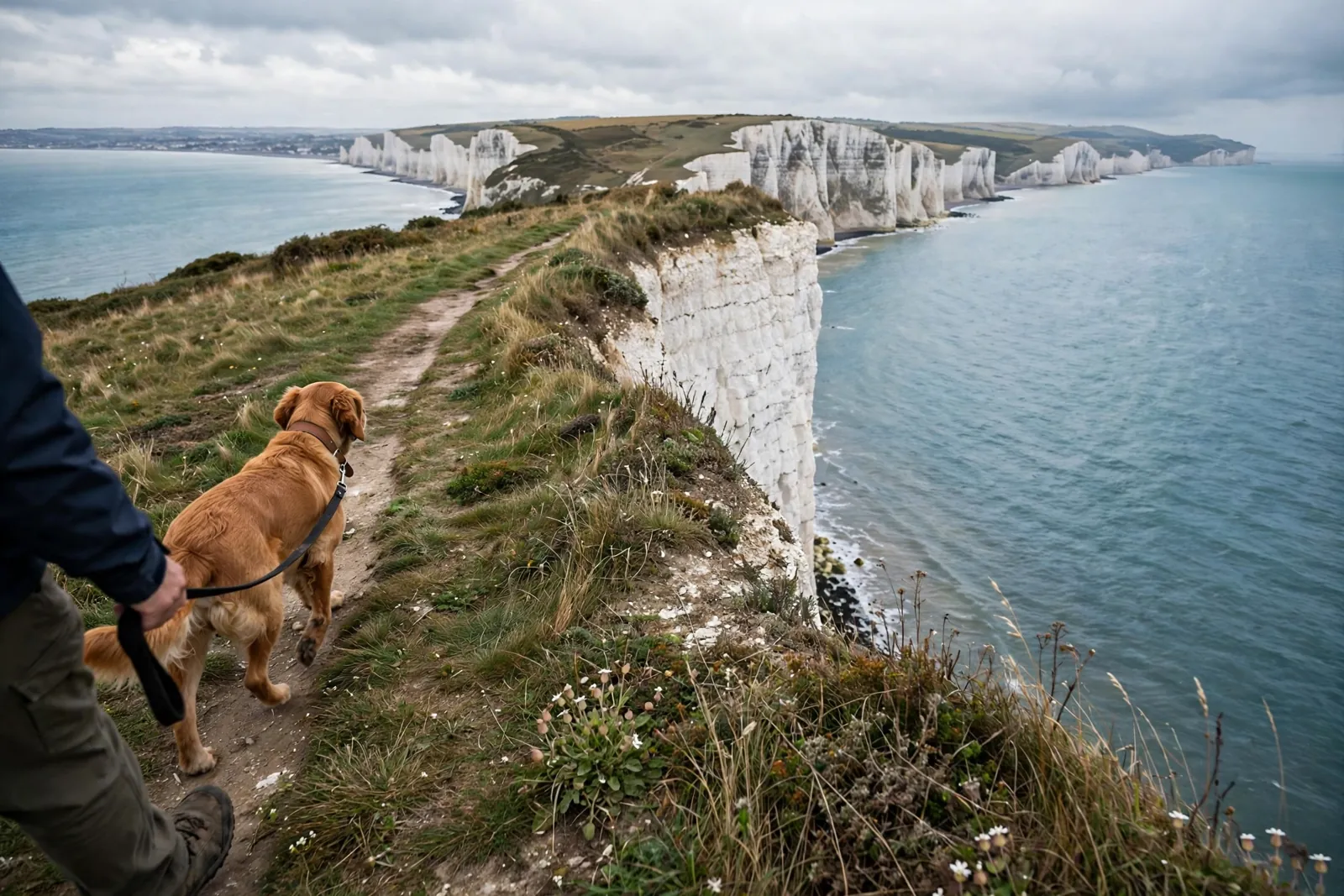
The White Cliffs near Dover are the image most people carry of Kent, and they deserve that status: chalk grassland high above the Channel, shipping moving far below, larks overhead and, on a clear day, the French coast on the horizon. They are also the place in this guide where cheerful encouragement must stop and clear safety language must start. There is no fence along much of the cliff top. Chalk paths run close to the edge in places. Chalk and short grass can be slippery after rain and polished smooth on popular slopes. Dogs chase birds, follow scents over crests, and misjudge how quickly ground falls away. Keep your dog on a short lead near cliff edges, on narrow chalk paths and around grazing livestock, full stop. Save any off-lead time, where it is allowed and appropriate, for safer inland sections well away from edges, roads and animals.
Routes around Dover and towards South Foreland and St Margaret's Bay reward walkers who respect distance and tide of people as much as distance on a map. Start from a recognised access point, stay on the clear path, and resist desire lines that cut towards the edge for a photograph. If the wind is strong enough to push you sideways, shorten the walk. If mist drops, turn back rather than navigating by phone near an edge you cannot see clearly. Footwear matters: trainers with worn soles are a poor choice on wet chalk, and a dog pulling downhill on a flexi lead is a genuine hazard to both of you. Use a fixed lead, a harness that does not slip, and a pace that lets you stop without skidding. Carry water even on a cool day, because exposed walking and sea wind dehydrate dogs without obvious panting at first.
Further along the coast the character changes but the caution travels with you. The Saxon Shore Way and King Charles III England Coast Path, as sections are named and signed locally, link towns such as Folkestone, Dover, Deal, Sandwich, Ramsgate, Broadstairs, Margate, Herne Bay and Whitstable in a string of promenades, cliff tops, harbour walls and quieter stretches. Promenade sections can be ideal for older dogs, buggies and anyone who wants a flat, obvious route with cafes and toilets. Cliff-top sections need lead discipline, wind checks and an exit plan. Beach-level sections need tide awareness: at high tide some routes narrow or disappear against defences, leaving you to retrace your steps. Check tide times as well as the forecast, and never let a dog swim in rough water, near harbour entrances, or where local signs warn about currents or water quality.
Livestock is the other regular reason for a short lead on the Kent coast. Chalk grassland is often grazed by sheep or cattle to keep it open, sometimes in fenced compartments you enter through gates, sometimes with animals visible only once you round a rise. Put the lead on before you reach them, give them a wide arc, and if cattle approach, stay calm and be prepared to let go of the lead and leave the field by the nearest safe exit if official countryside guidance for that situation applies — check the latest official guidance where you are unsure. Ground-nesting birds and seasonal wildlife restrictions can also apply on coastal reserves. Signs at gates are not decoration; they are the local rule for that week. For a broader framework on reading beach and coastal signs before you set off, see our guide to dog-friendly beaches in the UK: rules, bans and fines, which explains how restrictions are usually signed and enforced.
End a cliff walk with margin. The most tiring part for many dogs is not the distance but the concentration: wind noise, other walkers passing on narrow paths, cyclists on shared sections, and constant lead work on slopes. Build in a sit-down stop on a bench set back from the edge, offer water, check paws for chalk grit and small stones, and watch for shivering or overheating depending on the season. If your dog is done, a short out-and-back that finishes near a cafe is a better memory than a completed loop finished in distress. The cliffs will still be there on a calmer day.
Beaches and seasonal restrictions: Whitstable, Botany Bay and beyond
Kent beaches are mostly shingle, shelving and characterful rather than endless sand, and that suits many dog owners once expectations adjust. Shingle is hard work for tiny paws and pushchairs, brilliant for dogs who love to sniff seaweed lines and watch gulls from a respectful distance, and often quieter outside the main summer weeks. The crucial point is seasonal restriction. Many Kent beaches restrict dogs on the main bathing sections during the summer season, commonly from May to September, while allowing them on leads on promenades or on quieter sections year-round. Exact dates, times and boundaries differ by beach and by council, and enforcement is real in the busiest places. Check the sign at the beach entrance and the council page on the day you visit, and treat a friendly blog post from two summers ago as history, not permission.
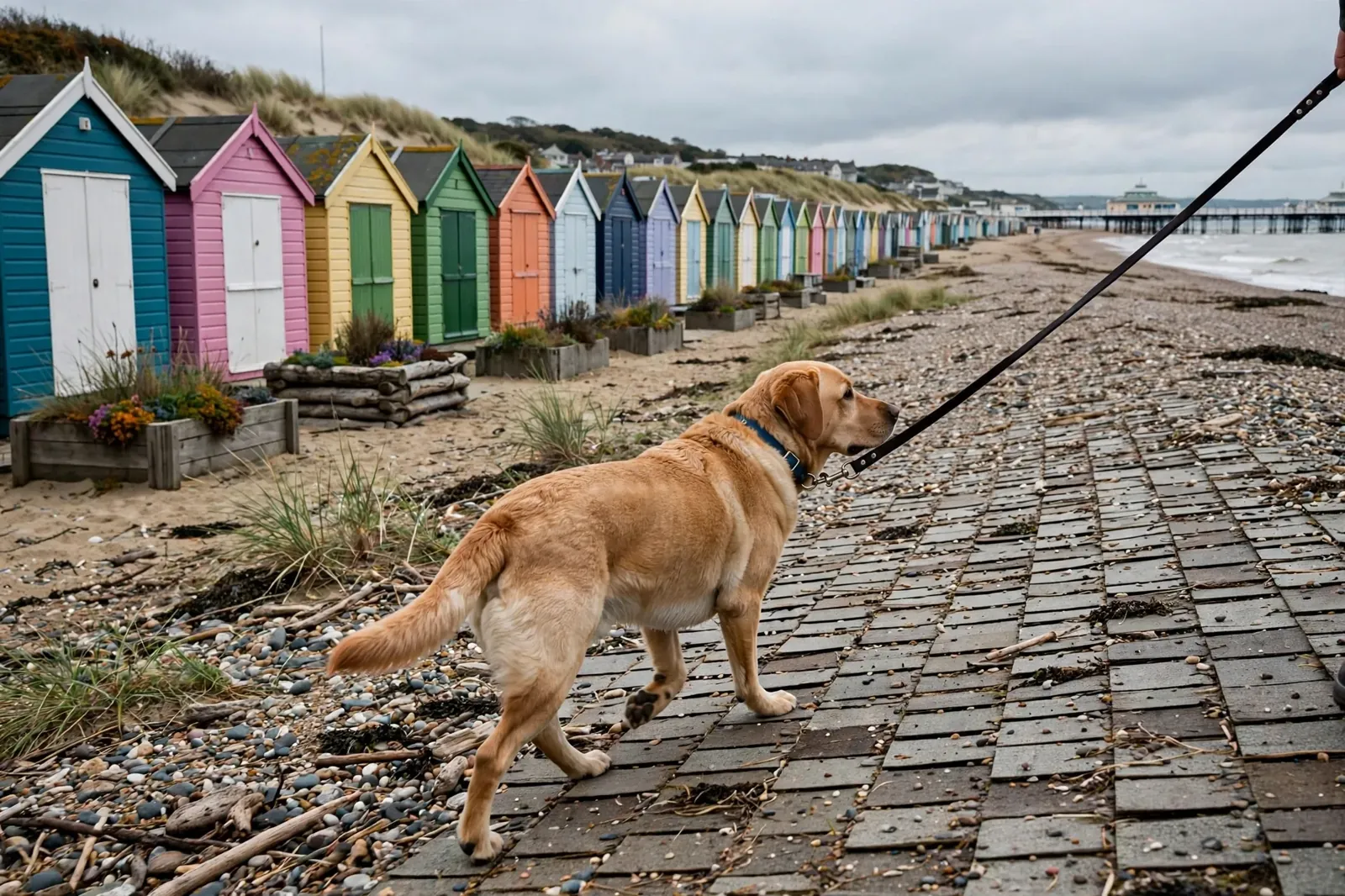
Whitstable, on the north Kent coast, is a working harbour town with oyster heritage, independent shops, a long shingle shore and a promenade that many visitors use for an easy dog walk. The beach experience changes along its length: busier near the harbour and main town sections, quieter as you head towards Tankerton with its grassy slopes and beach huts. Seasonal rules can apply to parts of the beach, dogs are commonly expected on leads on busy promenades, and harbour areas need extra care with fishing gear, boats, slippery surfaces and food stalls. Plan a Whitstable day as town plus promenade plus permitted beach section, rather than assuming the whole shore is available for off-lead running in July. Go early for space, carry fresh water because dogs should not drink seawater, and rinse salt and shingle grit from paws afterwards. If you want a guaranteed long sand run in high summer, Kent may not be the county that delivers it on its most famous beaches, and choosing a different season will serve you better.
Botany Bay, near Broadstairs, is famous for chalk stacks and a photogenic cove, and it illustrates every beach-planning lesson at once. Access, tide and cliff safety matter: chalk cliffs can shed material, so do not sit dogs or people directly under cliff faces, and check tide times so a falling tide does not tempt you round a headland that the returning tide will cut off. Seasonal dog restrictions can apply to the main beach, access can be busy at peak times, and facilities are limited compared with a large resort. Nearby Broadstairs, Ramsgate and Margate each have their own bays, byelaws and dog sections, sometimes within a few hundred metres of each other, so a rule you read for one bay does not transfer to the next. Walk to the entrance sign, read it, photograph it if it helps, and plan your lead, swimming and ball-game decisions from that sign.
Other Kent shores reward the same careful approach. Deal and Walmer offer long, relatively straightforward promenade and shingle walking linked to their castles. Folkestone has harbour, creative quarter and coastal park options where surfaces and rules change as you move. Herne Bay and Reculver combine promenade walking with a wilder-feeling stretch towards the towers. Dungeness, at the far south-eastern edge, is a vast, exposed shingle landscape unlike anywhere else, with wind, sparse shelter and specific sensitivities around wildlife and private areas; it is memorable, but it is not a casual paddling beach. Everywhere, take litter and dog waste to a bin even if you have to carry it to the town, keep dogs away from seal haul-outs and resting birds where signs ask for distance, and never assume a quiet weekday means restrictions have been lifted. If you are comparing Kent with the year-round sandy options further east, our Suffolk Coast dog guide shows how different a neighbouring coast can feel for beach choice.
North Downs Way sections: countryside without the crowd
Inland Kent is the counterweight to its coast. The North Downs Way National Trail runs across the county's chalk ridge, linking Farnham in Surrey towards Dover through Canterbury-adjacent sections and a loop that gives walkers choices in the east. For a dog day, you do not need to walk a heroic distance. The best approach is a single, well-chosen section between two settlements or stations, walked one way with a train or bus return, or a modest out-and-back from a village with a pub. Look for sections that combine ridge views, woodland shade, and a start and finish where you can park or arrive by train without a long road walk on lanes without pavements.
Chalk downland has its own etiquette and hazards. Grazing sheep and cattle maintain the grassland, skylarks and other birds nest on the ground in season, and rare plants grow in short turf that boots and paws can damage by straying. Keep dogs close on leads around livestock and during bird-nesting season where signs request it, and close on paths through crops and farmyards. Gates tell a story: if a gate is closed, close it behind you; if a field is being moved or a farm vehicle is working, wait and make room. Blue-green algae can appear in still water troughs and ponds in warm weather, adder risk exists in sunny, undisturbed spots across southern England in season, and ticks are a routine summer check after any woodland or long-grass walk. None of this should put you off. It should change what you carry: water and a bowl, a tick tool, a charged phone with offline mapping, and a plan that does not depend on a single stile a large or injured dog cannot cross.
Station-to-station Downs days suit confident walkers. Areas around Wye, Chilham, Charing, Lenham, Hollingbourne and the Canterbury approaches all offer, in different combinations, village facilities and access to higher ground — but every route needs checking on a current map for distance, ascent, road crossings and stile types before you commit a dog to it. A circular walk that looks neat on a screen can include a busy A-road crossing or a long, shadeless climb that ruins an older dog's afternoon. Read recent route information, check whether replacement buses affect your return train, and tell someone your plan if you are walking a quiet section alone. In winter, chalk mud in gateways and on bridleways can be deep; in summer, carry more water than you think you need, because Downs villages are not spaced like London high streets and a closed shop is a long way from the next tap.
The reward for this care is a Kent many day-trippers never see: orchards below the ridge, hop gardens, flint churches, dry valleys that appear suddenly between woods, and pubs where a dog can collapse under a table while walkers compare maps. If your dog is reactive, a weekday Downs section often offers more passing space than a harbour promenade, provided you manage livestock and narrow sunken lanes sensibly. If your dog is elderly, choose a short ridge-top potter from a high car park rather than a valley-to-ridge climb. Either way, finish while your dog still looks pleased. Downland walking is addictive precisely because it feels spacious; leaving energy in reserve is how you get to come back.
Pubs and cafes: Canterbury and the coastal towns
Food is not an afterthought on a Kent dog day. It is the rest stop, the water refill, the shade or shelter, and often the moment your dog finally settles. Canterbury is the inland hub most visitors choose: a compact historic city with the cathedral at its centre, riverside walks along the Stour, gardens, and a good spread of pubs and cafes in streets that are busy at peak times. Dogs are commonly welcome in pub gardens, terraces and many cafe outdoor areas, and a growing number of places welcome them indoors in bar areas, but cathedral precincts, indoor dining rooms and individual businesses set their own rules. Check ahead for the specific place, especially if you are counting on an indoor table in rain. Assume you will need a lead, a settle mat if your dog uses one, and a position tucked away from serving routes and other dogs.
Canterbury rewards an early or late rhythm. Arrive before the main day crowds, walk the river and city walls areas while they are quieter, let your dog toilet and drink before any cafe stop, and then eat while the city fills up. Keep leads very short in narrow lanes and shop doorways, watch for dropped food around outdoor tables, and remember that a cathedral visit itself is a people-only plan in most cases unless current official guidance says otherwise for assistance dogs — do not build a dog day around entering major indoor attractions. The better Canterbury dog itinerary is outdoors: river, gardens, streets, a dog-welcoming pub lunch, a browse of shops that allow dogs where signed, and a unhurried walk back to Canterbury East or West station depending on your line.
On the coast, each town eats differently. Whitstable leans towards seafood, harbour-side eating and small independent cafes where space is tight and queues form; a dog who can wait calmly tied nowhere and settled under a small table will cope, while a large, restless dog may be happier with a takeaway eaten on a bench set back from the harbour bustle. Broadstairs and Margate offer bay-side and old-town options where a short walk separates a busy front from quieter streets. Folkestone's harbour and old high street areas can be lively with events and food stalls, brilliant for confident dogs and overwhelming for shy ones at peak times. Deal and Sandwich often feel a notch calmer, with promenade walks feeding naturally into pub gardens and cafes. Everywhere, ask the same practical questions when you book or arrive: are dogs inside, outside only, or in a specific bar area; is there water; is there shade or shelter; and how long is the wait for food, because a 45-minute wait is a training session for a young dog.
Pub etiquette in Kent is the same as anywhere, only more visible in small places. Feed and water your dog outside busy doorways where staff advise, keep them off furniture unless explicitly invited, do not let them greet every table, and take them out promptly if barking starts rather than hoping the whole pub will adapt. Muddy Downs or beach paws are part of the county's walking life and many pubs expect them, but wiping paws and keeping wet dogs off upholstered seating is basic courtesy. A cafe stop should restore your dog, not just refuel you. If they cannot settle after ten minutes, a walk around the block and a quieter bench may be the kinder lunch.
Trains from London with a dog: the return journey is part of the plan
Kent is one of the easiest counties in England to reach by train with a dog, and one of the easiest to get wrong by assuming every London terminal and every service behaves the same. Southeastern is the main operator for most Kent routes, with high-speed services from London St Pancras International and other services from London Victoria, Charing Cross, London Bridge, Waterloo East and Blackfriars depending on the destination. Journey times, stopping patterns and Sunday engineering work vary a great deal. Check your exact station pair and date, and check the return before you book the outward leg. For the national picture on fares, carriage rules and etiquette, read our guide to taking a dog on UK trains alongside the operator's latest pages.
Dogs usually travel free on National Rail services in Great Britain, with up to two dogs per passenger, provided they do not endanger or inconvenience other passengers and are kept on a lead or in a suitable carrier. Operators can apply conditions, so check the latest official guidance before you travel. Travel off-peak where you can: a dog needs floor space that a packed commuter service cannot give, and peak restrictions on tickets, not on dogs, are often what catch visitors out. At the station, keep leads short on escalators and stairs — carry small dogs on escalators where guidance advises it — use lifts where provided, keep well back from platform edges, and board towards a vestibule or a quieter end of the train where your dog can lie without blocking the aisle. Muzzle requirements are not a general National Rail rule for ordinary pet dogs, but a dog who is anxious in crowds may travel more calmly with familiar equipment and space rather than with new gear introduced on the day.
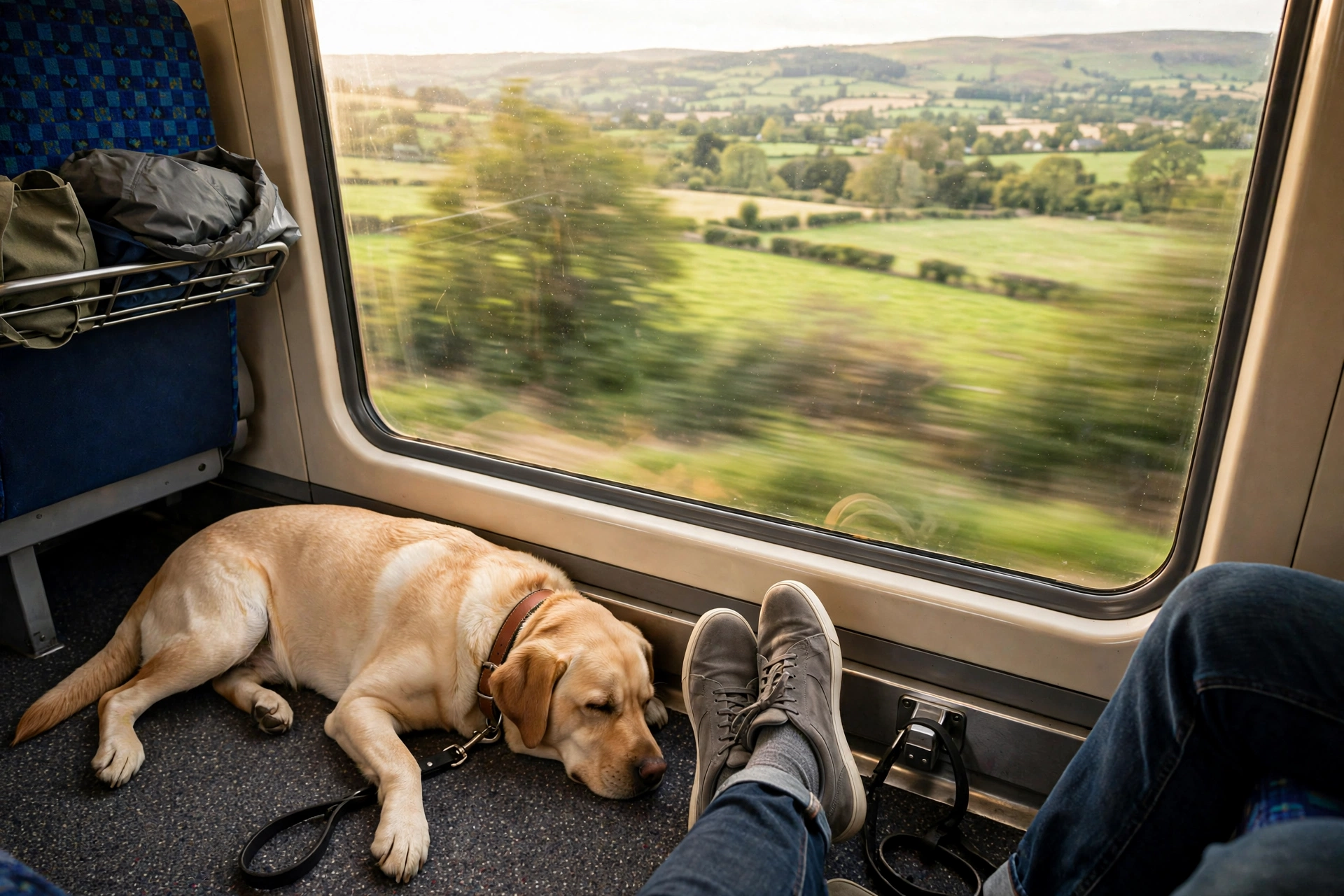
Plan the dog's journey as carefully as the walk. Offer water and a toilet chance before entering the station, because the next reliable opportunity may be an hour away. On board, settle your dog on the floor, not on seats, with a familiar mat if that helps, and keep treats low-key and odour-light out of courtesy. If the train is delayed, your dog still needs air, water and patience; carry a collapsible bowl and enough water for the return leg, not just for the hill. At your Kent station, note step-free access, gaps between train and platform, and how far the exit is from the castle, beach or trailhead. A station that looks close on a map can involve a steep hill in Dover, a long promenade in Folkestone, or a busy road in Margate that changes the plan for a nervous dog.
Driving remains an option for dogs who do not cope with trains, for multi-stop rural days, and for Downs sections with no convenient station. It brings different checks: secure travel in the car, shade and ventilation at stops, never leaving a dog in a warm car, parking charges and height barriers, and lanes that are narrow, hedged and slow. Whichever way you travel, set a hard turnaround time based on your dog, daylight and the last comfortable return, not the last possible one. The best Kent days end with a dog asleep on the train home or in the car, not with a sprint for a connection.
Three one-anchor itineraries that actually fit in a day
A castle day, done well, might run like this. Take a morning train to the nearest station for Leeds Castle or Dover, arrive as grounds open where booking allows, walk the furthest outdoor areas first while they are quiet, rest with water and shade late morning, eat at an outdoor or dog-welcoming option you checked the day before, walk one shorter second loop only if your dog is still keen, and leave with at least one train in hand before your planned return. Photograph the site map at the entrance, identify toilets, water points and the exit early, and give a reactive dog a decompression walk away from the entrance crowds before you go in. If interiors matter deeply to the humans, accept that someone may need to take turns while the other stays outside with the dog, and decide that rota before you arrive, not in a queue.
A coast day needs tide, wind and restriction checks before it needs a cafe shortlist. Choose Whitstable for town plus promenade, Broadstairs and Botany Bay for a classic bay with careful tide planning, or Dover for cliffs with strict lead discipline. Start with the beach entrance sign, walk the permitted section at your dog's pace, keep cliff and harbour hazards in mind, and time food for when your dog is ready to settle. Build the return around daylight and tide, not around squeezing in a second town. If the wind rises or rain sets in on an exposed shore, shortening the day is a success, because you noticed. Dogs remember the feeling of a day more than its itinerary, and a calm early finish protects the next trip.
A countryside day is the quietest of the three and the one most likely to be underestimated. Pick a North Downs section you have checked for distance, climbs, stiles and livestock, carry food and water as if no shop will be open, and walk it without adding a town tour at the end. Stop often. Let your dog sniff the hedgerows that make downland walking slow and satisfying. Finish in a village with a pub garden or a station and enough time that a delayed train is an inconvenience, not a crisis. Across all three itineraries, the shared kit list is short and non-negotiable: a fixed lead and spare, poo bags and somewhere to carry waste, water and a bowl, a towel, paw checks, any medication your dog needs, and a phone with tickets, maps and official rule pages saved. That preparation is invisible in photographs. It is the reason the photographs look relaxed.
Practical questions
Before you go
Are dogs allowed inside Kent castles or only in the grounds?
At most large Kent castles dogs are welcome in the grounds, gardens and outdoor areas on a short lead, but not inside furnished interiors, exhibitions or indoor cafes, with assistance dogs excepted. Rules differ between Dover Castle, Leeds Castle and Hever Castle and can change for events, so check the official page for the exact site and date before travelling.
Can dogs go off lead on the White Cliffs near Dover?
Keep your dog on a short lead near cliff edges, on narrow chalk paths and around grazing livestock. There is no fence along much of the cliff top, chalk can be slippery after rain, and a dog chasing a bird can reach the edge in seconds. Off-lead time belongs on safer inland sections away from edges, roads and livestock.
When are dogs restricted on Kent beaches such as Whitstable and Botany Bay?
Many Kent beaches restrict dogs on the main bathing sections during the summer season, commonly from May to September, while allowing them on leads on promenades or on quieter sections year-round. Exact dates, times and boundaries differ by beach and council, so check the sign at the beach entrance and the council page on the day you visit.
Can I take my dog on trains from London to Kent for free?
Dogs usually travel free on National Rail services in Great Britain, with up to two dogs per passenger, provided they do not endanger or inconvenience other passengers and are kept on a lead or in a suitable carrier. Southeastern and other operators can apply conditions, so check the latest official guidance before you travel and avoid busy peak services where possible.
How much time do I need for a dog-friendly day in Kent?
Allow a full day for one main anchor, such as a castle grounds visit or a cliff walk, plus one town stop for food. Trying to combine Dover, Canterbury and the coast in one day leaves too little time for trains, toilet breaks and rest. Most dogs do better with one long walk, a long lunch and an early train home.