This guide is independent and contains no paid placement. If affiliate links are added later, they will be clearly marked and will not change our editorial checks.
Travel with a Chihuahua by keeping trips short, warm and calm: a coat and blanket for cold mornings, frequent rests, indoor-friendly stops, a carrier for the long stretches, and a vet-checked plan for knees and teeth. If the day starts to feel like an endurance event, it is too long for this dog.
The cold-morning test
It is a cold morning in a British market town, the kind where the pavement is still damp and the wind finds every gap in a coat. You lift your Chihuahua out of the car and, within a minute, the shivering starts: a fine, whole-body tremble, paws lifted one at a time from the cold ground, ears back, body hunched low as if trying to fold itself smaller. This is not fussiness and it is not a performance for attention. A dog that weighs two or three kilograms, stands barely twenty centimetres tall at the shoulder and may have a very thin single coat simply loses heat fast, and cold air close to the ground, wet grass and a draughty doorway all make it worse.
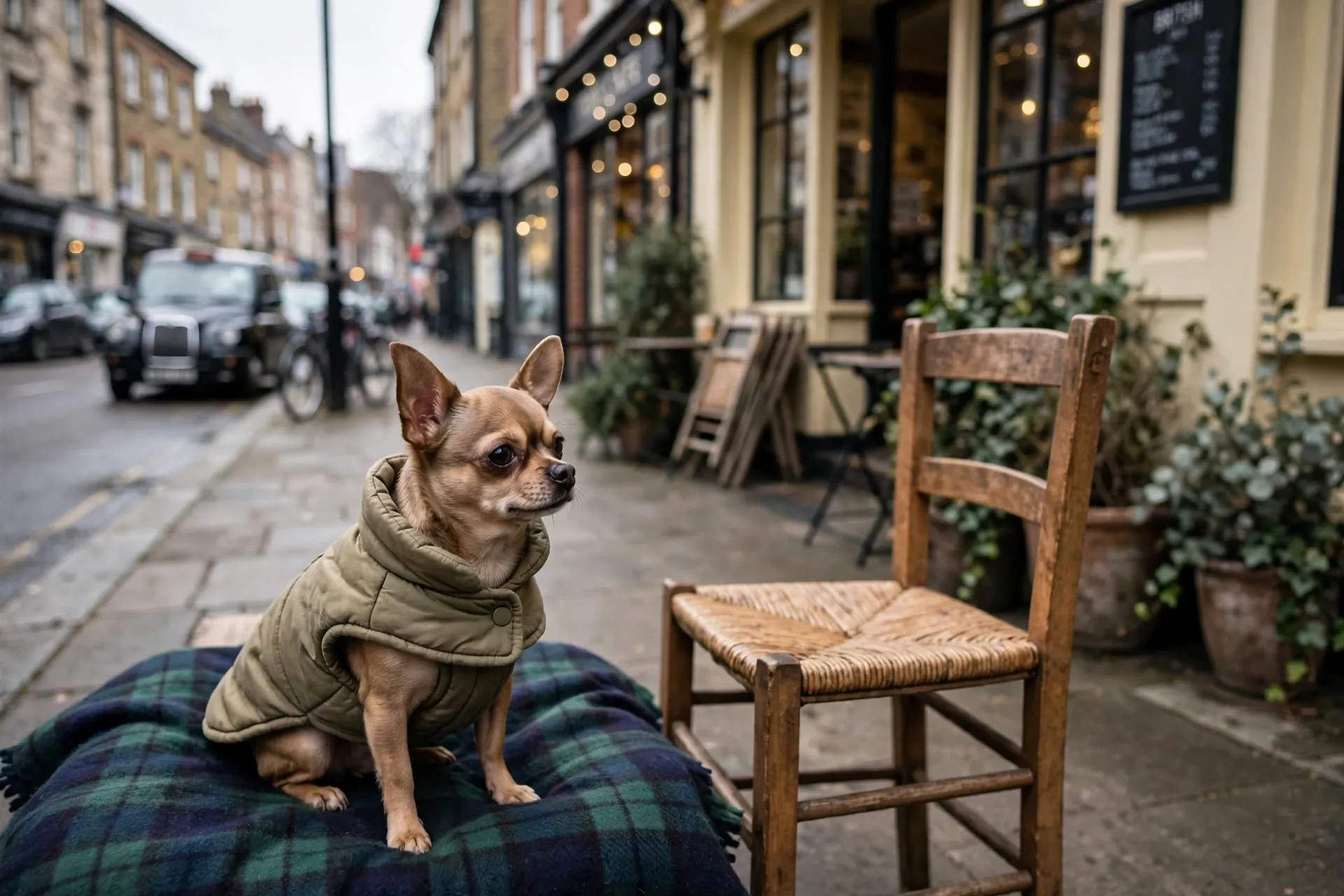
So you stop, and you do the unglamorous work that makes a Chihuahua trip succeed. You slip on the fleece-lined coat before you leave the car, not halfway down the street when the shivering has already set in. You fasten it snugly without pulling it tight across the shoulders, you check that it covers the belly, and you put a folded blanket in the bottom of the carrier so the dog is not sitting on cold fabric. Then you walk a short loop, not the long riverside path you had planned, and you duck into the cafe while the dog is still warm enough to enjoy it. Ten minutes later, settled on the blanket beside your chair with a bowl of water, the trembling has stopped and the dog is watching the room with bright, interested eyes. That change, from a shivering bundle to a relaxed companion, is the whole point of this guide.
Use that cold morning as your planning test for every outing. If the route, the weather and the stops would leave a small, thin-coated dog cold, wet or exhausted before lunch, redesign the day. Shorten the walk, add an indoor stop, pack an extra layer, or move the outing to the warmest part of the day. Chihuahuas can be enthusiastic, curious and surprisingly bold travellers, but they are not small Labradors, and a day designed for a medium-sized dog will punish them quietly: first with shivering, then with reluctance to walk, then with a dog that spends the rest of the holiday hiding under a blanket. Plan for the dog you have, and the dog you have will travel happily.
The same test applies to heat, rain and wind, in different ways. A Chihuahua overheats less obviously than it chills, because owners who are alert to cold sometimes over-layer in summer, and a small dog in a thick coat on a warm day can pant hard without much room to cool down. Rain soaks a short-legged dog from below, chilling the belly and legs even when the back stays dry under a coat. Wind on an exposed coastal path or a hilltop cuts through a thin coat and makes a nervous dog more anxious, because the noise and movement are harder to predict. Check the forecast for the exact place and hour, not just the daily summary, and build a warm, dry retreat into every plan, whether that is a cafe, a car with the heater ready, or a hotel room a short drive away. If you cannot name the retreat, the outing is too exposed for this breed.
The size and temperament truth
Chihuahuas are the smallest recognised dog breed, and that single fact shapes almost every travel decision. Adults commonly weigh between one and three kilograms, although some are larger, and their legs are short relative to a human stride. A distance that feels trivial to an owner, such as a mile to the beach and back, is a long expedition for a dog of this size, especially on rough ground, sand, steps or a steep slope. Small does not mean fragile in spirit: many Chihuahuas are alert, confident, loyal and intensely bonded to one person, and they often want to be in the middle of everything. But confidence does not lengthen legs, strengthen kneecaps or add body fat, and owners who mistake boldness for stamina are the ones who end up carrying a tired dog home in their arms.
Temperament matters just as much as size. Chihuahuas are famous for strong attachment to their favourite person, and many are wary of strangers, new dogs and sudden handling. That wariness is not bad behaviour to be corrected by flooding the dog with busy places; it is information about what kind of trip will work. A quiet village cafe, a small bookshop that welcomes dogs, a sheltered garden and a short walk on a quiet lane will usually suit a Chihuahua far better than a crowded festival, a noisy market hall or a beach full of off-lead dogs. The dog that barks at the postman at home is not going to become a relaxed festival dog because it is on holiday. Choose places where the dog can observe from a safe distance, retreat to a carrier or blanket, and stay close to its person, and you will see the calmer, funnier side of the breed instead.
Attachment also means separation is a real travel issue. A Chihuahua that follows its owner from room to room at home will not suddenly be content left alone in a strange hotel room while the owner goes out for dinner. Many accommodation providers prohibit leaving dogs unattended anyway, and a distressed small dog in an unfamiliar room can bark, scratch at doors, refuse food and become genuinely upset in a short time. Plan the holiday on the assumption that the dog comes with you everywhere, or that one person stays with the dog. If you do need a short separation, practise it at home first with the same carrier, blanket and settling routine you will use away, and keep it brief. Do not test a new separation routine for the first time in a hotel room on the first night of a holiday.
Age changes the picture further. A Chihuahua puppy under a year old is still learning the world, may not have completed its vaccinations, and tires quickly; a senior Chihuahua may have a heart murmur, dental pain, reduced vision or stiff joints that make travel harder. Puppies need toilet breaks far more often, and older dogs need ramps, non-slip mats and shorter, slower walks. Both need more rest than a healthy adult, and both are more sensitive to cold. Ask your vet about the specific dog in front of you rather than relying on breed generalisations, because two Chihuahuas of the same age can differ enormously in confidence, fitness and health. The best travel plan is written for one dog, not for the breed label on the pedigree.
Finally, be honest about handling. Chihuahuas are often picked up by well-meaning strangers, children and friends who want a cuddle, and a dog that is lifted without warning, held too tightly or passed from person to person can become snappy or fearful. On a trip, protect your dog from unwanted handling as firmly as you would protect a child from the same thing. A polite, short refusal is enough: the dog is resting, or the dog does not like being picked up by people it does not know. Indoors, keep the dog on its blanket or in its carrier when strangers approach, and let the dog choose whether to come forward. A Chihuahua that feels safe is a charming travel companion; a Chihuahua that feels grabbed is a stressed one, and stress is what ruins the rest of the day.
Warmth and anxiety management
Warmth is not one coat; it is a system. Start with a coat that fits: it should cover the chest and belly, stay in place when the dog moves, and not rub the armpits, neck or groin. A fleece or quilted coat works well for dry cold, while a waterproof coat with a fleece lining is better for wet British weather. Many owners use two layers, a thin fleece under a waterproof shell, and that combination is often better than one very thick coat that restricts movement. Check the fit at home before the trip, because a coat that slips sideways, rides up over the back or presses on the throat will be refused, and a refused coat is useless on a cold morning. Take a spare coat or a dry fleece as well, because a wet coat chills a small dog fast, and drying a coat on a radiator takes longer than the next outing allows.
Blankets, beds and carriers are the second layer of the system. A folded vet-bed or fleece blanket in the carrier insulates the dog from a cold car boot, a stone cafe floor or a damp bench. A raised bed or a blanket on a chair keeps the dog off cold tiles in a cafe or a cottage. In a hotel room, put the dog bed away from draughts and exterior doors, and add a blanket the dog can burrow under, because many Chihuahuas like to sleep covered and will settle faster that way. At night, check the room temperature before you check your own comfort: a room that feels cool to a human in a duvet can feel cold to a small dog sleeping on the floor. If the dog is shivering at night, add a blanket and move the bed, and ask the accommodation about heating rather than assuming the dog will adapt.
Anxiety management starts before the journey, not at the first bark. The most useful tool is predictability: the same carrier, the same blanket, the same settling cue, the same feeding times and the same bed, wherever you are. Feed at home times, walk at roughly home times, and keep the first day of any trip deliberately quiet. A short walk, a cafe stop and an early return to the accommodation beats a packed itinerary that leaves the dog overstimulated by lunchtime. Calming aids, such as pheromone sprays, calming music or a lick mat, help some dogs, but they are not a substitute for a calm routine, and any supplement or medication should be discussed with a vet before the trip, not tried for the first time on the morning of departure.
When anxiety does spike, the response matters more than the trigger. A dog that is trembling, panting, yawning repeatedly, licking its lips, tucking its tail or trying to climb into your lap is telling you it is overwhelmed. Do not scold, flood or force the dog to stay in the situation to get used to it. Move away from the trigger, increase distance, offer the carrier as a safe retreat, and let the dog settle on your lap or on its blanket without demanding interaction. Speak calmly, keep your own body relaxed, and wait for the trembling and panting to ease before moving on. If the dog cannot settle after a reasonable break, end the outing. Cutting a trip short is not failure; it is the decision that protects the next day, because an anxious dog that is pushed too far on Monday is often a more anxious dog on Tuesday.
Over-attachment deserves its own plan. Practise short, positive separations at home in the weeks before a trip: the dog settles on its blanket with a chew or a lick mat while you move to another room, then you return calmly before the dog becomes distressed. Build the duration slowly, and never make departures and arrivals dramatic events. On the trip, leave a worn item of clothing with the dog bed if that helps, but do not rely on it to solve a separation problem on its own. If your Chihuahua has a history of severe separation distress, talk to your vet or a qualified behaviourist well before booking, because a holiday that requires long separations is a poor fit for that dog, and a different kind of break, one where the dog is with you all day, is a kinder choice. Check the official guidance before you travel if you are unsure about anxiety support or behaviour help in the UK.
Noise deserves a mention, because British trips are full of it: fireworks in November, thunder in summer, busy roads, hand dryers in public toilets, vacuum cleaners in hotels and sudden applause in pubs. A Chihuahua that is sound-sensitive will cope better with a predictable routine, a safe retreat and distance from the noise than with any single product. For fireworks season, choose accommodation away from display sites if you can, keep curtains closed, play background sound at a steady level, and stay with the dog during the expected display period. For everyday noise, carry the dog past the noisiest stretch or cross the road rather than insisting the dog walk through it. Small kindnesses of this kind are what turn an anxious dog into a willing traveller.
Designing a short-trip rhythm
The ideal Chihuahua day is a rhythm, not a route. Think in blocks of thirty to sixty minutes of activity followed by a proper rest, rather than in miles covered. A workable pattern for many dogs is a short morning walk of fifteen to thirty minutes, a cafe stop, a rest in the accommodation or the car, a second short outing in the afternoon, and an early evening settle. Between blocks, the dog should have water, a toilet opportunity, warmth and quiet. This rhythm sounds unambitious compared with a walking holiday, but it matches how a small dog actually uses energy: in bursts of interest and sniffing, followed by sleep. A dog that has sniffed, watched, greeted one or two calm dogs and then slept is a satisfied dog, even if the total distance was under a mile.
Choose routes for interest, not distance. A short lane with hedgerows to sniff, a village green with a bench, a walled garden with sheltered paths, a short stretch of promenade with a cafe at the end, or a woodland trail that is level and not muddy will all suit a Chihuahua better than a long, exposed coastal path. Look for routes with an easy exit: a loop that can be cut short, a path with a cafe or car park halfway, or a walk that runs beside a road you can retreat along. Avoid routes that commit you to a long return leg, because a tired Chihuahua cannot be reasoned with about the last mile, and carrying a dog that is tired, cold and unhappy is no fun for either of you. If you do plan a longer route, plan to carry the dog for part of it from the start, and be honest about that in advance.
Rest stops should be real rests, not standing around in the cold while the humans admire a view. A rest means the dog is warm, dry, off the ground if possible, with water available, and free from demands. In a cafe, that is a blanket on a chair or on the floor beside you. In a car, it is a settled carrier with the heater or air conditioning at a comfortable level. In accommodation, it is the dog bed in a quiet room. Do not use rest stops for training, for meeting new dogs, or for posing for photographs, because each of those adds stimulation when the dog needs recovery. A dog that rests properly between outings will enjoy the next outing; a dog that is merely dragged from one stimulating place to another will become progressively more reactive as the day goes on.
Toilet planning is part of rhythm, not an afterthought. Chihuahuas have small bladders, puppies and older dogs smaller still in practical terms, and a dog that needs to go will become restless, vocal or accident-prone if the opportunity does not come. Offer a toilet break before every car journey, after every sleep, after meals, and at least every two hours during the day. Carry bags, and carry more than you think you need, because a small dog on a new diet, new water or a stressful day may need to go more often. In towns, look for grass verges, quiet side streets and park edges, and always clean up: small dogs produce small messes, but the rule is the same, and a responsible owner is what keeps venues welcoming the next small dog.
Build in a weather escape for every outing. The escape can be as simple as a cafe you have already checked, a car parked nearby, or a decision to go home early. What matters is that you have made the decision in advance, while you are calm, rather than in the rain with a shivering dog and a long walk back. A useful rule is that if the dog has stopped enjoying the walk, the walk is over, whatever the map says. Owners sometimes feel they have wasted a journey if they turn back early, but a short, happy outing followed by a warm rest is a successful day for a Chihuahua, and a long, miserable outing is not redeemed by the distance covered.
Indoor places and carrying etiquette
Chihuahuas are, in many ways, ideal indoor travel companions: they take up little space, they can settle on a blanket beside a chair, and they do not need a large garden to be content. That advantage only works if the venue genuinely welcomes dogs, and the rule for every cafe, pub, shop, bookshop, garden centre and attraction is the same: ask first, and accept the answer. A small dog is not automatically welcome because it is small, and being carried does not change the venue rule. Some places welcome dogs on the floor but not on furniture, some welcome dogs in a bar area but not in a restaurant, and some welcome dogs only on an outdoor terrace. The distinction matters, and the time to learn it is before you sit down, not after you have ordered.
Our guide to dog friendly cafes in the UK explains how to check indoor rules before you go, and the same approach works for shops and attractions: check the website, call ahead if the rule is unclear, and look for a clear dog policy at the door. When you arrive, choose a quiet corner away from the main walkway, food preparation areas and other dogs, and settle the dog on its blanket before you order. A dog that has a defined place, a bowl of water and nothing to guard will usually settle faster than a dog held on a lap in the middle of the room, because the blanket tells the dog where it belongs. If the venue provides dog treats, accept them only if they suit your dog diet and stomach, and do not let strangers feed the dog without asking you first.
Carrying etiquette is where Chihuahua owners most often get it wrong, through kindness rather than carelessness. Holding a dog up at table height, letting it sniff other diners food, or carrying it through a shop at face height for strangers puts the dog in the most stimulating position possible, with no retreat. It also makes the dog harder to control if it lunges, barks or tries to jump. A better approach is to carry the dog close to your body, low and secure, with one hand supporting the chest and the other supporting the hindquarters, and to put the dog down on its blanket as soon as you are seated. In shops, keep the dog in a carrier or on a short lead on the floor where possible, and carry it only for short stretches, such as up steps or through a crowded doorway, not for the whole visit.
There are places where carrying is genuinely useful. Steps, wet floors, crowded pavements, a busy market and a section of path with broken glass or grit are all easier with the dog carried for a short distance. A soft carrier, a sling or a small backpack designed for dogs gives you a hands-free option that also gives the dog a defined, enclosed space, which many anxious Chihuahuas prefer to being held in arms. Whichever you use, practise at home first: the dog should be able to enter, turn around and settle in the carrier without distress, and the carrier should support the dog weight without pressing on the knees or spine. A carrier that dangles, swings or tips is worse than walking, and a dog that is crammed into a carrier that is too small will arrive at the cafe more stressed than it left home.
Barking indoors is the issue that most often ends a visit early, and it deserves a calm, practical response. Chihuahuas bark because they are alert, excited, anxious or guarding their person, and a new indoor environment gives them plenty to react to. Prevention works better than correction: choose quieter times of day, sit away from the door, keep the dog settled before other dogs arrive, and reward quiet settling rather than waiting for barking to correct. If the dog does bark, increase distance from the trigger, offer the carrier, and take a short break outside if needed. Do not shout over the barking, and do not punish a fearful dog for communicating fear, because that usually makes the next visit worse. If a venue visit is going badly, leaving gracefully after a short, calm break is better than persisting until the dog, the staff and the other customers are all unhappy.
Shops and attractions have their own etiquette. Keep the dog away from food displays, low shelves and other customers belongings, and do not let the dog toilet indoors or against shop displays. In bookshops, garden centres and National Trust properties, the dog policy can vary by room, garden or season, so check at the entrance and follow signs rather than assuming the whole site has one rule. Assistance dogs have legal rights that pet dogs do not, and staff may ask different questions about assistance dogs; do not claim pet dog rights that do not apply, and do not be surprised if a venue that welcomes assistance dogs does not welcome pet dogs. Clear, polite behaviour from Chihuahua owners is what keeps the next small dog welcome, and it starts with asking, settling and leaving a place as clean as you found it.
Knees, teeth and other health notes
Patellar luxation, where the kneecap slips out of its groove, is one of the best-known health issues in Chihuahuas, and travel makes it more relevant, not less. A dog with a luxating patella may skip a step, hold a hind leg up for a few strides, or seem reluctant on stairs, slopes or slippery floors. Long walks, jumping on and off furniture, climbing steep steps and running on uneven ground can all aggravate a sore knee, which is one more reason to favour short, level routes, ramps and carried sections. If your dog shows a skipping gait, limping or reluctance to bear weight, do not push on to complete a walk: rest the dog, keep it warm, and seek veterinary advice if the problem persists or worsens. Keep a note of any known knee grade your vet has given, because that information helps an emergency vet on holiday to assess the dog quickly.
Dental disease is equally common, and it affects travel in ways owners do not always connect. A Chihuahua with painful teeth may eat less, drop food, chew on one side, or become grumpy when handled around the head, and a stressful trip can make eating problems worse. Before a trip, ask your vet to check the teeth and gums, and plan food that the dog can eat comfortably: the usual food, in the usual amounts, served at the usual times, with fresh water available. Do not introduce a new hard chew, a new treat or a raw bone on holiday as an experiment, because a broken tooth or an upset stomach away from home is a poor trade for novelty. Carry any dental care routine you use at home, whether that is a toothbrush, a dental chew your vet has approved, or simply a consistent feeding pattern, and keep it going on the trip.
Other health notes deserve a place in the travel plan. Chihuahuas can be prone to heart murmurs and heart disease, especially as they age, and a dog with a known heart condition may tire faster, cough, or struggle in heat. Tracheal sensitivity is another breed concern: a collar that pulls on the neck can cause coughing, so many vets and owners prefer a well-fitting harness for walks, with a collar used only for identification. Hypoglycaemia, or low blood sugar, is a risk in very small puppies and in tiny adults that miss meals, so keep feeding regular, carry a small snack your vet has approved for emergencies, and do not let a puppy go too long without food during a travel day. Eye problems, including dry eye and injury from low branches or grass seeds, are worth remembering on walks: keep the dog away from dense undergrowth at face height, and check the eyes after a walk in long grass.
The practical health kit for a Chihuahua trip is small but specific. Pack the usual food in a sealed container, measured for the trip plus one extra day, and the usual treats. Pack any medication in its original packaging with the dose written down, and carry the vet practice number, the insurance details and a note of any allergies or conditions in your phone and on paper. Pack a basic first-aid kit: a tick remover, saline for flushing eyes, a bandage, and the number of an emergency vet near your accommodation, saved before you arrive. Find that emergency vet before you need it, because rural practices can be a long drive away and may close early, and a small dog that is injured, cold or unwell should not wait while you search. If your dog has a chronic condition, ask your own vet for a short written summary you can show another vet, and check the official guidance before you travel if you are unsure about any treatment or travel rule.
Insurance and identification are not glamorous, but they are part of health planning. Keep your dog microchip details up to date, and check that the contact number on the chip is one you will answer while travelling. A collar tag with a mobile number helps a finder reach you quickly, even if the chip reader is not immediately available. Pet insurance that covers veterinary treatment away from home and third-party liability is worth having when a small dog will meet strangers, children and other dogs daily, and it is worth checking the policy wording before the trip, not after an incident. If you travel with a dog that has a known condition, tell the accommodation provider only what is relevant, such as a need for a ground-floor room or a quiet corner, and do not assume staff can provide veterinary care. The owner remains responsible for the dog health, wherever the holiday takes place.
Transport and safe restraint
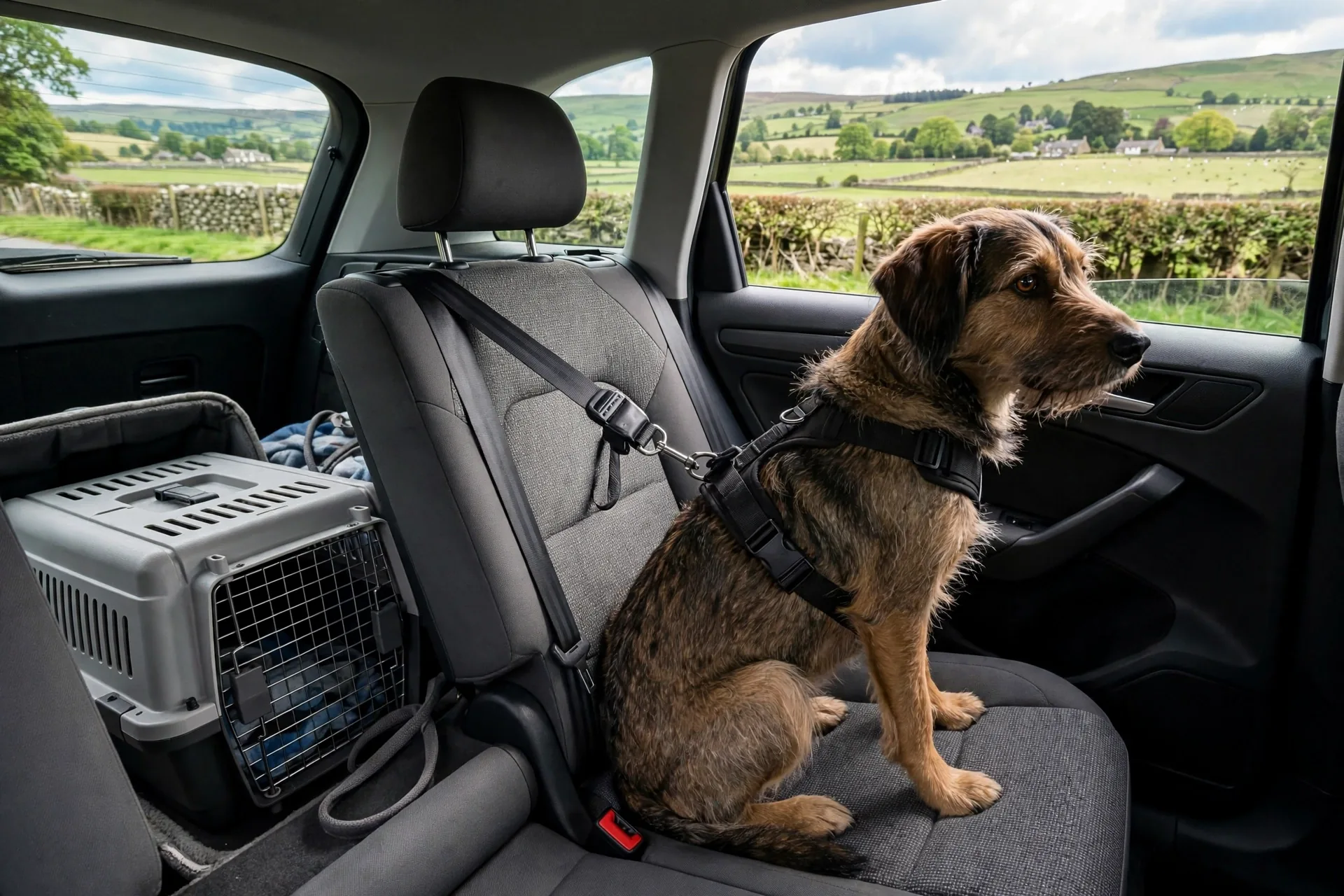
Car travel is the most common way to travel with a Chihuahua in the UK, and it is also where small size creates a specific risk: an unrestrained tiny dog becomes a projectile in a crash and a distraction in normal driving. The Highway Code requires dogs to be suitably restrained so they cannot distract the driver or injure themselves or others if the vehicle stops quickly, and the same principle applies whatever the journey length. For a Chihuahua, a crash-tested harness on the back seat, a secured crate in the boot, or a secured carrier on the back seat can all work, provided the restraint fits the dog and is fixed to the car, not merely placed in it. Our guide to dog car safety compares harnesses and crates in detail, and it is worth reading before you buy, because a harness that is too loose, a crate that slides, or a carrier that tips on a bend all fail the basic test.
Fit matters more than brand. A harness should be snug enough that the dog cannot slip out, with no pressure on the throat, and the attachment point should keep the dog on the seat without allowing it to climb into the front or onto the dashboard. A crate should be large enough for the dog to stand, turn and lie down, but not so large that the dog is thrown around inside it, and it should be secured so it cannot slide or tip. A carrier on a seat should be belted in, with the door facing away from the airbag zone and the carrier ventilated. Whichever you choose, practise short journeys at home before a long trip, with the same restraint, blanket and settling routine, so the car becomes familiar rather than a new stress on departure day. A dog that travels calmly is a dog that arrives ready to enjoy the holiday, not a dog that needs hours to recover from the journey.
Journey planning for a Chihuahua is about breaks, temperature and calm. Plan a break at least every two hours, and sooner if the dog is restless, panting, drooling, whining or asking to go out. Use breaks for water, a toilet stop and a short, calm walk on a lead, not for a long run or a play session that leaves the dog overexcited for the next leg. Keep the car at a comfortable temperature, never leave a dog alone in a parked car, and keep the dog out of direct sun through the windows on a warm day. For travel sickness, which affects some small dogs, keep journeys short at first, avoid feeding a large meal immediately before travel, keep fresh air flowing without a strong draught on the dog, and ask a vet for advice if sickness is frequent, because medication and behaviour plans exist and should not be improvised on a motorway.
Trains, buses and ferries each have their own rules, and a Chihuahua size is an advantage here, because a small dog in a carrier is often easier to accommodate than a large dog on a lead. On trains, check the operator policy before booking: many allow dogs, some require a carrier, and all expect the dog to be under control and not to occupy a seat needed by a passenger. A carrier gives a nervous Chihuahua a defined space and protects it from feet, luggage and other dogs in a crowded carriage, and it is usually the kindest option for a dog that is wary of strangers. On buses, the policy varies by operator and sometimes by driver discretion, so check before you board and do not assume a dog that was welcome on one bus will be welcome on the next. On ferries, check whether dogs stay in the car, in a kennel area, or in a designated lounge, and plan for the crossing length, the temperature and the toilet arrangements in advance.
Walking to and from transport is part of the journey, not a gap between journeys. A Chihuahua that is carried through a station, lifted onto a train and then walked through a busy town centre without a break can arrive overstimulated even if the train ride itself was calm. Build a buffer at each end: a short toilet walk, a drink, a few minutes on a blanket in a quiet corner, and only then the next leg. If you use a pushchair or a dog stroller for longer town days, check that it is stable, that the dog is secured inside it, and that it does not become a substitute for all walking, because a dog still needs to sniff, toilet and move. A stroller is a useful tool for a tired, older or recovering Chihuahua on a longer day out, not a reason to keep a healthy dog off its feet all day. Whatever the transport, the test is the same: does the dog arrive warm, calm and ready for the next short outing, or does it arrive exhausted and anxious? Plan backwards from a calm arrival.
Stays, seasons and packing
Choosing accommodation for a Chihuahua is less about luxury and more about quiet, warmth and a short distance to a toilet area. A ground-floor room, a cottage with a secure small garden, or a hotel room away from a busy corridor will usually suit a small, attachment-prone dog better than a grand room up several flights of stairs. Ask whether dogs are welcome in the restaurant or only on a terrace, whether the room has heating you can control, and whether there is a quiet outdoor area for last thing at night. Our guide to dog friendly hotels in the UK lists the booking questions that prevent disappointment, and the same questions work for cottages and bed and breakfasts: pet fee, number of dogs, where dogs can go, what happens if the dog barks, and whether the specific room you are booking accepts dogs.
On arrival, make the first hour boring, as with any dog, but with Chihuahua specifics. Walk the boundary of a garden or the route to the toilet area before unpacking, check for gaps a small dog could slip through, and check for hazards at Chihuahua height: low cleaning products, dropped food, open drains and gaps under gates. Put the dog bed, blanket, water bowl and food bowl in a quiet corner, and keep the first evening routine close to home: same feeding time, same bed, same last outing. If the dog uses a crate, set it up exactly as at home rather than improvising with hotel furniture. A small dog reads consistency as safety, and a boring first hour is the fastest route to a relaxed first morning, especially for a dog that has travelled, been carried, and met new people all in one day.
Seasons change the Chihuahua plan more than they change a larger dog plan. Spring brings mud, which soaks short legs and chills bellies, so pack a drying coat and a towel for every outing, and choose surfaced paths after rain. Summer brings heat, which can be harder to spot in a dog that is already panting from excitement, so walk in the morning or evening, carry water, seek shade, and never leave a dog in a car. Autumn brings fireworks, wet leaves and shorter days, so plan evening toilet walks with a torch, keep the dog on a lead near roads, and check whether nearby venues host displays. Winter brings cold, ice and salt on pavements, which can irritate paws and chill a small dog quickly, so use a coat, check paws after walks, wipe off grit and salt, and favour indoor stops. In every season, the question is the same: can the dog stay warm, dry and calm for the whole outing, and is there a warm retreat if the weather turns?
Packing for a Chihuahua trip is a short list with no room for improvisation. Pack the coat and a spare, a waterproof layer, two blankets, the carrier, a harness and lead, a collar tag, food for the trip plus one day, treats, a collapsible bowl and a water bottle, bags, a towel and a drying coat, any medication, the vet number, and a small first-aid kit. Pack a familiar toy or chew if the dog has one, but do not pack a new toy as a surprise, because a new item in a new place adds novelty when the dog needs familiarity. Pack a torch for evening toilet walks, a non-slip mat for slippery floors, and a ramp or steps if the dog uses them at home for the sofa, bed or car. The list fits in a small bag, which is the point: a Chihuahua trip should be light, organised and repeatable, so that packing does not become a stress in itself.
The final test for any Chihuahua holiday is simple, and it is worth applying before you book, before you leave, and each evening of the trip. Is the dog warm, is the dog calm, is the dog close to its person, and does the next day contain more rest than stimulation? If the answer is yes to all four, the holiday is working, whatever the distance covered or the sights seen. If the answer is no, change the plan: shorten the walk, add a cafe, move indoors, go home early, or choose a quieter place tomorrow. Chihuahuas do not need grand adventures to be happy travellers. They need warmth, a familiar blanket, a short interesting walk, a calm indoor stop, and a person who notices the first shiver and acts on it. Give them that, and a tiny dog can enjoy Britain as much as any dog, one short, warm, calm outing at a time.
Practical questions
Before you go
Do Chihuahuas get cold easily on UK trips?
Yes, many do. Their small body mass, short legs and often thin coats mean they lose heat quickly, especially in wind, rain and cold mornings. Pack a well-fitting coat, a blanket and a dry change of clothing, and watch for shivering, hunching or a reluctance to keep walking. Warm the dog up indoors rather than pushing on, and check the official guidance before you travel if you are unsure about cold-weather care.
How long can a Chihuahua travel in a car without a break?
Plan a break at least every two hours, and sooner for puppies, older dogs or anxious dogs. Use breaks for water, a toilet stop and a short calm walk, not for a long run. Keep the dog properly restrained for the whole journey, keep the car at a comfortable temperature, and never leave a dog alone in a parked car. If your dog is travel sick or distressed, ask a vet for advice before a long journey.
Can I carry my Chihuahua into a cafe or shop?
Only if the venue allows it, and the rule is set by the individual business, not by the size of the dog. Always ask first, keep the dog close and under control, and do not assume that being carried means the dog is welcome. If the dog is barking, restless or trying to reach food or other people, take a break outside. A calm dog on a blanket beside your chair is usually far more welcome than a dog held up at table height.
What health checks should I arrange before travelling with a Chihuahua?
Ask your vet to check the kneecaps for patellar luxation, the teeth and gums for dental disease, and the heart if your dog is older or has a murmur. Keep vaccinations, flea and worm treatment up to date, and carry the vet practice number and any medication in its original packaging. If your dog has a known knee, dental or heart problem, discuss a travel plan with the vet first, and check the official guidance before you travel.
Are Chihuahuas good dogs for long walks and hiking holidays?
Most are not built for long-distance hiking. Their short legs, small joints and limited stamina make a long, steep or exposed walk hard work, even for a fit adult. Choose short, level, interesting routes with frequent rests, and carry the dog in a suitable carrier for the sections that are too long, steep or rough. A series of short outings with cafe stops usually suits a Chihuahua far better than one big mountain day.