This guide is independent and contains no paid placement. If affiliate links are added later, they will be clearly marked and will not change our editorial checks.
Dog car harness vs crate has no universal winner. A harness suits dogs who travel on the back seat and need flexible space; a secured crate suits dogs who settle best enclosed and cars with a proper boot. Either way, UK drivers must restrain dogs suitably under the Highway Code, the restraint must be fitted or anchored correctly, and an unrestrained dog is a risk to everyone in a crash.
What UK law and the Highway Code actually require
Start with the duty, because it frames every product claim that follows. Rule 57 of the Highway Code states that when in a vehicle, dogs or other animals should be suitably restrained so they cannot distract the driver or injure the driver, themselves or others if the vehicle stops quickly, and it names a seat belt harness, pet carrier, dog cage or dog guard as ways of doing this. Breaking the Highway Code is not automatically a separate offence in itself, but driving with an unrestrained dog that distracts you can contribute to careless or inconsiderate driving charges, and insurers may take a dim view of a claim involving a loose dog. Check the current Highway Code wording before you travel, as it is updated periodically.
Beyond distraction, consider the physics honestly. In a collision at 30 miles per hour, an unrestrained dog continues travelling at 30 miles per hour until something stops them — a seat back, a windscreen, or a person. Even a small dog becomes a serious projectile force at that speed, and a large dog loose in a boot behind a weak guard is little better. Restraint is therefore not primarily about keeping the dog tidy or the seats clean. Harnesses, crates and guards exist on a spectrum of protection, and understanding where your setup sits on that spectrum is the first job of this dog car harness vs crate comparison.
There is also the everyday legal-adjacent layer: a dog with its head out of the window can be injured by debris and can distract other drivers; a dog loose at a petrol station or services is a road-safety problem within seconds; and a dog left in a hot car creates both a welfare emergency and potential liability. Suitable restraint, used consistently, quietly solves most of these scenarios before they start. Whatever you choose below, choose something you will actually use on the four-minute school run as faithfully as on the four-hour holiday drive, because short trips are where habits — and accidents — live.
Company cars, hire cars and lifts from friends deserve a thought too. Your perfect fitted system may not transfer, so a well-fitted harness that works with any seatbelt is the usual fallback. Our broader guide to driving with a dog and UK law covers the surrounding rules, from distractions to leaving dogs in vehicles, and complements the restraint decision made here.
The harness case: flexibility, closeness and fit risks
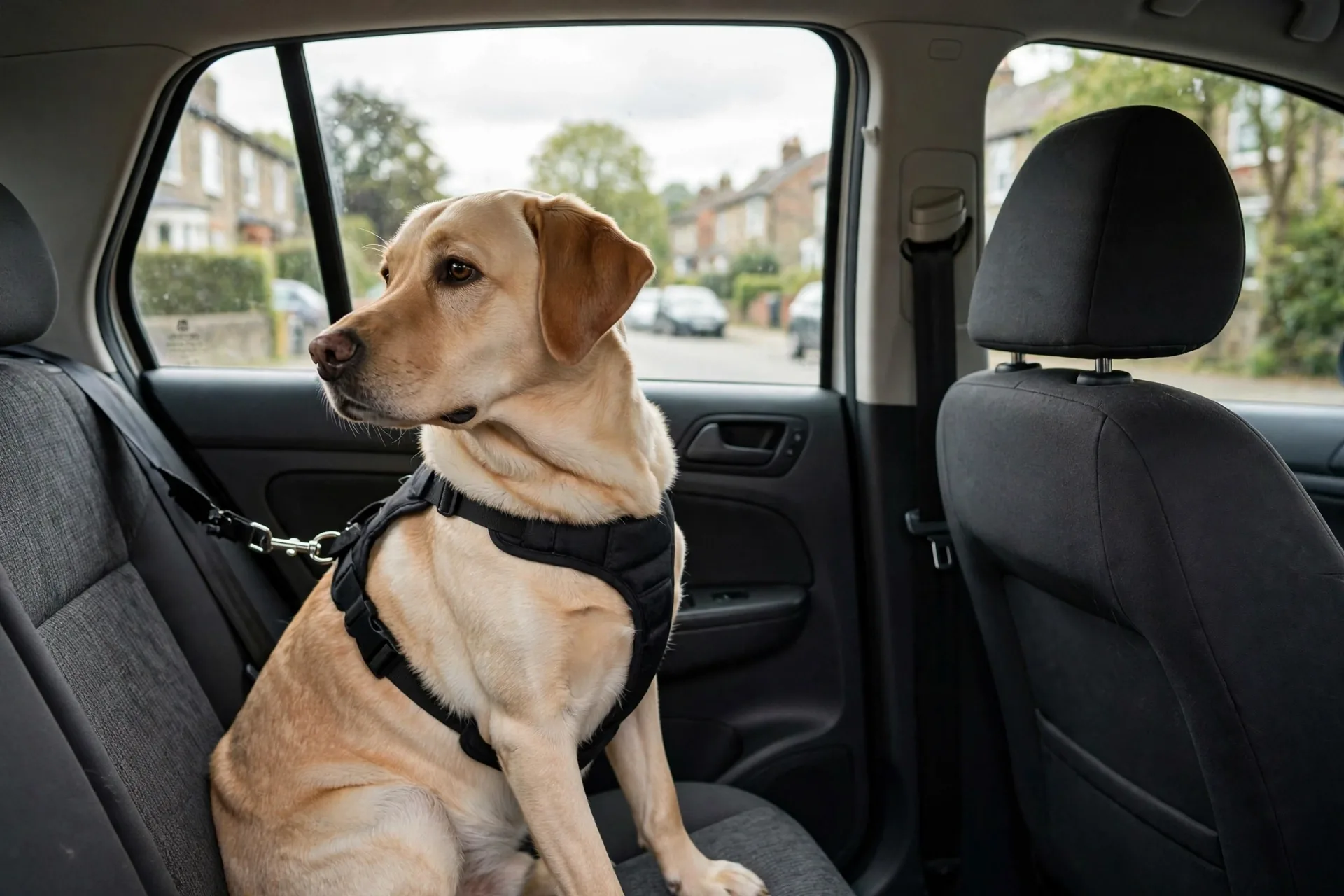
A car harness is a body harness — never a collar — with a short attachment that clips to the car's seatbelt system or a dedicated anchor. Its strengths are real. It takes almost no space, moves between cars in a coat pocket, lets the dog sit or lie on the back seat within reach of family life, and suits dogs who panic when enclosed. For small and medium dogs, for multi-car households, and for dogs who travel occasionally in different vehicles, a harness is often the system most likely to be used correctly every single trip — and correct, consistent use beats theoretical superiority left in the garage.
The weaknesses live in the fitting. A walking harness is not automatically a car harness: look for wide, padded chest construction designed for vehicle restraint, strong metal hardware, and an attachment short enough that the dog cannot reach the front seats, tangle in the strap, or be thrown into the footwell. Too long a tether recreates the projectile problem with added rotation; too short prevents the dog lying down and guarantees fidgeting. Fit the harness snugly — two fingers under straps, no twisting — and practise at home, because a dog wrestling a new harness at the kerbside starts every journey stressed.
Crash protection claims need calm scrutiny. Some harnesses and crates on the market have been independently crash-tested by recognised organisations, and those test results are worth seeking out and reading carefully, including the size of dog tested. Many products use words like crash-tested in marketing without publishing a standard, a speed or a result. There is no single UK legal certification for dog car restraints comparable to child seat regulation, so the burden of evidence-reading sits with the buyer. A modest harness used correctly still outperforms an unrestrained dog by a wide margin; just do not pay a premium for a badge nobody will explain.
Behaviour decides the rest. Seat-harnessed dogs can still chew belts, bark at passing dogs through windows and attempt to climb into laps at traffic lights if the tether allows it. Position the dog behind the passenger seat where the driver cannot be reached, provide a chew once underway, and accept that some dogs — the determined, the destructive, the highly reactive — are simply safer in the enclosed option described next. Nervous travellers in particular often do better when their space is defined, as our guide to calming anxious dog travel explains.
The crate case: containment, calm and anchoring duties
A crate converts the boot or a folded-seat area into the dog's own room. For dogs who already relax in a crate at home, who chew, who react to passing traffic, or who travel muddy from walks, containment is a genuine welfare advantage as well as a safety one: the dog cannot interfere with the driver, cannot be flung around the cabin, and arrives with the mess — wet coat, sandy paws — confined to one washable space. Crates also stack the logistics in your favour on holiday, doubling as the dog's bed and safe place in unfamiliar accommodation.
None of that protection exists if the crate itself can move. An unsecured crate in a crash becomes a heavy box sliding or tumbling with the dog inside it. Anchor it: straps to the car's lashing points, a snug fit between fixed structures, or a purpose-built vehicle crate designed for the boot space and fixed accordingly. Measure honestly before buying — length for the dog to lie fully stretched, height to stand and turn, boot depth with the seats up, and the slope of the tailgate, which steals more room than brochures admit. Ventilation matters as much as dimensions: a crate in a sun-heated boot with poor airflow is a hazard on a summer day regardless of how sturdily it is built.
Material choice involves trade-offs. Wire crates ventilate well, fold flat and let the dog see out, but can deform in an impact and rattle themselves into a dog's bad books. Solid aluminium or moulded crates are quieter, darker and calmer for reactive dogs, usually stronger, and cost considerably more. Soft fabric crates are for calm dogs in parked cars and holiday cottages, not as primary collision protection — say so plainly if you own one, and do not let its presence in the boot create false confidence.
Crate training is the gatekeeper. A dog who has never been enclosed will not discover a love of it at motorway speed. Build the association at home over days — door open, bedding in, meals and chews inside — exactly the gradual staircase used for anxious travellers. If the dog remains distressed in a crate despite patient training, that dog is a harness dog, and forcing the issue trades a theoretical safety gain for a real welfare loss and a very distracted driver.
Head to head: the six comparisons that decide it
Crash protection. A properly anchored, well-built crate generally contains a dog better in a severe impact; a correctly fitted, genuinely vehicle-designed harness restrains the dog within the cabin's own safety systems. Both collapse as options if fitted badly. Edge: crate, if anchored; otherwise equal.
Everyday usability. The harness wins clearly — seconds to fit, any car, no boot space consumed. Crates demand measuring, lifting and a permanent chunk of luggage room. Edge: harness, especially for multi-car or hire-car life.
Dog comfort and calm. Entirely individual. Enclosure calms crate-trained and reactive dogs; it distresses dogs who dislike confinement. Back-seat harness travel suits sociable dogs who settle near people. Edge: whichever your dog chooses in honest home trials.
Driver distraction. A crate removes interference almost completely. A harnessed dog on a short tether is well controlled but still visible, audible and occasionally ambitious. Edge: crate for known distractors and chewers.
Cost and space. A good harness costs a fraction of a fitted vehicle crate and leaves the boot for luggage — which matters on the holiday trips in our dog travel costs guide, where roof boxes and extra kit already compete for room. Edge: harness.
Two dogs and big dogs. Two harnessed dogs can tangle and wind each other up; two crates, or a divided crate, keep peace and double the measuring homework. Very large dogs may simply fit a boot crate better than any back seat allows. Edge: crate for pairs and giants, provided the car is big enough to anchor everything properly.
Score your own situation honestly across those six lines. Most households land clearly on one side once temperament and car are given their proper weight — and some land, sensibly, on both: a harness for everyday local runs and an anchored crate for long holiday drives, provided the dog is trained happily for each.
Guards, barriers and carriers: the supporting cast
Between the two headline options sits a supporting cast worth placing correctly. A dog guard behind the rear seats keeps the dog in the boot area and out of the cabin, and the Highway Code names it as a restraint method — but a guard alone does not restrain the dog within the boot. In a sudden stop the dog still travels forward into the guard or seats. Guards work best combined with a crate, a boot divider or a short harness anchor point inside the boot, and they must be the rigid, properly fitted kind: a wobbly universal guard that pops out under pressure is decoration.
Small-dog carriers and booster-style seats suit tiny dogs who travel harnessed inside them. The carrier itself must be belted or anchored so it cannot slide, and the dog clipped in by harness so an open top does not become an ejection route. For very small dogs this hybrid often beats either headline option: contained like a crate, close like a harness, and lifted out in one piece at services while still secure.
Boot liners, hammocks and seat covers protect upholstery and stop dogs slipping into footwells, but they restrain nothing. Buy them for cleanliness by all means — a non-slip surface genuinely helps a dog brace and feel secure — while being clear-eyed that they are comfort accessories in the safety conversation, not answers to it. The same honesty applies to window shades and fans: valuable for heat management, irrelevant to collision protection.
Whatever combination you assemble, run the kerbside test. Load the dog, drive around the block with an adult in the back watching, and note what moves, rattles, tangles or distresses. Then brake firmly once, safely, on a quiet road. A surprising number of carefully purchased systems fail this humble examination, and it costs nothing but ten minutes to find out at home rather than on the motorway.
Set up, fit checks and the pre-journey routine
Whichever restraint wins, install it once, properly, and then leave it alone. For a harness: adjust it off the dog first, fit and check the two-finger rule, attach to the seatbelt or anchor in the position the manufacturer specifies, and set tether length so the dog can sit and lie but not reach the front. For a crate: position, anchor with straps to fixed lashing points, check it cannot slide under firm hand pressure in any direction, add non-slip bedding, and confirm ventilation reaches the dog's level with the tailgate closed and the car's ventilation running.
Layer the routine around the restraint. Toilet break before loading, water offered, dog loaded and secured before luggage tempts anyone to leave doors open, and a familiar blanket in place. On the move, plan stops every couple of hours at most, lead clipped on before any door opens, and never — in any weather — a dog left alone in a warming car while humans enjoy a long services lunch. Flat-faced and anxious dogs need even tighter heat discipline; the rules in our flat-faced dog travel guide apply on top of everything here.
Recheck fit as dogs change. Puppies outgrow harness sizes in weeks, adult dogs gain winter weight, and straps loosen with use. Put a monthly thirty-second check in your diary: straps, clips, stitching, anchor points, crate door latches. After any incident — even a minor shunt — inspect everything and replace damaged webbing or bent hardware rather than trusting it a second time. Restraints are cheap compared with what they protect.
Finally, practise the emergency exit. If you had to get the dog out quickly on a hard shoulder, could you? Know which door, which clip, and where the spare lead lives. Keep the lead reachable from outside the car, carry water and a towel, and save your vet and destination vet numbers offline. Safety systems earn their keep in the worst five minutes of a trip; a few calm rehearsals at home are what make those minutes go to plan.
Practical questions
Before you go
Is it illegal to drive with an unrestrained dog in the UK?
The Highway Code, Rule 57, says dogs should be suitably restrained in a vehicle so they cannot distract the driver or injure anyone if it stops quickly. An unrestrained dog that causes distraction can contribute to careless driving charges and may affect insurance claims. Check the current Highway Code wording, as it is updated from time to time.
Which is safer overall, a dog car harness or a crate?
A properly anchored, well-built crate generally contains a dog best in a severe impact, while a correctly fitted vehicle harness restrains the dog within the cabin. Either fails if fitted badly: an unsecured crate becomes a moving hazard, and a loose or over-long harness tether allows dangerous travel. Fit and anchoring matter more than the category.
Can I just attach my dog's collar to the seatbelt?
No. A collar concentrates force on the neck in a sudden stop, which risks serious injury, and a startled lunge adds the same pressure. Always use a well-fitted body harness designed for vehicle use, with a short attachment to a proper seatbelt or anchor point, fitted so two fingers pass under every strap.
Are dog guards on their own enough restraint?
A guard keeps a dog in the boot area and is named in the Highway Code, but it does not restrain the dog within that area — in a sudden stop the dog still travels forward. Combine a rigid, well-fitted guard with a crate, divider or short harness anchor in the boot for a complete setup.
How do I know if a harness is genuinely crash-tested?
Look for published test detail: who tested it, at what speed, with what size of dummy dog, and what the result was. There is no single UK certification scheme for dog restraints, so vague crash-tested marketing without evidence should be treated cautiously. A correctly used quality harness still beats no restraint by a wide margin.