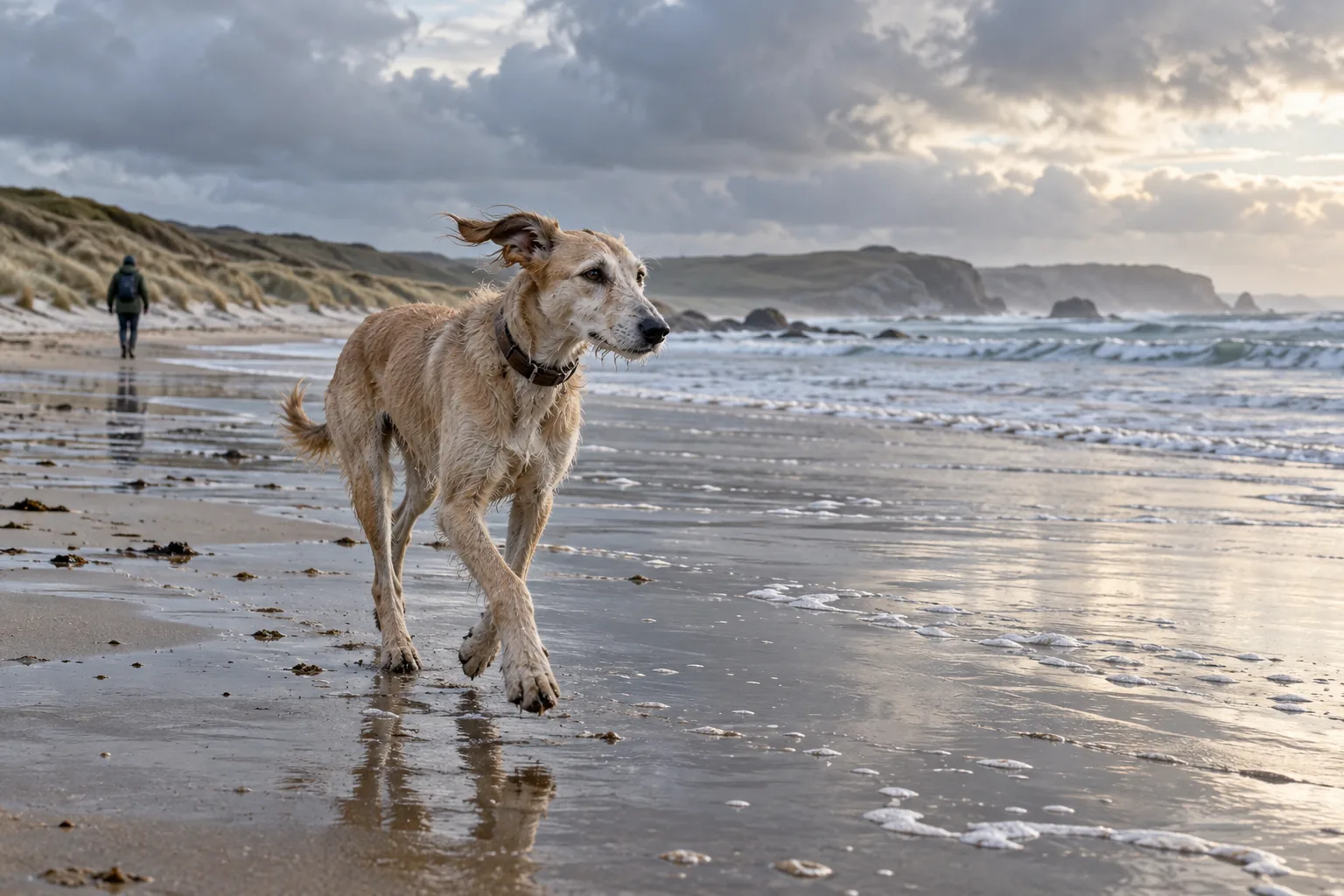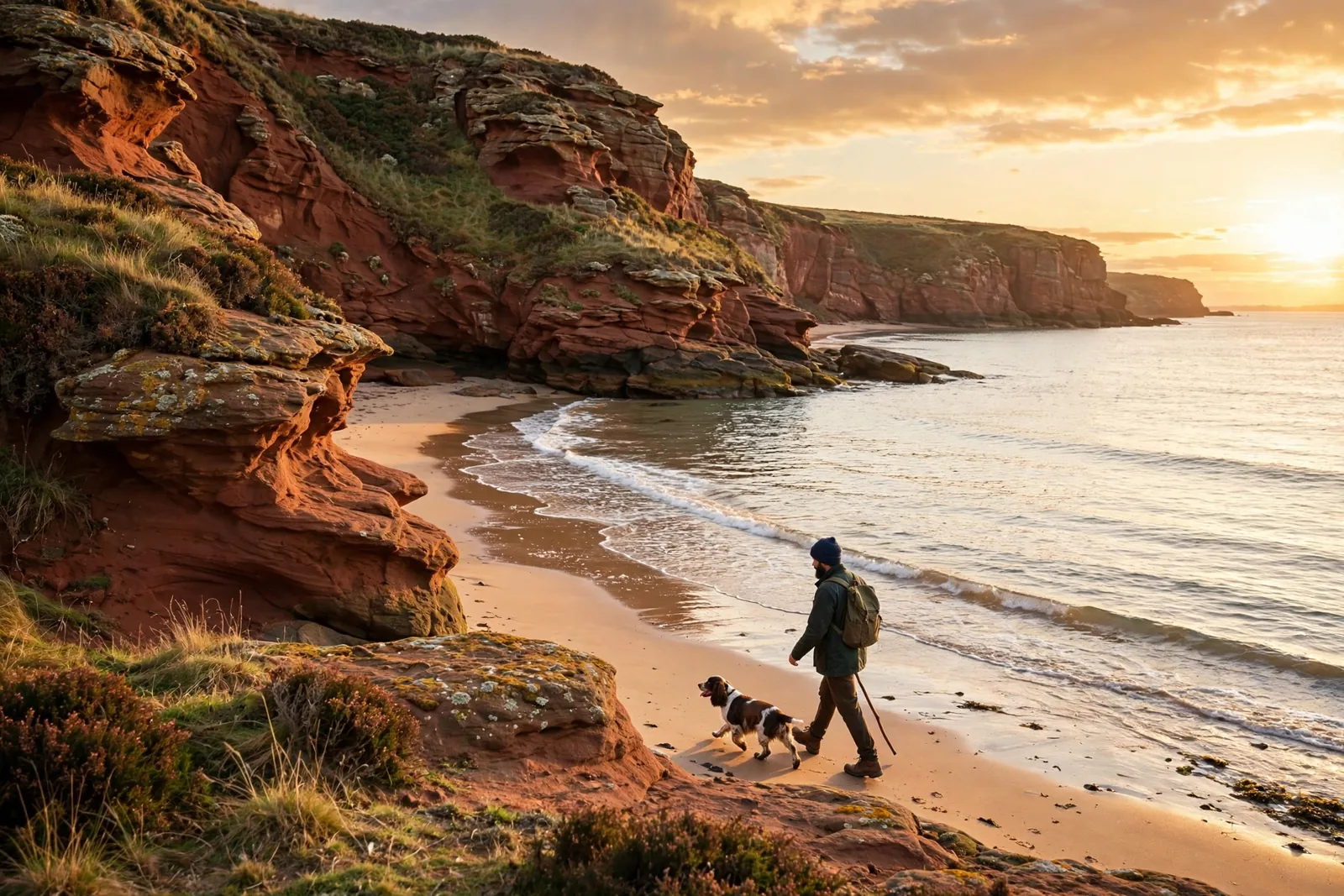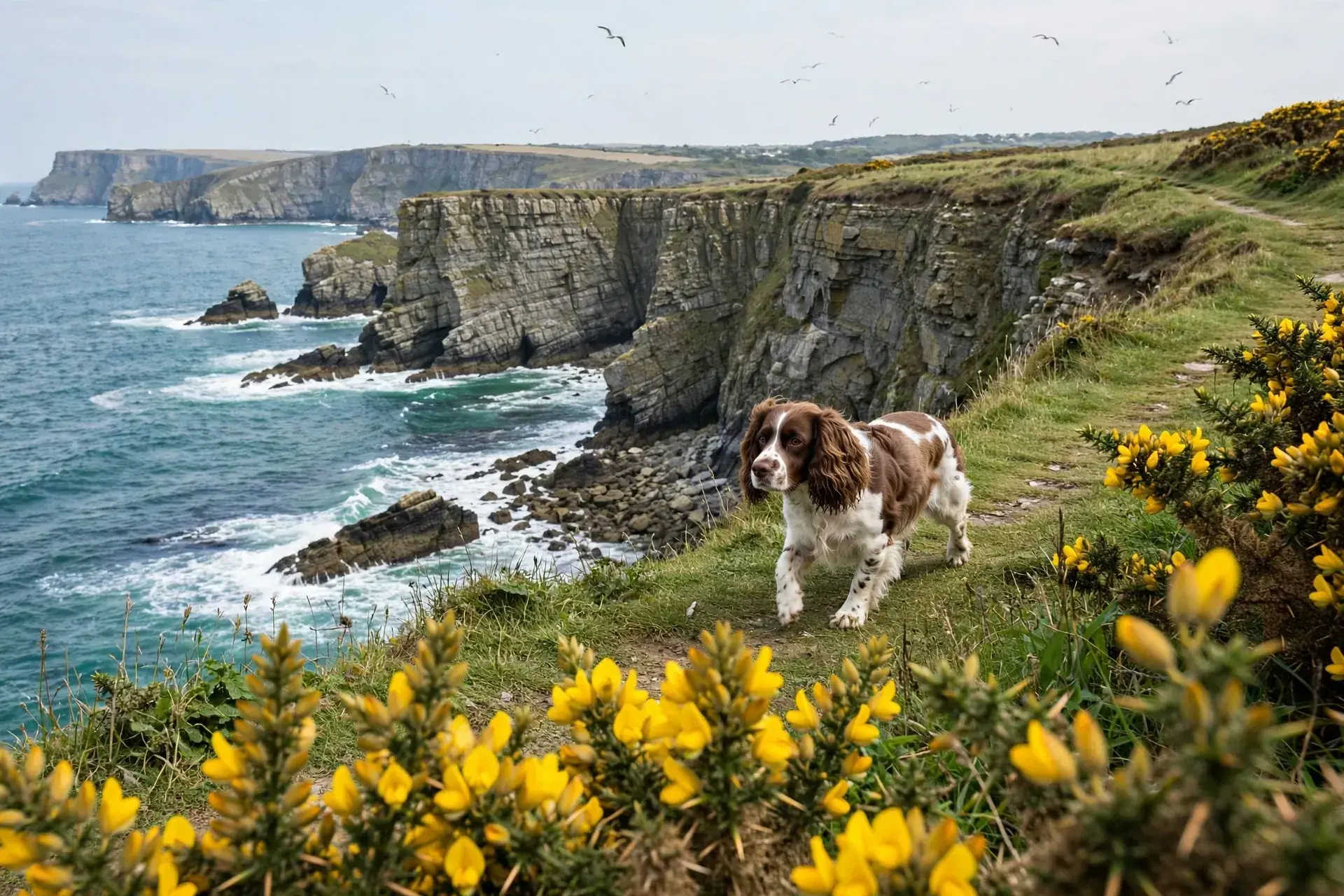
Match the county to the trip, not the dog alone. Devon wins the long weekend (shorter drive, cheaper, year-round dog beaches), Cornwall wins the full week (wilder coastline, bigger beach payoff), Devon wins the family-and-grandparent trip (gentler, cheaper), Devon wins the senior-dog trip (softer walks), Cornwall edges the young-dog surf trip (more off-season open space) and both win winter — pick by accommodation, not county.
Start with your trip, not the map
Most people settle the Cornwall-versus-Devon question the wrong way round: they compare the counties in the abstract, fall for the prettier photographs, and only then discover that the drive, the beach bans and the prices were the real variables. Cornwall usually photographs better. That fact is worth almost nothing once you are standing in a service-station car park at 6pm on a Friday with a restless dog in the back.
A more reliable way to choose is to fix the trip first and let the trip pick the county. A three-night October break with an eleven-year-old labrador is a completely different product from a two-week August holiday with a bouncy young collie, and the two counties are optimised for different versions of the problem. Cornwall is the destination you invest a full week in: longer to reach, dearer to stay in, but with the most spectacular stretch of coastline in England and a beach culture built around long summer days. Devon is the destination that forgives you: closer, cheaper, milder in its rules, with two coasts to choose from and some of Britain's best inland walking as a backup when the weather turns.
Neither county is meaningfully "less dog-friendly" than the other at the level that matters. Both have hundreds of dog-welcoming cottages, caravan and holiday parks that accept pets, pubs where the dog gets the fireside seat, and miles of the South West Coast Path — the same 630-mile trail runs through both. The differences are structural rather than attitudinal: how far you must drive, what the beach restrictions say in August, how much a cottage costs in school holidays, and whether the landscape behind the beach is a cliff, a moor or a chocolate-box village with no parking. This guide compares those structures, then matches them to six real trip shapes. Find yours and the decision almost makes itself.
The head-to-head table
Before the scenarios, the raw comparison in one place. Treat figures as typical rather than guaranteed — prices shift with season and beach rules are reviewed most years, so check the current position for your dates before you book.
| Measure | Cornwall | Devon |
|---|---|---|
| Coastlines | One county, two very different coasts: wild surf on the north, sheltered swimming coves on the south | Two coasts as well: the dramatic Jurassic-style cliffs of the north, the gentler Riviera bays of the south |
| Year-round dog beaches | Fewer near the honeypot towns; many main beaches run seasonal bans | More spread around the county; several popular sandy bays welcome dogs all year |
| Typical seasonal beach ban | Often Easter Sunday to 1 October, sometimes 8am-7pm only in some coves | Often 1 July to 31 August on Blue Flag beaches; many others unrestricted all year |
| Surf for dogs to play in | Some of Britain's strongest surf on the north coast; needs real caution | Milder surf; friendlier for paddling and first-time swimmers |
| Inland walking | Farmland, wooded valleys, Bodmin Moor; no national park | Dartmoor and Exmoor national parks: vast open moorland, plus soft rolling countryside |
| Drive from London (typical) | 5-6+ hours to the far west; last stretch on slow A-roads | 3-4 hours to most towns; motorway most of the way |
| Peak-season cottage cost | Highest in the south west; sea-view properties carry a heavy premium | Noticeably cheaper for equivalent quality, especially off the honeypots |
| Eating out | Excellent but pricey in Padstow, St Ives, Rock; good value inland | Generally cheaper; strong pub culture with dogs genuinely welcome |
| Crowds in August | Intense around St Ives, Newquay, Padstow; roads clog | Busy in Salcombe, Dartmouth, Woolacombe; quieter pockets easier to find |
| Best for a long weekend | Works, but the drive eats the trip | Natural fit: you arrive before lunch and leave after lunch |
| Best for a full week | The classic: enough time to justify the journey and explore both coasts | Excellent value week; consider splitting coast and moor |
The table already hints at the pattern the rest of this guide unpacks: Cornwall asks more of you and pays it back in spectacle; Devon asks less and quietly delivers. Your job is to work out which bargain your particular trip wants.
The three-night long weekend
Winner: Devon, by a distance. A long weekend is won or lost on the drive, and the maths is brutal. From London to the Devon border is roughly three and a half hours on the M5 and A30; from London to St Ives or Penzance is five to six, and Friday-afternoon traffic can push it past seven. On a three-night trip that extra ninety minutes to two hours each way removes a full half-day of actual holiday — the Friday evening walk and the Monday morning beach both evaporate into motorway services.
The same arithmetic applies from the Midlands and the South East, just less dramatically. Only if you live in Bristol, Bath or the South West itself does Cornwall become a sensible long-weekend proposition, and even then the Cornish lanes from the A30 to the coast can turn a short final leg into a long one. A dog does not care about your itinerary; a dog cares about being out of the car. Plan the trip so the animal spends Friday evening on a beach rather than in a queue on the A303.
Devon's other long-weekend advantage is flexibility. Arrive in Dartmouth, Salcombe, Sidmouth or the villages around Exeter and you have a dog-friendly pub, a beach and a walk within minutes of the cottage door — the trip works even if you arrive at 7pm in the rain. Cornwall's magic is more spread out: the best beaches are a drive from most bases, and spreading that driving across three nights feels like commuting. If Cornwall is non-negotiable for a short break, base yourself as far east as sensible — Bude, the Tamar valley or the Looe area — so the journey in matches the time you actually have.
One exception: an October-to-March long weekend, when traffic vanishes and the drive shrinks. A winter long weekend in Cornwall — storm-watching, empty cliff paths, fire-lit pubs — is one of the best dog trips in Britain, precisely because everyone else has decided the drive is not worth it. That is the moment to take Cornwall's spectacle at Devon's price.
The full seven-night week
Winner: Cornwall, just — but only in summer and only if you use both coasts. A full week changes the economics of the drive completely. Six hours each way is a tax; spread over seven nights it becomes a footnote. And once you are there, Cornwall offers the densest concentration of outstanding coastline in England: you can surf-watch at Fistral in the morning and swim in a sheltered Helford cove in the afternoon, with the dog getting two entirely different kinds of beach day.
The week also solves Cornwall's biggest dog problem, which is that the best beaches are rarely all near your cottage. With seven days you can afford to drive: one day for the north coast, one for the Lizard, one for the Roseland, a rest day in the village. On a short break the same itinerary is a punishment; over a week it becomes the holiday. Rent a cottage with an enclosed garden — Cornwall's lanes are narrow and fast, and a secure garden is worth more than a sea view — and plan beach days around the tide tables rather than the clock.
Devon is still an excellent week, and a cheaper one. The smart Devon week splits itself: three or four nights on one coast, the rest inland or on the other coast, because Devon is compact enough that a mid-week move costs you an hour, not a day. A coast-plus-moor split — say Torquay then Dartmoor, or Woolacombe then Exmoor — gives a dog the two things it values most: variety underfoot and a change of smells. Families who would find Cornwall's prices painful in August often discover that a Devon week buys them a better cottage, better restaurants and a calmer dog.
If the week is outside school holidays, the price gap narrows and Cornwall's case strengthens further: September and October in Cornwall bring warm seas, empty beaches as the seasonal bans lift, and accommodation at a fraction of August rates. A September week in Cornwall with a dog is arguably the single best-value premium holiday in the English south west.
With grandparents or small children
Winner: Devon, clearly. Multi-generational trips are governed by a different law: the holiday must work for the least mobile person in the party, and everything else is decoration. Grandparents and toddlers both need level ground, short distances, parking near the destination, and somewhere to sit down — and they need it reliably, not as a lucky find. Cornwall's loveliest villages fail this test with enthusiasm: St Ives is a cascade of steep cobbled lanes, Tintagel's castle is a cliff, and many Cornish coves are reached down paths that a pushchair or a bad knee will not forgive.
Devon is simply gentler. The south-coast resorts — Sidmouth, Exmouth, Teignmouth, Torquay — were built for Victorian invalids and it shows: level promenades, gardens with benches, beaches you can reach without an expedition. Dartmouth and Salcombe are prettier and hillier, but even there the water is close and the boat trips give everyone, dog included on many services, a spectacular day with no walking at all. Check each operator's dog policy before you board, as rules vary, but the south Devon rivers are generally welcoming.
Devon's price advantage matters most here too, because multi-generational trips are the most expensive kind: you need the bigger cottage, the extra bedroom, the meals out that suit fussy eaters. The money Cornwall would extract for the same footprint can instead buy the week where nobody has to cook. And for the dog, Devon's softer countryside means the older family dog — the one who travels with the grandparents — gets level riverside walks instead of cliff scrambles.
If the grandparents are the fit, adventurous sort who specifically want drama, Cornwall's south coast around Falmouth and the Helford offers a workable middle ground: sheltered water, gentler paths than the north coast, and gardens like Trebah and Glendurgan where dogs are welcome on leads and the walking is graded. It is Cornwall at its kindest, and worth knowing about.
With a senior or low-energy dog
Winner: Devon, on terrain. An older dog's holiday is defined by surfaces and gradients, not scenery. What a fourteen-year-old spaniel wants is a level mile, a place to paddle without a steep shingle bank, and a bed it can reach without stairs — repeated daily, without the car. Devon's rolling countryside and river valleys deliver this almost everywhere: the Exe estuary trail, the Tarka Trail's level miles, the meadows around the Dart. These are walks an old dog can do twice a day and still enjoy.
Cornwall's coast path, for all its beauty, is a young dog's path: constant up and down, granite steps, exposed drops that demand a lead and a strong arm. An older dog can still enjoy Cornwall, but the enjoyable version is the south-coast version — the Helford, Falmouth's beaches, the Camel Trail from Wadebridge to Padstow, which is flat, long and made for exactly this kind of trip. The Camel Trail, a disused railway line, is one of the best senior-dog walks in the country and almost alone justifies Cornwall as a choice for an older animal.
Accommodation matters more than county for the senior dog, whichever you choose. Ground-floor bedrooms, no steep caravan steps, an enclosed garden on the level of the door, and a pub within a short flat walk for the evenings — these details decide the trip. Ask about them specifically when booking; our Cornwall holiday parks guide and Devon holiday parks guide both include the access questions worth putting to any park, and they apply to cottages just as well.
One practical note: Cornwall's veterinary cover thins out west of Truro, so for a dog on regular medication, note the nearest practice to your cottage before you travel — rural surgeries can be twenty minutes away and close early. Devon is better served along the M5 corridor.
With a young, high-energy dog
Winner: Cornwall, outside school holidays; a draw in August. A young dog with an engine needs two things: space to run legally, and water to cool off in. Cornwall's north coast in the off season is the great engine-room of English dog holidays — miles of open sand at Perranporth, Holywell and Mawgan Porth where a fit dog can sprint itself empty while the Atlantic does the cooling. In winter and spring these beaches are gloriously empty, the seasonal bans are lifted, and the dog gets the kind of freedom that city life never offers.
In August the picture flips. The same beaches that are a paradise in February are restricted, crowded and hot in August, and a young dog in peak-season Cornwall needs careful management: early-morning and evening beach windows, shade, and water discipline. This is where Devon's moors earn their keep. Dartmoor in August is cool, vast and empty — a young collie can run for an hour on open moorland while the coast below bakes. Few holiday landscapes handle a high-energy dog in a heatwave as well as a national park at 400 metres.
Safety note for the young and the reckless: north Cornwall's surf is genuinely powerful, and an enthusiastic young dog will throw itself into waves it cannot handle. Keep first swims to the south coast or to Devon's calmer bays, use a long line until you know the dog's sense, and never let a dog swim near a flagged surf zone or a harbour mouth with boat traffic. Our UK beach rules guide covers seasonal restrictions and the assistance-dog exceptions in detail.
Whichever county you pick, the young dog's holiday improves enormously with a secure exercise field or a large enclosed garden at the accommodation — an hour of safe off-lead time before breakfast sets up the whole day. Cornwall's cottage stock is better supplied with big enclosed gardens than Devon's park-heavy coast, so filter for it explicitly when you book.
The winter break
Winner: both — choose by cottage, not county. Winter is the great leveller. The crowds vanish, the seasonal beach bans lift, prices fall by half or more, and both counties reveal the version of themselves that summer visitors never see: storm-lit cliffs, empty sands, pubs with fires and no booking required. A dog does not know it is November. A dog knows the beach is empty and the smells are extraordinary.
Cornwall in winter is the more dramatic choice and the slightly riskier one. Atlantic storms are real events on the north coast — magnificent to watch from a cottage window, less fun as a walk — and some villages effectively close, with cafés and pubs on winter hours. Check what is actually open near your base, especially west of Truro. The payoff is the south coast on a still winter day: the Helford river in low December sun, with the dog swimming and nobody else there, is one of the great quiet pleasures of the English year.
Devon in winter is the more reliable choice. The south-coast towns stay livelier year-round, Dartmoor in frost is starkly beautiful and usually walkable, and the shorter drive matters more when daylight is scarce — arriving in daylight is worth real money on a winter break. Exmoor in winter suits the hardy; the coast path between Lynton and Lynmouth with the dog in a drying coat is a proper adventure.
Winter rules that apply to both: drying facilities become the single most important accommodation feature — ask about them before price. Pack the drying coats, check the cottage heating is actually adequate (old stone cottages can be cold), and keep the vet's number saved. Fireworks season around early November affects both counties equally; a noise-sensitive dog wants a rural base away from town displays either way.
Beach rules: the summer decider
If your holiday falls between Easter and October, this section decides more than any other. Both counties restrict dogs on many beaches in summer, but they do it differently — and the difference is large enough to swing a booking.
Cornwall's regime is the stricter of the two. A long list of the best-known beaches — including large stretches around St Ives, Newquay, Perranporth and Polzeath — ban dogs during the day through the main season, commonly from Easter Sunday to 1 October. The bans are enforced by local orders with fines attached, and they apply to the headline beaches precisely because those beaches are the busiest. What saves the Cornish summer is the sheer number of beaches: with over 300 to choose from, there is almost always an unrestricted cove within a twenty-minute drive — but it will not be the famous one on the postcard, and you will need to research it in advance rather than discovering it on arrival.
Devon's regime is patchier but friendlier in practice. Many of its Blue Flag beaches restrict dogs only in July and August rather than the whole season, and a good number of sandy bays — particularly around the south coast and parts of the north — welcome dogs all year. The practical effect is that a Devon summer holiday needs less daily research: you are more likely to be able to walk to your nearest beach with the dog without consulting a timetable of bans first.
Three rules for either county. First, check the specific beach, not the county: restrictions are set beach by beach and change most years, so confirm the current position on the local council's site before you travel. Second, learn the tide times: the best dog beaches in both counties are transformed by the tide, and a beach that is a paradise at low water can be a strip of shingle at high water. Third, remember the bans lift: from October to Easter both counties' beaches are overwhelmingly open to dogs, which is a large part of why the off-season south west is such good value.
Surf safety for dogs
The surf is the one area where the two counties are genuinely, physically different, and it matters for dogs. Cornwall's north coast faces the full Atlantic: at Fistral, Perranporth, Polzeath and their neighbours the waves are big, the rip currents are strong, and the conditions that delight surfers are exactly the conditions that endanger a swimming dog. A dog does not understand a rip current. It understands that the water is exciting, and it will swim out until it is in trouble.
The rules for surf beaches with dogs are simple and non-negotiable. Never let a dog swim in a flagged surf zone or near surfers — boards and dogs are a bad combination. Keep an enthusiastic swimmer on a long line at big-swell beaches until you have seen how the dog handles the water. Avoid harbour mouths and estuary channels where boat traffic and currents combine. After any sea swim, rinse the dog with fresh water: saltwater ingestion causes vomiting and, in quantity, salt poisoning, and several dogs each year are made seriously ill by drinking seawater on hot days. Watch for the strandline too — fishing line, hooks and dead marine life wash up after storms on both coasts.
Devon's surf is a gentler introduction. Woolacombe and Croyde have real waves but the beaches shelve more gradually and the currents are generally less fierce than Cornwall's north coast; the south coast — Bigbury, Bantham, the Teignmouth area — is better for a first swim. Cornwall's own south coast, around Falmouth, the Helford and the Roseland, is equally forgiving. The pattern to remember: north coasts are for watching the surf, south coasts are for swimming in it, and the dog's first sea swim of the holiday should always be the calm one.
Lifeguard cover is seasonal on both coasts, typically late May to late September on the main beaches, and absent outside it. An unguarded beach in October is a wonderful thing and a slightly more serious one: the water is colder, the currents unchanged, and help further away. Adjust your confidence accordingly.
Walking: cliffs, moors and woods
Both counties share the South West Coast Path, and it is the single best dog walk in either: 630 miles of cliff-top trail where the dog gets sea air, new smells every hundred yards and, on most stretches, sensible off-lead walking if the dog has reliable recall near drops. The Cornish sections are the more dramatic — towering cliffs, old mine workings, coves appearing around headlands — while the Devon sections mix drama with gentleness, especially along the south coast where the path dips through wooded valleys to the water.
Inland is where they diverge. Devon has the two great moors, and for a walking dog they are transformative. Dartmoor is a vast open plateau of granite tors, bogs and wild ponies where a fit dog can run legally and gloriously for hours; Exmoor is softer, wooded in its valleys, with red deer and some of the darkest skies in England. Both demand respect — weather changes fast, bogs are real, livestock is everywhere and the livestock-worrying law applies — but they give a dog the closest thing to wilderness in southern England. Cornwall has Bodmin Moor, which is wilder and emptier than its modest reputation suggests, but it is one moor against two, and smaller than either.
For gentler walking, both counties oblige. Cornwall's wooded valleys — the Fal, the Fowey, the Camel — offer sheltered riverside miles; Devon's river valleys and the level trails (the Tarka Trail, the Exe estuary, the Dart valley) are made for older dogs and easy days. In high summer, inland walking is also the heat strategy: the coast path is exposed and shadeless, while a wooded valley walk at 2pm keeps everyone comfortable. Whichever county you choose, plan one inland day for every two coastal days and the dog will thank you.
Money: the real price gap
Devon is cheaper. That is the short version, and it holds across almost every category that matters on a dog holiday. A like-for-like self-catering cottage in school holidays typically costs noticeably less in Devon than in Cornwall; the gap is widest for sea-view and honeypot properties, where Cornwall's premium can be dramatic — St Ives, Padstow and Rock operate in what is effectively a different market from the rest of the south west. Outside school holidays the gap narrows but rarely closes.
Holiday parks follow the same pattern. Both counties are well supplied with dog-welcoming parks, and the pet fees themselves are similar — typically £25 to £75 per dog per week, sometimes with a damage deposit on top — but the underlying accommodation price is lower in Devon. Eating out repeats the story: Cornwall's famous food towns are excellent and priced accordingly, while Devon's pubs and cafés are generally kinder to the wallet, with dogs genuinely welcomed rather than merely tolerated. Our county guides to Cornwall and Devon holiday parks break down the booking questions that protect you from fee surprises in either.
The hidden costs are worth pricing too. Cornwall's longer drive means more fuel and, for many, an extra night's accommodation en route or a very early start. Parking at Cornish honeypot beaches in August can be expensive and scarce; Devon's parking is rarely cheap either, but the pressure is lower. And in both counties, the dog-specific costs — the pet fee, the extra cleaning, the second set of everything you forgot — are the ones people under-budget. Get the all-in figure in writing before you pay the deposit, and budget as if the dog were a small adult in the party's finances.
Value strategy for Cornwall: travel in September or October, when prices fall sharply, the sea is at its warmest and the beach bans have lifted. Value strategy for Devon: travel in May or June, when the countryside is at its best, the moors are dry underfoot and the summer prices have not yet arrived. Both strategies buy you a better holiday than the same money in August.
Getting there and getting around
The journey is part of the product, because the dog experiences every minute of it. To Devon, the route is straightforward: M5 to Exeter, then the A30, A38 or A361 fanning out to the coasts. It is motorway almost all the way, services are frequent, and the final leg is usually short. Most Devon destinations are three to four hours from London, two to three from the Midlands, and the drive is the kind a dog sleeps through.
To Cornwall, the route is the same until Exeter — and then it becomes a different journey. The A30 runs the length of the county but it is a single-carriageway road in places, it clogs badly around Bodmin in summer, and the final approach to the far west — St Ives, Penzance, the Lizard — is slow lanes and farm traffic. Five to six hours from London is typical; seven in August is not unusual. Plan comfort stops the dog can actually use: the services on the A30 are better than their reputation, and a twenty-minute sniff around a service-area green transforms the second half of the drive.
Once there, the car remains essential in Cornwall in a way it is not quite in Devon. Cornish attractions are spread along a long thin county with limited public transport; you will drive to most beaches. Devon's bus and rail network is better — the scenic rail lines to Exmouth, Barnstaple and along the south coast all make fine dog days out, with dogs usually carried free — and the county is compact enough that a base near Exeter puts both coasts and Dartmoor within an hour. If anyone in the party would rather not drive on holiday, that alone can settle it.
Train travellers should note: both counties are reachable by rail with a dog, and the Cornish branch lines (St Ives, Falmouth, Looe) are delightful. But the far west of Cornwall by public transport with a dog and luggage is an expedition; Devon by public transport is merely a holiday. Check the latest rules with the operator before you travel, as policies on dogs vary.
Crowds and temperament
August changes both counties, but it changes Cornwall more. St Ives in August is one of the most crowded small towns in Britain: the lanes clog, the beaches fill by mid-morning, parking becomes a competitive sport and restaurant bookings are essential. Newquay and Padstow are not far behind. A dog that is sensitive to crowds, noise or other dogs will find peak-season Cornwall genuinely stressful — and a reactive dog in a St Ives lane in August is a problem for everyone.
Devon gets busy too — Salcombe, Dartmouth and Woolacombe have their intense weeks — but the county absorbs crowds better. It is bigger, its honeypots are more spread out, and there is almost always a quieter alternative within half an hour: if Woolacombe is heaving, the Hartland coast is empty; if Salcombe is full, the Dart valley is calm. Cornwall has quiet corners too — the Roseland, the upper Fal, the coast between Bude and Boscastle — but in August they are quieter by degree rather than by kind, and reaching them still means the A30.
The temperament question cuts both ways, though. Some dogs are energised by bustle: the young social butterfly that loves watching the world go by will find a Cornish harbour in June far more entertaining than an empty Devon lane. And some owners want the buzz — the restaurants, the galleries, the feeling of being somewhere. Be honest about which holiday you are actually buying: the quiet one or the lively one. Cornwall does lively better; Devon does quiet better. Outside school holidays, both do quiet superbly.
The verdict, scenario by scenario
If you have read this far, you probably want a decision. Here it is, compressed: Devon for the long weekend, the family trip, the senior dog and the budget; Cornwall for the full summer week and the young dog's off-season adventures; either for winter, decided by the cottage. The drive is the variable most people underweight — weight it properly and half the scenarios resolve themselves.
A few final tie-breakers. If the sea matters most, Cornwall's is bluer and wilder, but Devon's is warmer-feeling and calmer — choose spectacle or swimming. If walking matters most, Devon's moors beat Cornwall's cliffs for variety, but Cornwall's cliffs beat everything for drama. If money matters most, Devon wins outright and it is not close in August. If the dog is the anxious type, Devon's gentler, less crowded version of the south west is the kinder choice; if the dog is the bold type, Cornwall's big empty winter beaches are the making of it.
And the honest footnote: you cannot really go wrong. Both counties are among the most dog-welcoming places in Britain, the South West Coast Path runs through both, and the worst Cornwall-versus-Devon decision is still a very good holiday. Pick the trip shape, book the enclosed garden, check the beach rules for your dates — and go.
Practical questions
Before you decide
Which is better for a dog beach holiday: Cornwall or Devon?
For summer beach days, Devon often edges it: several of its sandy bays stay open to dogs year round and July-August-only restrictions are common, whereas many Cornish beaches run seasonal bans from Easter to 1 October. In winter the gap closes and Cornwall's wild beaches are spectacular. Always check the current restriction for the specific beach before you go, as rules change year to year.
Is Cornwall or Devon cheaper for a dog-friendly holiday?
Devon is usually cheaper across the board: self-catering cottages, holiday parks and eating out all tend to cost less than their Cornish equivalents, especially in school holidays. Cornwall's premium is largest for sea-view properties near St Ives, Padstow and the north-coast surf towns. Both counties charge pet fees of roughly £25-£75 per dog per week, so compare the all-in total rather than the headline price.
Which has better walking for dogs: Cornwall or Devon?
Both share the South West Coast Path, but they differ inland. Devon offers Dartmoor and Exmoor — vast open moorland where a fit dog can run for hours — plus softer rolling countryside for older dogs. Cornwall's inland walking is gentler farmland and wooded valleys, with Bodmin Moor as its one wilder option. For sheer off-lead variety, Devon wins; for cliff-top scenery with a pub at each end, Cornwall wins.
Is the drive to Cornwall much longer than to Devon with a dog?
Yes, noticeably. Devon towns such as Exeter, Sidmouth and Torquay are roughly 3-4 hours from London, while Cornwall's far west around St Ives and Penzance can take 5-6 hours or more, with the last stretch on slow A-roads and summer bottlenecks at Bodmin and the A30. For a short break that extra 90 minutes each way costs you a full half-day of holiday, which is why Devon suits long weekends and Cornwall rewards a full week.
Are Cornish beaches dangerous for dogs in the surf?
North-coast Cornish beaches have some of Britain's strongest surf and rip currents, so keep dogs on a long line at big-swell spots and never let a dog swim in a flagged surf zone. South Cornwall and Devon's south coast are calmer and far more forgiving for paddling. In all cases rinse saltwater off after swimming, keep dogs away from fishing gear and dead marine life on the strandline, and treat lifeguard-absence dates with extra caution.