This guide is independent and contains no paid placement. Beach rules change by council and by season, so treat the dates below as the typical pattern and always verify the specific beach on the council’s own pages before you travel.
There is no UK-wide beach dog ban. Local councils restrict named beaches, usually 1 May to 30 September and often only 10:00–18:00. Breaching a restriction typically means a £100 fixed penalty. The 2026 summer bans lifted on 1 October, so autumn and winter are the easiest seasons for beach days with a dog.
When the bans apply
Most people meet the beach rules as a sign at the top of the slipway, and the sign usually follows one of two patterns. The common one bans dogs from named beaches from 1 May to 30 September. The shorter version runs 1 July to 31 August. Either way, many restrictions only bite between 10:00 and 18:00, which means early mornings and evenings stay open even in midsummer — the hours when most dogs would rather be on the sand anyway.
The ban normally covers the beach itself, but read the sign’s map before you assume the boundary. Some orders extend to adjoining promenades, piers or slipways, while others stop at the high-water line. Where a beach is only partly restricted, the line is usually marked with posts or painted markers rather than described in words you can picture, so walk to the marker before letting the dog off the lead rather than estimating from the car park.
Outside the restricted window, the same beach is typically fully open — which is why the calendar matters more than the county. The 2026 summer restrictions lifted on 1 October 2026, and from that date the beaches that were off-limits all summer reopened to dogs. If you are planning an autumn or winter break, the seasonal bans are simply not a factor; the rules to check instead are the year-round ones, such as leads-only requirements on certain promenades.
One warning: “no sign” does not always mean “no rule”. Orders cover the area whether or not every access point is signed, and signs go missing in winter storms. If a beach looks suspiciously empty of dogs in July, check the council’s website rather than treating the absence of a sign as permission.
Who actually makes the rules
In England and Wales, beach dog restrictions are made by local councils through Public Spaces Protection Orders — PSPOs — under the Anti-social Behaviour, Crime and Policing Act 2014. Each council writes its own order: its own list of beaches, its own dates, its own hours. That is why blanket statements like “dogs are banned from Cornwall beaches in summer” are useless. One cove can be restricted while the next one along the coast is completely open, and the boundary between the two councils’ areas can split a single bay.
Scotland does not use PSPOs; restrictions there are made through byelaws. Northern Ireland uses byelaws or dog control orders. The practical difference for you is terminology and where the rules are published, not the principle: in all four nations the decision is local, beach by beach, and the council’s own website is the authoritative source.
Cornwall is a useful worked example because it is the county most visitors ask about. The council’s PSPO was renewed in 2026 and sets a £100 fixed penalty for breaches. Its Blue Flag beaches carry restrictions from 15 May to 30 September, 10:00 to 18:00 — a different window from the generic 1 May pattern, which is exactly why checking the specific order matters. Our Cornwall holiday parks guide goes into how the county’s beach rules interact with choosing where to stay.
Orders are also reviewed and renewed, so last year’s dates are a hint, not a guarantee. A PSPO typically lasts three years and can be extended, varied or allowed to lapse. When you are planning a trip months ahead, check the current order rather than relying on what applied last summer.
What breaking the rules can cost
Breaching a PSPO is a criminal offence, but in practice it is dealt with by a fixed penalty notice — usually £100. Cornwall’s 2026 PSPO sets the penalty at £100, and that figure is typical across England and Wales. If you refuse the notice or ignore it, the council can prosecute, and the maximum fine on conviction is £1,000.
Enforcement is carried out by council officers, and the offence is simpler than many people expect: being on the restricted beach with a dog during restricted hours is enough. Nobody has to catch the dog off the lead mid-splash, and “I didn’t see the sign” is not a defence, though officers do have discretion in how they handle a genuine first encounter.
The practical advice is boring but effective. Keep the dog on a lead when you are anywhere near a boundary between restricted and open sand, because boundaries are where most accidental breaches happen. If a sign is ambiguous — dates smudged, map faded — photograph it before you walk on; that photograph is useful if you later need to query a penalty. And if you are challenged, don’t argue on the beach. Comply, note the officer’s details, and check the order afterwards. An order with a defective sign or an expired date range is worth challenging properly, through the council’s process, not through a debate at the slipway.
Assistance dogs: the exception that isn’t automatic
Most beach orders exempt assistance dogs — guide dogs, hearing dogs and other dogs trained to assist a disabled person. But the exemption only counts if it is written into that specific order’s text. It is not a background right that overrides any local rule automatically, and some older or sloppily drafted orders phrase the exemption narrowly.
Do not assume; check. The PSPO or byelaw published on the council’s website will state the exemption in plain terms if one exists. If you are planning a trip and the wording is unclear, email the council before you go and keep the reply. That two-minute check is far easier than a discussion with an enforcement officer on a busy beach in August.
One distinction worth knowing: emotional support animals are not assistance dogs in UK law for this purpose. The exemption applies to dogs trained by recognised assistance-dog organisations to perform tasks for a disabled handler. If your dog does not fall into that category, the standard restrictions apply to you.
How to check a specific beach before you go
The reliable method takes about five minutes per beach. Search the web for the council’s name plus “dog beach PSPO” or “dog control order” — for example, “Cornwall Council dog beach PSPO”. The published order lists every restricted beach by name, with the dates, hours and usually a map. Save or screenshot the relevant page; mobile signal at the coast is unreliable, and you want the reference on your phone when you arrive.
Treat the on-beach signs as the legal reference point once you are there, and photograph them. If the sign and the website disagree, the sign as posted is what an officer will enforce — but a clear photograph of a contradictory or defective sign is exactly what you need if you decide to challenge a penalty later.
Use third-party “dog-friendly beaches” lists only as a starting hint. They go stale quickly because councils revise their orders, and a list compiled two summers ago can easily show a beach as open that is now restricted, or miss a newly opened stretch. The council’s own pages are the only source that matters.
Planning the wider trip at the same time? Our Cornwall guide explains how to pick a base around the county’s beach rules, and if you would rather leave the car behind, taking a dog on UK trains covers the rail rules for reaching the coast car-free.
Why autumn and winter are the real beach season
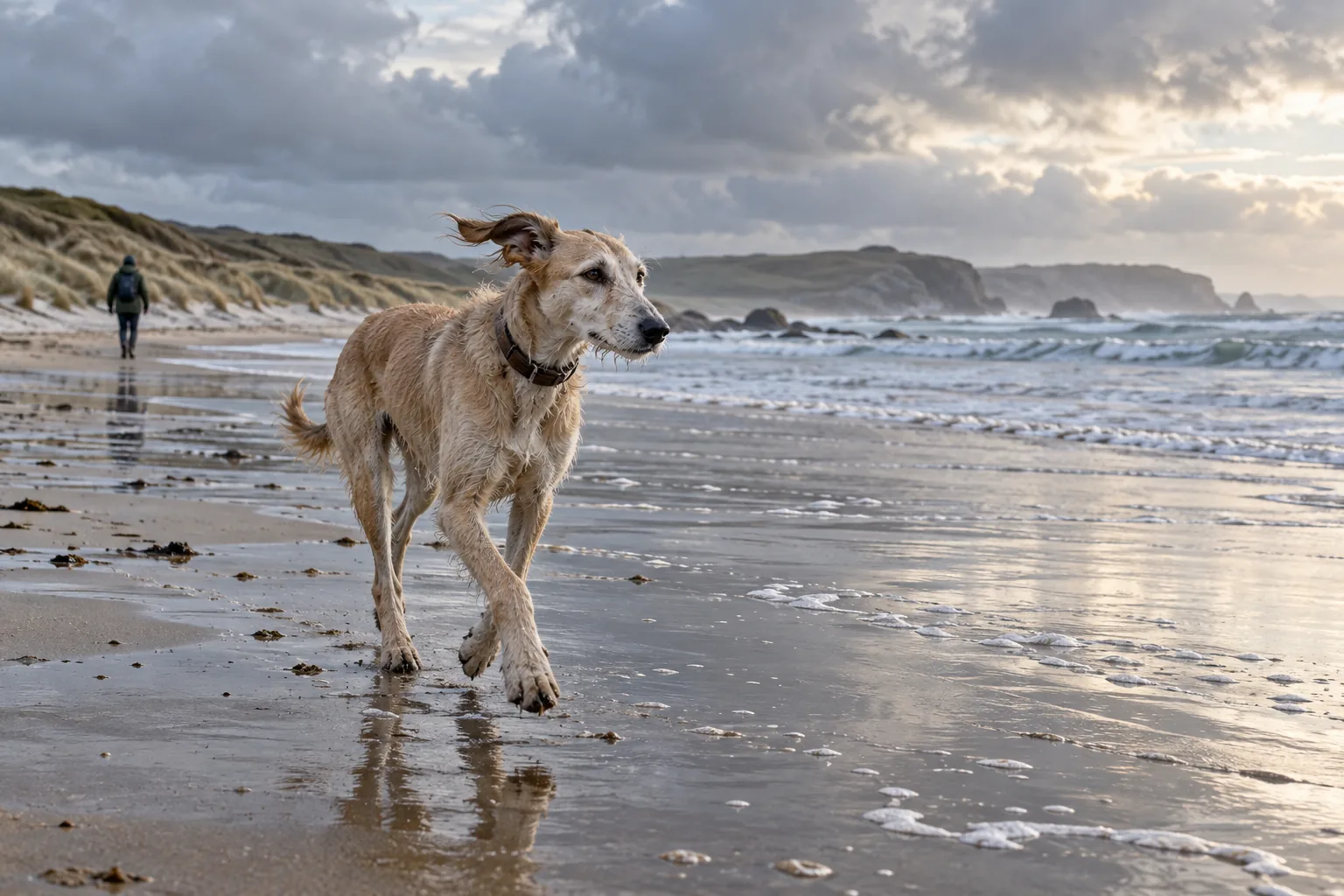
Here is the part the summer crowds miss. With the 2026 seasonal bans lifted on 1 October, the beaches that were off-limits all summer are now open — long, empty stretches of sand, cooler air that suits dogs far better than July heat, and none of the peak-season congestion in the car parks or the nearby towns. For many dogs, October through March is simply the better beach season.
Winter beach days need a little more planning than summer ones. Daylight is short, so time your walk around the low tide and the light rather than around lunch. Atlantic storms can throw debris onto the sand and make cliff paths slippery, so check the forecast and keep the dog away from cliff edges after heavy rain. Some beach car parks close or switch to limited winter hours, and the café that sold puppuccinos in August may be shuttered until Easter — pack water, a towel and a warm layer for the dog as a matter of routine.
Tide times deserve their own mention. Winter’s bigger tides can cut off sections of beach that are walkable in summer, and a dog chasing a ball does not read tide tables. Check the tide before you set off, keep the dog within recall range on unfamiliar beaches, and be particularly careful around estuaries where channels shift. The payoff for this modest extra care is a beach almost entirely to yourselves — which, for most dogs, beats a crowded August afternoon by a wide margin.
Practical questions
Before you go
Are dogs banned from all UK beaches in summer?
No. There is no national ban. Restrictions are set beach by beach by local councils through Public Spaces Protection Orders in England and Wales, or byelaws in Scotland and Northern Ireland. One cove can be restricted while the next one along the coast is fully open, so always check the specific beach rather than the county.
How much is the fine for taking a dog onto a restricted beach?
Breaching a Public Spaces Protection Order usually brings a fixed penalty notice of £100 — Cornwall’s 2026 PSPO sets £100, for example. If the matter goes to court, the maximum fine is £1,000. The offence is simply being on the restricted beach with a dog during restricted hours.
Do seasonal beach bans apply to assistance dogs?
Most orders exempt assistance dogs, but the exemption only counts if it is written into that specific order’s text. Do not assume it applies: check the PSPO or byelaw wording on the council’s website, or contact the council before your trip.
When did the 2026 summer beach dog bans end?
Most seasonal bans in England and Wales run to 30 September, so the 2026 summer restrictions lifted on 1 October 2026. Some councils use different dates — Cornwall’s Blue Flag beach restrictions run 15 May to 30 September — so confirm the exact dates for the beach you plan to visit.
How can I check whether a particular beach allows dogs?
Start with the local council’s website and search for its dog beach PSPO or dog control order — the published order lists the restricted beaches, dates and hours, often with a map. Treat the on-beach signs as the legal reference point and photograph them. Third-party lists go stale quickly, so use them only as a starting hint.
Are the beach dog rules the same in Scotland and Northern Ireland?
No. The PSPO system described in this guide applies in England and Wales under the Anti-social Behaviour, Crime and Policing Act 2014. Scotland uses byelaws and Northern Ireland uses byelaws or dog control orders, so the terminology and the way restrictions are published differ — check the relevant council’s own pages.