This guide is independent and contains no paid placement. If affiliate links are added later, they will be clearly marked and will not change our editorial checks.
Build the trip as a chain of short legs: never more than two hours of driving without a proper stop, one good walk or beach visit per leg, and an overnight stay that leaves the next morning's road simple. Check beach restrictions, cliff-path conditions and tide times before you travel, because those three details decide whether a leg works for a dog.
Plan the route around the dog
A road trip planned around a dog looks different from one planned around a map. Start with the dog's limits, not the destination list. Most dogs cope well with a two-hour leg followed by a real break, but some do not: puppies need toilet stops far more often, older dogs stiffen up after sitting still, and dogs that pant, drool or vomit in the car may need legs of an hour or less. Before you book anything, take your dog on a practice drive of the length you are planning, with the same restraint and the same boot or seat setup you will use on the trip. What you learn in that hour tells you more than any guide can, and it is much cheaper to learn it close to home.
Once you know a comfortable leg length, plot the route backwards from the stops rather than forwards from the start. Pick the walks, beaches and overnight towns first, then check the driving time between them on a normal weekday, not a bank-holiday Saturday. The south coast's A-roads and coastal lanes slow down sharply in summer, around school holidays and whenever a seafront event closes a road, so add a buffer of at least thirty minutes to every leg in your plan. A leg that looks like ninety minutes on a quiet Tuesday can easily become two and a half hours on a hot August Saturday, and that is exactly the kind of stretch that turns a happy dog into a stressed one.
Choose comfort stops with the same care as the headline walks. A good mid-leg stop has shade, water, a patch of grass away from traffic, a bin for waste, and enough space for the dog to move without meeting every other dog in the car park. Motorway and major A-road services vary a great deal: some have a signed dog exercise area and a grassy bank, while others offer little more than a strip of verge beside lorries. Check the stop on a map before you set off, and always carry a backup stop ten minutes further along the road in case the first one is closed, crowded or unsuitable. For each day, write down three things before you leave the accommodation: the leg distance, the planned stop, and the backup stop.
Timing matters as much as distance. Dogs travel best in the cooler parts of the day, so on warm days aim to do the longest leg early in the morning and keep the middle of the day for a shaded walk, a swim or a rest at the accommodation. Avoid arriving at a cliff walk at midday in a heatwave, and avoid planning a beach visit that depends on a low tide you have not checked. Tide times, beach restrictions and cliff-path closures all change through the year, so check the official guidance before you travel for every beach and every cliff section you plan to walk. Keep the daily plan loose enough that you can drop one stop without unravelling the rest of the day.
Leg 1: Brighton to the Seven Sisters
Brighton makes a natural first base for a south coast road trip because it is easy to reach, easy to park in if you plan ahead, and full of dog-friendly places to eat and walk. Start the day with a gentle walk rather than a long drive: the undercliff path east of the marina and the quieter stretches of beach away from the busiest central sections give the dog a proper outing before the car journey begins. Brighton beach itself has seasonal dog restrictions on the central sections, so check the current local rules before you travel and head for the stretches where dogs are welcome at the time of your visit. A calm first morning sets the tone for the whole trip.
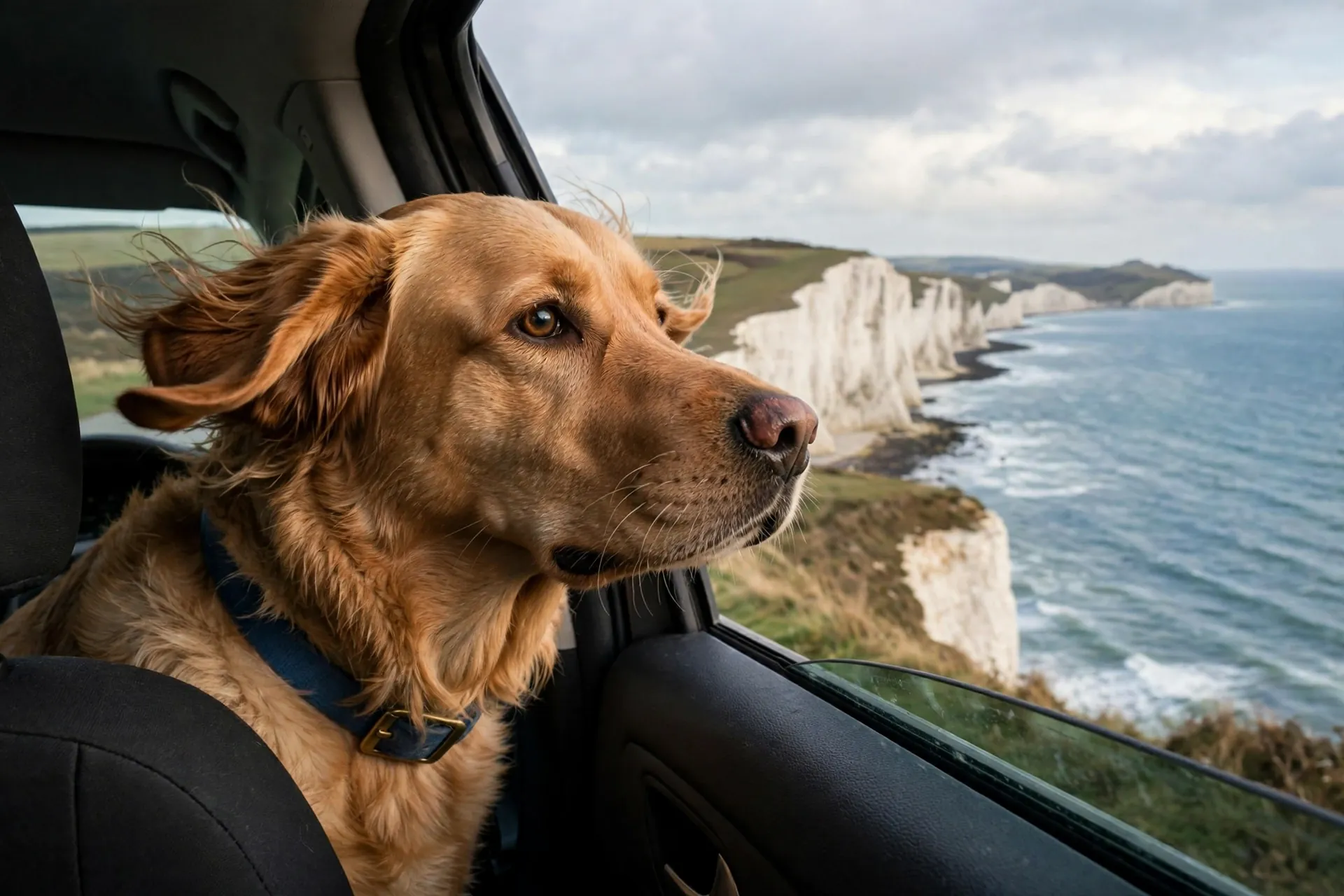
The drive from Brighton towards the Seven Sisters country park is short, usually well under an hour, which makes it an ideal first leg for a dog that is still settling into car travel. The landscape changes quickly: the city gives way to open downland, and the chalk cliffs appear long before you reach the car park. At Birling Gap and the Seven Sisters, the walk along the cliff tops is spectacular but exposed, so keep the dog on a lead near the edge, stay well back from the cliff line, and remember that chalk cliffs erode and sections can be fenced off without much warning. If your dog is a strong puller or a keen bird chaser, a harness and a short lead are essential here rather than optional.
After the cliff walk, the dog will want water, shade and a rest, and this is where a two-hour leg rule proves its worth: you have used well under two hours of driving, but the walk itself is the tiring part. Plan a slow lunch at a dog-friendly cafe or pub nearby, with the dog settled under a table rather than left in the car, and check that the next leg is short too. Many dogs sleep soundly after a cliff walk, which makes the afternoon drive much easier than a morning drive after a restless night. End this leg at accommodation near Eastbourne or further west along the coast, so the next day starts without backtracking.
One practical warning for this leg: the Seven Sisters area gets very busy on fine weekends, and the car parks fill early. Arrive before mid-morning or later in the afternoon, and have a quieter downland walk in reserve, such as a loop inland from a village car park, in case the main car park is full. If the weather turns, the same rule applies in reverse: an exposed cliff top in high wind or driving rain is no place for a dog, and a sheltered woodland or village walk is a far better use of the day. The cliffs will still be there tomorrow, and a dog that has had a good walk in the rain is happier than one dragged along a windswept edge.
Leg 2: Seven Sisters to Portsmouth
The leg west from the Seven Sisters towards Portsmouth is the one most likely to take longer than expected, because it threads through seaside towns, roundabouts and stretches of slower coastal road. Keep the driving portion honest: if the route is showing close to two hours, split it with a proper stop halfway rather than pushing through. A village green, a quiet common or a dog-friendly garden centre cafe all work, provided the dog can toilet, drink and stretch its legs properly. A five-minute stop in a lay-by is not a break; it is a pause, and the dog knows the difference.
Portsmouth itself rewards a slower approach. The historic harbour area is best explored on foot, with the dog on a lead, and the seafront promenade gives a straightforward, level walk when the dog is tired from a day of cliff paths. Check which sections of beach allow dogs on your dates, because Portsmouth's beaches, like most on this coast, have seasonal restrictions and the rules differ between sections. Our guide to dog-friendly beaches and their UK rules explains how seasonal bans and local orders work, and it is worth reading before you try to match a beach to a date. Keep the Portsmouth day flexible: a harbour walk, a cafe stop and a short beach visit is a full day for most dogs without adding a longer excursion.
Overnight in Portsmouth or just outside it, choose accommodation with a practical evening walk. A hotel near a busy road with no green space nearby means a car journey for the last toilet trip of the day, which is the last thing you want after a long drive. Ask before booking where the nearest grass is, whether the dog can be left briefly in the room, and what time breakfast runs, because an early start suits the next leg better than a late one. Confirm the pet fee and the number of dogs allowed in writing, since Portsmouth's dog-friendly rooms can carry stricter limits than a rural cottage.
If the weather or the traffic spoils this leg, the fallback is simple: stop earlier, stay an extra night, and let the next day absorb the delay. A road trip with a dog is not a timetable to defend; it is a chain of good days, and one short day protects the rest. The most common mistake on this stretch is trying to recover lost time by skipping the dog's stop, which only creates a restless dog and a tense car for the following leg.
Leg 3: Portsmouth to the New Forest
From Portsmouth, the New Forest is a short and welcome change of pace: the coast gives way to open heath, ancient woodland and free-roaming ponies, cattle and pigs. This leg is usually well under two hours, which leaves most of the day for walking rather than driving. That is the right balance for the middle of a trip, when the dog has already had several days of new places and needs a day that feels spacious rather than rushed. Pick one good New Forest walk rather than three short ones, and let the dog set the pace.
The New Forest has its own rules, and they matter for dogs. Keep the dog under close control around livestock, because ponies and cattle are everywhere and a chasing dog can cause real harm and serious trouble. During ground-nesting bird season, roughly spring and early summer, dogs should stay on paths in sensitive areas, so check the official guidance before you travel for the area you plan to walk. Some car parks and villages are much busier than others, so choose a quieter starting point if your dog is reactive or easily over-aroused by other dogs. A long line can help on open heath, but only where it is safe and where livestock are not nearby.
Water is the other New Forest detail worth planning. Streams and ponds look inviting, but standing water can carry risks in warm weather, and some dogs drink from anything. Carry fresh water and a bowl even on a short walk, and rinse the dog's paws and belly after muddy or boggy sections. After the walk, a village pub with a dog-friendly garden is the natural stop, and the New Forest has plenty; pick one with shade and water bowls rather than the first place with a car park. The dog will sleep well after a forest day, which makes the following leg to Dorset far easier.
Staying in or near the New Forest also simplifies the next morning, because the onward road to Dorset starts without a detour back to the coast. If you are travelling with a dog that struggles with new places, this is the leg to repeat rather than rush: a second morning in the same woodland, with the same walk, often settles a dog more than a brand-new beach. Routine is a kindness on a road trip, and the New Forest gives you room to build some.
Leg 4: New Forest to Dorset
The leg into Dorset is where the south coast road trip earns its reputation: the road drops towards the Jurassic Coast, the light changes, and the walking shifts from woodland to cliffs and coves. Keep the drive under two hours by stopping before the coast rather than driving straight to the busiest car park. A village stop for a walk and a drink breaks the journey and means you arrive at the coast with a settled dog rather than a restless one. The Dorset coast rewards patience: the famous viewpoints are at their best when you arrive calm, not when you arrive in a hurry.
Lulworth Cove and Durdle Door are the obvious draws, and they are also the places where dog rules need the most checking. Access involves steps and steep paths in places, the beaches have their own seasonal arrangements, and the car parks are among the busiest on this coast. If your dog is older, very small or unsteady on steps, plan a gentler Dorset walk instead, such as a level stretch of the South West Coast Path away from the honeypot viewpoints, or a quieter cove where the approach is shorter. The Dorset coast is long, and a quieter cove with a happy dog beats a famous arch with a stressed one.
Tide times matter more on this leg than anywhere else on the trip. Some beach sections are cut off at high tide, and a walk that is easy at low water can become a scramble against the cliff at high water. Check tide times the night before and again in the morning, and never let the dog swim in a current you have not assessed: the Dorset coast has strong tidal flows, and a confident swimmer can still get into trouble quickly. Carry a towel and a drying coat, because a wet dog in a car for the next leg is uncomfortable and can chill fast in wind.
Overnight in Dorset, the choice is between a coastal village and a slightly inland base. A coastal village gives you an evening beach walk, but parking and evening noise can be harder; an inland base is usually quieter, cheaper and easier for the dog's last walk of the day. Either works if the morning route is simple, so choose by the dog's needs rather than the view from the window. Confirm in advance whether the accommodation allows the dog in the breakfast room or only in the bedroom, because that single rule shapes the whole morning.
Leg 5: Dorset to Lyme Regis
The final leg west to Lyme Regis is a fitting end to the trip: a working harbour town, a long promenade, fossil beaches and a slower pace than the busier resorts further east. The drive from central Dorset is short, which leaves time for a proper harbour walk and a relaxed lunch. Lyme Regis beach has seasonal dog restrictions on some sections, so check the current local rules before you travel and plan the beach visit around them rather than assuming the whole front is open. A promenade walk with the dog on a lead is a good fallback on any day, whatever the beach rules say.
Lyme Regis also teaches a useful road-trip lesson: the best last day is not the most ambitious one. After several days of new cliffs, forests and beaches, most dogs benefit from a familiar rhythm: a morning walk, a long rest, an afternoon wander and an early night. If you are driving home the next day, keep the final evening deliberately dull: the same food, the same bed, a short last walk, and an early start. A tired dog that has slept well travels far better than one that has had a late, exciting night.
Before the drive home, run through a short closing checklist. Is the dog's water topped up and within reach? Is the lead, not just the harness, packed where you can reach it at the first stop? Has the dog had a toilet break and a drink in the last hour? Is the car loaded so nothing can slide onto the dog under braking? These small checks take two minutes and prevent the most common homeward problems. The drive home is often the longest leg of the trip, so split it even if the outward legs were shorter, and stop early rather than late.
If you have more days, the route extends naturally west into Devon and Cornwall, but the same rules still apply: two-hour legs, one good walk per leg, a checked beach, a checked tide and a quiet overnight stop. Extending a good trip is easy; rescuing an over-ambitious one is not. End while the dog is still enjoying it, and the trip becomes a memory worth repeating rather than a test of endurance.
Car safety on every leg
Car safety is not a single purchase; it is a system that has to work on every leg, including the short ones. The dog should travel restrained, either in a crash-tested crate or behind a dog guard, or in a harness attached to a seat-belt point, because an unrestrained dog becomes a danger to everyone in the car in a sudden stop. Whichever system you use, practise with it before the trip so the dog associates it with good things rather than with a stressful first morning. A dog that settles in its crate at home will settle in the car; a dog meeting a new harness for the first time on day one will not.
Ventilation and temperature need attention even on mild days. Keep the car at a comfortable temperature with air flowing to the dog's space, not just to the front seats, and never direct a hot air vent straight at a crated dog. On sunny days, a sunshade on the rear window helps, and a light-coloured blanket over a crate can reduce heat build-up, provided air can still circulate. Stop immediately if the dog is panting heavily, drooling, restless or quiet in an unusual way, and check for overheating before continuing. Dogs cool down slowly in a car, so a stop for shade and water is always better than pressing on.
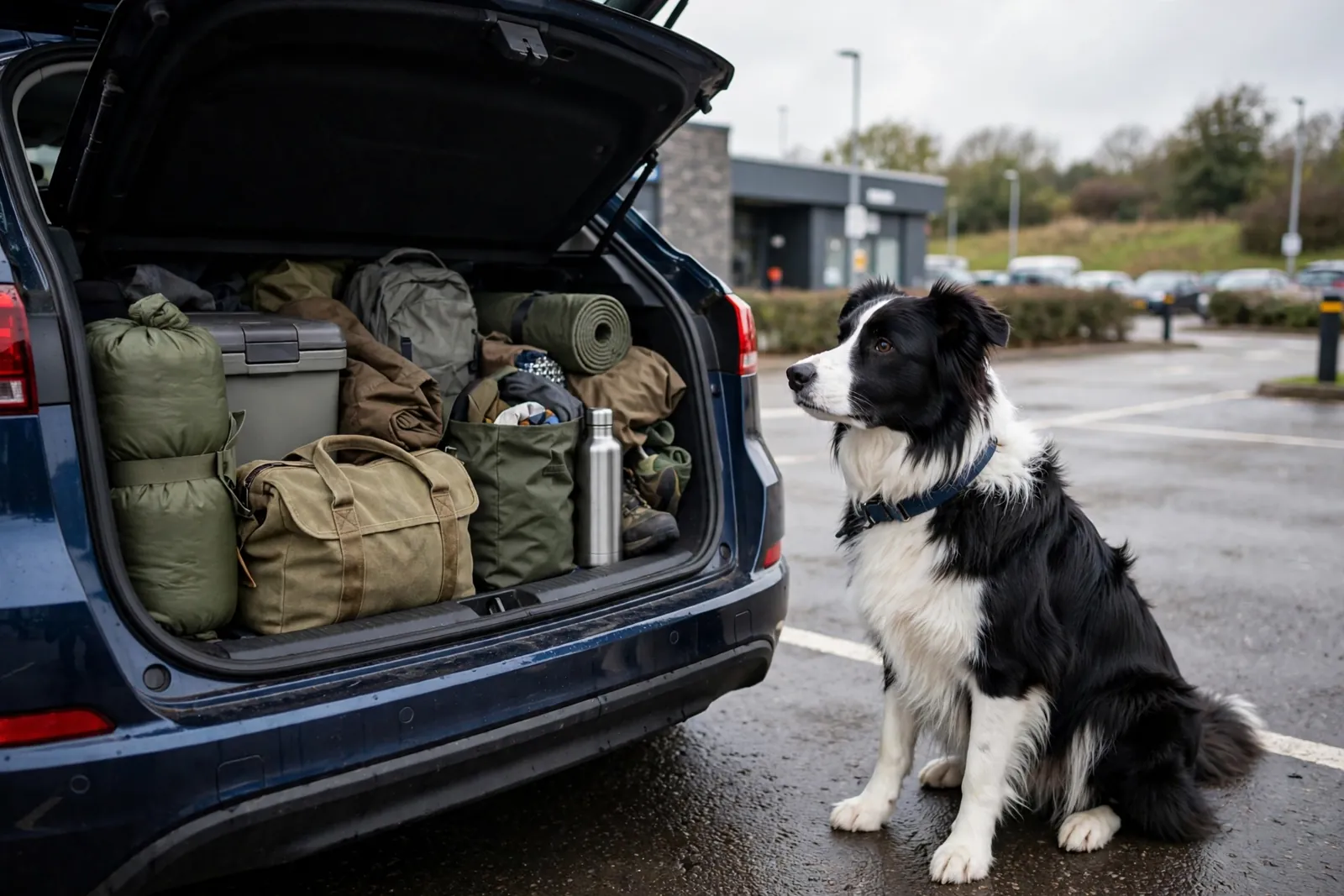
Plan the loading of the car as carefully as the route. Heavy bags should sit low and forward, nothing loose should be able to slide onto the dog, and the dog's essentials, water, bowl, lead, medication and a towel, should be reachable without unpacking the whole boot. Keep a spare lead in the glovebox, because leads get dropped, chewed or left at a cafe, and a road trip without a lead is a road trip that stops. Finally, check the car's condition before a multi-day trip: tyres, coolant, air conditioning and breakdown cover all matter more when a dog is waiting in the car during a delay.
Summer heat and hot cars
Summer is the most popular season for a south coast road trip and the most dangerous one for dogs in cars. A parked car heats up astonishingly fast, even on a mild day and even with a window left open, and a dog left alone in a hot car can suffer heatstroke in minutes. The rule is simple and absolute: never leave a dog alone in a parked car in warm weather, for any length of time, for any reason. If your plans for a stop do not include the dog, change the plans, not the rule.
Plan hot days around shade and water. Walk early in the morning or late in the evening, avoid sand and tarmac at midday, because both can burn paws, and carry more water than you think you need. Watch for the signs of overheating: heavy panting that does not settle, drooling, wobbliness, vomiting or collapse. If you see them, move the dog to shade, offer small amounts of cool water, wet the belly and paws with cool water, and seek veterinary help promptly, because heatstroke can worsen even after the dog seems better. Brachycephalic breeds, older dogs, overweight dogs and puppies are at higher risk and need shorter, cooler days.
At overnight stops, heat planning continues. A south-facing room with no shade can stay warm all evening, and a dog that has spent the day in the heat needs a cool, quiet place to recover. Ask for a shaded parking space, keep the room ventilated, and offer water little and often rather than a large bowl all at once after a hot walk. If the accommodation has no dog-friendly shaded area for the evening toilet trip, that is a reason to choose somewhere else, not a detail to tolerate. Heat is the one road-trip risk that is almost entirely preventable, and prevention is entirely a matter of planning.
Joining the days together: where to sleep
The overnight stop is the joint between one day and the next, and a bad joint weakens both days. The best overnight stops share three features: the dog is genuinely welcome, not merely tolerated; there is a practical evening and early-morning toilet walk within a few minutes on foot; and the next morning's route starts without a detour. A beautiful room that fails any of these three will cost you more in stress than a plain room that passes all three. Read our guide to dog-friendly hotels in the UK before booking, because it sets out the room types, pet fees and dining rules that separate a room that works from one that merely allows dogs.
Book each stop with the same questions, and get the answers in writing. How many dogs are allowed in the room? What is the total pet fee for the stay, not per night? Can the dog be left alone in the room, and if so, for how long and under what conditions? Is the dog allowed in the breakfast room, the bar or only the bedroom? Where is the nearest grass for a late-night toilet trip? These questions take five minutes by email and prevent the most common road-trip disappointment: arriving tired to discover a rule nobody mentioned. If a property cannot answer clearly, treat that as information and book elsewhere.
Budget for the whole trip, not just the rooms. Pet fees, parking, beach car parks, cafe stops and extra fuel for detours add up quickly, and a road trip that runs out of budget halfway tends to cut the dog's walks first. Our dog holiday costs breakdown gives sample budgets for a weekend and a week, and it is worth comparing your own estimate against it before you leave. Keep a small contingency fund for an unplanned extra night, because the ability to stop early and stay over is the single most useful safety valve on a dog road trip.
Finally, build a settling routine for each new room. Walk the dog around the building before unpacking, find the water bowl spot and the bed spot, and keep feeding times and the last walk as close to home as possible. Dogs read routine as safety, and a dog that settles quickly in a new room sleeps better, travels better the next day, and enjoys the trip more. The routine takes ten minutes and pays for itself every morning.
When the plan breaks: backups and bad weather
Every south coast road trip meets a broken plan: a closed car park, a beach ban you did not expect, a cliff path shut after a landslip, a rainstorm that arrives at lunchtime, or a dog that simply has an off day. The trips that survive are the ones with backups built in before departure. For each day, keep one alternative walk, one alternative beach or green space, and one indoor or sheltered option, such as a dog-friendly cafe, a covered market or a quiet village hall area where dogs are welcome. Write them down the night before, not when you are standing in a full car park with a restless dog.
Bad weather deserves its own plan rather than improvisation. Rain changes the south coast quickly: chalk paths become slippery, clay paths become mud, and exposed cliff tops become unpleasant in wind. A wet-weather day should still include a good walk, just a different kind: a woodland trail, a sheltered valley path, a promenade walk in a raincoat, or a forest track that drains well. Pack a drying coat and two towels, and keep a spare set of bedding in the car so a wet dog does not mean a wet bed all night. A dog that has been dried properly after a rainy walk usually sleeps as well as after a sunny one.
Health backups matter too. Save the number and address of a veterinary practice near each overnight stop before you need it, and note which practices offer out-of-hours cover. Carry any regular medication in the car's cabin, not buried in the boot, and keep a simple first-aid kit with bandages, antiseptic wipes, tick removers and a muzzle, because even a gentle dog may snap when in pain. If the dog becomes ill, lame or unusually lethargic, stop the trip and seek veterinary advice rather than driving on to the next viewpoint. The coast will wait; a sick dog should not have to.
The best road trips end with a dog that is tired in the good way: walked, fed, settled and ready to do it again. That outcome comes from short legs, checked beaches, safe cliff walking, a cool car, a quiet room and a plan that bends instead of breaking. Drive the south coast at the dog's pace, and the white cliffs, the harbour towns, the forests and the coves become a shared trip rather than a route imposed on a passenger. The dog will not remember the itinerary, but it will remember whether every day felt good, and that is the only measure that matters.
Practical questions
Before you go
How long should each driving leg be on a south coast road trip with a dog?
Keep each leg to two hours or less, then stop for at least 20 to 30 minutes so the dog can toilet, drink and stretch. Shorter legs suit puppies, older dogs and dogs that pant or drool in the car, so plan the route around the dog's needs rather than the fastest road.
Are south coast beaches dog-friendly all year?
No. Many south coast beaches restrict dogs in the summer months, usually from around May to September, while others stay open all year. Check the current local rules for each beach before you travel, because restrictions change and fines can apply, and always have a nearby alternative beach or walk in reserve.
Is it safe to walk a dog on south coast cliff paths?
Cliff paths can be safe with care: keep the dog on a lead near unfenced edges, stay well back from crumbling edges, check the tide before beach sections, and avoid the path in high winds or after heavy rain. If your dog pulls hard or chases birds, a short lead and a harness give you far more control than a long line near a drop.
What should I pack in the car for a dog road trip?
Pack water and a bowl, the dog's usual food, a lead and a spare, poo bags, a towel and a drying coat, any medication, a first-aid kit, a blanket that smells of home, and a shade cloth or sunshade for stops. Keep the water and the lead within reach of the driver-side door so stops stay quick and calm.
Can I leave my dog in the car during a road trip stop?
Never leave a dog alone in a parked car in warm weather, even for a few minutes and even with a window cracked, because a car heats up fast and can become dangerous very quickly. Plan stops where the dog can come with you, take turns staying with the dog if you must split up, and check the official guidance before you travel.
How do I choose overnight stops on a south coast road trip?
Choose stops where the dog is welcome in the room, where there is a practical evening toilet walk nearby, and where the next morning's leg starts without a long detour. Confirm the pet fee, the number of dogs allowed and the alone-in-room rule in writing before you pay, because a room that looks dog-friendly online may still have strict limits.