This guide is independent and contains no paid placement. If affiliate links are added later, they will be clearly marked and will not change our editorial checks.
Pet dogs are not allowed inside the shop floor at any major UK supermarket chain. Assistance dogs are always allowed by law. The practical fixes are shopping in pairs, using click and collect, or heading to a farm shop or market stall instead — and never leaving a dog tied up outside for longer than a few minutes.
The short answer
If you are driving to a supermarket with your dog in the car, the honest answer is that your dog will almost certainly be waiting outside. Every major British supermarket chain — Tesco, Sainsbury's, Asda, Morrisons, Aldi, Lidl, Waitrose and Marks & Spencer — keeps pet dogs off the shop floor as a matter of policy. This is not a quirk of one grumpy branch manager. Supermarkets sell open food, handle fresh meat and bakery goods, and run under food hygiene rules that treat animals in food areas as a contamination risk. The result is a consistent picture across the country: the dog stays at the door, in the car park, or at home.
That does not mean the weekly shop is impossible with a dog in tow. It means the shop has to be planned differently. Two people travelling together solve the problem cleanly: one shops, one waits with the dog, and the dog gets a pavement walk while the trolley fills up. A solo shopper has fewer good options, and the best of them is click and collect, where the shopping is brought out to the car and the dog never has to be left alone at all. Farm shops, markets and independent food shops fill the remaining gap, because many of them set their own rules and welcome dogs on a lead.
There are exceptions, but they are narrow and easy to misunderstand. A store that lets a small dog ride in a trolley once is not a dog-friendly store; it is a member of staff using their discretion on a quiet day, and the next shift can say no. A dog sitting on the outdoor terrace of an in-store cafe is not the same as a dog allowed down the aisles. And a supermarket inside a shopping centre follows the centre's rules at the entrance as well as its own rules at the door, which is how a dog can be welcome in the mall and still barred from the food hall. Treat every exception as branch-specific and temporary unless you have it confirmed in writing.
The other common misunderstanding is about the law. There is no general legal right to take a pet dog into a shop in the UK, and there is no law that forces a supermarket to admit one. The legal protection that does exist covers assistance dogs only, and it is strong: refusing an assistance dog is unlawful discrimination under the Equality Act 2010. Knowing where that line falls saves a lot of pointless arguments at the door and keeps the focus on the practical question, which is how to get the shopping done without leaving your dog in a bad spot.
So the plan for this guide is simple. First, the chain-by-chain picture, so you know what to expect before you park. Then the assistance dog rules in detail, because they are the one area where the law is firmly on your side. Then the safety rules for the wait outside, which is where most of the real risk sits. Then click and collect, farm shops, and the special case of a reactive dog that cannot cope with a busy car park at all. Policies change, and individual branches differ, so where a detail is uncertain this guide says so — check the official guidance before you travel.
Chain by chain: who lets dogs in
Start with the big four and the discounters, because they cover most weekly shops. Tesco does not admit pet dogs inside its stores, including Tesco Extra, Tesco Superstore and Tesco Express. Assistance dogs are welcome throughout. The same position holds at Sainsbury's, where pet dogs are not allowed past the entrance and assistance dogs are admitted without question, and at Asda, where the rule is the same across its superstores and smaller Asda Express sites. Morrisons follows the same pattern: pet dogs wait outside, assistance dogs come in. None of these chains publishes a different rule for its petrol station shops or its smaller convenience formats, so do not assume that a small branch will be more relaxed — in practice, small branches have less space to manage a dog safely and are often stricter.
Aldi and Lidl are the two chains where shoppers most often report being turned away, and that matches their operating model. Both run lean stores with narrow aisles, fast checkouts and trolleys that need a coin or token, and neither admits pet dogs. Their car parks are usually the busiest part of the site, because the stores are compact and the turnover is high, which makes the wait outside less comfortable for a dog than at a large out-of-town superstore. If you shop at Aldi or Lidl with a dog, plan for the dog to stay with a second person or in the car only while you are inside for a short, timed shop — and remember that a locked car in warm weather is never an option, however quick you think you will be.
Waitrose & Partners and Marks & Spencer sit at the other end of the market, and their policies are sometimes described as more welcoming. The description is misleading. Waitrose does not admit pet dogs into its food halls, and Marks & Spencer does not admit them into its food halls either. What both chains do have is a network of in-store cafes, and some of those cafes allow dogs on an outdoor terrace or in a designated seating area — but this is decided branch by branch, and a cafe terrace is not the shop floor. The same distinction applies to the larger Tesco Extra and Sainsbury's stores that have a cafe: the dog may be welcome at a table outside while you drink a coffee, and still barred from the aisles ten metres away. Always ask the specific branch, and ask about the cafe separately from the shop, because the two answers are often different.
The Co-op and Iceland cover the middle ground. Co-op stores are often small, neighbourhood shops, and their rule is the same as the big chains: assistance dogs only inside. Iceland, including its Food Warehouse branches, follows the same line. Spar and Budgens, which operate as symbol groups with many independently owned stores, are the one place where genuine variation appears: the national guidance is assistance dogs only, but an individual franchisee sets the door policy for their own shop, and a handful of village Spar or Budgens stores are known to welcome regulars' dogs. That is worth knowing, but it is not something to rely on for a weekly shop — a change of franchisee or a single complaint can end it overnight.
Two more patterns are worth naming. First, supermarkets inside shopping centres or retail parks add a second layer of rules: the centre may allow dogs in its malls and corridors while the supermarket still bars them at its own entrance, and the centre's security staff may move a waiting dog on even if the store is happy for it to sit by the door. Second, the big chains' own delivery and collection operations are far more dog-friendly than their shop floors, which is why click and collect features so heavily in this guide. If a chain's door policy disappoints you, its collection bay is usually the answer, not an argument with the door staff.
One final caution about reports you will read online. Social media is full of photographs of dogs in trolleys at one branch or another, and those photographs are real, but they are not evidence of a policy. Staff discretion, a quiet Tuesday morning, a manager who owns a dog — any of these can produce a one-off exception that a photograph then turns into a rumour. Before you drive to a store because someone online said dogs are allowed there, check the official guidance before you travel, or phone the branch and ask for the duty manager by name. A two-minute call beats a wasted trip and a dog left in a hot car park.
Assistance dogs vs pet dogs
The distinction between an assistance dog and a pet dog is the single most important fact in this whole subject, because it is the only place where the law speaks clearly. Under the Equality Act 2010, it is unlawful for a service provider — and a supermarket is a service provider — to refuse entry to a person because they are accompanied by an assistance dog, or to impose a condition on that person that does not apply to others, such as charging a fee or insisting the dog wait outside. This applies in England, Scotland and Wales, and it applies to every supermarket, cafe, petrol station and food hall on the high street. A store that turns away a guide dog owner is not exercising a house policy; it is breaking the law.
What counts as an assistance dog is wider than many people realise. Guide dogs for blind and partially sighted people are the best known, but the same protection covers hearing dogs for deaf people, mobility assistance dogs, medical alert dogs trained to detect seizures or blood sugar changes, and psychiatric assistance dogs trained to perform specific tasks for people with mental health conditions. The key word is trained: the dog must be trained to perform tasks that mitigate a disability. That is also the boundary of the protection. Emotional support animals, however genuinely helpful, are not recognised as assistance dogs under UK law, and a supermarket is not obliged to admit them. Therapy dogs that visit hospitals and care homes are in the same position — their work is real, but it does not carry the legal right of access that an assistance dog has.
There is no legal requirement for an assistance dog to carry identification, wear a specific jacket or hold a certificate, and there is no official national register of assistance dogs in the UK. In practice, most assistance dogs from recognised organisations — Guide Dogs, Hearing Dogs for Deaf People, Dogs for Good, Canine Partners, Medical Detection Dogs and similar charities — wear a branded harness or jacket and the handler carries an ID booklet, which makes the conversation at the door very short. Staff are allowed to ask what tasks the dog is trained to perform, but they cannot demand paperwork, quiz the handler about their disability, or refuse entry while they check something with a manager. If you are a handler, carrying the ID booklet smooths the exchange even though the law does not require it.
Assistance dogs in training occupy a greyer area. Most supermarkets welcome them, and many chains train their staff to treat a dog in a clearly marked training jacket the same way as a qualified assistance dog, but the strict legal protection attaches to the qualified partnership rather than the trainee. If you are training a dog with a recognised organisation, carry the organisation's letter and ask the branch in advance — a quick call to the duty manager before your first visit usually settles it for all future visits.
If you are refused entry with an assistance dog, stay calm and make the refusal specific. Ask for the duty manager by name, state plainly that the dog is an assistance dog and that refusing it is unlawful under the Equality Act 2010, and ask for the reason to be given in writing. Note the date, time, branch and the names of the staff involved, and keep your receipt or any other evidence of the visit. Afterwards, complain in writing to the chain's head office and, if the matter is not resolved, to the Equality and Human Rights Commission or to one of the assistance dog charities, which keep records of access refusals and advise handlers regularly. Guide Dogs UK publishes a guide for handlers on access rights that is worth reading before a dispute rather than during one.
One thing the law does not do is excuse poor behaviour, and assistance dog handlers know this better than anyone. An assistance dog that is out of control, fouling in the aisles or causing a genuine hygiene problem can be asked to leave, just as any customer causing a disturbance can be — but the reason must be the behaviour, not the dog's presence. For pet dog owners, the honest conclusion is the reverse: your dog is welcome in a great many British places, from pubs to beaches to holiday parks, but the supermarket floor is not one of them, and dressing a pet dog in a hi-vis vest does not change that. Misrepresenting a pet as an assistance dog makes life harder for the people who genuinely depend on one, and staff who have been misled once are harder to convince the next time a real assistance dog walks in.
Waiting outside: shade, water and safety
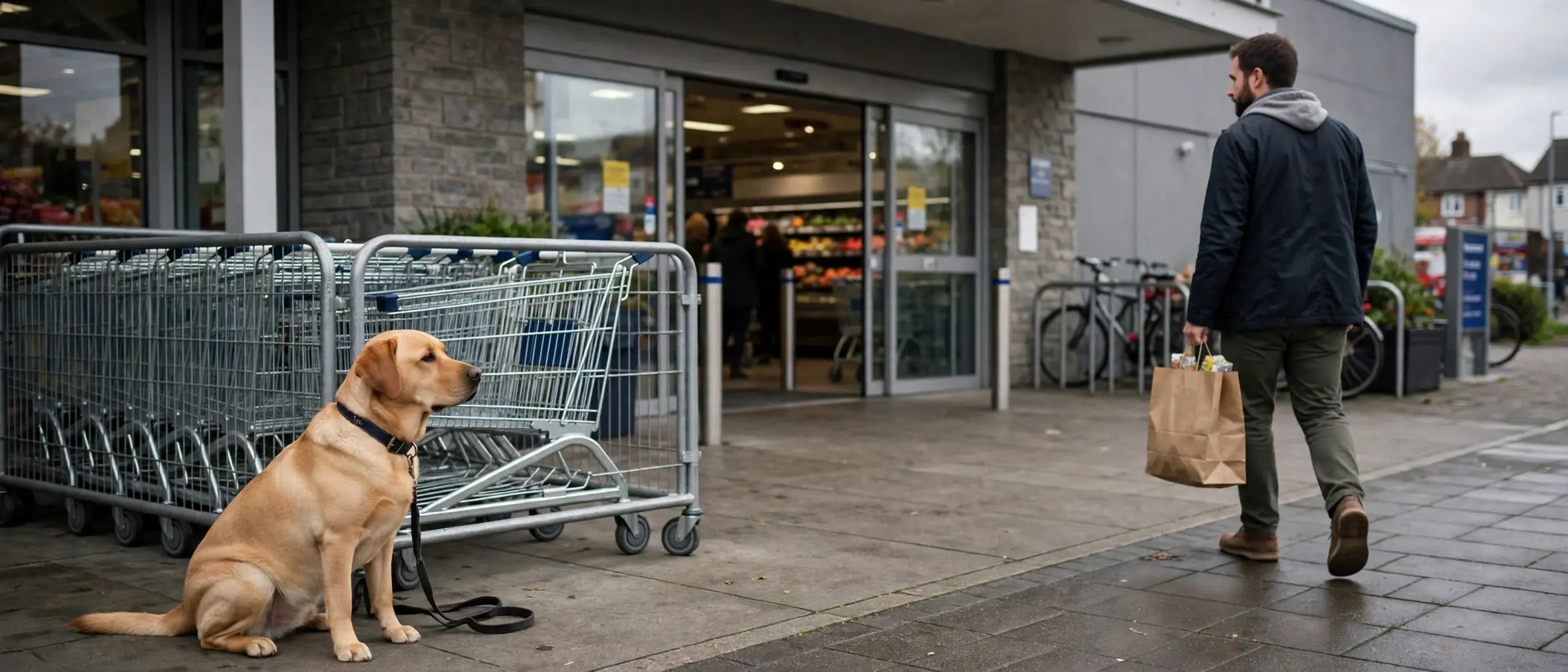
Most supermarket trips with a dog end the same way: the dog waits outside. The wait is short, but it is where almost all of the risk in this guide sits, so it deserves the most careful planning. The three hazards are heat, theft and other dogs, and they behave very differently across the seasons. A car park in July is a different place from the same car park in January, and a ten-minute wait that is harmless at 8am can be dangerous at 2pm.
Heat is the hazard people underestimate most. A dog tied to a rail in direct sun can overheat in minutes, and a dog left in a car is in far worse danger: on a warm day the temperature inside a parked car can climb past 30 degrees within ten minutes even with a window cracked open, and dogs do not sweat the way people do. The rule is simple and absolute: never leave a dog in a parked car on a warm day, even for a quick shop, and never tie a dog in direct sun while you do a full weekly shop. Choose the shaded side of the entrance, check where the shade will be when you come back out — it moves — and keep the wait short enough that you would be comfortable standing in the same spot in a coat. On a hot day, the right answer is usually to leave the dog at home in a cool room, or to shop at 7am or 9pm when the car park is cool and quiet.
Theft is the hazard people dismiss until it happens to them. Dogs are stolen from outside shops every year in the UK, and a dog tied to a rail by its lead is an easy target: the lead can be unclipped, cut or simply untied, and a friendly-looking stranger can walk away with a dog in seconds while the owner is at the till. Pedigree dogs, puppies and small breeds are the most targeted, but no dog is immune, and thefts are regularly reported in the local news. Reduce the risk by never leaving a dog out of sight, by keeping the wait under ten minutes, and by choosing a spot close to the entrance where staff and CCTV can see the dog. Use a short lead clipped to a fixed rail rather than looped over a trolley, because a trolley can be wheeled away. If the store has no suitable rail, stand the dog with a second person, or do not bring the dog at all. A lockable lead or a lead with a carabiner clip is a small extra barrier, and a visible tag with your phone number helps a finder return a dog that slips its collar — but neither replaces your presence.
The third hazard is other dogs and other people. A tethered dog cannot move away from a loose dog that approaches it, and a dog that is normally friendly can snap when it feels cornered at the end of a short lead. Children are a particular problem: a child who runs up to stroke a waiting dog can frighten it, and a parent who assumes every dog is friendly can create a confrontation in seconds. Choose a waiting spot away from the main flow of trolleys and children, ideally to one side of the entrance rather than directly in front of it, and consider a lead sleeve or a tag that says the dog needs space. If your dog is nervous, reactive or in season, the honest answer is that the supermarket entrance is the wrong place for it, and the shop should be done by someone else or by click and collect.
Water and comfort are the practical details that make a short wait a decent one. Carry a collapsible water bowl and a bottle in summer, and offer water before you go in as well as after you come out — a dog that has just drunk is a dog that will settle. Check the ground with the back of your hand: if the tarmac is too hot for your hand, it is too hot for paws, and a shaded patch of grass or a mat is kinder than bare asphalt. In winter the problem reverses: cold rain, wind and gritted pavements. Road salt and grit irritate paws, so wipe them when you get back to the car, and a drying coat or a towel in the boot makes the drive home comfortable. A familiar mat or blanket gives a waiting dog a defined place to lie, which helps it settle instead of scanning the car park for you.
Finally, think about the trolley bays. Supermarket entrances are built for trolleys, not dogs: metal rails, reversing cars, delivery vans and people pushing loaded trolleys past your dog's nose. Keep the lead short enough that the dog cannot step into the path of a trolley or a car, and never tie a dog to a trolley itself — a trolley is designed to roll, and a startled dog can drag one into traffic. The safest waiting spot is usually a fixed rail or a wall to one side of the entrance, in the shade, in sight of the doors, for less than ten minutes, with water available. If you cannot arrange all of that, the shop can wait, or the dog can stay home.
Click and collect with a dog
Click and collect is the single best answer to the supermarket problem for a solo shopper with a dog, and it is worth understanding properly because the details vary by chain. The principle is the same everywhere: you order and pay online, choose a collection slot, drive to the store, park in the marked collection bay, and staff bring the shopping out to your car. Your dog stays with you the whole time. There is no wait at a rail, no locked car, no argument at the door, and no ten-minute dash around the aisles while the dog waits outside.
Tesco runs the largest click and collect operation in the UK, with slots at most large stores and a minimum spend that is usually around £25, though the figure changes with promotions, so check the official guidance before you travel. You book a one-hour window, park in the signed collection bays near the entrance, and either tap the arrival button in the app or phone the number on the sign. Sainsbury's offers a similar service with one-hour slots and collection points at most superstores, and Asda's Click and Collect works the same way, with the added option of collecting from some petrol stations and Click and Collect lockers for smaller orders. Morrisons, Waitrose and Iceland all run their own versions, and the Co-op has been expanding collection from its smaller stores for customers who order through its app. The differences between chains are mostly about slot availability, minimum spend and how far ahead you can book — Tesco and Sainsbury's typically open slots a week or two ahead, while smaller chains may only offer same-day or next-day windows.
The dog-specific details matter more than the brand names. First, the dog stays in the car with you while you wait for the order, so the car's temperature and ventilation are your responsibility for the whole slot. Park in the shade if you can, keep the windows open enough for airflow, and do not leave the car locked with the dog inside while you walk to the collection point to ask where your order is. Second, the handover itself can be a pinch point: when the boot opens and a member of staff leans in with bags, an excitable dog may try to jump out, and a nervous dog may try to bolt. Keep the dog on the back seat with a seat-belt harness or a boot guard in place, and tell the staff member that there is a dog in the car before they open the boot. Most collection staff are used to dogs and will work around them happily if they are warned.
Third, think about timing. Collection slots at the weekend, especially Saturday late morning, can run behind schedule, and a delay that stretches a ten-minute wait into forty minutes changes the calculation for a dog in a car. Book an early morning or late evening slot when the car park is quieter and cooler, and avoid the hottest part of the day in summer. If the store phones to say the order is delayed, you have the option of driving home and coming back — the shopping will be held, and the dog will be happier for the break. Fourth, substitutions: the picker may substitute an item you did not want, and you can refuse a substitution at the point of collection. Check the bags quickly while the staff member is still there, because a missing item discovered at home means another trip.
There are two alternatives that solve the same problem in a different way. Home delivery removes the car entirely: the dog can be in another room or in the garden while the driver unloads at the door, and most chains will bring the bags into the kitchen if you ask. The delivery charge is usually £3 to £7 depending on the slot, and the minimum spend is similar to click and collect. The other alternative is the rapid grocery apps and the supermarket's own express delivery, which can bring a small shop within the hour — useful when the dog cannot be left and you only need a few things. For a holiday cottage or a caravan stay, delivery is often the better option anyway, because it removes the unfamiliar car park entirely: our guide to dog-friendly holiday parks covers how to plan a base that makes the weekly shop easy.
One last click and collect tip that dog owners learn the hard way: do not book a collection slot for the same time as the dog's walk. A dog that has been in the car for the drive to the store, then waits through a delayed collection, then drives home, has spent an hour in a car for a shop that took five minutes to load. Walk the dog first, then collect, or collect first and walk near the store afterwards if there is a green space nearby. The shop is a chore; the walk is the point of having the dog in the car at all.
Farm shops and local alternatives
If the supermarket chains all say no, the independent food trade often says yes, and this is where the weekly shop with a dog becomes genuinely enjoyable rather than a problem to manage. Farm shops are the best example. They are usually family-run businesses on working farms, they set their own door policy, and a large number of them welcome dogs on a lead inside the shop. Some keep a water bowl and a jar of dog treats by the till; some have a fenced field or a paddock where a dog can stretch its legs after the shop; and many sell the things supermarkets do badly — local meat, seasonal vegetables, fresh eggs, raw milk where the farm is licensed for it, and cakes from a farmhouse kitchen. The prices are usually higher than a supermarket, so a farm shop rarely replaces the whole weekly shop, but for a top-up shop on a holiday or a weekend, it is the most dog-friendly food shopping in Britain.
The reason farm shops can admit dogs when supermarkets cannot is partly scale and partly structure. A farm shop typically has one room, a small team and food that is mostly packaged, wrapped or behind a counter, so the hygiene risk is easier to manage than in a superstore with open bakery counters, loose fruit and a fish counter. That said, it is never universal. A farm shop with an open butchery counter, an unwrapped cheese counter or a cafe serving food may still ask dogs to wait outside, or may allow them in the shop but not in the cafe. The only reliable approach is to check the farm shop's own website or social media page before you go — most of them state their dog policy clearly, because they know it brings customers — and to keep the dog on a short lead and away from food displays once inside.
Butchers, bakers, delis and greengrocers on the high street follow the same pattern. A traditional butcher with a counter between the customer and the meat will often welcome a dog that waits quietly by the door; a bakery with open trays of bread is more likely to ask the dog to wait outside; a deli with a tasting counter may welcome a dog on a lead in the morning and ask it to wait outside at lunchtime when the shop is crowded. These are judgements made shop by shop, and the polite way to handle them is to ask at the door rather than to assume. A dog that is welcome in a shop is a guest, and guests behave: short lead, no sniffing the counter, no barking at the other customers, and out again quickly.
Outdoor markets are the easiest of all. A farmers' market, a street market or a car boot sale is mostly outdoors, and dogs on leads are welcome at nearly all of them. The food is sold from stalls, the dog stays at your side, and the hazards are the familiar ones — hot tarmac, dropped food, other dogs and children — rather than a door policy. Market stalls are also where you will find the food that makes a holiday shop memorable: local cheese, fresh fish, game in season, preserves and bread still warm from the oven. Keep the dog away from stalls selling raw meat and fish, carry a water bowl on warm days, and watch for dropped food — grapes, onions, cooked bones and chocolate are all dangerous for dogs and all common at market stalls.
Garden centres with food halls deserve a mention, because they sit in the middle. Many large garden centres allow dogs on a lead throughout the plant area and in the outdoor sections, and some allow them in the food hall too, but the restaurant or cafe inside the garden centre usually has its own rule. Our guide to garden centres covers this in detail, and the pattern is the same as with farm shops: check the specific centre, and treat the cafe as a separate question from the shop. Pick-your-own farms are the opposite case: dogs are almost always barred from the picking fields themselves, because food is being harvested from the ground, so a pick-your-own trip is a leave-the-dog-at-home trip unless the farm explicitly says otherwise.
Finally, the village shop and the petrol station shop are worth a word. A village shop that knows you and your dog may welcome the dog inside for years without a problem, and a petrol station shop at 6am is a very different place from the same shop at 6pm. Both are informal, relationship-based arrangements rather than policies, and both can change with a new owner or a single complaint. Enjoy them while they last, but do not build a weekly routine on them. For the routine shop, click and collect or delivery remains the reliable answer; for the enjoyable shop, the farm shop, the market and the high street are where the dog comes along.
Shopping with a reactive dog
A reactive dog — one that barks, lunges or panics at other dogs, strangers, trolleys or children — turns a supermarket car park from an inconvenience into a genuine problem. The car park is exactly the environment that triggers most reactive dogs: narrow gaps between cars, people appearing suddenly from behind vans, trolleys rattling past, children running, other dogs arriving on long leads. The first rule is to be honest about whether the dog should be there at all. For a big weekly shop, the answer is usually no: leave the dog at home, use delivery, or shop in pairs so the dog never has to wait in the car park. The supermarket is not a training ground, and a bad experience there can undo weeks of careful work.
If the dog does need to come along, timing is the most powerful tool you have. A supermarket car park at 7am on a weekday is a different place from the same car park at 11am on a Saturday. Early morning and late evening are the quiet windows: fewer cars, fewer trolleys, fewer children, and staff who have time to be helpful. Avoid Saturday late morning, Sunday lunchtime and the after-school rush, when the car park is at its busiest and the aisles are at their most crowded. Christmas week, the days before Easter and the first week of a big promotion are the worst times of all, and a reactive dog should not be within a mile of the store on those days.
Choice of store matters as much as timing. A large out-of-town superstore has a bigger car park, which means more space to park away from the entrance and walk in from a quiet corner — but it also has more traffic and more trolleys. A small neighbourhood store has a smaller car park and fewer people, but less room to keep your distance. The best compromise is often a medium-sized store with a quiet side entrance or a collection point away from the main doors. Park at the far end of the car park, where there is space to open the doors fully and let the dog out without another car pulling in beside you, and walk the dog in a wide arc rather than through the trolley bay scrum at the entrance.
The wait itself needs a plan, not an improvisation. A reactive dog should never be tied to a rail at a busy entrance, because it cannot move away from whatever approaches it, and a dog that feels trapped is a dog that will escalate. If two people are travelling, the second person should walk the dog at a distance from the entrance — around the edge of the car park, or on a patch of grass nearby — rather than standing still with the dog at the door. A moving dog is a calmer dog, and a dog that is walking and sniffing is a dog that is not fixating on the next trolley. Bring high-value treats and use them to reward the dog for looking at you rather than at the trigger, but do not try to train through a reaction in a car park: if the dog is already over threshold, the training is over, and the right move is to increase the distance.
Equipment helps, but only if it is already familiar. A well-fitted muzzle, introduced gradually at home with treats, allows a reactive dog to be in public safely and signals to other people that they should give the dog space. A lead sleeve or a harness patch that says the dog needs space is a clear message to other dog owners, and a yellow lead or ribbon is widely understood in the UK as a request for distance. None of this works if it is introduced for the first time in the supermarket car park — a muzzle that the dog is still fighting is worse than no muzzle at all. Practice at home, on quiet streets, and in empty car parks before you try a real shop.
The honest long-term answer for a reactive dog is to remove the supermarket from the dog's life as far as possible. Book a regular click and collect slot, or a regular delivery slot, and keep the dog's car trips for places it enjoys — a quiet walk, a familiar field, a cafe with a garden where it can settle. A dog that never has to wait at a supermarket entrance is a dog that never has to practise reacting there, and that is worth more than any single training session in a car park. If you want somewhere to eat out with a dog that needs space, our guides to dog friendly cafes and dog friendly afternoon tea both cover how to choose a venue with room to keep your distance.
Practical questions
Before you go
Can I take my dog into Tesco, Sainsbury's or Asda?
Pet dogs are not allowed inside the shop floor at Tesco, Sainsbury's or Asda. All three chains admit assistance dogs, as the law requires, but pet dogs must wait outside, so plan for one person to shop while the other stays with the dog, or use click and collect instead.
Are assistance dogs allowed in every UK supermarket?
Yes. Under the Equality Act 2010, refusing entry to an assistance dog is unlawful discrimination, and this applies to every supermarket in England, Scotland and Wales. Staff may ask what tasks the dog is trained to perform, but they cannot demand paperwork or charge a fee, and assistance dogs in training are generally welcomed too.
Is it safe to tie my dog up outside a supermarket?
It carries real risks: dogs are stolen from outside shops, leads can be chewed through or untied, and other dogs or children may approach a tethered dog that cannot move away. If you must do it, keep the wait under ten minutes, stay within sight, choose a shaded spot near the entrance, and use a short lead clipped to a fixed rail rather than a trolley.
Can I use click and collect with my dog in the car?
Yes, and it is the best option for solo shoppers with a dog. Book a slot with Tesco, Sainsbury's, Asda, Morrisons, Waitrose or Iceland, park in the marked collection bay, and staff bring the shopping to your car. Keep the dog cool and ventilated, never leave the car locked in warm weather, and keep the dog secured so it cannot jump out when the boot opens.
Which UK supermarkets have dog-friendly cafes?
No major chain runs a reliably dog-friendly cafe policy across all branches. Some larger stores allow dogs on the outdoor terrace of their in-store cafe, and some Waitrose and Tesco Extra cafes do, but it is a branch-by-branch decision, so check with the specific store before you go. Our guide to dog friendly cafes lists venues that welcome dogs indoors.
Do farm shops allow dogs inside?
Many farm shops do allow dogs on a lead inside, because they are smaller, family-run businesses that set their own rules, and some even keep water bowls and dog treats by the door. It is never universal, and shops that sell unwrapped meat, cheese or baked goods may still ask dogs to wait outside, so check the official guidance before you travel.