This guide is independent and contains no paid placement. Castle rules change by site, season and event, so treat this guide as a way to read and check the rules, not as a substitute for the official guidance for the castle you plan to visit.
Think of a Scottish castle as several places under one name. Pet dogs are often welcome in some outdoor areas on a lead, commonly excluded from historic interiors, and subject to extra limits on event days. Assistance dogs are treated separately. Check the official guidance before you travel, and plan the visit around the most restrictive boundary you will actually cross.
Start at the line, not the label
Stand, in your mind, at a castle gatehouse. On one side is a stone courtyard, open sky, a gravel path and a dog sniffing the air. On the other side is a doorway, a dark stair, a furnished room and a sign that may say something different. That threshold is the whole subject of this guide. A castle can be genuinely welcoming to dogs and still be the wrong visit for a dog owner, because the welcome stops at a particular door, a particular lawn or a particular fence. Equally, a castle that bars dogs from its interiors can still give a dog a good morning in its grounds, provided the party knows that in advance and chooses the visit for that reason.
The common mistake is to read a single phrase, such as dog-friendly, and treat it as a blanket permission. In heritage visiting, that phrase usually needs a follow-up question: friendly where, on what kind of lead, at what time of year, and under what event conditions? A courtyard that is open to dogs in February may be partly closed for a summer concert. A garden path that is fine for a calm dog may be closed during lambing, nesting or conservation work. A shop or cafe that welcomes dogs on a quiet weekday may ask dogs to wait outside when a coach party arrives. None of that makes a castle unfriendly. It makes it a managed historic site, with fragile interiors, working land, livestock nearby and many visitors sharing narrow spaces.
The most useful habit is therefore to map the visit in zones before you go. Draw, even mentally, four zones: the approach and car park, the outdoor grounds and courtyards, the semi-indoor spaces such as shops, cafes, covered walkways and ticket halls, and the historic interiors themselves. For each zone, ask whether dogs are admitted, whether a lead is required, whether there is a maximum lead length, and whether the rule changes on the day you will visit. If you cannot answer one of those questions from the official listing, that is the question to ask the castle directly. A visit planned zone by zone is far less likely to end in a disappointed wait at a doorway.
This approach also protects the dog. A dog that is comfortable on a wide coastal path may be stressed by echoing stone stairs, low ceilings, crowds pressing close, sudden cannon demonstrations or the smell of old timber and damp stone. A dog that loves people may still struggle when it cannot move away from a queue. Planning by zones lets you decide not only what is allowed, but what is kind: a long, sniff-rich walk in the grounds followed by a calm wait in a shady, familiar spot may be a better day than forcing a nervous dog through every permitted doorway.
Inside rooms: why interiors are usually different
Historic interiors are the area where pet dogs are most commonly excluded. The reasons are practical rather than personal. Rooms may contain original furniture, textiles, paintings, arms and armour, tapestries and other objects that are sensitive to dirt, moisture, claws, chewing and sudden movement. Floors may be uneven, polished or fragile. Staircases may be narrow, steep, spiral and without a safe passing place for a dog and a visitor coming the other way. In some towers, the only route in and out is the same tight stair, so a dog that panics, pulls or blocks the way creates a safety problem for everyone behind it.
Conservation also matters in ways that are easy to overlook. A wet dog shakes, a muddy dog transfers grit, and a dog that marks a corner can damage stone, wood or fabric in a way that is not repaired by wiping. Historic houses and castles often control temperature and humidity to protect collections, and they limit what enters the rooms for that reason. Food and drink rules in interiors serve a similar purpose: crumbs attract pests, and a dropped treat near an exhibit can cause a long-term problem. These controls are not aimed at well-behaved dogs in particular; they are aimed at the cumulative effect of many visitors, many dogs and many small incidents over a season.
There are exceptions, and they are worth understanding rather than assuming. Some privately run castles, smaller houses and castles that function partly as hotels, wedding venues or family homes may allow dogs in certain ground-floor rooms, entrance halls or cafes. Some sites allow dogs in a shop or ticket area but not beyond a second doorway. Others allow dogs in a modern visitor centre but not in the historic building itself. The distinction is often architectural: a modern extension with wipe-clean floors and wide doors is a different risk from a medieval hall with a single narrow stair. When a listing says dogs are welcome, read the next sentence. It often names the exact rooms, and that sentence is the rule.
Assistance dogs sit outside this general pattern. In the United Kingdom, assistance dogs are normally admitted to areas where pet dogs are not, subject to practical safety considerations. That does not mean every historic space is automatically accessible: a very narrow spiral stair, a fragile floor or a hazardous area may still require an alternative route or arrangement. If you travel with an assistance dog, check access details in advance, including step counts, doorway widths, surfaces, lighting and any place where staff may need to help you plan a different route. Keep any relevant identification or documentation ready if the site asks for it, and check the official guidance before you travel for the most current access information.
For pet dogs, the practical question is what happens to the interior part of the visit. If the interior is the main reason for going, and the dog cannot enter, the honest options are to take turns, to visit with a larger party so one adult can stay with the dog, or to choose a different castle where the outdoor experience alone justifies the trip. Leaving a dog tied outside, in an unfamiliar porch or in a car is not a plan. It is a risk, and on a warm day it can become dangerous quickly. Plan the split before you leave home, not at the ticket desk.
Grounds, courtyards and gardens
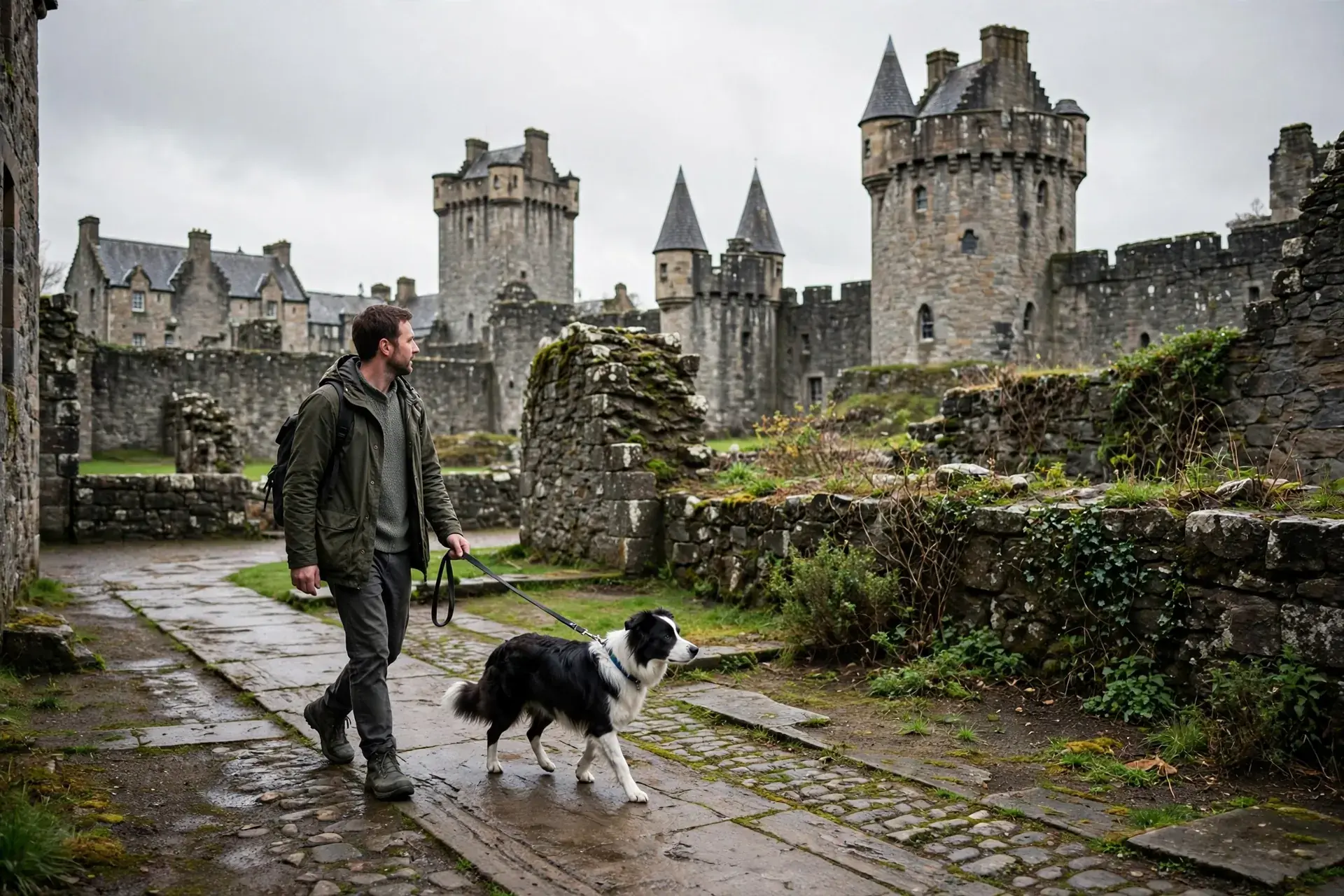
Outdoors, the picture is usually more generous, but it is still zoned. Courtyards, outer walls, woodland paths, parkland and some gardens commonly admit dogs on a lead. The lead is not a formality. Castle grounds often border farmland, contain grazing animals in adjacent fields, include formal gardens where planting is easily damaged, and attract wildlife that a loose dog can chase into a road, a loch or a cliff path. A short lead gives the owner control when a pheasant, rabbit, sheep or another dog appears around a blind stone corner.
Gardens deserve special attention because they are often subdivided. A walled garden may admit dogs on a lead while a rose garden, herb garden or newly planted area does not. Terraces and lawns used for weddings, photography or quiet sitting may be closed to dogs even when the wider parkland is open. Play areas, picnic lawns and areas near cafes may have separate rules to protect children and food areas. The signs at each garden gate matter more than the general statement on the home page. Photograph or note the sign if you are unsure, and follow the most recent sign on the day rather than a blog post from a previous year.
Paths and surfaces also shape the visit. Castle grounds can include gravel that is hard on paws after a long walk, cobbles that are slippery when wet, steep grass banks, uneven steps, and cliff or waterfront edges without a fence. Older dogs, small dogs and dogs recovering from injury may need a shorter route, more shade and more water stops. Carry water even on a cool Scottish day, because a castle walk can combine a steep climb, a long approach from the car park and a wait in a queue. Check whether there is a dog waste bin on the route, and carry bags regardless: bins in historic grounds are not always placed where a dog owner would expect them.
Wildlife and livestock rules extend beyond the castle wall. In Scotland, the Scottish Outdoor Access Code sets out responsible access, including keeping dogs under proper control and on a lead where livestock, wildlife or other visitors require it. Castle grounds that adjoin farmland or nature areas may apply that principle strictly during lambing, calving or nesting seasons. Even where a castle itself is relaxed, a neighbouring field is not part of the visit. Keep the dog out of fields with livestock, away from ground-nesting birds in spring and early summer, and off beaches or shorelines within the estate where wildlife rules apply. If you are combining a castle with a coastal walk, our guide to dog-friendly beaches in Scotland explains how seasonal and wildlife rules change the picture by the sea.
Finally, remember that grounds are also workplaces. Gardeners, stonemasons, guides and event crews may be moving equipment, closing paths or operating machinery. A path that is open in the morning may be closed for conservation work by the afternoon. Treat temporary barriers, cones and staff instructions as part of the rule for that day, even if they contradict a general online statement. The staff member at the barrier usually knows why the closure exists, and a polite question can often reveal an alternative route.
Who sets the rule, and why it varies
There is no single Scottish castle dog rule, because castles are not run by a single body. Some are cared for by large heritage organisations, some by charitable trusts, some by local councils, and some by private owners who also live, farm, host weddings or run accommodation on the site. Each operator balances conservation, safety, farming, commercial use and visitor experience differently, and each writes its own visitor guidance. That is why two castles a few miles apart can have opposite rules, and why a rule that seems inconsistent is often a response to a different building, a different collection or a different piece of land.
Large heritage operators tend to publish detailed visitor pages with a dedicated section on dogs, including whether dogs are allowed in grounds, whether they are allowed in the shop or cafe, and whether assistance dogs are admitted. Smaller private castles may publish a shorter note, or may answer only by email or telephone. Neither style is more reliable by itself. A detailed page can be out of date after a policy change, and a short note can hide an important exception for event days. The safest approach is to use the official page as the starting point and to confirm the specific zone you care about, especially if the interior is essential to your visit.
Ownership also affects what counts as part of the visit. A castle estate may include a hotel, a holiday cottage, a farm shop, a woodland walk and a historic building, each with its own rule. Dogs may be welcome in the hotel bar and on the estate walk, but not in the historic rooms. Dogs may be welcome in a self-catering cottage, but not in the castle tour that starts from the same car park. When you book accommodation, do not assume the castle tour rule matches the accommodation rule. Check both, and check whether the accommodation has its own pet fee, cleaning rule or limit on the number of dogs. Our guide to dog-friendly holiday parks in the UK shows how the same split between accommodation and attraction rules can catch visitors out in a different setting.
Insurance, staffing and building layout also influence the decision. A castle with wide modern galleries, a lift and a separate exit route can manage dogs more easily than a tower with one spiral stair and no alternative exit. A castle that relies on volunteers may restrict dogs on busy days when staffing is thin. A castle with a fragile collection may restrict dogs all year, while a ruin with no interiors may welcome dogs throughout the grounds. These factors are rarely spelled out on a visitor page, but they explain why a polite request for an exception is usually refused: the rule is not about one dog, but about the building and the flow of visitors through it.
When rules are unclear, ask a precise question rather than a general one. Instead of asking whether the castle is dog-friendly, ask whether pet dogs are admitted to the historic interiors, to the courtyard, to the gardens and to the cafe, and whether any of those answers change on the date you plan to visit. Precise questions produce precise answers, and a written reply by email gives you something to show at the gate if a temporary sign or a different member of staff gives a different impression.
Event days, filming and busy weekends
Event days are the most common reason a normal dog rule changes without warning. A castle that welcomes dogs in its grounds on a quiet Tuesday may restrict dogs during a re-enactment weekend, a concert, a food festival, a wedding, a Highland games demonstration or a filming day. The reasons are understandable: crowds reduce space for a dog to move away from stress, loud noises such as cannon fire, music, fireworks or vehicle engines can frighten even confident dogs, and temporary fencing, cables, stalls and catering areas create hazards that are not present on an ordinary day.
Re-enactments and living-history events deserve particular care. Horses, birds of prey, working dogs, costumed interpreters and staged combat can all trigger a pet dog, even one that is normally calm. A dog that lunges at a horse or chases a falconry bird creates a safety incident, not just an embarrassment. Some events therefore admit dogs only to a defined spectator area, require a short lead and a muzzle in certain zones, or exclude pet dogs entirely for that day. Check the event listing, not just the general visitor page, and look for phrases such as event-day restrictions, no dogs at this event, or dogs welcome in the grounds only. If the event page is silent about dogs, treat that silence as a reason to ask, not as permission.
Concerts, weddings and private hires can change access even more completely. A courtyard that is normally open may be closed for staging, a garden may be reserved for a private party, and a cafe may be closed to day visitors. On those days, the dog rule may be irrelevant because the area itself is closed. Check the opening calendar for closures as well as dog rules, and avoid building a long journey around a single castle on a day when a private hire could close the very area you wanted to see.
Filming and conservation closures are quieter but just as important. A film crew may close a courtyard, a garden or a tower for a day, and conservation work may close a stair or a room for weeks. These closures are often announced on the castle's own news page or social channels rather than on the main visitor page. A quick check of recent announcements, in addition to the main dog guidance, can save a wasted journey. If you are travelling a long distance, that extra check is worth the time.
Busy weekends, school holidays and bank holidays do not always change the written rule, but they change the experience. Queues become longer, narrow passages become congested, and a dog that copes well with ten people may struggle with a hundred. If you have a choice, visit on a quieter weekday, arrive early, and build in a calm walk before the castle so the dog is not arriving with unspent energy. If you must visit on a busy day, shorten the castle portion, spend more time in the wider grounds, and be ready to leave early. A short, successful visit is better than a long visit that ends with a stressed dog and a stressed owner.
Seasons, wildlife and weather
Scottish weather and seasons change both the rule and the practicality of a castle visit. In spring, lambing and nesting can bring stricter lead rules and temporary closures of fields and woodland edges. In summer, heat, crowds and events combine: stone courtyards can become hot, shade can be scarce, and water points may be limited. In autumn, shorter days, wet paths and earlier closing times change how much of the grounds can be enjoyed, and fireworks season can unsettle noise-sensitive dogs. In winter, some castles close entirely, others open only on selected days, and outdoor areas may be icy, muddy or closed for safety. Check the official guidance before you travel, even if you visited the same castle last year, because a seasonal change may have altered the opening pattern as well as the dog rule.
Wildlife seasons require particular respect. Ground-nesting birds, deer, seals on a nearby shore and livestock in adjacent fields are all vulnerable to disturbance. A dog off the lead in the wrong place can cause a wildlife incident that is not undone by an apology. Even a dog on a lead can cause stress if it barks persistently at livestock through a fence. Keep distance, keep the lead short near animals, and move on calmly rather than stopping to let the dog stare. If a path is closed for wildlife reasons, use the diversion even if it is longer. The closure is part of responsible access, not an inconvenience to be bypassed.
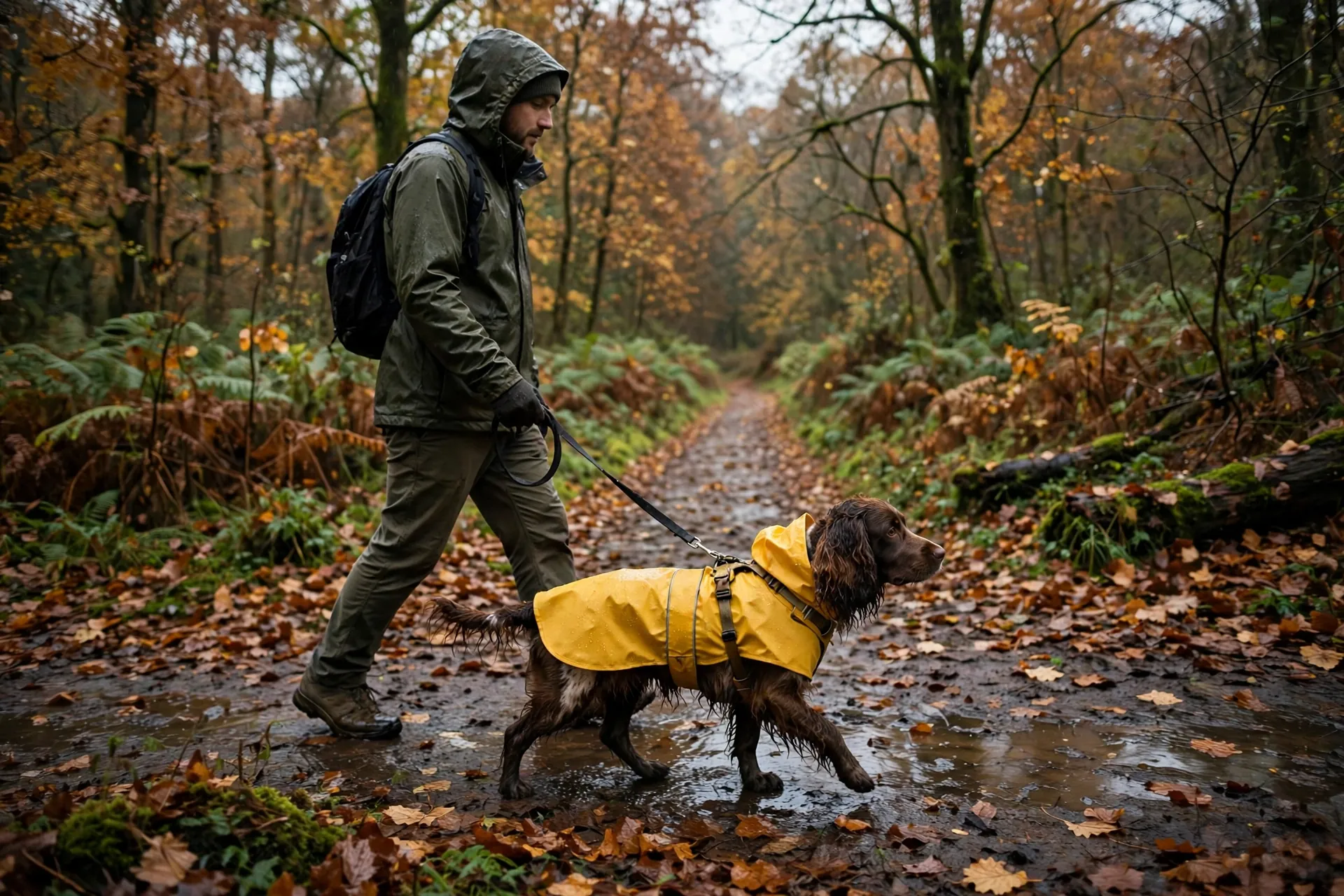
Weather planning for a castle is different from planning for a beach or a hill walk. Stone buildings stay cold and damp after rain, courtyards can be exposed to wind, and a dog that is wet from a morning walk will chill quickly if it then waits in a draughty entrance. Pack a drying towel, a waterproof coat if your dog uses one, and a familiar blanket for any waiting period. In summer, pack water, a portable bowl and a shade plan: a light-coloured courtyard can reflect heat, and a dark car, even for a short stop, is never a safe waiting place. In winter, check daylight hours and closing times before you set out, so a late arrival does not turn into a rushed walk in the dark. For a broader seasonal checklist, see our autumn dog holiday checklist for the UK, which covers warmth, waterproofing, lights and mud routines that apply well beyond autumn.
Seasonal opening also affects facilities. A cafe, shop or toilet block that is open in summer may be closed in winter, and a dog water bowl that is available in July may not be there in January. Do not rely on facilities that are not confirmed for your date. Carry water, bags, a towel and a small first-aid kit as standard, and plan toilet stops, food stops and shelter stops before you arrive. A castle visit that depends on a single cafe for water, shelter and a toilet break is fragile; a visit with a backup plan is resilient.
Lead, behaviour and other visitors
Lead rules in castle grounds are usually stricter than on an open beach or a forest trail, and for good reason. Narrow paths, blind corners, steep drops, livestock fences and other visitors all reduce the margin for error. A short lead, typically held close rather than on a long extending line, gives the owner control when another dog appears, when a child runs past, or when a guide group turns a corner. Extending leads can tangle around other visitors, wrap around stone posts, or allow a dog to reach a fragile display, a garden bed or a cliff edge before the owner can react. If a castle specifies a short lead, follow that specification rather than arguing that a longer lead is still a lead.
Behaviour expectations are equally important. A dog that is welcome in the grounds is still expected to be under control, to toilet only in appropriate areas, and to have waste picked up immediately. Some castles provide bins and bags, but the owner should carry bags regardless. Barking that continues for a long period, jumping up at other visitors, or pulling towards other dogs can lead to a request to leave, even where dogs are generally welcome. This is not a judgment on the dog; it is a judgment on the effect on other visitors in a confined historic space. A dog that is tired, toileted and settled before entering the grounds is far more likely to behave well than a dog that arrives full of energy after a long car journey.
Other visitors include people who are nervous around dogs, children who may run towards a dog without warning, and other dog owners whose dogs may be reactive, elderly or in training. Keep distance at pinch points, step aside on narrow paths, and do not assume every other dog wants to greet yours. If another owner signals that their dog needs space, respect that signal immediately. In a castle, a greeting that goes wrong cannot be undone by moving to a wide open field, because the next space may be even narrower.
Photography and social media add a modern complication. A dog in a castle courtyard is photogenic, but flash photography, tripods and long photo sessions can block paths and disturb other visitors. Keep photo stops brief, stay on permitted paths, and do not lift a dog onto walls, monuments or garden features for a picture. Climbing on historic stonework for a photograph can damage the structure and can also put the dog at risk if the stone is loose or the drop is hidden. A good photograph from a permitted path is better than a risky photograph from a closed area.
Finally, think about the dog's own comfort in a heritage setting. Stone floors are hard, echoes are loud, and crowds can be overwhelming. Watch for signs of stress: panting when it is not hot, yawning, lip licking, turning away, tucking the tail, or trying to pull towards an exit. Those signs are information, not disobedience. If the dog shows them, shorten the visit, move to a quieter area, or leave. A dog that leaves a castle calmly, after a good walk in the grounds, will be easier to take to the next castle than a dog that was pushed through every room until it became distressed.
The ten-minute check before you travel
A ten-minute check before you travel can prevent most castle disappointments. It does not require a phone call in every case, but it does require reading beyond the headline. Start with the official visitor page for the specific castle, not a general article, a review site or a social media post. Look for a section headed dogs, pets, visiting with dogs, or access. Read it in full, including any footnotes about assistance dogs, event days and seasonal changes. If the page links to a separate frequently asked questions page, read that too, because exceptions are often hidden there.
Next, check the date. Look at the opening calendar for your planned day, including last entry times, closures for private hire, and any event listing. A castle that is open may still have a closed courtyard, a closed garden or a closed tower on your date. Then check the weather and daylight forecast, and think about what that means for the dog: shade, water, wind, rain, ice and the time available before closing. A castle visit that starts too late, in poor weather, with a tired dog, is a different visit from the same castle on a calm morning.
Then, write down the questions that remain. Useful questions include: Are pet dogs admitted to the historic interiors, or only to the grounds? Are dogs admitted to the shop, cafe and toilets area? Is a short lead required throughout, and are extending leads prohibited? Are there any areas within the grounds where dogs are not allowed? Does the rule change on event days, and is there an event on my date? Is there a shaded waiting area, a dog water point and a waste bin on the route? What is the nearest alternative walk if the castle rule is stricter than expected? If you cannot answer these from the website, send a short email or message with those exact questions and keep the reply.
Pack for the zone plan, not just for the dog. That means a short lead, a spare lead if you use one, water and a bowl, waste bags, a towel, a coat if needed, a familiar blanket for waiting, and a plan for the car that does not involve leaving the dog in it. It also means a map or a note of the nearest vet, the nearest alternative walk, and the nearest cafe where dogs are welcome. A castle day that has a backup walk is a day that can still succeed if the castle rule surprises you. A day with no backup can turn a small disappointment into a wasted journey.
Finally, agree the plan with everyone in the party before you leave. Who will stay with the dog if the interior is closed to pets? How long will that wait last? What will the waiting person and the dog do during that time? Where will you meet afterwards? These questions sound obvious, but they are often left until the ticket desk, where the answer is rushed and the dog pays the price. A party that agrees the split in advance arrives calm, and a calm party is more likely to have a calm dog.
Planning a day that works for everyone
A good castle day with a dog is usually built backwards from the dog's needs. Start with a proper walk before the castle, not after it. A dog that has toileted, sniffed, stretched and settled is far more likely to walk calmly through a courtyard and wait quietly while one person visits an interior. A dog that has spent two hours in a car and then goes straight into a busy historic site is starting at a disadvantage. If the castle has a recommended approach walk, use it. If it does not, find a nearby park, riverside path or quiet lane for a pre-castle walk, and allow enough time for it.
Next, sequence the castle itself from the most open to the most confined. Begin in the widest grounds, move to courtyards and gardens, and only then approach the more confined areas that the dog is allowed to enter, if any. This gradual narrowing helps the dog adjust to stone surfaces, echoes and crowds. If the dog becomes stressed at any stage, you have already enjoyed the open part of the visit, and leaving early still feels like a visit rather than a failure. If you start with the most confined area, a stressed dog can colour the whole day.
Build in rest and water stops, even on a short visit. Stone courtyards offer little shade, and a dog that is panting needs water and a pause, not another staircase. Look for shaded benches, grass edges where dogs are permitted, and quiet corners away from the main flow. Avoid the temptation to fit three castles into one day with a dog. One castle, well planned, with a good walk and a calm lunch, is a better day than three rushed castles with a tired, overstimulated dog. Heritage visiting rewards slowness, and dogs reward it even more.
Lunch and cafe planning matters as much as the castle rule. If dogs are welcome in the castle cafe, confirm whether that means inside, on a terrace, or in a separate area, and whether the rule changes when the cafe is busy. If dogs are not welcome inside, plan a picnic in a permitted area, or a nearby dog-friendly cafe, rather than improvising at lunchtime. A hungry, tired party with a dog and no lunch plan is a party that makes poor decisions. A party with a picnic, water and a shaded spot can wait out a queue or a shower without stress.
End the day with a decompression walk. After a castle, a dog has processed many new smells, sounds, people and surfaces. A quiet walk, a sniff-rich lane or a familiar park can help the dog settle before the journey home. It also gives the party a chance to talk about what worked, what did not, and which castle to try next. That reflection is useful: it turns one castle visit into a pattern for future visits, and it helps you learn whether your dog prefers open ruins, wooded grounds, or quieter smaller castles over grand, busy ones.
If the answer is no at the gate
Even with careful checking, you may arrive to find a stricter rule than expected, a temporary closure, or a member of staff who interprets the rule differently. The first step is to stay calm and polite. Staff at historic sites deal with disappointed visitors every day, and a calm question often reveals an alternative: a different entrance, a grounds-only ticket, a later entry time, or a nearby walk that is open. Ask what is possible, not just what is prohibited. A grounds-only visit, a walk around the outer walls, or a visit to a nearby estate walk may still be worthwhile.
Do not argue the dog's behaviour as a reason for an exception. A rule that applies to all pet dogs cannot be waived for one well-behaved dog without creating an unfair precedent and a safety problem. Do not tie the dog outside while you go in, do not leave the dog in the car as a workaround, and do not ask a stranger to hold the dog. All three options put the dog at risk and can lead to intervention by staff or other visitors. If the interior is essential and the dog cannot enter, the responsible choice is to split the party, shorten the visit, or come back another day with a different plan.
Use the disappointment as information. Note the exact wording of the sign, the date, the event or closure that caused the change, and the name of the area that was closed. That note will help you check more accurately next time, and it will help you warn other dog owners without overstating the case. A castle that was closed to dogs for a wedding on one Saturday is not a castle that bans dogs. A castle that bars dogs from interiors all year is not a castle that bans dogs from its grounds. Precision in reporting helps other visitors plan, and it helps castle operators understand which parts of their guidance are unclear.
Finally, keep a list of castles that worked well, with the zones that were open, the lead rule, the best approach walk and the best waiting spot. Over time, that list becomes a personal guide that is more useful than any general article, because it is based on your dog, your party and your travel style. Share it carefully, with dates and caveats, because rules change. A list that says a castle welcomed dogs in its grounds in October 2026 is helpful; a list that says a castle is dog-friendly, without a date or a zone, is how the next visitor gets caught out at the gatehouse line.
Practical questions
Before you go
Are dogs allowed inside Scottish castles?
It depends on the castle. Many historic interiors do not admit pet dogs, while assistance dogs are normally admitted. Some smaller or privately run castles are more flexible, especially in entrance areas, shops or cafes. Always check the official guidance before you travel, because the rule for one castle does not transfer to the next.
Can dogs walk in castle grounds and courtyards in Scotland?
Often yes, on a short lead, but the permission is usually for specific outdoor areas rather than the whole site. Courtyards, paths and gardens may have different rules, and some lawns, terraces, play areas or wildlife areas are closed to dogs. Follow the signs at each boundary and keep the dog on the paths where that is requested.
Do Scottish castles allow dogs at events and re-enactments?
Event days can change the normal rules. Crowds, loud demonstrations, animals, vehicles and temporary fencing may mean dogs are restricted to certain areas or not admitted at all on that day. Check the event listing as well as the general visitor page, and have a backup plan in case the event-day rule is stricter.
What should I do if one person wants to tour the interior and the dog cannot go in?
Plan the split before you arrive. Take turns, use a shaded car only when it is safe and legal to do so and never as a routine solution, or choose a castle where the grounds alone will satisfy the whole party. Do not leave a dog tied outside an entrance or in a car on a warm day, and do not ask staff to look after a dog they have not agreed to hold.
Are assistance dogs treated differently at Scottish castles?
Yes. Assistance dogs are generally admitted to areas where pet dogs are not, although there may still be practical limits in very narrow, fragile or hazardous spaces. If you travel with an assistance dog, it is still worth checking access details in advance, including routes, steps, surfaces and any place where staff may need to offer an alternative.
When do castle dog rules change during the year?
Rules can change with seasons, opening hours, lambing and nesting periods, conservation work, filming and special events. A summer rule may not apply in winter, and a winter closure may change which outdoor areas are open. Re-check the official guidance before you travel, even if you visited the same castle last year.