This guide is independent and contains no paid placement. If affiliate links are added later, they will be clearly marked and will not change our editorial checks.
An autumn dog holiday needs five kinds of preparation: warmth, waterproofing, light, a mud routine and a fresh check of seasonal rules. Get those five right and the season's rewards follow: quieter beaches, golden woodland, cheaper shoulder-season stays and long evenings in dog-friendly pubs.
Why late October changes the plan
By late October, the summer version of a British dog holiday has quietly expired. Sunset in much of the UK falls in the late afternoon, and after the clocks go back at the end of October it falls earlier still, so a walk that felt leisurely at six o'clock in August now needs a torch and a reflective coat. Rain is no longer a passing shower to wait out under a tree; it can settle in for a whole day, soak a woodland path to clay, and turn a riverside meadow into standing water. Temperatures drop sharply after dark, and a dog that was happy sleeping on a cool kitchen floor in July may shiver on the same floor in November.
None of this makes autumn a bad time to travel with a dog. In many ways it is the best time, provided the plan is rebuilt around the season rather than carried over from summer. Crowds thin out, accommodation prices soften outside school holidays, woodland turns spectacular, and many beaches reopen to dogs after months of summer restrictions. The trick is to stop packing for the holiday you took in August and start packing for the one you are actually taking: shorter daylight, longer evenings indoors, wetter ground underfoot, and a dog that needs drying, warming and settling rather than simply tiring out.
The checklist below is organised by the five kinds of preparation that matter most, not by a generic packing list. Each section explains what changes in autumn, what to check before you book, what to pack, and what to do on arrival. Work through it in order a week before departure, and most autumn problems become small routines instead of holiday-ruining surprises.
How to use this checklist
Start with the dog, not the destination. A lean whippet, a thick-coated collie, a brachycephalic breed that overheats easily, a puppy still learning the world and a fourteen-year-old terrier with stiff joints do not need the same autumn kit, even on the same trip. Write down three things before you open a single booking page: how your dog handles cold and wet weather, how they react to darkness and to sudden noise, and how far they can comfortably walk on soft, muddy ground. Those three answers decide almost every choice that follows, from coat thickness to how far from a fireworks display you need to stay.
Next, check the rules for the exact places you will visit, not the region in general. Autumn is a season of changeovers: beach bans lift on different dates in different council areas, some attractions switch to winter opening hours or close certain days, coastal paths may be diverted after storms, and campsites and parks may reduce facilities or close altogether. A rule that was true in September may be wrong by November, so treat every seasonal claim in this guide as a prompt to verify, and check the official guidance before you travel for the beach, attraction or accommodation in question.
Finally, build slack into every day. Autumn daylight is short, so a plan that needs five hours of good weather and three outdoor stops will fail on the first rainy afternoon. Plan one main outing, one indoor backup and an early finish, and let the dog's energy and the weather decide which version of the day you take. The best autumn holidays feel unhurried precisely because they leave room for a slow woodland walk, a long pub lunch and an evening by the fire.
1. Warmth: coats, bedding and older dogs
Cold affects dogs unevenly, and the dogs most at risk are often the ones owners assume are fine. Short-coated and lean breeds lose heat fast once they stop moving, and a dog that runs happily for an hour can chill quickly during a stationary pub stop or a slow walk on the lead. Puppies have less body fat and less experience of regulating temperature, elderly dogs often have arthritis that stiffens in the cold, and dogs recovering from illness or surgery need extra protection. Thick-coated breeds, by contrast, may need no coat at all and can overheat in a heavy waterproof if the walk is vigorous, so warmth is a judgement about your dog, not a rule for all dogs.
Watch the signs rather than the thermometer. Shivering, a tucked tail, reluctance to keep walking, lifting paws off cold ground and seeking shelter are all signals to cut the walk short or add a layer. After the walk, feel the ears and the belly: a dog that is slow to warm up indoors, or that stays curled tightly for a long time, probably needs a warmer coat or a warmer bed for the next outing. A drying coat that doubles as insulation is often the single most useful autumn purchase, because it addresses warmth and wetness in one garment.
Fit matters as much as fabric. A coat should cover the chest and much of the belly, fasten without pulling across the shoulders, and leave the legs free to move and toilet normally. Try it at home first, on a normal walk, before trusting it on a holiday where a rub or a slip could spoil a day. For dogs that hate coats, a fleece underlayer under a lightweight waterproof, or a simple belly-covering raincoat, is often accepted more readily than a heavy padded jacket. Pack a spare: a coat soaked through on a morning walk will not dry by the afternoon without a radiator and several hours.
Bedding deserves the same attention as the coat. A raised bed or a thick insulated mat keeps a dog off cold floors, which is where most overnight heat is lost in a draughty cottage or caravan. Bring the dog's own blanket if you can, both for warmth and for familiarity in a new place, and ask the accommodation about heating before you book: is it on all day, is there a thermostat in the dog's sleeping room, and are there draughts around the door the dog sleeps near? Older dogs in particular sleep better, and move more easily in the morning, when their bed is warm, dry and away from a cold external wall.
2. Waterproofing: rain gear that actually works
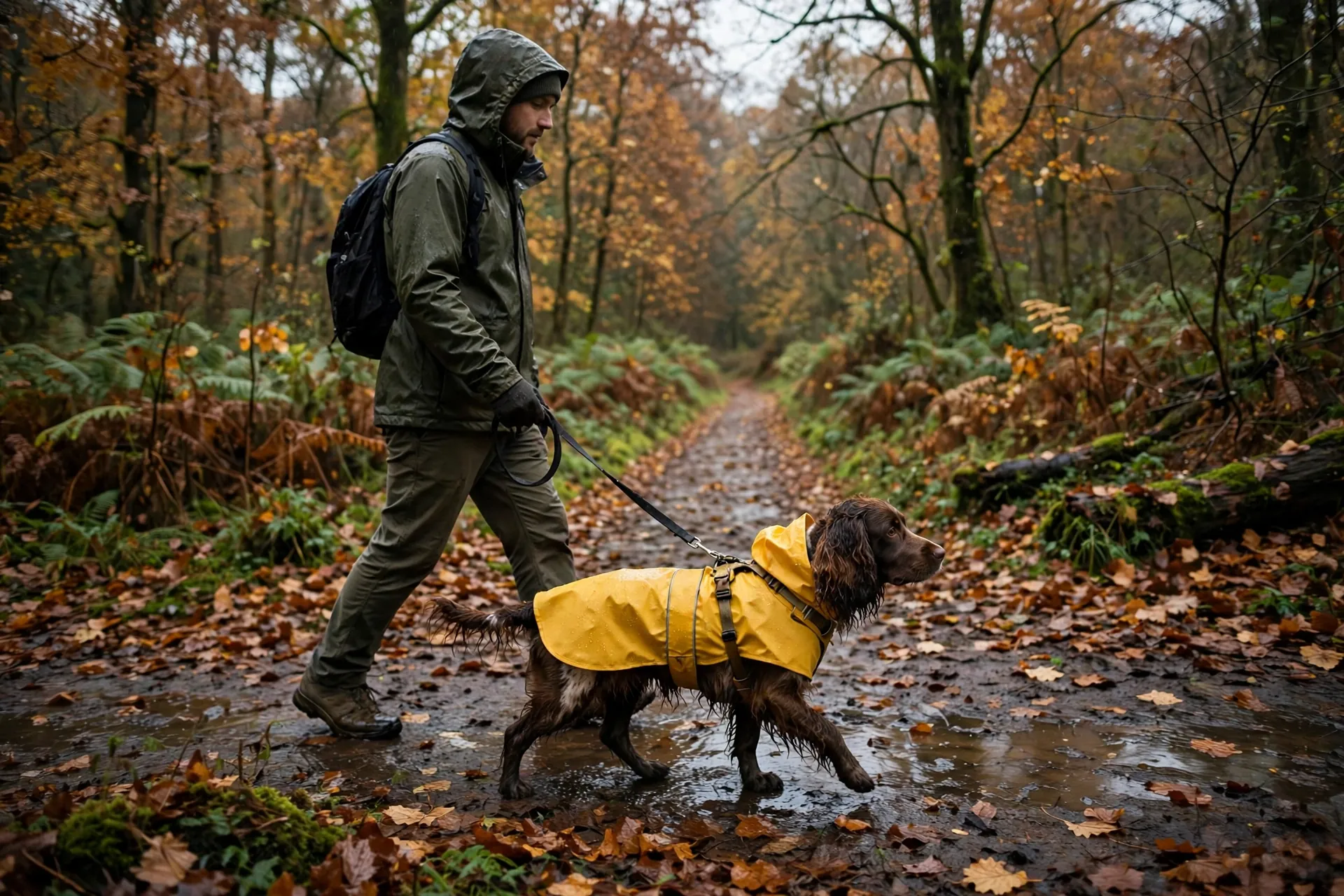
Autumn rain in Britain is rarely dramatic; it is persistent. A light drizzle that lasts four hours will soak a dog more thoroughly than a ten-minute downpour, and it will soak the owner too. The goal is not to keep the dog perfectly dry, which is impossible on a muddy woodland walk, but to keep the core warm, the belly protected, and the drying afterwards quick. That means a genuinely waterproof coat rather than a water-resistant fashion jacket, a lead that stays grippy when wet, and a plan for what happens at the door.
Test waterproofing before departure. Hold the coat under a tap for a minute, check whether water beads or soaks into the seams, and look at the belly panel after a wet walk at home. Sealed seams and a storm flap over the zip make a real difference in steady rain. For the owner, waterproof trousers matter more than a better jacket on many autumn walks, because sitting on wet ground, brushing against soaked bracken and kneeling to dry paws will soak ordinary trousers from the knees down. Walking boots with a waterproof membrane and a decent tread are essential on leaf-covered paths, which hide both mud and tree roots.
Carry a small wet-weather kit on the walk itself: a spare lead in case the first becomes a muddy rope, a dry towel in a waterproof bag, and a bottle of clean water for rinsing paws before the car. Dogs that swim in autumn need particular care: cold water, strong currents after rain and blue-green algae risks that persist into autumn all argue for keeping swimming short, supervised and close to the bank, and for drying and warming the dog immediately afterwards. If your dog is a keen swimmer, check the official guidance before you travel for any local water-quality warnings.
Back at the accommodation, waterproofing becomes a drying system. Ask where wet coats and towels can hang, whether there is a boot room or a porch, and whether the heating can dry a coat overnight. A dog that sleeps in a damp coat or on damp bedding will be colder and stiffer the next morning, so drying is not housekeeping fussiness; it is part of the warmth plan. Pack two sets of towels and two drying coats if space allows, and rotate them so one set is always dry.
3. Light: visibility after the clocks change
The end of October brings the clock change, and with it the sharpest single shift in a dog holiday all year. A walk that ended in daylight suddenly ends in darkness, and dogs that are perfectly visible on a beach at five o'clock become invisible on an unlit lane at half past five. Road safety, not wildlife or weather, is the main reason autumn walks need a light plan, because drivers do not expect a dog on a dark country road and cyclists on shared paths travel fast and quietly.
Build visibility in layers. A light attached to the harness or collar is the single most effective item, because it moves with the dog and is visible from all sides; a flashing mode is easier to spot than a steady one, but some dogs dislike flashing lights, so test both at home. Reflective trim on the coat or harness adds a second layer that shows up in headlights, and a light-coloured or hi-vis coat helps in the half-light of dusk when a torch beam has not yet become useful. The owner needs a torch too, not just for the path but to signal to drivers and to check what the dog is sniffing or picking up in the dark.
Change the route as well as the kit. Unlit field edges, fast country lanes and shared cycle paths are poor choices after dark, even with lights. Prefer lit pavements, parks with lighting, beach promenades and well-surfaced trails where you can see the ground ahead, and keep the dog on a lead near any road, however quiet it looks. Shorten the evening walk and move the longer walk to the middle of the day, when autumn light, low as it is, is at its best and the dog can run more freely. If you want a long evening walk, choose a route you have already walked in daylight so you know its gates, stiles and muddy patches.
Finally, check batteries and spares before the trip, and charge or replace lights the night before a long walk rather than discovering a dead light at the start of a dark lane. A spare light in the car, a spare set of batteries in the coat pocket, and a phone with charge for a torch backup turn a small failure into a non-event. Dogs that are nervous in the dark may also benefit from a familiar route and a calm, steady pace; darkness amplifies uncertainty, so keep the evening routine predictable and unhurried.
4. Mud: door routines that save the holiday
Mud is the autumn condition most likely to exhaust an owner, not because it is dangerous but because it is relentless. Leaf litter hides puddles, clay paths turn to paste after a day of rain, and a dog that has run through a ploughed field margin will bring half of it home. Without a door routine, every walk ends in a negotiation with the car boot, the hallway carpet and the bed, and the holiday slowly becomes a cleaning operation. With a routine, mud is a five-minute job.
Set the routine up on arrival, before the first muddy walk. Choose one door as the dog door, put a waterproof mat there, and lay out the drying kit where you will actually use it: towels within reach, a paw washer or a jug of clean water, a brush for dried mud, and a lidded bag or box for muddy leads and harnesses. If the accommodation has a porch, boot room or outdoor tap, use it as the drying station and keep the rest of the house mud-free by agreement, not by hope. Cars need the same thinking: a boot liner, a waterproof seat cover and a towel in the boot mean the drive home from a walk does not undo the drying you just did.
On the walk, choose ground that drains. Surfaced forestry tracks, coastal paths, park trails and gravel bridleways stay usable after rain, while riverside meadows, clay woodland and farm tracks can become impassable or deeply rutted. Ask locally which walks hold up best in a wet week; accommodation hosts and park staff answer this question constantly and their advice is rarely written down. After heavy rain, check river levels and path closures before setting out, and avoid fields with livestock that have churned the ground near gates, where mud is deepest and dogs are most likely to pick up something unpleasant.
Paw care belongs in the mud section because mud, grit and cold water all irritate paws. Rinse paws after every muddy walk, check between the toes for stones, grit and small cuts, and dry them thoroughly, especially in breeds with feathered feet where damp fur mats quickly. Trim excess fur between the pads before the trip if your groomer advises it, and consider a paw balm for cracked pads, applied at night so it absorbs rather than collecting grit on the walk. Dogs that limp, lick a paw persistently or refuse to walk after a muddy outing need a proper check, not another walk to test it.
5. Seasonal rule changes to re-check
Autumn is the season when rules change under you. Summer restrictions lift, winter hours begin, facilities close, and local conditions shift after storms. The five checks below are worth doing for every trip, because each one has ruined an otherwise good autumn break for someone who assumed the summer position still held.
First, beach rules. Many seasonal dog bans end in late September or at the start of October, but the date, the stretch of sand and the lead requirement all vary by council, and some beaches keep restrictions on specific sections year-round. Our guide to UK beach dog bans and the 2026 rules explains how the system works, but the council page for the exact beach is the final authority, and the signs on arrival override anything you read online. Second, attraction and accommodation hours: country houses, gardens, castles and cafés often switch to winter timetables in November, close on certain weekdays, or close their grounds earlier, so check opening days as well as opening times.
Third, countryside access and livestock. Autumn is a busy time on farms: tupping, harvesting, shooting and deer management all affect where dogs can go off lead, and some estates restrict access during shoots. Keep dogs on a lead near livestock at all times, follow local signs about shooting days, and remember that the right of access in Scotland and the public rights of way in England and Wales come with a responsibility to keep dogs under close control. Fourth, transport and parking: rural bus services may run a reduced winter timetable, car parks at popular walking spots may close earlier, and coastal car parks sometimes switch to winter charges or close gates at dusk. Fifth, accommodation rules themselves: some places that welcome dogs in summer restrict them to certain rooms in winter, or close dog-washing facilities, or change cleaning arrangements, so re-confirm the dog policy for your exact dates rather than relying on a summer listing.
One more seasonal change deserves a place of its own: hunting, shooting and fireworks calendars. Pheasant shooting runs through autumn, deer stalking is active in Scotland, and organised fireworks displays cluster around early November. None of these should stop a holiday, but all of them affect route choice, off-lead decisions and evening plans. A quick check of local event listings and estate notices before you travel will tell you which days to choose a woodland walk over an open moor, and which evenings to stay in.
The autumn beach bonus
For many dog owners, the single best reason to holiday in autumn is the beach. After months of summer bans, long stretches of sand reopen, and a beach that was a lead-only corridor in August can become a wide, empty playground in October. Dogs that have waited all summer for a proper run finally get one, and owners get the rare combination of space, scenery and a dog that sleeps soundly afterwards. It is worth planning a trip around this changeover, provided the changeover date is checked rather than assumed.
Autumn beaches need their own precautions, though. Tides are higher and more changeable, daylight is shorter, and a beach that feels empty at three o'clock can feel remote at five. Check tide times before a long beach walk, keep the dog in sight on a wide beach where other dogs may appear from a distance, and watch for hazards that summer visitors rarely meet: fishing lines and hooks washed ashore, dead seabirds, strong currents at river mouths after rain, and slippery seaweed on slipways. Cold water swimming should be short and supervised, and dogs should be rinsed and dried afterwards, especially if they have rolled in something unidentifiable, which autumn beaches seem to specialise in.
Facilities also thin out in autumn. Beach cafés close, toilets may be locked, and car parks may empty earlier, so carry water, a towel and a spare lead, and know where the nearest open café or pub is before you set out. The reward for this extra planning is a beach walk with almost no one else on it, which for a dog that is nervous around other dogs or children can be transformative. Autumn is often the season when reactive dogs get their best beach experiences of the year, simply because space makes everything easier.
Bonfire Night and fireworks noise
Bonfire Night, on 5 November, and the displays around it are the loudest challenge of the autumn calendar for dogs. Fireworks are not confined to one evening: organised displays, private garden fireworks and Diwali celebrations can stretch across late October and early November, and a dog holiday booked without checking local display dates can coincide with the noisiest week of the year. For a noise-sensitive dog, this is not a minor inconvenience; it can undo weeks of settled behaviour and make an otherwise lovely cottage feel unsafe.
Preparation starts before booking. Search local event listings for the area and dates, ask the accommodation host whether nearby venues host displays and how close the nearest one is, and favour accommodation set back from parks, sports grounds and large gardens where displays are likely. If your dog is severely noise-phobic, consider travelling in mid-October or late November instead, or choosing a remote rural stay where displays are fewer and further away. If you are already booked over fireworks season, plan the evenings as carefully as the walks: keep the dog indoors after dark, close curtains and windows, play steady background music or television, and create a den in an interior room away from windows, with familiar bedding and a long-lasting chew.
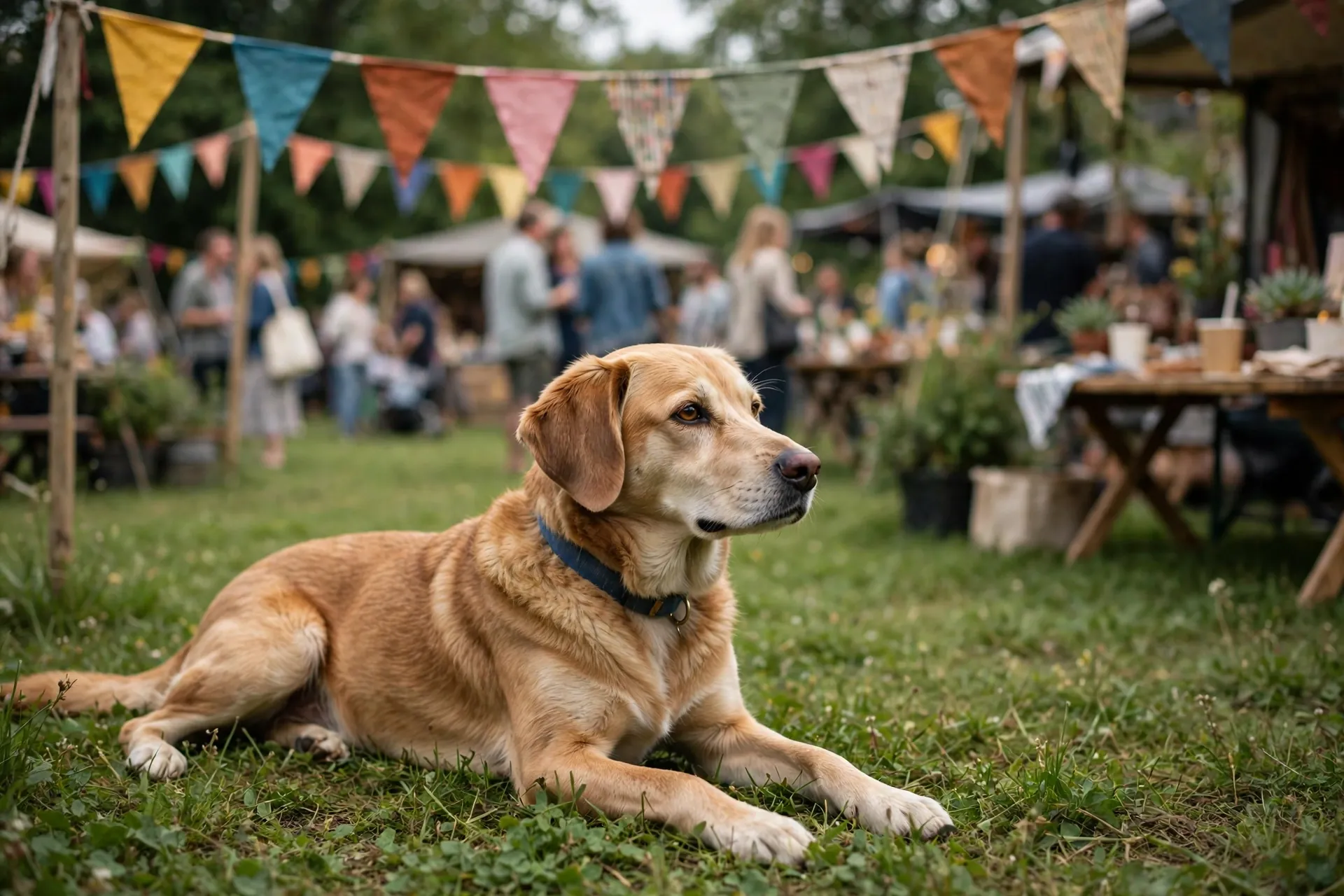
During a display, stay calm and stay with the dog if you can, but do not force comfort on a dog that wants to hide; a den the dog chooses is better than a lap the dog is held on. Keep the lead on for last toilet trips before dark, and avoid taking the dog out during a display unless absolutely necessary, because a panicked dog can slip a collar or bolt. For dogs with a known fireworks phobia, talk to your vet well before the trip about a behaviour plan and, where appropriate, medication; starting a new medication on the night itself is too late. Our guide to dog-friendly festivals, noise and crowds covers the same principles for noisy events generally, and the advice transfers directly: plan the exit, protect the ears and the nerves, and never assume a dog will simply get used to it.
The pack-once autumn kit list
A good autumn kit list is short enough to pack once and complete enough to cover a wet week. Start with the dog's walking kit: a waterproof coat, a drying coat or two large towels, a harness with a light, a reflective lead, a spare lead, a torch, a bottle of water and a collapsible bowl. Add the door kit: a waterproof mat, a paw washer or jug, a brush, a lidded bag for muddy gear, and a spare towel for the car. Add the sleeping kit: the dog's own bed or mat, a familiar blanket, and any medication in its original packaging with the vet's details.
Then add the autumn-specific items that summer packing omits. A hi-vis coat or a light for the dog, spare batteries, a waterproof bag for the phone and the car keys, waterproof trousers and boots for the owner, a spare set of clothes for the owner after a wet walk, and a small first-aid kit that includes tick removers, because ticks remain active in mild autumn weather. Include a copy of the dog's vaccination record and insurance details, the number of a vet near the accommodation, and a recent photograph of the dog in case they go missing on a dark walk. None of these items is expensive, but together they remove the small frictions that otherwise accumulate into a tiring trip.
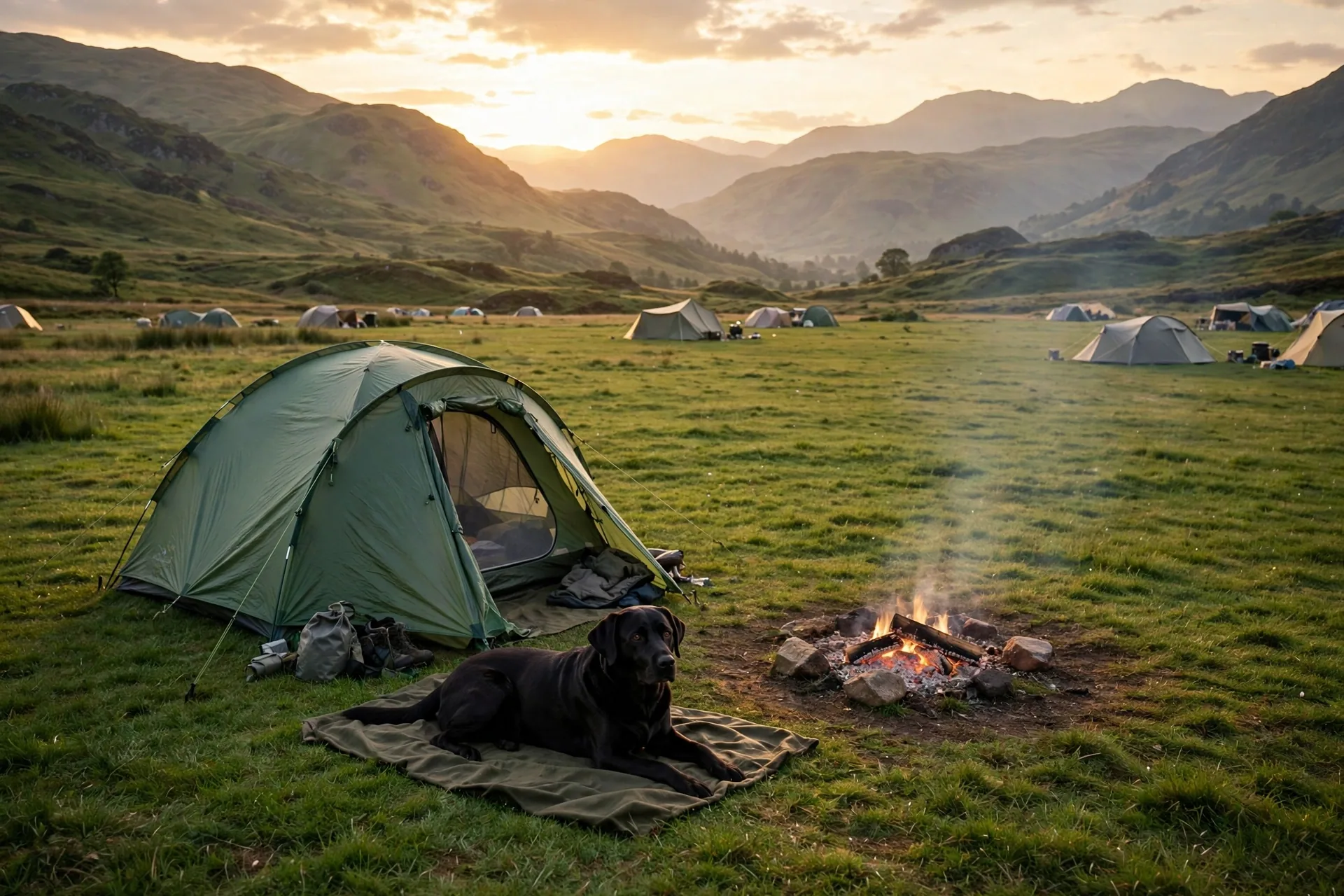
Pack for the car as a separate system. A boot liner, a waterproof cover for the back seat if the dog travels there, a towel, a bottle of water and a spare lead should live in the car for the whole trip, not in the accommodation. On wet days, the car is the drying room between walks, and a car that is prepared for mud stays pleasant for the drive home. If you are camping with a dog in the UK, the same kit applies with one addition: a way to dry the tent porch and the dog's sleeping area, because damp camping in autumn is miserable without a drying routine, and a wet dog in a small tent will chill fast overnight.
Finally, pack a wet-day backup that is not a walk. A long-lasting chew, a puzzle feeder, a snuffle mat and a few training games can fill a rainy afternoon indoors without the dog becoming restless. Autumn holidays involve more indoor time than summer ones, and a dog that is mentally tired is far easier to settle in the evening than a dog that has simply waited by the door all day. Plan one indoor activity per rainy day, and the weather stops dictating the mood of the trip.
Accommodation checks for cold, wet nights
Choosing autumn accommodation is less about the view and more about the evening. Ask how the heating works and whether it runs overnight, because a cottage that is warm at six o'clock and cold by midnight will unsettle both dog and owner. Ask whether the dog sleeps in the same room as you or in a separate utility space, and whether that space is heated and draught-free. Check the flooring: hard floors are easier to clean after muddy walks but colder and more slippery for older dogs, while carpet is warmer but harder to keep clean and may carry a stricter damage policy.
Drying space is the question most owners forget to ask. Is there a porch, boot room or utility area where a wet dog can be dried without soaking the living room? Is there an outdoor tap or a dog wash? Can coats and towels dry overnight near a radiator? Accommodation that answers these questions confidently has usually hosted many autumn dogs; accommodation that goes vague may expect you to improvise with one bath towel and a draughty hallway. Also ask about the after-dark toilet walk: how far is it, is it lit, is it enclosed, and does it involve a road crossing? A midnight toilet trip in rain, in the dark, across an unlit car park, is a very different proposition from the same trip in daylight.
Check the outdoor space with wet weather in mind. A garden that is lovely in July may be waterlogged in November, and a patio that drains well in summer may pool water after a week of rain. Ask whether the garden is enclosed, how high the fence is, and whether the gate fastens securely when the ground is soft. For dogs that need a quick toilet trip rather than a walk, a small enclosed area near the door is worth more than a large open garden at the end of a muddy path. Finally, re-confirm the dog rules for your exact dates: number of dogs allowed, pet fee, cleaning charge, and whether dogs are allowed on furniture or must stay on the floor, because winter terms sometimes differ from summer ones.
Car, train and wet-day travel
Autumn travel with a dog is mostly about wet journeys and short days. In the car, keep the dog secure with a harness, crate or guard, and protect the interior with a boot liner and a towel, because a wet dog on a long drive will steam up the windows and chill if the heating is not directed well. Stop every two hours on long journeys for a toilet break, water and a short walk, and choose stopping places with a lit, safe area rather than a dark layby. Never leave a dog alone in a car that is cooling down in cold weather for longer than a brief stop, and never leave a dog in a car that could overheat on an unseasonably warm autumn day, which still happens in early October.
On trains and buses, autumn brings wet coats, muddy paws and crowded carriages as commuters return after summer. Keep the dog on a lead, on the floor, and on a mat or blanket to protect both the seat and the dog from cold floors. Carry a towel for the journey, and be ready to dry the dog before boarding if the walk to the station was wet. Check the operator's dog policy before travelling, because some services restrict dogs at peak times or require them to be in a carrier, and a policy that was relaxed in summer may be enforced more strictly in autumn. For longer journeys, choose a daytime train where the dog can settle in daylight rather than a late service that arrives in darkness at an unfamiliar station.
Wet-day travel also means planning for disruption. Autumn storms can close roads, flood rural routes and delay trains, so check travel conditions on the morning of departure and keep an alternative route in mind. Pack food, water and medication in the car rather than in the boot under luggage, so a delay does not become a problem for the dog. If you are walking to a pub or attraction, check whether the route is passable after rain, and have a shorter alternative ready; a walk that is pleasant in dry weather can become a slog through standing water after a storm.
Health, paws and vet readiness
Autumn health risks are quieter than summer ones but no less real. Ticks remain active in mild weather, especially in bracken, long grass and woodland edges, so check the dog after every walk, remove ticks promptly with a tick remover, and keep flea and tick treatment up to date. Fallen conkers, acorns and mushrooms appear in autumn and can be toxic if eaten, so keep the dog from foraging in woodland and leaf litter, and know the signs of poisoning: vomiting, lethargy, drooling and collapse all need urgent veterinary attention. Standing water after rain can carry leptospirosis risk, so discourage drinking from puddles and slow-moving water, and keep vaccinations current.
Cold and damp also aggravate arthritis, and older dogs may need shorter, more frequent walks rather than one long outing, with a warm bed and a gentle warm-up afterwards. Dogs with heart or respiratory conditions may struggle in cold, damp air, so watch for coughing, reluctance to walk or unusual tiredness, and ask your vet before the trip if you are unsure about exercise limits. Puppies, meanwhile, need careful socialisation in autumn darkness and noise: short, positive exposures to rain, wind, lights and distant fireworks, paired with treats and calm handling, build confidence far better than a long, overwhelming outing.
Before departure, save the number and address of a vet near your accommodation, including an out-of-hours emergency vet, and note their opening times, because rural practices may close early or run reduced autumn hours. Carry the dog's medication, vaccination record and insurance details, and a note of any allergies or conditions, so a new vet can help quickly if needed. If your dog takes regular medication, pack extra doses in case of a delayed return, and keep medication in its original packaging. A small first-aid kit with tick removers, saline for rinsing eyes and wounds, bandages and a muzzle for a distressed dog in pain completes the preparation, and check the official guidance before you travel for any local disease alerts in the area you are visiting.
Practical questions
Before you go
Does my dog need a coat for an autumn holiday in the UK?
Not every dog does. Short-coated, lean, very young, elderly and arthritic dogs usually benefit most, especially in wind and steady rain. Judge by shivering, reluctance to walk and how long the coat takes to dry, and choose a coat that covers the chest and belly without restricting the shoulders.
Are dogs allowed on more beaches in autumn?
Often yes, because many seasonal bans end in late September or at the start of October, but the end date and the exact stretch of sand vary by council. Check the council page for the beach you plan to visit before you travel, and look for the current signs on arrival.
What should I pack for muddy autumn walks?
Pack a drying coat or two large towels, a paw washer or a bottle of clean water, a waterproof mat for the car, a lidded bag for muddy leads, and a spare lead. A quick rinse and dry at the door keeps cars, floors and bedding usable for the rest of the trip.
How do I keep my dog visible on dark autumn walks?
Use a light on the harness or collar, reflective trim on the coat, and a torch for yourself, and keep the dog on a lead near roads, cycle paths and unlit field edges. Test lights before the trip and carry spare batteries.
How should I prepare a noise-sensitive dog for Bonfire Night?
Book accommodation away from known display sites where possible, keep the dog indoors after dark, close curtains, play steady background sound, and provide a familiar den and a long-lasting chew. If fireworks distress is severe, ask your vet well before the trip about a behaviour and medication plan.
Do autumn holidays need different accommodation checks?
Yes. Ask about heating, draughts, drying space, hard floors versus carpet, enclosed outdoor space in wet weather, and how far the after-dark toilet walk is. A place that works in July can feel very different on a cold, wet November evening.