This guide is independent and contains no paid placement. If affiliate links are added later, they will be clearly marked and will not change our editorial checks.
Dunvegan works best as a three-part day: castle grounds and gardens in the morning, Coral Beach in the afternoon, and a seal boat trip when the tide and the weather suit. Keep your dog on a lead in the grounds, near livestock and cliff edges, and around the harbour; check the official guidance before you travel for castle access, boat rules and tide times.
Castle, loch and seals in one day
Few places on the Isle of Skye pack so much variety into such a small area as Dunvegan. The castle sits on a rocky outcrop above Loch Dunvegan, its gardens run down towards the water, and a short drive away a white beach made of crushed coral faces open sea. Out on the loch, seals haul out on low rocks and watch the boats go by. A dog can be part of all three experiences, provided the day is planned around the rules that protect the castle, the wildlife and the livestock.
The combination is what makes Dunvegan different from the better-known Skye viewpoints. At the Old Man of Storr or the Quiraing, the day is mostly about one dramatic walk and one crowded car park. In Dunvegan, the pace is slower and the variety is wider: a formal garden walk, a wild beach walk, and time on the water, all within a few miles. That suits dogs that enjoy sniffing and exploring but tire of long, exposed hill climbs, and it suits owners who want a full day without driving all over the island.
Start by thinking of the day in three blocks rather than one long outing. The castle grounds are best in the morning, when the light is soft over the loch and the gardens are quieter. Coral Beach is an afternoon walk, when you have time to take the rough path slowly and let the dog paddle. The seal trip depends on the tide and the operator's timetable, so it may sit at the start or the end of the day rather than neatly in the middle. Building the plan around the boat time, and fitting the castle and the beach around it, avoids the most common mistake: arriving at the harbour to find the next sailing is hours away.
Dunvegan is a village, not a resort, and that is part of its charm and part of the planning challenge. Facilities are limited, opening hours are seasonal, and the weather can change the day completely. A wet morning that rules out the beach may still suit the castle gardens, and a calm evening may be perfect for the loch even after a grey afternoon. Keep the three parts flexible, carry the right kit, and let the tide table and the sky decide the order.
This guide covers the practical detail: how to get there, what dogs can and cannot do at the castle, how to walk to Coral Beach safely, how seal trips work, where to park, where to eat, where to stay, and what to pack. Where a rule, price or timetable may have changed, the guide says so plainly and asks you to check the official guidance before you travel.
Getting to Dunvegan
Dunvegan sits on the west coast of the Isle of Skye, roughly 35 miles from the Skye Bridge at Kyle of Lochalsh and about 25 miles from Portree, the island's main town. The drive from Portree takes around 45 minutes to an hour on single-carriageway roads, some of them single-track with passing places once you leave the main routes. Allow extra time in summer, when caravans, campervans and slow-moving traffic are common, and when every viewpoint seems to have a queue of cars pulling in and out.
Most visitors reach Skye by car over the Skye Bridge, which is free to cross, or by ferry from Mallaig to Armadale in the south of the island. The ferry is a useful option if you are travelling up the west coast of the mainland, but it needs booking in advance in summer and adds a long drive north to Dunvegan afterwards. Our wider Isle of Skye with a dog guide covers the bridge, the ferries, single-track driving and the island's main routes in more detail, and it is worth reading before a first Skye trip.
Public transport to Dunvegan is limited. Buses run from Portree, but services are infrequent, especially outside the summer season, and they do not reach Coral Beach or the Claigan car park. A car is effectively essential for a Dunvegan dog day, not only for reaching the village but for the short drives between the castle, the village and the beach walk start. If you are travelling without a car, base yourself in Portree and book a tour or a taxi, and treat Coral Beach as a separate, longer walk rather than a quick stop.
Driving on Skye with a dog needs a little forethought. Keep the dog secure in the car, with a harness, crate or guard, and stop for a toilet break before the single-track sections. Sheep wander onto the roads here, especially at dawn and dusk, so drive slowly and be ready to stop. Passing places are for letting traffic through, not for parking, and blocking one while you take a photograph is the fastest way to annoy everyone behind you. Fill up with fuel in Portree or Broadford before heading west, because Dunvegan has limited fuel options and the next filling station may be further than you expect.
Arrive with a plan for the dog's first outing. After a long drive, most dogs need a short, boring toilet walk before anything else. The castle car park and the village green are not the place for an excited off-lead run after hours in the car. Walk the dog on a lead around the village first, offer water, and let them settle before the castle gardens or the beach path. A calm start makes the rest of the day easier for everyone.
Dunvegan Castle and Gardens with a dog
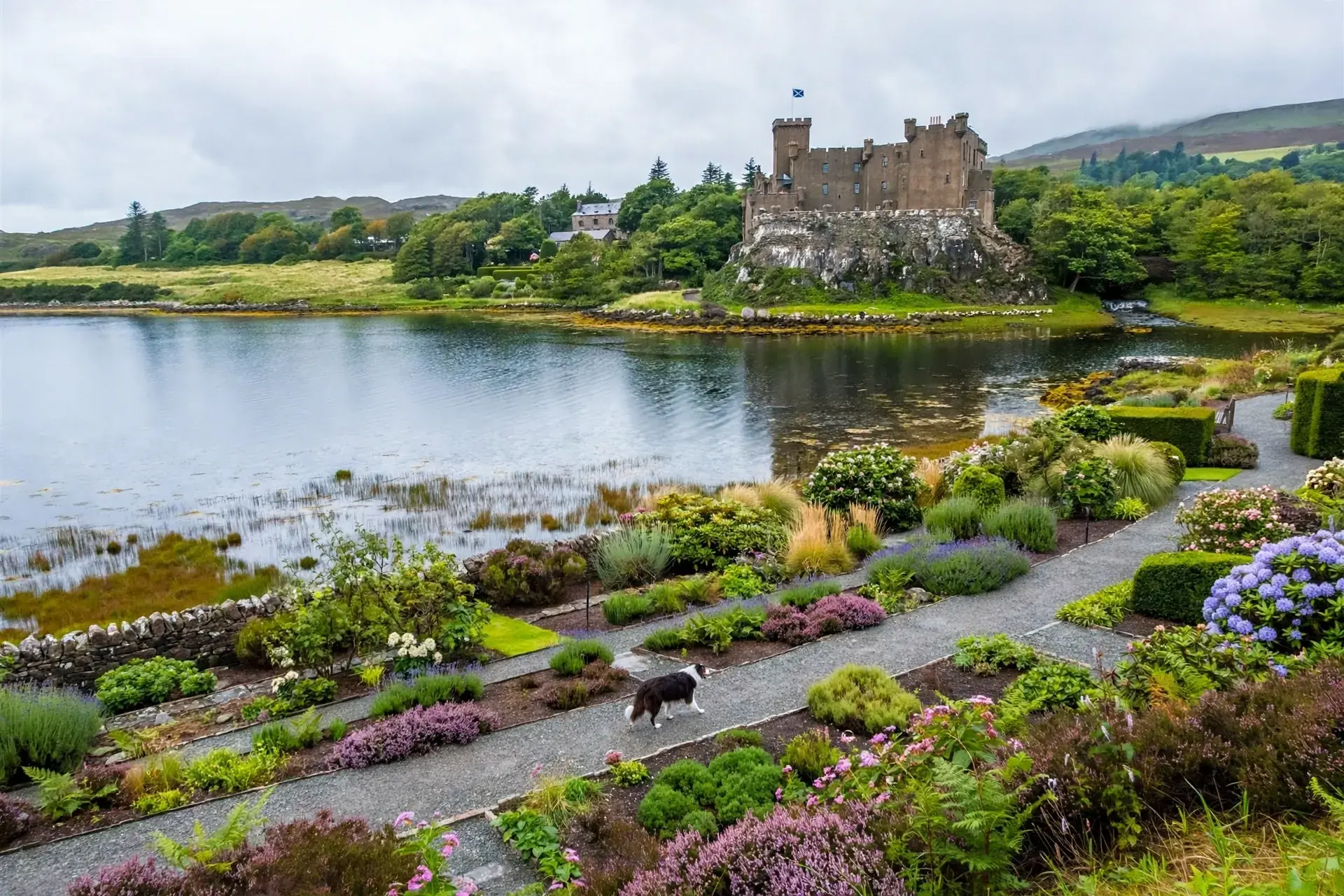
Dunvegan Castle is the ancestral home of the chiefs of Clan MacLeod and has been occupied by the same family for centuries, which makes it one of the oldest continuously inhabited castles in Scotland. It stands on a rocky promontory above Loch Dunvegan, with formal gardens, woodland walks and views across the water to the MacLeod's Tables, two flat-topped hills that dominate the skyline. For a dog owner, the interest is not only the building but the setting: the gardens and the lochside paths are the parts of the visit where a dog can genuinely share the day.
Dogs are generally welcome in the castle grounds and gardens on a lead, but they are not normally allowed inside the castle building itself. That distinction matters, because it shapes how a group should plan. If you are travelling as a pair, take turns: one person visits the interior while the other walks the dog through the gardens, then swap. If you are travelling alone with a dog, plan the visit as a grounds-only day and enjoy the gardens, the woodland and the loch views rather than the rooms inside. Check the official guidance before you travel, because access rules, opening dates and ticket arrangements can change by season.
The gardens are the highlight for most dog owners. They are formal in places, with flower beds, lawns and specimen trees, and wilder in others, with woodland paths and water features. Keep your dog on a lead throughout, stay on the paths, and do not let the dog dig, paddle in ornamental ponds or chase the birds that live in the grounds. The gardens are a managed landscape, not a dog park, and the staff who maintain them notice damage quickly. A short lead and a calm dog will get a warmer welcome than a long line trailing through a flower bed.
Allow at least an hour for the grounds, and longer if you want to walk the woodland paths properly. The ground is uneven in places, with steps, slopes and gravel paths, so sturdy footwear helps and a dog that pulls will make the walk harder than it needs to be. Bring water for the dog, because there may be no convenient tap once you are inside the grounds, and carry bags for waste. There are bins in the grounds, but do not assume one will be beside every path.
The castle also runs boat trips to the seal colony, which are covered in detail below, and the harbour area below the castle is part of the same visit for many people. If you are combining the castle with a boat trip, check the boat times before you pay for castle entry, so the two fit together. A morning in the gardens followed by a midday sailing is a natural pairing, with lunch in the village afterwards.
Photographs are part of the pleasure here, but keep the dog's welfare first. The lochside walls and the rocky outcrop are not safe places for a dog to scramble, and a dog that leans over a wall to look at the water can slip. Keep the dog back from unguarded edges, use a short lead near drops, and do not lift a dog onto a wall for a photograph. The best pictures here are taken from the paths, with the castle and the loch behind the dog, not from the edge.
Coral Beach: the walk and the shore
Coral Beach, near Claigan a few miles north of Dunvegan village, is one of Skye's most surprising places. The sand is not the usual golden or grey of a Scottish beach but a pale, almost white crushed coral, made from the skeletons of tiny sea creatures, and on a sunny day the water looks turquoise against it. The effect is startling after the dark moorland of the drive there, and it is the reason so many visitors make the walk. For dogs, it is a beach of two halves: a rough, uneven walk to get there, and then open sand and shallow water to enjoy.
The walk starts at the car park at Claigan. From there, a path of roughly a mile leads across moorland and rough grass to the shore. Most people allow 30 to 45 minutes each way, depending on pace, stops and how much the dog wants to sniff every tuft of grass. The path is not surfaced, and it can be boggy and muddy after rain, with uneven ground, small streams and rocky sections. Wear waterproof walking boots with good grip, and expect your dog to come back muddy even on a dry day. This is not a pushchair walk, and it is not a good choice for a dog that struggles with uneven ground or a long walk without a firm surface.
Keep your dog on a lead for much of the path. The route crosses grazing land, and sheep are often nearby. The Scottish Outdoor Access Code gives a right of responsible access, but it also expects dogs to be under control around livestock, and a dog that chases sheep can cause serious harm and legal trouble. There are also cliff edges and drops near the shore, and ground-nesting birds in the summer months. A long line gives the dog some freedom without losing control, but reel it in near livestock, other walkers and the cliff edge.
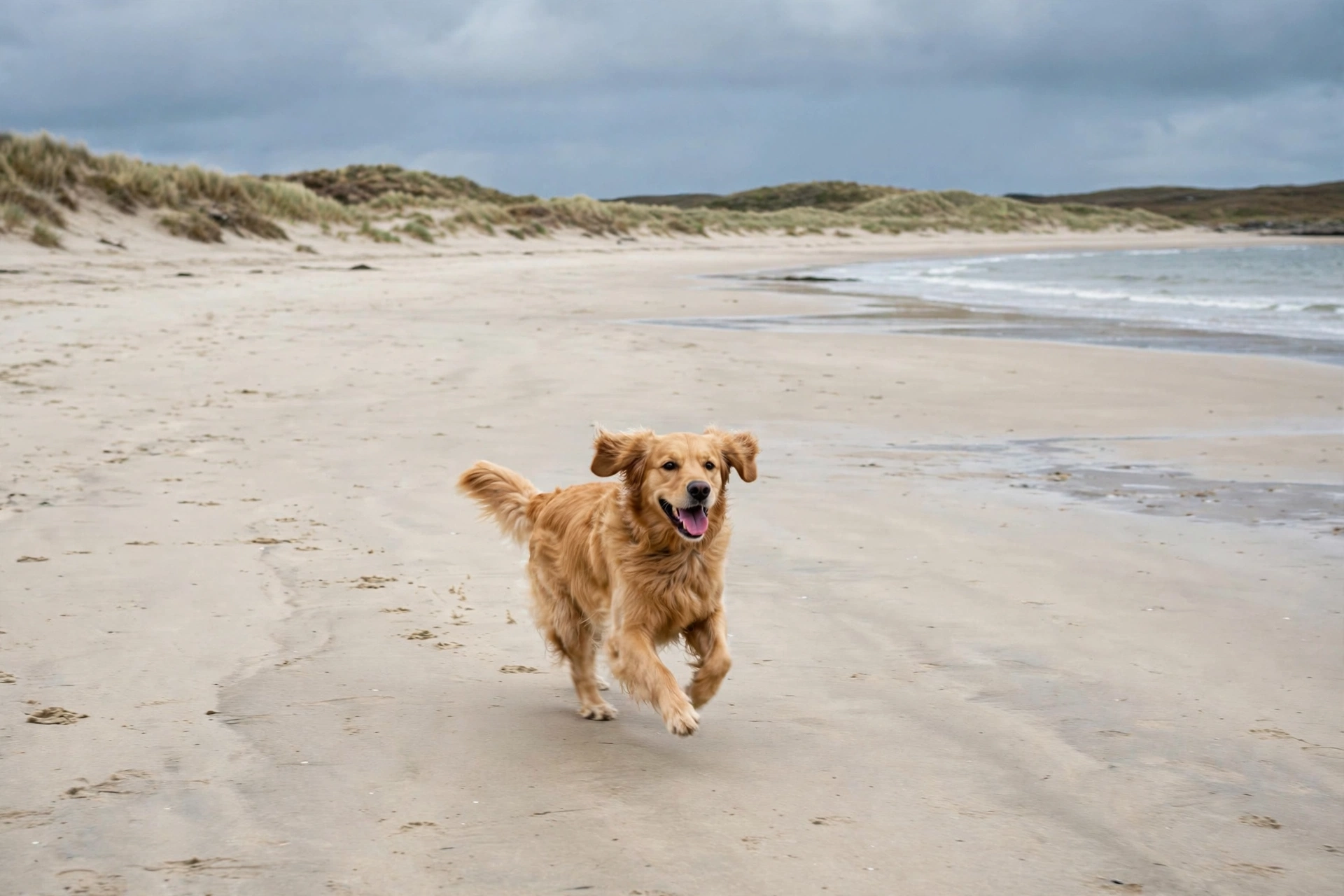
Once you reach the beach, the mood changes. The sand is firm in places and soft in others, the water is shallow for a long way out at low tide, and there is space to spread out even on a busy day. Many dogs paddle and swim here, and the sheltered bay looks inviting, but there is no lifeguard and conditions change with the tide and the wind. Check the tide times before you go, keep your dog in sight, and do not let a dog swim far out, chase boats or follow a ball into deep water. The tide comes in around the headlands, so note your route back and do not get cut off while you are distracted.
Coral Beach is not a beach with facilities. There are no toilets, no cafe and no shop at the shore, and the nearest facilities are back at Claigan or in Dunvegan village. Bring everything you need: water and a bowl for the dog, a towel, a lead, waste bags, sun protection for yourself on a bright day, and a waterproof layer for the changeable weather. Pack out everything you bring in, including dog waste, because there are limited bins and the beach is a fragile environment.
Our wider guide to dog-friendly beaches in Scotland covers tides, wildlife, seasonal rules and a beach-day kit in more detail, and the advice there applies directly to Coral Beach. The key points are the same: respect the tide, respect the wildlife, keep the dog under control, and leave the beach as you found it. Coral Beach rewards a slow visit. Sit on the sand, let the dog paddle, watch the light change on the water, and walk back unhurried. Rushing the walk to tick it off misses the point of the place.
Seal boat trips from Dunvegan
The seal colony on Loch Dunvegan is one of the island's most reliable wildlife experiences. Common seals haul out on low rocky islets in the loch, and boat trips from below the castle take visitors close enough to watch them without disturbing them. The boats are small, the trips are short, usually around 25 to 30 minutes, and the loch is sheltered, which makes this a good first boat trip for people who are unsure about open water. For a dog owner, the question is not whether the seals are worth seeing but whether the dog can come along, and the answer depends on the operator.
Some boat operators welcome well-behaved dogs on seal trips, while others do not, and places for dogs may be limited even when dogs are allowed. The only reliable approach is to ask the operator directly before you book, tell them your dog's size, age and temperament, and ask about the boarding arrangements, the seating and what happens if the dog becomes distressed. Check the official guidance before you travel, because operators, timetables and dog policies can change between seasons. Do not assume that a dog-friendly castle means a dog-friendly boat, or that one operator's policy applies to another.
If your dog can go on the boat, prepare carefully. Bring a lead, a towel for the dog to sit on, water and a bowl, and a familiar blanket if the dog settles better on something that smells of home. Keep the dog on a lead throughout, keep them seated or lying down, and do not let them lean over the side or bark at the seals. A dog that barks at wildlife will spoil the trip for everyone on board and may distress the seals, so be honest about your dog before you book. If your dog is nervous on boats, noisy in new places, or likely to try to jump, leave the boat trip for another visit and enjoy the seals from the shore instead.
If dogs are not accepted on the boat, the trip still works as a turn-taking activity. One person sails while the other stays ashore with the dog, walking the lochside paths or sitting in the gardens, then you swap on the next sailing if times allow. This is a common arrangement in Dunvegan, and it is better than leaving a dog in a car or a hot cottage while you sail. Never leave a dog in a parked car, even for a short boat trip, and never tie a dog up unattended outside the harbour.
Seals are wild animals, and the boat operators work to strict approach distances. Do not encourage the boat to go closer, do not shout or wave at the seals, and do not let your dog bark at them. The best seal watching is quiet seal watching: the seals stay relaxed, the boat stays at a respectful distance, and everyone gets a better view. Bring binoculars if you have them, because the seals are often more interesting through lenses than from the boat alone, and a camera with a zoom lens will serve you better than a phone held at arm's length.
Book the boat trip early in the day if you can, and check the weather. Trips are weather-dependent, and a windy morning can mean cancellations or a choppy crossing even on a sheltered loch. If your sailing is cancelled, treat it as a reason to spend longer at the castle or the beach rather than a ruined day. The seals will still be there tomorrow, and a calm loch on a still evening is often a better time to see them than a windy midday sailing.
Dunvegan village: food, toilets and parking
Dunvegan village is small, and its facilities reflect that. There is a hotel and restaurant, a cafe or two depending on the season, a small shop, a petrol station and public toilets, but opening hours are seasonal and places can be busy at lunchtime in summer. Do not arrive expecting a high street of options. Arrive expecting a handful of good places that reward planning, and you will enjoy the village far more.
Parking is the first practical question. There is parking near the castle and in the village, and a separate car park at Claigan for the Coral Beach walk. Both fill up on fine summer days, so arrive early, especially if you want to combine the castle and the beach in one day. Check the signs for charges and time limits, and do not park on verges, in passing places or across field gates. Rural parking that blocks a gate or a passing place causes real problems for farmers and other drivers, and it is the kind of behaviour that makes villages less welcoming to visitors.
Eating out with a dog in Dunvegan needs the same approach as elsewhere in rural Scotland: ask before you assume. Some places welcome dogs in a bar area or on an outdoor terrace, others welcome dogs only outside, and some do not accept dogs indoors at all. Policies can change between lunch and dinner, and between the bar and the restaurant in the same building. Ask when you arrive, keep the dog on a lead and settled under the table, and bring a mat for the dog to lie on. A dog that barks, begs or wanders between tables will not be welcome back, however friendly the staff are at first.
If you prefer to eat outdoors, the village green and the lochside are pleasant picnic spots on a calm day, provided you keep the dog under control and clear up afterwards. Bring a picnic from Portree or from the village shop, and carry water for the dog. The shop stocks basics, but it is not a supermarket, so buy specialist dog food, treats and any medication before you leave Portree or Broadford. The same applies to fuel, cash and phone signal: check you have what you need before you head west, because the village has limited options if you run out.
Toilets are available in the village, but they are not beside every car park or path. Use the facilities in the village before the Coral Beach walk, because there are no toilets at Claigan or on the beach. Carry hand sanitiser and tissues, and carry waste bags for the dog at all times. The village is a working community, not a theme park, and keeping it clean is part of being a welcome visitor.
Mobile signal in and around Dunvegan can be patchy, especially on the walk to Coral Beach and on the loch. Download maps, tide times and the castle and boat information before you leave Portree, and do not rely on a live signal to check a timetable at the harbour. A paper map or a downloaded offline map is worth carrying on Skye, where signal disappears in glens and behind hills without warning.
More walks around Dunvegan
Coral Beach is the headline walk, but it is not the only one. The area around Dunvegan has woodland paths, lochside strolls and longer hill routes, and the right choice depends on your dog's fitness, the weather and how much time you have. A short lochside walk after lunch suits an older dog; a longer moorland walk suits a fit dog that still has energy after the beach.
The castle woodland and garden paths are the gentlest option, with surfaced or well-trodden ground, shade on a hot day and shelter on a windy one. They are ideal for a first walk of the day or a last walk before the drive home. Keep the dog on a lead, stay on the paths, and watch for other visitors, especially children and people who may be nervous around dogs. The gardens are a shared space, and a dog that runs through a flower bed will not be forgotten.
For a longer walk, the coast and moorland north of Dunvegan offer open ground, sea views and a sense of space that the village itself does not. These routes are rougher, with boggy ground, uneven paths and livestock, and they need proper footwear, a map and a charged phone. Do not set off on a long moorland walk late in the day, in poor visibility or without telling someone your route. The weather on Skye can close in quickly, and a dog that is tired and wet on a remote path is a problem that is easy to avoid with a little planning.
Water is a recurring theme on Skye walks. Streams and burns are common, and many dogs will drink from them, but standing water and slow-moving pools can carry risks, especially after heavy rain or in warm weather. Carry fresh water for the dog and encourage the dog to drink from your bottle or bowl rather than from every puddle. Check the dog's paws after a long walk on rough ground, and look for cuts, thorns or salt irritation after the beach.
Wildlife is another reason to keep the dog under control. Seals are the famous attraction, but the area also has otters, seabirds, deer and sheep, and ground-nesting birds in the summer. A dog that chases wildlife can disturb a seal colony, flush nesting birds or scatter sheep, and the damage is not always visible at the time. Keep the dog close, recall promptly, and use a lead whenever you are unsure what is over the next rise.
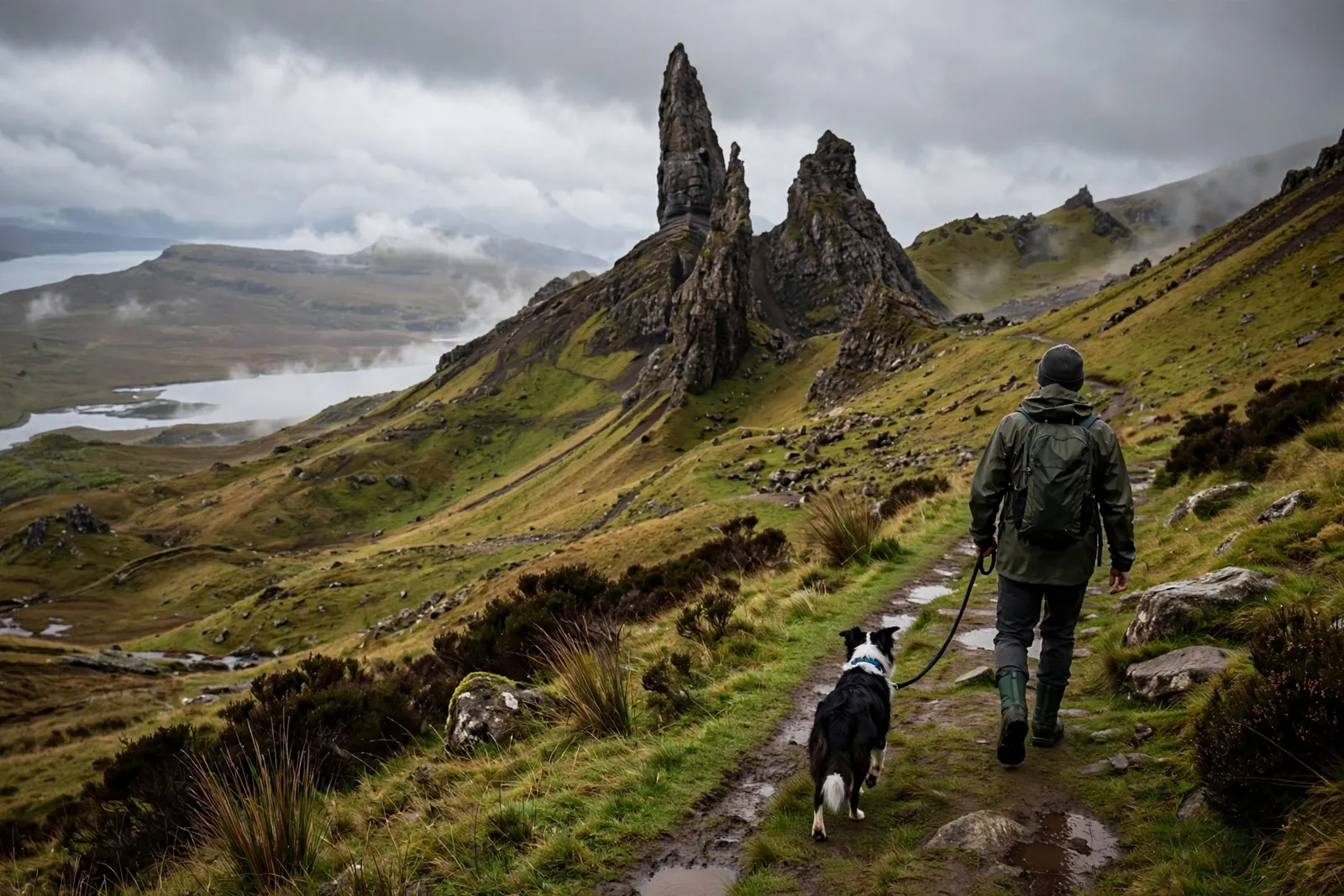
If you want more ideas for the rest of Skye, the island's other walks are very different from Dunvegan's gentle lochside. The Fairy Pools, the Old Man of Storr and the Quiraing are all busier, steeper and more exposed, and they need a separate day and a separate plan. Dunvegan is the place to slow down, not the place to rush between viewpoints. Give it a full day, and let the other Skye walks wait for their own day.
Where to stay nearby
Staying in or near Dunvegan makes the three-part day far easier than driving in from Portree and back. A base in the village means an early start at the castle, a relaxed walk to Coral Beach, and no long drive home with a tired, sandy dog. Accommodation in Dunvegan itself is limited, however, and the best places book up months ahead for summer, so plan early and be flexible about dates.
Options include the village hotel, bed and breakfasts, self-catering cottages and campsites, with more choice in Portree and in the wider north-west of Skye. Each suits a different kind of dog owner. A hotel is convenient for meals and for a short stay, but check the dog policy carefully: some hotels accept dogs only in certain rooms, charge a pet fee, or restrict dogs from the restaurant and lounge. A self-catering cottage gives the dog more space and a private garden, but check the garden fencing, the rules about leaving the dog alone, and the cleaning expectations before you book.
Our guide to dog-friendly hotels in the UK covers the questions worth asking before you book a hotel with a dog: room type, pet fees, dining rules, alone-time policy and the confirmation to get in writing. The same questions apply in Dunvegan, where a small hotel may have only one or two dog-friendly rooms and a cottage owner may have specific rules about muddy paws and wet dogs.
Book the accommodation before you book the boat trip, not the other way round. The boat trip can be rearranged if the weather changes, but a dog-friendly bed on a summer weekend cannot. Ask about the check-in time, the parking, the nearest toilet walk after dark, and the drying facilities for a wet dog. A cottage with a boot room, an outdoor tap and a tumble dryer is worth more after Coral Beach than a prettier cottage without them.
Camping and campervanning are popular on Skye, but they need extra care with a dog. The island has limited formal campsites, and wild camping with a dog needs to follow the Scottish Outdoor Access Code, respect livestock and leave no trace. Do not camp on the beach, in the castle grounds or in a car park, and do not leave a dog unattended in a tent or a campervan. If you are using a campervan, check where overnight parking is permitted and where waste can be disposed of, because the island's facilities are stretched in summer.
Whatever you book, confirm the dog policy in writing before you pay. Get the pet fee, the number of dogs allowed, the room or unit type, and any restrictions on leaving the dog alone, all in the same confirmation email. A verbal promise at booking is hard to prove if the policy changes before arrival, and a written confirmation protects both you and the host. Arrive with the dog's bed, food, water bowl and a familiar blanket, and set up the dog's sleeping area first, before you unpack your own bags.
Weather, tides and midges
Skye weather is famously changeable, and Dunvegan is no exception. A sunny morning can turn to rain by lunchtime, and a windy afternoon can calm to a still evening. The forecast is a guide, not a promise, and the best approach is to dress for four seasons, carry a waterproof layer even on a bright day, and be ready to change the order of the day if the weather changes.
Tides matter more here than in many British beach destinations, because Coral Beach and the seal colony are both tide-sensitive. At low tide, the beach is wide and the seals are visible on the rocks; at high tide, the beach narrows and the seals may be in the water. Check the tide times for Loch Dunvegan before you go, and plan the beach walk and the boat trip around them. A tide table app or a printed tide table from Portree is more reliable than a guess, and the harbour staff and the boat operators can advise on the best time to sail.
Wind affects the boat trips directly. A strong wind can cancel a sailing, even on a sheltered loch, and a choppy crossing is unpleasant for a nervous dog. If the forecast is windy, book the boat trip for the calmest part of the day, or accept that it may not run and enjoy the castle and the beach instead. The castle gardens are sheltered in places, and the woodland paths offer protection from the wind, so a windy day is not a wasted day in Dunvegan.
Midges are the island's most famous small problem, and they are worst from June to August, especially in still, damp conditions at dawn and dusk. The castle gardens, the woodland and the walk to Coral Beach can all be midge country, and a dog will attract them too. Bring midge repellent for yourself, consider a light covering for the dog's ears and belly if your dog is sensitive, and plan the beach walk for a breezy part of the day when midges are less active. A windy day that is bad for the boat may be a good day for the beach, because the wind keeps the midges away.
Sun protection is easy to forget in Scotland, but the light on the white sand at Coral Beach is strong on a sunny day, and the reflection from the water increases the exposure. Wear sunscreen and a hat, and offer the dog shade and water. Dogs can overheat even in cool Scottish weather if they run on sand in the sun, so watch for heavy panting, seek shade, and wet the dog's coat with fresh water if they seem hot. Never leave a dog in a car, even on a cloudy day, because the temperature inside rises quickly.
Winter in Dunvegan is quieter and wilder, with shorter days, stronger winds and fewer facilities open. The castle and the boat trips are seasonal, so check the official guidance before you travel in winter, and do not assume summer opening hours apply. A winter visit can be beautiful, with empty paths and dramatic light, but it needs warmer clothing, a shorter day plan and a base with heating and drying facilities. The beach walk in winter is a serious undertaking, not a casual stroll, and the path can be very boggy and exposed.
Packing list for a Dunvegan dog day
A Dunvegan dog day needs more kit than a village walk at home, because the day combines gardens, a beach, a boat and a rough moorland path. Pack the night before, and check the list before you leave your accommodation. The items below are the ones that make the difference between a comfortable day and a day spent improvising.
- Lead and long line: a short lead for the castle, the village and the harbour, and a long line for the beach path and the open sand. A harness that fits well is better than a collar for a dog that pulls on rough ground.
- Water and bowl: fresh water for the dog and a collapsible bowl, plus extra water for rinsing paws and sandy fur. Do not rely on streams or the sea for drinking water.
- Towels: at least two towels, one for the beach and one for the car, plus a drying coat if your dog wears one. A wet, sandy dog in a car is a problem that a towel solves cheaply.
- Waste bags: more than you think you need, plus a sealed bag or container for carrying full bags back to a bin. There are limited bins at Coral Beach, so be prepared to carry waste out.
- Footwear and layers: waterproof walking boots with grip, a waterproof jacket, a warm layer, a hat and sunscreen. The weather can change four times in a day, and the beach path is no place for trainers.
- Food and treats: the dog's normal food, treats for recall and settling, and a chew or a lick mat for the time you spend in a cafe or waiting for a boat. Do not change the dog's food on a travel day.
- First aid and medication: any regular medication, a basic first-aid kit, tick remover and a towel for checking paws. Know the location of the nearest vet before you need it, and save the number in your phone.
- Maps and tide times: a downloaded offline map, the tide times for Loch Dunvegan, and the castle and boat times saved offline. Do not rely on mobile signal at Claigan or on the loch.
Before you leave, run through the dog's welfare checks. Is the dog fit for a mile each way on rough ground, plus a garden walk and possibly a boat trip? An older dog, a puppy or a dog recovering from illness may need a shorter day: the castle gardens only, or the beach walk without the boat, rather than all three. Watch the dog during the day for tiredness, limping, overheating or distress, and be ready to cut the day short. A dog that is happy at lunchtime but exhausted by three o'clock has had enough, and the drive home will be easier if you stop while the dog is still enjoying it.
After the day, the routine matters as much as the packing. Rinse salt and sand from the dog's coat and paws, check between the toes for grit, dry the dog thoroughly, and offer fresh water and a normal meal. Check for ticks after the moorland walk, and look for any cuts from the rough path. A dog that has had a big day needs a quiet evening, a familiar bed and a normal routine, not another outing. Dunvegan is a place to return to, not a place to exhaust in a single day.
Practical questions
Before you go
Can dogs go into Dunvegan Castle itself?
Dogs are generally welcome in the castle grounds and gardens on a lead, but they are not normally allowed inside the castle building itself. Plan for one person to stay outside with the dog while the other visits the interior, or visit the grounds only and save the interior for another trip. Check the official guidance before you travel, because rules can change by season.
Is Coral Beach safe for dogs to swim?
Many dogs paddle and swim at Coral Beach, and the shallow, sheltered water looks inviting, but there is no lifeguard and conditions change with the tide and wind. Keep your dog in sight, check the tide times before you go, and do not let a dog swim far out or chase boats. Rinse salt and sand off afterwards and offer fresh drinking water.
Can dogs go on the seal boat trips from Dunvegan?
Some boat operators welcome well-behaved dogs on seal trips, while others do not, and places for dogs may be limited. Ask the operator directly before you book, tell them your dog's size and temperament, and bring a lead, a towel and water. If dogs are not accepted on the boat, the trip still works as a turn-taking activity with one person staying ashore with the dog.
How long is the walk to Coral Beach?
The walk from the nearest car park at Claigan to Coral Beach is roughly a mile each way across rough, uneven ground, and most people allow 30 to 45 minutes each way depending on pace and stops. The path is not surfaced and can be boggy after rain, so wear sturdy footwear and keep dogs on a lead near livestock and cliff edges.
Do I need to keep my dog on a lead around Dunvegan?
Yes, in most of the places that matter here. Use a lead in the castle grounds and gardens, on the Coral Beach path, near livestock and cliff edges, and around the harbour and boat area. There are open stretches where a reliable dog can run, but keep the lead ready and recall your dog promptly around sheep, seals, other walkers and nesting birds.
Where can I park in Dunvegan with a dog?
Dunvegan village has parking near the castle and the harbour area, and there is a separate car park at Claigan for the Coral Beach walk. Arrive early in summer, because both fill up on fine days. Never leave a dog in a parked car, even briefly, and check the official guidance before you travel for current charges and restrictions.