This guide is independent and contains no paid placement. If affiliate links are added later, they will be clearly marked and will not change our editorial checks.
Largs works brilliantly as a dog day out because everything is close together: the Viking Pencil monument at the south end of the promenade, the Cumbrae ferry slipway a short walk away, and a flat seafront path linking the two. Dogs can cross to Cumbrae on the ferry, walk the promenade on a lead, paddle on the shore at low tide, and join you at several dog-friendly cafes. Arrive by train from Glasgow in about an hour, or drive down the A78, and plan around ferry times and the tide.
Start at the Pencil: where Vikings and the ferry meet
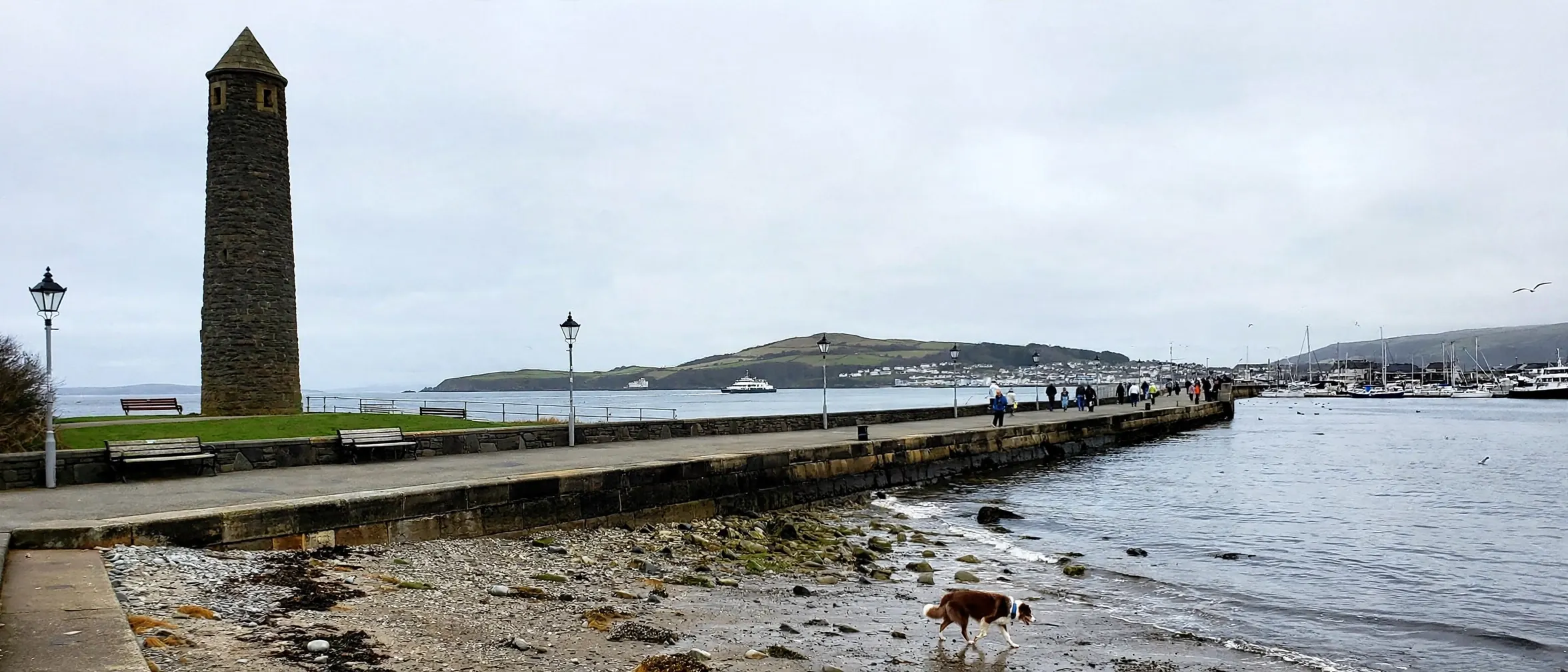
Stand at the southern end of the Largs promenade and you are looking at two stories at once. Behind you rises the Pencil, a tall, slim stone monument built in 1912 to mark the Battle of Largs of 1263, when a Norwegian fleet under King Haakon IV came ashore here and was fought off in a storm-battered encounter that helped end Norse rule over the Hebrides. In front of you, across a narrow stretch of the Firth of Clyde, sits the low green shape of the Isle of Cumbrae, and the ferry that crosses to it slides in and out of the slipway all day. It is the best place in town to begin, because it tells you what Largs is: a seaside town that has always faced the water, and a jumping-off point for somewhere else.
The monument itself is worth a slow look rather than a quick photograph. The Pencil is a tapering column of stone, deliberately plain, standing on a grassy mound above the shore. Information panels nearby explain the battle and the long Norse connection to this coast, and the setting does the rest: on a clear day you can see the water the longships crossed, the hills of Arran rising behind Cumbrae, and the yacht masts of the marina glittering in the marina basin. Dogs are welcome on a lead on the grass around the monument, and the open space is a good place to let a travel-stiff dog stretch its legs and sniff before you head into the busier part of town. Keep the lead on, because the road runs close by and the grass slopes down towards the shore.
The Pencil also anchors the town's Viking identity, which is worth knowing about before you visit. Largs holds a Viking Festival each year in early September, around the anniversary of the battle, with re-enactments, markets and living-history displays that fill the seafront. If you visit during the festival, expect crowds, music and considerably more dogs than usual, and plan your walks for early morning or late afternoon when the promenade is calmer. Outside festival week the monument area is quiet for much of the day, and it makes a calm first stop for a nervous dog that needs time to adjust to a new place before the smells and sounds of the pier.
From the Pencil, the geography of a Largs day out falls into place. The promenade runs north from here along the shore, past the marina, the ferry slipway and the pier, into the town centre and its cafes. The whole stretch is flat, which matters more than it sounds: older dogs, puppies, and owners pushing a dog buggy or carrying a small dog in a sling can manage it without the steep climbs that characterise so many Scottish coastal towns. You can treat the Pencil as your southern bookend, walk north as far as you like, and turn back whenever your dog tells you it has had enough.
One practical note before you set off: the grass around the monument can be boggy after rain, and the shore below it is rocky in places. If your dog loves to scramble down to the water, keep it on a lead until you reach the easier beach stretches further north. A towel in the car is worth having even on a dry day, because a dog that has found a rock pool will find a way to get wet, and the wind off the Clyde dries a coat slowly.
The Cumbrae ferry with a dog
The ferry is the reason many dog owners come to Largs, and it is simpler than it looks. Caledonian MacBrayne, known as CalMac, runs the crossing from the Largs slipway to Cumbrae Slip on the Isle of Cumbrae, a short hop of around ten minutes that carries cars, foot passengers and dogs. The crossing is frequent through the day, roughly every half hour in the busier months and less often in winter, so you rarely wait long — but do check the official guidance before you travel, because sailing times, timetables and dog rules can change with the season, the weather and the vessel in service.
Dogs travel on a lead and are welcome on the crossing. Foot passengers with dogs usually wait on the slipway, board with the other walk-on passengers, and stand on deck or sit in the passenger areas with the dog at their feet. The crossing is short enough that most dogs barely have time to get anxious, which makes it a good first ferry for a dog that has never been on a boat. Even so, a little preparation helps: exercise your dog on the promenade before boarding so it boards calm rather than fizzing, bring a familiar blanket or mat for the dog to lie on, and keep treats in a pocket for the moments when the engine note changes and the ramp clanks down.
Car drivers have a slightly different routine. You drive on at the slipway, park on the car deck as directed, and either stay with the car or go up to the passenger lounge, leaving the dog in the car only if it is genuinely settled there and the weather is safe — never in a hot car, and never for longer than the short crossing. Many owners with dogs prefer to travel as foot passengers precisely because it keeps the dog with them the whole time, and because parking on Cumbrae is straightforward. If you do take the car across, book ahead in the summer and at festival weekends, when the small ferry fills up and the queue on the Largs side can stretch back along the front.
Once you land on Cumbrae, the island is a dog walker's delight in miniature. Millport, the island's only town, sits a short walk from the slipway, and a mostly flat road loops around the whole island in about ten miles — too far to walk in full with most dogs, but perfect for cycling, and many visitors hire bikes in Millport, including tag-alongs and trailers that let a tired dog ride. The Garrison House grounds and the walks around the town are gentle and green, and the island's beaches, especially the sandy stretch at Millport Bay, are popular with dogs. Our guide to Arran with a dog covers the bigger island across the water and the ferry rhythm that island-hopping in this part of Scotland demands, if Cumbrae leaves you wanting more.
Plan the return with the same care as the outward trip. The last ferry back to Largs leaves earlier than many visitors expect, particularly in winter, and missing it means a long wait or a very expensive taxi via a different route. Check the return time when you arrive on Cumbrae, set a phone reminder for the sailing before the last one, and build in a buffer for a dog that dawdles on the way back to the slipway. The slipway on the Cumbrae side is exposed to the wind, so a waterproof coat for you and a drying coat for the dog make the wait comfortable rather than miserable.
Finally, remember that the ferry is a working crossing, not a tourist attraction, and it stops for weather. Strong winds on the Clyde can delay or cancel sailings, sometimes with little notice, so have a plan B for the day — the promenade, the Pencil and the town centre all make a fine day on their own — and check the official guidance before you travel on a blustery morning rather than discovering the cancellation at the slipway.
Walking the promenade
The promenade is the spine of a Largs visit, and it deserves to be walked slowly. It runs along the shore from the Pencil in the south to the town centre and beyond, a wide paved path with the sea on one side and a string of gardens, benches and cafes on the other. On a calm day the water is flat and the islands sit sharp against the sky; on a rough day the waves throw spray over the wall and the walk feels properly coastal. Either way, it is one of the most forgiving seafront walks in Scotland for dogs: flat, surfaced, with benches every few minutes and bins along the way.
Start at the Pencil and walk north with the sea on your right. The first stretch passes the marina, where yachts and small boats sit in rows and the smell of salt and diesel hangs in the air — interesting for dogs, but keep a short lead here, because the marina road carries traffic and the pontoons are not a place for a loose dog. Beyond the marina you reach the ferry slipway, the busiest point on the walk, where cars queue, passengers gather, and the ferry comes and goes with a rumble you can feel through your shoes. Some dogs love the bustle; others find the noise and the reversing vehicles stressful. If your dog is in the second group, cross to the garden side of the road for this stretch, or time your walk to avoid the busiest sailings.
Past the slipway, the promenade opens out again towards the pier and the town centre. This is the classic Largs scene: families with ice creams, dogs trotting beside pushchairs, the green bulk of Cumbrae across the water and Arran's hills behind it. The path is wide enough for two dogs to pass comfortably, and there are grassy patches where a dog can have a sniff and a rest. In summer, street performers and market stalls can appear near the pier, so be ready to give a busker's speaker or a food stall a wide berth if your dog is sound-sensitive.
How far you walk is up to your dog. The full promenade from the Pencil to the northern end of the front is roughly a couple of miles there and back, which suits a fit adult dog as a main walk. Older dogs and small breeds will be happier with a shorter out-and-back from the Pencil to the pier, perhaps twenty to thirty minutes each way, with a cafe stop in the middle. Puppies should do less: follow the usual guidance of short, frequent walks rather than one long march, and carry a puppy rather than letting it walk the whole front on a cold or wet day.
Water and shade are the two things to plan for. There is little natural shade on the promenade, so on a warm day a dog can overheat faster than you expect, especially a dark-coated or flat-faced breed. Walk in the morning or late afternoon in summer, carry water and a collapsible bowl, and use the shaded benches under the trees near the gardens for rests. In winter the problem reverses: the wind off the Clyde cuts straight through a thin coat, so a dog coat for short-coated breeds is sensible, and a warm car or cafe at the end of the walk is a kindness, not a luxury.
Lead etiquette on the promenade is simple but worth stating. Keep your dog on a lead throughout, because the road, the slipway, cyclists and other dogs are all close by. A long line is fine on the quieter southern stretch, but switch to a short lead near the pier, the slipway and any cafe seating. Pick up after your dog — bins are frequent, and this is a town that takes pride in its front. And if your dog is reactive, walk early: before nine in the morning the promenade belongs to dog walkers and joggers, and you can see other dogs coming from a long way off.
Beaches and paddling spots
Largs does not have one big sandy beach of the kind you find at Troon or Ayr. What it has instead is a varied shore that changes character with the tide: sand and shingle at low water, rock pools and seaweed at the edges, and a long stretch of pebbles and sand that appears and disappears through the day. For dogs this is often better than a single manicured beach, because there is always somewhere quiet to paddle, and the changing tide keeps the walk interesting from one visit to the next.
The most useful beach access is along the central and northern front, where steps and slipways lead down from the promenade to the shore. At low tide the sand widens considerably and dogs can run, dig and paddle in the shallows while you keep an eye on the incoming tide. At high tide the beach narrows to a strip of shingle, and the walk becomes more of a scramble than a run. Check the tide times before you go — a dog that loves the sand will be disappointed at high water, and a dog that dislikes wet paws will be happier on the promenade instead. Our guide to dog-friendly beaches in Scotland explains tide safety, wildlife and seasonal rules in more detail, and it is worth reading before any Scottish beach day.
Rock pools are the hidden pleasure of the Largs shore. At low tide the rocks south of the pier hold small pools full of crabs, winkles and seaweed, and most dogs find them irresistible. Let your dog investigate, but watch for sharp barnacles and broken shells, and rinse sandy paws before the drive home. Seaweed is the other thing to watch: some dogs eat it, and dried seaweed can swell in a dog's stomach, so discourage snacking and carry fresh water so a thirsty dog does not drink seawater. Salt water in quantity causes vomiting and diarrhoea, so a dog that has been gulping waves needs water and a rest in the shade.
Wildlife deserves a mention too. The Clyde around Largs is busy with seabirds, and in some seasons you may see seals hauled out on rocks or bobbing offshore, particularly around Cumbrae. A dog with a strong chase instinct needs a lead when birds are feeding on the shore, and a seal sighting is a moment to keep the dog close and quiet rather than letting it splash towards the animal. The same applies to the oystercatchers and gulls that work the low-tide shore: give them space, and your dog will learn that the beach is a place for sniffing, not chasing.
After the beach, the practical routine matters. There are public toilets and a few outdoor taps along the front, but do not rely on finding a dog wash, so bring your own water for rinsing sandy legs and a towel that you do not mind getting filthy. Sand gets everywhere — in ears, between toes, and in the car — so a quick brush-down on the promenade before you load up saves a lot of cleaning later. If your dog has sensitive skin, a rinse at home after a salty swim is a good idea, and check between the toes for small stones or shell fragments that can cause a limp the next day.
Eating and drinking with your dog
Largs is a proper seaside town, and eating out with a dog is part of the pleasure rather than a problem to solve. The main street and the front are lined with cafes, ice cream parlours, pubs and takeaways, and many of them welcome dogs — usually on the terrace in summer and in a designated indoor area when the weather turns. Policies change from place to place and from season to season, so the habit to build is a quick check at the door or a look at the sign outside rather than assuming every table is dog-friendly. Our guide to dog-friendly cafes in the UK covers the etiquette that makes these visits work, and the same principles apply here: a settled dog under the table, a lead clipped short, and a mat or blanket for the dog to lie on.
The most famous name on the front is Nardini's, the Art Deco ice cream parlour that has been a Largs institution for generations. Dogs are not generally invited into the main parlour, but the terrace and the takeaway side of the business make it easy to enjoy an ice cream with a dog at your feet, and the front is the natural place to eat one anyway. Order at the counter, find a bench or a terrace table, and let your dog settle while you eat — a frozen treat from the dog-friendly end of the menu, if one is offered, is a nice touch, but plain water and a biscuit from your pocket are just as welcome.
Beyond the headline names, the town centre has the usual seaside mix: cafes serving soup, sandwiches and home baking, pubs with real fires in winter, and fish and chip shops for a takeaway to eat on a bench. The best strategy is to walk the main street once, note which places have water bowls outside or a dog on the terrace already, and pick the one that suits your dog's temperament. A busy cafe with a narrow gap between tables is a poor choice for a large or wriggly dog, while a quiet corner table in a calm cafe can be a lovely rest after a long walk.
Picnics are the other option, and Largs suits them well. Buy sandwiches, sausage rolls and fruit from the town centre, then carry them to a bench on the promenade or a patch of grass near the Pencil, where your dog can lie beside you with a proper view. This is often the best choice for reactive dogs, for owners with two dogs, or for anyone whose dog has not yet learned to settle in a cafe. Pack a picnic blanket, a water bowl, and a chew to keep the dog occupied while you eat, and take all your litter home — the front is cleaned regularly, but a seaside town is only as tidy as its visitors.
One more eating note: the seafront attracts gulls that are bold enough to snatch food from a hand or a table, and a dog that lunges at gulls will cause a scene. Keep food close, keep the lead short, and do not leave a sandwich unattended on a bench while you take a photograph. It is a small thing, but it is the difference between a relaxed lunch and a stolen lunch.
Getting there and parking
Largs sits on the Ayrshire coast, roughly thirty miles south-west of Glasgow, and it is one of the easiest seaside towns in Scotland to reach without a car. Trains run from Glasgow Central to Largs station, which sits a short walk from the seafront, and the journey takes about an hour through the Clyde coast scenery. Dogs travel on the train, usually free of charge and on a lead, and the walk from the station to the Pencil is a gentle downhill stroll through the town centre. Check the official guidance before you travel, because train times and dog rules can change, and because a busy summer Saturday service is a different experience from a quiet weekday train.
By car, the A78 coast road brings you into Largs from the north, past the marina and along the front. The road is scenic but narrow in places, and on summer weekends and festival days the approach can be slow, so allow extra time and do not plan a tight ferry connection on a busy day. Car parking is available at several points along the front and in the town centre, including the large car park near the marina and smaller bays closer to the pier. Charges and time limits vary, so read the signs and pay at the machine or by phone as directed — and check the official guidance before you travel if you need a long stay, because a ticket that expires mid-walk is a needless worry.
Parking with a dog deserves a little thought in itself. Choose a space with shade in summer, or at least a spot where you can open the windows a crack and return quickly, and never leave a dog in a parked car on a warm day — the temperature inside a car climbs far faster than most people expect, and the Clyde sunshine is stronger than it looks. In winter, park close to the promenade so the walk from the car to the sea is short, and keep a towel and a dry coat in the boot for the return journey.
Cyclists and walkers have other options too. The Ayrshire Coastal Path passes through Largs, and walkers following it will find the town a natural stopping point with cafes, shops and a station for the journey home. If you arrive on foot with a dog, the promenade is your route through town, and the station, the ferry and the cafes are all within a few minutes of each other. The town is compact enough that, once you have parked or stepped off the train, you will not need the car again until you leave.
For visitors staying longer, Largs makes a good base for the Clyde coast. Ayr, Troon and Irvine are all within easy reach by train or by the A78, and the ferry to Cumbrae opens up the island for a day trip without a long drive. Dog-friendly accommodation in and around the town includes hotels, guest houses and self-catering cottages, and the usual advice applies: confirm the dog policy in writing before you book, ask about the number of dogs allowed and any extra charge, and check whether the property has a garden or a nearby toilet walk for last thing at night.
A relaxed day plan
A good Largs day with a dog does not need to be packed. The town rewards a slow pace, and the best plan is one with a morning walk, a ferry crossing, a long lunch, and an unhurried afternoon on the front. Here is a shape that works for most dogs, which you can stretch or shrink to fit your own.
Arrive mid-morning and head straight for the Pencil. Park near the south end of the front or walk down from the station, and give your dog ten unhurried minutes on the grass around the monument. Read the information panels, look across to Cumbrae, and let the dog take in the new smells before the busier part of the day. This is also the moment to check the ferry times on the board at the slipway, so you know which sailing you are aiming for and how long you have.
Walk north along the promenade to the pier, taking your time. Stop at the benches, let the dog paddle at the shore if the tide is right, and buy a coffee to carry. By late morning you should be at the slipway in good time for a midday ferry, with a calm dog that has already had a walk and a drink. Cross to Cumbrae, walk into Millport, and have lunch at a dog-friendly cafe or on a bench in the Garrison House grounds, then stroll the bay before catching an afternoon ferry back.
Back in Largs, the afternoon is for the town centre. Wander the main street, pick up an ice cream, and find a cafe terrace for a late-afternoon rest. If your dog still has energy, a second short walk along the southern promenade at golden hour is the loveliest part of the day: the light on the water, the islands turning blue, and the front quieting down as the day visitors leave. If your dog is tired, drive home content — a dog that sleeps all the way back to Glasgow has had a proper day out.
Two variations are worth knowing. If the weather turns, skip the ferry and spend the day on the promenade, the cafes and the town centre, with a visit to the local museum or the shops for shelter. If your dog is young, old, or not a keen walker, cut the Cumbrae leg entirely and make Largs itself the day: Pencil, promenade, beach, cafe, and home. The town is small enough that a half day here still feels complete, and a dog that is not over-tired is a dog that will want to come back.
Seasons, weather and tides
Largs is a year-round town, but it changes its character with the seasons, and the best time to visit depends on the dog you have. Spring is many owners' favourite: the days lengthen, the gorse and the gardens come into colour, the ferries run more often, and the promenade is busy enough to be lively without being crowded. The wind can still be sharp in March and April, so a coat for a short-coated dog is sensible, and the shore can be cold underfoot for a dog that likes to paddle.
Summer brings the full seaside atmosphere: ice creams, busy terraces, families on the beach, and the Viking Festival in early September, which is the town's biggest event and the one weekend when accommodation and ferry queues need real planning. The promenade is at its most crowded between eleven and three on a sunny Saturday, so walk early or late if your dog dislikes crowds, and carry water — the combination of sun, salt air and a dark coat can overheat a dog faster than a walk inland would. Check the official guidance before you travel during the festival, because road closures and event layouts can change the usual walking routes.
Autumn is the quiet season and, for many dog owners, the best of all. The crowds thin after the festival, the light turns golden, and the ferry and the promenade feel like they belong to the locals again. October half term brings a short burst of families, but the town absorbs them easily, and the beach at low tide is often empty. This is the season for long, slow walks and for dogs that prefer space to sociability.
Winter in Largs is bracing rather than brutal. The town rarely sees deep snow, but the wind off the Clyde can be fierce, and rain can arrive horizontally along the front. The payoff is a clear, empty promenade, dramatic skies, and a cafe with a fire at the end of the walk. Dress for it: a waterproof for you, a coat for the dog, and a plan to cut the walk short if the weather turns. The ferry runs through the winter, though less often, and sailings can be cancelled in a gale, so the habit of checking the official guidance before you travel matters most in these months.
Tides deserve a paragraph of their own, because they shape the beach more than the calendar does. At Largs the shore is at its widest and most dog-friendly for a couple of hours either side of low tide, and at its narrowest at high water. A tide timetable, freely available online, tells you which it will be, and a glance at it the night before saves a wasted trip to a beach that is mostly underwater. The same timetable tells you when the rock pools are exposed, which is the detail that turns a good beach walk into a great one for a curious dog.
Practical kit and local rules
Packing for Largs is packing for a Scottish seaside day, which means preparing for two seasons at once. The list is short, but every item on it earns its place. Bring a lead and a spare, a collapsible water bowl and a bottle of fresh water, poo bags and a small bag to carry them in, a towel, a drying coat or an old fleece for the journey home, and a few treats for recall and for settling in a cafe. A familiar blanket or mat helps a dog settle on a ferry and under a cafe table, and a chew or a stuffed Kong keeps a young dog occupied while you eat.
Lead rules are straightforward: dogs should be on a lead on the promenade, in the town centre, at the slipway and around the Pencil, and under close control on the beach. There is no vast off-lead area in the town itself, and the places where a dog can run free are the beach at low tide and the open ground on Cumbrae — always with a recall you trust and a lead in your pocket. The legal position is the usual Scottish one: owners are responsible for their dog's behaviour, and a dog that worries livestock or wildlife can create serious trouble, so keep the lead on anywhere near farmland on Cumbrae.
Health and safety are mostly common sense with a seaside twist. Rinse salt water off a dog that has been swimming, check paws for cuts from shells and barnacles, and watch for ticks in the longer grass around the Pencil and on Cumbrae, particularly in spring and summer. A dog that has eaten seaweed or drunk a lot of seawater needs fresh water and a quiet rest, and a vet visit if it vomits repeatedly. Know where the nearest vet is before you need one — ask at a cafe or check online in the morning, and save the number in your phone rather than trying to find it in a panic.
Finally, a word about being a good guest. Largs is a town where people live as well as holiday, and the promenade is their daily walk as much as it is your day out. Pick up after your dog, keep it off the flower beds and the children's play areas, give other dogs space unless their owner invites a greeting, and thank the cafe staff who bring a water bowl without being asked. The town welcomes dogs warmly, and the owners who are welcomed back are the ones who leave the front as tidy as they found it.
If Largs leaves you wanting more of this coast, the islands are the obvious next step. Cumbrae is the gentle introduction, Arran is the full day out, and the Clyde coast towns each have their own character — but Largs, with its Viking monument, its ten-minute ferry and its flat, forgiving promenade, is the easiest place to start, and the one most dogs will remember fondly.
Practical questions
Before you go
Can dogs travel on the Largs to Cumbrae ferry?
Yes, dogs can travel on the Largs to Cumbrae ferry. They travel on the car deck or in the passenger areas on a lead, and the crossing takes around ten minutes. Check the official guidance before you travel, because sailing times and dog rules can change with the season and the weather.
Is the Largs seafront promenade suitable for dogs?
Yes. The promenade is a flat, paved walk along the Firth of Clyde with wide views across to the Isle of Cumbrae. It suits dogs of most ages and abilities, including older dogs that cannot manage steep paths. Keep your dog on a lead near the road, the slipway and the ferry queue, and carry water on warm days because there is little shade.
Are dogs allowed on the beach at Largs?
Dogs are generally welcome on the shore at Largs, which is a mix of sand and shingle that appears more fully at low tide. There is no single year-round dog ban of the kind some resort beaches apply, but local rules and seasonal notices can change, so check the official guidance before you travel and keep your dog under control near other beach users.
Where can dogs go in Largs town centre?
Many cafes and pubs in Largs welcome dogs, usually on the terrace in summer and in a dog-friendly area indoors in colder months. Policies vary from place to place and can change, so check before you sit down. The main street is compact and easy to walk, and several shops keep a water bowl by the door.
Is the Viking Pencil area dog-friendly?
Yes. The Pencil monument stands on the seafront at the southern end of the promenade, and the grassy area around it is open to dogs on a lead. It is a good first stop: you can look across the water to Cumbrae, read the story of the Battle of Largs, and let your dog settle into the walk before the busier stretch by the pier.
What is the best time of year to visit Largs with a dog?
Spring and autumn are the easiest seasons: mild weather, quieter ferries and a calm promenade. Summer brings the liveliest atmosphere and the Viking Festival in early September, but also more people and dogs around the pier and the slipway. Winter is bracing and often beautifully clear, though wind off the Clyde can be sharp, so dress for it and plan shorter walks.