This guide is independent and contains no paid placement. If affiliate links are added later, they will be clearly marked and will not change our editorial checks.
An Isle of Arran with a dog trip works best at island pace. Sail from Ardrossan to Brodick (or via Lochranza from Claonaig in season), base in Brodick, Lamlash or Whiting Bay, and treat Goat Fell as a lower-path destination unless your dog is a proven hill dog. Beaches are generous, forests shelter wet days, deer and livestock demand lead discipline, and the island circuit is best driven slowly over days, not raced in one.
Beyond 'Scotland in miniature': what Arran really offers a dog
Arran is marketed as Scotland in miniature — Highlands in the north, Lowlands in the south, islands offshore, a distillery, a castle, standing stones — and the slogan, though true, encourages a frantic style of tourism: everything in two days, car doors slamming from dawn to dusk. Dogs experience that style as a series of interrupted naps and hurried verge stops. Offer your dog a different Arran: fewer places, longer stays in each, walks that begin from the door where possible, and a circuit of the island spread across the week like a slow meal rather than a tasting menu grabbed standing up.
Geography helps the slow plan. Arran is compact enough that no base is truly remote, yet varied enough that each coast feels distinct: the mountainous north around Brodick, Lochranza and Sannox; the gentler south with Lamlash, Whiting Bay and Kildonan; and the quieter west coast facing Kintyre, with its standing stones and long sunsets. A dog does not care about ticking off compass points, but it will notice — and enjoy — the rotation of beach, forest, farmland and shore path that a slow circuit naturally provides.
Start, as with any island, by respecting the crossing and the calendar. The main ferry from Ardrossan to Brodick takes under an hour, and a second route links Lochranza in the north with Claonaig on Kintyre in season, with winter arrangements differing. Check the latest official guidance before you travel for current routes, timetables and dog arrangements, and book vehicles early for summer weekends, when Arran fills with Glasgow and Ayrshire escaping to its nearest island.
Brodick and Lamlash: picking your side of the bay
Brodick is the arrival point and the practical hub: ferry pier, supermarkets, cafés, the island's main shops and the great sweep of Brodick Bay beneath Goat Fell. Staying here means a beach walk before breakfast and supplies without a drive. The bay's shore is a daily gift for dogs — a long, changing edge of sand, shingle and seaweed that rewards a lead-free run only where it is safe, away from the road that hugs the shore, and under close control around other users, horses that sometimes use the beach, and birds feeding at the tide line.
Lamlash, a few miles south across the bay from the Holy Isle, is the quieter alternative: a village green, a sheltered shore, cafés and pubs, and a contemplative view that slows people down whether they planned it or not. Whiting Bay, further south again, offers another long beach and a village feel. Choosing between them is mostly about evenings: Brodick for choice, Lamlash for calm, Whiting Bay for beach-from-the-door. In all three, ask accommodation the dog specifics — charges, enclosed outdoor space, dogs in eating areas, and the nearest after-dark walk that does not involve an unlit coast road.
Holy Isle itself, owned by a Buddhist community and reached by a small boat from Lamlash, is best treated as a people-only excursion unless the boat operator and the island's current guidance clearly say otherwise. Dogs and a contemplative retreat island with ponies, goats and strict quiet are a combination to verify carefully rather than assume; check the latest official guidance before you travel and be ready for the answer to be no, in which case a Lamlash shore day is a fine exchange.
Goat Fell with a dog: the lower paths are the prize
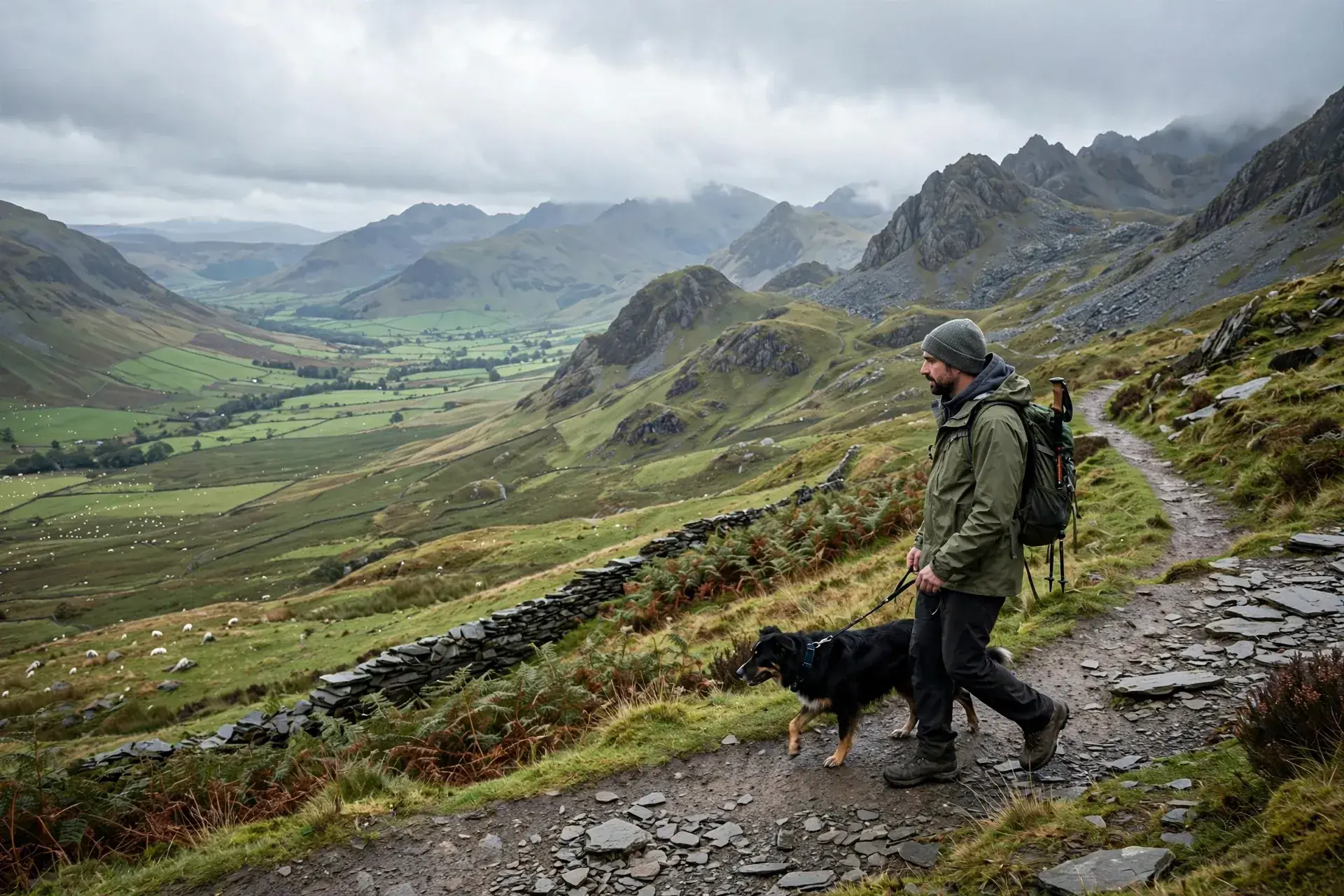
Goat Fell, at 874 metres the island's highest peak, dominates every view and every ambition. The main path from Brodick Castle's grounds climbs through woodland and onto open mountain, and in settled summer weather fit hill dogs do reach the summit with experienced owners. But the honest advice mirrors every serious hill: the summit is optional, conditional and frequently the wrong goal. Cloud sits on Goat Fell on days when the bay is bright, the upper mountain is exposed and rocky, and a dog that pulls on ascent will be a liability on the descent.
The lower mountain, by contrast, is unconditionally excellent. The woodland and riverside paths around Brodick Castle and Glen Rosa — the beautiful glacial valley running north-west from Brodick between the Goat Fell massif and lower hills — give hours of walking with mountain atmosphere and valley safety. Glen Rosa's path follows the Rosa Water beneath towering ridges, and you can turn at any point with honour intact. Our Snowdonia with a dog guide applies the same lower-paths-first thinking to Yr Wyddfa and is a useful companion read.
If you do attempt higher ground, apply the full hill protocol: mountain forecast checked twice, early start, harness and short lead, water carried rather than assumed, paw and energy checks at every stop, and a turn-round time agreed before you set off. Tell someone your plan, carry a map because signal fades in the glens, and remember that Brodick Mountain Rescue exists for emergencies, not for avoidable epics. The mountain will be there next visit; make sure the dog wants a next visit.
Beaches around the circuit: Sannox to Kildonan
Arran's coast road makes a natural beach circuit. In the north, Sannox Bay offers sand beneath steep hills and a famous glen behind it, while Corrie's harbour and shore are full of character and seals are often seen offshore — keep dogs from approaching any seal hauled out on rocks or sand. Lochranza, with its castle on a spit and deer grazing improbably on the shore and even the village green, demands particular lead discipline: the deer here are habituated to people and graze close, which is precisely why a dog must stay on a lead and calm.
The west coast turns its face to Kintyre and the evening sun. At Machrie, shore walks combine with the celebrated standing stones and chambered cairns on Machrie Moor, reached by a farm track where livestock rules apply strictly — dogs on leads, gates closed, stones admired with the dog beside you rather than climbing. Blackwaterfoot adds a harbour, a sandy stretch and the King's Cave coastal walk to the north, a dramatic shore of caves and arches where the path is rough in places and the sea deserves respect in swell.
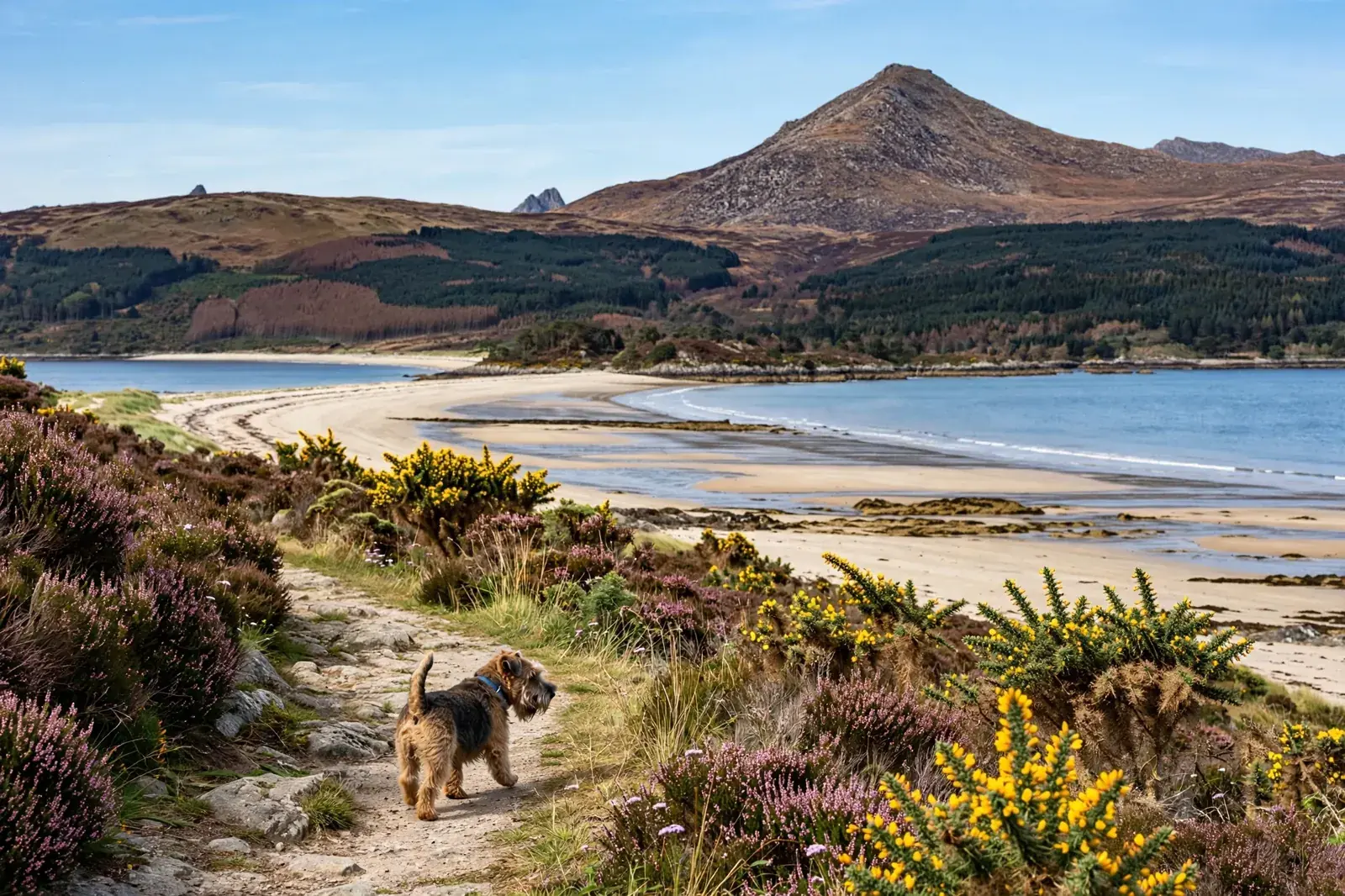
In the south, Kildonan beach looks across to Pladda island and Ailsa Craig, with seals frequently on the offshore rocks and a wide, gentle shore that suits older dogs and unhurried days. Silver sands, dune grass and big skies make this the island's lingering beach. Wherever you swim or paddle with a dog, think cold water, currents and jellyfish in season, rinse salt and sand from coats afterwards, and carry drinking water so the dog is not tempted by the sea. For ferry planning that underpins the whole circuit, revisit our dogs on UK ferries guide before booking multi-leg journeys.
Forests, gardens and wet-day Arran
Arran's forests rescue wet days and provide midge-free-ish shade on still summer ones — though nothing in Scotland promises midge-free. Around Brodick, the castle gardens and woodland trails combine formal gardens (where dog access is restricted to certain areas, typically on a lead — check current rules on arrival) with waymarked forest paths above the bay. The Merkland and other Forestry and Land Scotland woods near Brodick and Lamlash offer graded trails where a dog can enjoy scent-rich woodland without mountain exposure.
Further afield, the woodlands at King's Cross near Lamlash, the trails around Lochranza and the quiet forest roads of the south give variety through a week. Forestry operations move around the island, and paths close for felling without much notice to anyone who does not look: read the car park boards, obey closure signs with dogs especially, because machinery, timber stacks and frightened wildlife are a poor mixture, and check the latest official guidance before you travel if a particular trail is the centrepiece of a day.
Indoor Arran is largely a people-only pleasure — the heritage museum, distillery visitor experiences and craft shops each set their own dog rules, with assistance dogs distinct from pets throughout. Build wet days as a rhythm rather than a problem: a long forest walk in waterproofs, a café stop where dogs are welcomed in a bar or covered area, a harbour stroll between showers. Dogs are gloriously indifferent to rain if their owners are dressed for it and the walk ends with a towel, a warm room and a full bowl.
Eating, staying and the practical island week
Arran feeds dog owners well by island standards: pubs and hotel bars in Brodick, Lamlash, Lochranza and Blackwaterfoot, cafés with outdoor seating, bakeries and island produce shops, and a famous cluster of food producers around the island. Policies on dogs inside vary by room and by season, so ask when booking rather than at the door with a wet dog and a hopeful expression. The island's cheese, oatcakes and ice cream are for the human end of the lead; rich holiday scraps are a classic cause of island vet visits, so keep the dog's diet boringly consistent.
For stays, the island offers hotels, guesthouses, self-catering cottages, bunkhouses and campsites, many explicitly welcoming dogs. Campsite dog owners should confirm lead rules on site, exercise areas and whether dogs are charged, and should walk the boundary on arrival — coastal sites are glorious and breezy, and a tent is not a containment system. In any accommodation, bring the dog's own bedding, keep it off beds and furniture unless invited, and leave rooms as you would wish to find them: Arran's welcome for dogs rests on owners behaving well.
Veterinary cover exists on the island but with limited hours compared with a city; save the practice number, carry your own vet's details and your dog's medication in hand luggage quantities plus a buffer day, and note the mainland options near Ardrossan for the return. Ticks are a Scottish island constant in bracken and long grass — check coats nightly, remove ticks properly, and consider preventative treatment discussed with your vet before the trip. Our Isle of Wight with a dog guide offers a useful contrast in island scale if you are choosing between a first island trip and a bigger one.
A slow circuit: five days that fit a dog
Day one belongs to arrival: sail, settle, and walk Brodick Bay and the castle woodland paths without driving another mile. Day two goes north — Sannox Bay and glen in the morning, Corrie and Lochranza in the afternoon, watching deer from a lead's length and eating where the dog can join you. Day three is the mountain decision day: Glen Rosa deep into the valley, or higher on Goat Fell only if weather, fitness and the dog all agree, with the castle gardens as the graceful fallback.
Day four turns west: Machrie Moor's stones in the morning stillness, Blackwaterfoot and the King's Cave shore after lunch, and a sunset-facing picnic if the weather plays along. Day five drifts south to Lamlash, Whiting Bay and Kildonan, the gentlest shores for a last long walk, before an evening sailing or a final night and a morning boat. That pattern covers the island without a single day dominated by the car, and it leaves obvious returns — the east coast paths, a Lochranza-based stay, a winter visit — for next time.
However you arrange it, keep the island courtesies that keep Arran dog-friendly: leads around livestock and deer without exception, waste bagged and binned even on remote shores, gates closed, passing places kept clear, and gratitude expressed to the cafés and stays that welcome muddy paws. Islands notice their visitors. Visit like someone whose dog would be welcomed back, and it will be.
Arran with a senior dog, a puppy, or a second visit
Arran adapts gracefully to dogs at the ends of life. A senior dog that can no longer contemplate Glen Rosa in full can still own this island: Brodick Bay at low tide for a level amble, the castle woodland paths in short loops, Lamlash shore in the morning calm, and Kildonan's gentle sand with a picnic and a long, unhurried sit. Choose accommodation with step-free access and a garden the dog can reach without stairs, walk little and often rather than once and far, and let the island's scenery come to the dog — on Arran, unusually, it genuinely can, because so much of the view is available from shore level and village greens.
A puppy's first island is a different design again. Keep days short, protect sleep fiercely, and use Arran's variety as socialisation gold: harbour noises and ferry bustle in Brodick, calm deer-watching from a distance at Lochranza, new surfaces from sand to forest path to castle gravel, and cafés where a settled puppy under the table earns admiring comments. Carry the puppy when tired rather than pressing on, because growing joints do not care that the walk was almost finished, and build the ferry routine calmly — a puppy that learns boats are boring on Arran has learned a skill for every island after it.
And if this is a second or third visit, Arran rewards depth over novelty. Base in a different village, walk the coast path sections you previously drove past, visit in a different season — winter Arran, with woodsmoke, empty beaches and Goat Fell dusted in snow, is a local secret — and revisit your dog's favourite beach at a different tide. Islands are not destinations to complete; they are places to know. A dog that knows Arran has a geography of beloved smells to return to, which may be the best definition of a holiday home that exists.
Practical questions
Before you go
How do I get to Arran with a dog by ferry?
The main route sails from Ardrossan to Brodick in under an hour, with a seasonal northern route between Lochranza and Claonaig on Kintyre. Dogs travel on CalMac services under the operator's current arrangements, generally free. Book vehicles early in summer and check the latest official guidance before you travel for routes, timetables and where dogs may go on board.
Can my dog climb Goat Fell?
A fit, experienced hill dog can, in settled weather with a properly equipped owner, but most dogs are better served by the superb lower paths in Glen Rosa and around Brodick Castle. The summit involves exposed, rocky mountain ground. Check a mountain forecast, carry water, use a harness and short lead, and agree a turn-round time before starting.
Where do red deer affect dog walks on Arran?
Most famously at Lochranza, where deer graze on the shore and village green, but deer roam widely across the island, especially at dawn and dusk. Keep your dog on a lead wherever deer are present or likely, and give them a wide berth. Never allow a chase: it endangers the deer, your dog and other road users.
Which Arran beach is best for dogs?
Kildonan in the south is wide, gentle and good for unhurried days, while Brodick Bay gives a long daily walk from the town itself. Sannox suits walkers combining beach and glen. Keep dogs under control around other users and seals, use leads near livestock behind the beaches, and carry drinking water.
Is the Holy Isle suitable for a visit with a dog?
Treat it as a people-only excursion unless you have verified otherwise. The Holy Isle is a retreat island reached by boat from Lamlash, with its own community, livestock and quiet ethos. Check the latest official guidance before you travel, and plan a Lamlash shore day for the dog if dogs are not admitted.