This guide is independent and contains no paid placement. If affiliate links are added later, they will be clearly marked and will not change our editorial checks.
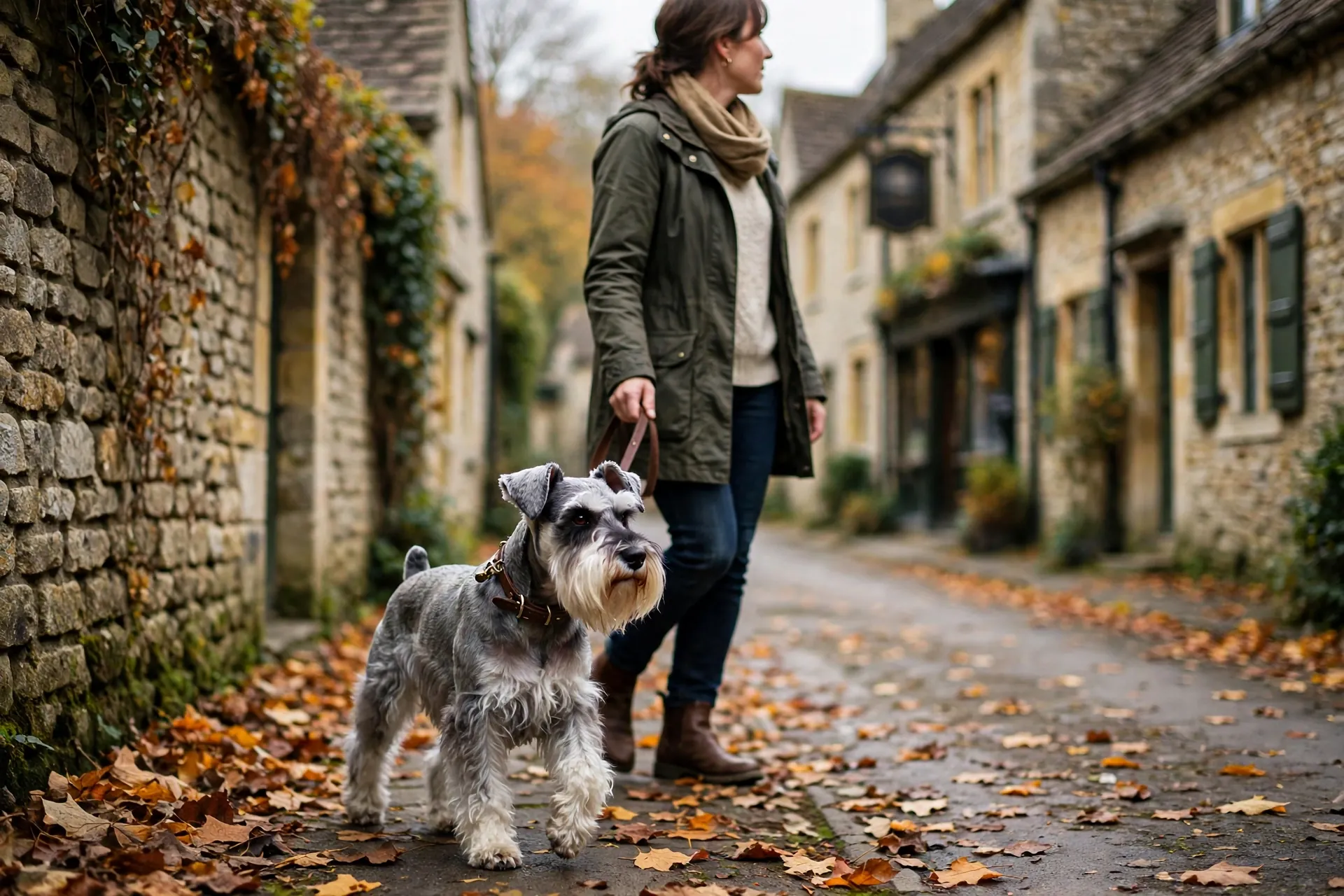
A Miniature Schnauzer travels brilliantly where a bigger dog causes friction: trains, pubs, small hotel rooms and narrow village lanes. The price of that portability is vigilance. Manage the barking, keep the beard and coat under control, and plan walks that suit short legs rather than marathon ambitions, and this small terrier becomes an outstanding travel companion.
The size advantage, honestly weighed
At roughly five to eight kilograms, a Miniature Schnauzer changes the logistics of a trip in ways that matter every single day. The dog fits in a soft carrier on a train, curls on a hotel bed without taking over the room, and can be lifted over a stile, carried across a busy road or tucked under a pub table without a negotiation. For travellers without a car, that portability is decisive: buses, trains and even crowded station concourses are all far simpler with a compact dog that can be held close when the crowd thickens. Owners who have travelled with both large and small breeds usually notice the difference most at the small friction points, the taxi that accepts one dog but not a large one, the cafe with one dog-friendly table that is really only big enough for a small dog, the cottage where the dog bed fits in the corner rather than the middle of the floor.
Small does not mean low-maintenance, and it does not mean fragile in the way people sometimes assume. Miniature Schnauzers are sturdy terriers with a strong sense of their own importance, and they can be surprisingly heavy to carry for long stretches despite their size. A dog that is carried everywhere also loses confidence on its own four feet, so use the lift as a tool for specific obstacles rather than a default mode of transport. The other honest trade-off is vulnerability around bigger dogs: a Schnauzer that charges up to a large dog on a narrow path is at real risk, and the owner of the small dog has to be the one who manages that meeting. Keep the lead short on blind corners, cross the road early when a large off-lead dog approaches, and never assume that a small dog will be forgiven for rude greetings simply because it is small. Size opens doors, but it does not excuse manners.
The beard and the wiry coat on the road
The Schnauzer beard is the breed's signature and the traveller's daily chore. After every meal, every drink and every wet walk, that beard collects water, food and mud, and a dog that looks smart in the morning can look bedraggled by lunchtime. The practical answer is a small beard towel kept in a pocket or day bag, used as a matter of routine rather than as an emergency measure. Wipe the beard after drinking, comb it out in the evening, and check for tangles behind the ears and in the armpits, where mats form quietly. A slicker brush and a metal comb are the two tools that matter; leave the full grooming kit at home and pack only what you will genuinely use each evening, because a travel bag full of unused grooming tools is dead weight.
Wiry coats have a second travel quirk: they shed less hair around a rental than a heavy-coated breed, but they pick up burrs, seeds and mud with enthusiasm. After a countryside walk, run your hands over the legs and belly before the dog jumps into the car, and carry a small comb for the burrs that a brush will not shift. Many owners keep the coat clipped short for travelling, which is a sensible compromise, though clipping changes the texture over time compared with hand-stripping, so discuss the choice with your groomer before the trip rather than improvising mid-holiday. If you are travelling in wet weather, a lightweight waterproof coat keeps the wiry coat from soaking through and shortens the drying routine at the end of the day. Whatever you do, never leave a wet Schnauzer to dry in a cold car or draughty porch: small dogs lose heat faster than large ones, and a chilled, damp dog is a miserable travelling companion.
Barking: the make-or-break issue
Miniature Schnauzers were bred as watchdogs and ratters, and most of them take that job seriously. A stranger at the cottage door, a footstep in the hotel corridor, a dog passing the window of a holiday let: all of these can trigger a volley of sharp barking that is entirely normal for the breed and entirely unwelcome at seven in the morning in a quiet hotel. This is the single issue that most often cuts a Schnauzer trip short, and it is worth more planning than any other part of this guide. The foundation is laid long before departure, with short, rewarded practice at settling while everyday noises happen around the house. A dog that has only ever lived in a quiet home will find a hotel corridor overwhelming, so practise in busier settings gradually, starting with a friend's house and building up to a dog-friendly cafe at a quiet hour.
On the trip itself, manage the environment before you manage the dog. Ask for a room away from lifts, stairwells and the main corridor, and at the end of a corridor rather than beside it, where every passer-by becomes a trigger. Tire the dog properly before check-in with a real walk, not a ten-minute toilet break, and give the dog a long-lasting chew or a stuffed food toy on arrival so the new room is associated with something calm. If you need to leave the dog, keep absences short, build them up over the trip, and never leave a dog that you know will bark for an hour: a single complaint can end a stay, and a dog that barks itself hoarse is not enjoying the holiday either. When in doubt, take the dog with you. A Schnauzer that settles under a pub table is far less trouble than a Schnauzer left barking in a room, and most of the UK's dog-friendly hospitality exists precisely for that choice.
Walking range and little legs
Healthy adult Miniature Schnauzers are far sturdier walkers than their size suggests, and most will happily cover five to eight kilometres of varied ground in a day, including gentle hills and woodland paths. The mistake is to plan by distance alone. Short legs work harder on steep, rocky or deeply muddy ground, and a route that is easy for a spaniel can be exhausting for a Schnauzer on a hot day or on a long climb. Plan routes with options: a circular walk with a short cut back to the car, a village walk that can be extended along a canal towpath, or a coastal path with a cafe stop halfway. Build the distance up over the first days of a trip rather than attempting the longest walk on day one, and include a rest day after any genuinely long outing, especially for older dogs.
Watch the dog rather than the map. A Schnauzer that starts lagging, seeking shade, lying down or hesitating at stiles is telling you the walk is long enough, and pushing on for the sake of the route is how sore paws and exhausted dogs happen. In summer, pavements and sand can burn small paws quickly, so test surfaces with your own hand and walk in the cooler hours. In winter, short legs mean the belly and legs spend more time in wet grass and slush, so a waterproof coat and a drying routine matter more than they do for a taller dog. Carry water on every walk, even short ones, because small dogs dehydrate faster than their owners expect, and a collapsible bowl weighs almost nothing. The best Schnauzer walks in Britain are not the most dramatic ones: they are the village-to-village lanes, the canal towpaths, the woodland loops with a pub at the end, where the dog can trot, sniff and meet people without being ground down by distance.
Pubs, cafes and settling under tables
Miniature Schnauzers are natural pub dogs, provided the settle has been trained rather than assumed. The breed is sociable, food-motivated and small enough to fit under most tables, and a Schnauzer that has had a proper walk will often sleep through a long lunch. The training to prioritise is a relaxed settle on a mat: practise at home with increasing distractions, then in a quiet cafe, then in a busier pub, always keeping sessions short enough that the dog succeeds. Bring the mat on every outing, because the mat becomes the cue that tells the dog this is a settling place, not a playing place. Arrive after exercise, order promptly, and give the dog a chew or a small food toy while you eat, so the first twenty minutes, which are the hardest, pass calmly.
Choose venues with the dog in mind, not just the menu. A pub with space between tables, a quiet corner and a water bowl already out is a better bet than a crowded bar where every passer-by brushes past the dog's head. Ask where dogs are welcome before you sit down, because policies differ between the bar, the restaurant and the garden, and a dog that is welcome on the terrace may not be welcome inside on a wet day. Keep the lead short and under your foot, keep the dog off other diners' laps and food, and be ready to leave early if the dog cannot settle: a short, successful visit builds the habit, while a long, stressful one teaches the dog that pubs are exciting and chaotic. Our guide to dog friendly cafes in the UK explains how to check indoor policies before you go, which matters for a breed that does much of its socialising indoors.
Cars, trains and carriers
In the car, a Miniature Schnauzer needs the same restraint as any dog, and the small size makes it tempting to skip that step, which is exactly when accidents happen. A crash-tested harness on the back seat or a secured crate in the boot both work well; a loose dog on a lap is dangerous for the dog and a distraction for the driver. The Highway Code expects dogs to be suitably restrained so they cannot distract the driver or injure themselves, and insurers may take an unrestrained dog into account after a collision, so treat restraint as non-negotiable rather than optional. Practise with the harness or crate before the trip, keep journeys broken up with toilet and water stops every couple of hours, and never leave the dog in a parked car on a warm day, when temperatures inside a vehicle climb far faster than most people realise.
Trains are where the Schnauzer's size becomes a genuine superpower. Most UK train operators allow up to two dogs per passenger free of charge, kept on a lead or in a carrier, and a Schnauzer in a soft carrier is unobtrusive on all but the busiest commuter services. Check the operator's current rules before you travel, because conditions differ and some services restrict dogs at peak times, and book a seat with floor space rather than a table seat where the carrier becomes an obstacle. On buses, policies vary by operator and region, so check before you board rather than assuming. A carrier also gives the dog a familiar den on a long journey: line it with a blanket from home, add a chew, and the dog will often sleep through a journey that would otherwise be a long stretch of corridor barking. Our dog car safety guide compares harnesses and crates in detail, including fitting and boot setups for small dogs.
Hotels and cottages that suit a Schnauzer
The best accommodation for a Schnauzer is not necessarily the most luxurious: it is the one with the fewest barking triggers and the easiest toilet access. A ground-floor room with a door to a garden beats a third-floor room with a long corridor walk at midnight, and a cottage at the edge of a village beats one on a busy main street where every passer-by sets the dog off. When booking, ask directly about the room's position, the nearest toilet area after dark, and whether dogs are welcome in the breakfast room or only on the terrace, because a dog that must be left alone at breakfast is a dog that will bark. Confirm the pet fee and any cleaning charge in writing, and check whether the fee is per dog or per stay, since the difference matters for a single small dog.
Inside the room, recreate the dog's home setup as closely as possible: the same bed, the same blanket, the same feeding routine, the same last outing before bed. A Schnauzer that knows where its bed is and when the last walk happens will settle faster than one improvising in a strange room. Protect the rental by keeping the dog off white bedding until the beard is wiped and the paws are clean, and bring a washable throw for the sofa if the dog is allowed up. If the cottage has a garden, check the fencing before letting the dog off the lead: Schnauzers are expert at finding gaps, and a garden that looks enclosed from the kitchen window may have a hole under the hedge that a determined terrier will find within minutes. A long line gives freedom while you learn the garden's weaknesses, and it is far cheaper than a lost-dog search in an unfamiliar village.
Food, treats and a sensitive stomach
Miniature Schnauzers have a reputation for sensitive stomachs, and travel is the worst time to test it. Changes in water, rich pub treats, dropped food on a pub floor and a new brand of kibble bought in a hurry can combine into an upset stomach that ruins two days of a trip. The simplest protection is to bring the dog's usual food from home, measured into daily portions, and to keep treats familiar and modest: a Schnauzer that is given a rich chew by every well-meaning stranger will pay for it later. If you need to buy food on the road, transition gradually over several days rather than switching in one meal, and keep a note of what the dog ate if anything goes wrong, because a vet will ask.
Weight is the quieter issue. Schnauzers gain weight easily, and holiday treats add up fast on a small frame, so budget treats into the daily food allowance rather than adding them on top. Ask family members and fellow travellers to check before feeding the dog, because the breed's pleading expression is a professional-level skill. Carry a small supply of the dog's usual food in the day bag as well as in the main luggage, so a delayed journey or a closed shop does not force a sudden diet change. If the dog has a known dietary sensitivity, carry a short written summary for any vet you might visit, and check the official guidance before you travel if you are unsure about any new food or supplement. A settled stomach is not glamorous, but it is the foundation of every other good day on the trip.
Weather, pavements and seasonal gear
British weather suits a Schnauzer better than it suits many breeds, provided the dog is dressed and dried properly. The wiry coat sheds rain reasonably well, but it soaks through on a long wet walk, and a small dog loses body heat quickly once wet. A lightweight waterproof coat for rain, a warmer fleece-lined coat for cold winter walks, and a drying coat or a stack of microfibre towels for afterwards will cover most of the year. In summer, the risks reverse: small dogs overheat faster than large ones, pavements and sand burn paws, and a dark-coated Schnauzer absorbs heat quickly, so walk early and late, carry water, and never rely on shade alone. Check the ground with your hand before a long pavement walk, and choose grass and woodland routes on hot days.
Seasonal hazards deserve a place in the packing list. In spring and summer, check for ticks after woodland and moorland walks, especially around the ears and beard, and remove them promptly with a tick remover. In autumn, watch for conkers and acorns on woodland floors, which are toxic if eaten in quantity, and keep the dog on a lead where they are thick on the ground. In winter, grit and salt on pavements irritate small paws, so rinse paws after urban walks and consider paw balm for dogs that walk mainly on treated surfaces. Fireworks season is a particular concern for a watchful, sound-sensitive breed: if you are travelling in late October or early November, check whether the area hosts displays, ask the accommodation about quiet rooms, and plan an indoor evening with a chew and background noise rather than a walk at display time. The gear list is short, but using it consistently is what keeps a small dog comfortable across a British year.
Building a Schnauzer-friendly itinerary
The happiest Schnauzer itineraries in Britain are built around villages, market towns and gentle countryside rather than mountain summits or long-distance trails. A typical good day might start with a village lane walk, include a mid-morning cafe stop where the dog settles on its mat, continue with a woodland loop or a canal towpath in the afternoon, and end at a pub with a garden where the dog can watch the world from under the table. The Cotswolds, the Yorkshire Dales villages, the Norfolk Broads lanes and the Devon lanes all offer this pattern in abundance, with short walks between settlements and plenty of dog-welcome stops. The key is to leave slack in the day: a Schnauzer that has time to sniff, meet people and rest between outings will behave far better than one dragged through a packed sightseeing schedule.
When you plan, think in terms of the dog's day rather than the human itinerary. One long walk plus one or two short outings is a better shape than three medium walks back to back, and a day with a single highlight and plenty of rest beats a day with five attractions. Book accommodation first, then build walks around it, checking that each walk has a short version and a wet-weather alternative, because British weather will eventually force a change of plan. Keep a list of nearby vets and an emergency vet number saved before you need them, and note the nearest late-night toilet area for the first night, when everything is unfamiliar. A Schnauzer trip done this way feels unhurried rather than restricted, and the dog's confidence grows with each successful day: by the end of a week, a well-planned Schnauzer is often calmer in new places than it was at home, which is the real reward for all the planning. Our guide to dog friendly hotels in the UK covers the room and fee questions that matter most for a small, watchful breed.
Practical questions
Before you go
Can a Miniature Schnauzer travel on UK trains?
Yes, most UK train operators allow up to two dogs per passenger free of charge, kept on a lead or in a carrier and off the seats. A Miniature Schnauzer fits a carrier easily, which helps on busy services, but check the operator's current rules before you travel because conditions differ.
How do I stop my Schnauzer barking in a hotel?
Reduce triggers rather than expecting silence on command. Choose a quiet room away from lifts and corridors, tire the dog with a proper walk before check-in, and leave a familiar blanket and a chew. Practise short absences at home first, and never leave a known barker alone in a hotel room.
What grooming kit does a travelling Schnauzer need?
Pack a slicker brush, a metal comb, a small pair of thinning scissors for tidying, and a beard towel for after meals and wet walks. Wiry coats pick up mud and burrs, so a five-minute brush each evening keeps the coat and the rental in good order.
How far can a Miniature Schnauzer comfortably walk?
Most healthy adults manage five to eight kilometres of varied walking in a day, built up gradually, with rest days after the longest outings. Puppies, older dogs and dogs new to hills need shorter routes. Watch for lagging, heavy panting or reluctance on steps, and shorten the walk if any appear.
Are Miniature Schnauzers good pub dogs?
Often yes, because they are compact, sociable and happy to settle under a table once they have had a walk. Success depends on training, not size: teach a solid settle at home, arrive after exercise, and choose pubs with space between tables rather than crowded bars.


