This guide is independent and contains no paid placement. If affiliate links are added later, they will be clearly marked and will not change our editorial checks.
Travel with a Scottish Terrier at terrier pace: short walks, frequent sniffing stops, a plan for every staircase, a short lead in gardens, and no forced greetings. Historic towns and castle gardens suit this breed beautifully, provided you plan the route around short legs and an independent mind rather than around a checklist of sights.
The Scottish Terrier character and travel rhythm
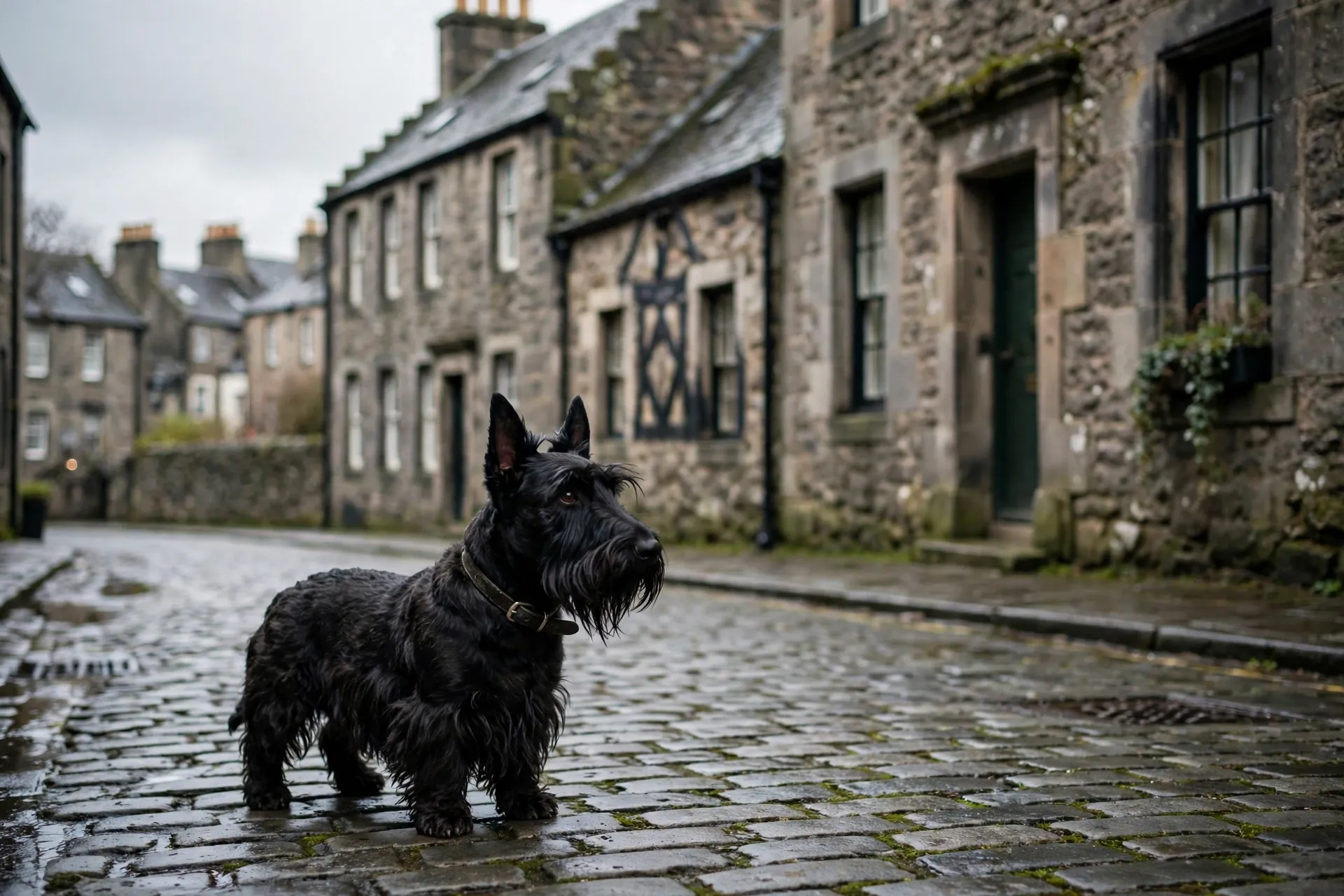
On a cobbled street in Edinburgh, a black Scottish Terrier stops dead. Not because it is tired, and not because it is frightened. It has smelled something interesting in a doorway, or spotted a pigeon worth watching, or simply decided that the left-hand pavement looks more promising than the right. Its owner waits. A minute passes. The terrier considers, sniffs the air once more, and sets off again in the direction it chose. That small negotiation is the whole of Scottish Terrier travel in miniature: you can suggest, you can guide, and you can certainly set the boundaries, but you cannot rush this dog into a timetable it has not agreed to.
Scottish Terriers, often called Scotties, are compact, sturdy dogs with short legs, a long body, a wiry outer coat, a beard and eyebrows that give them a famously serious expression. They were developed in Scotland as earth dogs, bred to follow vermin to ground and to work independently underground, away from human direction. That history still shows in the modern pet. A Scottie is confident, dignified and self-reliant. It is loyal to its own people, often deeply so, but it is not a dog that performs enthusiasm on demand for strangers. Many Scotties are slow to warm up, watchful with new people and selective about new dogs. None of this is a flaw. It is the breed's temperament, and a trip planned around it will be far happier than a trip planned as though the dog were a spaniel in a terrier coat.
The practical consequence is rhythm. A Scottish Terrier trip works best in short bursts with long pauses, rather than in long marches between sights. Think in terms of one historic street, one garden, one cafe stop, and then a rest, instead of a full day ticking off five attractions. A Scottie that has been allowed to sniff a wall for three minutes, watch the world from a bench for ten minutes, and walk at its own pace for twenty minutes will usually settle beautifully under a cafe table. A Scottie that has been hurried past everything interesting, lifted without warning, and introduced to six strangers in an hour may well dig in its heels, bark at the next dog it meets, or simply refuse to move at all. The refusal is information, not defiance for its own sake. It usually means the dog is overstimulated, tired, or has had enough social pressure for one outing.
Build the day around the dog's natural pattern. Scotties tend to enjoy purposeful sniffing, short explorations and bursts of alert watching, followed by solid rest. They are not built for all-day hiking, and their short legs and long backs argue against repeated jumping and long stair climbs, which are covered in detail below. They do enjoy mental work, though: a sniffing walk through an old town, where every doorway, drain cover and garden gate carries a new scent, can tire a Scottie more satisfyingly than a much longer walk on a featureless path. Let the dog lead the sniffing where it is safe to do so, and use a longer lead on open ground so the dog can investigate without constantly hitting the end of the line.
Social rhythm matters just as much as walking rhythm. Do not plan a day that depends on your Scottie loving everyone it meets. Some Scotties are friendly with strangers; many are politely reserved; a few are openly suspicious until they have watched a person for a while. All of these are normal for the breed. The kindest approach is to let the dog choose: stand to one side, let the dog approach or not, and ask well-meaning strangers not to reach over the dog's head or crouch face-to-face. Children in particular should be asked to let the dog come to them. If your Scottie moves away, turns its head, freezes or walks behind your legs, that is the dog asking for space, and giving it promptly is what keeps the next greeting calm.
The same slow approach applies to other dogs. Scottish Terriers can be dog-selective, and some are distinctly unimpressed by bouncy, face-to-face greetings from unknown dogs. Historic towns are full of narrow pavements where on-lead meetings are unavoidable, so a plan helps: cross the street early, step into a doorway or gateway, shorten the lead without yanking, and reward calm passing. Do not force nose-to-nose introductions on a narrow pavement just because the other owner is smiling. A Scottie that is allowed to pass at a comfortable distance, with something interesting to sniff as a distraction, will often cope far better than one that is held still while another dog bounces into its face. If your dog has known triggers, choose wider streets, quieter times of day and garden routes with room to manoeuvre, and check the official guidance before you travel if a venue's dog policy is unclear.
Finally, respect the Scottie's dignity about rest and retreat. A Scottie that can retreat to a familiar bed, a crate with the door open, or a quiet corner of a holiday cottage will recover from a busy morning far faster than one expected to stay social all day. Pack the dog's own bed and a familiar blanket, keep feeding times close to the home routine, and treat the afternoon nap as part of the itinerary rather than as wasted holiday time. The reward for this patience is considerable: a settled Scottie in a historic town is a wonderful companion, watchful, funny, full of character, and completely at home among old stone, garden smells and unhurried streets.
Historic towns and castle garden routes
Historic towns and castle gardens are the natural stage for a Scottish Terrier, and not only because the breed comes from Scotland. The scale suits the dog: old towns are built for walking, with short blocks, frequent corners, doorways to sniff, and benches to sit on. Castle gardens offer enclosed or semi-enclosed spaces, defined paths, and a concentration of smells that keeps a terrier's brain busy without demanding miles of walking. The trick is to choose routes that play to those strengths and to avoid the features that work against a short-legged, independent dog: very steep hills, long flights of worn stone steps, narrow crowded passages with no escape route, and gardens where dogs must stay on a short lead across open lawns with no shade or water.
Edinburgh is the obvious starting point, and it rewards a Scottie-paced approach. The Royal Mile and the Old Town closes offer exactly the kind of sniffing-rich, short-block walking Scotties enjoy, but the Mile is also steep, cobbled and busy, and the closes are narrow. Plan accordingly: walk one section at a time, use the flatter stretches around the Grassmarket and Greyfriars for rest stops, and avoid the steepest closes at peak times. The New Town, with its wider pavements and garden squares, gives the dog room to pass other dogs comfortably, and many cafes there welcome dogs indoors. If you want a quieter historic experience, consider smaller towns such as St Andrews, with its ruined cathedral and castle grounds, its wide streets and its coastal air, or Stirling, where the castle dominates a compact old town and the surrounding paths offer views without demanding a mountain climb. In England, towns such as York, with its Shambles and city walls, Bath, with its crescents and riverside paths, and Chester, with its Rows and walls, all offer the same basic recipe: old streets, defined routes, frequent stopping places, and gardens or parks nearby for a proper off-lead or long-line break.
Castle gardens deserve a specific plan of their own. Many castles and historic houses welcome dogs in their grounds while restricting them inside the house itself, and the rules vary from place to place, so check before you go and check the official guidance before you travel. When dogs are welcome in the gardens, keep to the paths, keep the lead short in planted areas, and remember that a Scottie will be tempted by every flower bed, loose border and gravel edge. Some gardens have formal parterres where a digging dog would be a disaster; others have woodland walks and walled gardens where a terrier can sniff happily without causing trouble. Ask at the entrance which areas are dog-friendly, where the water points are, and whether there is a shaded resting area. If only one adult is travelling with the dog and the house interior is not dog-friendly, plan for one person to wait with the dog, or visit the gardens only, rather than leaving the dog tied up or alone in a car.
Route planning for a Scottie is mostly about gradients, surfaces and exits. Before you set out, look at a map and mark the steep sections, the staircases and the narrow passages. Choose the gentler approach to a viewpoint where one exists, even if it adds a few minutes, and know where you can step aside if the street fills up. Cobbles are a particular issue: wet, worn cobbles are slippery for short legs, and the gaps between setts can catch small paws. A Scottie that is happy on dry, even cobbles may struggle on wet, uneven ones, so slow down, let the dog pick its footing, and carry the dog across the worst stretches rather than dragging it along. Grass, gravel paths and well-maintained tarmac are all kinder surfaces, and a route that mixes surfaces with regular rests will keep the dog comfortable for much longer than a route that is all cobbles and steps.
Timing is the other half of route planning. Historic towns are at their most Scottie-friendly early in the morning and late in the afternoon, when the streets are quieter, the light is softer, and the dog can sniff without being jostled. Midday in high season brings crowds, heat, dropped food, children, other dogs and delivery vehicles, all in narrow spaces. If you must visit at midday, keep the outing short, use the quieter side streets, and plan a cafe stop where the dog can rest under a table. In winter, the same towns are quieter still, but daylight is short and stone streets get cold and wet, so plan shorter outings with warm indoor stops. Whatever the season, carry water and a collapsible bowl, because historic towns do not always have obvious dog water points, and a low-slung terrier working hard on a warm day needs regular drinks.
Finally, give the historic walk a purpose the dog can understand. A Scottie does not care about architecture in the abstract, but it cares deeply about smells, movement and territory. A route that follows a burn or a garden wall, passes a market square with food smells, and ends at a park or a quiet green will hold a terrier's interest far longer than a route that is simply a straight line between two famous buildings. Let the dog stop, let it watch, and let it choose between two pavements now and then. The walk will take longer and cover less ground, and it will be a much better trip for it. If you are combining a town walk with a longer journey, read our guide to dog car safety before you set out, so the drive is as well planned as the walk.
Short legs, steps and high kerbs
A Scottish Terrier is a low, long dog, and that shape defines how it should move through a historic town. Short legs mean each step is proportionally larger, each kerb is proportionally higher, and each jump down from a wall or a car boot is a bigger impact on the spine and joints than it would be for a taller dog. Scotties are sturdy and often fearless, and they will happily launch themselves at obstacles that are not good for them, so the owner has to be the sensible one. The rule of thumb is simple: if the dog has to jump up or down more than its own shoulder height, or climb a long flight of uneven stone steps, find another way or carry the dog.
Start with the car, because that is where many Scotties jump most often. A low car boot may be manageable, but a high SUV boot or a tall estate sill is a jump down waiting to happen, especially on a wet car park surface. A lightweight folding ramp solves this cleanly, provided you practise with it at home first and on a flat surface, with treats and patience, before relying on it on holiday. A harness with a sturdy handle is the other essential tool: it lets you lift the dog safely and evenly, supporting chest and rear, rather than grabbing the dog by the front legs or the scruff. Never lift a Scottie by its front legs alone, and never let a dog jump from your arms. Set the dog down on a firm, non-slip surface, facing the direction of travel, and let it find its feet before you move on.
Stone staircases in historic towns and castles need the same careful approach. A short flight of shallow, even steps with a handrail and a non-slip surface may be fine for a fit adult Scottie taken slowly, on a short lead, one step at a time. A long flight of worn, uneven, open-tread or spiral stone steps is a different matter: the dog cannot see the footing properly, the treads may be deeper than its stride, and a slip could mean a fall. In those cases, carry the dog, or take the lift, ramp or alternative route if one exists. Many castles, museums and historic houses now publish step-free access information, and it is worth checking before you go rather than discovering a spiral staircase at the entrance with a tired dog on the lead. If access information is unclear, check the official guidance before you travel.
Kerbs, cobbles and thresholds are the smaller, everyday version of the same problem. Historic towns are full of high kerbs, dropped kerbs that are not where you expect them, and raised thresholds into shops and cafes. A Scottie may need a small lift over a high kerb, or a moment to judge a dropped kerb on wet stone. Do not drag the dog forward by the lead when it hesitates at a kerb: stop, let it look, and lift it if needed. Inside cafes and shops, watch for the raised threshold and the slippery tiled floor just inside the door, both of which can unsettle a short-legged dog. A small mat by the door, if the venue allows it, gives the dog secure footing while it settles.
At the accommodation, apply the same thinking to beds, sofas and staircases. Scotties love to be up on furniture with their people, but jumping down from a high bed or sofa onto a hard floor is exactly the kind of repeated impact that long-backed dogs should avoid. A pet ramp or a sturdy step beside the bed, a non-slip rug on a hard floor, and a stair gate at the top of a steep staircase all help. If the cottage has a steep, narrow staircase to the bedrooms, consider whether the dog should sleep downstairs on its own bed, with a baby gate rather than a closed door, so it can hear you but is not tackling the stairs at night. Ask about ground-floor bedrooms or step-free access when booking, and mention the dog's size and shape rather than just saying the dog is small: a Scottie is not a lapdog, and its needs are different from those of a tiny toy breed.
Finally, watch for tiredness as the day goes on. A Scottie that coped happily with steps in the morning may be reluctant by the afternoon, and that reluctance is worth respecting. Short legs tire faster on hilly ground, and a dog that is tired is more likely to slip. Plan the route so the hardest sections come early, when the dog is fresh, and the return leg is flat and easy. Carry a towel to dry paws, check between the toes for grit and small stones after cobbled streets, and keep an eye on the dog's gait: a Scottie that starts to bunny-hop, lag behind or sit down repeatedly is telling you it has had enough steps for one day. Listen, and the dog will be ready to enjoy the next town tomorrow.
The wiry coat: brushing and hand-stripping
The Scottish Terrier coat is one of the breed's most distinctive features and one of the most misunderstood parts of travelling with one. A Scottie has a dense, wiry outer coat over a softer undercoat, with the famous beard, eyebrows and skirt of longer hair on the legs and belly. That coat is weather-resistant and practical, but it is not wash-and-go. It needs regular brushing, it collects mud, burrs, twigs and food, and it needs professional attention every few months to keep its texture and shape. A trip that ignores the coat will end with a matted, muddy, unhappy terrier; a trip that plans for it will keep the dog comfortable and handsome throughout.
Daily care on a trip is straightforward. Brush the coat briefly each day, paying attention to the beard, the skirt and behind the ears, where tangles form first. A slicker brush and a metal comb are the usual tools, used gently and in short sessions, with treats to keep the dog cooperative. After wet walks, dry the coat rather than leaving it damp: towel the dog down, then use a drying coat or a warm room to finish, and comb through once dry to remove tangles before they tighten. Check the beard after meals and after drinking, because a wet beard left uncombed will mat and smell, and check the paws after every walk for mud packed between the toes, which can be uncomfortable and can hide small cuts.
Hand-stripping is the traditional method of maintaining a Scottie coat, and it is worth understanding before you book a groomer. Stripping means pulling out dead, ready-to-shed outer hairs by hand or with a stripping tool, so that new, harsh-textured hair grows through. It keeps the coat wiry, weather-resistant and the correct colour, with the dark coat staying dark and crisp. Clipping, by contrast, cuts the hair and leaves the dead undercoat in place, which over time softens the coat, lightens the colour and changes the texture. Many pet Scotties are clipped for convenience, and that is a legitimate choice for a family pet, but it is a choice to make knowingly, with a groomer who understands terriers, rather than by accident at a general grooming salon. If your dog is stripped, do not let a well-meaning groomer clip it on holiday without discussing the change, because the coat texture will not simply revert at the next appointment.
Timing matters around a trip. Do not book a first-time stripping session the day before a long journey, because the skin can be sensitive afterwards and the dog may be unsettled. Book routine grooming well before departure, so the dog travels in a tidy, comfortable coat, and book the next session for after you return if it falls due during the trip. If the trip is long, ask your groomer what daily maintenance the coat will need, and take the brush and comb you actually use at home rather than buying unfamiliar tools on the road. For a Scottie that is shown or kept in full coat, discuss the trip with your groomer or handler in advance, because a week of wet walks, muddy gardens and cafe floors will need a specific plan to keep the coat presentable.
On the road, the coat is also a weather system. The wiry outer coat sheds rain reasonably well, but the skirt and belly are low to the ground and will pick up mud, water and road grit on every wet walk. A waterproof coat that covers the belly helps enormously in rain, and it is much easier to wipe down a coat than to dry and comb a muddy skirt in a cold cottage. After a muddy walk, let the mud dry before brushing it out, rather than trying to wash a wet, muddy dog immediately: dried mud brushes out of a wiry coat far more easily than wet mud washes out, and the dog will be less chilled. If you must wash the dog, use a gentle dog shampoo, rinse thoroughly, dry completely and comb through, because shampoo residue left in a wiry coat can irritate the skin and attract dirt.
Finally, watch the skin as well as the hair. Scotties can be prone to skin sensitivities, and a trip brings new exposures: different water, different pollen, new laundry detergent on holiday bedding, and more time in a wet coat. If your dog starts scratching, develops red patches or smells different from usual, check for the cause early rather than hoping it settles: rinse the coat after walks in areas with road salt or agricultural spray, wash the dog's bedding before the trip if you use scented detergent at home, and keep the dog's regular food rather than switching to a new brand on holiday. A comfortable coat is not cosmetic for a Scottie; it is part of how the dog regulates temperature, stays dry and feels itself, and a little daily attention pays for itself in a happier travelling companion.
Digging instinct and lead management
Every Scottish Terrier owner knows the look: the head goes down, the front paws start to work, the back legs brace, and in seconds a neat hole appears in the lawn. Digging is not naughtiness in a Scottie. It is the breed's original job, bred into the dog over generations of going to ground after vermin. A Scottie that never digs is a Scottie that has not been given the chance, and a holiday full of loose soil, garden beds and sandy soil will present that chance constantly. The job of the owner is not to abolish the instinct, but to manage where and when it is expressed, so the dog can dig happily in the right place and not at all in a castle parterre.
Lead management is the first tool, and it matters more in historic gardens than on open walks. In planted areas, use a short lead, not a retractable lead and not a long line that lets the dog reach a flower bed before you can react. Walk the paths, not the beds, and keep the dog on the path side away from loose borders. If the dog starts to dig, interrupt calmly and early, redirect to a sniffing task on the path, and move on before the behaviour escalates. Do not yank the lead or shout: a Scottie that is startled mid-dig may become more aroused, not less, and the next bed will look even more interesting. Calm, early interruption and a clear alternative are far more effective than a confrontation after the hole is already dug.
Give the instinct a proper outlet elsewhere in the day. A Scottie that has had a good digging session in an allowed place is much less likely to dig in a forbidden one. On a trip, that outlet might be a sandy beach where digging is permitted, a patch of loose soil on a walk, or a digging box if you are staying in self-catering accommodation and can improvise one with a shallow tray and sand. If you are heading to the coast, our guide to dog-friendly beaches in Scotland explains where dogs can run and dig freely and where seasonal rules apply. Even ten minutes of allowed digging, followed by a walk and a rest, can take the edge off the urge for hours.
At the accommodation, the same principle applies. A Scottie left alone in a garden with loose borders, a vegetable patch or a freshly planted bed will almost certainly dig, and the damage may come out of a deposit or, worse, out of a relationship with a host. Check the garden before letting the dog off the lead: look for gaps in fences, loose soil, compost heaps and anything the dog could eat or dig up. A Scottie is small enough to get through gaps that look dog-proof to a human, so walk the boundary yourself and block gaps before the dog finds them. If the garden is not secure, keep the dog on a long line under supervision, or use the garden only for toilet trips on the lead. This is not over-caution; it is the realistic consequence of travelling with an earth dog.
Indoors, digging can appear in another form: scratching at carpets, bedding and sofa cushions, especially when the dog is settling or excited. A familiar bed, a blanket the dog can arrange to its satisfaction, and a chew or a sniffing puzzle at rest times all help. If the dog digs at the carpet by the door when left alone, that may be anxiety rather than play, and it is worth looking at the alone-time plan rather than simply scolding the digging. Scotties bond strongly with their people and may not enjoy being left alone in an unfamiliar place; keep absences short on a trip, leave a familiar-smelling item with the dog, and build up to longer absences gradually if you must leave the dog at all.
Finally, think about what digging means for garden etiquette more broadly. A Scottie owner in a historic garden is an ambassador for dog owners, whether they want to be or not. Keeping the dog on the path, picking up after it immediately, not letting it urinate on specimen plants or garden ornaments, and leaving no holes behind are the basics that keep gardens open to dogs. If a garden has a dogs-on-lead rule, follow it even if your dog is well behaved off the lead at home; the rule exists because of the cumulative effect of many dogs, not because of yours alone. A Scottie that behaves well in gardens will be welcomed back, and its owner will find that the next historic house is happy to have them.
Rain, cold and wet-weather kit
A Scottish Terrier is a low dog in a wet country, and that combination defines the wet-weather plan. Rain does not fall on a Scottie's back and run off neatly; it soaks the beard, splashes the belly and skirt, and works its way between the toes with every step through puddles. Cold wind finds the same low-slung body, and a wet, cold Scottie that is left to dry slowly in a draughty cottage or a cold car will be miserable and may become chilled. The good news is that Scotties are hardy dogs with a weather-resistant coat, and with the right kit they enjoy wet-weather walks as much as dry ones. The plan is not to avoid rain, but to manage it.
The essential kit starts with a waterproof coat that covers the belly. A coat that only covers the back leaves the skirt and belly to soak up every puddle, which defeats the purpose for a short-legged dog. Look for a coat with a belly panel, a snug but not tight fit that allows the dog to move freely, and reflective details for dark winter afternoons in historic towns. Practise wearing it at home before the trip, because a Scottie that has never worn a coat may freeze, wriggle or refuse to walk the first time it is put on. A drying coat or a set of highly absorbent towels is the second essential: after a wet walk, towel the dog down, put on the drying coat if you have one, and let the dog dry in a warm room rather than in a cold porch.
Paws need attention in wet and cold weather. Check between the toes after every wet walk for mud, grit, small stones and, in winter, road salt, which can irritate the skin. A paw balm applied before walks can help protect the pads, and a quick rinse in clean water after walks on salted roads is worth the effort. If the dog starts limping, licking its paws excessively or holding a paw up, stop and check immediately rather than pressing on to the next sight. In icy weather, be especially careful on stone steps, cobbles and metal grates, all of which become treacherous for short legs, and carry the dog across the worst surfaces.
Accommodation choices matter in wet weather too. A cottage with a boot room, a tiled porch or a utility area where a wet dog can be dried is worth more than a prettier cottage with only carpeted rooms and no drying space. Ask where you can dry the dog, whether there is an outdoor tap for rinsing paws, and whether the heating can be used to dry coats and towels. A Scottie that comes in wet and is dried promptly, with its bed in a warm, draught-free spot, will settle quickly; a Scottie that stays damp in a cold room will be restless and may develop a chill. Keep a spare set of bedding and towels, because one set will not last a wet week.
Cafe stops are part of the wet-weather plan, not just a treat. A dog-friendly cafe with space indoors gives the dog a warm rest between outings, a chance to dry off, and a break from the rain. Our guide to dog-friendly cafes in the UK explains how to find places that genuinely welcome dogs indoors and how to settle a dog calmly under a table. Take a mat for the dog to lie on, a towel for a quick dry before going in, and a chew or a quiet toy to help the dog settle. A Scottie that has a mat, a routine and a warm spot will usually lie quietly and watch the world, which is exactly what this breed enjoys most.
Finally, adjust expectations for the weather rather than fighting it. A wet day in a historic town is not a failed day for a Scottie; it is a day of shorter walks, longer cafe stops, more sniffing under sheltered archways, and an earlier return to a warm cottage. Plan a wet-day route in advance: a covered market, a dog-friendly cafe, a short garden walk with shelter, and a quiet street with interesting smells. Keep the dog warm and dry between outings, watch for shivering or reluctance to go out, and do not leave a wet dog in a cold car while you visit a shop. A Scottie that is kept warm, dry and unhurried in wet weather will be ready to enjoy the next dry spell with enthusiasm, beard and all.
A sample day that respects the terrier
Putting the pieces together, a good Scottie day in a historic town might look like this. Morning: a short toilet walk and breakfast at the accommodation, followed by a drive or a walk to the old town. Late morning: one historic street or one castle garden, walked slowly, with sniffing stops and a bench rest, lasting no more than an hour to ninety minutes. Midday: a dog-friendly cafe stop, with the dog on its mat under the table, a drink for you and water for the dog, and time to dry off if the weather is wet. Afternoon: a rest at the accommodation, with the dog on its own bed, followed by a second short outing if the dog is keen, perhaps a park or a riverside path where the dog can use a longer lead and, where allowed, dig. Evening: a quiet supper, a short last walk, and an early night. That is not a sparse itinerary; it is a full day for a terrier, and it leaves room for the unplanned stops that make a trip memorable.
Packing for that day is simple if you pack the night before. A bag for the dog should contain water and a collapsible bowl, a short lead and a harness with a handle, a lightweight ramp if you use one, poo bags, a towel, a brush, a mat for cafe stops, a waterproof coat in wet weather, and a few treats for rewarding calm passing and settling. Keep the bag by the door so the morning is calm, and check it each evening: refill the water, replace used towels, and remove mud from the lead and harness. A calm morning routine, with no rushing and no last-minute searching for kit, sets the tone for the whole day, and a Scottie that starts the day calmly is much more likely to stay calm in a busy street.
Before you book anything, run through a short checklist for the trip as a whole. Is the accommodation genuinely suitable for a short-legged dog, with ground-floor access or a manageable staircase, a secure garden and a drying area? Are the historic sites you want to visit dog-friendly in the areas you actually plan to use, and have you checked their current rules? Is there a vet nearby, and have you saved the number? Is the car set up safely for the dog, with a harness or crate that fits, and have you planned stops on a long drive? Have you booked grooming at the right time, and packed the brush and coat the dog needs? If you can answer yes to those questions, the trip is well planned, and the rest is up to the terrier, which is exactly as it should be. Check the official guidance before you travel for any site, rule or access detail you are unsure about, and enjoy the unhurried, opinionated, thoroughly entertaining company of a Scottish Terrier in Britain's historic towns.
Practical questions
Before you go
Can a Scottish Terrier manage a day in a historic town?
Yes, if the day is built around short legs, frequent pauses and a plan for steps. Keep walks to a few short blocks at a time, choose step-free or ramped routes where possible, carry the dog up long staircases rather than letting them jump, and build in rest stops in shade or shelter. A tired Scottish Terrier that has been allowed to sniff and choose its pace will usually settle far better than one that has been marched for miles.
How do I handle steep steps and high kerbs with a short-legged dog?
Scout the route first, use ramps and lifts where they exist, and lift the dog up and down long or uneven stone staircases instead of asking them to jump. A lightweight ramp helps at a car boot or a single raised threshold, and a harness with a handle gives you a safe grip. Ask venues about step-free access before you go, and check the official guidance before you travel if a site's access information is unclear.
How often does a Scottish Terrier coat need hand-stripping?
Most Scottish Terriers need hand-stripping every few months, with regular brushing and tidying in between. The exact interval depends on the individual coat, so ask your groomer to set a schedule for your dog rather than copying another dog's routine. Clipping changes the coat texture over time, so discuss stripping versus clipping with a groomer experienced with terriers before you decide.
Will my Scottish Terrier dig in castle gardens?
Probably, given the chance. Scottish Terriers were bred to go to ground, so loose soil, flower beds and lawn edges are all tempting. Keep the dog on a short lead in planted areas, walk garden paths rather than cutting across beds, and give the digging urge a proper outlet elsewhere, such as a digging box at home or a sandy beach where digging is allowed. If a garden has specific dog rules, follow them and check the official guidance before you travel.
Should I let strangers fuss my Scottish Terrier?
Only on the dog's terms. Scottish Terriers are often slow to warm up, so let the dog approach, sniff and decide. Ask strangers to crouch sideways, avoid reaching over the head, and stop if the dog moves away, freezes or turns its head. A dog that is allowed to say no to greetings is usually calmer and more sociable in the long run than one that is passed from hand to hand.
What should I pack for a Scottish Terrier in rain and cold?
Pack a waterproof coat that covers the belly, a drying coat or several absorbent towels, a brush for the wiry coat, paw balm, a short lead and a harness with a handle, plus a mat for cafe stops. Scottish Terriers are low to the ground, so mud and rain reach their bellies and beards quickly. Dry the coat and check between the toes after wet walks, and keep the dog warm and dry between outings rather than leaving a wet coat to dry slowly in a cold car.