This guide is independent and contains no paid placement. If affiliate links are added later, they will be clearly marked and will not change our editorial checks.
Setter travel is about gentleness and grooming. Brush the feathering daily, train with patience rather than pressure, give the dog a daily gallop and a quiet indoor life, and plan for a dog that matures slowly and feels everything deeply. Do that, and a Setter is one of the most affectionate and joyful companions for a British holiday.
Which Setter, and why it matters
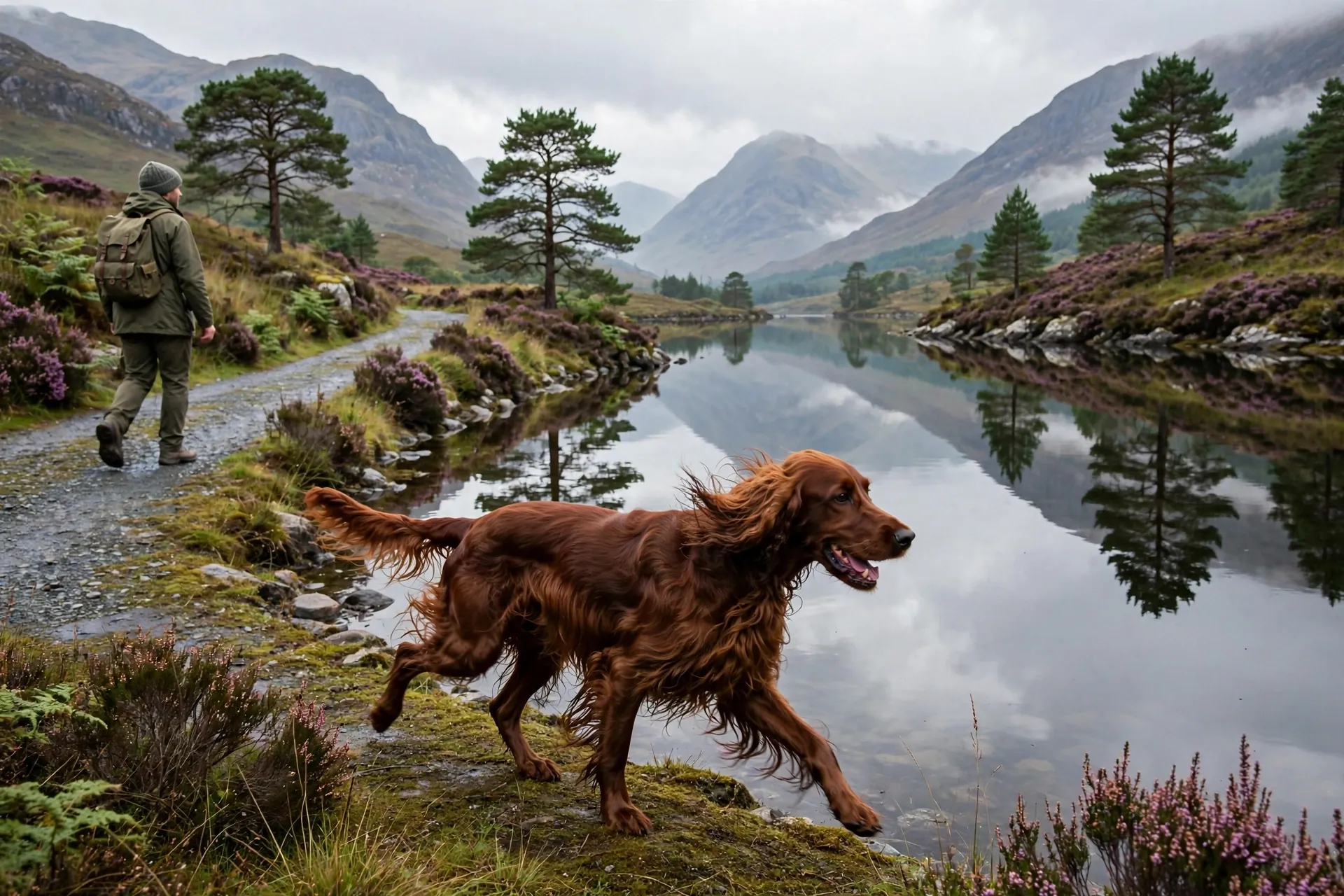
The word Setter covers several breeds, and the differences matter for travel, even though this guide's advice applies broadly. Irish Setters are the best known, with their flowing red coats, exuberant energy and famously slow maturity, often remaining puppy-like until they are three years old. English Setters are usually calmer and more methodical, with speckled coats that show mud with particular enthusiasm, and a working style that is more measured than the Irish Setter's joyful rush. Gordon Setters are larger, heavier and often more reserved, with black-and-tan coats that need the same feathering care but carry more weight on long walks. Irish Red and White Setters sit between the Irish and the English in temperament, and working lines of any Setter type are generally more intense, more driven and harder to tire than show lines, which are bred for a calmer temperament and a heavier coat.
Knowing which type you have, and whether it comes from working or show lines, helps you plan realistically. A working-line Irish Setter on a holiday will need more running, more scent work and more patience than a show-line English Setter, and will be harder to settle in a small hotel room. A Gordon Setter will need more attention to weight, joints and stamina on long hills than a lighter English Setter. Ask your breeder or your vet about your dog's lines if you are unsure, and observe your own dog: does it gallop in wide, joyful casts, or does it quarter methodically? Does it settle quickly indoors, or does it pace for an hour after a walk? The answers tell you more about the holiday you need to plan than any breed standard, and they are the reason this guide emphasises observation over prescription. A Setter is not a generic dog with a long coat: it is a specific dog with a specific history, and the trip should be built around that dog.
The feathered coat: beauty with a routine
The Setter's feathering, the long, silky hair on the ears, chest, legs, belly and tail, is the breed's glory and the traveller's daily responsibility. On a British holiday, that feathering collects mud, water, burrs, seeds and tangles with remarkable efficiency, and a coat that looks beautiful in the morning can be matted by the evening if it is not brushed. The routine is simple but non-negotiable: brush the feathering every day, using a slicker brush followed by a metal comb, working through tangles gently from the ends towards the skin, and check the places where mats form first, behind the ears, in the armpits, between the toes and at the base of the tail. A five-minute brush in the evening, done calmly and rewarded with a treat, will keep the coat in good order and will become a pleasant ritual for both dog and owner.
Never brush a wet, muddy coat aggressively, because wet hair breaks and mats more easily, and never cut out a mat with scissors held close to the skin, which is how injuries happen. Let mud dry, then brush it out, or rinse the feathering and dry it before brushing, and use a detangling spray for stubborn tangles. Bathing on holiday is rarely necessary unless the dog has rolled in something unpleasant, and frequent bathing strips the coat's natural oils, so a rinse of the legs and belly is usually enough. If you are staying in a rental, protect the furniture with washable throws, because a Setter will leave hair and, after a wet walk, a trail of mud, on everything it touches. The coat is not a reason to avoid the countryside: it is a reason to pack a brush, a comb and a towel, and to use them every day, so the dog can enjoy the mud and still look like a Setter at dinner.
A sensitive soul in a new place
Setters are famously sensitive dogs, and that sensitivity is the trait that most shapes their travel experience. A Setter notices its owner's mood, startles at raised voices, and can become anxious in a noisy, chaotic or unfamiliar environment, even when nothing obviously frightening has happened. On holiday, that means the dog's emotional state needs as much planning as its exercise: a calm arrival, a quiet first evening, a familiar bed and blanket, and a routine that mirrors home as closely as possible will do more for a Setter than any amount of sightseeing. Avoid the temptation to fill the first day with new experiences, because a Setter that is overwhelmed on day one will take days to recover, while a Setter that is given a gentle first day will grow in confidence with each successful outing.
Training a Setter, on holiday as at home, must be gentle. Harsh correction, shouting or physical punishment will shut a Setter down, damage trust and make the dog less willing to work with you, not more. Use positive reinforcement, reward good behaviour generously, and keep corrections to a quiet interruption, a redirection to something the dog can do right, and a reward for doing it. This applies to recall, to lead manners and to settling in a pub: a Setter that is praised for lying quietly will lie quietly again, while a Setter that is scolded for fidgeting will fidget more anxiously next time. Children, in particular, should be taught to be calm around a Setter, to avoid sudden grabs and loud games, and to let the dog come to them, because a sensitive dog that cannot escape a noisy group will become stressed, however tolerant it appears. Sensitivity is not weakness: it is the reason Setters are so affectionate, so responsive and so bonded to their people, and it deserves to be treated as a strength to work with, not a problem to overcome.
Two speeds: gallop and shadow
Setters live at two speeds, and a good holiday gives both of them their proper place. Outdoors, a Setter is a joyful, exuberant galloper, running in wide casts, leaping through heather, and working scent with its head high and its tail wagging. Indoors, the same dog becomes a shadow, following its owner from room to room, leaning against a leg, and sleeping for hours with its head on a foot. The mistake is to expect one speed without the other: a Setter that has not galloped will not settle indoors, and a Setter that has galloped hard will not want to go out again immediately. Plan the day around that rhythm, with a morning gallop, a midday rest, an afternoon sniffy walk and a settled evening, and the dog will be at its best in both modes.
The gallop itself needs open ground, and the same considerations apply as for any gundog: a secure dog field, an open beach out of season, or a stretch of moorland or common where the dog can legally run free and no livestock or game is present. A Setter that gallops daily is a dog that sleeps well, eats well and behaves well, while a Setter that is confined to lead walks will become frustrated, bouncy and destructive, not because it is naughty but because its body is full of unspent energy. After the gallop, give the dog time to cool down, drink and rest before the next activity, and do not expect it to settle immediately in a busy pub or cafe: a short, calm walk on the lead after the gallop helps the dog transition from full speed to settled, and a chew or a food toy on arrival gives it something to do while its body catches up with its surroundings. The two speeds are not a contradiction: they are the breed's design, and a holiday that honours both is a holiday that works.
Scent, recall and the wandering nose
Setters are scent hounds in the gundog sense, and their noses will lead them into trouble if recall is not trained with scent as the central distraction. A Setter that catches an interesting scent can drift away from its owner in a wide, scent-driven cast, following the scent rather than running away in a straight line, and it may not hear or may not attend to a voice call while it is working scent. Train recall with a whistle, which carries further than a voice and becomes a distinct cue, and practise in progressively more scent-rich places, from a quiet garden to a field margin to a woodland edge, always rewarding returns lavishly. Never punish a dog for returning, however long it took, because a dog that is scolded for coming back will hesitate next time, and hesitation at a distance is how a Setter gets lost.
On the trip, use a long line on any ground where you are unsure about livestock, game, roads, cliffs or ground-nesting birds, and keep the dog on a lead in spring on moorland and heathland, where ground-nesting birds are breeding and a free-running dog can destroy nests without being seen to do anything dramatic. Learn to read the Setter's body language: the head held high, the nose working the air, the sudden change of direction towards a scent, all signal that the dog is about to commit to a scent, and a recall given before it commits is far easier than one given during it. A GPS tracker on the collar can give peace of mind on open ground, but it is a backup, not a licence, and it does not work everywhere. The best Setter recall is built on a partnership in which the dog wants to return, and that partnership is built by rewarding every return, without exception, and by never asking the dog to do something it has not been trained to do in a place it has not been trained to do it.
Mud, water and the daily clean-up
Mud is not an occasional hazard for a Setter on a British holiday: it is a daily companion, and the clean-up routine should be planned as part of the walk rather than as an afterthought. After every walk, towel the dog down, paying attention to the feathering, the belly and the paws, and check for mud packed between the toes, which can cause soreness. A portable paw washer, a stack of microfibre towels and a washable throw for the car boot will save more time than any other kit you pack. If the dog has been in deep mud, let the mud dry before brushing, because wet mud brushed aggressively will mat the feathering, and a rinse of the legs and belly is often enough to restore the dog to presentable condition without a full bath.
Water adds a second layer to the routine. Many Setters love swimming, and a British beach, river or lake can be the highlight of their holiday, but water needs checking before swimming: tides, currents, water quality and hazards such as blue-green algae, which can be toxic to dogs, all matter, and a dog should never swim in a fast river or a tidal estuary without careful assessment. After swimming, dry the dog thoroughly, paying attention to the ears, which should be checked and dried to prevent infection, and put on a drying coat or a warm coat, because a wet Setter that stops moving will chill quickly, even with its long coat. Our guide to dog friendly cafes in the UK is useful for the indoor stops that follow a wet walk, because a Setter that is clean, dry and settled is welcome in far more places than one that is dripping mud across the floor. The clean-up routine is not glamorous, but it is what allows a Setter to enjoy the mud and the water without ruining the rental or the rest of the day.
Slow maturity and young Setters
Setters mature slowly, and that fact shapes the holiday for young dogs more than any other single factor. An Irish Setter may remain puppy-like, exuberant, distractible and physically immature, until it is two or three years old, and an English Setter, though often calmer, still takes longer to mature than many breeds. A young Setter on holiday will need shorter walks, more rest, more patience and more supervision than an adult, and it will be more easily overwhelmed by new places, new people and new dogs. Build the trip around the young dog's needs, not around the adult dog you hope it will become: short, successful outings, plenty of sleep, and a quiet first day will do more for a young Setter than a packed itinerary that leaves it exhausted and overstimulated.
Physically, young Setters should not be subjected to long, repetitive running on hard ground while their joints are still developing, so favour soft, varied terrain, keep distances modest, and build up gradually over the trip rather than attempting the longest walk on day one. Mentally, a young Setter needs training games, scent work and socialisation in small, controlled doses, rather than long, chaotic encounters with many new dogs and people. If you are travelling with a young Setter, choose accommodation with a secure garden, so the dog can play and toilet safely without a lead walk at midnight, and plan a rest day after any particularly busy day. The slow maturity of Setters is not a flaw: it is part of their charm, and owners who are patient with it are rewarded with a dog that, when it finally matures, is calm, loyal and deeply bonded. The holiday is not the time to rush that process.
Stays that suit a Setter
The best accommodation for a Setter is a cottage or a house with a secure garden, a quiet location and a comfortable, draught-free sleeping area, rather than a busy hotel with a long corridor full of triggers. A garden gives the dog a safe place to toilet, potter and play without a lead walk at midnight, and a quiet location means fewer strangers passing the window, fewer sudden noises and fewer opportunities for the sensitive dog to become anxious. When booking, ask about the garden fencing, because a Setter that finds a gap will use it, and check whether the garden is genuinely enclosed or merely bordered by a hedge with holes. Confirm the pet fee and any conditions in writing, and be honest about the breed and the coat, because a host who expects a short-coated dog may be surprised by the amount of hair and mud a Setter produces.
Inside the accommodation, recreate the dog's home setup as closely as possible: the same bed, the same blanket, the same feeding routine and the same last outing before bed. Protect the rental with washable throws on sofas and beds, and keep the dog off white bedding until it is clean and dry. If you are staying in a hotel, choose a ground-floor room near an exit, tire the dog properly before check-in, and bring a familiar bed and a chew for the transition. Our guide to dog friendly hotels in the UK covers the room and fee questions that matter for a large, long-coated breed, and our guide to crate training a dog for travel explains how a crate can give a sensitive dog a clear signal that it is time to rest. A Setter that settles in its accommodation is a dog that can be taken to breakfast, left for a short time and welcomed back next year, which is worth more than any single walk.
Health, ears and ageing gracefully
Setters are generally healthy dogs, but there are health issues that travellers should know about, because they affect the holiday directly. Ears are the most common concern: the long, feathered ears trap moisture and warmth, creating an environment where infections thrive, especially after swimming or wet walks. Check ears regularly, dry them after water, and watch for head shaking, scratching, redness or a smell from the ear, which should prompt a vet visit rather than a wait-and-see approach. Skin allergies and sensitivities are also common in the breed, and a new environment, new bedding or new food can trigger itching, so keep the dog's usual bedding and food, and note any flare-ups for the vet.
Older Setters deserve particular care on holiday. An older dog may have arthritis, reduced stamina and a lower tolerance for cold, and it will need shorter, gentler walks, a warm, supportive bed, and possibly a ramp for cars and steps. Do not expect an older Setter to gallop as it once did, and do not be disappointed if it prefers a village walk to a moorland hike: the dog's enjoyment of the trip is not measured by distance, and a gentle walk with plenty of sniffing can be just as satisfying for an older dog as a gallop was in its youth. Keep the nearest vet's number saved, and carry a short written summary of any medication or condition for any vet you might visit. A Setter that ages gracefully, with its coat brushed, its ears checked and its walks tailored to its body, is a dog that can enjoy British holidays for many years, and that is the real reward for the daily care.
Planning a Setter week in Britain
The best Setter weeks in Britain are built around gentle, varied countryside with secure gardens, quiet villages and plenty of water, rather than dramatic mountain summits or long-distance trails. Scotland offers superb Setter country, with lochs, glens and moorland, though the dog must be kept on a lead during nesting and shooting seasons and given its gallop in a secure field. The Yorkshire Dales and the North York Moors offer rolling hills, quiet lanes and dog-friendly pubs, with the same seasonal cautions. Norfolk and the Suffolk coast offer flat, open beaches out of season, long, straight trails and villages with dog-friendly cafes, and the flatness means the dog can gallop without the strain of steep hills. The New Forest offers woodland and heathland, though its free-roaming ponies and cattle mean the dog must be on a lead in many places, and a secure field is often the best daily gallop.
When you plan the week, think in terms of the dog's rhythm rather than a list of attractions. A typical good day might start with a morning gallop, include a midday rest and a cafe stop where the dog can lie beside you, and end with a short, sniffy evening walk and a settled night in the cottage. Book accommodation first, then find the nearest secure field and the nearest vet, and check that each planned route has a short version and a wet-weather alternative, because British weather will eventually force a change of plan. Keep a brush, a comb and a towel in the day bag, as well as in the main luggage, so the daily groom is never skipped for want of kit. A Setter week done this way feels unhurried rather than restricted, and the dog's confidence grows with each successful day: by the end of a week, a well-planned Setter is often calmer in new places than it was at home, which is the real reward for all the grooming, patience and planning. Check the official guidance before you travel if you are unsure about access rules in a new area, because local conditions change with the seasons and the land.
Practical questions
Before you go
How often should I brush a Setter on holiday?
Brush the feathering every day on a holiday, and thoroughly every few days for the whole coat. Feathering on the ears, legs, chest and tail mats quickly after wet walks, so a short daily brush prevents painful tangles and keeps the coat in show condition.
Are Setters sensitive to scolding on trips?
Yes, Setters are famously sensitive and respond badly to harsh correction, especially in a new place. Use calm, positive training, reward good behaviour generously, and keep corrections to a quiet interruption followed by a redirection, never a raised voice.
How much exercise does a Setter need each day?
Most adults need at least two hours of exercise, including free running and scent work, to stay settled. Puppies and young dogs need less, built up gradually, and older dogs need shorter, gentler outings with more rest.
Do Setters need a coat in British weather?
The long coat gives more protection than a short coat, but a wet Setter still chills when it stops moving, and older dogs feel the cold. Pack a waterproof coat for wet winter walks and a drying coat for after swimming or rain.
Are Setters good with children on holiday?
Generally yes: Setters are gentle, affectionate and tolerant, and many adore children. Supervise meetings, teach children to be calm around the dog, and give the dog a quiet retreat, because a sensitive dog that cannot escape a noisy group will become stressed.