This guide is independent and contains no paid placement. If affiliate links are added later, they will be clearly marked and will not change our editorial checks.
Do not start with the car. Spend week one with the door open, week two with short closed-door sessions, week three with stationary and short car practice, and week four with full dress rehearsals. A dog that walks into the crate willingly at home is far more likely to settle on the road.
Why a travel crate helps
A crate is not a cage for punishment, and it is not a shortcut for training. At its best, it is a portable bedroom: a familiar, enclosed space that smells of home, stays the same from room to room, and gives a dog a clear place to settle when everything else is new. That consistency is the whole point. A dog that has a reliable resting place is less likely to pace a hotel room, guard a doorway, or spend a car journey scanning for threats.
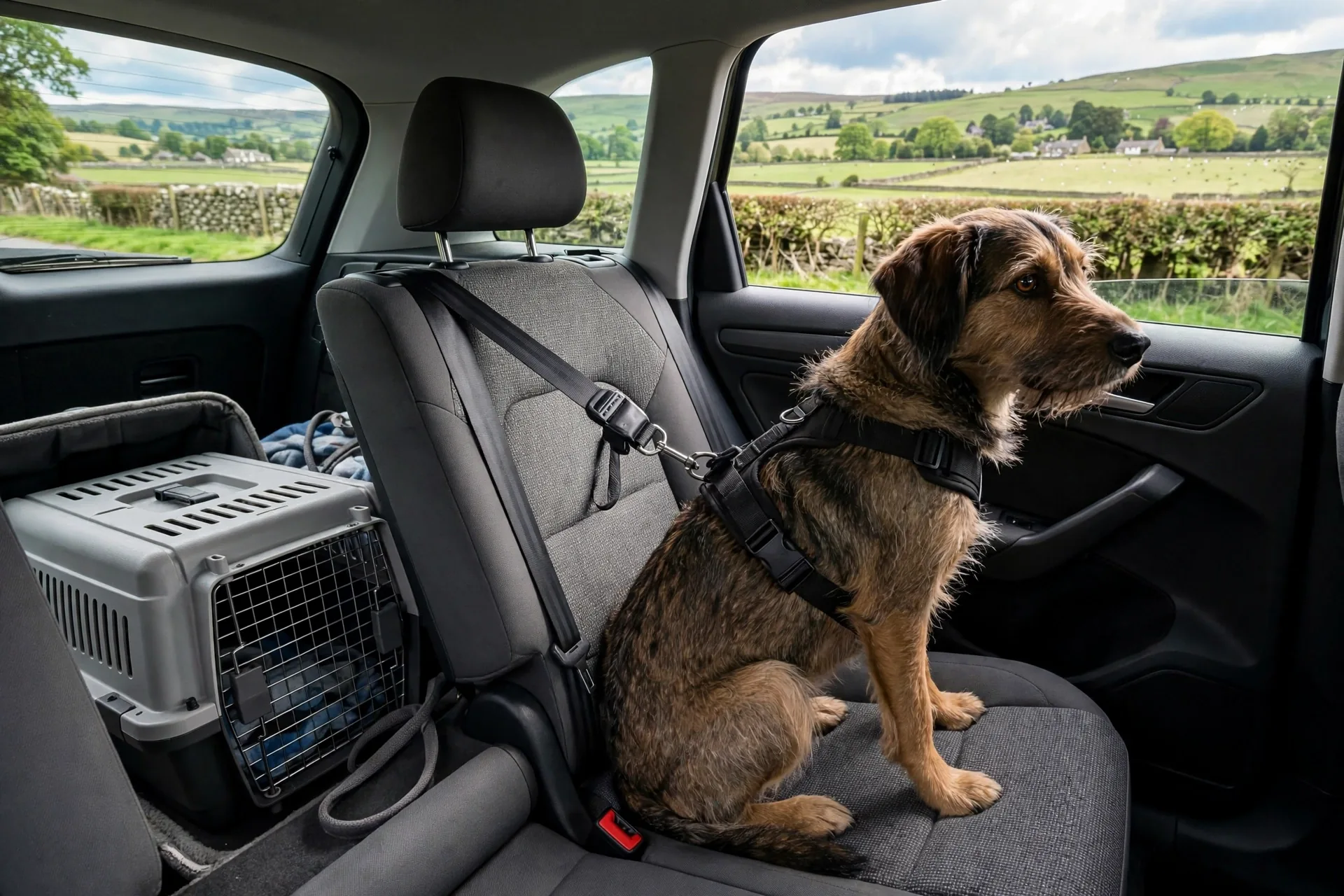
There is also a safety argument. In a car, an unrestrained dog can become a projectile in a sudden stop and a distraction at exactly the wrong moment. The Highway Code expects dogs to be suitably restrained so they cannot distract the driver or injure themselves or others if the vehicle stops quickly, and a well-fitted crate is one way to meet that expectation. The rules and the best restraint for a particular car are worth checking in detail before you travel, and our guide to dog car safety compares crates with harnesses, boot guards and other options. For legal detail, check the official guidance before you travel, because the wording and enforcement of road rules can change.
A crate also helps other people. Holiday lets, hotels, campsites and friends' houses often have different rules about where a dog may go, and a dog that settles in a crate is easier to accommodate in a room that is not fully dog-proofed. It protects soft furnishings, keeps a nervous dog away from an open front door, and gives hosts confidence that the dog will not be loose while the owners are in the shower. None of that works, however, if the dog experiences the crate as a trap. The training below is therefore built around choice first and confinement second.
It helps to be clear about what a crate cannot do. It cannot replace toilet breaks, exercise, water or company. It cannot fix separation anxiety on its own, and it cannot make a long journey comfortable if the dog is carsick, overheated or terrified. A crate is a tool for a dog that already knows how to settle, applied to a new setting. If your dog panics in enclosed spaces, barks for hours when left, or injures itself trying to escape, the priority is professional behaviour advice, not a faster training schedule.
Timing matters more than enthusiasm. Most owners start crate training the week before a holiday, discover that the dog will not enter the crate, and then spend the journey managing exactly the stress they hoped to avoid. Four weeks is a sensible minimum for a dog that is new to crates, and it is still only a starting point. Puppies often learn quickly because everything is new to them, but they also need frequent toilet breaks and shorter sessions. Adult dogs may be slower to trust a new routine, and rescue dogs may need extra time to learn that a closed door opens again. Build the plan around your dog, not around your departure date, and move the holiday plan if the dog is not ready.
Choose the right crate before week one
Choosing the crate first prevents the most common early failure: a crate that is the wrong size, in the wrong place, or impossible to load into the car. Start with the dog, not the catalogue. Measure the dog standing, from nose to tail base, and lying down in a natural resting position. The dog should be able to stand without crouching, turn around without squeezing, and lie stretched out. At the same time, the crate should not be so roomy that the dog slides across it on every bend. Most makers publish a size guide by breed and weight, but measurements beat breed labels, because two Labradors can differ by several centimetres.
Next, measure the car. A crate that fits the living room may not fit through the boot opening, may block the rear view, or may leave no room for luggage. Take a tape measure to the boot, note the narrowest point of the opening as well as the internal width, and allow space for ventilation around the crate. If the crate will sit on the back seat, check seat-belt routing and whether the seat folds. If you travel by train, ferry or taxi as well as by car, the same crate may need to work in several settings, or you may need a second, lighter crate for non-car legs. Decide that now, not on the platform.
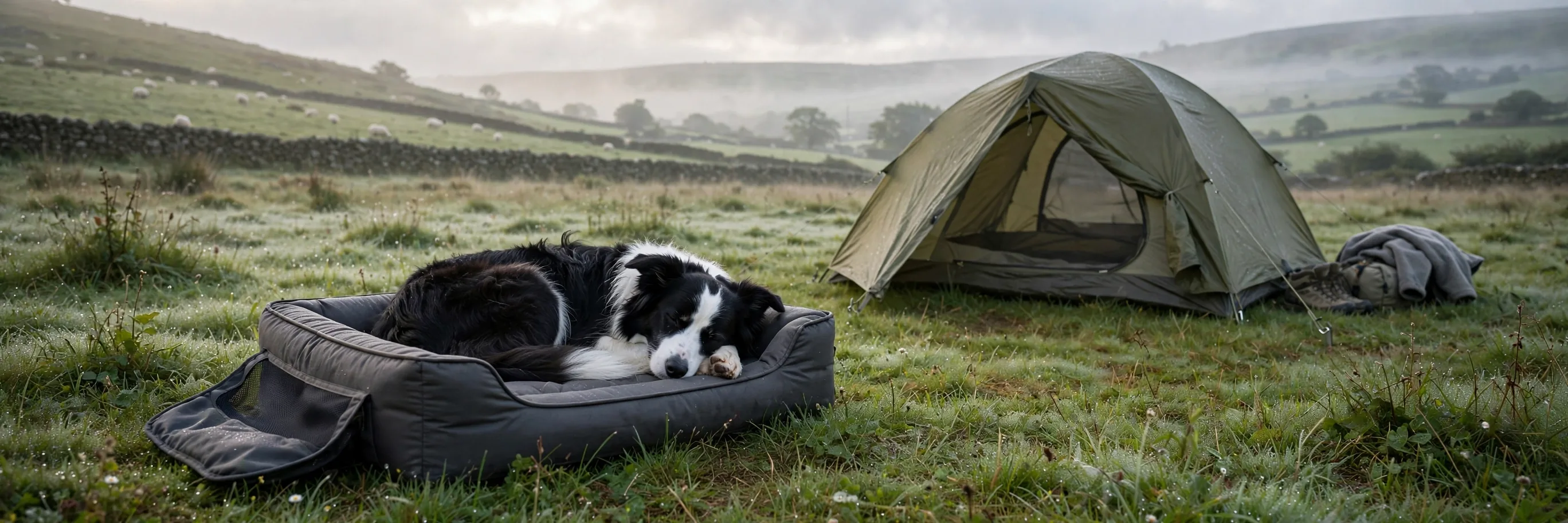
Crate types suit different dogs and journeys. Wire crates ventilate well, fold flat and let a dog see out, which suits confident dogs and warm cars, but they can be noisy and draughty, and a determined chewer may bend a wire. Hard plastic crates are quieter, darker and often easier to secure in a boot, but they ventilate less well and can feel more enclosed to a nervous dog. Soft fabric crates are light and packable, which suits hotels and camping, but they are not a safe car restraint and they will not contain a dog that scratches or chews through fabric. Crash-tested crates cost more, but for regular car travel they are worth comparing carefully, because not every crate marketed for cars has been tested in a crash. Check the maker's test claims before you travel rather than assuming that a sturdy look means a tested design.
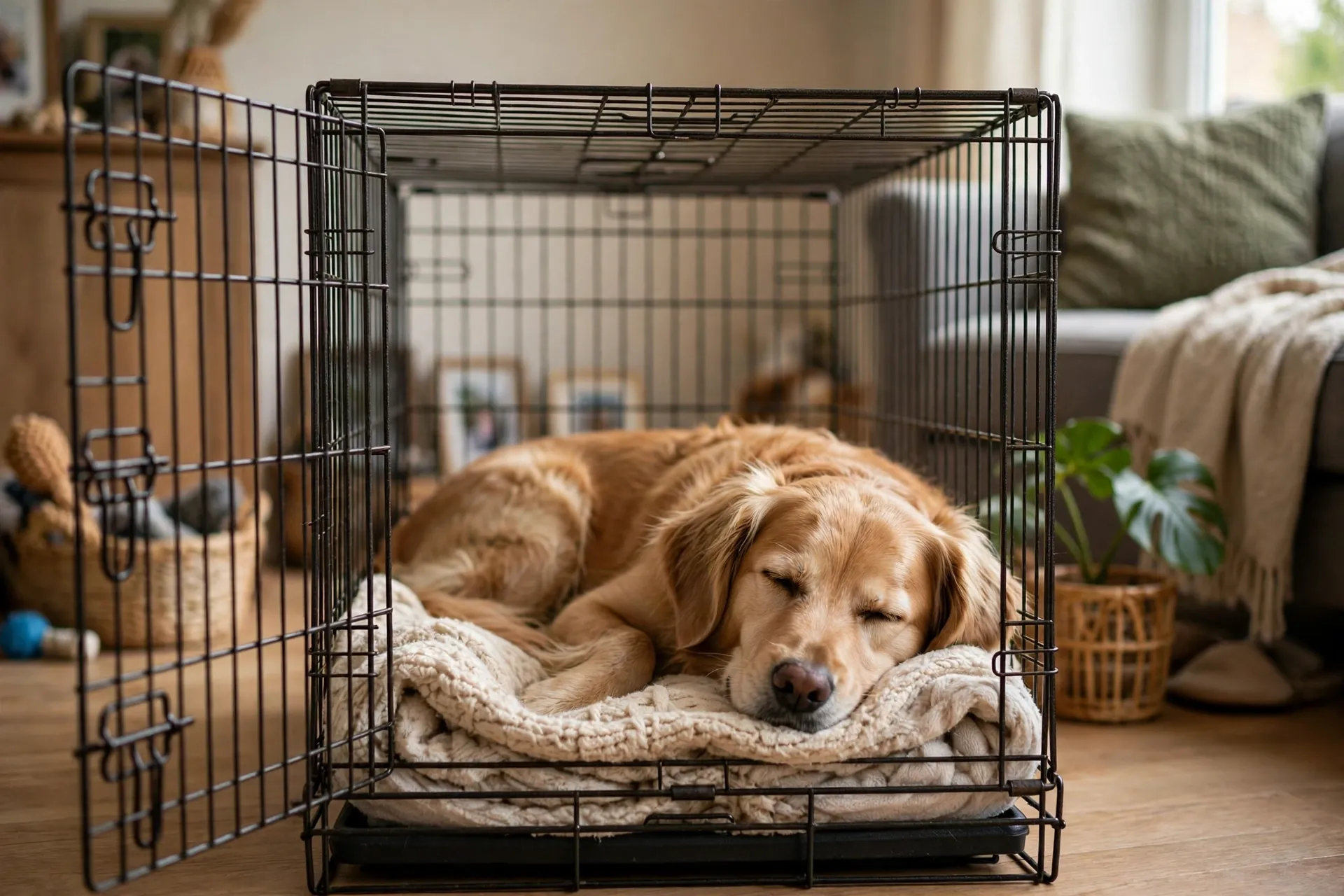
Furnish the crate simply. A flat, washable bed or vet bedding that does not bunch up under the dog is better than a deep pile of blankets that tangles around legs. Add one familiar-smelling item, such as an unwashed blanket from the dog's usual bed, and a safe chew or a stuffed food toy for early sessions. Avoid loose bowls inside a moving car, where water spills and a bowl becomes a projectile; use a clip-on water bottle or offer water at stops instead. Keep the crate in a social room at home, not in a garage or an isolated utility room, because a dog learns to settle where the family actually spends time. Covering part of a wire crate with a light blanket can help some dogs feel more den-like, but leave at least one side uncovered for airflow, and remove the cover if the dog pulls it in or chews it.
Finally, set the house rules before training starts. Decide who feeds the dog in the crate, who opens the door, and what the release word will be. A single consistent word, such as "free" or "out", spoken calmly, avoids the confusion of family members using different phrases. Agree that the crate door is never used as a threat, that children do not climb into the crate or poke the dog through the bars, and that a dog in the crate is left alone when it is resting. Those small consistencies make the four weeks that follow much smoother.
Week 1: open-door settling
Week one has a single goal: the dog chooses to enter the crate, relaxes inside it, and leaves again without fuss. The door stays open all week. If anyone is tempted to close it "just to see", that is the moment to wait. A dog that learns in week one that the crate is a place where good things happen, and where it is never trapped, will accept a closed door far more readily in week two.
Start by placing the crate in a room the dog already uses, with the door propped or tied open so it cannot swing shut and startle the dog. Put the dog's bed inside, or a blanket that already smells of home, and scatter a few high-value treats just inside the entrance. Let the dog investigate at its own pace. Some dogs walk straight in, some sniff the threshold for a day, and some need treats placed in a trail leading towards the crate. All of those are normal. Do not lure the dog in and then block the exit, and do not push the dog inside. The dog must learn that entering is safe because leaving is always possible.
Once the dog enters willingly, start feeding meals in the crate. Place the bowl at the entrance on day one or two, then move it gradually further inside over several meals. Keep the door open throughout. Add short, calm settling sessions: invite the dog in with a treat, give a long-lasting chew or a stuffed food toy, and sit nearby reading or working. Keep these sessions to five or ten minutes at first, two or three times a day, and always let the dog leave when it wants. If the dog walks out mid-chew, that is information, not disobedience. Shorten the next session or use a higher-value chew.
Use the week to build small rituals. A consistent cue, such as "crate" or "bed", said just before the dog enters, helps later when you need the dog to go in on a busy forecourt. Pair the cue with a treat tossed inside, not with a command barked from across the room. Practise the ritual at different times of day, after a walk and after play, so the crate is not only associated with departures or bedtime. By the end of week one, you want to see the dog choosing the crate for a nap, or at least walking in without hesitation for food and chews. If the dog still will not enter, stay in week one. Add a second bed, try a different room, remove a cover that makes the crate feel dark, or use a larger crate. Progress is measured in relaxed body language, not in days ticked off.
Watch for the signs that matter. Relaxed signs include a soft body, slow blinking, sighing, lying on the side, and choosing to stay after the food is finished. Warning signs include freezing at the threshold, whale eye, lip licking, yawning, pacing, or grabbing food and retreating immediately. If you see warning signs, make the step smaller: treats further out, a shorter session, or the door removed entirely for a day. Keep a simple notebook for the week, noting how long the dog stayed, what treat worked, and what time of day was easiest. That record makes week two much easier to calibrate.
Week 2: short closed-door sessions
Week two introduces the closed door, but only in tiny, successful steps. The principle is simple: close the door for a shorter time than the dog can comfortably manage, reward calm behaviour, and open the door before the dog becomes distressed. A dog that learns that the door always opens again will tolerate longer sessions. A dog that learns that barking or panicking is the only way to get out will practise exactly that behaviour.
Begin with the door closed for just a few seconds while the dog is eating or chewing. Stay in the room, speak calmly, and open the door before the dog finishes the food. Repeat several times a day, building from seconds to a minute, then to five minutes. Only increase the time when the dog is relaxed at the current step for several sessions in a row. A useful ladder is: 30 seconds, 1 minute, 2 minutes, 5 minutes, 10 minutes, 15 minutes, and then 30 minutes, but there is no obligation to reach 30 minutes by the end of the week. Some dogs will, some will need the week to reach ten comfortable minutes, and both outcomes are fine.
Once the dog is comfortable with you in the room, practise brief absences. Close the door, step into the next room for 30 seconds, return calmly, and open the door. Keep your return boring: no excited greeting, no apology, no fuss. Gradually extend the absence to a few minutes, then to the time it takes to make a cup of tea. Leave a safe chew or a food toy so the dog has something to do, and keep a radio or familiar household sounds on if that is normal at home. Avoid sneaking out silently and then reappearing with a fanfare, because both extremes teach the dog that departures are events.
Introduce the sounds and routines of leaving without actually leaving. Pick up car keys, put on shoes, or open the front door, then sit back down. Dogs learn departure cues quickly, and a dog that only hears keys when a long absence follows will start to stress at the first jingle. By pairing those cues with short, successful crate sessions, you lower their emotional charge. Similarly, practise the crate at different times, including after excitement, so the dog learns to settle from a range of starting states.
End week two with a clear test. Can the dog settle in the crate with the door closed for 20 to 30 minutes while you are in another room, with a chew, without sustained barking, whining or attempts to escape? If yes, the dog is ready for car practice. If the dog can manage ten calm minutes but not twenty, that is still progress, and week three can start with stationary car work while closed-door home sessions continue to lengthen. If the dog cannot manage a few minutes without distress, stay in week two and seek advice if the distress is intense. Do not move to the car hoping that motion will distract a dog that is already unhappy behind a closed door.
Week 3: car practice, in stages
Week three moves the crate, or the crate habit, into the car, again in stages. The mistake to avoid is driving for an hour on the first car day and concluding that the dog "hates the crate" when the dog actually hates the sudden combination of a new place, engine noise, vibration and motion. Separate those elements, and the dog can learn each one calmly.
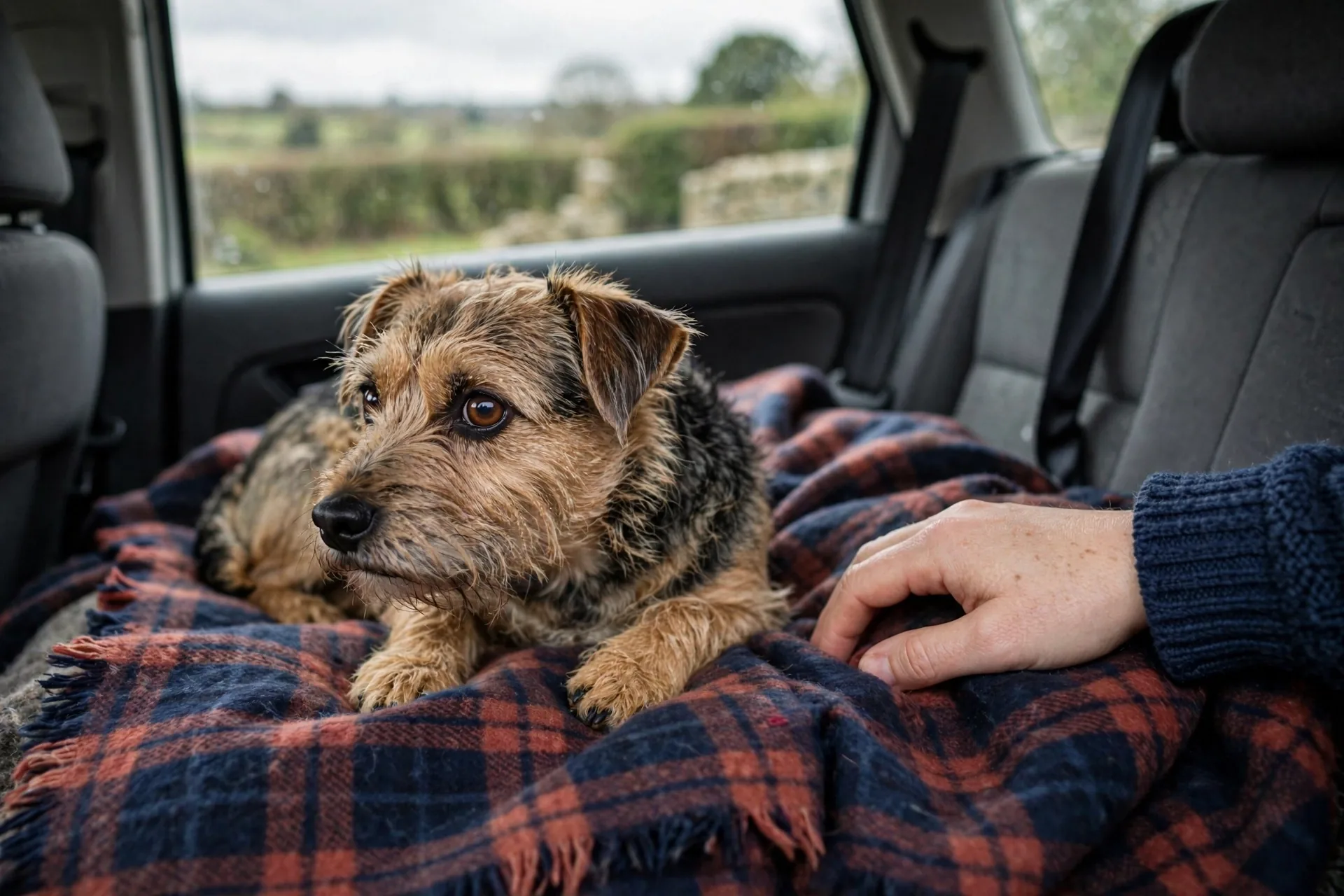
Stage one is the stationary car. Place the crate in the car exactly as it will travel, with the same bed and blanket, and let the dog enter with the engine off and the doors open. Give a chew, sit nearby, and let the dog leave when it wants. Repeat until the dog enters the car crate willingly. Stage two is the stationary car with doors closed and the engine running for a few minutes, while you sit in the driver's seat and the dog has a chew. Watch for drooling, lip licking, yawning or restlessness, which can signal early travel sickness as well as stress, and keep these sessions short.
Stage three is motion in tiny doses. Drive around the block, or to the end of the street and back, and then return home for a calm settle and a treat. Build to a five-minute drive, then ten, then twenty, choosing smooth routes at first and avoiding winding lanes if your dog is prone to sickness. End each drive with something pleasant, such as a short sniffy walk, so the car predicts good outcomes rather than only vet visits or long journeys. If the dog is sick, keep the car cool, avoid feeding a large meal immediately before travel, and ask a vet about travel sickness options rather than simply repeating longer drives and hoping the dog gets used to it.
During week three, also practise the practical details that cause stress on travel day. Load and unload the crate calmly, practise securing it so it does not slide, and rehearse opening the car door without the dog rushing out. Teach a wait at the crate door: the dog waits for the release word before exiting, which prevents bolting into a car park or service station. Practise at home first, then in the car, then in a quiet car park. A dog that bursts out of a crate in a busy place is at risk, and the habit is far easier to build in a driveway than on a motorway service area.
For dogs that travel by train or ferry rather than by car, adapt the same stages. Practise the crate in a hallway, then in a garden, then in a busier environment, then on a short local journey if the operator allows it. Check the operator rules before you travel, because crate and carrier requirements vary, and a crate that is acceptable in a car may not be the right carrier for a train. Our guide to calming anxious dog travel covers stress signals, settling routines and kit that helps nervous travellers, and it is a useful companion to this week if your dog is already showing anxiety.
Week 4: dress rehearsals
Week four is the rehearsal week. Instead of adding new skills, you combine everything the dog has learned into realistic, but still controlled, versions of the real trip. The aim is to discover problems while you can still fix them at home, not on the first night of a holiday.
Run a full morning rehearsal. Pack the car as you will for the trip, settle the dog in the crate, drive for the length of your longest planned leg, stop for a toilet break and water, and then drive home. Note what went wrong: did the crate slide, did the bed bunch up, did the dog need a toilet break sooner than expected, did you forget water, did the dog bark at a particular point? Fix one thing at a time and repeat the rehearsal. A second rehearsal later in the week, with a different route or a stop at a new place, tests whether the dog generalises the skill or only settles on a familiar road.
Rehearse the arrival as well. Set the crate up in a different room, or at a friend's house if the friend agrees, and practise the arrival routine: toilet walk first, then a calm settle in the crate, then a short exploration on lead, then a rest. Dogs often arrive over-aroused, and a rehearsed arrival routine prevents the first hour from becoming a free-for-all. Practise the evening routine too: last toilet break, a chew in the crate, lights low, and a calm settle. If the dog will sleep in the crate on holiday, it should already have slept in the crate at home, not for the first time in a strange room.
Include a service-station rehearsal if you can. Drive to a quiet car park, practise a toilet break on lead, offer water, and settle the dog back in the crate before driving on. Many dogs are fine for the first leg and unsettled after a break, because the break raises arousal and the return to the crate feels like a new confinement. Practising that transition makes it ordinary. Also practise a short alone period in the car crate with the engine off in a safe, cool place, only for the brief time you might need on a real trip, and never in heat. The point is to teach the dog that a pause is not an abandonment, not to test how long the dog can wait.
By the end of week four, you should have a dog that enters the crate willingly, settles with the door closed at home and in the car, travels for your planned leg length without sustained distress, and recovers quickly after stops. If you have that, the dog is ready for a real trip, starting with a shorter one if possible. If you have a dog that manages most steps but not all, take the real trip in a reduced form: a shorter drive, a single night, or a stay with a friend rather than a hotel. A successful short trip builds more confidence than a long trip that unravels.
When it stalls: troubleshooting the common sticking points
Most crate training problems fall into a small number of patterns, and each has a different fix. Guessing the wrong fix, such as leaving a barking dog to "cry it out", usually makes the problem worse. Work through the pattern that matches your dog, and change one variable at a time so you can tell what helped.
Won't enter at all. Check the basics first: is the crate large enough, is the floor slippery, is the door swinging, is the crate in a draughty or isolated spot? Move the crate to a social room, remove the door temporarily, put the dog's usual bed inside, and feed meals progressively closer to and then inside the crate. For very reluctant dogs, a larger crate, a different entrance, or a crate with a side door can change the picture. If the dog has a history of confinement distress, do not force entry.
Enters for food, leaves immediately. This is normal in week one, not a failure. The dog has not yet learned that staying is rewarding. Use a long-lasting chew or a stuffed food toy rather than a handful of treats that vanish in seconds, and sit nearby so staying feels social. Shorten sessions rather than blocking the exit. Over several days, the dog should start to stay longer after the food is finished.
Barks or whines when the door closes. Go back to a shorter closed-door time and rebuild. Open the door before the barking starts, not after a barking bout, so the dog learns that calm behaviour opens the door. Check whether the dog needs a toilet break, water, exercise or a chew, because a dog that is bursting, thirsty or under-exercised will struggle to settle for any reason. If barking is intense, sustained, or accompanied by panting, drooling, scratching, or attempts to escape, stop and seek professional advice. That pattern suggests distress or separation-related behaviour, not simple protest, and it needs a different plan.
Chews bedding or the crate itself. Remove loose bedding that can be shredded and swallowed, and provide a safe chew instead. Check whether the dog is bored, under-exercised, teething, or anxious, because chewing has many causes. A tired dog with a suitable chew is less likely to destroy bedding than a dog that has been crated straight after a day indoors. Never leave a dog unsupervised with a chew that can break into pieces, and check the crate for sharp edges after any chewing episode.
Toilets in the crate. First, rule out a medical cause and check whether the session was too long for the dog's age and bladder control. Puppies, older dogs and dogs with medical conditions need more frequent breaks. Keep a toilet routine before every crate session, clean accidents with an enzymatic cleaner so the scent does not invite repetition, and avoid a crate so large that the dog can toilet in one corner and sleep in another. A divider can help while a puppy grows.
Settles at home, panics in the car. This usually means the car steps were rushed or travel sickness is involved. Return to stationary car practice, check ventilation and temperature, and build drive length slowly. A dog that drools, vomits or becomes lethargic in the car should be assessed for travel sickness, because no amount of crate training will fix nausea. Similarly, a dog that settles in a familiar car but not in a hire car or a friend's car may need a few short practice drives in the new vehicle.
Regresses after a holiday or a break. Regression is common and not a reason to start again from scratch. Return to the last step where the dog was relaxed, rebuild for a few days, and then progress again. A stressful journey, a stay in a noisy hotel, or a period without crate use can all loosen the habit. Short, successful refresher sessions usually restore it faster than the original training took.
Travel day: the crate checklist
On travel day, the crate should be the least exciting part of the journey. Exercise the dog first with a walk that includes sniffing and a toilet break, offer a small meal well before departure rather than a large meal immediately before a long drive, and settle the dog in the crate with its familiar bed and a safe chew. Secure the crate so it cannot slide or tip, check ventilation, and keep the car at a comfortable temperature before the dog gets in. Never leave a dog in a parked car in warm weather, even with a window open, because temperatures inside a car can rise dangerously quickly. Check the official guidance before you travel if you are unsure about the rules that apply to leaving a dog in a vehicle.
Plan stops before you set off. As a general guide, stop every two hours for a toilet break, water and a short stretch, and more often for puppies, older dogs and dogs prone to sickness. Keep stops calm: lead on before the crate door opens, toilet walk first, water second, and a brief settle back in the crate before driving on. Avoid motorway service areas with busy dog areas if your dog is reactive, and choose a quieter corner for the break. Carry water and a collapsible bowl, and offer small amounts frequently rather than a large drink all at once after a long dry leg.
Watch the dog during the journey, not just at stops. A dog that starts panting heavily, drooling, whining continuously, or trying to escape may be hot, sick, distressed or in pain. Stop safely as soon as you can and assess the situation. Do not be tempted to open the crate while driving, or to let the dog travel loose because it seems happier that way. A loose dog in a moving car is a safety risk for everyone, and a dog that has learned to settle in a crate will usually recover after a calm stop and a toilet break.
Crates in hotels, lets and campsites
Setting the crate up correctly on arrival makes the whole stay easier. Choose a quiet corner away from the front door and the main walkway, with the same bed and blanket the dog used at home. Put the crate up before the dog explores the whole property, so the dog has a familiar base from the start. Give a toilet walk first, then a calm crate settle, then a short on-lead exploration. That order prevents the dog from rehearsing a frantic arrival and gives the dog a place to return to when the new room becomes overwhelming.
Check the property rules in writing before you book. Some hotels and parks allow crated dogs to be left for a short period, some prohibit unattended dogs entirely, and some require the dog to be crated whenever the owner is out. Those rules affect your whole itinerary, because a property that prohibits leaving the dog alone means someone must stay with the dog or the dog must come along. Ask about the rule, the maximum alone time, and whether the crate counts as an acceptable arrangement, and keep the answer with your booking confirmation.
Keep the home routine as far as possible. Same feeding times, same last toilet break, same bed, same release word, and the same evening wind-down. Dogs read routine as safety, and a holiday that preserves the home routine is far less disruptive than one that changes everything at once. If the dog sleeps in the crate at home, keep that arrangement on holiday rather than inviting the dog onto a hotel bed for the first time. If the dog does not sleep in the crate at home, do not start that habit on holiday.
What to pack with the crate
Pack the crate as a kit, not as a single item. The kit should include the crate itself, its bed or vet bedding, a spare cover or blanket, a familiar-smelling item from home, a safe chew or a stuffed food toy, a clip-on water bottle or a collapsible bowl, poo bags, an enzymatic cleaner, a spare lead, and any medication the dog needs. Add a towel for muddy paws and a small torch for night-time toilet breaks. If the crate folds, practise folding and unfolding it at home, because a fiddly crate in a rainy car park is a poor start to a stay.
Keep a copy of the essentials where you can reach them without unpacking the car. Vet contact details, vaccination records, insurance information and any medication instructions should travel in the cabin, not in the boot under luggage. A short written note of the dog's routine, feeding amounts and crate cues is also useful if someone else looks after the dog during the trip. For a fuller list, our travel documents checklist covers the paperwork to carry on every UK trip.
Finally, give yourself permission to adjust the plan. A dog that has learned to love its crate is a more relaxed travelling companion, but the crate is there to support the trip, not to dictate it. If a particular journey is too long, a particular property is too noisy, or a particular day is too hot, change the plan. The four weeks of training have given you a dog that can settle in a familiar space, and that flexibility is worth more than any single itinerary.
Practical questions
Before you go
How long does crate training a dog for travel take?
Four weeks is a realistic starting point for many dogs, but it is not a guarantee. Confident puppies may progress faster, while nervous adults, rescue dogs and dogs with a history of confinement problems may need six to eight weeks. Judge progress by calm behaviour at each stage, not by the calendar, and repeat a week rather than pushing a worried dog into the next one.
Should the crate door stay open during the first week?
Yes. In the first week the door should stay open and the dog should be free to walk in and out at any time. The aim is to build a positive association with the crate as a place, before the dog ever has to cope with a closed door, a moving car or a new room. Closing the door too early is one of the most common reasons crate training stalls.
What size crate does my dog need for car travel?
The dog should be able to stand up without crouching, turn around comfortably and lie down stretched out, but the crate should not be so large that the dog slides around in the car. Measure your dog standing and lying down, check the maker's size guide, and then check the crate against your boot or back seat before you buy. A crate that fits at home does not always fit in the car.
Is it safe to leave a dog in a crate overnight on holiday?
Only if the dog is already comfortable being crated at home for a similar length of time, has had a toilet break and water, and the room is at a safe temperature. A crate does not make a long absence safe or fair, and many hotels and parks set their own rules about unattended dogs, so check the property rules in writing before you book. If your dog is distressed when left, change the plan rather than relying on the crate.
What should I do if my dog barks every time the crate door closes?
Go back to a shorter closed-door step and rebuild more slowly. Close the door for a few seconds, reward calm behaviour, open it before the barking starts, and increase the time only in small steps. If barking is intense, persistent or accompanied by panting, drooling, scratching or attempts to escape, stop and seek advice from a qualified behaviour professional, because the dog may be distressed rather than simply protesting.
Can an older dog or a rescue dog learn to use a crate for travel?
Often yes, but expect a slower pace and more repetition than with a confident puppy. Older dogs may need a lower threshold, a ramp and extra joint support, while rescue dogs may need more time simply to trust that the door will open again. Keep sessions short, keep the crate in a social room, and let the dog set the pace. If a dog has a known history of panic in enclosed spaces, ask a vet or behaviour professional before starting.