This guide is independent and contains no paid placement. If affiliate links are added later, they will be clearly marked and will not change our editorial checks.
Truro is Cornwall's only city and one of the smallest cities in Britain, which is exactly why it works so well with a dog: the cathedral, the River Fal, Victoria Gardens, the markets and the main streets sit within a compact, walkable centre. Dogs are generally welcome on leads around the cathedral green and inside the cathedral, on the riverside paths and in the covered Pannier Market, and many cafes and pubs offer outdoor seating where dogs are welcome. Plan around the car parks and park-and-ride, keep the dog on a lead in the gardens and near the river, and check the official guidance before you travel, because market days and cathedral opening arrangements can change.
Truro from the spires down
Truro announces itself twice. First come the three spires of the cathedral, rising above the rooftops long before the city itself comes into view, and then comes the river: the Fal, formed where the Kenwyn and the Allen meet at the foot of the city and running out towards the sea at Falmouth. That pairing — a Gothic cathedral on a hill and a tidal river at its feet — sets the shape of every dog-friendly day here. The high ground belongs to the cathedral and its green, the low ground belongs to the river paths and the gardens, and the streets between them hold the markets, the shops and the cafes. Nothing is far from anything else, which is the single most useful fact about Truro for anyone travelling with a dog.
Truro is Cornwall's only city and one of the smallest cities in Britain, and its size is a genuine advantage rather than a limitation. A dog that finds big-city centres stressful — the traffic, the crowds, the long distances between green spaces — usually copes well here, because the walk from the cathedral to the river takes minutes rather than miles, and there is always a quieter street one turn away from a busy one. The city grew up as a port and a market town, and its centre still feels like a market town that happens to have a cathedral: narrow lanes, Georgian terraces, small squares and sudden views of the spires at the end of a street. That is a pleasant place to walk a dog, provided you treat it as a town walk rather than a countryside ramble and keep the lead short on the pavements.
Orientation is simple once you know the three anchors. The cathedral stands at the top of the centre, with its green and the High Cross in front of it. From there, Boscawen Street and River Street run down towards Lemon Quay and the river, passing the shops and the market hall on the way. Victoria Gardens sits just below the cathedral, between the city and the water, and Boscawen Park stretches along the river to the south. If you can find the spires you can find your way back to the car, which is worth remembering on a first visit: the cathedral is visible from most of the centre, so a lost owner only has to look up. Dogs notice the spires too, in their own way — the green in front of the cathedral is one of the few open spaces in the centre where a dog can pause, sniff and watch the city go by without blocking a pavement.
A practical day in Truro with a dog tends to follow the slope of the city. Start at the top, on the cathedral green, while the morning is still quiet and the light is good. Walk down through the gardens and along the river while the dog still has energy, then come back up into the markets and the streets for food and shopping once the dog has had a proper walk. The river loop is the dog's part of the day; the market is the owner's part, with the dog along for the ride. Trying to do it the other way round — shopping first, walking second — usually means a restless dog in a crowded market hall and a rushed walk at the end. Truro rewards the owner who walks the dog first and shops second.
There are a few city-centre habits worth adopting before you arrive. Keep the dog on a short lead on Boscawen Street, River Street and Lemon Street, where the pavements narrow and shoppers stop without warning. Carry water, because the centre has few natural water sources for a dog and a summer day in a stone city is warmer than it looks. Bring a mat or a blanket for cafe stops, so the dog has a defined place to settle rather than sprawling across a walkway. And plan your toilet stops: the riverside paths and Boscawen Park are the sensible places for a dog to relieve itself, not the cathedral green or the flower beds of Victoria Gardens, where the planting and the footfall make it inconsiderate. Pick up after your dog everywhere, and carry more bags than you think you will need, because the bins in the centre are not always where you expect them.
The time of year changes the city more than its size suggests. Spring and autumn are the easiest seasons for a dog: mild weather, thinner crowds and market stalls spilling onto Lemon Quay without the summer crush. Summer brings the busiest Saturdays, when the pavements around the market and the river fill up and a nervous dog will find the centre hard work; an early start makes a real difference, and the gardens are quietest before ten in the morning. Winter is quiet and often wet, and the low riverside paths can flood after heavy rain, so check the official guidance before you travel and be ready to swap the river loop for the higher streets if the paths are under water. Christmas brings a different kind of crowd, with the cathedral and the markets at their busiest, and a dog that dislikes crowds is better left to the morning and the open spaces.
Before setting off, a short packing list saves more trouble in Truro than in a larger city, because the centre's shops are small and a dog's needs are easy to forget among the stalls. Pack a lead and a spare, a collapsible water bowl, drinking water, poo bags, a towel for muddy paws, a mat for cafe stops and a chew to keep the dog occupied at the table. A harness is a better choice than a collar on the steep walk up from the river to the cathedral, because a dog that pulls on a collar on a slope will strain its neck, and a harness gives you more control on the narrow pavements. Bring a coat for the dog in winter, because the wind along the river is colder than the temperature in the sheltered streets, and bring a drying coat or an old towel in the car for the journey home, because a dog that has walked the riverside path in the rain will be wet through. None of this is heavy, all of it fits in a day pack, and every item on the list has saved a Truro visit from ending early.
The cathedral and its green
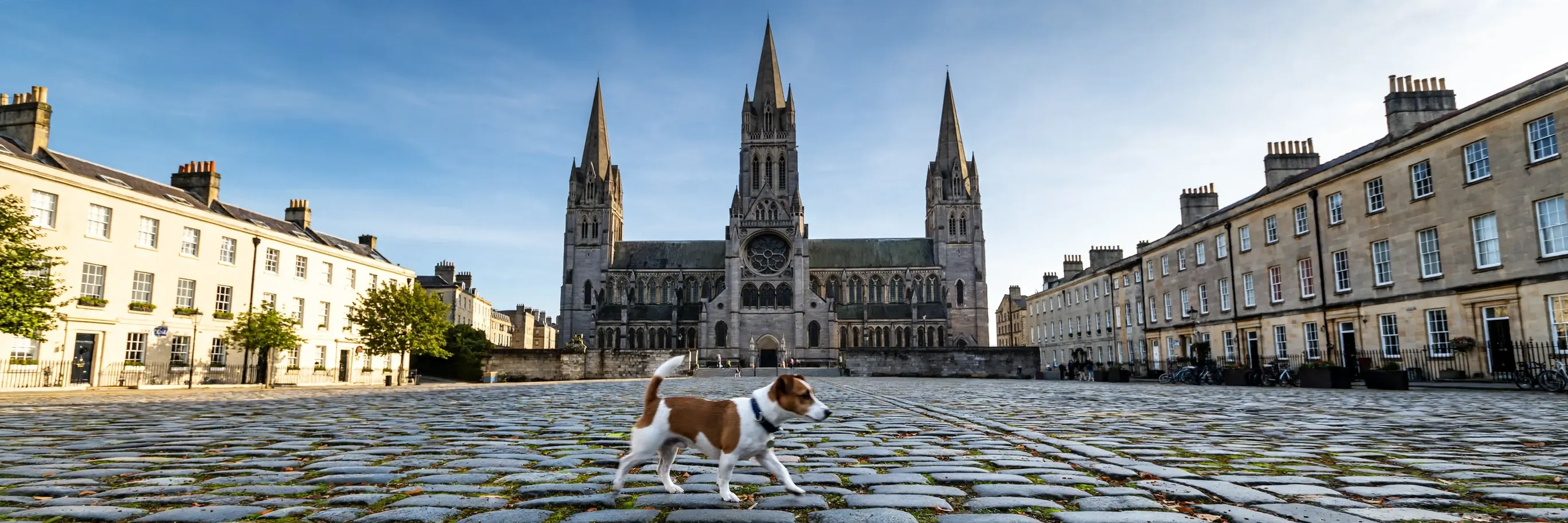
Truro Cathedral dominates the city for a good reason: it was built to be seen. Constructed between 1880 and 1910 on the site of the old parish church of St Mary's, and designed by the architect John Loughborough Pearson in the Gothic Revival style, it is a Victorian cathedral with three spires — two western towers and a tall central spire — that give Truro its unmistakable skyline. The building is made of local stone, pale and warm in morning light, and its size surprises first-time visitors: it is a proper cathedral, not a large parish church, and it anchors the whole city around it. For a dog owner, the cathedral is not just a sight to admire from the pavement; it is the starting point of the day, the meeting point if a group splits up, and the most reliable piece of shade and shelter in the centre.
Dogs are generally welcome inside Truro Cathedral on a lead, which puts it among the more dog-friendly cathedrals in Britain. Water is usually available for dogs, and the staff and volunteers are used to visitors arriving with a dog in tow. That welcome comes with an obvious condition: the cathedral is a working church, not a tourist attraction that happens to hold services. Keep the dog close to you, keep the lead short, and keep the dog quiet. If a service is in progress, wait outside or sit at the back and leave promptly if the dog becomes restless. Weddings, funerals and special events take priority over sightseeing, and on those days parts of the building may be closed to visitors. A well-behaved dog on a lead is welcome; a dog that barks during a service is not, and the distinction is entirely down to the owner.
The green in front of the cathedral is the more useful space for most dogs. It is open, level and grassy, with benches and a view of the spires, and it works as a rest stop, a meeting point and a place to let a dog sniff and settle before the busier streets. Keep the dog on a lead here: the green sits beside roads and footpaths, and it is used by everyone from office workers eating lunch to wedding parties posing for photographs. Do not let the dog dig, chase pigeons or relieve itself on the green, and pick up immediately if it does. The green is at its best early in the morning, before the city fills up, when the light catches the stone of the west front and the dog can have the space more or less to itself. Late afternoon, when the sun drops behind the spires, is the other quiet window.
Inside, the visit is worth doing slowly. The nave is long and light, the stonework is warm, and the three spires are echoed in the vaulting overhead. The cathedral's size makes it easy to keep a dog out of other people's way: choose a quiet aisle, keep the dog beside you rather than trailing behind on a long lead, and avoid blocking the central walkway. If your dog is large, nervous or excitable, a short visit is better than a long one — look at the nave, the font and the west front, and save a longer look for a day when you can visit without the dog. Some visitors find that a dog that has already had its walk settles happily for twenty minutes inside; a dog that has been in the car all morning will not, and no cathedral is improved by a frustrated spaniel.
A few practical points make the difference between a smooth visit and an awkward one. Check the cathedral's opening times before you travel, because services, concerts and events can change them, and the building is not open all day every day in the way a shop is. If you are visiting at Christmas, Easter or during a festival, expect crowds and consider whether the dog would be happier on the green or on the river path instead. The cathedral's cafe and shop have their own arrangements, so ask staff before taking a dog into a seating area rather than assuming the same welcome applies everywhere in the building. And remember that the cathedral is a place of quiet: a dog that barks at strangers, children or other dogs is better walked around the green and the gardens than taken inside, however keen the owner is to see the interior.
The streets immediately around the cathedral are worth a slow walk in their own right. The High Cross, the Georgian houses of the surrounding streets and the view down towards the river give a sense of the city that the shopping streets do not. The pavements here are wider and quieter than on Boscawen Street, which makes them a good place to let a dog settle into the rhythm of the city before tackling the busiest stretch. From the green, the walk down to Victoria Gardens takes only a few minutes, and it is the natural next step: cathedral first, gardens and river second, markets third. That order works because it follows the city downhill, and because a dog that has sniffed the green and walked the gardens is a calmer companion in a market hall than one that has been waiting in the car.
The Fal and Victoria Gardens
Below the cathedral, Truro changes character completely. The stone streets give way to water and green space, and the River Fal — tidal this far inland, rising and falling with the sea at Falmouth — sets the pace. The river is the reason Truro exists as a port city, and it is also the reason the city has such good dog walking so close to its centre. Victoria Gardens, Boscawen Park and the riverside path towards Malpas form a connected chain of green space that runs along the water, and a dog that has spent an hour on the pavements will visibly relax the moment the path turns onto grass beside the river.
Victoria Gardens is the first stop, and the most formal of the three. Laid out beside the river between the cathedral and the water, the gardens are a place of lawns, flower beds, mature trees and winding paths, with benches at regular intervals and views back up to the cathedral spires. Dogs are welcome on a lead, and the gardens suit a slow, sniffing walk rather than a run: the planting is dense, the paths are narrow in places, and the beds are not a place for a dog to trample or dig. Keep the dog on the paths, keep the lead short near the flower beds, and use the lawns at the edges for a pause rather than a game of fetch. The gardens are at their best in spring, when the bulbs are out and the trees are coming into leaf, and in autumn, when the colour turns and the crowds thin. In summer they are a welcome patch of shade in a stone city, and the benches by the river are a good place to sit with a coffee while the dog watches the water.
Boscawen Park, a short walk downstream, is the more practical dog-walking ground. It is a larger, more open riverside park to the south of the centre, with playing fields, open grass, a playground and a path that follows the river. This is where local owners bring their dogs for a proper walk, and it shows: the park has the worn paths, the thrown balls and the familiar dogs that mark a well-used piece of green space. Dogs with reliable recall can be let off the lead on the open ground here, provided they stay away from the sports pitches when games are in progress and away from the river itself. Keep a close eye on any dog near the water, because the Fal is tidal and the current is stronger than it looks, and the banks are muddy at low tide. A dog that goes in after a ball may come out coated in estuary mud, so this is not the place for a white dog on the way to a cafe.
The riverside path from the city towards Malpas is the walk to choose if you have half a day rather than half an hour. Malpas is a small village down the river, about two miles from the city centre along a path that follows the Fal through fields and riverside trees, and the walk there and back makes a satisfying half-day outing with a dog. The path is mostly level and easy underfoot, with views across the tidal river to the woods on the far bank, and Malpas itself has a pub and a riverside feel that makes a natural turning point. Take water for the dog, because there is little shade on the open stretches and no reliable drinking water along the way, and check the official guidance before you travel if there has been heavy rain, because low-lying sections of the path can flood. The return walk is the same route, which some owners find repetitive; the alternative is to walk out along the river and come back through the lanes, which gives the dog a change of scenery and a quieter road walk.
River safety deserves a paragraph of its own, because the Fal at Truro is not a gentle stream. It is a tidal river, which means the water level rises and falls twice a day, the current changes direction, and the muddy banks that look solid at low tide can be soft and deep. Never let a dog swim in the river near the city, and never throw a ball or a stick into the water, however keen the dog is to fetch. Dogs that fall in can struggle against the current, and the banks are steep and slippery in places, which makes it hard for a dog — and harder still for an owner — to climb out. The same caution applies to the smaller streams that join the Fal in the city: they look harmless, but after rain they run fast and the stone edges are slippery. Keep the dog on a lead near the water unless you are on open ground with a clear view and a reliable recall, and keep a towel in the car, because a dog that has found the mud will need it.
The river also connects Truro to the rest of the Fal estuary, and that connection is worth knowing about for a longer stay. Downstream, the river widens into the estuary at Falmouth, where the harbour walks, the ferry to St Mawes and the beaches offer a very different kind of day out with a dog. Our guide to Falmouth with a dog covers the harbour, the ferry and the seasonal beach rules, and it pairs naturally with a Truro visit: city one day, harbour the next, with the river running between them. The contrast is the point — Truro is a cathedral city on a river, Falmouth is a harbour town on the sea, and the Fal ties them together. If you are staying in Cornwall for a few days, the two make a good pair, and the drive between them follows the river valley for much of the way.
Wildlife is part of the riverside walk, and a dog owner should expect it rather than be surprised by it. Herons stand in the shallows at low tide, ducks and moorhens work the banks, and swans are a regular sight on the wider stretches of the river. A dog that chases birds will need a firm recall or a lead on the open stretches, because the birds are protected and the river is their home, not a playground. Squirrels work the trees of Victoria Gardens and Boscawen Park, and a squirrel-chasing dog on a long lead in the gardens is a hazard to other walkers. Keep the lead short where the trees overhang the path, and teach the dog that the river's birds are for watching, not for chasing. The reward for that discipline is a walk where the dog can enjoy the smells of the estuary — the mud, the salt, the river weed — without disturbing the wildlife that makes the Fal what it is.
Markets and independent shops
Truro's claim to be a market city is not a slogan; it is the daily reality of the centre, and it is the part of a visit that most owners enjoy once the dog has had its walk. The city has held markets for centuries, and the two that matter most to a visitor with a dog are the covered Pannier Market and the outdoor farmers' market on Lemon Quay. Both are dog-friendly in the practical sense — dogs on leads are welcome among the stalls — and both reward a slow browse rather than a quick pass. The trick is timing: arrive early, walk the dog first, and shop when the dog is calm and tired rather than fresh and pulling.
The Pannier Market is a Victorian covered market hall in the heart of the city, and it is one of the most characterful shopping spaces in Cornwall. Inside, stalls sell local produce, Cornish food, crafts, clothes, books and antiques, and the hall itself — iron, glass and stone, with light falling through the roof — is worth seeing even if you buy nothing. Dogs on leads are generally welcome in the hall, and most stallholders are used to them, but the space is narrow in places and busy on Saturdays, so keep the lead short and the dog close to your leg. Watch for dropped food around the food stalls, which will interest every dog in the building, and be ready to step aside into a wider part of the hall if the dog becomes overwhelmed. Some individual stalls, particularly those selling food, may ask dogs to wait outside their counter area, so watch for signs and ask the stallholder if you are unsure. The market is at its liveliest on Saturdays and quieter on weekday mornings, and a weekday visit is the better choice for a nervous dog.
The farmers' market on Lemon Quay is the outdoor counterpart, held on the open quayside by the river, usually on Wednesdays and Saturdays. Producers from across Cornwall bring vegetables, cheese, bread, meat, fish, plants and ready-to-eat food, and the stalls change with the seasons, so a market in October looks very different from one in June. Dogs on leads are welcome around the outdoor stalls, and the open air makes it easier than the covered hall for a dog that dislikes enclosed spaces. The same rules apply: short lead, watch for dropped food, and keep the dog out of the way of other shoppers. The quayside itself is worth a look even on a non-market day — it is one of the few places in the centre where you can stand beside the water and watch the river, and the wide open space gives a dog room to breathe after the narrow streets. Check the official guidance before you travel for current market days, because they can change around holidays and events.
Beyond the markets, Truro's shopping streets are unusually rich in independent shops, and that is where the city earns its reputation. Boscawen Street, River Street and Lemon Street hold a mix of independent retailers, bookshops, delicatessens, jewellers, clothes shops and gift shops, alongside the familiar high-street names, and many of the independents welcome dogs inside. The rule is to look for the sign — a water bowl by the door, a "dogs welcome" notice in the window, a treat jar on the counter — and to ask if there is no sign. Staff in independent shops are generally happy to say whether a dog can come in, and a polite question costs nothing. A small dog that can be carried is welcome in more places than a large one, and a dog that settles by the door is easier to accommodate than one that pulls towards the shelves. If a shop does not allow dogs inside, one person can browse while the other waits outside with the dog, which is one of the advantages of visiting as a pair.
Shopping with a dog has its own etiquette, and Truro's narrow streets make it more important than in a shopping centre. Keep the lead short and on the side away from the shopfronts, so the dog does not block the pavement or trip a passer-by. Do not let the dog sniff the produce on an outdoor stall, and do not let it drink from a water bowl that belongs to another dog without asking. Carry the shopping in a bag rather than in your hands, so one hand is always free for the lead. And keep the shopping trip short: a dog that has already walked the river and the gardens will tolerate an hour in the shops, but a dog that has been waiting all morning will not. The best shopping in Truro is done slowly, stall by stall, with the dog beside you — and the best souvenir is usually something edible, bought from a producer who is happy to tell you where it came from.
One place to note for its different rules is the Royal Cornwall Museum, just off River Street, which holds the county's collections of Cornish history, art and natural history. Museums generally do not admit dogs except assistance dogs, and the museum is no exception to that pattern, so plan to visit it without the dog or to take turns. Check the official guidance before you travel for the current policy, because it can change. The museum is worth the visit on a longer stay, but it is not a dog activity, and trying to combine it with a dog's day out usually means one of the two is rushed. The same applies to the larger chain stores and the indoor shopping areas: dogs are welcome in some and not in others, and the only reliable approach is to check the sign on the door and ask the staff.
The seasons show in the market stalls more clearly than anywhere else in the city, and a repeat visit at a different time of year is a different experience. Spring brings bedding plants, early vegetables and the first of the year's flowers; summer brings soft fruit, Cornish new potatoes and the busiest stalls; autumn brings apples, pumpkins, game and the harvest produce that fills the Pannier Market with colour; winter brings Christmas wreaths, local gin and cheese, and the stalls that sell the ingredients for a Cornish Christmas. A dog will notice the change too, mostly through the smells — a market in October smells of apples and woodsmoke, a market in June smells of strawberries and cut flowers — and a dog that has walked the river first will enjoy the market as a long sniffing session rather than a chore. If you are buying food to take home, choose the things that travel well and that you cannot buy at home: a Cornish cheese, a jar of local chutney, a loaf from a market baker. They are the souvenirs that taste of the place, and they are the reason the markets are worth a slow morning.
Cafes, pubs and restaurants
Eating out with a dog in Truro is easier than in many British cities, and the reason is the same as everything else about the city: it is small, the streets are walkable, and the outdoor seating is plentiful. The cafes and pubs of the centre are used to dogs, and many of them put out water bowls, keep a jar of treats behind the counter and have a regular crowd of four-legged customers. The best approach is to treat the dog as a guest that needs a plan, not as an accessory that will sort itself out: choose a place with outdoor seating or a dog-friendly interior, arrive with a tired dog, and settle the dog with a mat and a chew before you order. A dog that has walked the river and the gardens will sleep through a long lunch; a dog that has not will spend it pulling at the lead.
The outdoor seating is the key to a relaxed meal. Lemon Quay, River Street and Boscawen Street all have cafes and pubs with tables outside, and in good weather these fill up with people and their dogs, which creates a social, forgiving atmosphere. A table at the edge of a terrace is better than one in the middle: the dog has a wall or a railing behind it, fewer people pass behind it, and it can settle without being stepped on. In cooler weather, look for covered seating, a windbreak or a spot in the sun, because a dog that is cold and draughty will not settle. Some pubs have a beer garden or a courtyard behind the building, which is quieter than the street and better for a nervous dog, and it is worth asking whether there is one before you sit down. The riverside pubs, a short walk from the centre, offer the same thing with a view of the water, and they make a good end to a walk along the Fal.
Some cafes and pubs welcome dogs inside as well, and these are the places to know about in bad weather. The signs to look for are a water bowl inside the door, a dog bed in the corner, or a notice in the window saying dogs are welcome. When a place welcomes dogs indoors, the etiquette is straightforward: keep the dog on the floor, keep it under the table, and keep it from greeting every other table. Bring a mat so the dog has its own place, and a chew or a stuffed toy to keep it occupied while you eat. Do not feed the dog from the table, do not let it beg from neighbouring tables, and do not leave it tied up outside while you eat inside — a dog left alone outside a cafe is a dog that will bark, and a barking dog outside a cafe is a problem for everyone. If a cafe does not allow dogs inside, take the food away instead: a Cornish pasty eaten on a bench by the river, with the dog beside you, is often a better lunch than a formal meal indoors.
The food itself is part of the pleasure of eating in Truro, and the city's position in Cornwall shows in what is on offer. Bakeries sell Cornish pasties, saffron buns and local bread; delicatessens sell Cornish cheese, chutneys and cured meats; cafes serve cream teas, crab sandwiches and locally caught fish. A takeaway pasty is the most dog-friendly meal in the city: buy it, walk to the river or the gardens, and eat it on a bench while the dog has a sniff and a rest. Pubs serve the fuller meals — Sunday roasts, fish and chips, Cornish ale — and the ones with gardens are the best choice for a longer stop. For a practical guide to the etiquette of eating out with a dog anywhere in Britain, including how to settle a dog indoors and what to ask before you sit down, our guide to dog friendly cafes in the UK covers the ground in detail, and it is worth reading before a trip that involves several cafe stops.
Breakfast is the easiest meal of the day with a dog, because the city is quiet, the cafes are empty and the dog is usually at its most settled. A coffee and a pastry on a terrace at nine in the morning, after a walk on the river, is a calm start that sets the tone for the day. Lunch is the busiest meal, and the terraces fill up around midday, so a dog that dislikes crowds will do better with an early lunch or a takeaway eaten by the water. Dinner is the hardest meal, because the evening crowd is different — louder, later, and less tolerant of a dog under the table — and a dog that has had a full day will often be happier back at the accommodation than in a busy restaurant. The practical rule is to make breakfast and lunch the dog's meals out, and to keep dinner simple: a pub garden if the dog is settled, or a takeaway eaten together at the place you are staying.
A few habits make eating out with a dog work smoothly in any city, and Truro is no exception. Always ask before bringing a dog into a place, even if the sign says dogs are welcome, because policies change and a particular day — a busy Saturday, a private event, a health inspection — can change the answer. Keep the lead short and the dog close, and never let the dog wander between tables on a long lead. Carry water for the dog, because a cafe's water bowl may be empty or may belong to another dog. Bring a mat, a chew and a few treats, and use them: a dog that is busy with a chew is a dog that is not barking. And be ready to leave: if the dog cannot settle, the kindest thing for the dog, for the other customers and for you is to pay, take the food away and finish it by the river. No meal is worth a stressed dog, and Truro has plenty of benches with a view.
Stays and parking
Staying in Truro with a dog is a practical choice rather than a romantic one: the city is a good base, not a destination in itself, and its value is that it puts the cathedral, the river and the markets within walking distance, and the rest of Cornwall within a short drive. Dog-friendly places to stay in and around the city include hotels, bed and breakfasts, guest houses and self-catering cottages, and the choice between them depends on the dog you have. A hotel or a bed and breakfast suits a dog that settles well in a new room and is happy to be left for a short time while you eat; a self-catering cottage suits a dog that needs its own garden, a dog that barks at strangers in corridors, or a household with two or more dogs. Ask the same questions whichever you choose: how many dogs are allowed, whether there is a pet fee and how much it is, whether the dog can be left alone in the room and for how long, whether there is a garden or an enclosed area, and where the nearest practical toilet walk is after dark.
The location of the stay matters more than the building. A place in the centre puts the cathedral, the markets and the cafes on your doorstep, but it also means a dog that hears every passer-by, every delivery van and every late-night reveller. A place on the edge of the city — towards Malpas, Idless, Shortlanesend or the lanes to the south — is quieter, usually has more outdoor space, and puts the riverside paths and the countryside walks within reach, at the cost of a short drive or bus ride into the centre. For most dogs, the edge of the city is the better choice: the dog gets a garden and a quiet night, and the owner gets a five-minute drive to a car park in the morning. If you are staying in the centre, ask for a room away from the street and away from the stairs, and bring the dog's own bed and a familiar blanket, because a dog that can smell home settles faster in a strange room.
Staying outside Truro is also worth considering for a longer trip. The villages around the city, the coast at Falmouth and St Mawes, and the countryside towards St Austell and the south coast all offer dog-friendly places to stay, and Truro works well as a day out from any of them. The drive from Falmouth takes around half an hour, and the road follows the river valley for much of the way, which makes the journey itself part of the trip. If you are planning a stay on the south coast and want to combine a city day with a harbour day, our guide to Fowey with a dog covers the estuary town to the east, with its quay, its ferry and its coastal walks, and it pairs well with a Truro visit for a two-centre stay. The pattern is the same in both places: walk first, eat second, and let the dog set the pace.
Parking is the practical question every visitor asks first, and Truro's answer is straightforward: there are several central car parks, and there are two park-and-ride sites on the edge of the city. The central car parks — Moorfield, Garras Wharf and Lemon Quay are the best known, with others at Edward Street and Old Bridge Street — put you within a few minutes' walk of the cathedral, the markets and the river, and they are the right choice if you want to walk straight into the centre. They fill up on Saturdays and market days, so arrive early, and check the tariff and the time limit before you leave the car, because the limits vary and an overstay is an expensive mistake. The park-and-ride sites at Langarth, to the west, and Tregurra, to the east, are the better choice on a busy day: park outside the city, take the bus in, and avoid the hunt for a space altogether. The bus drops you in the centre, and the walk back to the bus at the end of the day is short.
A few parking habits are worth adopting. Never leave a dog in a parked car in warm weather, even for a few minutes and even with a window open — a car heats up far faster than most people expect, and a dog in a hot car is in danger. If you need to leave the dog in the car briefly in cool weather, park in the shade, leave the windows open a crack, and be back in minutes rather than hours, but the better rule is to take the dog with you whenever you can. Blue Badge holders should check the location of the accessible bays before arriving, because the centre is hilly and the walk from a distant car park to the cathedral involves a slope. Motorists arriving by train will find Truro station a short walk above the city centre; the walk down into the centre is easy, but the walk back up with a tired dog and shopping is a climb, so allow time for it. Check the official guidance before you travel for current car park tariffs, park-and-ride times and any roadworks, because all three change more often than the guidebooks suggest.
Getting to Truro is part of the planning, and the city is well connected for a Cornish town. The railway station sits on the main line from London Paddington to Penzance, with regular trains, and the bus station in the centre connects the city to Falmouth, St Austell, Newquay and the surrounding villages. Dogs are welcome on trains and buses in Britain, usually on a lead and at the owner's feet, and a dog that has travelled well will find the journey part of the adventure. If you are driving, the A30 is the main route into Cornwall, and the approach to Truro from the east or the west is straightforward. Whatever way you arrive, the first thing to do is the same: find the cathedral, find the river, and let the dog have a walk before you do anything else. Truro is a city that rewards a slow start, and a dog that has had its walk will enjoy the rest of the day far more than one that has been rushed from the car to the shops.
If something goes wrong during the visit, the city is well placed to cope. Veterinary practices in and around Truro cover routine and emergency care, so save the number of the nearest practice before you travel rather than searching for it in a crisis. The same goes for the simple things: a dog that has eaten something it should not have at a market stall, a paw cut on a rough path, or a dog that has rolled in something unpleasant by the river are all ordinary Truro problems with ordinary solutions, and a calm owner with a phone and a towel can deal with most of them. Keep the car keys, the water bowl and the towel in the same bag, so you are never hunting for them when the dog needs attention. A well-prepared visit to Truro is a quiet one, and a quiet visit is the one the dog remembers as a good day out.
Practical questions
Before you go
Can dogs go inside Truro Cathedral?
Yes, dogs are generally welcome inside Truro Cathedral on a lead, and water is usually available for them. The cathedral is a working church, so keep your dog close and quiet, avoid visiting during services, weddings or funerals, and check the official guidance before you travel, because arrangements for events and busy days can change.
Is Truro a good city for a day trip with a dog?
Yes. Truro is one of the smallest cities in Britain, and the cathedral, the River Fal, Victoria Gardens, the markets and the main shopping streets all sit within a compact, walkable centre. Most of a day out can be done on foot without moving the car, which suits dogs that settle better when the route is short and the stops are close together.
Where can I walk my dog off the lead near Truro?
Keep your dog on a lead in the city centre, in Victoria Gardens and on the cathedral green. Boscawen Park and the open ground along the riverside path towards Malpas are where local owners let settled dogs run, provided the dog has reliable recall and stays away from sports pitches, the tidal river and other walkers. Never let a dog swim in the Fal near the city, and check the official guidance before you travel.
Are dogs allowed in Truro's markets?
Dogs on leads are generally welcome in the covered Pannier Market and around the outdoor stalls on Lemon Quay, including the farmers' market. Markets get crowded on Saturdays, so keep the lead short, watch for dropped food, and check the signage at individual stalls, because some food counters ask dogs to wait outside. Check the official guidance before you travel for current market days.
Where should I park when visiting Truro with a dog?
Use one of the central car parks such as Moorfield, Garras Wharf or Lemon Quay if you want to walk straight into the centre, or use the Langarth or Tregurra park-and-ride sites and take the bus in. Arrive early on market days and Saturdays, check the tariff and time limit before you leave the car, and never leave a dog in a parked car in warm weather.