This guide is independent and contains no paid placement. Ferry times, beach restrictions and venue dog rules change, so where this guide flags a check, please confirm the latest official information before you travel.
Dog friendly Fowey in Cornwall works best when you plan around the water: stroll the quays on a short lead, cross by ferry to Bodinnick for the wooded Hall Walk to Polruan, walk south to Readymoney Cove after checking its seasonal dog rules, and use larger beaches nearby for a proper run. The town is steep, tides and currents in the estuary are strong, and parking sits mostly above the centre, so bring good shoes, a tide table and a towel.
The estuary sets the day
Fowey is not a town you simply wander into and improvise. It clings to the steep western bank of the River Fowey where the river meets the sea, facing Polruan across the water and looking upriver towards Bodinnick and the wooded creeks beyond. That geography explains almost everything a dog owner needs to know. The best walks start or end on a quay. Two different ferries shape the routes you can make. The beach inside walking distance is a small cove, not a wide strand. And nearly every return journey, whether from harbour, cove or car park, involves a climb.
None of that is a drawback. It is what makes a Fowey day feel distinct from a generic Cornish beach day. Instead of driving to one large beach and staying there, you move in short, varied stages: a harbour stroll while boats are loaded and unloaded, a five-minute ferry crossing that a dog experiences as a small adventure in itself, a shaded creekside path under oak and beech, then a different ferry or the same walk reversed to bring you home. Dogs who like novelty, sniffing and watching the world from a bench will be in their element. Dogs who need a long off-lead run every morning will need that need met deliberately, at a suitable beach or enclosed space outside the tight centre, rather than hopefully on a quay edge.
Start, therefore, by reading the day rather than the map alone. Check three things before you set out: the tide times, because coves shrink, creek paths change character and estuary mud appears and disappears with the tide; the ferry times in both directions, because a walk that depends on a crossing should never depend on the last sailing of the day; and the current beach restrictions for any cove you plan to use. Those three checks, which take minutes at breakfast, are the difference between a relaxed Fowey itinerary and a day spent discovering problems at a slipway. Where any detail in this guide could have changed, check the official latest guidance before you go.
Town, quays and narrow streets: the short-lead circuit
The centre of Fowey is compact, handsome and, in places, remarkably narrow. Fore Street and the lanes running down to the water were built for a working port, not for modern traffic, pushchairs and several dogs passing each other at once. Expect stone walls close on both sides, shop doorways opening straight onto the street, delivery vehicles easing past at walking pace and, in summer, a steady flow of visitors moving between cafés, galleries, bookshops and the harbour. A short lead is not a cautious extra here; it is the tool that makes the town pleasant for everyone.
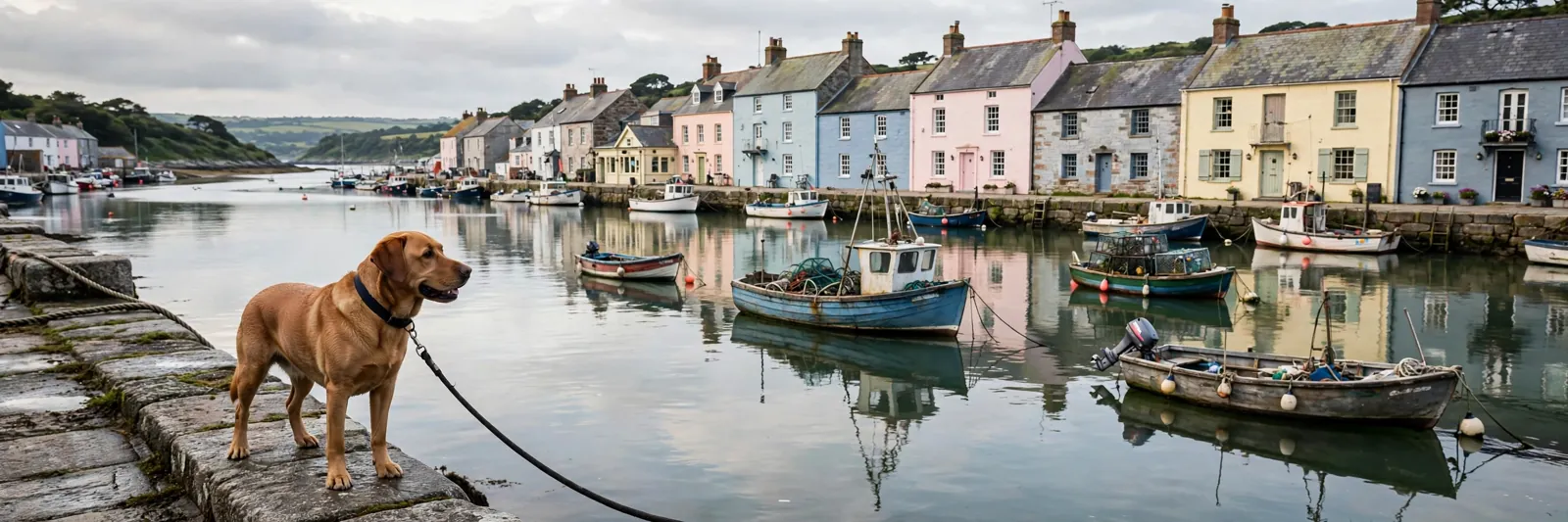
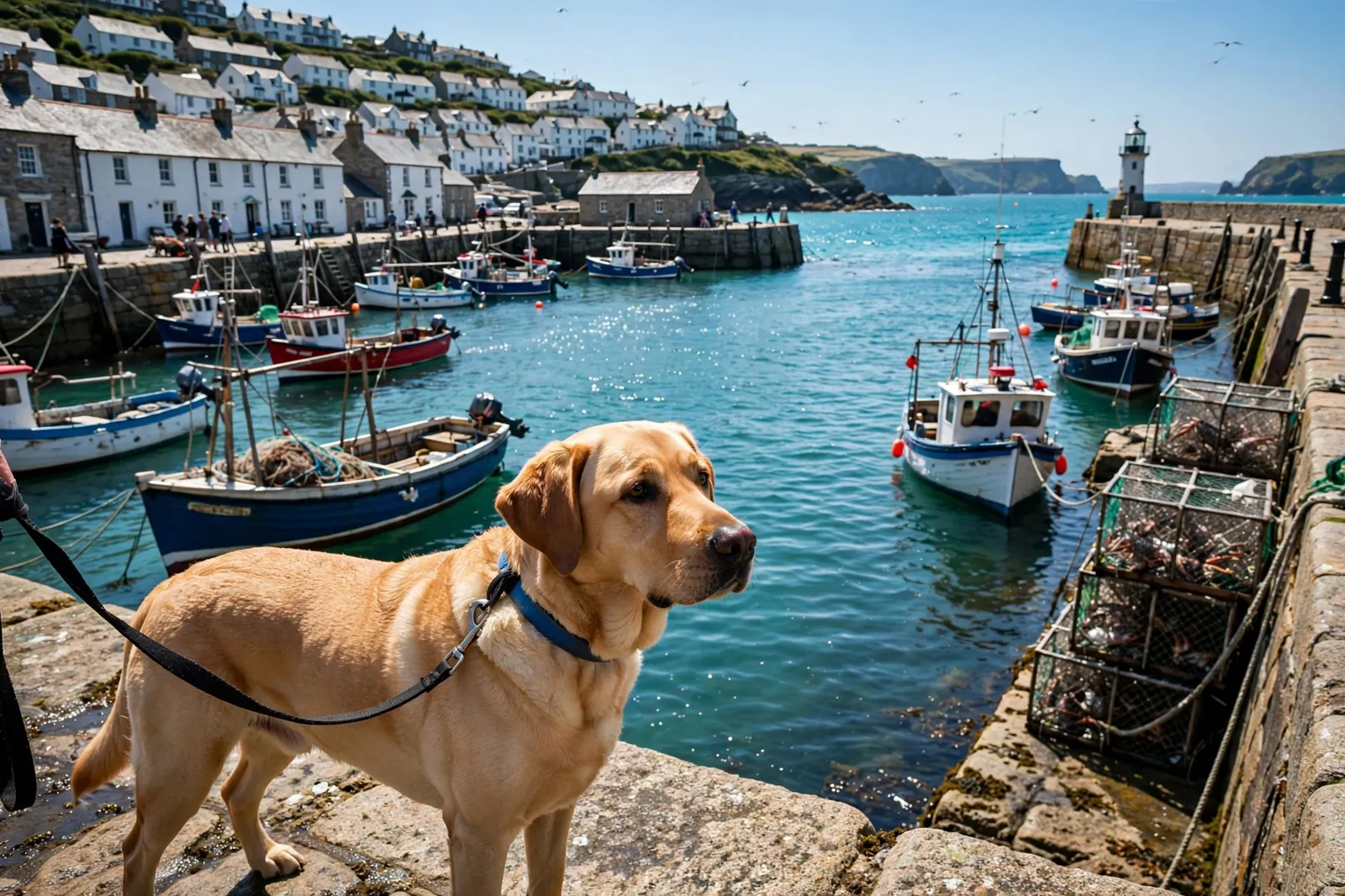
The natural dog circuit links the quays rather than the shops. Around Town Quay and along the waterfront towards Caffa Mill, a dog can watch ferries, fishing boats and yachts, meet other dogs with enough room to give space, and settle outside a café while the harbour does the entertaining. Keep well back from quay edges, which can be unfenced, high above the water at low tide and slippery after rain or with algae. Never let a dog jump onto pontoons, moored boats or slipways, and treat fishermen's gear, ropes, nets and lobster pots as working equipment to be walked around, not sniffed through. A dog who lunges at gulls should be kept on a particularly short lead by the water: gulls in harbour towns are bold, food-focused and entirely capable of leading a chase in the wrong direction.
Fowey also carries a strong literary association with Daphne du Maurier, who lived in and around the town and set work in this landscape, and the estuary and creeks around Pont Pill in particular are closely linked in readers' minds with her writing. You do not need to be following a literary trail to feel why the place held writers: the light on the water, the wooded banks and the contrast between a busy little port and a silent tidal creek a short walk away are striking even on an ordinary Tuesday. For a dog, the literary history translates into something simpler and better, which is a town where walking is the main activity rather than an interval between attractions.
Build in hill training, gently. The streets between the harbour and the upper town rise steeply, and older dogs, dogs recovering from injury and anyone pushing a buggy will feel those gradients. Plan a route down that you are also willing to walk up, take the climbs in stages, and use benches and harbour walls as planned pauses rather than emergency stops. On hot days the lower streets can be sheltered and airless while the upper roads catch a breeze, so carry water even for a short town stroll and do not assume a harbour town is automatically a cool one.
Ferries to Bodinnick and Polruan: two crossings, two walks
Fowey has two ferry connections that matter to dog owners, and confusing them is the classic first-visit mistake. The Bodinnick ferry, which carries vehicles as well as foot passengers, links the Caffa Mill side of Fowey with Bodinnick on the eastern bank, upriver from the town centre. The passenger ferry links Fowey with Polruan, the village directly across the harbour mouth, from quays in the centre of town. The first is your gateway to the Hall Walk. The second gives you a short hop to a quieter village, its own pubs and lanes, and a completely different view back at Fowey.
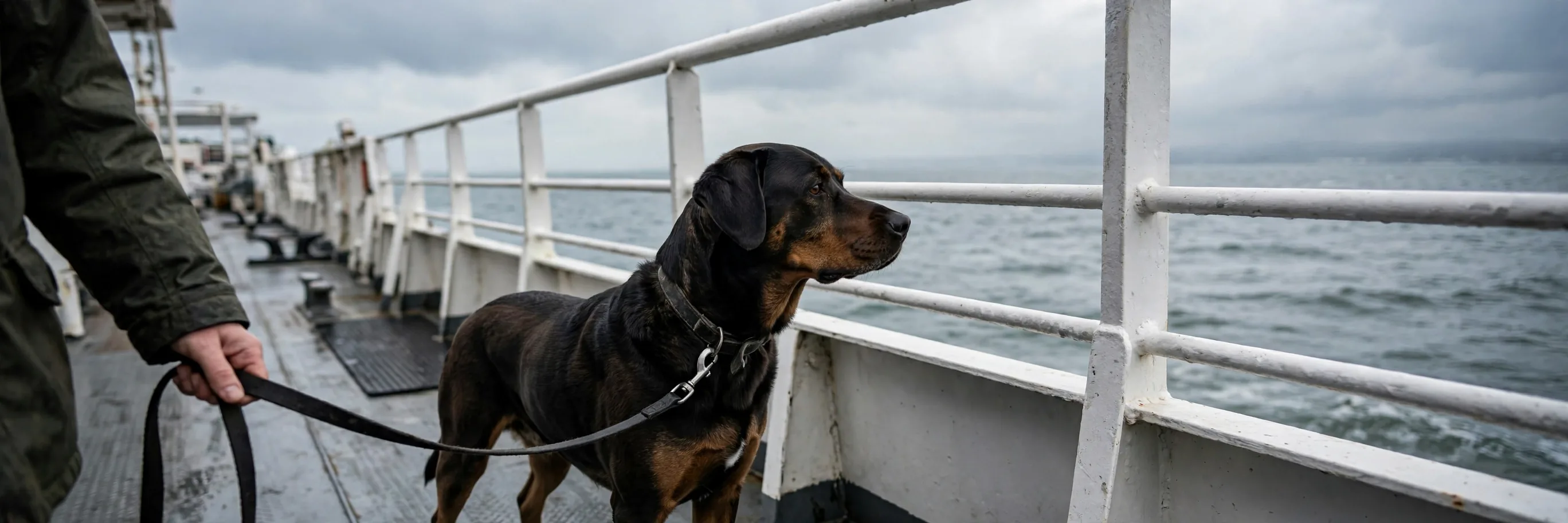
Our national guide to dogs on UK ferries sets out the general pattern that applies on small harbour crossings like these: keep the dog on a lead, board when the crew call you rather than when a gap appears, settle the dog out of the main walkway, and be ready to get off promptly at the far side. On the Bodinnick vehicle ferry that also means staying clear of cars as they load and unload, and never walking a dog between vehicles on the ramp. Crossings are short, but the deck can be wet, the engine noise unfamiliar and the movement noticeable for a nervous dog, so position yourself where your dog can stand four-square with a wall or your legs as a brace, and reward calm behaviour rather than making a fuss.
Timetables are seasonal and services can be affected by weather, tides and maintenance, so a timetable photographed on a previous holiday is not a plan. Check the official latest guidance before you go for current sailing times, fares and any dog conditions, and always identify the last return crossing before you start a walk on the far bank. If you miss it, the road alternative is long. That single fact should shape your Hall Walk timing more than any optimistic estimate of your walking speed.
The Polruan hop deserves time in its own right. Polruan is smaller and steeper even than Fowey feels, with lanes that reward slow exploration, harbour views back across the water and coast path access in both directions. A dog who has done the short crossing, climbed to a viewpoint and returned by ferry has had a rich half day without a long drive. Watch the same quay-edge discipline on that side, keep dogs out of boatyards and working areas, and remember that the return ferry, not your appetite for one more lane, decides when the visit ends.
The Hall Walk: woods, a creek and a proper climb
The Hall Walk is the walk most people mean when they say Fowey is superb for walking with a dog, and it earns that reputation by being unlike either a beach walk or a town stroll. From Bodinnick, reached by the ferry from Fowey, the route follows the eastern side of the estuary and the tidal creek of Pont Pill, through woodland and along field and creekside paths, down towards Polruan, from where the passenger ferry returns you to Fowey. It is a National Trust route, waymarked in places, and closely associated in many walkers' minds with du Maurier country, including views towards the house by the Bodinnick ferry slip where she first lived in Fowey.
Be clear about the effort involved before you romanticise it. Depending on the exact line you take and whether you walk the full point-to-point route, the Hall Walk is commonly described as a walk of around four miles, with repeated climbs and descents, steps, uneven woodland surfaces, stiles and gates. It is not suitable for every dog, and it is not a route to start late in the day in winter. Puppies whose joints are still developing, elderly dogs and dogs who struggle with steps should take a shorter creekside out-and-back instead, turning round while the walk is still enjoyable. Carry water for the dog as well as for yourself: a tidal creek is not a drinking bowl, and brackish water will not help a thirsty dog.
Control points are specific on this route. You will pass through or alongside farmland in places, so a lead goes on before gates where livestock may be present, not after a chase has begun. Woodland sections hold pheasants, squirrels and deer scent that can switch on even a usually steady dog near a drop or a creek bank, so use a long line only where the terrain allows you to manage it safely, and a short lead on narrow cliff and creek-edge sections. At Pont Pill, low tide reveals wide mudflats that look inviting and are not: estuary mud can hold a dog, cuts off easily and is a habitat for feeding birds who should not be disturbed. Admire the creek from the path, keep the dog out of the mud, and let the herons feed in peace.
End the walk intelligently. Polruan gives you a natural pause for water and food before the passenger ferry back, but check that ferry's times before you sit down, not after. If you are reversing the whole route on foot instead, allow substantially more time than the outward leg took, because tired legs climb the same hills more slowly. Either way, a dog who has done the Hall Walk well will be ready for a quiet evening, and Fowey's harbour benches at dusk are a civilised place to provide one.
Readymoney Cove and St Catherine's Castle
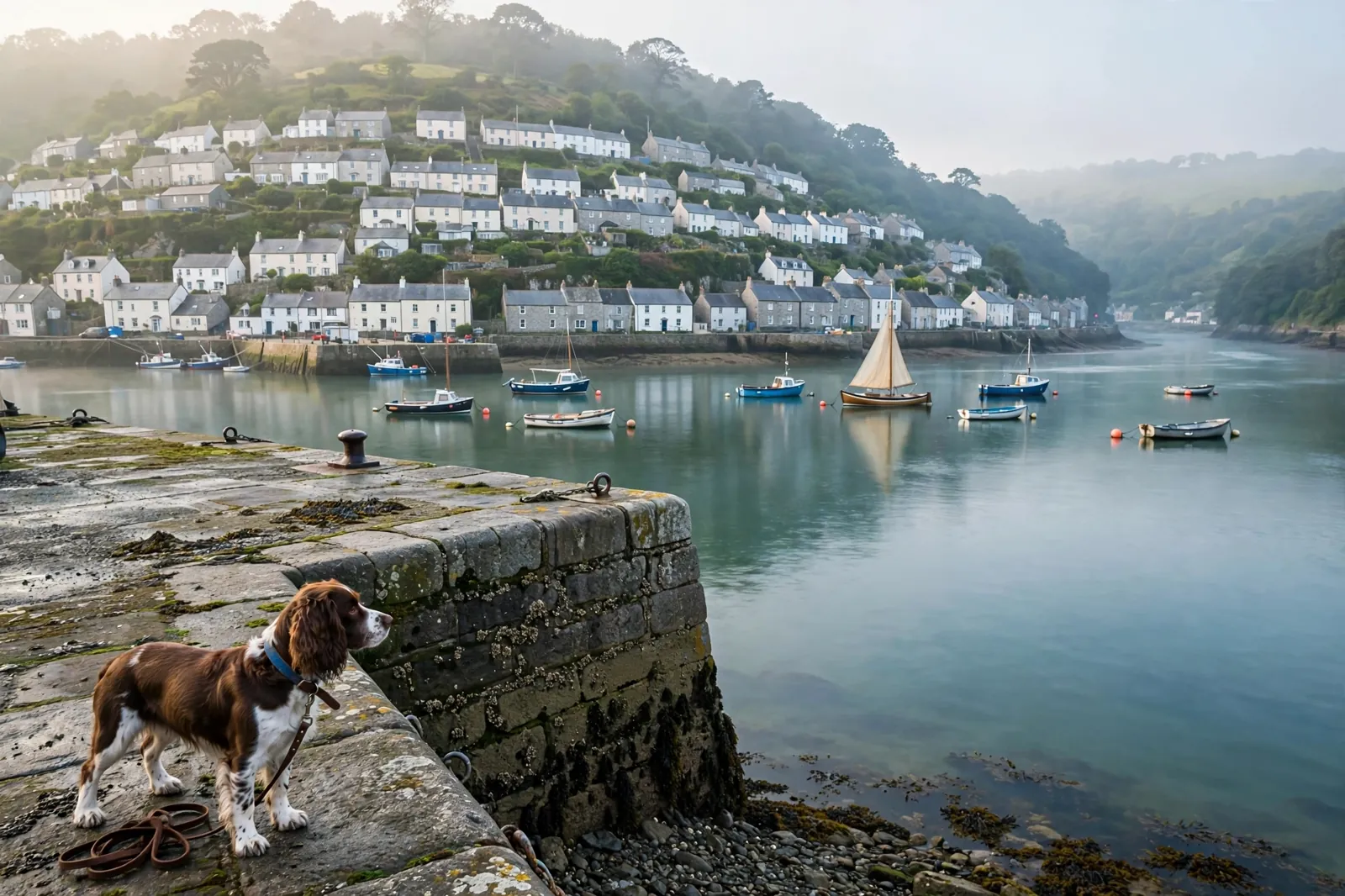
Readymoney Cove is Fowey's own small beach, a sheltered sandy cove a short walk south from the centre along the esplanade, overlooked by the small Tudor fort of St Catherine's Castle on the headland above. For a dog owner staying in town without a car, it feels like a gift: a place to paddle, sit on sand and watch boats enter the harbour without a drive or a bus ride. Its size is also its limit. At high tide the usable sand shrinks considerably, and in peak season a small cove fills quickly with families, swimmers and picnics, leaving little room for a dog who needs distance.
The dog rules need particular care here. Readymoney has had seasonal dog restrictions in recent years, with dates and conditions set locally and displayed at the cove. Treat every visit as a check-first visit: check the official latest guidance before you go, read the signs when you arrive, and if a restriction is in force, enjoy the walk and the view and take the dog to a beach where dogs are currently welcome instead. Arguing the point on the sand helps nobody, and the alternatives described in the next section are close enough that a Fowey trip never depends on this one cove.
When dogs are welcome, cove manners are simple and strict. Keep your dog close on a small, busy beach, do not let it shake over other people's towels, picnic rugs and lunches, and keep it out of rock pools except where you can do so without trampling the creatures that live in them. The castle above the cove is reached by a path and steps and is a worthwhile short climb for the view over the harbour entrance, but keep dogs on a lead around the headland, check the official latest guidance before you go for any access changes at the site, and keep well away from cliff edges, which around this coast can be undercut and crumbly after wet weather.
Beaches nearby: where to go for a real run
Because Fowey itself offers a harbour and a cove rather than a long strand, most dog owners staying here build at least one outing around a larger beach nearby. The principles in our guide to dog-friendly beaches and UK rules apply throughout Cornwall: restrictions are usually seasonal and timed rather than total, they vary from beach to beach even a mile apart, and the sign at the access point on the day outranks anything written anywhere else, including here.
West and east of Fowey, the character changes quickly. Towards Par and St Austell Bay, Par Sands is a large, comparatively flat beach backed by dunes and a local nature reserve area by the pool behind the beach, reached by a short drive from Fowey, and it has historically been one of the more dog-welcoming larger beaches in this part of Cornwall. Even there, respect any current restrictions, keep dogs under control around the dunes and waterbirds, and check the official latest guidance before you go. Polkerris, a small harbour village west of Fowey with a sandy beach in a sheltered cove, is attractive for a shorter visit, but its beach has seasonal dog restrictions, so it belongs firmly in the check-first category rather than the turn-up category.
For a wilder feeling without a long drive, the coves around the Gribbin Peninsula, including the beach at Polridmouth, reached on foot from parking near Menabilly or along the coast path, offer a quieter experience. These are walking beaches rather than drive-to-the-sand beaches: there may be no facilities, access involves fields and stiles, livestock can be present on the approaches, and a lead is needed until you are certain of the ground. That effort is exactly why they stay quieter, and why a fit dog and a prepared owner may remember them longer than a crowded resort beach. Tides matter acutely in small coves, which can be cut off or reduced to rocks at high water, so consult a tide table, not a guess.
Whichever beach you choose, apply a simple Fowey-area routine. Check restrictions the night before, arrive with bags, water and a lead you trust, spend the first five minutes reading the access signs and identifying where other beach users, horses, wildlife areas and exit points are, and only then decide how much freedom your dog has earned in that particular place on that particular day. Freedom given beach by beach, rather than assumed everywhere, is what keeps Cornish beaches welcoming dogs at all.
Pubs, cafés and harbour food with a dog
Fowey's eating scene suits dog owners in the way most harbour towns do when you approach it flexibly: plenty of pubs, cafés and takeaways in a small area, a mixture of places that welcome dogs inside, places that welcome them in gardens, courtyards or on terraces, and food premises that do not admit dogs beyond assistance dogs. Policies change with ownership, season and how busy a place is, so this guide will not pretend to a permanent list. The reliable method is to look for a water bowl and a clear sign, ask cheerfully before settling, and have a harbour-bench plan in reserve, because in Fowey a takeaway eaten watching the ferries is a good outcome, not a failed one.
Harbour food brings harbour hazards. Fish and chips, pasties and ice cream are dropped constantly around quays in summer, and gulls will snatch food from hands, benches and, given the chance, a dog's immediate vicinity. Keep your dog on a short lead while eating in public, positioned on the side of you away from passing foot traffic, and do not feed it scraps at the table where gulls can see the transaction. Cooked bones, corn cobs from beach barbecues, onion in dropped leftovers and rich fatty scraps are all genuine veterinary risks, so the pavement scan that you do in any busy town needs to be continuous here, especially around bins at the end of a warm day.
In pubs and cafés that do welcome dogs, the courtesies are the usual ones and they matter more in small Cornish interiors than in a large pub garden: dog on the floor and on a lead, out of the walkway to the bar and kitchen, towelled down after a wet walk, and settled rather than circulating. Fowey's buildings are old and its rooms are often small, so a large dog needs a genuinely good down-stay to be a pleasure indoors. If your dog cannot yet do that, choose outdoor seating, go at quieter times, and treat the visit as training with an exit plan, rather than as a test the whole room has to endure.
Coast path, Gribbin Head and onward legs
The South West Coast Path passes through Fowey and gives confident walkers a way to turn a town break into a walking holiday without moving base. Westwards, the path heads towards Polkerris and Par; eastwards, after the Polruan ferry, it continues towards Polperro and Looe. Both directions involve serious Cornish coast walking: repeated climbs, cliff-top sections, steps and stiles, exposure to weather coming off the sea, and stretches with no easy exit back to a road. That is glorious for a fit dog and an experienced owner, and entirely wrong as an unplanned extension to a harbour stroll because the first mile looked pleasant.
The Gribbin Head daymark, the distinctive red and white striped tower west of Fowey, makes a satisfying objective for a half-day walk from town or from parking closer to Menabilly. The tower was built as a navigation aid to distinguish this headland from others nearby, and the views from the headland take in the harbour entrance, St Austell Bay and long stretches of the coast you have been walking. Keep dogs on a lead near cliff edges and around any livestock on the headland approaches, carry water because there is little reliable fresh water for dogs on exposed coast, and be honest about heat: an unshaded cliff path in August is hard work for a dog in a fur coat, whatever the sea breeze feels like on your own face.
Cliff safety deserves plain words. Cornish cliff paths are generally well maintained, but edges can be unstable, paths narrow, and a dog chasing a bird or rabbit near an edge is in danger that no recall can reliably undo. The rule on exposed sections is a short lead, always, for every dog, however steady. Check the official latest guidance before you go for any path diversions or closures, which do occur after cliff falls and for maintenance, and tell someone your intended route and return time on longer legs. A coast path day should end with tired satisfaction in a Fowey pub garden, not with a rescue callout that a lead would have prevented.
Tides, boats and water safety in a working estuary
It is tempting to look at the River Fowey on a calm morning, flat and shining between wooded banks, and to classify it as a big, friendly swimming pool for dogs. Resist that classification. This is a tidal, working estuary with deep channels, a significant rise and fall, currents that strengthen around the harbour entrance and on the ebb, commercial and leisure boat traffic, moorings, chains and mud. Our guide to dog swimming safety in the UK makes the general point that the water most likely to get a dog into trouble is water its owner assumed was calm, and estuaries are the classic example.
Apply specific rules around Fowey. Keep dogs on a lead on quays, slipways and pontoons, and never throw a ball or stick into the main river for a dog to fetch. Do not let a dog scramble down seaweed-covered slipways, which are among the most reliably leg-breaking surfaces in any harbour town for humans and dogs alike. At low tide, keep dogs off exposed estuary mud, where they can become stuck, distressed and cut off by a returning tide faster than owners expect. If you want your dog to swim, choose a suitable cove or beach in suitable conditions, enter the water gradually yourself if it is safe to do so, keep swimming sessions short, and watch for exhaustion, because a dog will often keep fetching long after it should have stopped.
Boat trips and harbour tours operate from Fowey in season, and some operators carry dogs while others do not. If a boat trip matters to your trip, check the official latest guidance before you go with the specific operator, ask about dog size, lead and lifejacket expectations, and consider honestly whether your dog will enjoy an hour on a moving boat among strangers. A dog who loves the short ferry hop may still find a longer trip stressful, and there is no view so good that it justifies an hour of a dog trembling under a bench. The harbour seen from a bench, with an ice cream the dog is not allowed to share, is a perfectly complete Fowey experience.
Stays, parking and practicalities
Staying in Fowey itself puts the harbour at the end of your evening walk, and the town and surrounding villages offer hotels, inns, bed and breakfasts, self-catering cottages and holiday accommodation in the hills above the river and out towards Par and the Gribbin. Dog-welcoming is common in Cornwall but never uniform, so check the details that decide whether a stay actually works: how many dogs are accepted and at what charge, whether a dog may be left alone in the property and on what terms, whether there is an enclosed outdoor space that is genuinely enclosed for your size and breed of dog, and what the nearest late-night toilet walk involves on Fowey gradients. A ground-floor cottage with a door onto a lane you can walk in slippers is worth more here than a smarter upper-town apartment up two flights of stone steps with an elderly dog.
Parking and arrival need a plan of their own. Fowey's centre is not built for circulating cars looking hopefully for a space, and most visitors use car parks on the upper edges of town, including larger long-stay parking above the centre, then walk down into the harbour area. That walk down is pleasant; the walk back up with luggage, a tired dog and shopping is a different proposition, so drop bags at your accommodation first if your host allows it, or travel light enough to carry everything uphill in one go. Charges, restrictions and seasonal arrangements change, so check the official latest guidance before you go and read the signs on arrival. Never leave a dog alone in a parked car in Fowey or anywhere else, and be particularly careful with upper car parks in summer, which can be exposed to full sun even when the harbour below feels breezy.
For a car-free arrival, the nearest mainline station is at Par, with connections onward by bus or taxi towards Fowey, and there is also the branch line to Newquay from Par for other Cornish bases. If you are comparing this part of Cornwall with the north coast for a longer trip, our guide to Padstow with a dog shows how a similar harbour-and-ferry town works on a different estuary, and the contrast is useful: Padstow's Camel Trail gives flat cycling-path walking that Fowey cannot match, while Fowey answers with wooded creeks and the Hall Walk. Choose according to the dog and the legs you actually have, not the ones a brochure assumes.
Practical kit for Fowey is specific. Bring a towel and a drying coat, because a dog who has been near an estuary, a cove and a woodland creek in one day will be damp and muddy in three different ways. Bring a spare lead, because harbour hardware and wet rope chafe leads faster than park walking does. Save local veterinary details and the out-of-hours arrangement in your phone before you need them, download maps for offline use because signal in the creeks and coves is patchy, and carry a small torch in winter, when a Cornish harbour town gets dark early and its lanes are not all well lit.
A one-day plan that actually works
A good Fowey dog day starts above the town and works downhill. Park or leave your accommodation early, walk down through the waking streets to the harbour, and give the dog an unhurried quay circuit while the ferries start their day and the town is still mostly its own. Have breakfast at a place that has confirmed it welcomes your dog, or take it to a harbour bench, and use that pause to do the three checks that govern everything else: tide times, return ferry times and the current position on Readymoney and any other beach you hope to use.
Give the middle of the day to the crossing and the Hall Walk if your dog is fit for it. Take the Bodinnick ferry, walk the creek and woodland route towards Polruan at a pace that leaves margin for climbs, water stops and photographs, and return on the passenger ferry with time in hand before the last sailing. If the Hall Walk is too much for your dog, do the Polruan passenger ferry instead, explore that side at leisure and be back in Fowey for lunch; it is a complete and satisfying alternative, not a diminished one. Keep the afternoon for Readymoney if its rules allow dogs on the day, or for the Gribbin direction on the coast path for an hour out and an hour back, turning round by the clock rather than by how far you feel you ought to have got.
Finish where you started, by the water, as the day boats come in and the harbour empties of day visitors. A pub garden, a bench and a dog asleep with its chin on your boot is the right ending in Fowey, because this is a town that rewards people who move slowly between a small number of very good places rather than trying to collect all of Cornwall in a weekend. For a second day, take the larger beach outing towards Par, or compare the town with St Ives with a dog later in the same Cornish trip and notice how differently two small ports handle the same happy problem of dogs, tides and narrow streets. Fowey asks for planning, a lead in the right places and respect for a working river, and in return it gives you ferries, creeks and a harbour that a dog will remember in its feet for days.
Practical questions
Before you go
Are dogs allowed on the Fowey to Bodinnick ferry?
Dogs have generally been carried on the Bodinnick ferry and on the passenger ferry between Fowey and Polruan, usually on a lead and under close control on deck, but operators set their own conditions and arrangements can change. Check the official latest guidance before you go, keep your dog away from vehicles and boarding ramps while loading, and follow the crew's instructions on the day.
Can dogs walk the Hall Walk from Bodinnick to Polruan?
Yes, the Hall Walk is a well-known National Trust route and dogs are welcome on it, but it includes steep climbs, steps, stiles and gates, woodland, farmland and creekside sections where a lead is needed around livestock and near drops. It is not a flat estuary stroll, so check the official route description, tide times for Pont Pill and the ferry times for your return before you set off.
Are dogs allowed on Readymoney Cove beach?
Readymoney Cove, a short walk south from the centre of Fowey, has seasonal dog restrictions that have applied in the main holiday season in recent years, with rules and dates set locally. Do not assume the beach is open to dogs on the day you visit: check the official latest guidance before you go, read the signs at the cove itself, and use a nearby unrestricted beach if the restriction is in force.
Where can I park in Fowey with a dog?
Fowey is steep and narrow, and most visitors use the car parks on the upper edges of town, including the larger long-stay parking above the centre, rather than trying to park on Fore Street or by the quays. Charges, height limits and seasonal demand change, so check the official latest guidance before you go, arrive early in summer, and never leave a dog alone in a parked car.
Can my dog swim in the River Fowey estuary?
Treat the main estuary with caution. The River Fowey is tidal, with strong currents, deep channels, mud at low water, busy boat traffic and slippery slipways, so it is not a safe place to encourage most dogs to swim. Keep dogs on a lead on quays and pontoons, use calmer, clearly suitable coves or beaches instead, and check the official latest guidance before you go if you are unsure about a particular spot.