This guide is independent and contains no paid placement. Prices are typical examples to help you budget and compare, not quotes for a specific property. Always confirm the current fee, limit and house rules in writing before you pay.
Budget for the second dog before you fall in love with a place. Expect pet fees, cleaning supplements and deposits to be charged per dog in many properties, expect the dog limit to be counted per unit or per booking, and choose accommodation, leads, car space and walks for two separate animals — not for one dog, twice.
What the second dog does to the bill: a worked example first
Start with money, because money is where a holiday with two dogs in the UK first stops being a simple copy of a one-dog holiday. Imagine, as a clearly labelled example, a seven-night self-catering cottage or lodge that looks reasonably priced at first glance. The headline rent might be, for example, £700 for the week in shoulder season. That figure is the one in large type. The dog costs sit underneath it, in smaller type, and with two dogs they stop being small.
Work through that example line by line. If the property charges a typical pet fee of £35 per dog per week — well within the common £25 to £75 per dog per week range seen across cottages, lodges and holiday parks — one dog adds £35 and two dogs add £70. If instead the property charges per night, at say £7 per dog per night, one dog adds £49 for seven nights and two dogs add £98. Add a possible supplement that is easy to miss: a second-dog cleaning supplement, an extra charge for a larger dog-friendly unit because the one-dog units are smaller, or a higher refundable damage deposit. A deposit is not a fee if it is returned in full, but it still affects cash flow. A property that takes a £100 refundable deposit for one dog might, as an example, take £150 or £200 for two, and that money is held for the whole stay.
Keep going with the same worked example, because the bill does not stop at the property door. Food for two dogs for a week is roughly double the food for one, unless one dog is very small. Poo bags, chews and a spare lead are minor, but larger costs follow the same pattern: if you use a day of licensed doggy day care during a non-dog attraction visit, you pay for two places; if you pay for a dog-friendly taxi, ferry supplement or additional cleaning after a muddy week, check whether the price is per booking or per dog. Even the car matters. Two dogs may push you from a small hatchback that was fine for one dog and luggage into needing a roof box, a larger hire car, or a second trip — each with its own cost. None of these figures is a quote. They are typical ranges, labelled as examples, to show the shape of the change: the second dog rarely adds a single tidy charge. It multiplies several small charges and occasionally forces a step up to a bigger, more expensive category of accommodation or transport.
That is why this guide begins with a spreadsheet rather than with beaches. Once you have a realistic all-in total for two dogs, the fun planning gets easier and more honest. You can compare a cottage that charges £70 in dog fees but has an enclosed garden and a walk from the door with a cheaper cottage that charges nothing for dogs but needs a drive to every walk and has no space for two beds. Our guide to dog holiday costs in the UK breaks the wider budget — travel, food, insurance and activities — into the same kind of line-by-line comparison, and it is worth using it alongside the two-dog figures in this article. The point is not to make two-dog holidays sound unaffordable. Many two-dog households travel happily and economically every year. The point is to price the second dog in from the start, so there are no surprises at checkout, on arrival, or when the deposit is taken.
How dog limits are counted: per unit, per booking, and the exceptions
The phrase “dogs welcome” tells you almost nothing until you know how the limit is counted. In most cottages, lodges, caravans and hotel rooms, the limit is per unit: the accommodation itself is approved for a stated maximum, commonly one or two dogs, regardless of how many adults are staying. Two adults each bringing “their” dog have not created two separate allowances. They have used the unit allowance of two. In group bookings spread across several units, the counting can be per booking instead, or per unit within the booking, and the distinction matters if you plan to move dogs between units at night. A property might allow two dogs in each of three cottages, but not six dogs sleeping in one of them, even if the group as a whole is within a total of six. Ask which unit each dog is registered to, and keep sleeping arrangements aligned with that answer.
Some larger houses and farm stays count differently again. They may set a base allowance — for example, two dogs included — and then allow a third or fourth dog by prior arrangement, sometimes free and sometimes for an additional fee, depending on size and breed. Others set the limit by weight, by breed, or by a combination: two small dogs may be acceptable where two very large dogs are not, because the real constraint is floor space, stairs, or the strength of fences and doors. There is no universal British rule that a holiday property must accept a particular number of dogs. Apart from the separate treatment of assistance dogs described below, acceptance is a matter of the property contract and house rules. That means the booking confirmation, not a general assumption, is what protects you.
Assistance dogs sit in a separate category and should be handled separately in every conversation with a provider. An assistance dog should not count towards a pet limit and should not attract a pet fee, and a household travelling with one assistance dog and one pet dog should say so explicitly, in those terms, at booking. That clarity helps the property allocate an accessible unit, plan cleaning, and avoid a confused discussion on arrival. Rules and guidance in this area can be updated, so if a provider questions the position, check the latest official guidance before you travel rather than relying on a screenshot of an old page. For pet dogs, by contrast, declare everything: number, breed or type, size, age, and any relevant behaviour. An undeclared second dog discovered on arrival is one of the fastest ways to lose a deposit, be moved to a less suitable unit, or be refused entry altogether, and “the website said dogs welcome” is a weak defence when the same page also said “maximum two” and you have brought three.
Puppies and young dogs deserve a specific mention in the counting conversation. Some properties count a litter, a puppy under a certain age, or a dog in training differently, and some will not accept puppies at all because of chewing and toilet-training risk. If one of your two dogs is under twelve months, say so. Similarly, if you are fostering, borrowing, or walking a friend dog for part of the trip, that dog still counts while it is in the property. Limits are about animals present, not animals owned. Writing the count down — two named dogs, with breed and size, confirmed by email — takes two minutes and removes an entire category of holiday argument.
Fee structures, doubled: what you will be charged and how to verify it
Two-dog fees come in at least five recognisable shapes, and identifying which shape a property uses is the first negotiating skill. The first is per dog per stay: a flat amount, for example £30 to £50 per dog, however long you stay. This favours longer breaks. The second is per dog per week, commonly £25 to £75, sometimes pro-rated awkwardly for short breaks, so a three-night stay may still incur a full week charge for each dog. The third is per dog per night, commonly £5 to £12, which favours short breaks and punishes long ones. The fourth is a tiered structure: first dog at one price, second dog at a lower — or occasionally higher — price. A property might charge £40 for the first dog and £25 for the second because the cleaning visit is already happening, or £40 and £50 because the second dog pushes you into a larger unit. The fifth is “dogs free” or “one dog free, second dog charged”, which can be genuinely good value but often applies only to selected units, selected dates, or direct bookings.
Negotiation, in this context, rarely means haggling aggressively over a published tariff. It means verifying, bundling and asking precise questions at the right moment. Ask for the all-in dog total for your exact dates, for two named dogs, including cleaning, any second-dog supplement, and the deposit amount and return conditions. Ask whether a longer stay, a midweek arrival, or a direct booking changes the second-dog charge — some owners will waive or halve the second fee for a quiet week, a returning guest, or a stay of ten nights or more, even though they will not advertise that flexibility. Ask whether bringing your own throws, covers and stair gate, or agreeing to a specific cleaning routine, affects the deposit. Never assume, and never pay a vague “pet charge to be confirmed”. If the answer is not in writing, you do not yet have a price.
Verification matters because booking platforms, property pages and confirmation emails do not always agree. A listing may say “£35 per dog” in one place and “pet fee £35” in another, leaving unclear whether £35 covers both dogs or each dog. Take a screenshot or save the page, then email the specific question: “For two dogs for seven nights from this date, is the total pet charge £35, £70, or another amount, and is any part refundable?” Keep the reply with your booking documents and take it with you. If the property later tries to charge a different amount on arrival, a calm, dated email thread resolves the matter far faster than a memory of a phone call. The same discipline applies to deposits: ask what counts as damage, whether claw marks on doors or mud on soft furnishings are treated as normal wear or as a deduction, how soon after departure the deposit is inspected, and when the refund is processed. With two dogs, the chance of at least minor mud, hair and wet-weather mess roughly doubles, so the deposit rules matter more, not less.
Finally, compare fee structures across properties on a like-for-like total, not on the headline pet price. A cottage charging £75 per dog per week (£150 for two) with a secure garden, hard floors, a utility for wet dogs and a walk from the door may be better value than a cottage charging £25 per dog (£50 for two) where you must drive to every walk, pay for parking daily, and risk a carpet-cleaning deduction. Add the dog total to the rent, parking, and any larger-unit uplift, and only then decide which is cheaper in the sense that matters: total money for a holiday that actually works.
Finding stays that genuinely fit two dogs: floor space, two beds and a real garden
A property can accept two dogs on paper and still not fit two dogs in practice. The test is physical, and it has three parts: floor space for sleeping, floor space for moving, and outdoor space for toileting and decompression. Start with beds. Two medium or large dogs need two separate bed spaces, ideally not in a doorway, not under a dining table where chairs scrape, and not in the only route to the bathroom. In a small caravan or a compact cottage bedroom, there may be room for one bed and a human path, but not for two beds and that path. Ask for internal dimensions or a floor plan if the listing is vague, and be suspicious of photographs taken with a wide lens from a corner. Look for clues: can you see where a second bed would go without blocking a fire exit, a heater, or a door that swings inward?
Living space is the second test. Two dogs settle differently from one. They need room to choose distance from each other, especially on the first evening, after a long car journey, and when one dog is tired and the other is still wired. A single sofa and a small rug in front of a wood burner may be charming for one dog and a source of friction for two, particularly if one guards warmth, toys or people. Hard floors or washable rugs help with mud, but space helps with temperament. If the property has a utility room, a boot room, or a second reception room, that flexibility is worth paying for with two dogs in a way it is not with one. Stairs matter too: a property with the only toilet upstairs, narrow steep steps, or a mezzanine bedroom may suit one steady older dog and be unmanageable with a young dog that follows you and an older dog that should not climb.
The garden is the third test, and “garden” is one of the most elastic words in holiday listings. For two dogs, you want to know whether outdoor space is private to your unit or shared, whether it is genuinely enclosed, the height and construction of the boundary, whether there is a gate that latches at dog height, and whether there are gaps under fences where a small second dog can exit while the larger dog stays. A shared garden changes the calculation entirely: two dogs meeting unfamiliar dogs at the gate, at dusk, for a last toilet break, is a daily management task, not a relaxing routine. If the garden is shared or unenclosed, you will be doing lead-on toilet breaks for two dogs, several times a day, in whatever the British weather is doing. That is doable, but price it into your choice honestly. Our guide to dog-friendly holiday parks in the UK covers how to read site maps and unit positions in the same spirit, and many of those questions — edge units, distance to open space, after-dark toilet routes — become twice as important when every outing involves two animals.
Practical questions cut through marketing quickly. Ask: “Where would two dog beds go in this unit? Is there a photograph with normal furniture in place? What is the garden fence height, and is the garden shared? Is there an outside tap or hose? Are there hard floors in the living area? Can dogs go on furniture, and if not, is there room for us all if they stay on the floor?” A confident, specific answer signals a property that hosts two-dog households regularly. A vague answer signals a property that has ticked a “two dogs” box without walking through what it means at 10pm in the rain. Choose the first kind whenever the budget allows.
Lead handling and double-lead choices: one handler, two dogs, full control
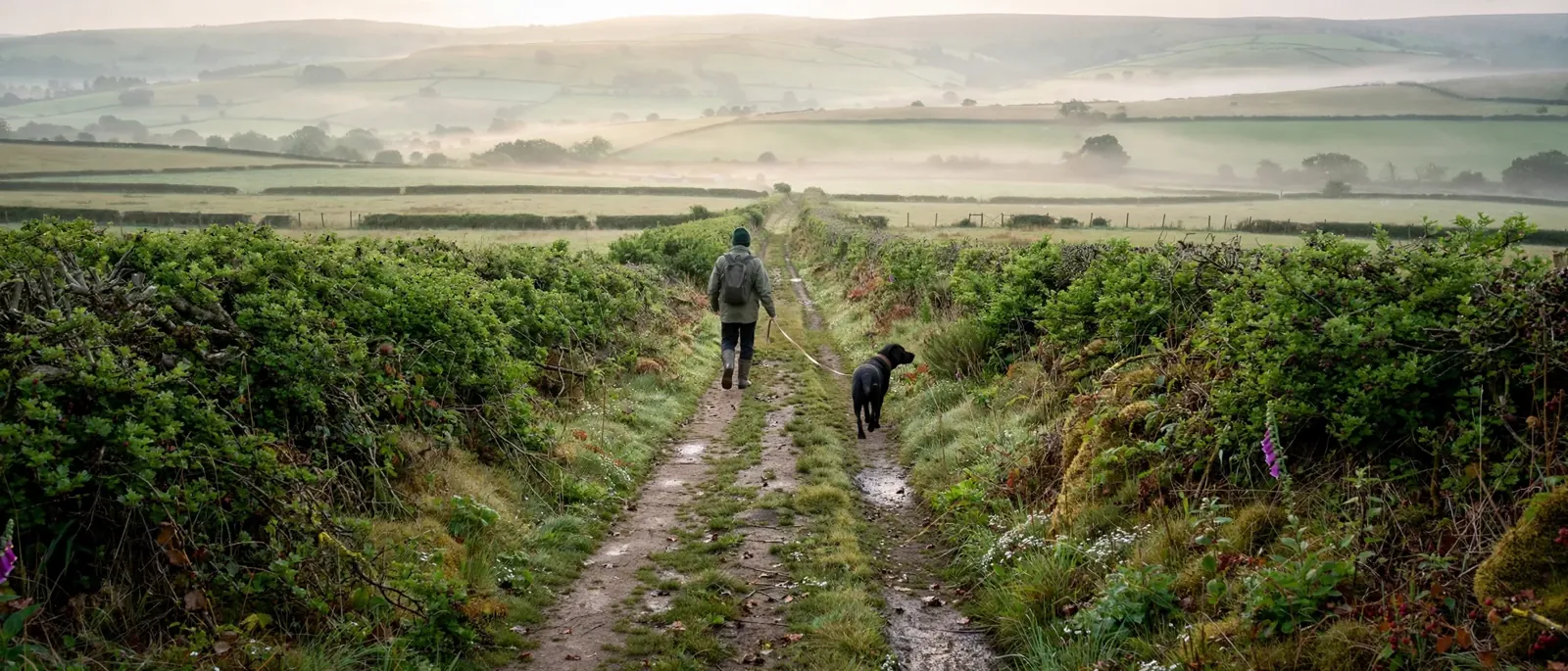
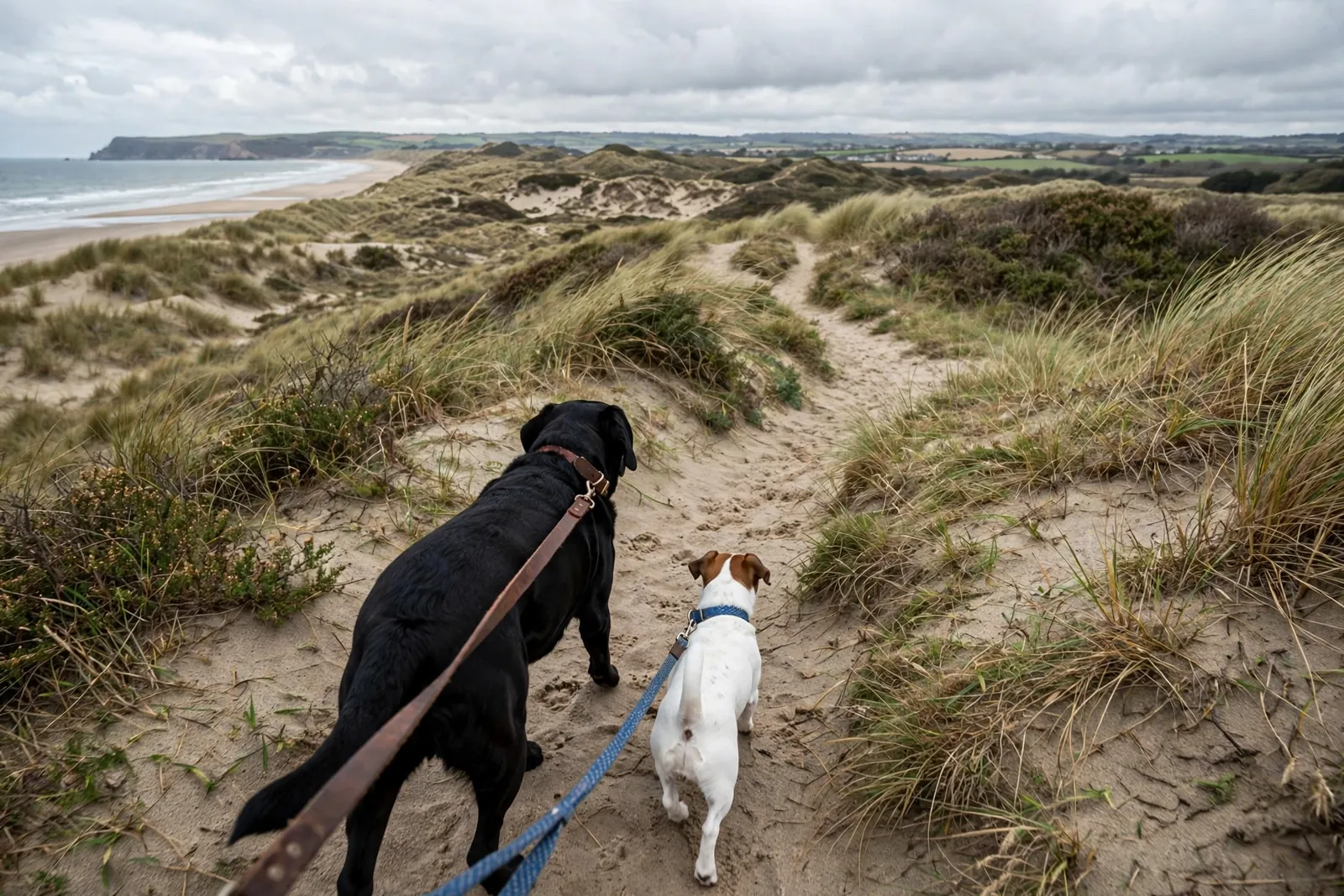
Walking two dogs is a handling skill before it is a shopping problem. You have two hands, two leads, and a finite amount of attention, and the system that works on a quiet lane may fail on a narrow pavement, at a road crossing, or when a third dog appears around a blind corner. Begin with the simplest reliable setup: two separate leads, held so that each dog can be shortened, lengthened or held still independently. Many experienced two-dog walkers use leads of different colours, so a glance tells them which clip belongs to which dog, and different lengths, so a taller or faster dog is not constantly correcting for a smaller or slower one. Attach each lead in a way that a dropped lead is retrievable — a wrist loop used safely, a waist belt with two attachment points, or a lead configuration you have practised at home. Do not learn a new system on a cliff path.
A coupler — a short Y-shaped connector that splits one lead into two clips — and a purpose-made double lead are appealing because they free one hand for a gate, a poo bag, or a coffee. They work best in a narrow set of conditions: two dogs of similar size, similar pace, similar temperament, walking in the same direction, in a low-distraction environment. In those conditions a coupler can feel calm and tidy. Outside them, its weakness is mechanical. Every pull, lunge, stop and direction change by one dog is transmitted to the other dog’s collar or harness. A small dog is dragged by a large dog’s enthusiasm. A calm dog is yanked when a reactive dog reacts. One dog cannot move away, sniff safely to the side, or be held back from a hazard while the other advances. For that reason, many handlers use a coupler only for short, predictable stretches — from car to holiday property door, across a quiet car park — and separate leads for real walking.
Harness choice matters as much as lead choice. If either dog pulls, lunges, or may need to be restrained suddenly near livestock or traffic, a well-fitted harness with a secure clip is generally kinder and safer than relying on a collar alone, and you should follow current product guidance and fit instructions for whatever you use. Keep identification up to date on both dogs, with a holiday contact number if your home number is not answered while you travel, because a loose dog in an unfamiliar place is harder to reunite quickly. Practise the boring drills before the holiday: stopping both dogs at a kerb, holding both still while you open a gate, passing a person on a narrow path by stepping aside with both dogs on the same side, and doing a calm U-turn when a route is blocked. These drills take ten minutes in a local park and save a great deal of improvisation later. If two adults are travelling, decide who handles which dog by default, and who handles both when the other person is paying, locking up, or carrying bags. Ambiguity at a busy car park is how leads get tangled around legs, ankles and other people’s dogs.
One reactive, one calm: managing the pairing, not just the dogs
Many two-dog households are not two versions of the same dog. They are a pairing: one reactive, anxious, frustrated or over-aroused dog, and one calmer, older, or more sociable dog. On holiday, that pairing needs its own plan, because the calm dog is not a guarantee of calm, and the reactive dog’s behaviour does not stay contained in one lead. A reactive dog that lunges and barks can wind up a previously steady companion, teach it that other dogs are a cue for excitement, or put it in the physical path of a reaction it did not choose. Equally, forcing the calm dog to miss every walk, pub visit and beach trip because the reactive dog cannot manage them is unfair and unsustainable across a week.
The workable pattern for many households is a mixture of together walks and split walks, planned in advance rather than improvised in guilt. Together walks are chosen for space, visibility and escape routes: wide beaches at quiet times, open fields with clear sightlines, and routes where you can see other dogs early and create distance without climbing a fence or reversing into traffic. Split walks are chosen for the individual dog: the reactive dog gets a quiet, sniff-heavy walk at an off-peak time, with training and decompression as the goal, while the calm dog gets the cafe-adjacent stroll, the village visit, or the longer hike it enjoys. If two adults are travelling, splitting is straightforward. If one adult is travelling alone with both dogs, splitting means leaving one dog safely in the property — only where the property rules allow it, only for a suitable duration, and only if that dog settles alone in an unfamiliar place. Otherwise, choose together routes that suit the more limited dog, and build the holiday around that reality rather than fighting it daily.
Accommodation and location choices follow from the pairing. An edge unit, a property with its own enclosed garden, and a walk from the door that does not pass a gauntlet of other holiday dogs will lower the daily arousal baseline for both dogs. Distance is your most useful tool: a garden fence with visual screening, a beach entry that avoids a crowded slipway, and a pub garden with a corner table all give the reactive dog room to observe without practising a reaction, and give the calm dog room to relax without being used as a shield. Do not place the calm dog between the reactive dog and a trigger as a deliberate barrier. That is a human convenience that puts the calm dog at risk if the other dog, or your dog, redirects in frustration. Our dedicated guide to reactive dog holidays goes deeper into choosing quiet stays, planning low-pressure days, and recognising when a dog needs a rest day, and it pairs well with the two-dog handling advice here. The underlying principle is simple: plan for the dog who finds the day hardest, give the easier dog its own good experiences separately, and do not measure a successful holiday by how much both dogs were forced to do together.
Eating out with two dogs: space, mats and an exit plan
One dog under a pub table is a familiar British sight. Two dogs under the same table is a geometry problem, and sometimes there is no solution that is fair to the dogs, to staff, or to the people at the next table. Before you go, check three things: whether dogs are allowed inside, only in a bar area, only in a garden or terrace, or not at all; whether there is any limit per table or per group at busy times; and whether you need to book and mention two dogs specifically. “Dog-friendly” in a listing may have been written with a single small dog in mind. A quick phone call — “Two dogs, one large, one medium, both settled, do you have a corner or garden table where they will not block a walkway?” — avoids the awkward doorway negotiation when everyone is hungry.
On arrival, set up deliberately. Choose a corner, a wall side, or a garden bench where both dogs can lie without spilling into a serving route, a doorway, a fire exit, or the path to the toilets. Put a mat or blanket down for each dog if space allows; a defined place to lie helps many dogs settle and keeps them off cold or dirty floors. Keep leads short but not taut, attached so a sudden stand does not drag a chair or tip a table, and never tie a lead to a table leg in a way that a lunge would pull furniture over. Position water where it will not be kicked. Keep both dogs on the same side of the table where possible, so staff are not stepping over leads. If one dog is restless, take it for a short walk and reset rather than letting restlessness build into barking that unsettles the second dog as well.
Timing and honesty complete the picture. Early lunches, early suppers and weekday visits are easier than peak Saturday service. A garden in fair weather is easier than a crowded bar in a storm, however welcoming the bar claims to be. If the only available table means two large dogs pressed against strangers’ legs for ninety minutes, the kind choice is a takeaway, a picnic, or a different venue, even if the venue is technically willing. Plan food stops as part of the route, not as a hopeful afterthought: identify one dog-welcoming option and one outdoor backup for each area you visit. That way a full pub, a function, or a “dogs in the garden only” rule on a rainy day does not unravel the afternoon. Two dogs can be excellent pub companions, and many are — but the successful visits are almost always the ones where space was checked before hunger took over.
Packing the car for two: crates, guards, water and the mud system
Two dogs change a car from “boot with a dog in it” to a load-planning exercise with legal, safety and comfort dimensions. Start with restraint and separation. Each dog needs a safe travelling position — a correctly sized crate, a secured harness arrangement, or a divided boot space with a guard — that prevents them interfering with the driver, being thrown forward in a sudden stop, or tangling and stressing each other across a long journey. A crate that suits one dog may be too small for two to share comfortably, and sharing is not automatically desirable: dogs that are relaxed together at home may not want enforced closeness for three hours in a warm, moving car. If they travel in one larger crate or one boot area, be certain both can lie down, turn, and rest without lying on each other, and follow current vehicle and product guidance for safe fitting. Check the latest official guidance on travelling with animals before you go, as rules and best practice should be verified for your vehicle and set-up.
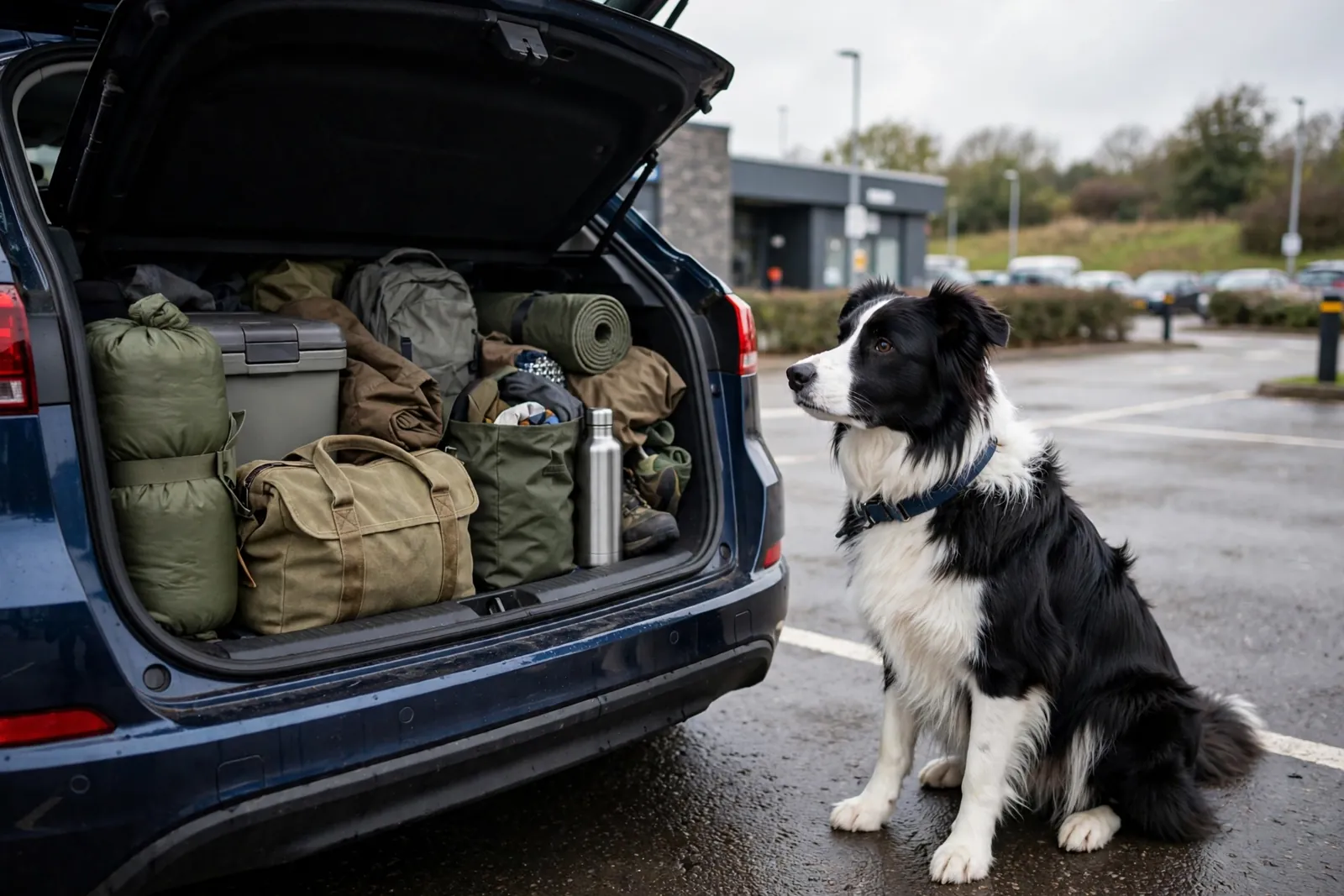
Space budgeting shows the two-dog effect again. Two beds, bedding for a week, towels for two wet dogs, food measured for two, bowls, leads and spare leads, poo bags, medication for either dog, and human luggage compete for the same cubic capacity. Pack dog food in a sealed container that cannot be raided in a service-station stop, keep a separate small kit in the cabin or at the top of the boot — water, a travel bowl, bags, a towel, and any urgent medication — and plan water and leg-stretch stops for both dogs, not just the one who asks. On a long drive, toilet and sniff breaks are slower with two: both dogs need to be unloaded safely, on leads, away from traffic, watered, and reloaded in an order that does not leave one dog unattended in a hot or insecure car. In warm weather, never leave dogs in a parked car in conditions that could overheat them; plan stops where both dogs can come out with you, and if that is impossible, rethink the stop.
Then build the mud system, because British holidays with two dogs produce roughly twice the wet paw traffic and the property deposit is watching. Keep a dedicated drying kit by the property door: two towels in rotation, a washable mat, paw-cleaning supplies if your dogs tolerate them, and a bag for wet items that seals smell in the car on the way home. In the car itself, washable covers or liners protect seats and boot carpet and make the return journey less grim. Label or colour-code the essentials for each dog — medication, a specific harness, a muzzle if one dog uses one, a particular dietary food — so a tired human at 11pm, or a partner who does not usually feed the dogs, cannot mix them up. The goal is boring reliability: every item has a place, every dog has its own kit, and a wet, late arrival does not turn into unpacking chaos while two hungry dogs circle a strange kitchen.
Walks where two dogs change the risk: livestock, cliffs and narrow paths
Most walking advice scales from one dog to two, but a few situations do not scale — they change character. Livestock is the clearest example. In fields with sheep, cattle or other grazing animals, you must keep dogs under close control and follow the Countryside Code and any local signs, because worrying livestock is a serious matter for farmers, for the animals, and for your dogs. With two dogs, your control is divided, your ability to shorten both leads quickly is tested, and one dog’s excitement can trigger the other’s in a way that a single dog, alone, might have contained. If cattle approach or behave defensively, the safest course is generally to let go of leads if you are in genuine danger, rather than being pulled over or trapped — but the real skill is avoidance: choose a different field, a different gate, or a different route when livestock, calves, or a bull make the margin too thin for two dogs and one pair of hands. Never let the holiday timetable pressure you through a field you would have avoided at home.
Cliff paths, harbour walls, steep coastal steps and narrow mountain paths present a similar divided-attention problem, with gravity added. Two dogs pulling in different directions on a narrow path with a drop on one side is not a picturesque moment; it is a fall risk for human and dogs alike. Keep both dogs on short leads, on the inside of the path where that is safer, stop fully to let others pass rather than shuffling along in motion, and turn back if wind, mud, or crowding narrows the usable width. A dog that is usually reliable off lead at home should be on lead where a single chase — a bird, a rabbit, a dropped ball — could end at an edge, and with two dogs the chance that at least one dog is surprised, startled, or tempted on any given walk is higher. The same logic applies at roads, car parks, level crossings, and around water where currents, deep mud, or blue-green algae may be a risk in season. Check local signs and current official advice for the specific place, because hazards are local and seasonal.
Meeting other dogs on narrow routes is the third risk multiplier. One dog can be stepped aside, held, and given distance. Two dogs occupy more width, tangle more easily, and present a more intense picture to an approaching dog, which may react to a pair even if it would have ignored a single dog. Use passing places properly: step well in, put both dogs on the same side, shorten leads, and wait. If a route is known for bottlenecks — a single stile, a narrow bridge, a beach access with steps — time it for quieter hours or choose a wider alternative. Stiles themselves deserve respect with two dogs: lifting one dog over while the other is loose on the far side is a recipe for a pulled shoulder or an escaped dog. Clip, lift, secure, repeat, in an order you have thought through, or find the gate. A good two-dog walk is not the longest or most dramatic route in the guidebook. It is the route where you retain control, choice and an exit at every point, for both dogs, all the way back to the car.
When a house-sitter beats taking both: the honest comparison
The final decision is the one many two-dog households avoid until the last minute: should both dogs actually come? Sometimes the honest answer is no — one dog should stay with a trusted sitter, boarder or family member, or both should, and the holiday should be reshaped or taken without dogs. That is not failure. It is the same welfare calculation you have applied to fees, space and walks, extended to the whole trip. Take the example of a holiday built around two long non-dog days, a property that only realistically fits one dog despite a “two dogs” label, and a pairing where one dog is reactive and the itinerary cannot be adapted. Forcing both dogs through that week produces cost, stress and management from morning to night. Leaving the reactive dog with a familiar sitter for a quiet week at home, while the calm dog enjoys the trip — or leaving both, and taking a genuinely restful break — can be kinder to every animal involved.
Make the comparison with numbers and with stress, side by side. On the taking-both side, list the full dog total: fees and deposits for two, any larger-unit uplift, day-care or sitter costs during the trip for non-dog activities, extra travel costs, and the activities you will skip or curtail because two dogs cannot join. On the staying-home side, list licensed boarding for two, a house-sitter who will live in and keep both dogs in their own home and routine, or a split arrangement where each dog goes to the person it knows best. Then add the non-money column honestly for both options: sleep quality, daily management load, the dogs’ likely stress in a new place versus in a familiar home, and medical or age factors. An older dog with arthritis facing a week of steep coastal stairs may prefer its own bed and its own vet nearby, regardless of cost. A young dog in a critical socialisation or training phase may benefit from coming, if the trip can be shaped around it.
If you use a sitter or boarder, use a properly licensed and insured arrangement where licensing applies, visit or video-call in advance, leave written instructions for each dog separately — food, medication, triggers, vet details, and what to do if the dogs need to be separated — and do a trial night before a full week where possible. If you take both dogs after all, take them with the plan in this guide: priced, counted, housed, handled and walked as two. The households that enjoy two-dog holidays most are not the ones who pretend the second dog changes nothing. They are the ones who priced the change, planned for the change, and still decided the trip was worth it — eyes open, leads in both hands, and a garden gate that definitely latches.
Practical questions
Before you go
How are dog limits usually counted — per dog, per unit or per booking?
Most properties count dogs per unit or per booking, not per person, so two dogs travelling with two adults still count as two. A small number of larger houses count per bedroom or allow extra dogs by prior arrangement for a fee. Always state the exact number, breed and size of both dogs at booking and keep the written confirmation, because arriving with an undeclared second dog can lead to an extra charge or refusal.
Do assistance dogs count towards the two-dog limit or the pet fee?
Assistance dogs should be treated separately from pet dogs. They should not count towards a pet limit and should not attract a pet fee. Tell the property in advance that an assistance dog will be present, alongside any pet dog, so the unit, access and cleaning plan are set correctly, and check the latest official guidance before you travel if a provider questions this.
Is a double lead or coupler better than two separate leads?
Neither is universally better. A coupler keeps two similar-sized, calm dogs moving together and frees one hand, but it transfers pulling and lunging from one dog to the other and is a poor choice if one dog is reactive, much smaller, or needs distance. Two separate leads, ideally in different colours and lengths, give independent control and are safer around livestock, cliffs, roads and other dogs.
Can we take two dogs into pubs and cafes in the UK?
Many pubs and cafes welcome dogs in bar areas, gardens and terraces, but two large dogs need more floor space than one and some venues limit dogs per table at busy times. Phone ahead, choose a corner table where both dogs can lie out of walkways, bring a mat for each dog, and be ready to sit outside or split the visit if space is tight.
When is it better to leave one or both dogs with a sitter?
A sitter or trusted boarder is often kinder when the trip involves long non-dog days, steep or exposed walks one dog cannot manage, a property that only realistically fits one dog, or a pairing where one dog is reactive and the itinerary cannot be adapted. Compare the full cost and stress of taking both with licensed boarding or a house-sitter, and decide for the dogs rather than from guilt.