This guide is independent and contains no paid placement. If affiliate links are added later, they will be clearly marked and will not change our editorial checks.
Travel with a Westie works best when you plan for mud, not against it: pick shorter, varied loops over long slogs, keep the dog on a lead near livestock and wildlife, rinse and dry the white coat after every wet walk, and protect sensitive skin with gentle grooming and early vet advice rather than frequent bathing.
The grey terrier moment
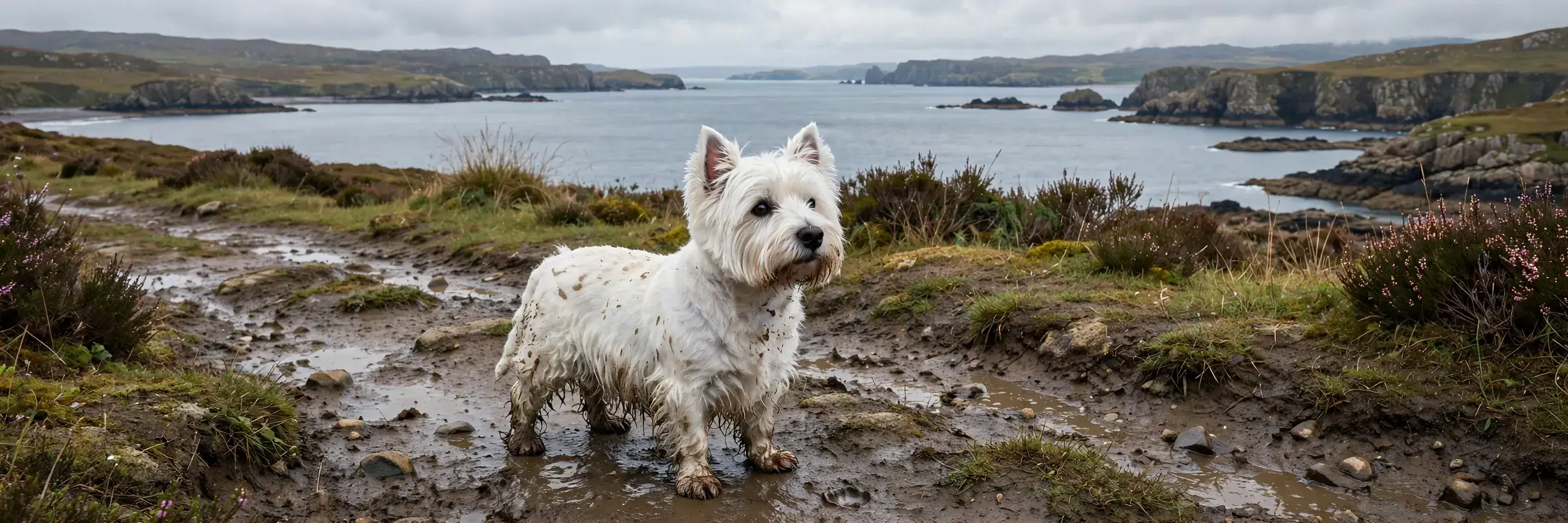
It happens about twenty minutes into the first coastal walk of the holiday. The path has been rained on overnight, the puddles are the colour of milky tea, and the dog that set off gleaming white is now trotting along in shades of grey and brown, belly splashed, beard dripping, tail up and entirely delighted with itself. Somewhere ahead there is a rockpool to investigate, a gull to stare at and a patch of grass that smells, to a terrier nose, like the most interesting thing in Scotland. This is not a problem to solve. It is the whole trip, and the sooner you accept it, the better the holiday goes.
West Highland Terriers were bred for rough, wet, outdoor work in Scotland, and the modern pet Westie still carries that inheritance in a compact frame. They are sturdy, confident and famously determined, with a double coat that sheds rain reasonably well and legs that are short only in comparison with a collie, not in ambition. A Westie will happily pick its way over rocks, splash through streams and climb a grassy bank that looks twice its height, then stop dead to examine a hole in the ground as though a career depends on it. That combination — toughness plus curiosity plus a coat that shows every mark — is what makes travelling with one different from travelling with a larger, darker or less inquisitive breed.
This guide is built around that reality. Instead of a generic packing list, it follows the four things that actually shape a Westie trip in Britain: the walks that suit short, sturdy legs; the daily routine that keeps a white coat and sensitive skin in good order; the lead manners that keep a chase-driven terrier safe around sheep, deer, ground-nesting birds and gulls; and the calm, settled behaviour that makes hotels, cottages and cafes enjoyable rather than stressful. Get those four right and the rest — the scenery, the seafood stops, the long evenings in a dog-friendly pub — takes care of itself.
One honest note before the detail. Every Westie is an individual. Some are calm, biddable and almost cat-like indoors; others are vocal, reactive and convinced that every passing dog is a matter for urgent discussion. Age matters too: a fit three-year-old and a stiff twelve-year-old need very different days. Use this guide as a framework, adjust distances, social plans and grooming to the dog in front of you, and ask your vet about anything involving skin, ears, joints or breathing. Where local rules, access rights or seasonal restrictions are involved, check the official guidance before you travel, because signs on the ground and the current local code always outrank a general guide.
Choosing coastal and Highland trails
The best Westie walks in Scotland and the wider UK share a pattern: varied ground, plenty to sniff, regular places to stop, and an escape route if the weather turns or the dog tires. A two-hour loop with a beach, a burn, a stretch of short turf and a cafe at the end will suit most Westies far better than a single four-hour trudge along an exposed ridge. The dog gets the mental stimulation terriers crave — new smells, new surfaces, small problems to solve — without the long, repetitive pounding that short legs and a low-slung body find hardest.
Coastal paths are the natural home of the Westie holiday. Surfaced promenades are useful for older dogs and wet days, but the real value lies in the mixed routes: a harbour wall, a sandy bay, a grassy cliff-top path and a rocky shore in one outing. Rocky sections need care, because a small dog can slip between boulders or cut paws on barnacles, and wet rock is treacherous for dogs as well as people. Keep the dog on a lead on cliff edges, watch for steep drops hidden by grass, and remember that a Westie that can scramble up a rock may not be able to scramble back down. A short lead, a harness with a handle for lifting over awkward steps, and the willingness to turn back are worth more than any amount of determination.
In the Highlands, think in terms of glens, lochsides and forest tracks rather than summits. Forestry tracks are forgiving underfoot and often quiet, lochside paths give easy water access for a paddle, and low-level glen walks offer distance without serious climbing. Munros and steep mountain paths are a different proposition: they demand fitness, sure footing and the ability to cope with wind, cold and long exposure, and a small dog that tires halfway up cannot simply be carried for miles without a proper dog-carrying pack. If a hill day appeals, pick a low, rounded hill with a clear path, check the forecast and daylight hours, and have a shorter valley alternative ready. There is no prize for reaching a summit with an exhausted terrier.
Distance deserves a realistic rule of thumb. Many healthy adult Westies cope happily with five to eight kilometres of varied walking in a day, split into two or three outings, and some fit adults manage more. But distance alone misleads: five kilometres of flat beach is a different day from five kilometres of boggy moorland, deep sand or steep, rocky coast. Bog is particularly tiring for short legs, because every step sinks and the dog must lift its legs high to keep moving. Deep, soft sand has the same effect. Build distance gradually over the first two days of a holiday, watch how the dog recovers overnight, and treat stiffness, reluctance to start, lagging behind or lying down mid-walk as a clear signal to shorten the next outing.
Water is part of the trail plan, not an afterthought. Carry water and a collapsible bowl even on short walks, because streams on farmland may not be safe to drink from and coastal walks rarely offer fresh water. On hot days, offer water at every stop rather than waiting for the dog to ask, and plan shade breaks on open ground. On cold, wet days the opposite problem appears: a wet Westie loses heat through a soaked coat, so a walk that ends with a long, wet drive home needs a drying plan at the car. Keep a towel and a drying coat in the boot, and dry the dog before the journey rather than letting it sit damp in a draughty car.
Livestock and wildlife shape route choice all year, and never more than in spring and early summer. Fields with sheep and lambs, deer country, and moorland where ground-nesting birds are breeding all call for a lead, distance and quiet movement. In Scotland, access rights come with responsibilities, and in England and Wales the Countryside Code sets out the same basic expectation: keep dogs under close control, on a lead near livestock, and away from nesting birds in the breeding season. Check local signs and the official guidance before you travel, because a particular estate, nature reserve or beach may have its own seasonal rules, and those rules are the ones that apply on the day.
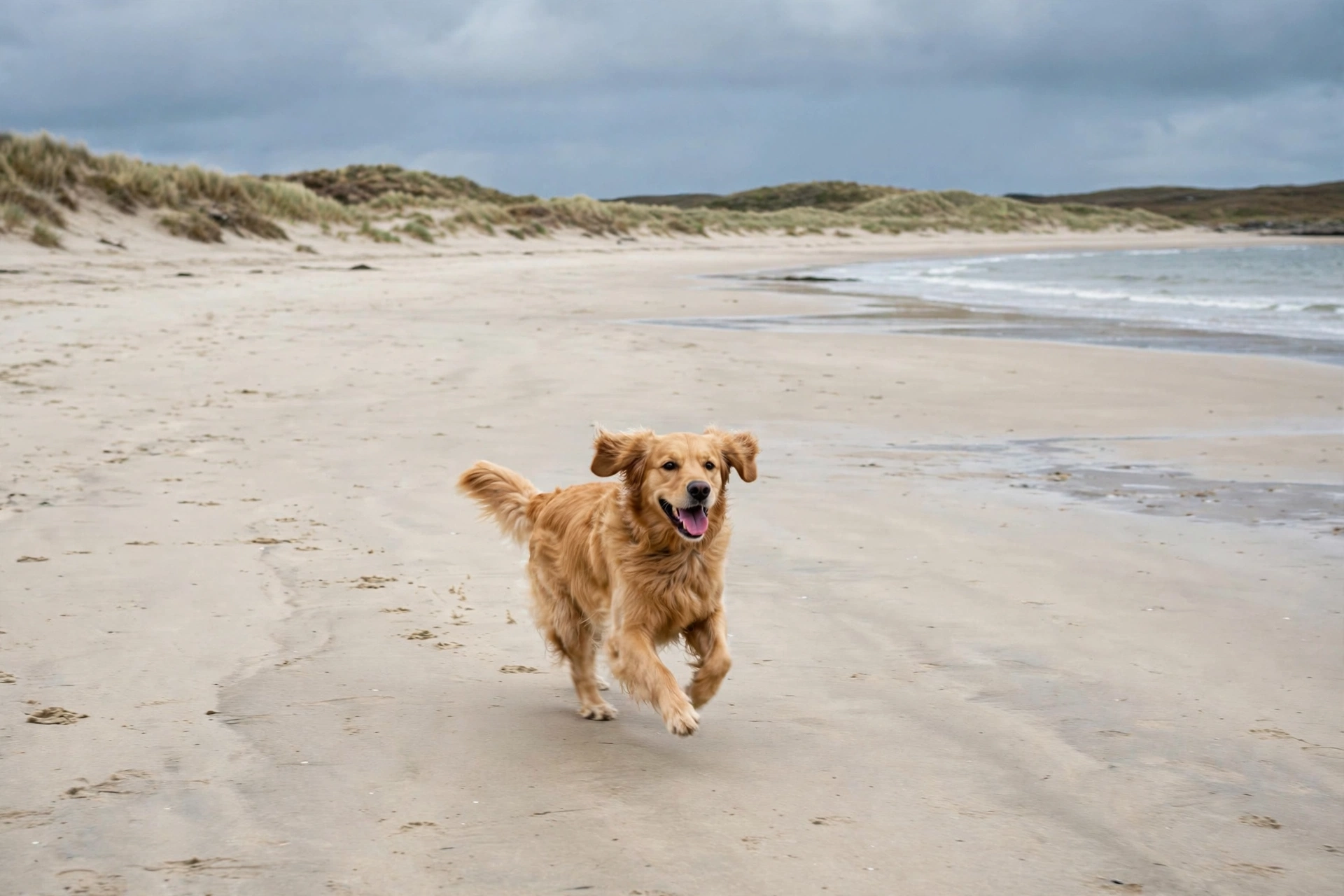
Beaches deserve a special mention because they combine everything a Westie loves — sand to dig, water to paddle, birds to watch, other dogs to meet — with several things to manage. Check whether dogs are allowed on the beach you plan to visit and whether any seasonal restriction applies, because many popular beaches restrict dogs in summer while quieter Scottish beaches welcome them all year. Our guide to dog-friendly beaches in Scotland covers seasonal rules, tides and wildlife in more detail. On the beach itself, rinse salt and sand from the coat afterwards, watch for broken glass, fishing line and discarded food, and keep the dog away from dead seabirds and marine animals. A Westie nose will find things you would rather it ignored, and a lead is the simplest prevention.
Finally, plan the walk backwards from the car or the accommodation. The most common Westie walking mistake is a long outward leg with no easy return: the dog is full of energy at the start, the scenery improves with every step, and by the time anyone checks the distance the dog has already done its best work. Loops beat out-and-back routes for terriers, because the smells stay new. A route with a cafe, a pub garden or a sheltered bench two-thirds of the way round gives the dog a rest and the humans a reason to stop. And if the dog is flagging, there is no shame in a short walk well done: a Westie that comes home tired, clean-ish and content has had a better day than one dragged around a route chosen for the map rather than the dog.
White coat and mud management
A white coat is a wonderful thing on a sunny photograph and a full-time job on a wet holiday. The trick is not to keep the dog clean — that is a lost cause on a Scottish coastal path — but to make cleaning fast, routine and unstressful, so that mud never becomes a reason to cut a walk short or dread the return to the car. The dogs that enjoy muddiest holidays are usually the ones whose owners have a system and stick to it without fuss.
The system starts at the door. Before the first walk, put a washable mat or old towel by the entrance of your accommodation, and keep a second set by the car boot. A portable paw washer — a cup with soft bristles that you fill with water and twist gently around each paw — works well for Westie legs, which are short enough to lift easily and hairy enough to hold mud. A jug of warm water and a microfibre towel do the same job. The routine that works is: paws and lower legs first, then belly and beard if needed, then a brisk towel dry, then a drying coat while the dog settles. Doing the same steps in the same order every time teaches the dog that coming in from a walk is a calm, predictable ritual, not a wrestling match.
Drying coats earn their place on a Westie holiday. A good drying coat absorbs water from the coat while the dog rests, which matters because a wet double coat takes a long time to dry naturally and a damp dog in a cold cottage or car will chill. Put the coat on after towelling, leave it on for twenty to thirty minutes, then remove it and brush through. Two coats are better than one if you walk twice a day, because a soaked coat needs time to dry between outings. The same logic applies to towels: pack at least four, rotate them, and hang them where air circulates. A damp towel left in a heap helps nobody.
Brushing is where dried mud actually leaves the coat. Wait until the coat is fully dry, then brush gently with a slicker brush, working in small sections and checking for tangles behind the ears, under the front legs and around the feathering on the legs and belly. Never brush a soaking wet, muddy coat aggressively: wet hair breaks more easily and the dog will learn to hate grooming. If mud has dried into hard clumps, a little plain water or a dog grooming spray softens it. Trimming the hair around the paws and between the pads — carefully, or by a groomer — reduces the amount of mud, snow and grit the feet pick up, and makes paw checks after walks much easier.
Bathing needs restraint. A Westie coat that is bathed every day of a holiday will dry out, and dry skin itches, flakes and invites scratching. Rinse mud off with plain water, towel dry, and save shampoo for when the dog is genuinely dirty, has rolled in something unpleasant, or is due a bath anyway. When you do bathe, use lukewarm water, a gentle fragrance-free dog shampoo, and rinse thoroughly: shampoo residue left in a dense double coat is a common cause of itching. Dry the coat completely with towels and gentle brushing, because a damp undercoat left to dry slowly in a cold room can leave the dog chilled and the coat musty.
The car is the other half of mud management. A boot liner, a waterproof seat cover or an old blanket, a box for muddy leads and a bag for wet towels keep the journey home civilised. After a beach walk, shake sand from the coat outside the car rather than inside it, and check between the toes for sand and small stones. At the accommodation, keep the dog off light-coloured bedding and sofas until it is dry, and bring the dog's own blanket for furniture: it protects the host's furnishings and gives the dog a familiar-smelling place to settle. Hosts notice this kind of care, and it makes the next booking easier too.
One more practical point: a white coat shows stains, and some stains are worth investigating rather than scrubbing. Brown staining around the mouth, eyes or paws can be normal tear or saliva staining, but sudden changes, redness, smell or soreness deserve a vet's opinion rather than a whitening shampoo. Tear staining in particular is often linked to eye irritation, blocked tear ducts or allergies. A gentle daily wipe with a damp cloth keeps the face tidy on holiday, and anything more persistent is a question for the vet at home, not a problem to solve with stronger products on the road.
Sensitive skin and allergy care
West Highland Terriers are well known among vets and groomers for sensitive skin, and a holiday is exactly when skin problems tend to show up: new grasses, different water, sand, salt, pollen, house dust in a new cottage, a different diet because the usual food ran out, and more baths than usual. None of this means a Westie cannot travel happily. It means skin care should be planned like walk routes — in advance, with the right supplies, and with a clear idea of when to seek help.
Start with the baseline before you leave home. If your Westie has known allergies, ongoing skin treatment or ear problems, visit the vet before the trip and take a written summary: current medication, how it is given, what to do if a dose is missed, and the signs that mean the dog should be seen sooner. Pack enough medication for the whole trip plus a few extra days, keep it in its original packaging, and carry it in hand luggage rather than in a suitcase that could go astray. Know where the nearest vet practice is at your destination, and save the number of an emergency vet that covers out-of-hours care. Rural practices in the Highlands and on the islands may be some distance away and may not be open all weekend, so this is not a detail to leave until the dog is uncomfortable at ten at night.
On the trip, the daily skin check is simple and takes a minute. After the last walk, look at the paws for redness, cuts, grass seeds caught between the toes, and soreness from salt or grit. Check the belly and groin, where contact allergies and grass irritation show first. Look inside the ears for redness, smell or discharge, because Westies are prone to ear irritation and a holiday of swimming and wet walks can aggravate it. Watch behaviour as well as skin: foot licking, face rubbing, flank scratching, head shaking and restlessness at night are often the first signs of a flare, and catching one early — a rinse, a dry coat, a night off swimming — is easier than treating a full-blown hot spot days later.
Grass seeds are a particular seasonal hazard for terriers that run through long grass and meadows. Barley-like seeds can work their way between the toes, into ears and under the skin, and a dog that suddenly starts limping, shaking its head or licking one paw obsessively after a meadow walk should be checked promptly. A quick paw check after every walk through long grass, and keeping the hair between the pads trimmed, reduces the risk. If you suspect a grass seed, do not try to dig it out yourself: a vet can remove it safely and check for infection.
Salt water, sand and swimming need their own routine. A paddle in the sea is fine for most Westies, but salt left to dry on the coat irritates skin, and sand trapped in the coat rubs. Rinse with fresh water after sea swimming, towel dry, and brush out sand once dry. If your dog swims regularly, dry the ears as your vet advises and watch for head shaking afterwards. Dogs that drink sea water can become unwell, so offer fresh water frequently on beach days and discourage drinking from rockpools. Algal blooms in still water are another hazard: do not let the dog swim in or drink from water that looks green, scummy or unusually coloured, and check local warnings where they are posted.
Diet continuity matters more than it sounds. A sudden change of food on holiday is a common cause of upset stomachs and can aggravate sensitive skin, so take the dog's usual food in measured portions, plus a little extra in case of delays. Treats are part of the same rule: a holiday cottage full of well-meaning new treats, dropped pub food and rich leftovers is a recipe for a sore stomach. Keep treats familiar, keep portions small, and make sure everyone travelling with the dog knows what the dog may and may not eat. If the dog does develop diarrhoea or vomiting, keep it hydrated, offer bland familiar food only as your vet advises, and seek veterinary help if it persists, if there is blood, or if the dog becomes lethargic.
Finally, be cautious with new grooming products on holiday. A scented shampoo bought at a gift shop, a borrowed flea treatment, or a heavily fragranced coat spray can trigger exactly the irritation you are trying to avoid. Use the products the dog already tolerates, and introduce nothing new in the week before travel. Flea and tick prevention should be up to date before a trip into grassland, moorland and woodland, and your vet can advise on the product that suits your dog and the area you are visiting. Ticks are common in deer and sheep country: check the coat after walks in bracken and long grass, remove ticks promptly with a tick remover, and watch the bite site afterwards.
Terrier instinct and lead etiquette
Every Westie owner knows the look: ears up, body tense, eyes locked on something small and moving, and a complete loss of interest in everything else, including you. That is not disobedience in the ordinary sense. It is a terrier doing what terriers were selected to do — notice small animals, pursue them, and investigate holes — and it is the single most important behaviour to manage on a British walking holiday, because the countryside is full of things worth chasing and many of them must not be chased.
Sheep come first, because the consequences are serious. A dog chasing sheep causes stress, injury and sometimes death to the animals, and it can be dangerous for the dog too. Farmers have legal powers in certain circumstances, and the distress caused to livestock is taken seriously. The rule is simple and non-negotiable: if there are sheep in the field, on the path or anywhere the dog could reach, the dog is on a lead. No exceptions for a dog that is usually good, has never chased before, or is only interested for a second. The same applies to lambs in spring, cattle with calves, and deer, which can injure a small dog with a kick. Keep distance, move calmly, and do not let the dog stare, stalk or fixate from the end of a long line.
Wildlife needs the same discipline in a quieter form. Ground-nesting birds on moorland and coast, nesting seabirds on cliffs and islands, hares, rabbits and squirrels all suffer when a dog flushes or pursues them, and in the breeding season the damage can mean lost nests and chicks. Seagulls on a beach are a classic Westie fixation: the dog is on a lead, the gulls are twenty metres away, and the dog is still barking, lunging and utterly convinced that one more step would settle the matter. Do not test this. Increase the distance, turn away before the dog locks on, and reward the dog for looking away and moving with you. A walk where the dog practises noticing wildlife and then moving on calmly is a successful walk, even if it is shorter than planned.
Recall training is worth honest assessment before a holiday. A Westie with a genuinely reliable recall on open ground, around other dogs and around wildlife is a pleasure to walk off lead. A Westie whose recall works in the garden and fails at the sight of a rabbit is not. There is no shame in using a long line: it gives the dog freedom to sniff, run and explore while keeping it safe and legal. Use a long line on open, hazard-free ground, keep it untangled, wear gloves to avoid rope burns, and never attach a long line to a collar on a dog that lunges — a harness spreads the force safely. Practise recall on the long line during the holiday, with high-value rewards for coming back, and treat every successful recall around a distraction as a win worth celebrating.
Lead manners around other dogs and people are part of the same picture. Westies are confident and can be feisty with unfamiliar dogs, especially on a lead where they cannot choose their distance. Do not let a Westie rush up to an unknown dog, even if the other owner says their dog is friendly. Ask before greeting, keep greetings short, and move on while both dogs are still calm. On narrow coastal paths, step aside, shorten the lead and let others pass. In villages and on promenades, keep the dog close, watch for dropped food, and clean up after the dog every time: terrier-sized deposits are still the owner's responsibility, and bagged waste should be binned, not left on a wall or hung from a fence.
Travel in the car is an extension of lead etiquette, because a dog that arrives over-excited is harder to manage on the first walk. Restrain the dog properly for every journey, as the Highway Code requires, whether that means a crash-tested harness, a secured crate or a dog guard with a boot setup that suits the dog. Our guide to dog car safety compares harnesses and crates in detail. Arrive, let the dog toilet and sniff for ten minutes, and start the first walk calmly rather than straight from an exciting car ride into a field of sheep. The first ten minutes of a walk set the tone for the next two hours.
Training on holiday should be short, positive and built into walks rather than bolted on as a separate chore. Practise a settle on a mat at the cafe, a wait at gates and stiles, a turn-away from distractions, and a recall on the long line. Keep sessions to a few minutes, reward generously, and end while the dog is still succeeding. A Westie that has practised settling on a mat at home will settle on a pub floor; a Westie asked to settle for the first time in a busy restaurant will not. The holiday is the exam, not the first lesson, so do the homework before you travel and keep the holiday practice light and rewarding.
Stays, cafes and calm behaviour
A Westie is a portable dog, and that is a real advantage when booking stays. Small size means most dog-friendly hotels, bed and breakfasts and cottages can accommodate one, and a dog that fits under a cafe table is easier to take out for a meal than a dog that needs a whole corner. But small does not mean low-maintenance: a vocal, restless Westie in a thin-walled hotel room can be more disruptive than a large, sleepy dog, and a terrier that has never settled in a strange room will not learn to do so at midnight on the first night of a holiday.
Book with specifics, not just a tick box. Ask whether dogs are allowed in the particular room or cottage type you are booking, whether there is a pet fee and what it covers, whether dogs may be left alone and for how long, where dogs may toilet, and whether dogs are welcome in the restaurant, bar, terrace or breakfast room. Some hotels welcome dogs in the bar but not the restaurant; some cottages have enclosed gardens and some do not; some allow one dog and charge extra for a second. Get the answers in writing with the booking, and read them again before you arrive. Our guide to dog-friendly hotels in the UK lists the booking questions that prevent disappointment. A hotel that answers clearly is usually a hotel that has thought about dogs properly.
Room choice matters for a terrier. A ground-floor room near an exit makes night-time toilet trips easy and reduces the number of corridors, lifts and strangers the dog must navigate when it is tired. A room away from the main stairwell, lift and ice machine is quieter, which helps a dog that barks at passing footsteps. If the dog is a known barker, say so honestly when booking and ask for a quieter location: hosts would rather place you well than deal with a complaint later. Bring the dog's own bed, blanket and a worn item of clothing if that helps it settle, and set the bed up in a corner away from the door so the dog has a safe spot that is not in the traffic of people coming and going.
The first evening in a new place should be deliberately boring. Arrive in daylight if you can, walk the dog around the grounds or the nearest quiet street, let it toilet and sniff, then settle in the room with the same routine as home: same feeding time, same bed, a short chew or a quiet play session, and a last toilet trip before bed. Do not plan a long restaurant meal on the first night and leave a new dog alone in a strange room: that is the combination most likely to produce barking, scratching and a complaint. Eat in the room, on the terrace with the dog, or in a dog-friendly bar for the first evening, and build up to longer separations only if the dog is genuinely settled and the hotel permits it.
Cafes and pubs reward preparation. Practise settling on a mat at home and in quiet local cafes before the holiday, so that the mat itself becomes a cue to relax. On arrival, choose a table with space, settle the dog on its mat with a chew or a stuffed food toy, and order promptly so the dog is not waiting hungrily while everyone else eats. Keep the lead short enough that the dog cannot reach other tables, watch for dropped food and other dogs passing close by, and be ready to step outside for a toilet break or a calming walk if the dog becomes restless. A short, calm cafe visit that ends well is better than a long one that ends with the dog barking at every passer-by.
Alone time in a stay needs a plan, not hope. Many hotels and cottages do not allow dogs to be left alone at all, and those that do usually limit it to a short period and require the dog to be quiet and crated or settled. If you want to visit somewhere dogs cannot go — a castle interior, a boat trip, a restaurant that does not welcome dogs — plan who looks after the dog, whether that means taking turns, using a local dog sitter or daycare service booked in advance, or choosing a different attraction. Never leave a Westie alone in a car, especially in warm weather, and never leave a dog that barks when alone to bark through a neighbour's holiday. Honesty about your dog's alone-time tolerance, made at booking, prevents the awkward mid-holiday discovery that your plans and your dog's needs do not fit.
Holiday cottages bring a different set of checks. Enclosed gardens vary enormously: a fence that contains a Labrador may have gaps a Westie slips through, gates may not latch securely, and a garden that borders farmland or a road needs a lead even if it is described as enclosed. Walk the boundary on arrival, check gates, gaps under fences and low hedges, and supervise the dog in the garden until you know it is secure. Inside, move cleaning products, medicines and food out of reach, check for mouse traps or rat poison in outbuildings, and keep the dog away from open fires and wood-burning stoves. A cottage that is safe for a terrier is one whose owner and guest have both checked it, not one whose listing simply says dog-friendly.
Seasons and weather
Britain gives a Westie four very different holidays in one year, and each season changes the planning in ways that matter for a white, short-legged, skin-sensitive terrier. The good news is that there is no bad season for a Westie trip, provided the season's particular problems are planned for. The bad trips are the ones where a summer plan is used in January, or a winter coat routine is used in a heatwave.
Spring is the season of lambs, nesting birds and mud. March to May offers longer days, quieter paths and beaches that are still open to dogs before summer restrictions begin, but it is also the season when livestock and wildlife need the most care. Keep the dog on a lead in fields and on moorland, watch for ground-nesting birds, and expect paths to be wet underfoot after winter rain. Spring pollen can aggravate sensitive skin and eyes, so keep the post-walk rinse routine going even when the sun is out. It is also a good season for a first Westie holiday, because temperatures are mild, crowds are thin and the dog can build fitness gradually.
Summer brings the two problems Westie owners most often underestimate: heat and beach restrictions. A Westie in a thick double coat overheats more easily than it looks, especially on a humid day with no shade, and small dogs dehydrate quickly. Walk early in the morning and late in the evening, carry water, plan shade, and never leave the dog in a parked car. Check beach rules before travelling, because many popular beaches restrict dogs between spring and autumn, while quieter Scottish and Welsh beaches remain open. If your chosen beach is restricted, look for the nearest year-round dog beach rather than arguing with a sign. Summer also means more people, more dogs and more dropped food on paths, so lead manners and recall matter even more than in winter.
Autumn is, for many Westie owners, the best season of all. Beaches reopen to dogs as summer restrictions lift, crowds thin out, temperatures are comfortable for walking, and the light on the coast is at its finest. The trade-offs are mud, shorter days and fireworks. From late October into November, fireworks can unsettle noise-sensitive dogs, so check whether your accommodation or nearby venues host displays, keep the dog indoors during display times, and create a safe, quiet den with familiar bedding and background sound. Autumn storms can also make coastal paths dangerous, with high winds, large waves and slippery surfaces, so check forecasts and tide times before a cliff walk and do not take risks for a photograph.
Winter in Scotland and the north of England is a serious, beautiful season that suits Westies well, provided the dog is dry, warm and not over-faced. Short days mean walks must be planned around daylight, and a walk that starts in sunshine can end in darkness, so carry a light and a charged phone. Cold itself rarely troubles a healthy Westie in a good coat, but wind chill, wet ground and long periods standing still in the cold do. Keep walks moving, dry the dog thoroughly afterwards, and check paws for grit and salt from treated paths and roads. Snow brings its own fun and its own checks: snow can ball up between the toes, ice can cut paws, and antifreeze spilled on roads is poisonous, so keep the dog away from puddles near parked cars and wash paws after urban walks.
Midges deserve a paragraph of their own, because they can ruin a Highland summer evening for humans and dogs alike. Midges are worst in the west of Scotland from roughly June to August, especially in still, damp conditions at dawn and dusk. Dogs are bitten too, particularly on ears, belly and thinly haired areas, and some dogs react with itching and soreness. Avoid still, sheltered spots at midge times, keep moving on walks, and ask your vet whether a repellent product is suitable for your dog — never use a human insect repellent on a dog without veterinary advice, because some ingredients are toxic to dogs. A midge-proof approach is mostly about timing and location: a breezy coastal walk beats a still glen at dusk, every time.
Tides, weather and daylight are the three things to check every morning of a coastal holiday, whatever the season. Tide times decide whether a beach walk is possible or whether the route will be cut off. Weather forecasts decide whether a cliff path is safe or whether a valley walk is wiser. Daylight hours decide when to turn back. A Westie does not know about any of these, and will happily walk towards a rising tide, a storm or darkness with complete confidence. That is the owner's job, and it takes two minutes with a phone each morning. The best Westie holidays are not the ones with the most dramatic routes; they are the ones where the dog comes home every day tired, dry and ready for the next morning.
Packing and travel-day routine
Packing for a Westie is mostly about mud, skin and lead management, and the list below is built around those three things. Food and water come first: the dog's usual food in measured portions plus extra, a water bottle and a collapsible bowl, and familiar treats. Then the coat kit: two drying coats, four microfibre towels, a paw washer or jug, a slicker brush, a gentle fragrance-free shampoo, and a grooming spray if the dog tolerates one. Then the lead kit: a comfortable harness, a short lead, a long line for open ground, poo bags, a torch for night walks, and a dog-carrying sling or pack if you plan steep or rough ground where a tired dog might need help.
Health and comfort items follow: any medication in original packaging plus a written summary, a basic first-aid kit with a tick remover, a pet first-aid booklet or card with your vet's number, ear cleaner only if your vet has advised it, and the dog's own bed and blanket. Add a waterproof mat for the car boot, a box for muddy leads, a spare lead in case one breaks, and a copy of the dog's vaccination record if your accommodation or a local service asks for it. A photo of the dog on your phone, and the dog's microchip number saved somewhere accessible, are useful if the dog ever slips a lead or gets lost on an unfamiliar path.
Travel day itself should be calm and boring in the best sense. Feed the dog at the usual time, give it a good toilet walk before setting off, and stop every two hours on a long journey for water, a toilet break and a short stretch. Keep the car at a comfortable temperature, never leave the dog alone in the car, and arrive with enough daylight left to walk the accommodation boundary, find the toilet area and settle the dog before dark. Unpack the dog's things first — bed, water bowl, food, mat — so that the dog's corner of the new place is ready before the humans' suitcases are opened. A dog that arrives to a ready-made corner settles faster than one that waits while humans unpack.
The last point is the simplest and the most important. A Westie holiday is not a test of how far, how high or how muddy you can go. It is a week of short, interesting walks, a coat that gets cleaned without drama, a terrier that learns to look at sheep and gulls and then look away, and evenings in a warm room with a dry dog asleep on its own blanket. Plan for the mud, respect the instinct, protect the skin, and let the scenery do the rest. The white dog will turn grey most days, and that is not a failure of planning. It is the sign of a Westie that has had exactly the holiday it wanted.
Practical questions
Before you go
How do I keep a West Highland Terrier's white coat clean on a muddy trip?
Accept that a white coat will get dirty, and build the trip around a fast clean-up routine rather than trying to prevent mud altogether. Pack two microfibre towels, a portable paw washer or a jug, a drying coat and a slicker brush. Rinse legs and belly with plain water after muddy walks, towel dry, then put the drying coat on for twenty minutes while the dog settles. Brush out dried mud once the coat is fully dry, and save full baths for when the dog is genuinely dirty or smelly, because over-bathing can dry out sensitive Westie skin.
Can a Westie walk all day in the Highlands?
Many healthy adult Westies are surprisingly sturdy walkers and enjoy two to four hours of varied walking in a day, but short legs, steep ground and rough terrain change the maths. Plan shorter loops with breaks, water and a chance to sniff, rather than one long forced march. Watch for slowing, lagging, limping or heavy panting, and turn back while the dog still has energy in reserve. Puppies, older dogs and dogs recovering from illness need much shorter outings, and your vet can advise on a sensible distance for your individual dog.
What should I do when my Westie lunges at sheep or gulls?
Keep the dog on a lead wherever livestock, ground-nesting birds or busy wildlife are possible, and increase distance before the dog locks on. Practise a reliable turn-and-move-away cue at home and on quiet paths first, reward calm looking away, and use a long line on open ground where it is safe and permitted. Never let a terrier chase sheep, lambs, deer or nesting birds: it is stressful for the animals, it can be dangerous, and in farmland it can have legal consequences, so check the official guidance before you travel.
Is a West Highland Terrier good for a first dog-friendly hotel stay?
Westies are often well suited to hotel stays because they are small, portable and usually sociable, but the stay still needs preparation. Practise settling on a mat, short alone-time waits and calm greetings before the trip. Choose a room on a quiet corridor, bring the dog's own bed and blanket, and ask in advance where dogs may go, where they can toilet, and whether they may be left alone. A first stay works best when the first evening is quiet and the dog's routine stays close to home.
How often should I bathe a Westie with sensitive skin?
There is no single right frequency, because it depends on the dog's skin, coat condition and veterinary advice. As a starting point, many Westies do well with a bath every four to eight weeks using a gentle, fragrance-free dog shampoo, plus plain-water rinses for mud in between. If the skin is red, flaky, itchy or smelly, or if the dog is scratching, licking paws or shaking its head, do not just bathe more often: ask your vet, since Westies are prone to skin allergies and ear problems that need diagnosis rather than extra washing.
Do Westies cope with Scottish midges and cold coastal weather?
Westies generally cope well with cold, wind and rain thanks to a dense double coat, but midges, wet ground and wind chill still need planning. Use a vet-approved insect repellent if your vet recommends one, avoid still, damp spots at dawn and dusk in midge season, and dry the coat thoroughly after wet walks so the dog does not chill. In winter, check paws for grit and salt after treated paths, keep walks shorter in driving rain, and always have a warm, dry place for the dog to recover after a coastal walk.