This guide is independent and contains no paid placement. If affiliate links are added later, they will be clearly marked and will not change our editorial checks.
Wye Valley walks with a dog work at two levels. Stay low for riverside paths, swimming-free paddling spots to avoid, pubs and villages between Monmouth, Tintern and Chepstow, or climb to the gorge rim for Offa's Dyke viewpoints such as the Devil's Pulpit and Symonds Yat Rock. Keep dogs on a lead around livestock, at heritage sites and near steep drops, check Tintern Abbey and canoe hire dog policies before you travel, and time an autumn visit for mid-October to early November colour.
River level or rim? Choosing your Wye Valley
Every Wye Valley walk begins with the same decision, and it is worth making deliberately rather than discovering halfway up a climb: do you walk at river level, in the cool green tunnel of the valley floor, or on the rim, in the open air above the gorge where the river appears far below as a bright, looping ribbon? The two experiences share a postcode and almost nothing else. River-level routes are shaded, sociable and forgiving, with villages, bridges and pubs at useful intervals and gradients a senior dog can manage all morning. Rim routes are wilder and more committing, threading ancient woodland to sudden viewpoints, with stiles, exposed edges and long stretches where the only facilities are the ones in your rucksack.
The geography explains the contrast. The Wye, one of Britain's least polluted and most protected rivers, cuts a deep, meandering gorge through limestone and old red sandstone between Ross-on-Wye, Monmouth and Chepstow, much of it designated a National Landscape — the newer name for an Area of Outstanding Natural Beauty — and the river itself protected as a Site of Special Scientific Interest and Special Area of Conservation. Ancient semi-natural woodland clothes both banks, among the most important surviving examples in Britain, and that woodland is both the valley's glory and its practical challenge: paths are often muddy, roots cross the tread, and after rain the limestone can be polished and slippery under paw and boot alike.
For a first visit with a dog, a honest pattern is one day at each level. Walk low from Tintern along the river, or between Monmouth and Redbrook, and let the dog learn the valley's smells at a relaxed pace. Then climb once, properly, to a single great viewpoint — the Devil's Pulpit above Tintern or Symonds Yat Rock above the horseshoe bend — rather than attempting a full rim traverse. Dogs read repetition as reassurance; two contrasting days teach them the valley better than one exhausting attempt to do everything, and they teach owners which level suits their team before longer routes are planned.
Whichever level you choose, build the day around water and shade. The river looks inviting and in places dogs have traditionally paddled at gentle edges, but currents are deceptive, banks can be steep or undercut, and the Wye's protected status means disturbance matters: keep dogs out of sensitive margins, never let them chase birds or worry swans, and carry drinking water so the river is a view rather than a necessity. Tidal influence reaches up to Tintern and beyond, so lower-valley banks and paths can be affected by high tides and by flooding after heavy rain upstream. Check river levels and path conditions before you travel, and treat any flooded section as closed rather than as a challenge.
Tintern Abbey with a dog: ruins, rules and the village
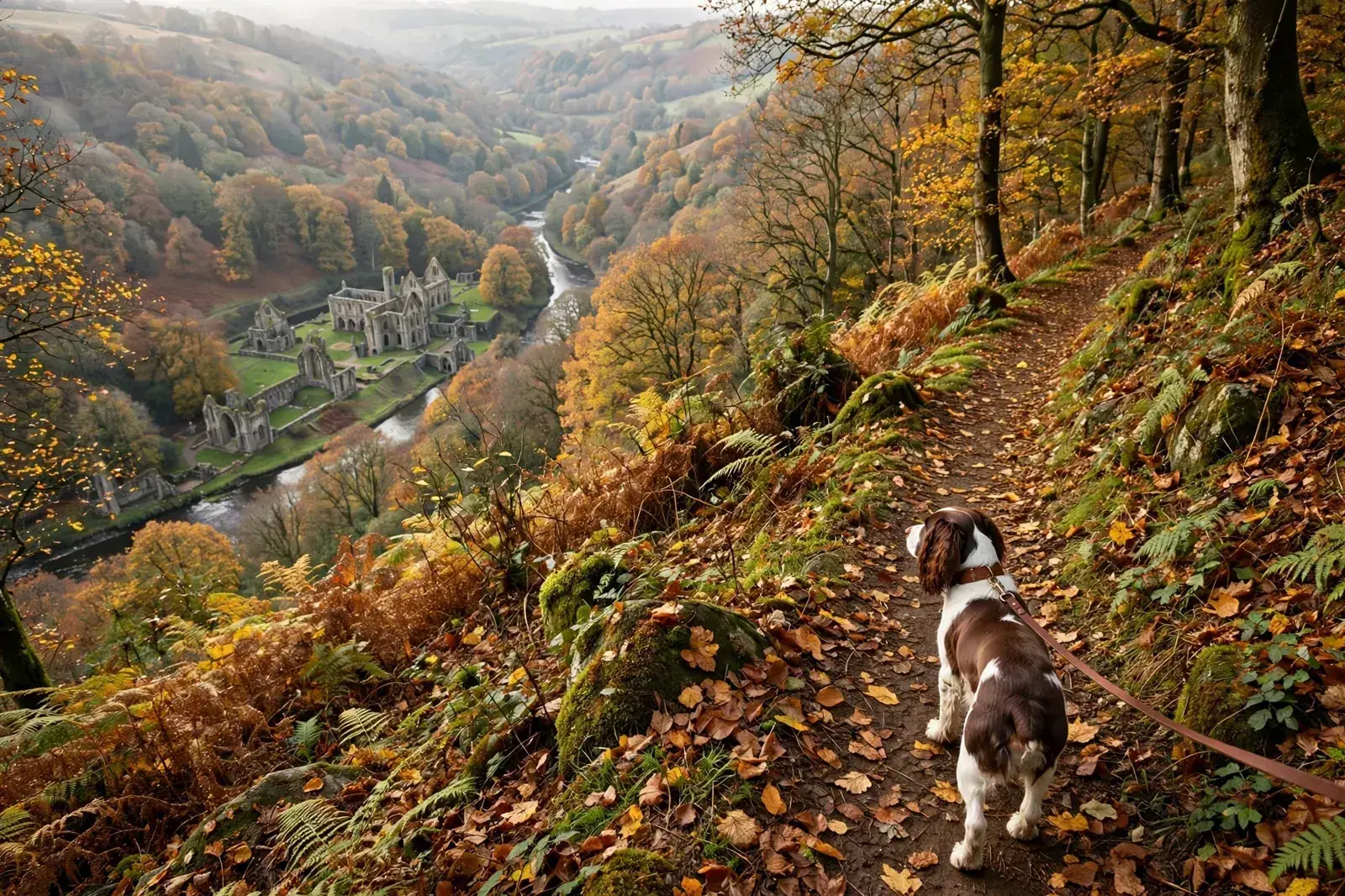
Tintern Abbey is the valley's great set piece: a Cistercian abbey founded in the twelfth century, dissolved under Henry VIII, and left as a roofless Gothic shell so beautiful that it helped invent British tourism — Wordsworth wrote his famous lines a few miles above Tintern, and Turner and a generation of picturesque travellers came to see the ruins reflected in the Wye. For dog walkers it has a second virtue: it sits directly between the river path and the climb to the Devil's Pulpit, so a visit stitches naturally into a walking day rather than competing with one.
Dogs on leads have generally been welcomed in the abbey grounds, which makes Tintern one of the more rewarding heritage stops you can make with a dog in Wales. That welcome comes with conditions that deserve respect rather than negotiation. Keep the lead short inside the ruins, where other visitors, uneven medieval floors and sudden pigeons concentrate; keep dogs out of any roped or signed conservation areas; and clear up without exception on ground that is both a scheduled monument and, for many visitors, a place of real quiet. Our English Heritage with dogs guide explains how heritage dog rules work across the border in England; Tintern is cared for by Cadw, the Welsh Government's historic environment service, under its own arrangements. Check the latest official Cadw guidance before you travel for current dog policy, opening hours and admission charges, and confirm on arrival if anything is unclear — policies and conservation closures do change, and this guide cannot override the signs on the day.
Tintern village supports the visit well if you plan for popularity. Parking near the abbey fills early on fine weekends and throughout the autumn colour season, and the village's cafés and pubs are correspondingly busy at lunchtime. An earlier start solves most of it: abbey first in the morning light, when the nave is quiet and the dog can settle, then the river path or the Pulpit climb, then lunch once the day visitors have spread out along the valley. Dogs that find crowds difficult will manage Tintern far better at opening time than at one o'clock on a Saturday.
One caution belongs to every Tintern day: the A466 through the village is a busy road with fast traffic and narrow pavements in places. Cross at clear sightlines, keep the dog on the inside, on a short lead, and do not let a photo stop on the bridge become a traffic problem. The Wye Bridge views are superb and worth taking — from the pavement, with the dog held close, rather than from the carriageway.
Two long trails, one valley: Offa's Dyke and the Wye Valley Walk
Unusually, this one valley holds substantial sections of two long-distance paths, and they divide the river-versus-rim choice almost perfectly. The Wye Valley Walk runs for around 136 miles from the river's source on Plynlimon to the Severn at Chepstow, and its lower-valley sections stay mostly close to the water, linking Hay-on-Wye, Ross, Monmouth, Tintern and Chepstow at a walker's pace. Offa's Dyke Path, the National Trail following the eighth-century earthwork attributed to Offa of Mercia for much of the Welsh border, runs for around 177 miles between Sedbury and Prestatyn; in the Wye Valley it takes the high line, shadowing the gorge rim through woodland on the eastern side. Same river, same week, two completely different holidays.
The Wye Valley Walk is the natural choice for most dog teams. Its valley sections offer frequent settlements for water, food and bail-out options, gentler gradients, and long shaded stretches where an older dog can keep its rhythm. Sections worth targeting include Monmouth to Redbrook and on towards Bigsweir, where the river is wide and the path companionable, and Tintern to Chepstow, where the walk finishes the valley's story as the gorge opens towards the Severn. Watch for livestock in riverside meadows — a lead is essential there — for anglers' gear on the path, and for the occasional flooded or diverted stretch after wet weather. Waymarking is generally good, but carry a map or downloaded route regardless; phone signal is unreliable in the gorge, which is part of its charm and all of its inconvenience when you take a wrong turn.
Offa's Dyke Path in this section is the connoisseur's choice and the harder day. The climb from Tintern or Brockweir to the Devil's Pulpit viewpoint, where the abbey appears framed far below, is one of the great short ascents in border country, and the Dyke's line through the woods above the gorge delivers repeated, sudden views. The costs are real: stiles that a large or elderly dog may not manage, gates and livestock fields requiring full lead discipline, exposed drops near viewpoints where a lunging dog is a genuine danger, and long gaps between roads and villages. Walk it in chosen sections rather than as a through-route with a dog unless you have planned accommodation, food and escape routes with unusual care.
A combined pattern serves many visitors best: walk out on one trail and back on the other where the two run on opposite banks or at different levels, using the bridges at Monmouth, Bigsweir, Brockweir, Tintern's area crossings where available and Chepstow to build loops — but plan loops from a map at the kitchen table, not from optimism at a junction. Distances in a gorge always exceed their appearance on the page, and a dog that has climbed to the rim once already will give you an honest opinion about doing it twice.
Symonds Yat: the horseshoe bend from both banks
If the lower valley has a rival to Tintern, it is Symonds Yat, where the Wye loops through a near-complete horseshoe beneath steep wooded hills near the England–Wales border. The place divides into two halves facing each other across the river: Symonds Yat East, on the Gloucestershire side, beneath the famous viewpoint of Symonds Yat Rock; and Symonds Yat West, on the Welsh side, with its own paths, parking and leisure facilities. A small hand-pulled ferry has traditionally connected the two for foot passengers — check locally whether it is running before building a route that depends on it, and check its current position on dogs before relying on carrying yours across.
Symonds Yat Rock is the viewpoint most visitors aim for, and it earns the climb: from the managed viewpoint the river's loop unrolls below, and peregrine falcons — which nest on the cliffs in season and are watched by volunteers with telescopes in some years — stoop over the gorge. For dogs, the Rock demands your best lead work of the trip. The approach paths are fine, but the viewpoint area is busy, fenced in places and close to serious drops; keep the lead short, hold the dog away from edges and other visitors, and do not let it bark at or lunge towards birds. A dog that can settle on a mat while you take in the view will enjoy the stop; a dog that cannot is better walked through the woods and admired-from rather than perched at the rim.
At river level, the walks from both banks are gentler and, for many dogs, better. Riverside paths run towards Biblins and downstream towards Monmouth in one direction and towards Kerne Bridge and Goodrich in the other, with the suspension bridge at Biblins giving a memorable crossing where it is open — check its current status locally if your loop needs it. Swans, herons, kingfishers and, in quieter moments, otters use this river; a dog under close control watches all of it without disturbing any of it, which is exactly the standard this protected river asks. Keep dogs out of the water at busy ferry, landing and swimming spots, and on leads around anglers, whose lines, hooks and bait are all hazards to a curious nose.
Practicalities decide whether a Yat day feels easy or fraught. Parking on both sides is limited and chargeable, lanes are narrow, and peak autumn weekends can queue. Arrive early or late, walk the quieter bank if crowds build, and carry cash or a payment app as directed by current signage. If you are extending north, our Shropshire dog walks guide covers the neighbouring border hills and the Severn, and the comparison is useful: the Wye gorge is deeper and more wooded, Shropshire's tops more open — both ask the same livestock and lead discipline of a visiting dog.
Dogs afloat: canoe hire, river manners and when to stay ashore
The Wye is one of Britain's classic canoeing rivers, and the half-day drift from Kerne Bridge to Symonds Yat, or from Ross towards Kerne Bridge, is for many visitors the valley's signature experience. Inevitably, dog owners ask whether the dog can come. The honest answer is: sometimes, with the right dog, the right operator and the right preparation — and the decision deserves more thought than simply adding a passenger to a booking.
Hire companies on the Wye set their own dog policies, and they vary: some welcome dogs in certain canoes, some allow them only in specific circumstances, and some do not carry them at all. Policies can also change with river conditions, boat availability and insurance terms. Check the latest hire terms directly with the operator before you book, state the dog's size and temperament honestly, and never arrive assuming a dog will be accepted because another company, or the same company last year, allowed one. If dogs are accepted, ask about maximum weights, whether a buoyancy aid for the dog is provided or required, and where the dog is expected to sit — a dog amidships, low and settled, is a passenger; a dog standing at the bow scanning for ducks is a capsize with a timetable.
Prepare the dog as you would for any new transport. A properly fitted canine buoyancy aid with a handle is sensible even for strong swimmers, because a tipped canoe in a cold, flowing river is not a swimming lesson. Practise settling on a mat at home and in the garden, reward stillness, and choose the shortest trip first. On the water, keep the dog on a lead that is held but never tied to the boat — a trapped lead in a capsize is dangerous — and keep the dog out of the river at launches and landings used by other people. Wildlife comes first on this protected river: a barking, lunging dog near swans, nesting birds or an otter holt is not a charming extra, it is a reason for operators to tighten their policies for everyone.
Know when to stay ashore, and say it without disappointment. Nervous dogs, dogs that chase wildlife, dogs too large to sit low and still, puppies, and dogs recovering from injury are usually happier walking the bank path while the rest of the party paddles — the valley is one of the few places where the shore-based alternative is arguably the better day anyway. River conditions settle the question on other days: after heavy rain the Wye rises and quickens fast, and no dog belongs in a canoe on a river running high, brown and full of debris. Reputable operators cancel in those conditions; take the hint as a gift and walk the woods instead.
Wild boar and woodland sense on the Forest of Dean fringe
West of the river, the Wye Valley's woods merge into the Forest of Dean, and with the Forest comes the subject every local dog walker has an opinion on: wild boar. Free-living boar became established in the Dean after escapes and releases in the 1990s and 2000s, and the population is managed by Forestry England, including through culling, because rooting boar damage woodland floors, verges and, occasionally, gardens. Walkers on the Forest fringe — around Staunton, the Kymin above Monmouth, and the woods between the valley and Coleford — may see unmistakable rooting damage long before they ever see an animal.
Perspective first: boar generally avoid people and dogs, most walks pass without any encounter, and the valley's main paths on the river and rim are not a boar safari in either direction. The risk that matters is specific and manageable. A dog off lead that finds, chases or corners a large wild animal — above all a sow protecting piglets in spring and early summer, identifiable young with striped coats — can be seriously injured, and an owner who runs in shouting makes everything worse. Boar are powerful, fast over short distances and entirely entitled to defend their young.
The precautions are the same woodland discipline this guide recommends everywhere, applied with extra consistency. Keep your dog on a lead or under genuinely close control in Forest-fringe woodland, especially where rooting is fresh, underfoot is dense with bracken or cover, and visibility is short. Stick to clear paths, make normal walking noise so animals can move away, and if you do see boar ahead, stop, shorten the lead, turn calmly and give them a wide berth and an escape route that is not through you. Never let a dog chase deer either — fallow deer are numerous in these woods, and the same encounter logic applies with hooves instead of tusks. Follow Forestry England guidance and local signs on the day, particularly during any notified management activity in the Forest.
Two smaller woodland notes complete the picture. Ticks are common in the valley's woods and bracken from spring to autumn, so check the dog — and yourself — after walks and remove ticks promptly with a proper tool. And in autumn, the same woods drop acorns, beech mast and fungi in quantity; a dog that scavenges should be watched, because acorns and some fungi are harmful if eaten. None of this is a reason to avoid the Forest fringe, whose beechwoods in October are among the finest walking in Britain. It is a reason to walk it awake, lead in hand, which is how the locals who love it walk it too.
Pubs, bases and the evening walk: Monmouth to Chepstow
A Wye Valley trip is well supplied with places to stay and eat, but the bases have distinct characters, and choosing the right one shapes the walking. Monmouth, at the valley's middle, is the all-rounder: a proper market town with independent shops, dog supply options, a vet within reach, riverside meadows for the evening walk and both long trails passing through. It suits a first visit and anyone who wants supper choices after a long day. Chepstow, at the valley's mouth, adds a castle, a wider choice of stays and the start of both the Wye Valley Walk and Offa's Dyke Path at Sedbury nearby — plus the practical advantage of main-road and rail connections for car-free arrivals, subject to checking current services.
Tintern itself is the romantic's base: a small village in the gorge with the abbey at its heart, walks from the door in both directions and up both climbs, and evenings that empty out beautifully once day visitors leave. Its limits are the mirror of its charms — fewer eating choices, busier middays, and parking pressure that guests feel less than visitors. Ross-on-Wye, perched above a great loop of the river at the valley's northern end, works as a gentler, town-based alternative with excellent river meadow walks and easy access to Symonds Yat and Goodrich for day trips.
The valley's pubs are part of the walking infrastructure and many welcome dogs in bars and gardens — riverside inns at Redbrook, Brockweir, Tintern, Symonds Yat on both banks and Llandogo among them. Welcome varies by house and by room, and muddy-paw rules tighten in wet weeks, so check the current position with the pub before you plan a route around a specific lunch, carry a towel and settle mat, and keep the dog off furniture and out of dining rooms unless explicitly invited. A dog that lies quietly under a table while walkers eat is the single best ambassador for every dog that follows; a dog that tours the bar greeting strangers undoes that work in an afternoon.
Evenings deserve a line of planning anywhere you stay. Gorge villages go dark and quiet, lanes are unlit, and the riverside path that was obvious at noon is a torch-lit proposition at nine. Identify the after-dark walk on arrival — a lit village circuit, a meadow loop near town lights — and carry a torch and a lead light for the dog. Ask hosts the standard questions before booking: dog charges, enclosed garden or not, dogs alone in rooms or not, and the earliest practical breakfast if you want the viewpoints to yourselves. In the Wye Valley, the early party gets the gorge in mist and the abbey in silence, and your dog will think you arranged both personally.
Autumn colour and the other seasons: timing the valley
Autumn is the Wye Valley's famous season, and it is famous for a sound ecological reason: few places in Britain hold so much ancient woodland in so deep a gorge, so when beech turns gold, oak russets, sweet chestnut yellows and field maple flares, the colour arrives in layers from rim to river. The usual peak runs from mid-October to early November, shifting with the year's weather — a dry, settled autumn colours slowly and lasts; a stormy one can strip the show in a weekend. The great colour viewpoints are the same great viewpoints, working harder: Symonds Yat Rock over the loop, the Devil's Pulpit over Tintern, the Kymin above Monmouth and the Eagle's Nest viewpoint above Wyndcliff on the Piercefield walks near Chepstow, where the path is steep and exposed in places and dogs need close lead control near drops.
Come in autumn with a dog prepared for the season's terms. Paths are at their muddiest, limestone and wet leaves make a skating combination, and low sun through the gorge means some valley-floor walks spend much of the day in beautiful, chilly shade. Shorter daylight compresses the rim routes: a Dyke section that was an easy summer afternoon becomes a plan-with-a-headtorch exercise by November. Parking and pubs are at their busiest on fine colour weekends. The compensations — mist in the gorge at dawn, woodsmoke in the villages, the river running clear and quick — make it many local walkers' favourite time, dogs included, provided paws are towelled and older joints are given the shorter option without apology.
The other seasons each make a case. Spring fills the woods with bluebells and wild garlic — glorious to walk through, though garlic-scented dogs will share the experience with your car for days — and brings lambs to the riverside meadows and nesting birds to the river, tightening lead discipline exactly when the walking tempts you to relax it. Summer offers the longest days for the two-trail combinations and canoeing in settled conditions, balanced against heat in the open rim sections, busier paths and the need for early starts and carried water. Winter, on a frosty, settled day, may be the connoisseur's valley: bare woods open views the summer canopy hides, the abbey stands stark and quiet, and a fit dog can have the Wye Valley Walk almost to itself between villages — with flooded paths after rain as the standing price to check before setting out.
Whenever you come, leave the valley as its protected status asks: gates closed, waste carried to a bin, leads where livestock, wildlife and other visitors need them, and nothing fed to any animal that lives here. The Wye has been walked, painted, paddled and written about for over two centuries, and it has stayed this good because generations of visitors treated it as a privilege rather than a backdrop. Walk it that way with your dog — low by the water on one day, high on the rim on the next — and the valley will give you both its two best days in a single trip.
Practical questions
Before you go
Can dogs go into Tintern Abbey?
Dogs on leads have generally been welcomed in the grounds and ruins at Tintern Abbey, which is cared for by Cadw, but access arrangements, charges and any areas that are closed for conservation can change. Keep your dog on a short lead, away from other visitors in the nave and out of any roped areas. Check the latest official Cadw guidance before you travel and confirm the current dog policy on the day.
Which is better for dogs, Offa's Dyke Path or the Wye Valley Walk?
For most dogs, the Wye Valley Walk is the gentler choice: it stays lower, closer to the river, villages and pubs, with easier bail-out points. Offa's Dyke Path in this section is higher, more exposed and more committing, with stiles, livestock fields and longer gaps between settlements, but it gives the great gorge viewpoints. Confident, fit dogs can enjoy short Dyke sections; older dogs and first visits usually suit the valley floor.
Can dogs go in canoes on the River Wye?
Some hire companies on the Wye allow dogs in canoes and some do not, and policies vary by operator, boat type and river conditions. A dog should only go afloat if it is calm, can settle low in the boat, wears a properly fitted buoyancy aid and will not lunge at wildlife or swimmers. Always check the latest hire terms directly with the operator before you book, and never assume a dog is included in a standard booking.
Are wild boar a risk for dogs in the Wye Valley?
Free-living wild boar are established in the Forest of Dean, which borders parts of the Wye Valley, and walkers may encounter signs of rooting or, rarely, the animals themselves. Keep your dog on a lead or under very close control in woodland on the Forest fringe, do not let it chase or corner any large animal, and give a sow with young a wide berth and a clear escape route. Follow Forestry England advice and local signs on the day.
When is the best time to see autumn colour in the Wye Valley with a dog?
Mid-October to early November is usually the peak window, when beech, oak and sweet chestnut colour in sequence and the gorge viewpoints are at their best, but timing shifts with the weather each year. Weekday mornings give the clearest light and the quietest paths. Arrive early at Symonds Yat and Tintern, carry a towel for muddy paws, and check local reports before you travel for the current year's colour.