This guide is independent and contains no paid placement. If affiliate links are added later, they will be clearly marked and will not change our editorial checks.
Travel light, travel warm, and keep the dog close. A soft carrier, a well-fitting harness, a coat for cold days, a daily brush, and a ramp for hotel furniture cover most of what a Yorkshire Terrier needs on a UK city break. Plan short walks, warm indoor stops, and quiet hotel routines, and the tiny size that makes this breed so portable stops being a vulnerability and becomes the whole advantage.
The train to York: a city trip in miniature
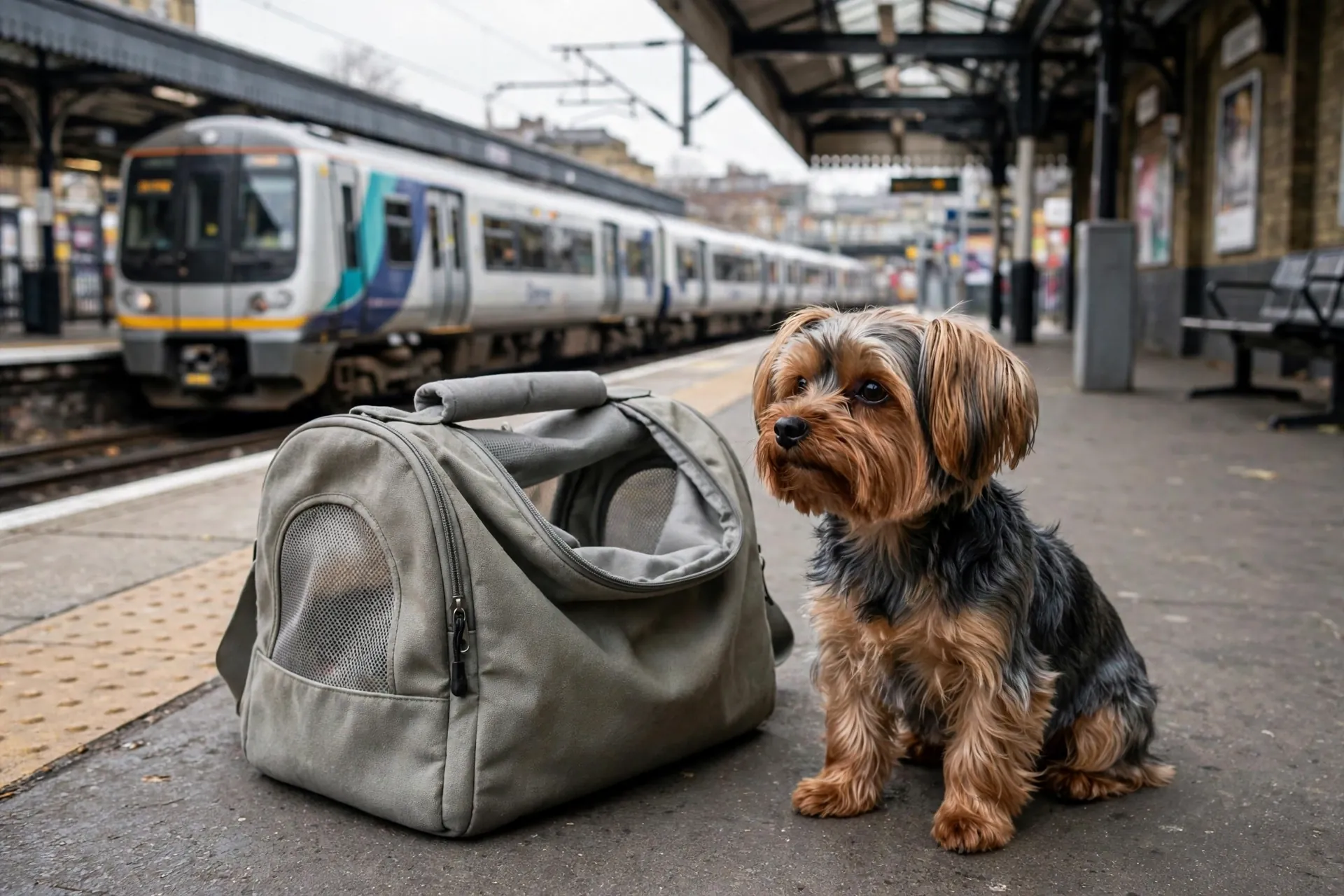
The platform is busy, the announcements are loud, and the train doors are about to open, but the whole journey fits inside one soft bag. You unzip the top just enough for a small head to appear, check that the lead is clipped, and lift the carrier onto the train in a single movement. Inside, the dog settles onto a familiar blanket, watches the world slide past through the mesh panel, and falls asleep before the first station. That is the Yorkshire Terrier city break in its simplest form: no boot full of crates, no long drive to a remote cottage, no muddy field walk before breakfast. The dog travels as a companion in the city itself, close to you, at pavement level, in the places where people actually spend a weekend.
York is a good picture of why this works. The centre is compact, the streets are walkable, the attractions are close together, and a small dog can be carried through a crowded stretch and then set down again on a quiet lane. A morning can include a walk along the walls in short sections, a coffee stop where the dog lies on a blanket under the table, a museum visit where the dog waits in the carrier or stays with a companion, and a hotel room in the afternoon where the dog naps while you rest. Nothing in that day needs a car, a long hike, or a large garden. It needs a carrier that opens easily, a coat for a cold wind on the walls, a brush for the evening, and a plan for what happens when the dog barks at a stranger in the corridor.
The same picture applies in Bath, Chester, Cambridge, Edinburgh, or any city where the best sights are within a mile or two of the hotel. A Yorkshire Terrier does not need a countryside itinerary squeezed into a city weekend. The breed was shaped as a small companion dog, and modern city travel suits that history: short distances, frequent rests, indoor warmth, and constant company. The challenge is not distance or stamina. It is the detail that comes with being very small. A cold draught at ankle height, a gap under a hotel bed, a flight of stone steps, or a sudden noise in a tiled station hall affects a two-kilogram dog differently from a twenty-kilogram dog. This guide works through those details one by one, so that the train journey stays as calm as the first scene suggests.
It also helps to be honest about what a city break is not. A Yorkshire Terrier is not the dog to choose for a ten-mile moorland walk, a swim in a cold river, or a day left alone in a holiday cottage while the owners explore. Those trips can be done by other breeds with more body mass, thicker coats, and stronger joints. For a Yorkie, the best city weekend is built from short walks, carried stretches, warm rooms, and interesting indoor places. When the plan respects the dog in front of you, the dog is relaxed, the barking drops, the coat stays tidy, and the weekend feels easy rather than fragile. When the plan ignores the dog, every small problem arrives at once: a cold dog, a tangled coat, a sore paw on wet pavements, and a tired owner carrying a stressed dog back to the hotel. The difference is almost entirely in the preparation described below.
Planning a toy-dog city trip
Start with the shape of the day, not with a list of attractions. A Yorkshire Terrier does best with a rhythm of short activity, rest, food, and sleep, repeated through the day. A workable city pattern is a morning walk of twenty to thirty minutes, a long indoor break, a second short walk in the afternoon, and a final toilet walk in the evening. Between those walks, the dog should have a warm, quiet place to sleep, whether that is a hotel room, a carrier under a cafe table, or a blanket on a friend's lap. Dogs that are pushed from one sight to another for six hours without a proper rest become overtired, and an overtired small dog is more likely to bark, nip, tremble, or refuse to walk. Build rest into the itinerary as deliberately as you build sightseeing into it.
Choose the city and the hotel together. A hotel near the centre matters more for a small dog than a hotel with a large garden on the edge of town, because every extra walk to the centre is an extra stretch of cold pavement, traffic noise, and tired little legs. Look for a hotel within ten to fifteen minutes of the places you most want to visit, on streets that are reasonably quiet at night. Check the hotel's dog policy in writing before you book: the charge per night, the size or weight limit, whether dogs may be left alone in the room, whether dogs are allowed in the restaurant or only in the bar, and whether there is a charge for damage or extra cleaning. A policy that welcomes dogs in the bar but not in the restaurant changes where you eat. A policy that forbids leaving the dog alone changes whether you can visit an attraction that does not admit dogs. Our guide to dog friendly hotels in the UK explains the booking questions that prevent disappointment later, and it is worth reading before you pay a deposit.
Map the practical points before you arrive. Find the nearest vet practice to the hotel and save the number in your phone, along with the number of an emergency vet that opens at night. Find a park or quiet green space within a few minutes of the hotel for morning and evening toilet walks, because a small dog cannot always wait while you search for grass in an unfamiliar city. Note which attractions admit dogs and which do not, and plan the non-dog attractions for times when another adult can stay with the dog, or when the dog can rest in the hotel room under the hotel's rules. If you are travelling alone and an attraction does not admit dogs, you may need to skip it, split the visit with a companion, or choose a different attraction. That decision is much easier at home than at the entrance with a disappointed dog in a carrier.
Weather planning deserves more attention for this breed than for most. Yorkshire Terriers feel the cold quickly because they have little body fat and a single, fine coat rather than a dense double coat. A forecast of eight degrees with wind and rain is a different trip from a forecast of eight degrees, dry and still. Pack for the worse version of the forecast: a coat, a spare fleece, a towel, and a carrier lining that can be swapped if it gets wet. In summer, the opposite problem appears. A small dog overheats faster than its size suggests, especially in a closed carrier on a warm train or in a sunlit hotel room. Never leave a dog in a parked car, even briefly, and on hot days choose shaded walks, carry water, and keep carrier ventilation open. City pavements also matter: hot tarmac in summer and gritted, salty pavements in winter can both sore small paws, so check paws after each walk and wipe them clean.
Finally, plan the journey as part of the holiday, not as an obstacle before it. Book train seats with space for a carrier if you can, avoid the busiest commuter services, and allow extra time at stations so that you are never running with a carrier swinging at your side. Pack the day bag the night before, with food measured out, medication in a labelled pouch, and a spare lead in case one breaks or gets muddy. Tell the hotel in advance that you are bringing a small dog, confirm the room location if you can, and ask for a ground-floor or lift-access room if stairs are a problem for the dog or for you while carrying the dog. Small requests made early are usually granted. The same requests made at a busy reception desk, with a tired dog barking in a carrier, are much harder to sort out.
Carriers and transport choices
The carrier is the single most important purchase for a Yorkshire Terrier city traveller, more important than any coat, toy, or travel bowl. A good carrier lets the dog travel on trains, in taxis, through hotel lobbies, and into cafes without stress, and it gives the dog a familiar den wherever you go. A poor carrier, by contrast, turns every journey into a struggle: the dog pants, scratches, whines, or refuses to enter, and the owner ends up carrying a wriggling dog in their arms through a crowd. Spend time choosing well, and train the dog to love the carrier at home long before the first trip.
Look for a soft-sided carrier with a rigid base, mesh ventilation on at least two sides, a top opening as well as a side opening, and a shoulder strap that leaves your hands free. The dog should be able to stand up, turn around, and lie down comfortably, but the carrier should not be so large that the dog slides around on bends or when you set it down. For most adult Yorkshire Terriers, which typically weigh between about two and three kilograms, a carrier around forty centimetres long is a sensible starting point, but measure your own dog rather than trusting a breed average. Check the train operator's rules as well: some operators ask that dogs travel in a carrier or on a lead, and a carrier that fits under a seat is easier on a crowded service than one that must sit on your lap for two hours. If you are unsure about a particular operator's conditions, check the official guidance before you travel.
A sling or front-pack carrier is a useful second option for short stretches, such as a walk through a busy market or a climb up station steps. A sling keeps the dog close to your body, warm, and visible, and it leaves both hands free. It is not a substitute for a proper carrier on a long train journey, because the dog cannot lie flat, stretch, or sleep properly, and a restless dog in a sling can wriggle free. Use the sling for short, supervised periods, and use the structured carrier for the main journey. A backpack carrier suits some owners, especially on longer walks, but check that the dog's weight sits comfortably on your back, that ventilation is good, and that the dog cannot climb out of the top. Whichever style you choose, the dog should enter willingly. Practise at home with treats, short sessions, and the carrier left open in the living room for a week before travel.
On the train, routine matters more than novelty. Place the carrier on the floor between your feet or on the seat beside you if the service allows it, keep the mesh panel facing you, and speak quietly to the dog during the first few minutes. Offer water at station stops rather than during fast stretches, and avoid feeding a full meal just before departure, because travel sickness, although less common in adult dogs than in puppies, can still occur. Bring a familiar blanket that smells of home, a chew or lick mat for the first part of the journey, and a spare blanket in case of an accident. If the dog barks at other passengers, cover part of the mesh panel with a light cloth to reduce visual stimulation, and move to a quieter carriage at the next stop if you can. Most fellow passengers are tolerant of a small, quiet dog in a carrier. Very few are tolerant of a barking dog in a carrier for an hour.
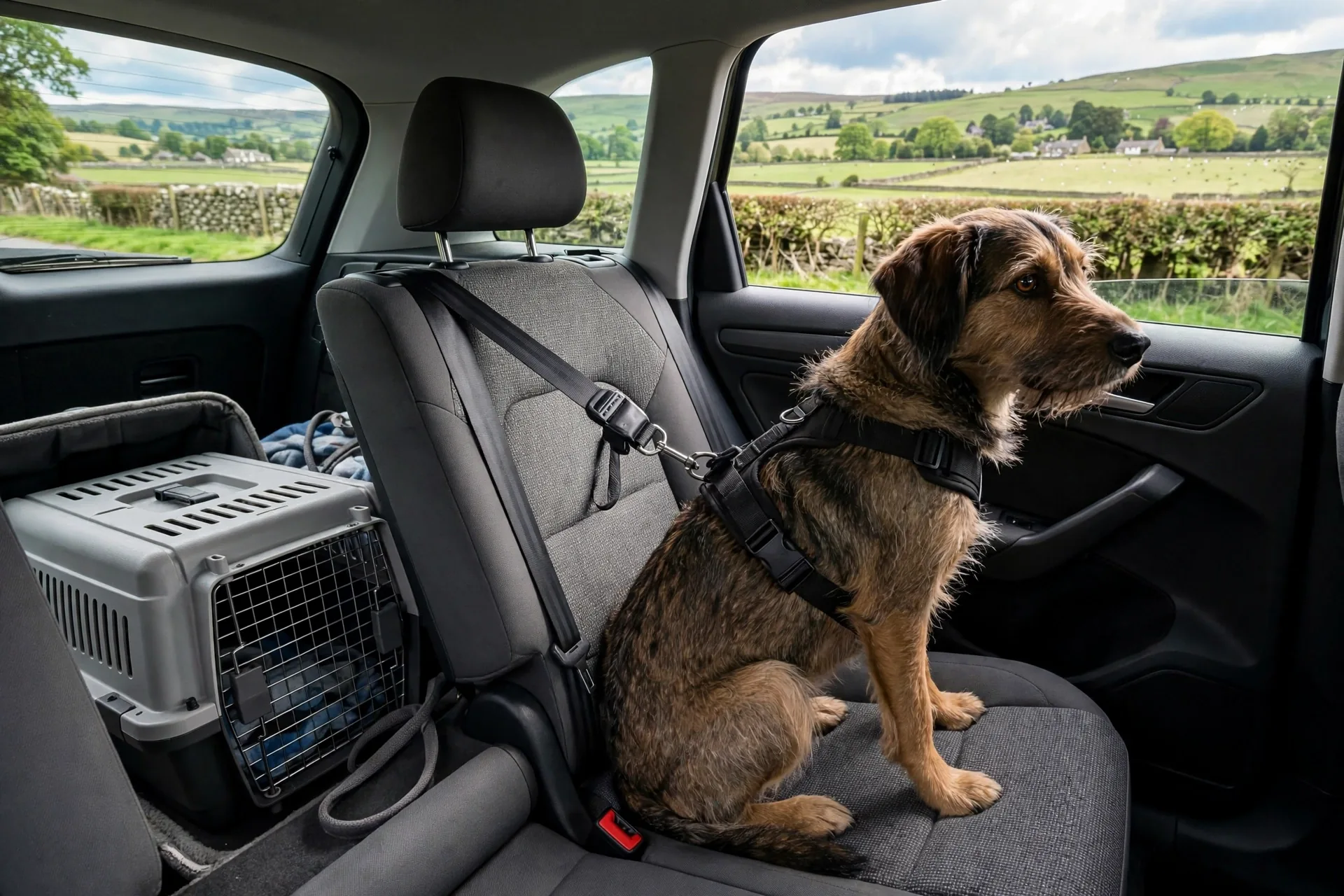
For journeys by car, the rules are different but the principle is the same: the dog must be restrained so that it cannot distract the driver or be thrown forward in a sudden stop. A small dog should never travel loose on a lap or on the parcel shelf. A crash-tested carrier secured with a seat belt, or a harness attached to a seat-belt restraint, is the usual choice, and the right choice depends on the car, the dog, and the length of the journey. Our comparison of dog car harness versus crate choices covers fitting, crash claims, and boot setups in detail, and it is worth reading if you regularly travel by car as well as by train. In a taxi or a ride-hailing car, keep the dog in the carrier, place it on the floor or on your lap, and tell the driver in advance that you have a small dog in a carrier. Most drivers accept this without difficulty, but a surprise dog at the kerb can lead to a refusal.
Walking between transport and hotel is where many city trips go wrong. A Yorkshire Terrier can walk a surprising distance on a lead, but city walking is not the same as a country walk. Pavements are hard, kerbs are high relative to a small dog, crowds force sudden stops, and traffic noise is constant. Use a harness rather than a collar for city walking, because a harness spreads pressure across the chest and protects the delicate windpipe that small toy breeds can injure by pulling on a collar. Keep the lead short in crowds, lift the dog over busy crossings if you need to, and carry the dog through the worst stretches rather than insisting on a walk for the sake of it. A carried stretch is not a failure. It is sensible management of a tiny dog in a large city.
Long-coat care and keeping warm
The Yorkshire Terrier coat is the breed's glory and its main daily chore. It is long, fine, and silky, closer to human hair than to the dense fur of most dogs, and it tangles with very little encouragement. On a city break, tangles form in the places where life rubs against the coat: behind the ears, under the front legs, around the collar or harness, and wherever a coat strap sits. Rain makes the problem worse, because wet silky hair clumps and knots as it dries. Wind makes it worse again, because it blows the coat into itself. A dog that arrives in a city with a tidy coat can look windswept and matted after a single wet, windy afternoon if nobody brushes it that evening. The answer is a short daily routine, done at the same time each day, before the knots have a chance to set.
Pack a small grooming kit and use it every evening. A pin brush for the main coat, a steel comb for checking for tangles, a small pair of blunt-ended scissors for trimming stray hairs around the paws, and a detangling spray or a tiny amount of conditioner on a damp coat are enough for most trips. Work in sections, starting at the ends of the hair and working towards the skin, and never pull a comb through a mat. If you find a mat behind an ear or under a leg, hold the base of the mat close to the skin so that pulling does not hurt, and tease it apart gently with your fingers before combing. If a mat is tight against the skin, leave it for a groomer rather than cutting it out yourself, because it is easy to nick thin toy-breed skin with scissors. A five-minute brush each evening, plus a quick check after a wet walk, prevents almost all travel mats.
Many travelling owners keep the coat in a shorter puppy trim for the duration of a holiday, and for a city break this is a practical choice rather than a compromise. A shorter trim dries faster after rain, tangles less under a harness, and needs less evening grooming, which leaves more time for the city itself. If you prefer the full show coat, be realistic about the commitment: a full coat needs careful brushing, a topknot or band to keep hair out of the eyes, and protection from rain and wind. Either choice is respectable. What causes problems is choosing a full coat and then skipping the grooming, because the dog pays for that choice with discomfort and, in bad cases, with matted skin that must be clipped out by a groomer.
Warmth is closely linked to coat care, because a wet or thin coat does not insulate well. Yorkshire Terriers lose heat quickly, and they will tell you: shivering, tucking the tail, lifting paws, slowing down, or trying to climb into your coat are all signs that the dog is cold. A well-fitting dog coat should cover the chest and belly, allow free leg movement, and fasten securely without rubbing behind the front legs. Fleece is warm and light for dry cold days, while a waterproof outer layer is better for rain. On very cold days, a fleece layer under a waterproof coat works well, provided the dog can still move and toilet comfortably. Check the fit before the trip, not on the first morning of the holiday, because a coat that rubs under the legs will create both a sore patch and a tangle in the same place.
Inside, warmth needs a different kind of attention. Hotel rooms can be draughty at floor level, where a small dog lives, even when the room feels warm to a standing adult. Place the dog's bed away from the door and the window, on a blanket or mat that insulates from a cold floor, and add a familiar blanket that the dog can burrow into. In a carrier, a fleece lining or a small blanket serves the same purpose. After a wet walk, dry the dog thoroughly before settling, paying attention to the belly, legs, and ears, because a damp dog in a cool room will chill quickly. A small towel, a drying cloth, and a few minutes of gentle towelling are more useful than any gadget. If the dog is still shivering after drying and warming, keep the dog close to you and consider whether the next walk should wait until the weather improves. No city sight is worth a chilled, miserable dog.
Feeding and hydration also affect warmth and energy on a cold city day. A small dog has a fast metabolism and a small stomach, so regular small meals suit travel better than one large meal. Keep to the usual food and the usual feeding times, measure portions rather than guessing, and carry a small supply of treats for training and for rewarding calm behaviour in new places. Offer water frequently, especially after walks and on trains, but avoid letting the dog drink large amounts immediately before a long carrier journey. If the dog has a sensitive stomach, which many toy breeds do, avoid rich cafe food, unfamiliar treats, and scraps from restaurant tables, however tempting it is to share. A stomach upset in a hotel room at midnight is a miserable end to a city day, and it is almost always avoidable.
Hotel rooms and indoor attractions
A hotel room is a small, unfamiliar territory that a Yorkshire Terrier must learn quickly. The first hour in the room sets the tone for the whole stay, so make it calm and boring on purpose. Put the dog's bed in a quiet corner away from the door, place a familiar blanket on it, put down water, and let the dog sniff the room on a lead before you unpack. Check the room for hazards at the dog's height: cables behind the bedside table, cleaning products in a low cupboard, medication left on a low surface, chocolate in a welcome tray, and gaps under furniture where a tiny dog could get stuck. Move anything dangerous out of reach, and block gaps beside tall wardrobes or under low beds where a small dog could crawl and become frightened. A room that is safe at human eye level is not automatically safe at twenty centimetres above the floor.
Furniture is the main hotel hazard for this breed. Beds, sofas, and armchairs are high relative to a Yorkshire Terrier, and jumping down from them is a repeated risk to small bones and joints. Bring a portable ramp or a set of lightweight pet steps, place them beside the bed, and train the dog to use them at home before the trip. If the dog will not use the ramp, lift the dog up and down yourself, and do not leave the dog unsupervised on a high bed. At night, many owners find it simplest to have the dog sleep in its own bed on the floor beside the owner's bed, or in a carrier with the door open, rather than on the bed itself. This is not a punishment. It is a safe, predictable sleeping place, and most dogs settle faster in their own bed than in a strange, high, soft hotel bed that they cannot safely leave.
Noise is the second hotel problem, and it is closely linked to barking. Corridor footsteps, doors closing, housekeeping trolleys, and voices outside the room are all triggers for a small dog that is already alert in a new place. Reduce the triggers rather than trying to train them away in a single weekend. Keep the dog's bed away from the door, close the curtains to reduce visual stimulation if the room faces a busy street, and leave a low background sound, such as a radio at low volume or a white-noise app, running while you are out of the room for a short period. Tell the hotel honestly if the dog barks when left alone, and ask whether there is a quieter room away from the lift or the ice machine. A room at the end of a corridor is worth more than a room with a view for a dog that reacts to every passer-by.
Etiquette in indoor attractions and cafes follows the same principle: the dog should be calm, close, and unobtrusive. In a cafe, place the dog on a blanket under or beside the table, keep the lead short, and order only after the dog has settled. Bring a small chew or a lick mat for longer stops, and be ready to leave early if the dog becomes restless, rather than waiting for a barking incident. Many cafes welcome dogs indoors, but the welcome depends on owners keeping dogs under control. Our guide to dog friendly cafes in the UK explains how to check indoor policies before you go and how to behave once you are inside. The same rules apply in shops, museums that admit dogs, and hotel lounges: the dog stays on a lead or in a carrier, stays off furniture unless the venue invites dogs onto it, and stays close to the owner at all times.
Some indoor attractions do not admit dogs at all, and this needs a plan rather than a hope. Before you travel, list the attractions you most want to visit, check each one's dog policy on its official site, and decide what happens to the dog during each visit. Options include visiting in turns with a companion, choosing a dog-friendly alternative, or skipping the attraction and enjoying the city from outside. Leaving a Yorkshire Terrier alone in a hotel room for a long museum visit is often a poor choice, both because many hotels forbid it and because a small dog left alone in a strange room is likely to bark, scratch at the door, or become distressed. If you must leave the dog briefly, keep the absence short, leave the dog tired after a walk, and return before the dog becomes anxious. If the hotel forbids leaving dogs alone, respect that rule even if it changes your plans. Breaking it risks the stay, the deposit, and the dog's welfare.
Housekeeping deserves a short conversation at check-in. Tell housekeeping staff, via reception, that a small dog is in the room, and agree a time for cleaning when you will be out or when the dog will be in its carrier. Put the dog in the carrier or on a lead while staff are in the room, and check afterwards that the door is properly closed and that no cleaning products have been left within reach. Keep the room tidy in a dog-specific way: food and water bowls on a mat by the wall, poo bags in a sealed bag by the door, grooming tools in a pouch, and the carrier in a corner where it does not block the exit. A tidy room is easier for staff to clean, safer for the dog, and less likely to attract a cleaning charge at check-out.
Small-body safety and health
The most important safety fact about a Yorkshire Terrier is also the most easily forgotten: the dog is very small, and the world is built for larger creatures. A fall that a spaniel would shake off can fracture a toy breed's leg. A gap that a larger dog could not enter can trap a Yorkie. A child who wants to cuddle a cute small dog can squeeze harder than the dog can bear. None of this means that the dog is too fragile to travel. It means that the owner must act as the dog's size manager, noticing the hazards that a larger dog would ignore and removing them before they cause harm.
Start with handling. Teach everyone who will hold the dog, including children and well-meaning strangers, to sit down first, to hold the dog securely against the body with one hand under the chest and one under the hindquarters, and never to hold the dog at arm's length or above a hard floor. A dog that wriggles free from a standing adult's arms falls a long way for its size. In the city, this matters on steps, at kerbs, and on station platforms, where a dropped lead or a sudden pull can send a small dog into traffic or down a gap. Use a lead with a secure clip, check the harness fit each morning, and keep a spare lead in your bag. In crowds, shorten the lead and walk on the side away from the road. At a busy crossing, pick the dog up and carry it across rather than trusting a tiny dog to navigate a surge of pedestrians.
Stairs and steps deserve a specific plan. Stone steps in old cities are often steep, uneven, and slippery when wet, and a small dog's legs work hard on each one. Carry the dog up and down long flights, especially in stations, and use lifts where they exist. At home and in the hotel, use ramps or steps for furniture, as described above. Outdoors, watch for open-tread steps, metal grates, and gaps in decking, all of which can trap a small paw. After walks, check paws for cuts, grit, or salt, and check the coat for burrs or debris picked up from pavements and parks. Small problems found early are easy to deal with. The same problems found hours later, after the dog has been limping or licking, are harder and more expensive.
Health planning for a city break should be practical rather than anxious. Yorkshire Terriers are prone to a number of breed-related issues that are worth knowing about, including dental problems, a collapsing windpipe, low blood sugar in very small or young dogs, and kneecap problems. None of these should stop a healthy dog from travelling, but they should shape the trip. Dental problems mean that hard chews and bones need care, and that a vet check before a long trip is sensible. A sensitive windpipe means using a harness, not a collar, and avoiding situations where the dog pulls hard or coughs repeatedly. Low blood sugar in puppies or very tiny adults means regular meals, no long gaps between feeds, and prompt attention if the dog becomes weak, shaky, or unusually sleepy. If your dog has any diagnosed condition, carry the medication, keep the vet's number handy, and tell the hotel where the medication is kept in case of an emergency. If you are unsure whether a symptom is serious, contact a vet promptly rather than waiting to see if it passes. Check the official guidance before you travel if you need to confirm local emergency vet arrangements.
Identification and insurance are the quiet safety net behind every trip. Make sure the dog is microchipped and that the chip details are up to date, because a small dog that slips a lead in a city can be found quickly if the chip details are correct and slowly if they are not. Use an ID tag on the harness with a mobile number, and carry a recent photograph of the dog on your phone. Pet insurance that covers emergency treatment away from home is worth checking before you travel, including whether it covers the area you are visiting and whether there is an excess that makes small claims pointless. Keep the insurance number and the microchip number in your phone, not only on paper in the hotel room. If the dog is lost, the first hour matters, and you should be able to act from the street, not from the hotel.
Finally, think about the dog's emotional safety as well as its physical safety. A Yorkshire Terrier that is constantly carried, constantly stared at, and constantly handled by strangers can become stressed even if nothing physically harmful happens. Give the dog choice where you can: a chance to walk as well as be carried, a quiet corner as well as a busy cafe, a rest as well as a sight. Watch for stress signals such as lip licking, yawning when not tired, turning away, trembling, or refusing treats, and respond by moving to a quieter place. A city break should be enjoyable for the dog, not merely endurable. The best sign of a successful trip is a dog that sleeps soundly in the hotel room, eats normally, and greets the next morning's walk with enthusiasm. If the dog is not doing those things, change the plan, even if it means missing an attraction.
Barking, confidence and social skills
Yorkshire Terriers have a reputation for barking, and the reputation is not entirely unfair. The breed is alert, territorial, and vocal, and a small dog in a new city has many things to bark at: strangers at the door, dogs across the street, noises in the corridor, and people who approach too quickly. Barking is communication, not bad behaviour in itself, but in a hotel, a cafe, or a quiet museum, uncontrolled barking quickly becomes a problem for other guests, for the owner, and for the dog. The goal of a city break is not a silent dog. It is a dog that notices a stimulus, looks to the owner, and settles again, most of the time.
Preparation at home matters more than any technique used on the trip itself. In the weeks before a city break, practise the situations the dog will meet: short departures from the room, settling on a blanket in a busy place, walking past strangers without greeting every one, and hearing recorded sounds such as doorbells, footsteps, and traffic at low volume. Reward calm behaviour with treats and quiet praise, and keep sessions short. A dog that has practised settling on a blanket at home will settle faster on a blanket in a cafe. A dog that has never been left alone for more than a few minutes will not suddenly cope with an hour alone in a hotel room. Build up gradually, from seconds to minutes, and always return before the dog becomes distressed. If the dog already barks persistently when left alone, seek help from a qualified trainer or behaviourist before the trip rather than hoping that a new environment will fix the problem. It usually makes it worse.
On the trip, management is more reliable than correction. Keep the dog's world small and predictable: the same blanket, the same bed, the same walking route in the morning, and the same settling routine in the evening. When a trigger appears, increase distance rather than confronting it. Cross the street to avoid an approaching dog, step into a shop doorway while a noisy group passes, or cover the carrier mesh panel to reduce visual stimulation. Reward the dog for looking at you, for sitting quietly, or for turning away from the trigger. Avoid shouting at a barking dog, because shouting usually sounds like joining in, and avoid punishing a dog for barking at a genuine fright, because punishment increases anxiety and anxiety increases barking. If the dog barks in the hotel room, return calmly, settle the dog without fuss, and consider whether the dog was left too long, was overtired, or was reacting to a specific noise that you can reduce.
Socialisation in the city should be controlled and brief. Not every stranger needs to stroke the dog, and not every dog needs to greet yours. A short, calm greeting with a known, friendly dog is useful. A chaotic greeting with an unknown, excitable dog on a narrow pavement is not. Teach the dog a simple default: when a stranger approaches, the dog sits beside you and looks at you, and the stranger is told that the dog is in training or resting. Most people accept this gracefully, especially when they see a small dog that is clearly being managed well. Children deserve particular care: teach them to stroke gently, to avoid picking the dog up, and to stop if the dog moves away. A dog that can move away from unwanted attention is a dog that is less likely to snap. Never force a small dog to accept handling it does not want, however cute the dog looks.
Confidence grows from small successes, not from overwhelming experiences. A successful city day for a nervous Yorkshire Terrier might include one short walk, one calm cafe stop, and one quiet evening in the hotel, rather than five attractions and a crowded restaurant. Over several trips, the dog learns that cities are predictable: the carrier means a journey, the blanket means a rest, the harness means a walk, and the owner means safety. That learning is the real souvenir of a city break, more valuable than any photograph. Owners who rush the process, who insist on every sight, and who ignore the dog's stress signals often return home with a dog that barks more, not less. Owners who pace the trip, who rest the dog, and who reward calm behaviour often return home with a dog that is more confident in new places than before. The difference is patience, and patience is free.
To bring the whole guide together, think of the Yorkshire Terrier city break as a series of small, well-managed moments. The carrier on the train, the coat on a cold wall walk, the brush in the evening, the ramp beside the hotel bed, the quiet blanket in the cafe, and the calm return to the hotel room are not separate chores. They are the trip itself, repeated with care each day. When those moments work, the dog is warm, tidy, safe, and settled, and the owner is free to enjoy the city. When they are skipped, the trip becomes a series of small emergencies. The good news is that none of them is difficult, none of them is expensive, and all of them can be practised at home before you travel. Pack the carrier, check the coat, brush the dog, plan the hotel, and book the train. The city, and the small dog beside you in it, will do the rest.
Practical questions
Before you go
Can a Yorkshire Terrier travel in a pet carrier on a UK train?
Yes, in most cases. A Yorkshire Terrier is small enough to travel comfortably in a soft carrier that fits under a seat or on your lap, provided the dog stays inside the carrier where the operator requires it. Check the official guidance before you travel, because rules differ between operators and some services have their own conditions for pets on board.
How do I keep a Yorkshire Terrier warm on a winter city break?
Use a well-fitting coat that covers the chest and belly, add a fleece layer inside the carrier on cold days, and plan short outdoor stretches with warm indoor breaks. Watch for shivering, lifting paws, or reluctance to walk, and head indoors at the first sign. Keep the dog dry, because a wet silky coat loses warmth fast.
How often should I brush a Yorkshire Terrier coat while travelling?
Brush briefly every day on a trip, and twice a day in wet or windy weather. The fine, silky coat tangles easily behind the ears, under the legs, and where a harness or coat rubs. A short daily session prevents mats from forming and is far easier than trying to untangle a week of knots at the end of a holiday.
Is a Yorkshire Terrier safe to jump off a hotel bed or sofa?
Repeated jumping from beds and sofas is a real risk for such a small, light-boned dog. Use a ramp or steps, lift the dog down when you can, and block the gap beside tall furniture where a fall could happen. One clumsy landing may cause only a scare, but fractures and joint injuries are more likely in tiny dogs, so prevention is worth the small daily effort.
How can I reduce barking in a hotel room?
Keep the room calm and predictable: settle the dog on a familiar bed away from the door, use background sound to soften corridor noise, and tire the dog out with sniffing walks before you return. Practise short departures at home before the trip, reward quiet settling, and never leave a barking dog alone in a room to hope it stops on its own.
What should I pack for a Yorkshire Terrier city break?
Pack a soft carrier, a harness and lead, a coat, a brush and a small detangling comb, poo bags, food and a collapsible bowl, a familiar blanket, a portable ramp or steps, and any medication. Add a spare lead, a towel for wet paws, and the number of a vet near your hotel. For a city trip, the carrier and the coat matter more than extra toys.