This guide is independent and contains no paid placement. If affiliate links are added later, they will be clearly marked and will not change our editorial checks.
Check the tide before you check anything else. At low tide Aberdyfi gives your dog miles of firm sand towards Tywyn; at high tide the beach narrows and the best dog day moves up into the hills, along the estuary paths and around the village. Dogs are kept out of only a small marked zone by the main car park from 1 April to 30 September — the rest of the beach is open all year — but the estuary current at the mouth is strong, there is no lifeguard service, and the sandbanks shift, so keep dogs out of the main channel and check the official guidance before you travel.
Let the tide decide the day
Aberdyfi, also spelled Aberdovey, sits on the northern side of the mouth of the River Dyfi, where the estuary meets Cardigan Bay on the southern edge of Eryri National Park, the park still widely known as Snowdonia. The village is small enough to cross on foot in minutes, yet the ground your dog can use changes completely twice a day. That is the whole secret of planning a visit here: the tide is not background information, it is the itinerary. A morning that starts with a vast, empty beach can end with the sea pushed right up against the dunes, and a walk that felt effortless at low water can become a scramble over soft sand and shingle if you misjudge the return.
The practical habit is simple and worth building into every Aberdyfi trip. Before you leave your accommodation, look up the tide times for the day and write down three numbers: low water, high water, and how long you have either side of low water. Then plan backwards from them. The long beach walk belongs in the low-tide window. The hill walk, the village wander, the pub stop and the drive across the estuary belong in the high-tide window. If you try to force the beach walk into a rising tide, you will spend the second half of it watching the water cut off the firm sand and hurrying a tired dog along the soft upper beach, which is the worst surface for paws and the worst mood for everyone.
This tide-first approach also explains why two visitors can describe completely different villages. The person who arrives at low tide on a quiet weekday finds a wide, golden beach that curves for miles towards Tywyn, dunes to explore, and room for a dog to run without meeting another soul. The person who arrives at high tide on a busy bank holiday finds a narrow strip of sand, a crowded car park and a village that feels full. Both are telling the truth about the same place on different water. Choosing your hours is choosing which Aberdyfi your dog meets.
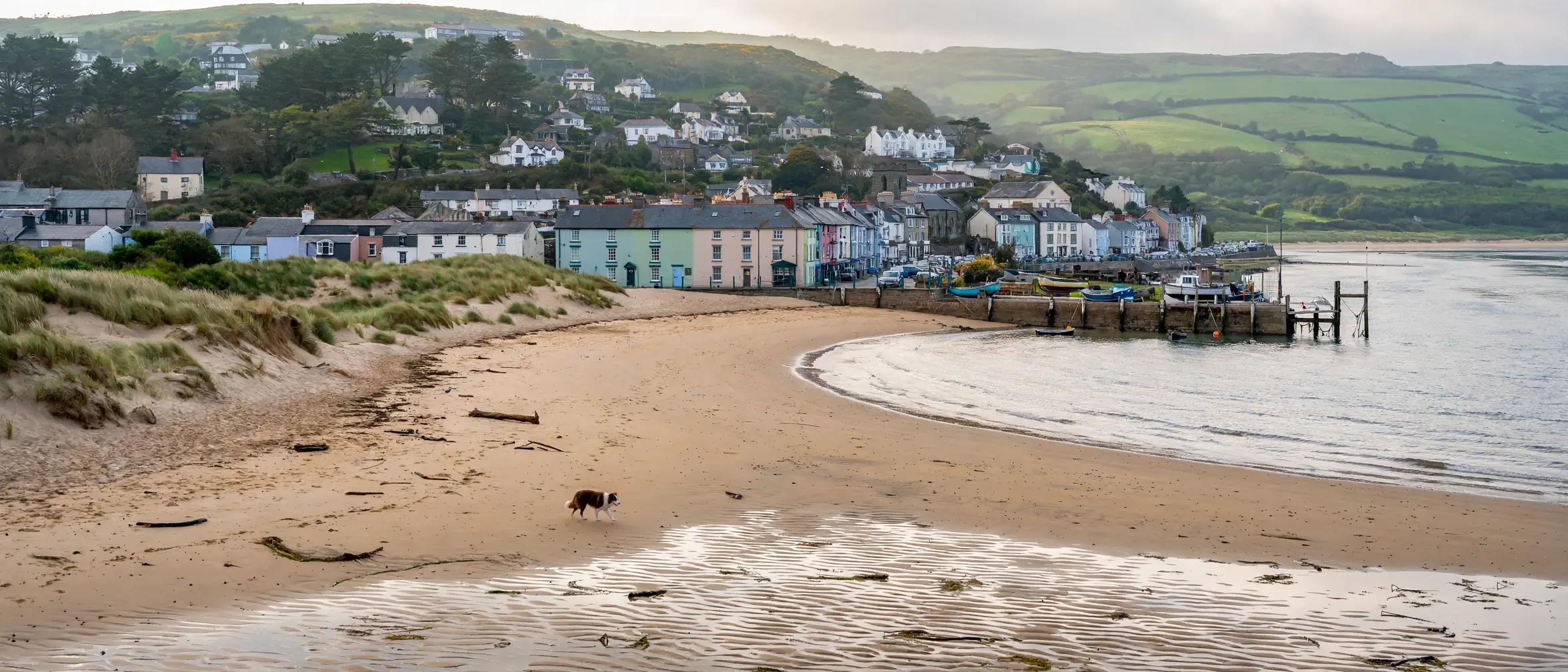
There is a second, quieter rhythm to learn as well. The Dyfi is a living estuary, not a still lake. Its channels move, its sandbanks appear and disappear, and the water that looks calm from the jetty can be moving fast a few metres out. The village grew up around that water: shipbuilding and slate exports in the nineteenth century, the railway arriving in 1863, a jetty built in 1887 that carried coal commercially until 1959, and the first Outward Bound centre opening here in 1941. The harbour, the jetty and the pastel seafront terraces are still the centre of the village, and they are all worth a slow look — on a lead, at high tide, when the beach is not calling. The Time and Tide Bell beneath the pier, installed as an art piece in 2010 and rung by the movement of the water, is a fitting symbol for the place: here, the tide literally rings the changes.
So this guide is organised the way a good Aberdyfi day is organised — by the water. It starts with the beach rules, then follows the low tide out along the sand, follows the high tide up into the hills and around the village, looks across the estuary to the wilder southern shore, and only then deals with the practical questions of trains, parking, stays and seasons. If you read it in that order, you will arrive with a plan that fits the place instead of fighting it.
Reading the beach and its dog zone
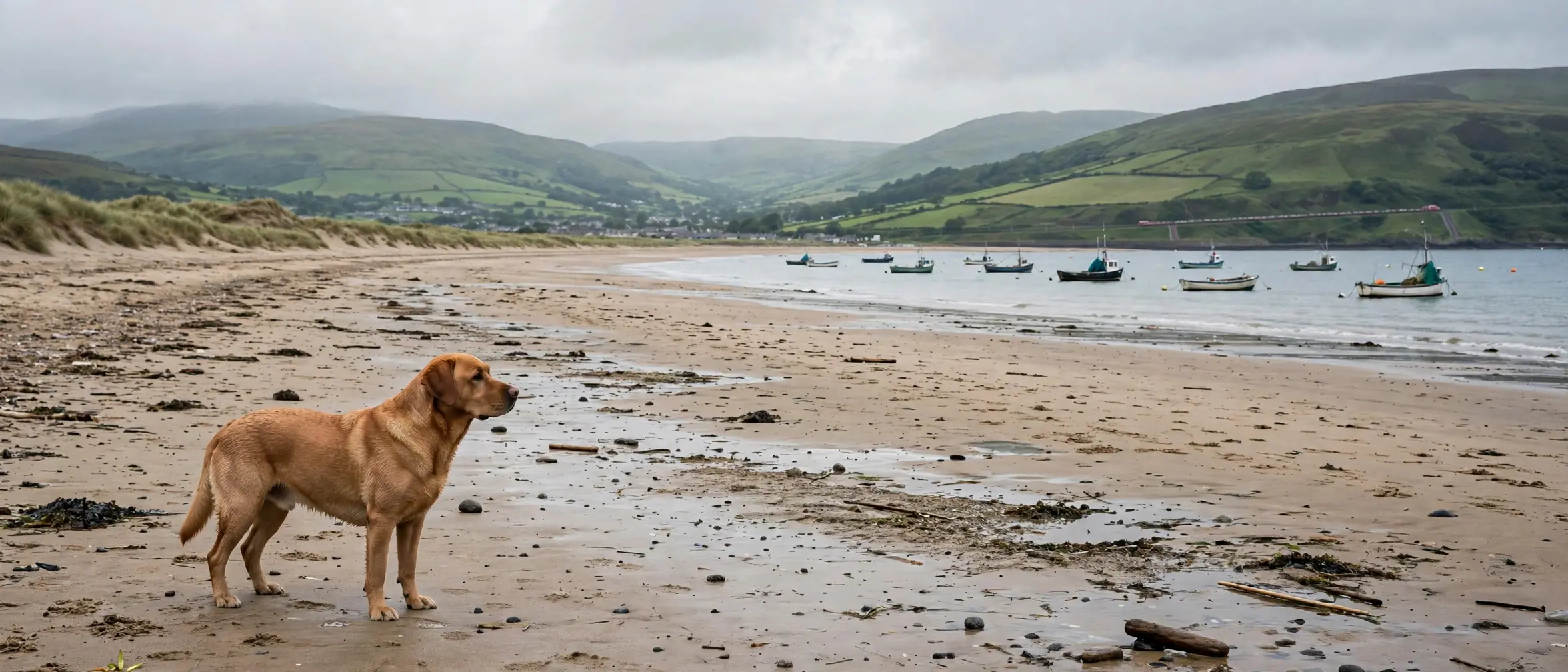
Aberdyfi beach is a long, unspoilt stretch of golden sand that runs north from the village towards Tywyn, backed for much of its length by dunes and the links of Aberdovey Golf Club, founded in 1892. Sources variously describe it as three miles or well over four miles long, and the honest answer is that the usable length depends on the tide: at low water the firm, wet sand goes on and on, while at high water the walkable strip shrinks to the upper beach and the dunes. Either way, it is one of the great dog beaches of the Cambrian coast, and the reason is space. Even on a sunny day, a few minutes beyond the car park usually puts distance between your dog and the next group, which matters for reactive dogs, for recall training, and for anyone whose dog simply needs room to run without a crowd.
The dog rules are straightforward, but they catch people out because Gwynedd starts its summer restrictions earlier than much of Wales. From 1 April to 30 September, dogs are excluded from the marked zone of beach in front of the main car park, roughly from the slipway to the end of the car park. The rest of the beach — from the dunes westwards and north towards Tywyn — remains open to dogs all year round. From 1 October to 31 March, dogs are allowed on the whole beach. That is the rule as published by Gwynedd Council and repeated by local guides, but the exact boundary on the ground is whatever the signs and the council map say on the day you visit, so read them before you let your dog off the lead. Fines are real: reports cite a fixed penalty of £100, reduced to £75 if paid within ten working days, with a much larger fine possible if a case goes to court. Check the official guidance before you travel, because seasonal orders can change.
In practice, the restricted zone is small and easy to respect. Park, walk your dog on a lead past the car-park frontage, and once you are beyond the signs and into the dunes section, you are in the year-round dog area. The mistake to avoid is treating the whole beach as either banned or free. Neither is true, and the dog owners who get into trouble are usually the ones who did not look for the signs at all. A useful routine is to stop at the first sign, read it, take a photograph of it for reference, and only then decide where the lead comes off. That thirty-second pause also gives your dog a chance to settle after the car journey instead of exploding onto the sand.
The other thing to read on the beach is the ground itself. At low tide the sand near the waterline is firm and kind to paws, which is why the long walk works so well. Higher up, the sand softens, and the dunes are a different surface again — deep, tiring and full of interesting smells that can swallow a small dog from view in seconds. Keep a dog that vanishes into dunes on a long line until you know how they behave there, and watch for the golf course boundary: the dunes back onto the links, and a dog chasing a ball across a fairway is a problem for golfers and for the dog. The estuary side of the beach, towards the mouth, has the strongest currents and the steepest shelving in places, so keep swimming and paddling to the calmer, open-sea side and well away from the channel.
Finally, respect the beach as a shared space. Pick up after your dog everywhere, including the dunes, and use the bins provided rather than leaving bags on the sand. The beach has been described by visitors as immaculately clean and unspoilt, and keeping it that way is part of what keeps the year-round dog access working. If you see a dog bin, use it; if you cannot find one, carry the bag back to the village. That small discipline is what separates the beaches that stay dog-friendly from the ones that end up with wider bans.
The low-tide day: sand to Tywyn
The best dog walk in Aberdyfi is also the simplest: out along the beach at low tide, with the sea on your left and the dunes on your right, for as far as your dog's legs and your timetable allow. The full stretch to Tywyn is about four to five miles one way, and walkers generally allow one and a half to two hours for it. That sounds like a lot, but the ground is flat, the surface is firm, and the scenery does the work — Cardigan Bay opening out to the west, the hills of Eryri behind you, and on a clear day the long view along the coast that makes the miles pass without noticing. Most dogs will happily do the whole distance and still want to play at the end; older dogs and puppies should do a shorter out-and-back instead, turning around at a dune gap or a landmark you choose in advance rather than pushing on because the sand keeps going.
Start the walk properly and it will repay you. Give your dog a short lead walk around the car park and the village front first, let them toilet, offer water, and check paws for any existing soreness before the sand. Then walk past the restricted zone on the lead, and only let the dog off once you are clearly in the open area and you have checked what is ahead: other dogs, children playing, kite surfers setting up, or horses. The first ten minutes set the tone. A dog that is allowed to sprint flat out from a cold start on soft sand is a dog that may pull a muscle or overheat; a dog that is walked out gently, allowed to sniff, and then given freedom in stages will last the whole walk. If your dog's recall is not reliable around other dogs or around the smell of the dunes, use a long line for the first stretch. There is no shame in it, and the beach is wide enough that a long line never feels like a constraint.
Water is the thing people forget on a beach walk, because water is everywhere and none of it is drinkable. The sea will make a thirsty dog sick if they drink enough of it, and the sun on open sand is stronger than it feels in a coastal breeze. Carry fresh water and a collapsible bowl, offer it little and often, and watch for the signs of a dog getting too hot: heavy panting that does not settle, a tongue that goes very wide and flat, slowing down, or seeking shade that does not exist on an open beach. The dunes offer the only shade, and they are also the hottest, stillest air on the walk, so the best cooling strategy is the sea itself — a paddle at the waterline, a wetting of the belly and paws, and a rest in the breeze rather than in the dunes.
Turning around is a decision, not a failure. A good rule is to turn at the halfway point of your dog's energy, not at the halfway point of the distance. If you are walking to Tywyn with the idea of catching the train back, agree the plan before you set off: which station, what time, and what you will do if you miss the train. Tywyn has its own long beach, its own promenade and its own seasonal dog zone in front of the promenade, so the arrival end of the walk needs the same care as the Aberdyfi end. Our companion guide to Tywyn with a dog covers its beach rules, the Talyllyn Railway and the Dysynni estuary in detail, and it is worth reading before you commit to the one-way version. If you are walking back the way you came, start the return while your dog still has energy in reserve, and keep an eye on the tide: the firm sand you walked out on can narrow faster than you expect once the water turns.
There is also a shorter, gentler version of the low-tide day that suits older dogs, small dogs and anyone arriving late. Walk north for twenty or thirty minutes, play and paddle, then loop back through a dune gap and return along the top of the beach. You still get the sea air, the space and the views, and your dog still gets a proper outing, without the commitment of a five-mile walk. The beach rewards short visits as generously as long ones, as long as you arrive on the right tide. That is the point to carry away from this section: in Aberdyfi, timing is not a detail, it is the walk.
The high-tide day: hills and village
When the tide is high, the beach narrows and the smart move is to go up instead of out. Aberdyfi is built on a steep hillside, and the streets that climb away from the seafront lead quickly into the green, sheep-farmed landscape that surrounds the village. The classic short climb is to the bandstand on the hill above the village centre, where the view opens out across the rooftops, the estuary and the bay. It is a steep pull for a few minutes rather than a long hike, so it suits most dogs, but take it slowly with older dogs and small dogs, and keep the lead short on the narrow lanes where cars pass close to the pavement.
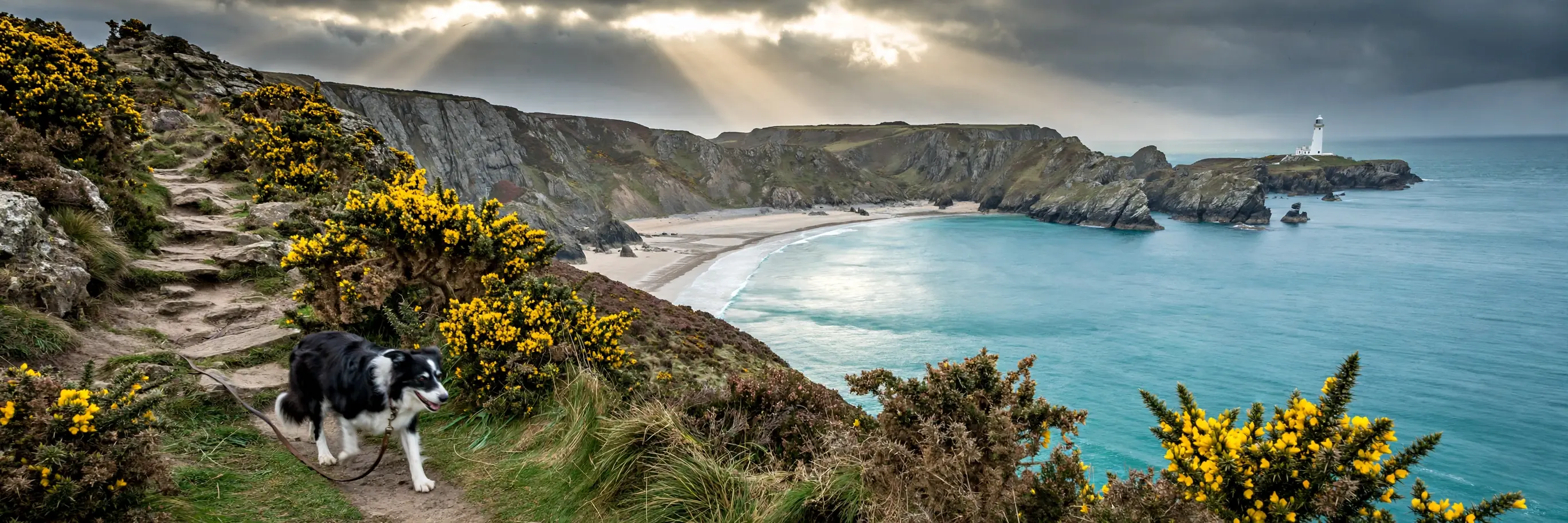
For a longer high-tide walk, the Aberdyfi Circular is the route to know. It is about six kilometres, rated easy, and usually takes one and a half to two hours. It starts from the car park by the beach, follows the shoreline while the tide allows, then cuts across the golf course area and climbs into the hills behind the village before descending again, with the Panorama Walk section giving the wide views the name promises. A second option, the Aberdyfi and Foel Lwyd Circular, follows the shoreline before climbing the Foel Lwyd hillslope and crossing green fields on the way back. Both routes mix beach, field and hillside, and both need the same care: livestock, gates, and ground that can be steep and slippery after rain. Keep your dog on a lead through fields with sheep, close every gate behind you, and check the official guidance before you travel for the current path conditions, because coast and hill paths can close or divert after storms.
Hill walking with a dog in this part of Wales is different from beach walking, and the kit changes with it. On the beach you worry about sun and salt water; on the hills you worry about ticks, about sheep, and about a dog that disappears over a ridge. A lead is not optional where livestock are present, and it is good manners everywhere else on a working hillside. Carry tick removal tools and check your dog thoroughly after any walk through bracken, long grass or woodland, especially in spring and summer. If your dog is the sort that chases, keep them on a lead for the whole hill section, however tempting the open ground looks. A single chase can end a farmer's tolerance for dogs on a path, and it can end very badly for the dog if the ground drops away or the sheep panic towards a fence.
The village itself is the other half of a high-tide day, and it is best taken slowly. The centre is clustered around the harbour, the jetty and the beach, with the streets stretching back and up the hillside. There are pubs, cafes and shops along the front, and several of the inns date from the 1700s, including the Dovey Hotel, the Britannia and the Penhelig Arms. Dog policies in individual pubs and cafes change with the season and the management, so do not assume that a place that welcomed dogs last year still does, and do not assume that a place with dogs on the terrace welcomes them inside. Ask at the door, look for the signs, and have a backup plan — a takeaway eaten on a bench by the harbour, with the dog beside you, is often a better lunch than a stressful negotiation in a crowded bar. The Penhelig Arms, at the eastern end of the village near its railway station, is often mentioned as a dog-friendly stop, but check the official guidance before you travel rather than relying on that.
A high-tide afternoon can also be a rest afternoon, and that is not a wasted day. Dogs that have had a big low-tide morning need sleep, and a village the size of Aberdyfi rewards the visitor who sits still: the boats moving on the estuary, the light changing over the water, the sound of the Time and Tide Bell as the water moves under the pier. If your dog is tired, let them sleep. The next low tide will come, and the beach will still be there.
Across the water: Ynyslas and the far shore
Stand on Aberdyfi beach and look south across the estuary, and you will see the far shore: the wide sands and high dunes of Ynyslas, part of the Dyfi National Nature Reserve and the wider UNESCO Dyfi Biosphere. It looks close enough to walk to, and that is exactly the mistake to avoid. There is no regular passenger ferry across the Dyfi, and the estuary mouth has strong currents, shifting sandbanks and deep channels. Do not try to wade or swim across with a dog, and do not let a confident swimming dog try it for you. The far shore is a separate trip, not an extension of the beach walk.
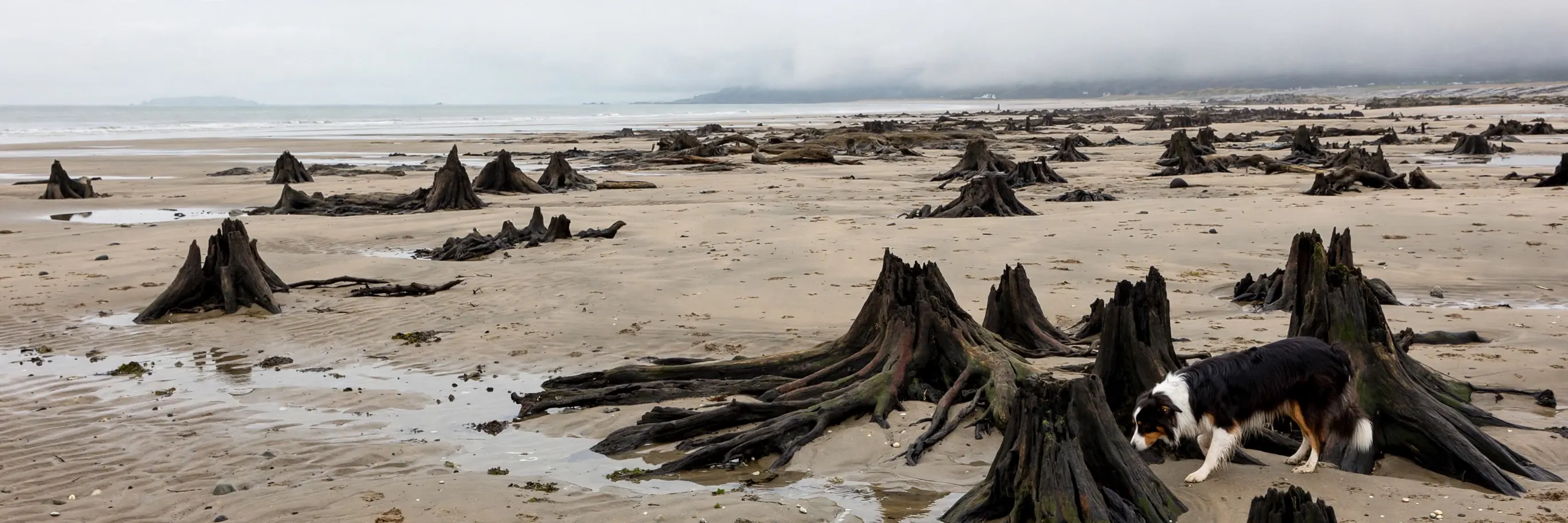
Getting to Ynyslas by road means going the long way round: inland to Machynlleth, across to the southern side of the estuary near Dovey Junction, and back out to the coast. It is a drive rather than a stroll, so treat it as a half-day outing and plan it on a day when the tide at Ynyslas itself is right, because the same tidal logic applies there. What you get for the drive is one of the most spectacular dog beaches in Wales: vast dunes, a wide open shoreline, and a sense of space that makes even Aberdyfi beach feel busy. The nature reserve status matters, though. This is a protected landscape with sensitive wildlife, nesting birds and fragile dune plants, so keep your dog under control, keep to the paths through the dunes where they are marked, and do not let a dog disturb birds or chase wildlife. Our guide to Borth with a dog covers the northern side of the estuary and the submerged forest at low tide, and it pairs well with a Ynyslas visit because the two shores face each other across the same water.
The history of crossing the Dyfi is part of the story of the place. Ferries are said to have run from Ynyslas to Aberdyfi as early as the twelfth century, and at one stage there were three of them: a large ferry for cattle and heavy vehicles, a middle ferry for slow traffic, and a small ferry for people. The railway company took the ferry over in the nineteenth century, and the idea of a rail bridge across the estuary was discussed but never built. The ferry was sold in the early twentieth century, and the crossing that once defined the village is now a piece of history rather than a transport option. Knowing that changes how you look at the water: the estuary was a barrier and a highway at the same time, and the village grew up precisely because people had to stop, wait and cross here.
If a full Ynyslas trip does not fit your stay, you can still enjoy the far shore from Aberdyfi itself. The best views of it come at low tide from the beach, when the sandbanks show and the light picks out the dunes, and from the hillside above the village, where the whole shape of the estuary opens up. Bring binoculars if you have them, and a pair for the dog is not needed — the dog will be far more interested in the smells at their feet than in the view. That is as it should be. The far shore is for looking at; the near shore is for walking on.
Wildlife, livestock and lead discipline
The Dyfi estuary is a wildlife-rich place, and a dog visit here is a wildlife visit whether you plan it that way or not. The estuary and its southern shore form part of the Dyfi National Nature Reserve, and the wider area is a UNESCO biosphere reserve, which means the birds, the plants and the water itself are protected for good reason. Ospreys are seen on the estuary in the summer months, otters are present though rarely seen, and the bay is known for dolphins, which are sometimes spotted from the beach and the coastal path. Wading birds work the mudflats at low tide, and the dunes hold skylarks and other ground-nesting birds in the breeding season. None of this requires specialist knowledge to enjoy, but all of it requires a dog under control.
The rule that covers almost every wildlife encounter is simple: if your dog cannot be recalled instantly away from birds, keep them on a lead. A dog that chases wading birds off the mudflats is not having harmless fun; it is burning the energy those birds need to survive the winter, and in the breeding season it can destroy a nest in seconds. The same applies in the dunes, where a dog crashing through the vegetation can do damage that takes years to repair. The beach is big enough to give wildlife space, and the kindest way to use it is to choose your stretch of sand, keep the dog close when birds are feeding nearby, and move on if the birds are clearly disturbed. If you are unsure whether birds are nesting in an area, keep the dog on a lead through it and check the official guidance before you travel.
Livestock is the other half of lead discipline in Aberdyfi. The hills behind the village are working sheep country, and the fields on the circular walks are grazed. Dogs must be on a lead around sheep, full stop, and under close control near cattle and lambs. The law in England and Wales allows a farmer to shoot a dog that is worrying livestock, and even where that extreme outcome does not happen, a chase can injure sheep, scatter lambs and end a dog's freedom on that path for everyone. Keep the lead on until you are back on open ground with no livestock in sight, and if you meet sheep on a path, put the lead on early, walk calmly past at a distance, and do not let the dog stare, stalk or fixate. If your dog has a history of chasing livestock, do not take them on the hill routes at all; the beach gives them all the exercise they need.
There are smaller wildlife hazards to know as well. Adders are present in parts of Wales, including coastal dunes and heathland, and dogs are most at risk when they nose into warm, sheltered spots in spring and summer. The risk is low and the answer is practical: keep dogs out of dense bracken and rocky crevices where adders bask, watch where a dog puts its nose, and know the signs of a bite — sudden pain, swelling, limping or distress — and the location of the nearest vet. Ticks are a more everyday concern after walks through long grass and bracken, so check ears, armpits, groin and between the toes after every hill or dune walk, and remove any tick promptly with a proper tick tool. Jellyfish can wash up on the beach, and a curious dog that mouths one can get a nasty sting, so steer clear of stranded jellyfish and keep a dog from eating anything dead on the sand, including fish and seabirds, which can carry disease.
The railway trick: one-way walks
Aberdyfi has a feature that most small seaside villages do not: two railway stations. Aberdyfi station, also signed as Aberdovey, sits at the western end of the village near the beach and the golf course, while Penhelig station, in Welsh Penhelyg, sits at the eastern end. Both are on the Cambrian Coast line, which runs along the coast through Tywyn, Barmouth and on towards Pwllheli in one direction and Machynlleth and Shrewsbury in the other. For a dog walker, that line is not just transport; it is a way to turn a long out-and-back walk into a comfortable one-way walk with a train ride home.
The classic use is the beach walk to Tywyn. Walk north along the sand to Tywyn, enjoy the town, and catch the train back to Aberdyfi or Penhelig. The train ride is only a few minutes, which feels almost comically short after a two-hour walk, and it is exactly what a tired dog needs. The same trick works in reverse: take the train to Tywyn and walk back to Aberdyfi, so that the walk ends at your accommodation rather than starting from it. Either way, check the timetable before you set off, because services on this rural line are not frequent, and a missed train can mean a long wait in a place with few facilities. Have a backup plan — a cafe to wait in, or the willingness to walk back — and do not assume the train will have space for a large dog at a busy time.
Dogs are generally carried on the Cambrian Coast line, but the details matter and they change. Check the train operator's current dog policy before you travel, including any charges, whether dogs need to be on a lead, whether they can travel in all carriages, and how many dogs each passenger can bring. Keep your dog on a lead on the platform at all times, keep them clear of the platform edge, and be ready to lift a small dog or guide a nervous dog over the gap between the train and the platform. Some of the stations on this line are request stops, where the train only stops if you signal the driver or tell the guard, so check the official guidance before you travel for whether your station is one of them and what you need to do. If you are unsure, ask station staff or the guard; guessing on a rural line is how walks end with a long extra leg.
The railway is also the practical answer to the question of how to get to Aberdyfi without a car. The A493 coast road is beautiful and narrow in places, and parking in the village is limited on busy days, so arriving by train and walking everywhere is a genuinely good option for a dog trip. The village is compact, the beach is a short walk from either station, and the circular walks start from the village itself. If you do arrive by train, pack light and pack for the weather: there is no car to retreat to for a spare coat or an extra towel, so the dog's kit has to fit in your bag. The Wales Coast Path with a dog guide covers the longer coastal walking context, including section planning and tide times, and it is useful background if your Aberdyfi walk is part of a longer coastal trip.
The village at dog height
Seen from a dog's height, Aberdyfi is a village of smells, sounds and surfaces, and it helps to think about it that way. The harbour smells of salt, fish and rope. The jetty smells of tar and seaweed. The streets climb steeply, the pavements are narrow in places, and the seafront is where everyone and every dog converges. That convergence is the thing to manage. A sociable dog will love the village; a reactive dog will find the seafront at midday hard work. The answer is timing again: walk the village early in the morning or in the evening, when the streets are quiet and the light is good, and save the middle of the day for the beach or the hills.
The jetty deserves a slow visit on a lead. Built in 1887, it is about 370 feet long, and it was built so that ships could load and unload whatever the tide. Standing on it with a dog, you can feel the estuary moving underneath you and see the shape of the channel that makes the currents so strong. Keep a firm hold on the lead here: the jetty has drops to the water, gaps that a small dog could slip through, and the sudden movement of boats that can startle a nervous dog. The Time and Tide Bell hangs beneath the pier and rings with the movement of the tide, which is a lovely idea and a strange sound the first time you hear it — a bell rung by water rather than by a person. If your dog is sound-sensitive, be ready to move away from the pier if the bell unsettles them.
Eating and drinking with a dog in Aberdyfi follows the usual Welsh seaside pattern: terraces and outdoor seating are generally more welcoming than indoor rooms, and policies vary from place to place and from season to season. Ask before you sit down, rather than assuming, and be ready to eat outside even if the weather is not perfect — a waterproof coat for you and a mat for the dog make an outdoor lunch comfortable in most conditions. Bring the dog's own water bowl rather than relying on a pub to provide one, and bring a chew or a settled mat so the dog has something to do while you eat. A dog that has just had a long beach walk will usually settle quickly; a dog that has been in the car all morning will not. Time the meal for after the walk, not before it.
Shopping with a dog is a matter of small courtesies. The village stores are small, the aisles are narrow, and a wet dog in a food shop is not welcome anywhere. Do the shopping while the dog rests at your accommodation, or leave one person with the dog outside while the other goes in. The same applies to the beachfront facilities: use the toilets before the walk, not during it, and know where the nearest public toilets are before your dog needs you to wait. These are small points, but they are the difference between a village that feels welcoming and one that feels like an obstacle course.
Getting there, parking and access
Aberdyfi is reached by the A493 coast road, which runs between Machynlleth and Tywyn, and the drive itself is part of the trip — narrow in places, with views over the estuary and the bay that reward a slow approach. If you are driving from England, the usual route is through Shrewsbury and Machynlleth, then west to the coast. Allow more time than the satnav suggests, especially in summer, because the coast road is single-carriageway, tractors and caravans are common, and the last stretch into the village is not a road to rush. If your dog travels badly, plan a stop before the coast road so they arrive settled rather than stressed.
Parking is centred on the large pay-and-display car park by the beach, which has direct access onto the sand by a ramp and a small number of steps. It is the most practical base for a beach day, and it is also the place that fills first on sunny weekends and bank holidays, so arrive early or accept a later, quieter start. There is some roadside parking in the village, but it is limited, the streets are steep, and parking inconsiderately in a small village is a fast way to annoy the people whose goodwill keeps the place welcoming. Check the official guidance before you travel for current charges, time limits and any seasonal changes, and never leave a dog in a parked car in warm weather, even with the windows open — a car in the sun heats up far faster than most people expect, and the beach car park has no shade.
Access for dogs and people with limited mobility is mixed, and it is better to be honest about it than to promise a step-free village that does not exist. The beach car park gives level access to the sand by a ramp, and the firm sand at low tide is manageable for many older dogs, but the village streets climb steeply, the pavements are narrow, and the hill walks are not suitable for wheelchairs or for dogs that struggle with steps. If your dog is older, arthritic or recovering from surgery, plan around the beach and the flat seafront rather than the hill routes, and choose accommodation close to the beach so the walk to the sand is short. A portable ramp can help a dog into a car or over a step, but it does not solve a steep village street. If you need step-free information for a specific property, ask the property directly and check the official guidance before you travel.
Arriving by public transport is a realistic alternative, as the railway section above explains, and the village is compact enough that a car-free stay works well. If you arrive by train, the walk from Aberdyfi station to the beach is short and flat, while Penhelig station is at the eastern end of the village and involves a slightly longer walk through the village. Either way, the first thing to do on arrival is the same: find the tide times, find the beach signs, and give the dog a short lead walk to settle before the main walk of the day.
Staying over with a dog
Aberdyfi is a place that rewards staying over rather than visiting for a day, because the tide timetable only makes sense across several days. A single day gives you one low tide and one high tide; a long weekend gives you the full range, with the low tide moving later each day and a different beach at a different hour. If you can stay for three or four nights, you will see the village at its best and its quietest, and your dog will settle into a routine of beach mornings and hill afternoons that a day trip cannot offer. Self-catering cottages and dog-friendly holiday lets are the most common base, and many of them are used to dogs, but do not assume that means every property in a complex accepts them — check the specific property, the number of dogs allowed, the pet fee, and whether the garden or outside space is enclosed.
The questions to ask before booking are the same ones that matter anywhere on the coast, and they matter more here because of the sand and the water. Is the outside space genuinely enclosed, and how high is the fence? Is there a hose or an outside tap for washing sandy paws, and is there a covered spot by the door for towelling a wet dog down? Where is the nearest practical toilet walk after dark, and does it involve a road crossing or a steep lane? Are dogs allowed on the furniture, and is there a washing machine for sandy bedding? How far is the property from the beach, and is the route flat or steep? A property that answers those questions clearly is a property that has thought about dogs; a property that answers with a vague reassurance has not, and the sand will find its way into every corner of the stay.
Pack for the stay as well as for the walk. Sand gets everywhere in Aberdyfi, and a dog that has been on the beach twice a day will bring half of it back with them. Bring extra towels, a dog drying coat, a spare bed or blanket that can be washed, and a brush for removing sand from paws and coats. Bring the dog's usual food and any medication, because the village shops are small and may not stock your brand. Bring a first-aid kit that includes a tick tool, saline for rinsing eyes after salt water, and the number of the nearest vet saved in your phone before you need it. Rural practices can be some distance away and may close early, so do not leave that search until an emergency.
Finally, think about the dog's alone time. If you plan to eat out in the evening, check whether the property allows dogs to be left alone, and for how long, and whether the dog settles alone in a new place. Many dogs do not, and a dog that barks in a holiday cottage at night is a problem for the neighbours and for the dog. The kindest plan is usually to eat where the dog can come with you, or to take food back to the property and eat together. Aberdyfi is a small village, and the evenings are quiet; a takeaway eaten with a tired dog beside you, listening to the estuary, is a good end to a tide-planned day.
Seasons, weather and water
Aberdyfi changes with the seasons more than most seaside villages, because the beach, the estuary and the hills all respond to the weather. Summer is the busiest season, with the longest days, the warmest water, and the seasonal dog zone in force from April to September. It is also the season when the beach car park fills, the village feels full, and the sun on open sand is strongest. If you visit in summer, go early or late, carry water, and use the shade of the dunes sparingly — the dunes are hot, still air, and a dog can overheat there faster than on the breezy shoreline. The summer also brings sailing, paddleboarding and other water sports on the estuary, which means more boats, more people and more things for a dog to watch, so keep the lead handy near the harbour and the jetty.
Autumn is, for many dog owners, the best season in Aberdyfi. The summer dog zone lifts on 1 October, so the whole beach opens to dogs, the crowds thin, the light softens, and the walking is cooler. September and October often give the best balance of weather and quiet, though Atlantic storms can arrive quickly and the estuary can become rough. Winter is quieter still, and the beach at low tide on a clear winter day, with the hills behind and the bay empty, is one of the great dog walks in Wales. But winter also brings short days, cold wind off the sea, and paths that can be muddy and slippery, so pack for the weather and do not plan a long beach walk that ends after dark. Spring brings the dunes back to life, with nesting birds and new growth, and it is the season to be most careful about keeping dogs on leads through the dunes and away from nesting areas.
Water safety deserves its own paragraph, because the Dyfi estuary is not a swimming pool. The currents at the mouth are strong, the sandbanks shift, the beach shelves steeply in places, and there is no lifeguard service. That does not mean dogs cannot paddle and swim here, but it does mean the choice of where and when matters. Paddle at the waterline on a calm low tide, on the open-sea side rather than in the channel, and keep a dog that swims on a long line or close to the shore until you know how they behave in moving water. Never let a dog swim in the estuary mouth, near the jetty, or where boats are moving. After heavy rain, the river can carry debris and the water quality can change, and after storms the beach can have hazards washed up on it, so check the official guidance before you travel and read the signs on the day. If in doubt, the answer is to stay on the sand and let the dog paddle rather than swim.
Weather on this coast changes fast, and the forecast for Aberdyfi is not the forecast for the hills behind it. A sunny morning on the beach can become a wet, windy afternoon, and the wind on the open sand is stronger than it feels in the shelter of the village. Check the forecast before each walk, not just once in the morning, and carry a waterproof for yourself and a drying coat for the dog even on a day that starts sunny. If the weather turns while you are on the beach walk to Tywyn, the safest response is to turn back early or to leave the beach at the nearest dune gap and return by the coast path, rather than pressing on into a rising tide and a headwind with a tired dog.
The Aberdyfi kit list
The right kit for Aberdyfi is the kit for a beach, an estuary and a hill in the same day, and it is worth packing it as one system rather than as separate lists. Start with water: a bottle and a collapsible bowl for the dog, carried on every walk, because there is no reliable drinking water on the beach and the sea is not a substitute. Add a long line as well as a short lead, so you can give freedom on the open sand and control in the dunes, on the hills and near livestock. Add a harness that fits well when wet, because a collar can slip on a wet, sandy dog, and a harness gives you a handle if you need to lift a dog over a gap or away from a hazard.
For the dog, bring a drying coat or two large towels, a brush for sand, a tick tool, and a small first-aid kit with saline for eyes and a bandage for a cut paw. Bring poo bags and a holder that clips to the lead, because the beach is long and the bins are not always where you need them. Bring a mat or blanket for the dog to settle on in a pub garden or on the seafront, and a chew for settling during a meal. For yourself, bring a waterproof jacket, a hat and sun protection even on a cloudy day, and shoes that can handle wet sand, muddy hill paths and steep village streets — one pair rarely does all three well, so bring two.
The car kit matters too, especially if you are driving the coast road. Bring a towel and a change of clothes for the drive home, a waterproof sheet or crate liner for the boot, and a spare lead in case the first one gets soaked or sandy. Do not leave the dog in the car while you walk the village, and do not leave valuables visible in a beach car park. And bring the paperwork: the dog's identification, the vet's number, the tide times for your stay printed or saved offline, and the address of your accommodation written down, because mobile signal on this coast can be patchy and a dead battery should not leave you without the information that keeps the day safe.
A two-day plan that follows the tide
Day one starts with the tide table, not with the car. If low water falls in the morning, that is your beach morning: park by the beach, walk north towards Tywyn for as far as your dog is comfortable, paddle and play, and turn back or catch the train from Tywyn while the tide is still low. Eat lunch in the village after the walk, when the dog is tired and ready to settle, and spend the high-tide afternoon on the bandstand climb or a short village wander, with the dog on a lead and the pace slow. If low water falls in the afternoon instead, reverse the plan: hills and village in the morning, beach in the afternoon, and dinner back at your accommodation with a tired dog asleep beside you.
Day two is the day for the far shore or the longer hill walk. If you are driving to Ynyslas, make it a morning trip on a low tide there, with the same water, lead and wildlife care as the Aberdyfi beach. If you are staying local, take the longer circular walk — the Aberdyfi Circular or the Foel Lwyd route — in the high-tide window, with the dog on a lead through the fields and the tick check afterwards. Either way, end the day on the beach at low water if the tide allows, because the last low tide of a stay is the one you will remember: the light low over the bay, the sand firm underfoot, and a dog that knows the beach well enough by now to run with confidence rather than with excitement.
That is the shape of a good Aberdyfi trip: not a list of attractions ticked off, but a rhythm learned and followed. Check the tide, read the signs, give the dog water and space, keep the lead handy for livestock and wildlife, and let the estuary set the pace. Do that, and Aberdyfi will give your dog what it gives every dog that visits on the right water — miles of sand, a village that fits in a short walk, and a coastline that rewards the visitor who plans around it rather than against it. Check the official guidance before you travel, and let the tide decide the day.
Practical questions
Before you go
Can dogs go on Aberdyfi beach in summer?
Yes, on most of the beach. Dogs are excluded only from the marked zone in front of the main car park and slipway from 1 April to 30 September. The rest of the beach, from the dunes towards Tywyn, stays open to dogs all year. From 1 October to 31 March the whole beach is open to dogs. Always read the signs on the day, because the marked zone is what enforcement follows, and check the official guidance before you travel.
Is it safe to let my dog swim in the Dyfi estuary?
Treat the estuary mouth with real caution. Currents at the mouth are strong, sandbanks shift, the beach shelves steeply in places and there is no lifeguard service. Many dogs are happier paddling at the waterline on a calm low tide than swimming in the channel. Keep your dog out of the main current, stay close to the shore, and check the official guidance before you travel.
How long is the beach walk from Aberdyfi to Tywyn with a dog?
About four to five miles one way along the beach and dunes, usually around one and a half to two hours of walking. It is mostly flat and easy underfoot at low tide. Many walkers take the train back from Tywyn to Aberdyfi or Penhelig, which makes it a comfortable one-way walk. Check train times and the official guidance before you travel, and carry water because there is little shade on the sand.
Can I take my dog across the estuary to Ynyslas?
There is no regular passenger ferry across the Dyfi, so do not plan to wade or swim across with a dog. Ynyslas, on the southern side of the estuary, is reached by road via Machynlleth and Dovey Junction, and it is a separate trip from Aberdyfi village. Its dunes and wide sands are part of the Dyfi National Nature Reserve, so keep your dog under control around wildlife and check the official guidance before you travel.
Are dogs allowed on the trains to Aberdyfi?
Dogs are generally carried on the Cambrian Coast line, which serves both Aberdyfi and Penhelig stations, but conditions, charges and the number of dogs per passenger can change. Check the train operator's current dog policy before you travel, keep your dog on a lead on platforms, and have a plan if a train is busy or delayed, because the next service may be some time away.
Where do I park in Aberdyfi with a dog?
The large pay-and-display car park by the beach is the most practical base, with direct access to the sand by a ramp and a small number of steps. It fills on sunny weekends and bank holidays, so arrive early or use the quieter hours. Do not leave a dog in a parked car in warm weather, and check the official guidance before you travel for current charges and any seasonal changes.