This guide is independent and contains no paid placement. If affiliate links are added later, they will be clearly marked and will not change our editorial checks.
Borth rewards visitors who check the tide table first. Arrive an hour or two before low water, walk the long beach north to Ynyslas, look for the dark stumps of the submerged forest on the sand, and leave time to get back before the sea returns. Outside the summer restricted zone near the village, dogs can enjoy one of the longest, emptiest beaches in Wales.
The forest that only appears at low tide
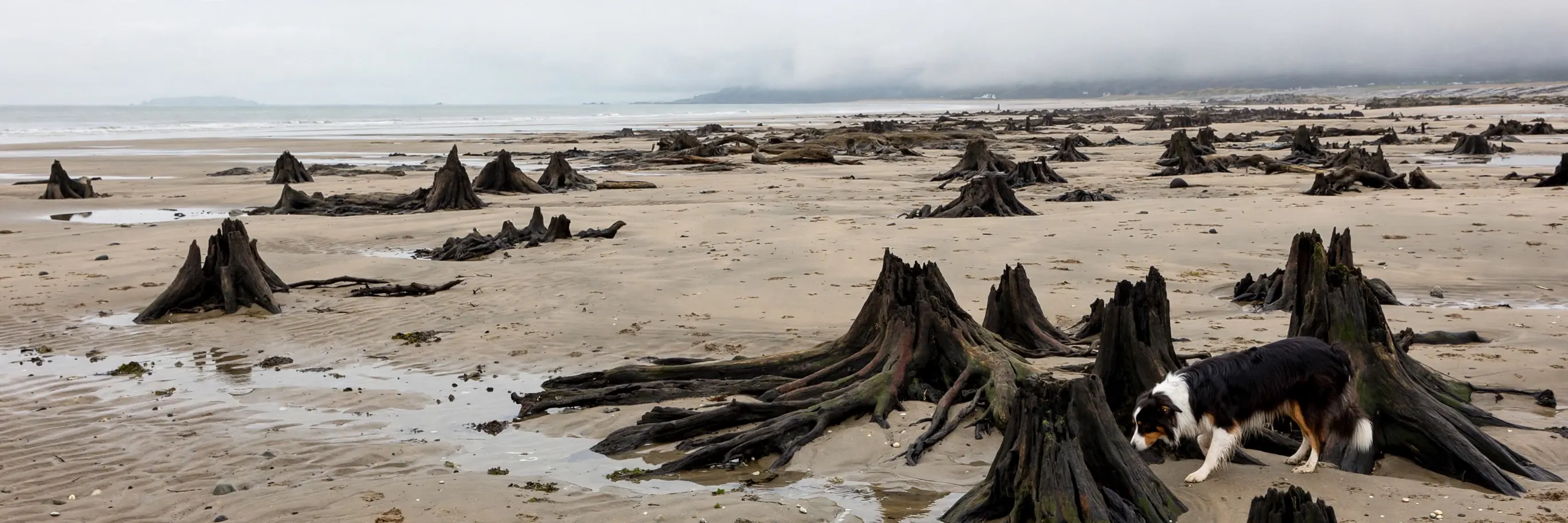
Most beaches give you the same view whatever the hour. Borth does not. Twice a day the sea draws back across Cardigan Bay and uncovers something extraordinary on the sand: the blackened stumps and fallen trunks of a prehistoric forest, preserved in peat for around four and a half thousand years. On a good low tide you can walk among them with a dog at your side, tracing the lines of trees that grew here when the coastline stood much further out to sea. It is the single best reason to visit Borth, and the single best reason to plan your visit around the tide table rather than your satnav.
The stumps are not evenly spread, and they do not appear on every low tide. They show best on spring tides, when the moon pulls the sea furthest back, and they can be buried again under shifting sand for weeks at a time. Some days you will find a whole field of them, dark and upright in the wet sand; other days only a scatter of low stumps and the odd fallen trunk near the waterline. That uncertainty is part of the place. Check the tide times for Borth before you set out, look for the lowest tide of your visit, and treat a clear sighting as a bonus rather than a guarantee. If you are staying for several days, you get several chances, and the forest often shows better on the second or third low tide of a stay as the sand shifts.
The trees belong to a landscape that vanished under rising sea levels after the last ice age. The peat beds that hold them are the same dark layers you will notice underfoot on the lower beach, soft and springy in places, and the stumps themselves are the remains of oak, pine, birch and alder that once grew on dry land here. Local legend ties the drowned land to Cantre'r Gwaelod, the lost lowland kingdom said to lie beneath Cardigan Bay, and the story is told all along this coast, from Borth to Aberdyfi and beyond. The legend is folklore, but the stumps are real, and standing among them with the bay stretching away on both sides is one of the strangest and most memorable dog walks in Britain.
Walk among the trees with care, and keep your dog close. The stumps are sharp in places, the fallen trunks are slippery when wet, and the peat can be soft enough to catch a small dog's paw or a walking boot. Do not let your dog chew the wood or dig in the peat, and do not try to take a piece home: the forest is a protected part of the shoreline, and removing stumps or peat damages a record that has survived thousands of years. Photographs cost nothing and last longer. Keep your dog on a lead while you are among the stumps, partly for their own safety and partly because the lower beach can be busy with other visitors at a good low tide, all of them looking down at the same trees.
Timing matters as much as location. The forest is best seen in the hour either side of low water, when the sand is firm and the stumps stand clear of the pools. Arrive too early and the sea is still over them; arrive too late and the water is already coming back across the sand, filling the pools and hiding the lower stumps first. Low, raking light in the morning or late afternoon shows the stumps at their most dramatic, and a grey, overcast day can be better than bright sunshine for seeing the dark wood against the pale sand. If the tide is right and the light is kind, give the forest a full hour of your walk, and let your dog sniff its way slowly along the lines of trees rather than rushing past them.
Plan the day around the tide, not the clock
The first thing to do before any trip to Borth is to look up the tide times. This is not a polite suggestion; it is the difference between a great day and a wasted one. At high tide the sea reaches the sea wall and the sand all but disappears, leaving no beach to walk a dog on at all. At low tide the same shoreline becomes a vast, flat expanse of sand several hundred metres wide, with room for every dog, kite and family in the village. The beach changes completely twice a day, and a visitor who arrives without checking the tides can easily find themselves staring at a wall and a strip of shingle where they expected a beach.
Tide times for Borth are published by the UK Hydrographic Office, the BBC weather service and several tide-table websites, and the village noticeboards and local shops often display them too. Pick a reliable source and check it again the morning you travel, because weather and atmospheric pressure can shift the actual water level from the prediction by a noticeable amount. Plan to arrive an hour or two before low water, which gives you the falling tide and the widest, firmest sand, and plan your return so you are off the lower beach well before the tide turns. The tide comes in faster than it goes out, and the flat sand that looks so safe at low water can be covered surprisingly quickly once the water starts to return.
Spring tides and neap tides matter more here than at most beaches. On spring tides, around the new and full moon, the sea falls further and stays out longer, uncovering the most sand and the most of the submerged forest. On neap tides, around the quarter moons, the range is smaller, the forest may barely show, and the beach is narrower. If you have a choice of dates, pick a spring tide weekend. If you do not, simply adjust your expectations: a neap-tide day at Borth is still a good beach day, with firm sand and room to walk, but the forest may stay hidden under the water and the sand.
Build the rest of the day around the tide window. A common pattern works well: arrive mid-morning, walk the beach as the tide falls, spend the low-water hour among the forest stumps, then walk back to the village as the tide turns and eat lunch while the sea comes in. In the afternoon, when the beach is gone, use the coast path, the dunes or the village instead. The reverse also works, with a late-afternoon low tide followed by an evening in the village, and on long summer days you can catch both low tides if you are staying overnight. The mistake is to treat the beach as available all day, because at Borth it is not, and the best dog days here are the ones where the timetable is written in pencil around the sea.
Keep a special eye on the northern end of the beach, where it meets the Dyfi estuary. The estuary mouth carries a fast current, and the sand and mud near it can be soft enough to trap a dog that runs ahead. Keep dogs on a lead near the estuary, do not let them swim in the channel, and never try to cross to the far side on foot. The same caution applies to the mouth of the little river at the southern end of the village beach after heavy rain, when the water runs fast and the sand around it is soft. These are not reasons to avoid the beach; they are reasons to walk it with your eyes open, and to keep the lead in your hand rather than in your pocket until you know the ground.
The long beach walk: Borth to Ynyslas
The walk that defines Borth runs north along the beach to Ynyslas, at the southern edge of the Dyfi estuary. It is about three miles each way, almost entirely flat, and on firm low-tide sand it is one of the easiest long walks a dog will ever do. There are no stiles, no gates and no climbs, just the sea on your left and the dunes on your right, and the walk can be as short or as long as your dog wants it to be. Turn around after twenty minutes for a gentle leg-stretcher, or walk the whole way to the dunes for a proper half-day out.
Start from the village beach and head north with the sea on your left. The first stretch passes the houses and the sea wall, and the sand here is the busiest part of the beach, especially on summer weekends. Beyond the village the crowds thin quickly, the beach widens, and the walk opens out into the long, empty middle section where dogs can run properly. The submerged forest sits along this stretch, so keep an eye on the sand as you go: the stumps are easiest to spot when the light is low and the sand is wet, and they tend to appear in bands rather than evenly across the beach. Walk slowly through the forest zone, then pick up the pace again once you are past it.
As you approach Ynyslas the character of the walk changes. The dunes rise on your right, the beach narrows towards the estuary, and the birdlife thickens: waders feeding on the mud, gulls overhead, and in winter, large numbers of wildfowl on the estuary itself. The dunes at Ynyslas are part of the Dyfi National Nature Reserve, a protected landscape of sand dunes, saltmarsh and estuary, and they are worth an hour on their own. Keep your dog on a lead in the dunes, where ground-nesting birds breed in spring and summer, and stick to the marked paths rather than cutting across the fragile dune grass. There is a visitor centre at Ynyslas in the summer months, with information about the reserve and the estuary, and the dunes offer a completely different walk from the beach: soft sand, winding paths, sheltered hollows and views back down the bay towards Borth.
Ynyslas is also a good turning point for a shorter walk. If three miles each way is too much for your dog, drive or walk to the Ynyslas end and walk the southern part of the dunes and beach instead, or walk halfway from Borth and turn back at the point where the village disappears behind you. There is no shame in a shorter walk here: the beach is so long that even a mile out and back gives a dog a proper run, and the return leg is always into the wind, which tires dogs faster than the outward leg. Older dogs, puppies and small breeds are often happier with a two-mile round trip and a long rest in the dunes than with the full six miles.
On the way back, watch the tide. The beach that was wide and firm on the way out can narrow as the water returns, and the firm sand near the waterline is the first to go. If the sea is already lapping at the base of the dunes or the sea wall, do not try to squeeze past it on the beach; use the coast path or the road back to the village instead. Carry water for the dog on the full walk, because there is no fresh water on the beach and the nearest tap is back in the village or at Ynyslas. A long line is a good compromise here: it gives a dog freedom to run on the open sand while keeping them under control near the estuary, the forest stumps and other beach users.
The village itself: a working seaside strip
Borth is not a resort town, and that is its charm. It is a long, narrow village strung out along the seafront, with a railway station in the middle, a handful of shops and cafes, a golf course at the northern end and houses that look straight out over the bay. Everything is within a short walk, the pace is slow, and a dog fits in without fuss. There is no promenade crowded with arcades, no funfair and no queue for anything, which is exactly why people who like Borth keep coming back.
The railway station sits almost on the beach, on the Cambrian Coast line between Aberystwyth and the north Wales coast, and it is one of the pleasant surprises of the village. Arriving by train with a dog is genuinely practical here: step off the train, cross the road, and you are on the sand. Dogs travel on the train under the usual rules, and the line itself is one of the prettiest in Wales, running along the coast and across the Dyfi estuary. If you are staying without a car, Borth is one of the easiest beach villages in Wales to reach, and the station makes a car-free weekend realistic rather than heroic. Check the official guidance before you travel for the latest train times, because the service is not frequent and a missed train can mean a long wait.
The village has the essentials: a small supermarket and general stores, a couple of cafes, a pub or two, and takeaway food along the front. It does not have the range of a town, so if your dog needs a particular food or you need a particular piece of kit, buy it in Aberystwyth, about seven miles south, before you arrive. The shops that are here are used to dogs and to sandy boots, and a well-behaved dog on a lead is a normal sight on the seafront. The golf course at the northern end of the village, Borth and Ynyslas Golf Club, runs between the village and the dunes, and golfers and dog walkers share the edges of the course: keep your dog on a lead near the fairways, stay off the greens, and give players plenty of room.
Borth also has a small zoo, the Borth Animalarium, set back from the seafront. It is a popular stop for families, but it is not a dog attraction: dogs are not admitted, so plan it as a human-only outing and leave the dog resting at your accommodation. The same applies to any indoor attraction in the village. That is not a drawback so much as a fact to plan around, and it is one reason a self-catering stay suits Borth better than a hotel room: a dog that can rest comfortably alone for an hour or two gives you far more freedom than one that cannot.
Evenings in Borth are quiet, and that suits most dogs. The sunset over Cardigan Bay can be spectacular, with the light falling across the water and the hills of Snowdonia visible across the estuary on a clear day, and the seafront is a good place for a last short walk before bed. The village has street lighting along the front, but the beach and the dunes are dark at night, so take a torch and keep the last walk short and on the lead. A quiet evening, a settled dog and an early start for the morning low tide is the rhythm that works best here, and it is a rhythm the village seems built for.
Beach rules through the year
Like most Welsh beaches, Borth has rules about dogs that change with the season, and they are worth understanding before you arrive rather than discovering them from a sign on the day. Parts of the main beach near the village are subject to seasonal restrictions, usually running from May to September, when dogs are not allowed on the restricted stretch during the day. The long northern section towards Ynyslas, on the other hand, is generally open to dogs all year round, which means that even in high summer there is always somewhere in Borth to walk a dog on the beach. The restricted zone and the exact dates are set by Ceredigion County Council, and they can change, so check the official guidance before you travel and read the signs at the beach entrance on the day.
The rules exist for a reason, and they are enforced. The main beach near the village is where families with small children swim and play in summer, and the restrictions are about sharing a small space safely. Fines can apply for breaking a Public Spaces Protection Order, and the amount is not trivial, so do not assume that a quiet morning or a rainy day makes the rules optional. If you are unsure where the restricted zone starts and ends, ask in a village shop or look for the signs at the access points: the boundary is usually marked clearly, and the northern end of the beach is an easy walk from the village even with a dog that needs a long run.
Outside the summer season, from October to April, the whole beach is generally open to dogs, and this is when Borth is at its best for dog owners. The beach is empty, the light is low and golden, the forest shows well on the winter spring tides, and a dog can run for miles without meeting another soul. Autumn and winter also bring their own cautions: storms can throw debris onto the beach, including driftwood and fishing gear, and strong winds can make the sand sting, so check the forecast and keep a reactive or nervous dog on a lead when the weather turns. Our guide to dog-friendly beaches in the UK explains how seasonal bans, PSPOs and fines work across the country, and it is worth reading before any beach trip, not just this one.
Year-round rules apply whatever the season. Pick up after your dog everywhere on the beach, in the dunes and on the paths, and use the bins provided or take the bag home with you. Keep your dog under control at all times, which means close enough to recall even when other dogs, children or wildlife appear. Dogs should not chase the wading birds on the estuary or in the dunes, and they should not be allowed to dig in the dune grass or the peat beds. Assistance dogs are exempt from the usual restrictions, as they are on beaches across the UK, but the exemption covers the dog's working role, not a general right to roam off lead.
One more seasonal pattern is worth knowing. The summer restricted period coincides with the busiest weeks in the village, when the car parks fill early and the beach near the village is crowded. If you visit in July or August, plan your beach walk for early morning or late evening, when the beach is quieter and the light is better, and use the northern stretch for the main run. In spring and autumn, when the restrictions have lifted but the weather is still kind, Borth offers the best of both worlds: warm sand, an empty beach and no zones to worry about. Those shoulder-season weeks are, for many regulars, the best time of year to visit with a dog.
Beyond the beach: dunes, estuary and hills
Borth makes a good base for more than the beach, and the walks beyond the sand are what turn a day trip into a proper break. The most obvious is the Wales Coast Path, which runs through the village and links Borth to Aberystwyth in the south and to Aberdyfi across the estuary in the north. The southern section, from Borth to Clarach Bay and on to Aberystwyth, climbs onto the cliffs and gives long views back over Cardigan Bay, and it is a very different walk from the flat beach: up and down, with steps, narrow sections and livestock in the fields. Keep dogs on a lead on the cliff sections, give grazing animals a wide berth, and do not let a dog run ahead around blind corners where the path meets the cliff edge.
The Dyfi estuary itself is a landscape worth exploring slowly. The saltmarsh and mudflats on the northern side of the village are rich with birdlife, and the estuary is one of the best places in Wales to watch waders, ducks and geese, especially in autumn and winter. The RSPB reserve at Ynyslas and the wider Dyfi National Nature Reserve protect this landscape, and the reserve's paths and hides are a good wet-weather alternative to the beach. Dogs are welcome on the reserve's paths under control, but they should be kept on a lead near the hides and the saltmarsh, where birds feed close to the path and are easily disturbed. A dog that sits quietly while you watch the birds will be welcome; one that lunges at every heron will not.
Inland from Borth, the land rises quickly into the hills of Ceredigion, and the lanes and forestry tracks behind the village offer shaded summer walks when the beach is too hot or too busy. The old lead-mining country around the village, and the wooded valleys that run down to the coast, are quiet and little visited, and they suit dogs that prefer shade and scent to open sand. These walks need a map rather than a signpost: the paths are not always waymarked, and the lanes are narrow with passing places, so plan the route before you set out and take water, because there are no shops once you leave the village. The hills also give the best views of the bay, and a climb of a few hundred feet is enough to see the whole curve of the beach from Ynyslas to Aberystwyth.
If you want a longer coastal walk, the Wales Coast Path south from Borth to Aberystwyth is a realistic day out for a fit dog, around seven miles each way along the cliffs, with the option of the train or the bus back. It is a much harder walk than the beach, with steep climbs and descents, and it should only be attempted in good weather with plenty of water and a dog that is used to distance. For a gentler version, walk as far as Clarach Bay, a sheltered cove about two miles south, and turn back there. Our guide to the Pembrokeshire Coast Path with a dog covers the same kind of cliff, livestock and multi-day planning questions in more detail, and much of its advice about water gaps, cliff safety and tired dogs applies just as well on this stretch of the Welsh coast.
Whatever you choose, remember that the landscape around Borth is a working one. Sheep graze the cliff fields and the hills, cattle graze the lowland pastures, and ground-nesting birds use the dunes and the moorland in spring. Keep your dog on a lead whenever livestock is in sight, even if the animals look far away, and keep them out of fields with lambs in spring. A dog that worries sheep can cause real harm and real trouble for its owner, and a single incident can close a path to dogs for everyone. The countryside code is not a formality here; it is the agreement that keeps these walks open.
Eating and staying with a dog
Feeding yourselves and the dog in Borth takes a little planning, but nothing difficult. The village has a small supermarket and general stores where you can buy the basics, and a handful of cafes and pubs along the front. Dog policies vary from place to place and can change between seasons, so ask before you sit down rather than assuming, and expect outdoor seating to be the easiest option. A dog that settles quietly under a table on its own mat, with a water bowl of its own, will be welcome in far more places than one that barks at every passer-by or begs at neighbouring tables. Bring the mat and the bowl with you, because not every cafe keeps spares.
For a longer stay, self-catering is the most comfortable option in Borth. There are holiday cottages, caravans and apartments in and around the village, many of which accept dogs, and a self-catering base gives you the freedom to come and go with the tides, dry a wet dog properly, and feed the dog on its normal routine. When you book, ask the same questions you would anywhere: how many dogs are allowed, whether there is a pet fee, whether the garden or outside space is enclosed, and whether the property has a hard floor that is easy to clean after a sandy walk. A cottage with a walled garden near the beach is worth more than a larger one a mile inland with no outside space at all. Our guide to dog-friendly holiday parks in Wales covers the same booking checks in detail, and its advice about boundaries, fees and cancellation terms applies to cottages and caravans just as much as to parks.
If you prefer a holiday park, there are parks in the wider area around Borth and Aberystwyth, and they suit families who want a base with facilities and a choice of accommodation types. Book early for school holidays and summer weekends, because the dog-friendly units sell out first, and confirm in writing that the specific unit you have booked accepts dogs, rather than relying on a general statement on the website. Ask where the nearest dog walk is from the unit, whether there is an enclosed area for a first and last toilet break, and what the rules are about leaving a dog alone in the unit while you eat out. The answers matter more than the brochure photographs.
Camping is also possible around Borth, with campsites in the area that welcome dogs, though pitches near the dunes and estuary can be exposed to wind and need a sturdy tent. Whatever you choose, pack for the beach: a drying coat or two, spare towels, a lidded box for muddy leads, and a waterproof mat for the floor by the door. Borth sand gets everywhere, and a dog that has run on the beach will bring half of it back with them. A quick rinse at an outdoor tap, if your accommodation has one, saves a lot of cleaning later, and a dog that is dried properly before coming indoors is a much happier houseguest.
Eating out in the evening is easiest in the village pubs, where dogs are often welcome in the bar area, and in Aberystwyth, a short drive south, where the choice is much wider. If you drive to Aberystwyth for dinner, plan the dog's evening too: a dog that has had a long beach walk during the day will usually settle happily at your accommodation, while a dog that has been in the car all afternoon will not. The best evenings in Borth are often the simplest ones, with fish and chips eaten on the seafront while the dog dozes at your feet, watching the light fade over the bay.
Practical kit: tides, mud, vets and parking
Pack for Borth as you would for any exposed west-coast beach, with the tide table at the top of the list. Print the tide times or save them on your phone before you travel, and check them again each morning. A long line is more useful than a short lead on the open beach, and a harness is kinder than a collar for a dog that pulls towards the water. Bring fresh water for the dog, because there is no fresh water on the beach and salt water is not a substitute: dogs that drink seawater can become ill, so offer fresh water regularly and watch for a dog that keeps lapping at the sea. A collapsible bowl weighs nothing and saves a lot of trouble.
The sand itself needs a little respect. On a hot day the dry sand near the dunes can be surprisingly warm underfoot, so check it with your own bare foot before letting a dog run on it, and walk on the firm wet sand near the waterline instead. In winter the wind can drive sand hard enough to sting, and a dog with sensitive eyes may need a break in the shelter of the dunes. After the walk, rinse the salt and sand out of your dog's coat and paws, check between the toes for sand and small stones, and look for any cuts from shells or sharp driftwood. A dog that licks its paws constantly after a beach walk is telling you something hurts, so check the pads properly rather than assuming it is just the salt.
Mud is the other hazard, and it is easy to underestimate. The peat beds on the lower beach are soft and can catch a small dog, and the mud near the estuary and the river mouth is softer still. If your dog runs into soft ground, call them back calmly rather than chasing in after them, and keep a long line on them near the estuary so you can guide them back to firm sand. Wet sand that looks firm can be soft underneath after rain, so test it with your own foot before letting a dog run across it. A dog that is stuck in mud is a frightening sight, but a person who rushes in after them can get stuck too, so stay on firm ground and use the lead and your voice.
Parking in Borth is straightforward but limited. There is car parking near the beach and by the station, and street parking along the seafront, and on sunny weekends and school holidays the village fills early. Arrive before mid-morning if you can, park once, and walk everywhere rather than moving the car between the beach and the dunes. Leave nothing valuable visible in the car, and never leave a dog in a parked car on a warm day, even with the windows open: the inside of a car heats up far faster than the air outside, and a dog can overheat in minutes. Public toilets and litter bins are available in the village, but take your own poo bags and a spare, because the bins near the beach can be full on busy days.
Know where the nearest vet is before you need one. The closest practices are in Aberystwyth, about seven miles south, and there are emergency vets further afield, so save the number in your phone before you travel and check the opening hours. If your dog cuts a paw on a shell or eats something odd on the beach, a phone call to the vet is worth more than guesswork, and a basic first-aid kit with saline, bandages and tweezers is worth carrying on the longer walks. Check the official guidance before you travel for the latest information on parking charges, beach restrictions and local services, because the details change and the signs on the day are the ones that count.
A slow two-day plan
Two days is enough to see Borth properly with a dog, provided the tide table cooperates. The plan below is a framework rather than a schedule: move the pieces around to fit the low tides of your visit, and do not try to do everything in a single day. Borth is a place that rewards a slow pace, and a dog that has had a long beach walk in the morning will be far happier with a quiet afternoon than with a second long walk.
On the first day, aim for the morning low tide. Arrive an hour or two before low water, walk the beach north from the village, and spend the low-water hour among the submerged forest stumps. Walk as far as your dog wants to go, then turn back and eat lunch in the village while the tide comes in. In the afternoon, when the beach is gone, walk the dunes at Ynyslas or explore the village, and finish with a short evening walk along the seafront. This is the day for the forest and the long beach, and it is worth building the whole trip around getting the tide right for it.
On the second day, use the coast path. Walk south from Borth towards Clarach Bay and the cliffs above Aberystwyth, or head north through the dunes to the estuary and the nature reserve, depending on the weather and your dog's energy. The coast path is hillier and slower than the beach, so allow more time than the distance suggests, and carry water and a snack for both of you. In the afternoon, drive to Aberystwyth for a change of scene, or stay in Borth and let the dog rest while you explore the village shops. If the tide falls in the late afternoon, a second beach walk at sunset is a fine way to end the trip.
If the weather turns, Borth still works. A rainy day is a good day for the dunes and the estuary paths, which are sheltered and quiet, or for a drive along the coast to Aberdyfi and the towns of the Dyfi valley. A very wet or windy day is a good day to leave the beach alone and use the car: the coast road north and south of Borth is scenic, and there are dog-friendly cafes and pubs in the nearby towns where you can wait out the worst of the weather. The one thing not to do on a bad-weather day is to walk the beach at high tide in a storm, when the sea is over the sand and the wind is driving spray across the front.
Before you leave, do a final check of the beach. Walk the dog one last time on the sand if the tide allows, pick up any litter you see, and make sure you have everything you came with. Borth is a small village, and the people who live there notice the visitors who look after the beach and the ones who do not. Leave the place as you found it, and the forest will still be there, under the sand, waiting for the next low tide and the next dog to walk among the trees.
Practical questions
Before you go
Can dogs go on Borth beach all year round?
It depends on where you stand. Parts of the main beach near the village have seasonal dog restrictions, usually from May to September, while the long northern stretch towards Ynyslas is generally open to dogs all year. Read the signs at the beach entrance on the day, and check the official guidance before you travel, because the restricted zone and the dates can change.
When is the submerged forest visible?
Only around low tide, and best at spring low tides, when the sea pulls back furthest and exposes the dark stumps and fallen trunks on the sand. Check the tide times for Borth before you set out, aim to arrive an hour or two before low water, and leave enough time to walk back before the tide turns. On a neap tide the forest may barely show at all.
Is the beach at Borth safe for dogs at high tide?
At high tide the sea reaches the sea wall and the sand almost disappears, so there is nowhere safe to walk a dog on the beach itself. Plan beach time around low water, keep dogs on a lead near the water's edge, and stay well clear of the Dyfi estuary mouth at the northern end, where currents run fast and soft sand and mud can trap a dog.
Can I walk from Borth to Ynyslas with a dog?
Yes, it is one of the best dog walks in Ceredigion: about three miles of flat sand from the village to the dunes at Ynyslas, with the estuary on one side and the open bay on the other. It is an out-and-back walk, so allow time for the return leg, carry water for the dog, and check the tide times before you travel so the beach is still there for the walk home.
Where can I park in Borth with a dog?
There is car parking near the beach and by the station in the village, and street parking along the seafront. Arrive early on sunny weekends and school holidays, because the village is small and the car parks fill quickly. Park, settle the dog, and walk to the beach rather than trying to drive closer to the sand.
Are dogs allowed in the cafes and pubs in Borth?
Some are, and some are not, and policies can change between seasons, so ask before you sit down rather than assuming. Outdoor seating is usually the safest bet, and a dog that settles quietly under a table is welcome in far more places than one that barks at every passer-by. Bring a mat and water bowl of your own.