This guide is independent and contains no paid placement. If affiliate links are added later, they will be clearly marked and will not change our editorial checks.
Tywyn works for dogs because its three best things all welcome them: the Talyllyn narrow-gauge steam railway takes dogs on board, the beach runs for miles with room to spread out, and the Dysynni estuary paths give you flat, quiet birdwatching walks. Plan around the tide, read the beach signs for the summer restriction zone, and check the official guidance before you travel for current railway times and dog rules.
Start with the whistle
Most seaside towns announce themselves with the smell of chips and the sound of gulls. Tywyn announces itself with a steam whistle. The Talyllyn Railway runs from its little station at Tywyn Wharf, a short walk from the seafront, and the first train of the day sets the rhythm of the whole town: the hiss of steam, the clatter of narrow-gauge carriages, and a queue of passengers that often includes at least one dog sitting patiently by its owner's feet. That is the right way to understand this place. Tywyn is not a resort that happens to have a railway. It is a railway town that happens to sit on one of the longest beaches in Wales.
The railway's claim to fame is a serious one. Opened in 1865 to carry slate from the quarries above Abergynolwyn down to the sea, the Talyllyn was the first railway in the world to be saved and run by volunteers, rescued in 1951 when closure seemed certain. It is a narrow-gauge line, just 2 feet 3 inches between the rails, and it climbs from the coast into the wooded valley of the Afon Fathew and on to Nant Gwernol, a journey of about seven and a quarter miles. The little locomotives have names and personalities that regulars argue about the way other towns argue about football teams, and the line inspired the fictional Skarloey Railway in the Thomas the Tank Engine stories. For a dog owner, the important fact is simpler: this is a working heritage railway that treats dogs as ordinary passengers, not as a problem to be managed.
Tywyn itself is a small, unshowy town on the southern edge of Snowdonia, between Aberdyfi to the south and Barmouth to the north along the Cardigan Bay coast. It has a long sandy beach, a promenade, a high street with the everyday shops a dog owner actually needs, and the Dysynni estuary curling around its southern side. It is quieter than its neighbours, and that is part of the appeal. There are no crowds to thread a nervous dog through, no long queues for ice cream with a lead wrapped around your ankle, and the pace of a day here is set by tide tables and train times rather than by anybody else's schedule. If your dog is happiest with space, sea air and something interesting to watch, Tywyn fits.
This guide is organised the way a good day here runs: railway first, because the trains set the timetable; then the beach, because the tide sets the walking; then the estuary, because the late afternoon light over Broad Water is the town's quiet reward; and finally the practical business of eating, sleeping and parking. Every section includes the dog rules as they stand, and where a rule changes with the season or the operator, the guide says so plainly and tells you to check the official guidance before you travel rather than guessing.
Dogs on the Talyllyn Railway
Dogs are welcome on Talyllyn Railway trains. The working rule is straightforward and familiar to anyone who has taken a dog on a heritage line: the dog travels on a lead, stays on the floor of the carriage rather than on the seats, and remains under your control for the whole journey. Dogs usually travel free, but fares, timetables and any conditions attached to special events change through the year, so check the official guidance before you travel rather than relying on last year's arrangement. On a normal operating day, turning up at Tywyn Wharf station with a dog is entirely unremarkable, and the staff are used to it.
A little preparation makes the ride much better for the dog. Arrive in good time so the dog can settle before the carriage fills, and choose a seat near the door if you can, which gives you a quick exit at the far end and a shorter walk through a crowded carriage. Bring water and a small bowl, because steam trains are warm places even on a cool Welsh day, and the carriages can be snug when they are full. A familiar blanket or mat on the floor gives the dog a defined place to lie down and stops them trying to curl up in the gangway, where feet and luggage trolleys pass constantly. If your dog is noise-sensitive, the whistle is the thing to think about: it is loud and sudden, and it sounds more than once. A dog that startles at sharp sounds will do better away from the locomotive end of the train, and a first journey on a shorter hop, such as Tywyn Wharf to Dolgoch, is a kinder test than the full run to Nant Gwernol.
Boarding is part of the experience, so give it the same calm attention you would give any new situation. The carriages sit low and the step up is small, but the gap between platform and carriage and the bustle of other passengers can unsettle a hesitant dog. Let the dog look, then lift or guide them in with a steady hand and a treat, and settle them before the train moves. Keep the lead short while the train is moving and the carriage is swaying, and keep the dog clear of the doors and the open windows. Most dogs settle within a few minutes once the rhythm of the rails takes over, and many of them spend the journey with their chin on the seat edge, watching the valley slide past.
Timetables are seasonal, and that shapes the day more than anything else on the railway. In the main season trains run several times a day; in the quieter months the service thins out, and some weekdays may have no trains at all, so the timetable is the first thing to check when you plan. Special events, such as gala weekends and Santa trains, draw bigger crowds and can have their own conditions, so read the event information before you book. If you want a seat on a popular summer departure, book ahead online where that option is offered, and remember that a return ticket gives you the freedom to hop off at a station, walk, and catch a later train back, which is exactly how the line is best used with a dog.
One more thing worth knowing before you go: the railway is run largely by volunteers, and the atmosphere is part of the charm. Staff and volunteers will often make a fuss of a well-behaved dog, and the shop and cafe at Tywyn Wharf are used to dogs waiting outside or sitting quietly nearby. Treat the station as you would any small community space — keep the lead short, pick up after the dog, and do not let them wander onto the track side of the platform — and you will be welcomed back.
Walks from the line
The best way to use the Talyllyn with a dog is not to ride it end to end and come straight back, but to treat it as a walking shuttle. Ride out, walk down through the valley, and catch a later train or walk back along the valley floor. The line threads through a landscape that was shaped by slate quarrying and then reclaimed by woodland, and the stations are spaced so that each one opens a different kind of walk.
Dolgoch is the stop most dog owners should aim for first. The station sits beside a famous set of waterfalls, and a short waymarked trail climbs through the woods to the falls themselves, where the Afon Fathew drops through a series of rocky pools. The path is uneven in places and can be slippery after rain, so keep the dog on a lead on the steeper stretches and on the footbridges, and do not let them scramble down to the water at the falls, where the rocks are slick and the current is strong. The reward is a walk that feels like a proper woodland adventure without ever being far from the station, and the falls are loud enough to be exciting without being frightening for most dogs. Allow at least an hour for the falls loop if the dog likes to stop and sniff, and take water, because there is no shop at the station.
Abergynolwyn, the village at the top of the line's populated section, is the gateway to longer walks and to a gentler pace. From here the valley opens out, the river runs alongside old quarry workings, and the paths lead towards the forest trails of the Nant Gwernol terminus. The walk between Abergynolwyn and Nant Gwernol follows the river through woodland and is one of the quietest stretches on the line, which suits dogs that find busy paths stressful. Keep the dog on a lead where the path runs close to the track, because trains pass without much warning on a narrow-gauge line, and remember that the valley sides are steep and the ground can be boggy after heavy rain. Good boots and a long line for the open stretches will serve you better than a short lead and city shoes.
Nant Gwernol itself, the terminus, is a good turning point rather than a destination with facilities. The station is a small platform in the woods, and the forest trails that start there lead into the kind of deep, quiet woodland that many dogs love best: soft ground, leaf litter, streams to paddle in and very few other people. The trails are waymarked but not surfaced, so they get muddy, and the walk back down to Abergynolwyn is downhill all the way, which is kinder on human knees than the climb up. If you plan to walk one way and ride back, check the return train time at the station before you set off, because missing the last train from Nant Gwernol means a long walk back to Tywyn.
Between the stations, the valley floor walk along the river is the quiet option for dogs that need space rather than excitement. The route follows the Afon Fathew through meadows and woodland, with sheep in some fields, so a lead is essential where livestock is present, and the ground can be wet underfoot even in summer. The walk from Tywyn Wharf itself follows the line out of town and into the valley, and it is a good choice for a first morning, because you can turn back at any point and you are never more than a few minutes from the road. Whatever you choose, carry a towel: valley dogs come home wet, and a wet dog in a steam train carriage is a smell that stays with you.
Tywyn beach with a dog
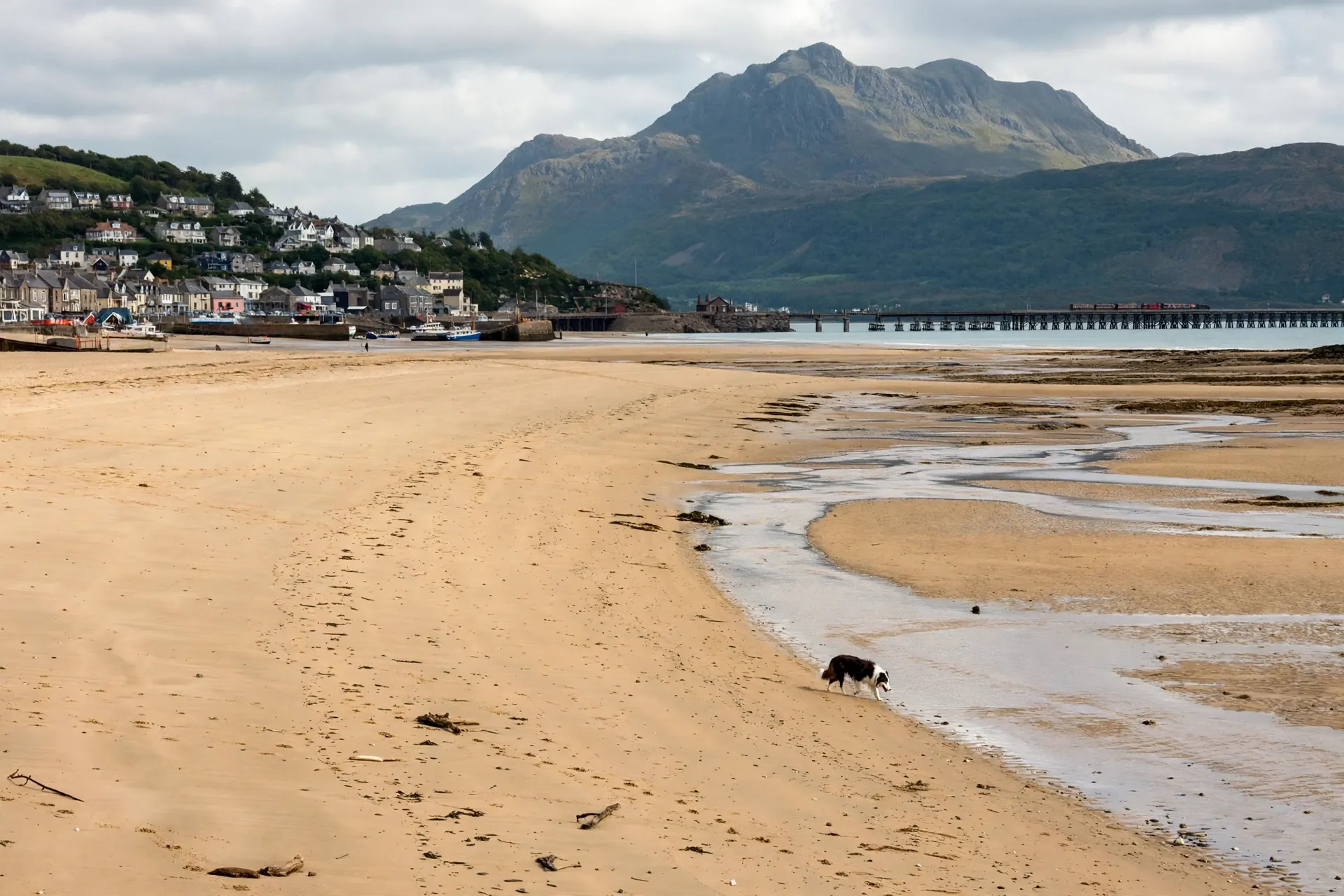
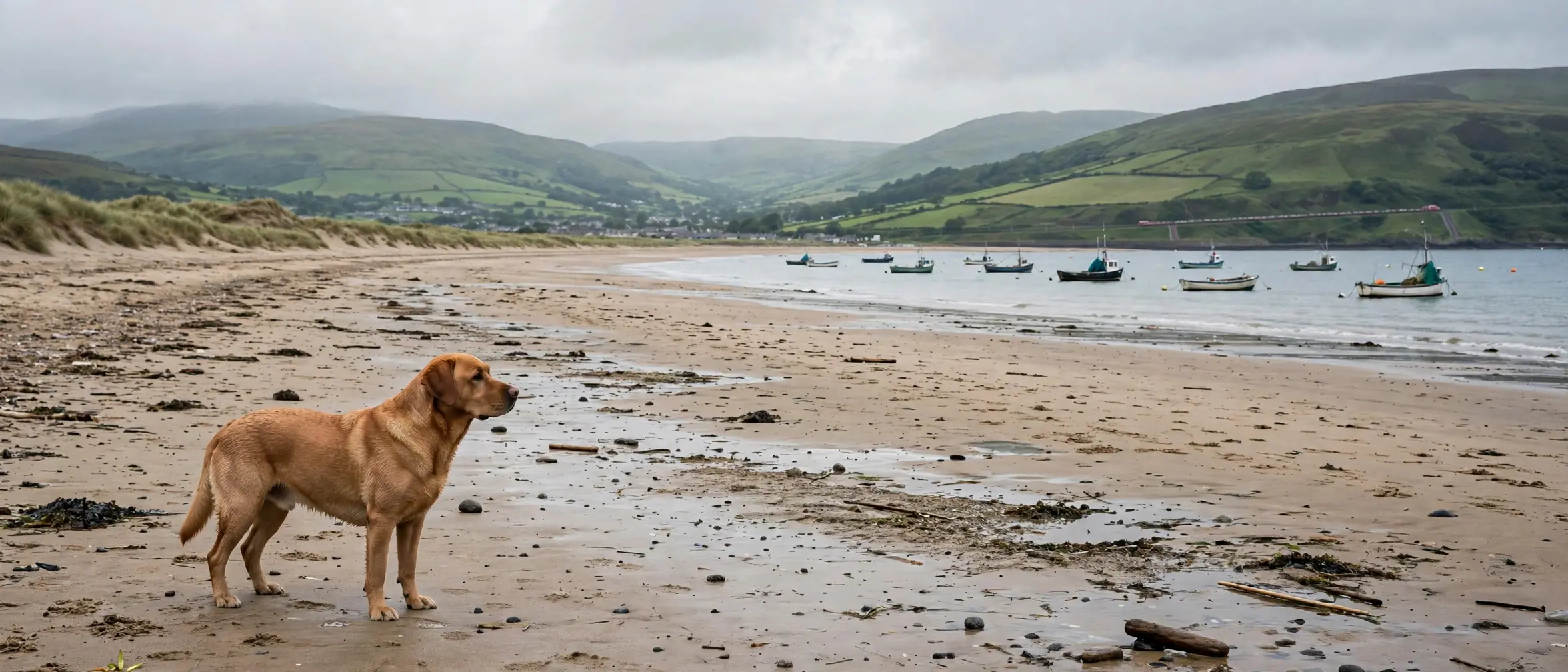
Tywyn beach is the town's great open space, and its scale is the first thing that strikes you. The sand runs for miles in both directions along Cardigan Bay, backed by dunes to the south and a low sea wall and promenade at the town end, and on a weekday outside the school holidays it can feel as though the whole beach belongs to you and the dog. The sand is firm and flat near the waterline at low tide, which makes it kind to older dogs and to dogs that like to run without tripping over soft sand, and the beach shelves gently, so paddling dogs can wade out a long way before the water gets deep. That combination of space, firm sand and shallow water is why so many dog owners come back to Tywyn year after year.
The rules, however, need attention, because they are not the same all year. Seasonal dog restrictions can apply to part of Tywyn beach during the summer months under the local public spaces protection order, and the restricted zone and its dates can change, so read the signs at every access point and check the official guidance before you travel. Our guide to dog-friendly beaches and the 2026 rules explains how these orders work, what the fines can be and how to check a beach before you go, and it is worth reading alongside this section. The practical habit is simple: walk to the beach, read the sign, and if the sign says the stretch in front of you is restricted, walk on until you are past the restriction markers. Outside the restricted zone and outside the restricted season, dogs can run on the sand, but a lead is still wise near the car park, the promenade and any place where children are playing.
Tides matter more at Tywyn than at many beaches, because the bay is so flat. At low tide the sea goes out a long way and the beach becomes enormous, which is wonderful for a run but also means the incoming tide can cover ground quickly and cut off a dog that has wandered far out. Check the tide times before you set off, walk out with the tide rather than against it, and keep an eye on the water while the dog is off the lead. The same flatness means that the sand near the high-tide line can be soft and tiring for a small dog, while the firm sand near the waterline is where the best running happens. If you are walking south towards Aberdyfi, remember that the Dysynni estuary crosses the beach, and the channel can be deep and fast-flowing near the mouth, so do not let the dog swim across it and do not try to wade it yourself at anything other than low water.
The dunes behind the southern end of the beach are a habitat worth treating with respect. They are home to ground-nesting birds in the breeding season and to plants that hold the sand in place, and dogs running loose through the dunes can do real damage. Keep the dog on a lead or under close control in the dunes, stick to the paths where they exist, and do not let the dog dig in the dune faces. The same care applies to the salt marsh edges near the estuary, where the ground looks firm and is not, and where a dog can get stuck in soft mud while chasing a bird. A long line gives the dog freedom to explore the open sand while keeping them out of the places where they can cause harm or get into trouble.
On the beach itself, the practical details are the ones that make the difference between a good morning and a miserable one. Bring fresh water, because dogs that drink seawater will be sick, and the nearest tap may be a long walk away. Bring a towel and a drying coat for the journey home, because a wet sandy dog in a car is a problem that only gets worse with time. Watch for the things dogs find on beaches: fishing line and hooks near the anglers' spots, broken shells, and the occasional dead jellyfish, which can still sting. In summer, the sand can get hot enough to be uncomfortable on paws at midday, so walk early or late and test the sand with your own hand. And always carry bags and pick up after the dog, even on an empty beach, because the tide does not reliably take it away and the next walker will find it.
For dogs that need a calmer introduction to the sea, the town end of the beach is the best place to start. The promenade gives you a firm surface to walk on while the dog gets used to the sound and the smell of the sea, and you can step down onto the sand for a short paddle and step back up again if the dog is unsure. Nervous dogs often do better at low tide, when the water is far away and the beach is at its widest, and they can approach the sea at their own pace rather than having waves arrive at their feet. Let the dog choose the distance, keep the lead loose, and do not carry them into the water, because a dog that is put into the sea before it is ready will remember it.
The Dysynni estuary and Broad Water
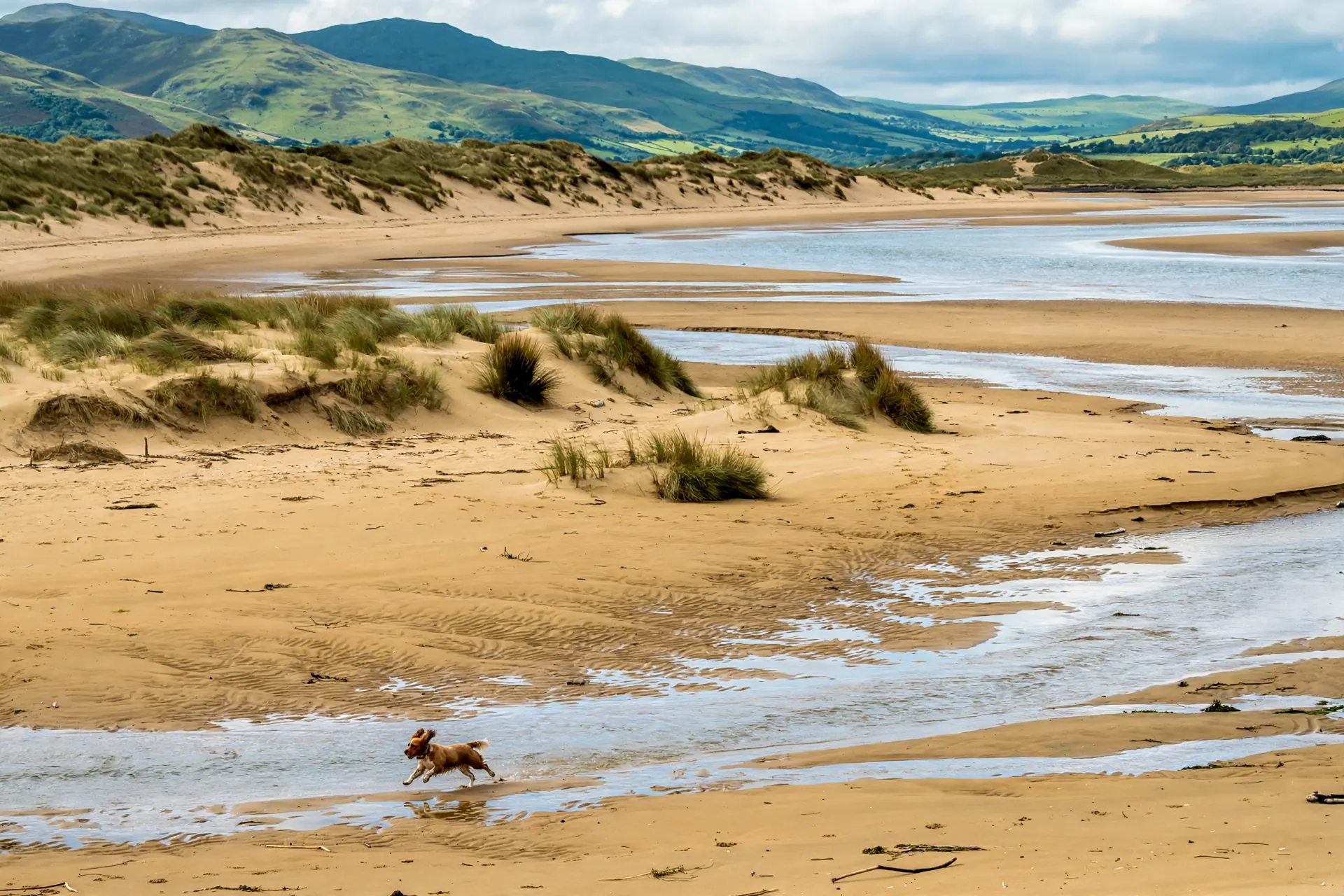
South of the town, the Afon Dysynni reaches the sea through a shallow estuary that is one of the quietest and most rewarding corners of the Cardigan Bay coast. At low tide the river winds between sandbanks and salt marsh; at high tide the water spreads out across the flats and the whole landscape changes colour. The place to aim for is Broad Water, a brackish lagoon set back from the beach behind the dunes, which draws birdwatchers from across Wales and is the centrepiece of the estuary walk with a dog. It is not a dramatic landscape of cliffs and coves. It is a flat, open, watery place where the interest is in the birds, the light and the sense of being a long way from anywhere, and dogs that are happy to walk quietly on a lead will enjoy it as much as their owners.
The birdlife is the reason to come, and the reason to keep the dog close. Broad Water and the estuary are important for wading birds, wildfowl and herons, and in winter the lagoon holds ducks and geese in numbers that make it one of the best birdwatching spots on this coast. Little egrets, which were once a rarity in Wales, are now a regular sight, standing white and still in the shallows. In spring and summer, the salt marsh and the dunes hold breeding birds that nest on the ground, and a loose dog can destroy a nest in seconds without ever meaning to. Keep the dog on a lead around the lagoon and the marsh, keep them out of the water at the water's edge where birds are feeding, and use the bird hides and viewing points rather than pushing through the reeds for a closer look. The birds are the point of the place, and a dog that has learned to sit quietly and watch them is a better companion here than one that is allowed to chase.
The walking itself is flat and straightforward, which makes it a good choice for older dogs and for dogs that are tired after a morning on the beach. The Wales Coast Path runs through this area, and the waymarked routes from the town lead out along the estuary and around Broad Water in a loop that can be shortened or extended to suit the dog. The ground is a mixture of firm paths, grass and soft marsh edge, and it can be wet and uneven after rain, so wear waterproof boots and expect mud. There are stiles and gates in places, and some of the paths cross grazing land, so a lead is essential where livestock is present and gates should always be left as you find them. The estuary paths are exposed to the wind, and on a wet day the wind off the bay can be biting, so a waterproof coat for the dog as well as for yourself is worth packing.
Timing the estuary walk to the tide changes everything. At low tide you can walk out along the river channel and see the waders feeding on the mudflats, with the dog on a lead beside you and the whole estuary spread out in front of you. At high tide the water pushes up into the marsh and the birds move closer to the paths, which makes for better viewing but also means the lower paths can flood, so check the tide times and do not try to cross a flooded path. The best light is often late in the afternoon, when the sun drops over the bay and the lagoon turns gold, and the walk back to town in the evening, with the dog tired and the sky changing colour, is one of the quiet pleasures of a stay in Tywyn. Allow two to three hours for the full loop if you stop to watch the birds, and carry water, because there are no facilities once you leave the town.
One practical warning deserves emphasis: stay off the estuary mud. It looks firm from the path, and dogs are drawn to it because it smells of everything interesting, but the soft mud of the Dysynni can hold a dog fast, and the tide comes in over it faster than a person can run. Keep the dog on the paths and on the firm sand, and if the dog does get stuck, do not wade in after them without thinking about your own safety and the tide. The same caution applies to the river channel near the beach, where the current is strong and the water is deep at high tide. The estuary is a beautiful place, and it rewards the walkers who treat it with respect.
Promenade, cafes and pubs
Tywyn's promenade is short, flat and made for an easy evening walk with a dog. It runs along the sea wall at the town end of the beach, with benches facing the bay and a view across the water to the hills of the Llyn Peninsula on a clear day. It is the place where the town gathers at the end of the day: families with children, dog walkers, anglers heading out to the sea wall, and people who have simply come to watch the sun go down. The surface is level and the walking is easy, which makes it a good first walk for a dog that is new to the sea, and a good last walk of the day for a dog that is already tired. Keep the lead short on the promenade itself, because it is a shared space and not every passer-by wants a friendly dog in their path, and keep the dog off the sea wall, where the drop to the beach is steep and the wind can catch a small dog off balance.
Eating and drinking with a dog in Tywyn follows the pattern of most small Welsh towns: the welcome is real, but it varies from place to place and it is usually the terrace or a specific dog-friendly area rather than the whole building. Several cafes and pubs around the promenade and the high street welcome dogs, often with a water bowl by the door and a biscuit for a well-behaved visitor, and the terraces are the natural place to sit with a dog on a warm day. The practical approach is to look for the dog-friendly sign at the door, or to ask before you sit down, rather than assuming. Policies change with the season and with the management, and a place that welcomed dogs last year may have changed its rules, so check the official guidance before you travel or simply ask when you arrive. A dog that can settle under a table and stay there quietly will be welcomed far more warmly than one that wanders between tables, so a mat for the dog and a chew to keep them occupied are worth carrying.
The high street is worth a wander in its own right, because it has the shops a dog owner actually needs on a break: a supermarket for supplies, a bakery, a butcher and a handful of independent shops that are used to dogs waiting outside or popping in with their owners. It is also where you will find the town's pubs, including the long-established high-street inn that has served travellers on this coast for generations, and where a dog that can settle by the fire in winter is part of the furniture. If you are staying for a few days, the high street becomes familiar quickly, and the shopkeepers and pub staff will know your dog by the end of the week. That is the kind of town Tywyn is.
For a wet day, the promenade and the high street are also the fallback when the beach and the railway are not appealing. Tywyn has a small cinema, the Magic Lantern, which is a community-run venue and a genuine local institution, although dogs are not part of the audience, so it is a human-only outing. The railway's museum and shop at Tywyn Wharf, on the other hand, are worth a look with a dog waiting outside in the care of one of your party, and the station cafe is a good place for a coffee while the dog rests. The honest advice for a rainy day in Tywyn is to accept the weather, put on waterproofs, and take the dog out anyway: the beach in the rain is empty, the light is often beautiful, and the dog will not mind the rain nearly as much as you do.
Staying over and parking
Tywyn suits a short stay as well as a day trip, and the accommodation is mostly small-scale: dog-friendly holiday cottages, bed and breakfasts, a handful of small hotels and guest houses, and caravan and camping sites on the edge of town and in the surrounding countryside. The cottages are the most flexible choice for dog owners, because they usually offer an enclosed garden, a kitchen for preparing the dog's food and no shared corridors to negotiate with a nervous dog, but they book up early for the summer and the school holidays, so a stay in August should be arranged months ahead. When you book, ask the questions that matter rather than relying on a "dog-friendly" label: how many dogs are allowed, whether there is an extra charge per dog, whether the garden is genuinely enclosed and how high the fence is, and whether the dog can be left alone in the property at all. Get the answers in writing with the booking confirmation, because a cottage that allows one dog may charge extra for a second, and a garden that is described as enclosed may have a gate that a terrier can slip through.
Caravan and camping sites around Tywyn are a good fit for dogs that like the outdoors, and several of them sit within walking distance of the beach or the estuary paths. The practical checks are the same as anywhere: the size and surface of the pitch, the distance to the nearest toilet walk after dark, the rules about dogs on leads around the site, and whether there is a dog exercise area or a direct path to open ground. Sites on the edge of town tend to be quieter than the ones on the main road, and a pitch away from the play area and the reception building is usually calmer for a dog that watches every passer-by. In the summer, the sites fill up with families, so a dog that is unsettled by children and ball games will do better on a pitch at the edge of the site, while a sociable dog will enjoy the middle of things.
Bed and breakfasts and small hotels in Tywyn can be a good choice for a night or two, but the rules vary more than they do for cottages. Some welcome dogs in the room, some only in certain rooms, and some welcome dogs only in the bar or the garden. Ask before you book whether the dog can stay in the room while you eat, whether breakfast is served somewhere the dog can join you, and whether there is somewhere practical for the last walk at night. A small hotel that welcomes dogs properly will have thought about these things and will answer without hesitation. One that has not will be vague, and vagueness at booking usually means awkwardness on arrival.
Parking in Tywyn is straightforward by the standards of a seaside town, but it still needs a little planning on a busy day. The beach and promenade car parks put you closest to the sand and are the natural choice for a beach morning, while the car park at Tywyn Wharf station is the practical choice on a railway day, because you can park once and walk to the trains. Charges and time limits vary by season, so check the signs and the official guidance before you travel, and leave extra time on a summer weekend, when the beach car parks can fill up by late morning. If you are staying overnight, ask your accommodation about parking, because some cottages and guest houses have a space included and some do not, and the difference matters when you are unloading a dog, luggage and a week's worth of supplies.
For drivers, the approach to Tywyn is part of the trip. The town sits on the A493 coast road between Aberdyfi and Barmouth, and the drive along the coast is one of the prettiest in Wales, with the sea on one side and the hills on the other. The road is narrow in places and busy in summer, so allow extra time and do not rely on a tight schedule for a train departure. The nearest mainline station is at Tywyn itself, on the Cambrian Coast line, which runs along the coast from Shrewsbury and Machynlleth to Pwllheli, and dogs travel on the mainline under the usual conditions, so a car-free trip is possible. If you are coming from the south, the drive through Aberdyfi and along the estuary is slow and scenic, and it is worth allowing an extra half hour simply to enjoy it. Our guide to Barmouth with a dog covers the next town north, where the estuary, the beach and the Mawddach Trail make a natural second day to a Tywyn stay.
Seasons, tides and weather
Tywyn changes character with the seasons more than most seaside towns, and the best time to visit with a dog depends on what kind of trip you want. Spring is the gentlest season: the valley turns green, the waterfalls on the Dolgoch trail run full after the winter rain, and the beach is quiet enough for a nervous dog to have the run of the sand. The railway timetable is building up again after the winter, the days are getting longer, and the town is waking up without yet being busy. It is also the season when ground-nesting birds are most vulnerable in the dunes and on the salt marsh, so the lead stays on around the estuary even when the beach feels empty. A spring visit suits a dog that needs space and a human who likes walking without crowds.
Summer is Tywyn at its busiest and its most beautiful, and it is also the season that needs the most planning. The beach fills up on fine weekends, the trains run most often, and the cafes and pubs put their tables outside. The heat is the thing to plan around: the sun on Cardigan Bay is stronger than it looks because the sea breeze keeps the air cool while the sun works on exposed skin, and dogs with pale noses, thin coats or short muzzles can overheat quickly. Walk early in the morning or late in the afternoon, carry water even for a short walk, and never leave a dog in a parked car, even with the windows open and even for a few minutes, because a car in the sun becomes dangerous far faster than most people expect. The summer beach restrictions are in force in this season, so the signs at the access points matter more than ever, and the restricted zone is not always where you expect it to be. Check the official guidance before you travel, read the signs when you arrive, and walk on to the unrestricted stretches rather than arguing about the boundary.
Autumn is, for many regulars, the best season of all. The summer crowds have gone, the beach belongs to the dog walkers again, and the light over the estuary turns gold in the late afternoon. The railway timetable thins out as the season ends, so check the trains before you plan a railway day, but the valley walks are at their finest, with the woodland turning colour and the waterfalls running well after the autumn rain. The sea stays warm enough for a paddle well into October, and the dogs that swim in summer will often keep swimming long after their owners have stopped. Autumn storms can arrive quickly off the bay, so watch the forecast and be ready to cut a beach walk short if the wind rises, because a flat beach with no shelter is no place to be in a gale. A waterproof coat for the dog earns its keep in autumn more than in any other season.
Winter in Tywyn is quiet, wild and honest. The town settles down to its year-round residents, the promenade is empty on a weekday, and the beach in a winter storm is a spectacular place to watch from a safe distance with a dog on a lead. The railway runs a reduced service in winter, with some weeks having no trains at all, so a winter visit should be planned around the walks rather than the trains, and the timetable should be checked before you book accommodation. The short days mean planning around daylight: a walk that takes three hours in summer takes the same three hours in winter, but the light goes at four in the afternoon, so start early and carry a torch. The cold is rarely severe on this coast, but the wind off the bay is, and a short-coated dog will feel it. A warm coat, a dry towel in the car and a warm room to come back to are the winter essentials.
Tides deserve a paragraph of their own, because they shape every walk in Tywyn. Cardigan Bay has a large tidal range, and at low water the beach is enormous while at high water the sea reaches the sea wall and the sand all but disappears. The tide tables are published for the whole year and are easy to check online, and the habit of checking them the night before is the single most useful thing a dog owner can do in Tywyn. Walk out with a falling tide and back with the water still low, never let the dog chase the water out across the flats, and remember that the estuary channel near the Dysynni mouth is deep and fast even when the beach looks safe. The same tide that makes the beach wonderful at low water can cut off a walker who has gone too far, so keep an eye on the sea while the dog is off the lead, and always know which way the water is moving.
Weather on this coast changes fast, and the forecast for Tywyn can be different from the forecast for the towns twenty miles inland, because the sea makes its own weather. A morning that starts grey can turn into a bright afternoon, and a bright morning can cloud over by lunchtime, so the practical approach is to dress for the worst and hope for the best. Waterproofs, layers and a hat are worth carrying even on a day that starts sunny, and a dog that is comfortable in the rain will enjoy Tywyn far more than one that is not. The rain here is usually light and passing rather than heavy and settled, and a shower that sends everyone else indoors leaves the beach empty for the dog walkers who are prepared. If the forecast does promise a genuinely wet day, the railway is the best shelter: a steam train in the rain, with the valley misty and the waterfalls full, is one of the great experiences of this line, and the dog will be warm and dry in the carriage while the valley slides past the window.
One good day in Tywyn
The best day in Tywyn is built around two timetables, the trains and the tide, and the simplest plan is to check both the night before and then let them shape the day. Start at Tywyn Wharf station with the first train of the day, ride out to Dolgoch, and walk the waterfall trail while the morning is still cool and the woods are quiet. The dog will be tired in the best way by the time you catch a later train back, and the ride back down the valley, with the sea coming into view as the train descends, is the moment when the whole place makes sense. Give the dog water and a rest at the station cafe, and then walk down to the beach for the afternoon.
Time the beach for the falling tide if you can. Walk out onto the firm sand at low water, let the dog run, and walk south along the beach towards the estuary until you reach the dunes and the edge of Broad Water country. Turn back before the tide turns, and finish the afternoon on the promenade with a drink at one of the dog-friendly terraces, the dog settled under the table and the bay in front of you. If the weather turns, the estuary walk is the sheltered alternative: it is flat, it is quiet, and the birds are at their best in the late afternoon light. The full loop around Broad Water takes two to three hours, so it can stand in for the beach entirely on a day when the wind is too strong for the open sand.
Packing for the day is straightforward, but the list is worth running through because Tywyn is the kind of place where the nearest shop can be a long walk from where you are. Water and a bowl for the dog, a lead and a long line, bags, a towel and a drying coat, a blanket or mat for the train, treats for settling the dog in the cafe, and a waterproof layer for both of you. Sun protection for the dog matters on a bright day on the beach, because the sea breeze hides the strength of the sun, and a dog with a pale nose or thin coat can burn. In winter, the same list applies with the addition of a warm coat for the dog, because the wind off Cardigan Bay cuts through a short-coated dog quickly.
Know where the nearest vet is before you need one. Tywyn has a local veterinary practice, and the larger practices in the surrounding towns cover out-of-hours emergencies, but the numbers and the opening hours are the kind of detail that should be saved in your phone before the trip rather than searched for in a panic. Keep the dog's usual food, any medication and the vaccination record with you, and carry a basic first-aid kit with a tick remover, because the valley paths and the estuary edges are tick country in the warmer months. A dog that picks up a tick on a woodland walk is not an emergency, but it is a nuisance that is easier to deal with promptly.
Finally, give the dog a rest day if you are staying for a week. Tywyn is a place that rewards a slow pace, and a dog that has had a railway day, a beach day and an estuary day will be ready for a quiet morning in the cottage garden. The town is small enough that a rest day still feels like a holiday: a short walk on the promenade, a coffee on a terrace, and an afternoon asleep in a patch of sun. That is the rhythm of a good break here, and it is why people come back to Tywyn with the same dog, year after year.
Practical questions
Before you go
Can dogs ride on the Talyllyn Railway?
Yes, dogs are welcome on Talyllyn Railway trains, kept on a lead and on the floor rather than on the seats. Dogs usually travel free, but timetables, fares and any special-event conditions change through the year, so check the official guidance before you travel and arrive in good time at Tywyn Wharf station.
Are dogs allowed on Tywyn beach all year round?
Tywyn has a very long sandy beach and dogs can use large stretches of it, but seasonal restrictions can apply to parts of the beach in the summer months under the local public spaces protection order. Read the signs at every access point and check the official guidance before you travel, because the restricted zone and the dates can change.
Is the Dysynni estuary walk suitable for dogs?
Yes, the estuary paths and the Broad Water birdwatching walk suit dogs that are happy on a lead, but keep them close to you near wading birds, nesting areas and livestock, and stay off the soft estuary mud. The ground can be wet and uneven after rain, so wear proper footwear and carry water for the dog.
Where can dogs go for a drink or a meal in Tywyn?
Several cafes and pubs around the promenade and the high street welcome dogs, usually on the terrace or in a dog-friendly seating area, often with a water bowl on offer. Policies change, so look for the dog-friendly sign at the door or ask before you sit down, and keep your dog on a lead and settled under the table.
Where is the best parking for a dog day out in Tywyn?
The beach and promenade car parks put you closest to the sand, while the car park at Tywyn Wharf station is the practical choice on a railway day. Charges and time limits vary by season, so check the signs and the official guidance before you travel, and leave extra time on busy summer weekends.