This guide is general information, not veterinary advice for an individual dog. If you suspect a bite, stop reading and phone a vet now. For anything time-sensitive or uncertain, check the latest official guidance before you travel.
Suspect a bite if your dog yelps and develops rapid, painful swelling — usually on the face or a front leg — in heathland, dunes or woodland-edge habitat. Keep your dog calm and still, carry them to the car, phone the vet on the way and go straight there. No tourniquet, no sucking the wound, no human medicines unless a vet tells you otherwise on the phone.
Where and when adders are active
The adder is Britain’s only venomous snake, and it is a shy, well-camouflaged animal that would far rather slip away than bite. Bites to dogs almost always happen when a curious dog investigates, paws at or steps close to a snake that has run out of escape routes. Knowing where adders live, and when they are out, is therefore the foundation of both recognition and prevention.
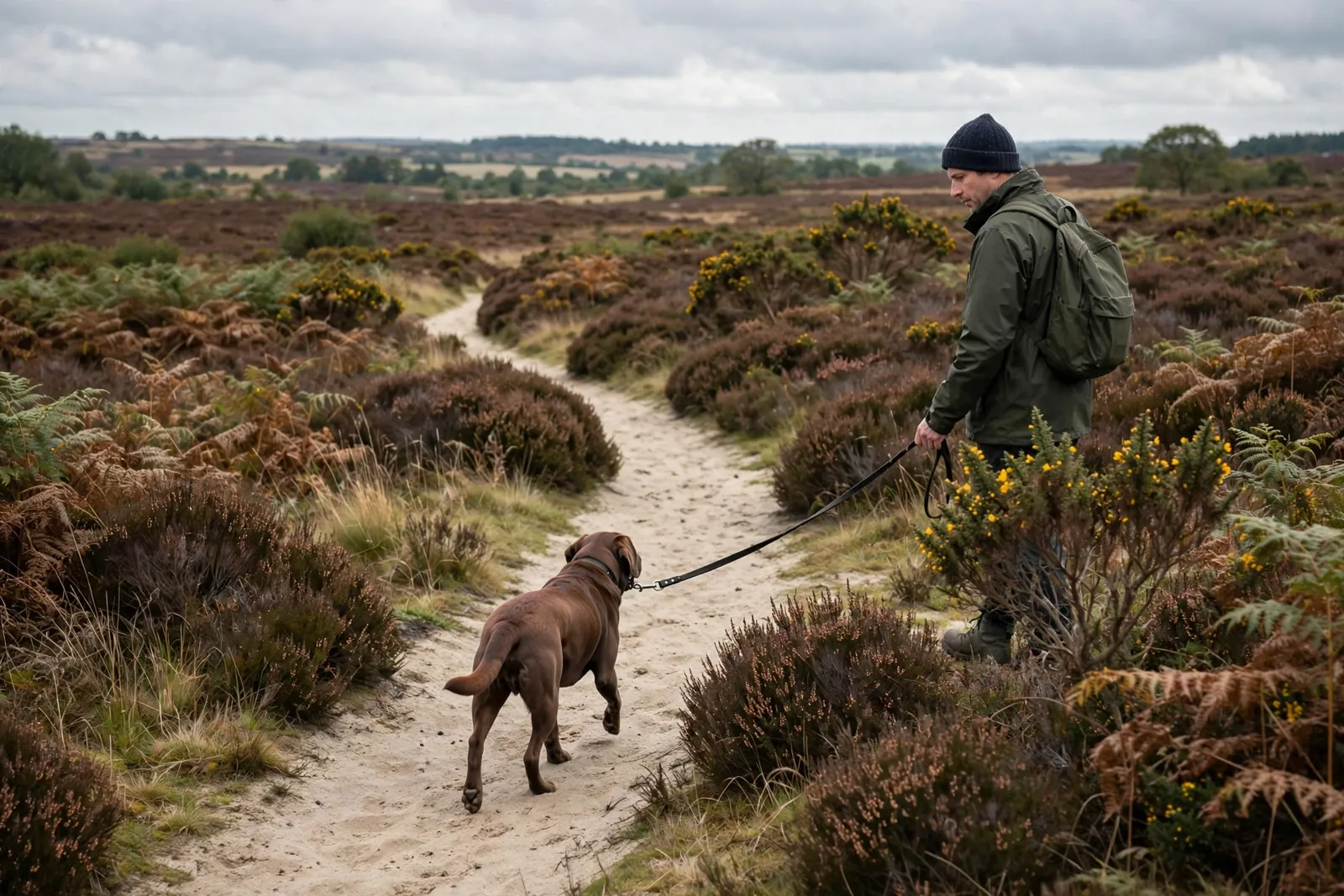
Classic adder habitat is open, sunny and undisturbed: lowland heathland, moorland edges, sand dunes and coastal grassland, woodland clearings and rides, railway embankments, rough common land and the sunny edges of bracken and gorse. Adders favour south-facing banks and patches of bare ground where they can bask, often close to cover they can vanish into. Many popular dog-walking areas — the heaths of Surrey, Dorset and the New Forest, dune systems along the coast, and moorland fringes — are exactly this kind of ground. The same caution applies on the dune-backed stretches covered in our guide to dog-friendly beaches and their rules: the beach itself is low risk, but the dunes and marram grass behind it are prime basking habitat.
Adders emerge from hibernation in early spring, roughly from March, and are active through to the autumn, typically until October, when they return to their hibernation sites. The riskiest encounters tend to happen on warm, sunny days in spring and summer, particularly in the morning when snakes are basking to warm up and are sluggish, and after rain breaks a hot spell. In the height of a very hot afternoon, adders often retreat into shade, but there is no hour of an active-season day when you can assume a heathland path is snake-free. Assume adders may be present in suitable habitat from March to October, and adjust how your dog walks that ground accordingly.
Signs of an adder bite
When owners search for adder bite dog symptoms UK guidance, it is usually because something has already gone wrong — and speed matters more than certainty. You will rarely see the bite happen, and you may never find the snake. Judge by the dog in front of you and the habitat you are in.
The most common picture is sudden and dramatic. The dog yelps, jumps back or snaps at the air, then becomes acutely painful in one area. Swelling usually develops quickly — often within minutes — and can become severe over the following hours. Most bites are on the face, muzzle, head or a front leg, because those are the parts a dog leads with when investigating. You may find two small puncture marks, but under fur and swelling they are frequently impossible to see, so do not waste time hunting for them.
Wider signs can follow as venom takes effect: limping or refusing to bear weight, drooling, panting, restlessness giving way to lethargy or dullness, trembling, vomiting, pale or darkened gums, bruising around the swollen area, and in more serious cases weakness, collapse or difficulty breathing if swelling affects the face and neck. Small dogs, puppies and dogs bitten on the face or neck can deteriorate faster. Signs do not always arrive in a tidy order, and an initially mild-looking swelling can worsen significantly. The working rule is simple: sudden pain plus rapidly developing swelling in adder country is a bite until a vet proves otherwise. Do not wait to see whether it settles.
Immediate first aid, step by step
There is no field treatment that neutralises adder venom, and that is liberating rather than frightening: your job is not to treat the bite, it is to slow the venom down and get your dog to professional help with the least possible delay. Everything below serves one of those two aims.
- Stop and keep your dog still. Movement and excitement pump venom around the body faster. Settle your dog, keep them calm and quiet, and prevent any further walking wherever you possibly can.
- Move away from the snake, not towards it. Give the spot a wide berth. Do not try to find, photograph at close range, catch or move the adder — a second bite, to you or the dog, helps no one.
- Carry your dog to the car. If your dog is small or medium, carry them. If they are too heavy, use a coat or blanket as a stretcher with help, or walk them the shortest distance at the slowest pace — but treat walking as a last resort, not the plan.
- Phone the vet while you travel. Call your usual practice, or the nearest practice or out-of-hours emergency service if you are away from home. Say you suspect an adder bite, give your estimated arrival time, and follow any instructions they give on the phone. Phoning ahead means the team and any treatment can be ready.
- Keep the bitten area still and low-key. Do not apply tight bandages, ice packs or anything else unless your vet advises it during the call. Keep the dog cool, quiet and lying down in the car, and watch their breathing, especially with bites to the face.
- Note the time and the place. When the bite happened, where the swelling started and how it is changing are genuinely useful details for the vet. A quick phone photo of the swelling can help track its progress on the journey.
If you are walking away from home, build the vet’s number into your routine before you ever need it. Our dog travel first-aid guide covers what to carry and how to prepare for emergencies on a trip — including saving the nearest emergency vet at your destination before you set off, which turns a panic into a phone call. An emergency vet bill far from home is exactly the situation pet travel insurance is meant to soften, so it is worth checking the vet-fees section of your policy before you go.
What not to do
Old snakebite folklore is persistent and actively harmful. None of the following helps an adder-bitten dog, and several make things measurably worse or waste the minutes that matter.
- No tourniquet or tight bandage. Constricting a bitten limb concentrates venom in one area, damages tissue and can make the eventual injury far worse.
- Do not suck the wound or cut it. You cannot remove meaningful venom this way. You risk infection, tissue damage and a mouthful of venom yourself.
- Do not give human medicines on guesswork. Some human painkillers are dangerous for dogs, and the wrong drug complicates the vet’s options. If — and only if — a vet advises a specific medicine during your phone call, follow that advice exactly.
- Do not apply ice, heat or herbal remedies. None of them neutralise venom; all of them cost time.
- Do not “wait and see”. Swelling that looks manageable at twenty minutes can be serious at two hours. Early treatment consistently gives the best outcomes.
- Do not go back for the snake. Identification rarely changes treatment — vets know what an adder bite looks like — and adders are legally protected, as explained below.
The pattern is consistent: anything that delays the drive to the vet, tightens around the bite or adds a substance to your dog’s system is the wrong move. Stillness, a carry and a phone call beat every folk remedy ever recorded.
What happens at the vet
Knowing roughly what awaits at the practice helps you stay calm and make decisions quickly. This is a general overview only: the exact treatment depends on your dog, the bite and the practice’s protocols, and your vet’s judgement on the day always takes precedence over anything written here. Check with the practice for the latest official guidance if anything is unclear.
Expect the team to assess your dog promptly, examining the bite site and checking breathing, circulation and pain levels. Blood tests are commonly used to see how the venom is affecting the body and to guide monitoring. Most dogs receive intravenous fluids and appropriate veterinary pain relief, and are kept in for observation because swelling and other effects can evolve over many hours. Where the vet judges it necessary, a specific antivenom treatment exists and may be given; it is a clinical decision based on the severity and progression of the case, not an automatic step for every bite, and earlier presentation gives the vet the widest range of options.
Some dogs are discharged the same day with a monitoring plan; others stay one or more nights, particularly if the bite is to the face or neck, if the dog is small, or if blood results need watching. Ask before you leave what swelling pattern is expected, which changes should trigger an immediate phone call, and when the practice wants to recheck your dog. If cost is a worry, raise it openly at the start — vets would rather discuss options early than have an owner delay bringing a dog in at all. And if you are travelling, remember that unfamiliar countryside carries legal as well as medical tripwires; our guide to the livestock worrying law is worth reading alongside this one before a rural holiday.
Recovery and monitoring at home
Recovery from an adder bite is usually measured in days rather than hours. Swelling often peaks after the bite and then subsides gradually; bruising can look dramatic as it fades, and the bitten area may stay sore and stiff for a while. Tiredness is normal — venom, pain, a stressful journey and a hospital stay are a great deal for a dog to process.
Follow the discharge instructions precisely. Give any prescribed veterinary medicine exactly as directed, keep exercise to short, gentle lead walks for toilet breaks until the vet advises otherwise, and stop the dog licking or scratching the bite site — a protective collar is unglamorous but effective. Rechecks matter even when your dog looks brighter: book them, keep them, and mention anything that seems off, however small.
Phone the practice promptly if swelling spreads or returns after improving, if your dog becomes dull, refuses food, vomits repeatedly, struggles to breathe, or if the bite site becomes hot, weepy or increasingly painful after the first day or two. These changes can indicate complications that are far easier to deal with early. Most dogs that receive prompt treatment recover fully and are back to normal walks within a couple of weeks, but let the vet — not the calendar, and not this guide — decide when yours is ready for full exercise again.
Prevention on every walk
You cannot remove adders from the countryside, and you should not want to: the adder is a protected species in the UK, listed under the Wildlife and Countryside Act 1981, and it is an offence to kill or injure one. Adders are not aggressive; they bite only when cornered, stepped on or investigated at point-blank range by a dog’s nose. Prevention is therefore about managing your dog’s curiosity, not about the snake’s behaviour.
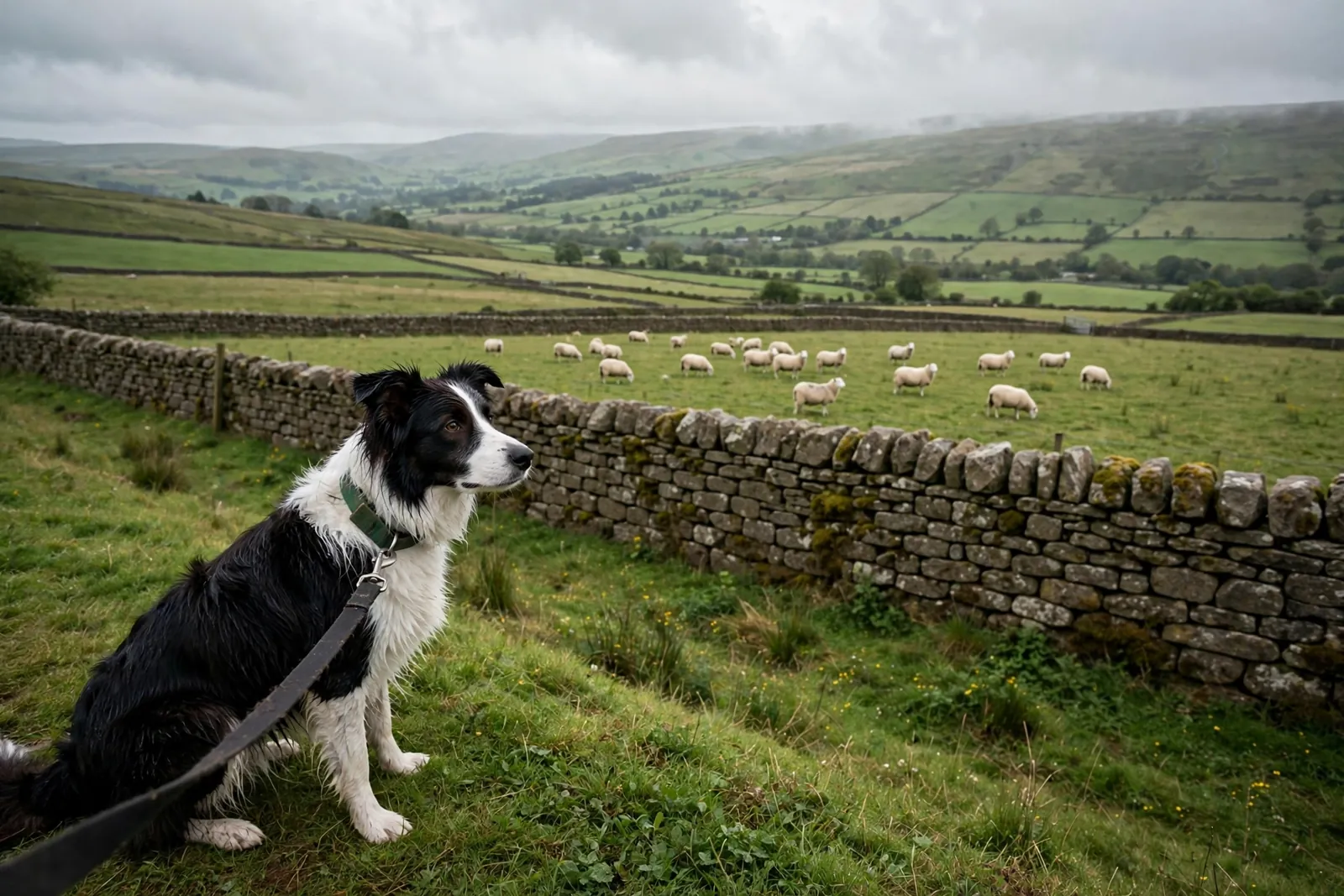
- Keep dogs on a short lead in known adder habitat during the active season — heathland, dunes, moorland edges and sunny woodland rides from March to October. A dog on a lead cannot dive nose-first into bracken after a basking snake.
- Stick to the path. Adders bask at path edges but rarely in the middle of a well-used track, and a dog walking the path is visible and steerable. Cut the corner across rough grass and you enter the snake’s living room.
- Stay extra vigilant on warm mornings and after rain breaks a hot spell, when snakes are out basking and at their most sluggish and hardest to spot.
- Train a reliable recall and a solid “leave it” before you need them. The dog that comes away instantly from interesting smells is the dog that comes away from a snake.
- Watch where your dog puts its nose. Sniffing under gorse, bracken edges, dry-stone walls, log piles and dune grass deserves an immediate, cheerful interruption and a change of direction.
- Note local information. Nature reserves and heathland sites often signpost adder presence and seasonal advice. Read the board at the gate, and check the site’s latest guidance before you visit if you are unsure.
None of this should put you off heathland and dune walks, which are among the best dog walks in Britain. It simply means walking them the way you would walk beside livestock or along a cliff path: lead on in the risky stretches, eyes up, dog close. Do that, and the adder remains what it ought to be — a rare, protected part of the landscape you share the path with, at a respectful distance.
Practical questions
Before you go
What are the first signs of an adder bite on a dog?
The first signs are usually sudden pain, yelping and rapid swelling around the bite, most often on the face, muzzle or a front leg. Puncture marks may be hard to see under fur. Limping, drooling, panting, restlessness, lethargy, vomiting and bruising can follow. Any dog that becomes suddenly painful and swollen in adder habitat should be treated as a bite until a vet says otherwise.
How quickly do I need to see a vet after an adder bite?
Immediately. An adder bite is a veterinary emergency and minutes matter, because venom spreads faster when a dog keeps moving. Keep your dog still, carry them to the car if you can, phone the vet on the way so the practice is ready, and go straight there — or to the nearest out-of-hours emergency service if your usual vet is closed.
Can I give my dog human painkillers or antihistamines after a bite?
Do not give any human medicine unless a vet specifically tells you to during your phone call. Some human painkillers are dangerous for dogs, and guessing can make treatment harder. The safest first aid is stillness, a calm carry back to the car and a fast trip to the vet, who can give appropriate pain relief and monitor for a reaction.
Will my dog recover from an adder bite?
Most dogs that reach a vet promptly recover well, although swelling and soreness can take days to settle and some dogs need hospital monitoring. Outcomes are worse when treatment is delayed, when a small dog is bitten, or when the bite is on the face or neck. This is general information only — your vet, who can examine your dog, is the right guide to their individual outlook.
Should I move, catch or kill an adder that has bitten my dog?
No. Adders are a protected species in the UK and it is an offence to kill or injure one. They bite in self-defence and will move away given space. Keep your dog away, note the location if you can do so safely, and focus entirely on getting to a vet. Never try to catch the snake or take your dog back past the same spot.