This guide is general information, not legal advice. Livestock law is being updated across the UK and rules differ between nations. Before relying on any detail, check the latest official guidance for England, Scotland, Wales or Northern Ireland.
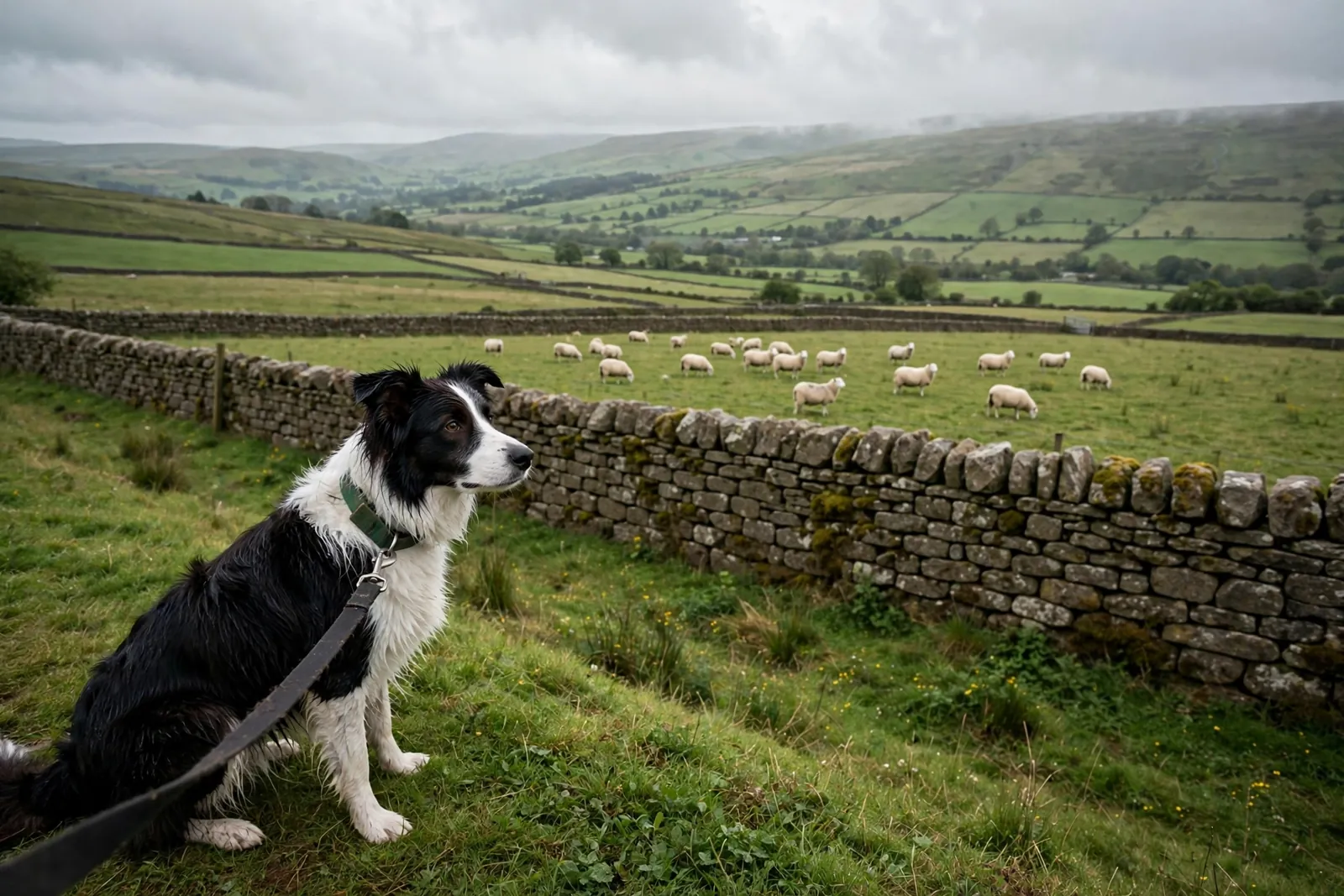
Under the Dogs (Protection of Livestock) Act 1953, “worrying” includes chasing — not just biting. A dog at large among sheep can be an offence even if nothing is injured. Keep your dog on a lead whenever livestock are, or might be, in the next field, give animals a wide berth, and avoid lambing fields altogether.
What worrying means — and why a chase counts
Most owners picture worrying as a dog biting a sheep. The law is wider than that, deliberately. A chase that ends with no physical contact can still cause serious harm: sheep can injure themselves on fences and walls while fleeing, ewes can abort lambs after stress, lambs can be separated from their mothers and fail to feed, and cattle can stampede in ways that endanger people as well as animals. The definition in the 1953 Act therefore covers attacking livestock, chasing livestock in such a way as may reasonably be expected to cause injury or suffering, and — specifically for sheep — being at large in a field or enclosure where sheep are present. Around livestock, the safest legal position is a lead: see UK dog lead law for where leads are required and what counts as proper control.
“At large” is the phrase that catches visitors out. It means not on a lead and not otherwise under close control. A friendly, well-socialised dog trotting loose through a flock is still at large in that field, however good its intentions look to its owner. Recall that works in an empty park may fail completely when a sheep bolts and triggers a chase instinct, and the law does not grade the offence by how confident the owner felt beforehand. That is also why this subject belongs on any countryside trip plan alongside more familiar rules such as those in our guide to dog-friendly beaches in the UK and their rules: in both cases, a local rule that seems fussy from a distance exists because of harm that happens quickly and repeatedly.
Livestock in this legislation means animals kept for agriculture, including cattle, sheep, goats, pigs, horses and poultry, with precise definitions varying by provision and nation. Do not assume that only sheep matter. Cattle — especially cows with calves — can be dangerous to a dog and its owner, horses can bolt or kick, and even free-range poultry count. If animals are farmed on the land you are crossing, treat the whole field as a lead-on area from gate to gate.
The Dogs (Protection of Livestock) Act 1953 in plain English
The 1953 Act makes it an offence for a dog to worry livestock on agricultural land. The person in charge of the dog at the time is generally the person responsible — which can be the person walking the dog that day, not only the registered owner. Police can investigate incidents, and dogs found worrying livestock may be seized in some circumstances while enquiries continue. Courts have powers that can include fines and, in serious or repeat cases, orders affecting how a dog is kept or whether it can be kept at all.
The Act has been amended and supplemented over time, and recent reforms in England and Wales have strengthened police powers, broadened the places and animals covered, and increased the tools available after an attack — including evidence gathering from a dog in some cases. Scotland has its own strengthened regime under the Dogs (Protection of Livestock) (Amendment) (Scotland) Act 2021, with higher maximum penalties that have included substantial fines and the possibility of imprisonment for the worst offences. Northern Ireland has separate legislation. Because the detail is changing, treat any fixed figure quoted on older websites with caution and check the current official position for the nation you are visiting. Where this guide is uncertain, that is stated plainly: please check the latest official guidance before you travel.
Two neighbouring laws matter in practice. The Animals Act 1971 creates civil liability: the keeper of a dog can be liable for damage it causes by killing or injuring livestock, which means paying for veterinary treatment, losses and the value of animals that die — bills that can run far beyond any criminal fine. The same Act also sets the narrow circumstances in which a person protecting livestock may have a defence in civil law if a dog is injured or killed while worrying animals. Separately, if a dog injures a person, or someone fears it will, the Dangerous Dogs Act 1991 offence of a dog being dangerously out of control may also be engaged. One bad ten minutes in a field can therefore have criminal, civil and personal consequences at once.
Penalties and liability: fines are only part of the cost
Owners often ask for a single number — “what is the fine?” — but the honest answer is a range of outcomes rather than a tariff card. Outcomes depend on the nation, the harm caused, whether the offence is a first incident, and whether the owner cooperated afterwards. Possibilities include a criminal conviction and fine, compensation and costs, a civil claim under the Animals Act for the full value of dead or injured animals plus consequential losses, seizure of the dog while an investigation runs, and court orders restricting or ending dog ownership in the most serious cases. Under the strengthened Scottish regime, maximum penalties have included a fine of up to £40,000 or imprisonment, or both, for the gravest offences.
The civil side is routinely underestimated. A single ewe has a market value, but an incident rarely involves one animal tidily. A flock that scatters can produce multiple injuries, aborted lambs across several ewes, veterinary call-outs and hours of farm labour to gather and check every animal. Farmers can also face lost sales and breeding value that do not appear in a simple price-per-sheep calculation. Pet insurance with third-party liability may help with a civil claim, depending on its terms, but it does not prevent prosecution and it does not excuse the incident. Check your policy wording before a countryside holiday, not after one — and note that the same planning habit applies to car travel, where our guide to dog car law in the UK and Rule 57 explains the separate restraint rules that apply before you even reach the walk.
There is also a cost that never reaches a courtroom: a dog that has chased once has rehearsed a rewarding behaviour and is more likely to chase again. Owners who continue walking the same dog loose in livestock country after a warning are judged far more harshly — by farmers, by police and, if it reaches court, by magistrates — than an owner who reports an accident immediately and changes their routine visibly and permanently.
Farmer and landowner rights
Farmers are entitled to protect their animals, and the law recognises that in narrow circumstances a dog worrying livestock may lawfully be stopped by force, including shooting, as a genuine last resort. The conditions are strictly judged — broadly, the dog must be worrying or about to worry livestock, there must be no other reasonable means of stopping it, and the incident must be reported to the police promptly, typically within 48 hours. This is not a general permission and cases are examined carefully, but dog owners should understand the practical point without any sugar-coating: a loose dog among livestock can be lawfully killed, and every year some are. No recall cue is a substitute for a lead in that setting.
Farmers and landowners can also require dogs to be kept off specific fields, close paths temporarily during sensitive operations, and report every incident to the police and their insurer. Many now log incidents with photographs and location data, and rural police teams actively encourage reporting because patterns of repeat incidents at the same beauty spot are how enforcement and signage get prioritised. If a farmer tells you to put a dog on a lead or to leave a field, comply first and discuss later — politely, from a distance, with the dog already under control. Arguing on the footpath helps nobody and is remembered if the incident is reported.
Remember, too, that a public footpath crossing a field does not create a right to roam across the whole field, and it never creates a right for a dog to run loose through stock. Sticking to the path line, lead on, is both the legal and the neighbourly position, and it is the behaviour that keeps access welcome for the next dog walker.
Leads, access land and the differences across Britain
The Countryside Code for England, and its equivalents elsewhere, give the practical rule: keep your dog on a lead or under close control around livestock, always clean up after it, and follow local signs. On land designated as open access land in England and Wales under the Countryside and Rights of Way Act 2000, there is a specific legal requirement to keep dogs on a short, fixed lead — no more than two metres — in the vicinity of livestock, and also generally between 1 March and 31 July to protect ground-nesting birds, even where no livestock are visible. Local restrictions can go further, and some access land excludes dogs entirely for parts of the year.
Scotland works differently. Access rights under the Land Reform (Scotland) Act 2003 are balanced by the Scottish Outdoor Access Code, which advises keeping dogs under close control, avoiding fields with lambs, calves and other young animals, and never letting a dog worry livestock. “Close control” means the dog responds reliably and immediately — if that is not true for your dog around sheep, the honest translation is a lead. Wales largely follows the England pattern for access land but has its own guidance and campaigns, particularly around lambing, and Northern Ireland has separate access and livestock legislation.
Because signs are your fastest source of truth on the day, build a habit of reading every gate notice before entering a field, not after. If a sign says dogs on leads, that instruction applies from the gate, not from the point where you first spot an animal over the brow of the hill. Livestock move, fields link, and a flock can be hidden in a dip twenty metres ahead. Browse route ideas in advance through our dog-friendly destinations across Britain and favour waymarked trails, forestry tracks and enclosed dog fields on days when you want genuine off-lead time — planned freedom in the right place beats improvised freedom in the wrong one.
Lambing season: the highest-risk months
Risk peaks in spring. Lambing runs roughly from late winter into late spring depending on region and altitude — hill flocks lamb later than lowland flocks — and fields may contain heavily pregnant ewes, newborn lambs and protective mothers for weeks. Stress alone, without any contact, can cause a ewe to abort or reject a lamb, and a newborn separated in a chase may not be found in time. During these months, simply choose different walks: avoid fields with sheep entirely where you can, even on a lead, because a barking, lunging dog at close quarters can still cause harm and distress.
The same caution extends to other young farm animals. Cows with calves are among the most common causes of serious injury to walkers in Britain. Official countryside guidance is consistent: keep your dog on a short lead near cattle, give cows with calves a very wide berth, never get between a cow and her calf, move quietly and predictably, and if cattle approach aggressively, let go of the dog’s lead so you can both escape — a dog can outrun cattle, a person holding a lead often cannot. That single exception — releasing the lead when your own safety is at immediate risk from cattle — is about human safety in an emergency, not a general permission to let dogs run among stock.
Ground-nesting birds add a second spring reason for leads away from farmland altogether. Skylarks, curlews and many waders nest on open moorland and coastal grassland, and a ranging dog can flush a sitting bird or crush a nest without the owner ever seeing it. The March-to-July lead rules on access land exist for livestock and birds together, which is why upland walks in the destinations you may be planning need the same discipline as lowland farmland at that time of year.
If an incident happens: what to do in the first hour
If your dog chases livestock, act to regain control as safely as you can — recall, move towards an exit, and use a calm, familiar cue rather than chasing the dog yourself, which often drives it further. Never place yourself between a dog and cattle, and do not grab at animals. Once the dog is back, put the lead on, leave the field by the nearest sensible route, and check your dog for injuries, especially kicks and bites.
Then report it. Find the farmer or landowner, explain honestly what happened, and exchange names, contact details and insurance information. If you cannot find anyone, contact the police non-emergency number for that area and report the time, location and what occurred, and leave your details with a nearby farmhouse or on a note if it is safe to do so. Note everything while it is fresh: which field, how the dog got loose, how long the chase lasted, and whether any animal appeared injured. Owners who self-report and cooperate are treated very differently from owners identified later from photographs — and livestock owners frequently do photograph incidents, as do other walkers.
Follow up in the days after. A vet check for your dog, a written record kept with your insurance documents, and a genuine change of routine — different routes, lead always, perhaps professional training help for recall and impulse control around animals — all matter, both ethically and if the incident is investigated. If you receive a claim or a police visit, respond promptly and take independent legal advice rather than relying on general guides like this one.
A safer walk plan for livestock country
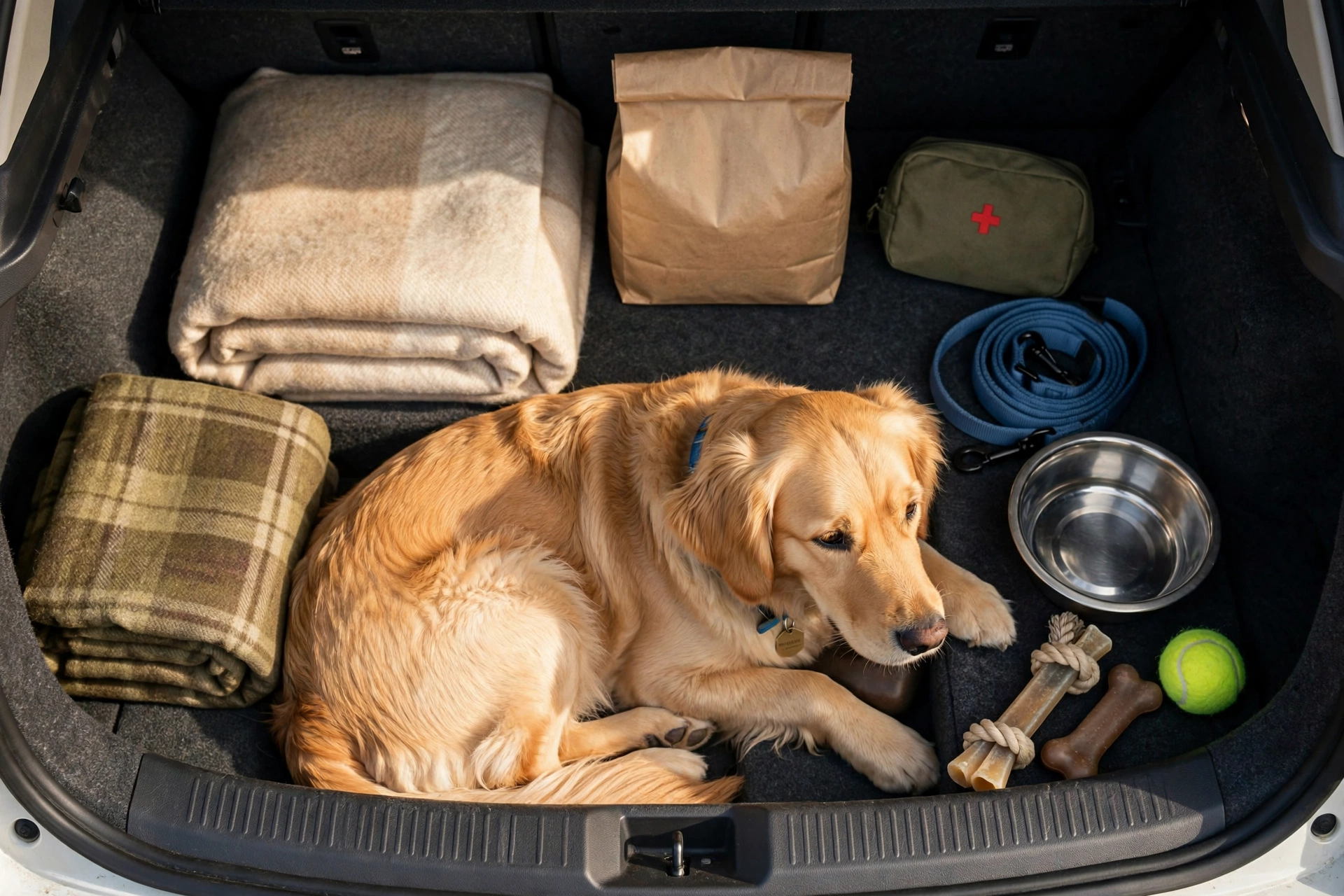
Prevention is unglamorous and almost entirely effective. Before the walk, check the route for farmland, look for lambing and grazing notices, and pack a standard lead plus a spare — extending leads are a poor tool around stock because they tangle, snap and give a dog a long run-up. Our dog road-trip packing checklist is a useful place to add the countryside extras: a spare lead, a whistle your dog actually knows, high-value treats for focus work, and a charged phone for reporting an incident or finding help.
During the walk, work field by field. Stop at every gate, scan the whole field including dips and far corners, clip the lead on before opening the gate if there is any doubt, and cross on the path line at a steady pace without letting the dog weave towards animals. Keep distance as your main tool: a route along the far hedge from a flock is safer and calmer for everyone than the direct line past them. If animals move towards you, turn calmly and increase distance rather than pushing through. Puppies, adolescents and any dog with a known chase history belong on a long line or a lead in this environment for far longer than their owners expect — adolescence in particular can erase a previously solid recall for months.
Finally, plan proper off-lead time into the trip deliberately, in places designed for it: secure dog-walking fields you can hire by the half hour, beaches outside restriction periods and away from grazing marsh, and enclosed park areas. A dog that has had a genuine run and sniff in a safe place earlier in the day is a dog that walks past a sheep field on a lead without frustration. That balance — freedom where it is safe, control where it is not — is the whole skill of countryside dog walking, and the law, read properly, is simply asking for exactly that.
Practical questions
Before you go
What legally counts as worrying livestock in the UK?
Under the Dogs (Protection of Livestock) Act 1953, worrying includes attacking livestock, chasing livestock in a way that could cause injury, suffering, abortion or loss of young, and being at large - off a lead and not under close control - in a field or enclosure where there are sheep. A dog does not need to bite an animal for an offence to occur.
Can a farmer shoot a dog that is worrying livestock?
In limited circumstances, yes. Civil law provides a defence for protecting livestock, and there have been lawful cases where a dog worrying animals was shot as a last resort. The circumstances are narrowly judged, the incident should be reported to the police, and no dog owner should test the point. Keeping a dog on a lead near livestock removes the risk.
What is the penalty for dog worrying livestock in the UK?
Worrying livestock is a criminal offence. Penalties, court powers and enforcement routes have been strengthened in recent years and differ across the UK, and owners can also face civil claims for the value of killed or injured animals. Always check the latest official guidance for the nation you are in, because amounts and powers change.
Does my dog have to be on a lead near livestock?
In practice, yes - use a lead whenever livestock may be present. On open access land in England and Wales dogs must generally be on a short lead near livestock and during the 1 March to 31 July ground-nesting season, and the Countryside Code advises keeping dogs on a lead or under close control around farm animals. In Scotland, keep dogs under close control and avoid lambing fields.
What should I do if my dog chases or injures livestock?
Get the dog back under control and on a lead as safely as you can, move away, and do not put yourself between fighting animals. Tell the farmer or landowner promptly, exchange details, note what happened and contact the police if animals are injured or the farmer cannot be found. Report the incident honestly - leaving the scene makes the legal and financial position worse.