This guide is independent and contains no paid placement. If affiliate links are added later, they will be clearly marked and will not change our editorial checks.
Andover suits a dog day built around water: the River Anton through the town, the River Test a short walk or drive away, and Anton Lakes for an easy lakeside loop. Keep dogs on a lead beside fishing beats, leave the dog out of the Hawk Conservancy Trust, and finish on the High Street, where several pubs welcome dogs.
A chalk-stream town
Andover is a market town in north-west Hampshire, and its whole character comes from water. The River Anton rises on the chalk downs to the north, runs through the town, and joins the River Test at Chilbolton a few miles to the south-east. That puts Andover at the meeting point of two chalk streams, the rare, spring-fed rivers that run clear over gravel even in a dry summer. England holds most of the world's chalk streams, and the Test is the best known of them all, famous for its trout fishing, its water meadows and its improbably transparent water. A dog day in Andover is therefore a water day, and the town rewards anyone who plans around the rivers rather than around the shops.
The town's history is older than its modern ring roads suggest. Andover grew up as a Saxon settlement on the Anton, became a market town, and later thrived on the wool trade and on the great Weyhill Fair, held just west of the town at Weyhill, which was once one of the largest sheep fairs in the country. The Guildhall on the High Street, built in 1825, still anchors the town centre, and St Mary's Church, rebuilt in the 1840s, stands close by with its tall tower visible across the rooftops. The Andover Museum and Museum of the Iron Age, on Church Close, tells the deeper story, including the Iron Age hillfort of Danebury, a few miles to the south-west, one of the most excavated hillforts in Britain. Dogs cannot go into the museum, but the streets around it, the churchyard paths and the river walk that threads behind the town centre make a pleasant short loop for a dog while one person looks around.
What makes Andover work as a dog destination is its scale. The town centre is compact enough to cross on foot in fifteen minutes, yet the countryside starts almost immediately: water meadows to the south, the Anton valley to the north, and the Test Way long-distance path passing nearby. That matters for dogs that dislike long car journeys between walks, because a morning at Anton Lakes, a riverside lunch and an afternoon on the Test can all happen within a few miles of one another. The town is also a useful base for the wider Test Valley, with Stockbridge, Chilbolton and the villages of the Bourne valley all within a short drive, and Winchester about eighteen miles to the south-east. If you are travelling by train, Andover station sits on the line between London Waterloo and Exeter, with services via Basingstoke and Salisbury, and the walk from the station to the High Street takes about ten minutes along Western Avenue and Bridge Street, crossing the Anton on the way.
Timing shapes the trip more here than in most Hampshire towns. Spring brings the chalk streams to their clearest, with water crowfoot flowering white on the Test and the water meadows full of birdsong, while summer can make the shallow Anton warm and slow, and the riverside paths busy with families. Autumn is arguably the best season for a dog visit: the fishing season winds down, the leaves turn along the Anton, and the paths quieten. Winter brings the risk of flooded water meadows after heavy rain, when the Test can spill across low paths near Chilbolton and Stockbridge, so check the official guidance before you travel and be ready to swap a riverside route for the higher, drier paths around Anton Lakes. Whatever the season, the town's chalk geology means the paths beside the Anton drain quickly after rain, which is one reason local dog walkers favour the river walk even in a wet week.
The River Test walk
The River Test is the walk most visitors come for, and it deserves a careful approach, because much of its bank is private fishing water. The Test runs for about forty miles from its source near Ashe, north of Basingstoke, to Southampton Water, and the stretch nearest Andover passes through Upper Clatford, Goodworth Clatford, Wherwell, Chilbolton and Stockbridge. The Test Way, a forty-four-mile waymarked trail from Inkpen Beacon in Berkshire to Eling on Southampton Water, follows the river for much of its length, and the section from Andover southwards is the most practical for a dog day. From Andover, the Test Way heads through the villages of the Clatfords and on towards Wherwell, on paths that mix riverside meadow, woodland edge and quiet lanes, with the river rarely far from view.
Start at Upper Clatford, a mile and a half south-east of Andover, where the Test Way crosses the river and the village green gives a good place to settle the dog before setting off. The walk south towards Goodworth Clatford follows the river through water meadows grazed by cattle, so keep the dog on a lead through the grazing stretches and watch for the electric fencing that sometimes edges the meadows. The path is mostly flat and easy underfoot, with kissing gates rather than stiles on the waymarked route, which suits older dogs and anyone pushing a buggy alongside a dog. In spring, look for kingfishers flashing blue along the banks, grey wagtails on the gravel shallows, and the white flowers of water crowfoot trailing in the current; in summer, dragonflies hunt over the slower stretches, and brown trout hold in the deeper pools, visible as dark shapes in the clear water.
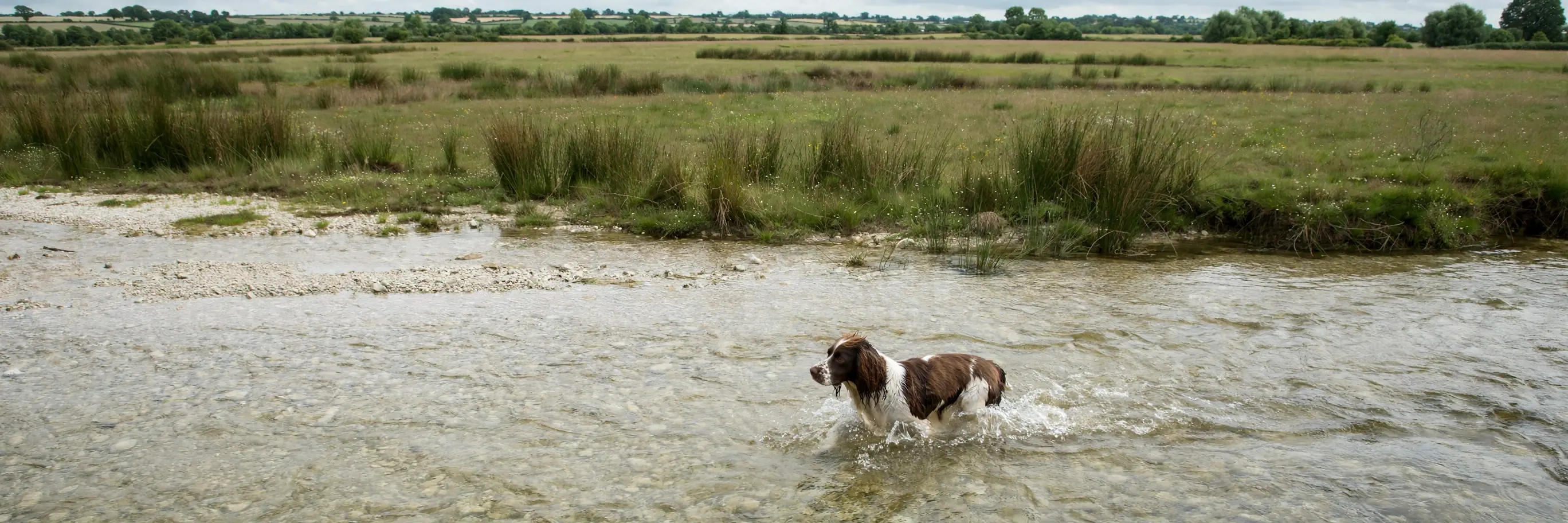
The fishing matters, and it is where dog owners most often get things wrong. The Test is divided into beats leased by fishing clubs and syndicates, and anglers pay substantial sums for quiet water. A dog splashing through a beat ruins a morning's fishing and can create real ill feeling, so the rule is simple: keep the dog on a lead along the river, and only let it paddle where the bank is clearly public, the water is shallow and gravelly, and no one is fishing. The stretch at Chilbolton, where the Anton joins the Test, has accessible riverside ground, and the meadows around Stockbridge offer wider space, but always read the signs at the access point, because beats change hands and local rules vary by stretch; check the official guidance before you travel if you are unsure whether a particular bank is public. After rain, the Test can rise quickly and run fast over the gravel, so a dog that normally paddles happily should stay on the bank when the water is up and coloured.
For a longer day, continue from Goodworth Clatford to Wherwell, a village of thatched cottages and a restored mill, then on to Chilbolton, where the combined river flows broad and slow past the village. The full walk from Andover to Stockbridge is around seven or eight miles one way, which is a serious day for most dogs, so many walkers drive to one village, walk a two- or three-mile out-and-back section, and finish at a village pub. The White Hart at Stockbridge and the Mayfly at Fullerton, both on the Test, are well-known stopping points, though their dog policies and opening hours change with the season, so confirm before you rely on them. If you want a shorter riverside taste without the Test Way, the Anton itself offers one: the path beside the River Anton from the town centre follows the smaller river through Rooksbury Mill Local Nature Reserve and out towards the water meadows, a flat, shady walk of about a mile each way that suits a first walk of the day or a last stretch before the drive home. Our guide to the South Downs Way with a dog covers the longer chalk-downland walking to the south-east, if a Test Valley day leaves you wanting a bigger ridge walk.
Anton Lakes and the nature reserve
Anton Lakes, on the north-western edge of Andover, is the town's easiest dog walk and the one local owners use most. The reserve is a Local Nature Reserve centred on two lakes formed from flooded gravel pits, ringed by reedbeds, wet woodland and grassland, and managed as a wildlife site where the birds come first. The main lake is open water fringed with reeds; the smaller lake is quieter, with wooded banks that suit warblers and woodpeckers. A surfaced, mostly flat path loops around the lakes, with benches at intervals and views across the water that change with the light. The full circuit is roughly a mile and a half, which makes it a forty-minute stroll for most dogs, or a longer morning if you stop to watch the birds.
The birdlife is the reason to bring binoculars. Great crested grebes display on the open water in spring, tufted ducks and pochard gather in winter, and kingfishers work the quieter corners of the smaller lake. Herons stand motionless in the shallows, reed warblers sing from the reedbeds in summer, and in autumn the surrounding trees fill with redwings and fieldfares. Because the lakes are a wildlife habitat, dogs should stay on a lead and out of the water, and the shoreline reedbeds are out of bounds. That rule is easy to keep on the surfaced loop, where the path stays well back from the water for most of its length, and it is worth explaining to children before you set off, because the temptation to throw a stick into the lake is exactly what the reserve asks visitors not to do. Clear up after your dog, use the bins provided at the entrances, and keep to the marked paths through the wet woodland, where the ground can be soft after rain.
Getting there is straightforward. The reserve sits off Anton Road on the north-west side of town, with a car park at the main entrance and pedestrian access from the housing estates to the south and east, which means many visitors walk in from home rather than driving. From the High Street, the walk to Anton Lakes takes about twenty-five minutes, following the River Anton north-west out of the town centre and then picking up the paths towards the lakes. Cyclists share some of the approach paths, so keep the dog close on the narrower stretches. The reserve links naturally to the wider Anton valley: from the lakes you can continue north along the river towards the open downs, or loop back into town along the Anton for a longer, roughly three-mile figure-of-eight that mixes lakeside, riverside and town-centre ground in a single walk.
Anton Lakes also works as the wet-weather fallback for an Andover day. The surfaced loop drains well, the tree cover around the smaller lake gives shelter in a shower, and the paths stay usable when the Test valley meadows flood. In high summer, the lakeside trees offer shade that the open water meadows lack, so an early-morning or late-afternoon circuit suits dogs that struggle in the heat, with the cooler riverside stretch back into town to finish. If you are staying in Andover for a few days, the reserve repays repeat visits: the birdlife changes week by week, the light on the main lake is different every morning, and the short loop is an ideal first walk for a dog settling into a new place. Pair it with the Rooksbury Mill Local Nature Reserve, a smaller riverside site south of the town centre on the Anton, for a second short walk that shows the river's wilder, more wooded side, with old mill structures, alder carr and the sound of running water under the trees.
Hawk Conservancy: can dogs go?
The Hawk Conservancy Trust, at Weyhill just west of Andover, is one of the town's best-known attractions, and it needs a clear answer: pet dogs cannot go in. The Trust is a conservation charity and bird-of-prey centre set in woodland and meadow, with flying displays in which eagles, vultures, owls and falcons fly free over the arena. Dogs and free-flying raptors are an unsafe combination in both directions, so the Trust does not admit pet dogs, with assistance dogs as the usual exception. That is a firm rule rather than a seasonal one, so do not plan to bring the dog to the gate and ask; plan the visit around the dog instead, and check the official guidance before you travel for the latest admissions detail.
What you would be missing is worth knowing, because it shapes how to split the day. The Trust's flying displays run through the day in season, with the vultures, eagles and owls each flying in turn, and the centre also keeps a hospital for injured wild birds of prey, a breeding programme for endangered species, and woodland trails through its grounds. A visit takes a good half day, and the displays are outdoors, so the centre suits a dry day with time to sit in the arena. Weyhill itself is a small village with a long fairground history: the Weyhill Fair was once one of the great sheep fairs of southern England, and the village still carries that open, downland character, with the fairground site and the church of St Michael standing on the edge of the downs.
The practical answer is a split visit. If two people are travelling, one visits the Trust while the other walks the dog on the downland paths around Weyhill, where the open chalk grassland and field edges give a very different walk from the river valley. The lanes around Weyhill and the paths towards Clanville and the Bourne valley are quiet, with wide views across the downs, but they are also exposed, with little shade and working farmland, so keep the dog on a lead near livestock and stick to the rights of way. If you are travelling alone, leave the Trust for a day when the dog can stay comfortably at your accommodation, or visit the centre first and collect the dog afterwards for an afternoon at Anton Lakes. Either way, book tickets ahead in busy periods, because the Trust can sell out on school holidays and summer weekends, and check the display times before you travel so the split visit lines up with the flying programme rather than the gaps between displays.
While you are at Weyhill, the village is also the gateway to Harewood Forest, a large ancient woodland south of the village, where the paths run through beech and oak and the ground rises onto the downs. Harewood Forest suits a cooler, shadier walk than the open river meadows, and its tracks are popular with local dog walkers, though the forest is a working woodland, so keep the dog close around forestry vehicles and follow any temporary closures. The contrast is the point of an Andover trip: within ten minutes of the town centre you can move from chalk-stream meadow to lakeside reedbed to ancient woodland, and each of those landscapes asks something slightly different of the dog.
The High Street and the Guildhall
Andover's High Street is a working town centre rather than a polished visitor attraction, and that is part of its charm for dog owners: it is a place where dogs are an ordinary sight, not an exception. The street runs from the Guildhall at its heart down towards the Anton, lined with a mix of national chains, independent shops, cafes and the Chantry Centre, the town's covered shopping centre. The Guildhall, built in 1825 with its classical portico and clock, still hosts the town council and community events, and the space in front of it is the town's natural meeting point, with the market stalls setting up nearby on market days. Dogs on a lead are welcome on the street itself, and the pavements are broad enough for a dog to walk comfortably beside you, though the street can be busy on Saturdays, when the market and the shops draw crowds from across the Test Valley.
Start a town-centre stroll at the Guildhall and work down the High Street towards St Mary's Church, whose tower and churchyard offer a quieter pause after the shops. The churchyard paths are a good place to let a dog sniff and settle, though dogs should stay on a lead and off the planted areas. From the church, Church Close leads to the Andover Museum and Museum of the Iron Age, where the displays cover Danebury hillfort and the archaeology of the surrounding downs. The museum is a short visit, and while dogs cannot go inside, the streets and riverside paths around it make a pleasant loop for the person staying outside with the dog. The museum's Iron Age focus is worth a mention to anyone planning a longer Test Valley trip, because Danebury itself, a few miles south-west of Andover, is an open hillfort you can walk around freely, with ramparts, wide views and a sense of the downland landscape that has shaped this part of Hampshire for three thousand years.
Market days repay a visit. Andover's market, held in the High Street area, brings stalls selling local produce, plants, bread and crafts, and the atmosphere is far more relaxed than a supermarket shop, with stallholders who are generally happy to see a well-behaved dog. Keep the dog close through the stalls, because the gaps between them are narrow and the smells are distracting, and carry water for the dog in summer, when the paved High Street holds the heat. The Chantry Centre offers shade and shelter on a wet day, though its indoor dog policy is set by the centre and individual shops, so check the official guidance before you travel if you plan to take the dog inside rather than sticking to the street.
From the High Street, the river is never far. Bridge Street crosses the Anton at the lower end of the town centre, and the riverside path from there leads south through Rooksbury Mill and out towards the water meadows, while the path north follows the Anton towards Anton Lakes. That is the shape of an ideal Andover day: a morning walk at the lakes or on the Test, lunch on the High Street, an afternoon pottering between the Guildhall, the church and the market, and a final riverside stretch before the drive home. The town centre also has the practical things a dog trip needs: a couple of pet shops, vets on the edge of town, and supermarkets with car parks where a dog can be settled in the car for a short shop in cool weather, though never in a warm car. Parking in the town centre is in the Chantry Centre and other town car parks, with the riverside and lakeside walks a short stroll from the High Street.
Pubs and stays
Andover's pubs reflect the town's market-town character: solid, unpretentious and generally welcoming to dogs in the bar or garden. On the High Street itself, the Angel Inn is a long-standing town-centre pub with a bar area where dogs are commonly welcomed, and the streets around the centre hold several other traditional pubs where a dog by the fire is an ordinary sight. Policies vary from pub to pub and from season to season, and some pubs welcome dogs only in the bar or only in the garden, so ask at the door rather than assuming, and keep the dog settled under the table once you are in. The John Russell Fox, on Weyhill Road towards the Hawk Conservancy, is another local favourite for walkers, with a garden that suits a post-walk drink in summer, while the Cricketers Inn and the Lamb Inn, both close to the town centre, offer the same straightforward welcome. If you are walking the Test Way, the village pubs south of Andover are the real prize: the Mayfly at Fullerton sits beside the Test with a riverside garden, and the Peat Spade Inn at Longstock, a thatched Test Valley pub, welcomes walkers and their dogs in its bar and garden, though both are popular and worth ringing ahead on a summer weekend.
For an overnight stay, Andover has the chain hotels that many dog owners rely on: a Premier Inn and a Travelodge on the edge of town, both of which accept dogs in selected rooms for a small nightly charge, with ground-floor rooms worth requesting if your dog dislikes lifts or long corridors. Book the dog in at the same time as the room, because the number of dog-friendly rooms is limited and they sell out first on weekends, and confirm the charge in writing, because it is usually added per stay rather than per night and varies by hotel. Beyond the chains, the Test Valley has a scattering of countryside inns and bed-and-breakfasts that welcome dogs, particularly around Stockbridge and Chilbolton, where several pubs with rooms sit within a few minutes' walk of the river. Those are worth considering if you want to wake up on the Test rather than in the town, though they book up early in the fishing season and on summer weekends, so check the official guidance before you travel and book well ahead.
Self-catering is the other strong option, and it suits Andover well because the town is a good base for a week. Cottages and lodges in the villages around Andover, from Upper Clatford to Longstock and Wherwell, often come with enclosed gardens, which matter more than any other single feature for a dog stay, and many sit directly on the Test Way or a short walk from the river. When you compare listings, ask the same questions you would ask of a holiday park: how high and how secure is the garden fence, is there a dog-wash tap or an outdoor tap, where is the nearest vet, and is there a surfaced path from the door for a rainy-night toilet trip. Our guide to dog-friendly holiday parks in the UK sets out those questions in full, and they apply just as well to a Test Valley cottage as to a lodge in a park. If you are travelling with more than one dog, declare the number at booking, because many cottages cap the count at two and charge per dog.
Eating out with a dog in Andover is easiest at lunchtime, when the pubs and cafes are quieter and a table in the bar or garden is simpler to arrange. The High Street cafes vary in their dog policies, with some welcoming dogs inside and others offering outside tables only, so a short walk along the street will usually find a table that works, and the riverside benches near Rooksbury Mill make a good fallback for a takeaway lunch eaten with the dog beside you. For an evening meal, book a table and mention the dog when you book, because a pub that welcomes dogs at lunch may still want to place you at a particular table in the evening. And if the day has gone well, the best end to it is simple: a last short walk along the Anton as the light fades, the chalk stream running clear under the bridge, and a dog that has walked, paddled, sniffed and settled, ready for the drive home.
Practical questions
Before you go
Can dogs swim in the River Test near Andover?
Paddling is possible at a few shallow, publicly accessible spots, but much of the Test is private fishing water where dogs should stay on the bank and on a lead. Never let a dog swim across a fishing beat, and check the official guidance before you travel, because access and local rules vary by stretch.
Are dogs allowed at Anton Lakes Nature Reserve?
Yes, dogs are welcome at Anton Lakes, but they should be kept on a lead and out of the water, because the lakes are a wildlife habitat and a Site of Importance for Nature Conservation. Stick to the surfaced paths, clear up after your dog, and check the official guidance before you travel for the latest access notes.
Can I take my dog to the Hawk Conservancy Trust?
No. The Hawk Conservancy Trust at Weyhill does not admit pet dogs, because free-flying birds of prey and dogs do not mix safely. Assistance dogs are the usual exception. Plan a split visit, with one person staying with the dog on a nearby walk, and check the official guidance before you travel.
Where can I walk my dog from Andover town centre without a car?
The River Anton path from the town centre, the Rooksbury Mill Local Nature Reserve and the walk out to Anton Lakes all start within walking distance of the High Street. The Test Way also passes close to Andover, giving a longer waymarked route south towards Stockbridge.
Are there dog-friendly pubs and places to stay in Andover?
Yes. Several pubs on and around the High Street welcome dogs in the bar or garden, and the town has chain hotels and nearby countryside inns that accept dogs, usually for a small charge. Dog policies change, so confirm directly with the pub or hotel and check the official guidance before you travel.