This guide is independent and contains no paid placement. If affiliate links are added later, they will be clearly marked and will not change our editorial checks.
Walk the Bath Skyline or the Kennet and Avon Canal for proper exercise, treat the Roman Baths as a split visit because only assistance dogs go inside, use Sydney Gardens and Royal Victoria Park for daily green space, and base yourself within an easy morning walk of one of them.
Start with the skyline, not the spa queue
Bath rewards owners who reverse the usual order of a city break. The famous interiors — the Roman Baths, the Abbey, the museums — are mostly closed to pet dogs, while the city's best asset for a dog needs no ticket at all: the ring of hills and meadows that wraps around the centre. If you spend the first, freshest part of the day up on that green rim, your dog arrives at the sightseeing hours exercised, settled and far more able to cope with pavements, queues and cafe floors. Leave the hill until last and you will spend the whole day managing a dog who has only had snatched toilet walks between attractions.
The geography helps you. Bath sits in a bowl in the valley of the River Avon, so almost every neighbourhood is a short climb from open country and a short descent back to coffee. A stay in Widcombe puts the Skyline path minutes from your door; a stay near the canal gives you flat towpath miles before breakfast; even a central hotel is rarely more than fifteen minutes from Sydney Gardens or the river path. Plan each day as one hill or towpath walk, one neighbourhood explored slowly, and one sit-down meal where the dog is genuinely welcome — and confirm that welcome in advance, because policies do change.
Set a realistic pace for the stone city itself. Bath's pavements are beautiful and, in the centre, busy; the Abbey churchyard, Stall Street and the streets around the Roman Baths carry a steady flow of tour groups for much of the year. Dogs who struggle with crowds will do better on the wider crescents, the gravel paths of the parks and the residential streets of Bathwick and Widcombe, dipping into the very centre early in the morning or later in the afternoon. That is not a lesser version of Bath. For most dogs, it is the version they will actually enjoy.
The Roman Baths and the Abbey: the split visit
The honest starting point is the rule that shapes the whole trip: pet dogs cannot enter the Roman Baths museum. Only assistance dogs are admitted, a policy shared by many major heritage interiors, and it is applied at the door rather than negotiated there. The Abbey alongside it operates as a working church with its own visitor arrangements, and dogs should never be assumed welcome inside; check the official site before you go for both venues, because event days, services and conservation work can change access at short notice. Knowing this in advance turns a potential disappointment into a simple piece of planning.
For two adults, the split visit works well here because the dog's half of the bargain is genuinely good. While one person tours the Roman Baths — allow a good ninety minutes, and book ahead on busy dates — the other can walk through Sydney Gardens behind the Holburne Museum, follow the canal towpath from Bathwick, or take a slow circuit of the nearby streets and the river path. Then swap, or reunite for lunch and give the second person their turn later in the trip. Solo travellers face a straight choice: enjoy Bath from its streets, parks and viewpoints, which is a rich trip in itself, or arrange trusted local dog care for the hours of an interior visit.
Our wider guide to dogs at English Heritage sites explains how assistance-only rules work across historic properties, and the same expectation is a sensible default for Bath's smaller museums and galleries: check each venue individually, expect interiors to be assistance-only until you have confirmed otherwise, and build the day so the dog's walk never depends on a last-minute exception. The Pump Room and the commercial spa experiences follow their own house rules too, so verify before you build a plan around them. Bath, fortunately, is a city where the outdoors is the headline act, which softens every one of these restrictions.
The Bath Skyline walk: the city's great dog walk
The Bath Skyline is the walk to build the trip around: a waymarked circuit of about six miles through the meadows, woodland and viewpoints on the hills south and east of the centre, managed in large part by the National Trust. It links Prior Park's valley, the meadows around Bathwick, woodland at Smallcombe and the open ground above Widcombe into a route that feels properly rural while the city stays in view below. Strong walkers with fit dogs can complete the full circuit in three to four hours with stops; most visitors will enjoy it more as two half-days, taking one side of the valley at a time and dropping back into the city between.
Underfoot conditions vary more than the distance suggests. Meadow grass, woodland tracks and some steep, stony climbs all feature, and after rain the valley paths and Prior Park side can be muddy enough to need boots and a dog towel at the end. Livestock graze parts of the meadows in season, so leads are essential wherever cattle or sheep are present, and signs at field entrances give the current position — follow them rather than assuming yesterday's arrangement holds. Carry water for the dog as well as yourself; there are long stretches without a supply, and the climbs are honest ones even on a cool day.
The viewpoints repay the effort. From the open ground above the city, the crescents and the Abbey tower sit in their bowl of hills in a way no street-level wander can show you, and early morning, when mist can sit in the valley, is the finest time to be up there. Dogs who find the full circuit too much still have excellent shorter options: the climb from Widcombe to the meadow edge and back, or a woodland loop at Smallcombe, each gives the Skyline flavour in an hour. For more on how National Trust places handle dogs, including graded pawprint ratings at many properties, see our guide to dog-friendly National Trust visits, and always check the official site before you go for path closures or grazing changes.
Canal and river: flat miles for easy days
Not every Bath day needs a climb. The Kennet and Avon Canal leaves the city from Bathwick and Sydney Gardens and runs east toward Bradford-on-Avon through some of the most peaceful towpath walking in the south west, passing locks, stone bridges and the Dundas Aqueduct further out. The towpath is flat, well surfaced in its city stretches and rich in interest for a dog, and you can shape the outing to any energy level: thirty minutes to the first locks and back, or a half day out toward Bathampton and beyond, returning by train or bus where services allow — check the official site before you go for current timetables if you plan a one-way walk.
Share the towpath considerately. Cyclists use it heavily at commuting hours and weekends, anglers line the banks, and moored boats often come with resident boat dogs, so a short lead or close control near boats, locks and bridges keeps everyone comfortable. Keep dogs out of the canal itself: the water is slow but the banks are steep in places, algae can occur in warm weather, and jumping in among moored boats and fishing lines helps nobody. Sydney Gardens, where the canal and the railway both pass through the park, is the natural starting point — one of Bath's oldest pleasure gardens, with lawns and paths that suit a lead walk and a coffee pause.
The River Avon path gives a second flat option on the city's other flank, following the river west from the centre through Newbridge and toward Saltford and Keynsham, and east in shorter stretches. Riverside sections can flood after heavy rain and may close at short notice in winter, so treat any barrier or diversion sign as final. Between the canal east, the river west and the Skyline above, Bath offers something many prettier-on-paper cities do not: a genuine choice of long, interesting, dog-first walks in three directions, none of which requires a car once you have arrived.
Crescents, the Circus and Royal Victoria Park
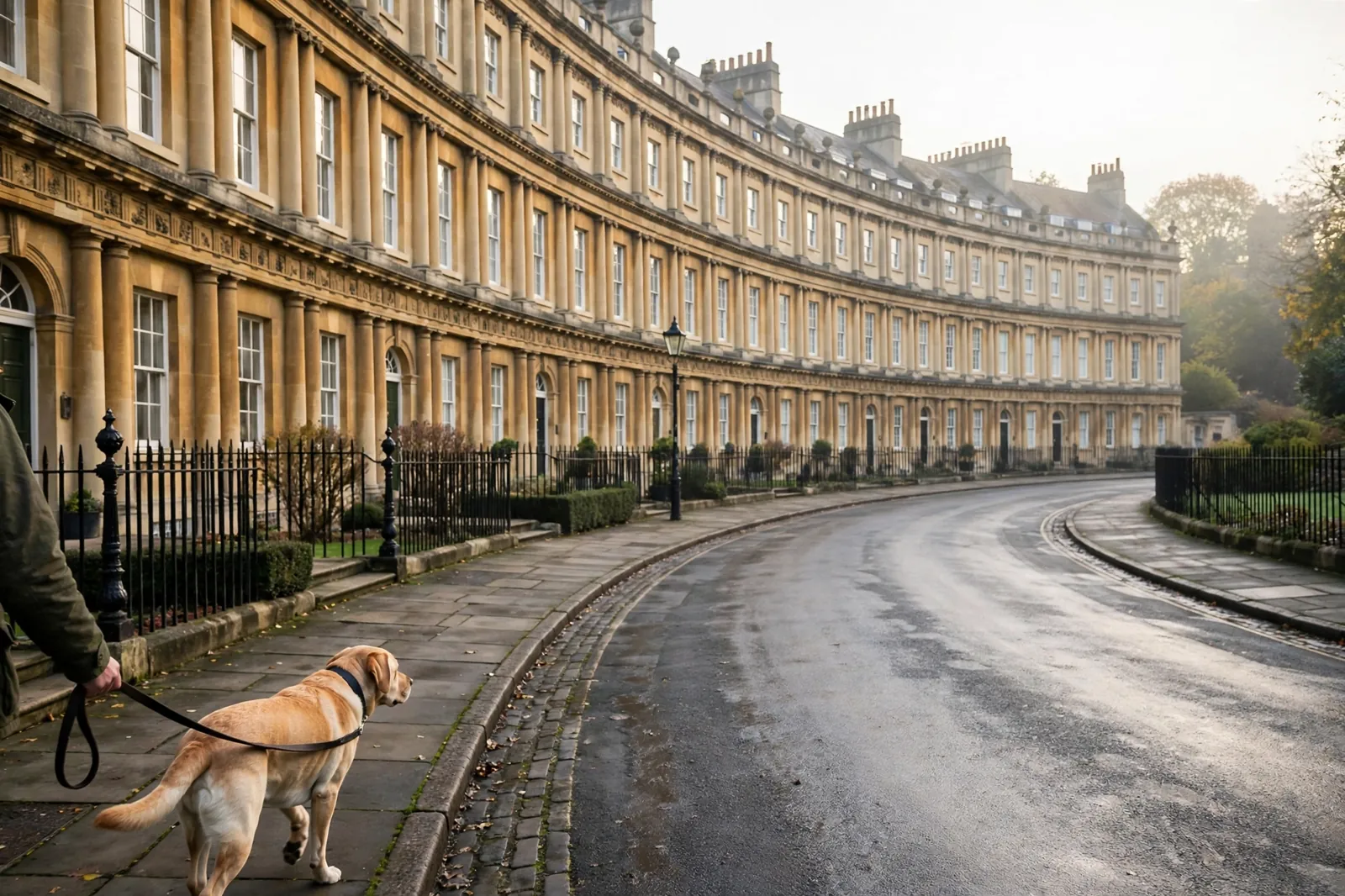
The Georgian set pieces are outdoor sights, which makes them naturally dog-friendly territory. The Royal Crescent, the Circus and the long curve of Camden Crescent are streets and lawns rather than interiors: walk them on a lead, keep dogs off the private garden enclosures and the Crescent's residents' lawn where signs require it, and enjoy architecture that needs no ticket. Early morning is the connoisseur's slot, when the stone is warm in low light, the tour groups have not arrived and your dog can amble rather than weave. The gravel sweep in front of the Crescent and the tree-shaded Circus make a fine unhurried hour combined with the park below.
Royal Victoria Park, stretching west from the Crescent, is the city's everyday dog ground: a large Victorian park with open lawns, avenues, a duck pond area and botanical planting. Dogs are welcome across most of it on leads or under close control, with the fenced Botanical Gardens section and the children's play areas among the places to give a wide, leaded berth — follow the signage on the day. The park suits the morning and evening toilet-and-exercise walks that keep a city stay civilised, and its size means reactive dogs can usually find space by heading for the quieter western end.
Treat the interiors tucked among the terraces — the museum at No. 1 Royal Crescent, the Herschel Museum and the city's art galleries — as split visits on the Roman Baths pattern unless you have confirmed otherwise with the venue. Bath's shopping streets, from Milsom Street to the artisan lanes around Walcot, are browsable with a dog at pavement level, and many independent shops welcome a well-behaved dog inside, but asking at the door takes seconds and prevents awkwardness. The pattern of the whole city is consistent: outside, generous; inside, check first.
Where to stay with a dog in Bath
Choose the neighbourhood by its morning walk, and Bath accommodation largely chooses itself. Widcombe and Bathwick, just across the river from the centre, put the Skyline and the canal on your doorstep and tend to offer quieter streets at night. The streets around Royal Victoria Park suit owners who want the park as a daily base. Larkhall and Walcot, to the north east, have a village feel, independent shops and good access to meadows along the Lam Brook valley. A central address maximises sightseeing convenience but can mean a longer walk to real grass at 7am, which is the walk that decides whether a city stay feels easy or effortful.
Interrogate the dog policy precisely before booking, wherever you stay. Ask which rooms accept dogs and whether they involve stairs — Bath's converted Georgian townhouses are famous for them, and several flights of stone steps are a real consideration for older dogs, very large dogs and anyone arriving with luggage. Ask the fee, whether it is per night or per stay, any size or number limit, whether dogs may join you in the dining room or bar, and whether a dog may be left alone in the room, since that answer shapes your Roman Baths plan. Our national guide to dog-friendly hotels in the UK lists the full set of booking questions worth asking anywhere.
Self-catering often gives a dog the easiest Bath stay: hard floors, a routine you control and space for a familiar bed away from hotel corridors. Cottages and flats in the residential terraces can also solve the garden question, but verify that any courtyard or garden is genuinely enclosed, because Georgian railings and shared access passages surprise many owners. Book ahead for the busiest periods — the Christmas market weeks, festival dates and summer weekends fill the best-located dog-welcoming rooms first — and bring the settling kit that makes any room familiar quickly: the dog's own bedding, a chew for the first evening and a towel stationed by the door for Skyline mud.
Eating and drinking with a dog
Bath eats well with a dog if you verify each venue rather than assuming. Independent cafes in Widcombe, Walcot and Larkhall, and pubs with a traditional bar area across the city, are the most reliably welcoming, often with water bowls and a corner where a dog can settle out of the walkway. Formal dining rooms and hotel restaurants vary the most. The etiquette that keeps welcomes warm is the same here as everywhere in Britain, and our UK dog-friendly cafes guide covers it in full: a walked, toileted dog settled under the table, no dogs on seats, leads short and out of the way, and a mat to mark the dog's place if floors are polished stone.
Timing matters in a city this popular. At weekend lunchtimes the best-known dog-welcoming places fill, and a dog who copes at 11am may not cope at 1pm in a packed room with a queue at the door. Eat early or late, favour the larger venues and pub gardens in good weather, and use Bath's delis, bakeries and market stalls to build picnics for the Skyline meadows, Sydney Gardens or Royal Victoria Park when the sun is out. The Saturday farmers' market scene and the independent food shops around Walcot make picnic-building a pleasure rather than a fallback.
In winter the calculation flips in your favour: a fireside pub lunch after a muddy Skyline circuit is one of the great pleasures of a Bath dog trip, and arriving before the rush secures the corner table that suits a tired dog. Carry the small kit that smooths every outing — portable bowl, water, a long-lasting chew for waits, bags in every coat — and re-check a venue's current policy on its own website or by phone the day before, because dog policies change with refurbishments and new management more often than guidebooks admit.
Getting there, parking and the seasons
Bath Spa station sits at the southern edge of the centre, a short walk from the Abbey and the river, and arriving by train is often the calmest option with a dog: no parking hunt, and the canal and Widcombe walks begin almost at the station door. Dogs travel on trains under the usual national conditions; our guide to taking a dog on UK trains covers leads, busy services and the etiquette that keeps journeys smooth. If you drive, Bath's central streets are constrained and its hills unforgiving of circling; the park-and-ride sites on the city's edges are usually the sanest base for a car, with bus connections into the centre — check the official site before you go for current park-and-ride arrangements, charges and bus dog policies.
On foot, remember that Bath's beauty is built on gradients. The climb from the centre to the Crescent, Camden Crescent or the Skyline is short but real, and the stone pavements and setts are slippery when wet for paws and shoes alike. Plan routes that climb once and traverse, rather than repeatedly dropping into and out of the valley, and keep a short lead on the steep lanes. Local buses crisscross the city and dogs are generally carried at the driver's discretion, on a lead and off the seats; travel off-peak where you can and verify the operator's current conditions before you rely on a bus for a tired dog at the end of a long walk.
Seasonally, Bath is a genuine year-round city with distinct moods. Spring brings the meadows and gardens into flower and the Skyline into its freshest green. Summer adds crowds, festival dates and warm stone — walk the hills early, rest at midday and carry more water than the distances suggest. Autumn light on Bath stone is arguably the finest of the year, with quieter streets after the summer peak. Winter is atmospheric and busy again around the Christmas market, when the centre is at its most crowded and dogs are better exercised in the parks and on the canal before any market browsing, on a short lead, in short bursts. Whenever you come, save a local veterinary practice's details near your stay before you need them, and leave one unplanned half day in the itinerary: Bath's lanes and viewpoints reward wandering.
Practical questions
Before you go
Can dogs go into the Roman Baths?
Pet dogs cannot enter the Roman Baths museum; only assistance dogs are admitted. Travelling pairs usually split the visit, with one person touring while the other walks the dog in Sydney Gardens or along the canal, then swapping. Book ahead on busy dates and check the official site before you go, as event arrangements can change.
Are dogs allowed in Royal Victoria Park and Sydney Gardens?
Yes, dogs are welcome in both parks, on a lead or under close control, and they make excellent daily exercise ground near the centre. Keep dogs out of play areas and follow signage for any fenced or planted sections, such as the Botanical Gardens area of Royal Victoria Park. Both parks are busiest at weekends, so reactive dogs may prefer early mornings.
Where can dogs go off lead in Bath?
Dogs with reliable recall can enjoy off-lead exercise in the open meadow areas of the Bath Skyline and the wider lawns of Royal Victoria Park, away from roads, play areas and other park users. Where livestock are grazing on the Skyline meadows, dogs must be on a lead. Always follow the signs at field and park entrances, as grazing and closures change through the year.
Are dogs allowed on buses in Bath?
Dogs are generally carried on Bath's local buses at the driver's discretion, provided the dog is on a lead, well behaved and does not sit on seats or block the aisle. Travel off-peak where possible for a calmer journey, and check the operator's current conditions before you travel, as policies can change.
When is the best time to visit Bath with a dog?
Spring and autumn usually offer the best balance of mild weather, manageable crowds and good walking on the Skyline and canal. Summer is lively but busy and warm, so walk early and rest at midday. Winter is atmospheric, though the Christmas market period makes the centre very crowded, so exercise dogs in the parks first and keep market visits short.