This guide is independent and contains no paid placement. If affiliate links are added later, they will be clearly marked and will not change our editorial checks.
The South Downs Way is 100 miles from Winchester to Eastbourne. Late spring and early autumn suit dogs best. Carry water on the dry chalk ridge, keep the dog on a lead near livestock, and use the railway stations along the route to shorten any day that gets too much.
Choosing your season: spring, summer, autumn, winter
The South Downs Way changes more with the seasons than almost any other British long-distance trail, and the right season for your dog is the single most important decision in the whole plan. The route is a high chalk ridge with almost no shade, no trees and very little water, so the weather you walk in decides whether the days feel generous or punishing. The table below compares the four seasons honestly, from a dog's point of view rather than a postcard's.
| Season | Walking | For the dog | Watch out for |
|---|---|---|---|
| Spring (Apr–May) | Cool, lengthening days | Best balance of comfort and daylight | Lambs, nesting birds, chalk mud after rain |
| Summer (Jun–Aug) | Warm, long days | Heat risk on the shadeless ridge | No water, sunburn on pale noses, busy viewpoints |
| Autumn (Sep–Oct) | Cool, golden light | Excellent: cool air, firm ground | Shorter days, wet chalk after autumn rain |
| Winter (Nov–Mar) | Short, cold days | Hard work: mud, wind, early dark | Chalk mud, flooded valley paths, few daylight hours |
Spring is the classic choice, and for good reason. April and May bring cool air, daylight that stretches well into the evening, and the downland at its best: skylarks singing, cowslips and orchids in the turf, and the chalk paths drying out after winter. The downsides are real but manageable: lambs in the fields mean strict lead discipline, ground-nesting birds need the dog on the path and on a lead, and a wet spring turns the chalk into a slippery paste that clogs boots and paws alike. A dog that is comfortable on a lead and used to livestock will be happy in spring, and the long evenings make the walking days feel unhurried.
Summer is the season to treat with the most caution. The South Downs Way has almost no shade on the ridge, and on a hot day the chalk reflects the sun back at the walker from below as well as above. A dog walking fifteen miles over open downland in 25-degree heat, with no stream to drink from and no tree to rest under, is a dog at real risk of heatstroke. If you must walk in summer, start at dawn, rest through the middle of the day in a village pub garden, carry twice the water you think you need, and be ready to cut a day short. Pale-nosed dogs can sunburn, and dark-coated dogs overheat fastest of all. Autumn, by contrast, is the connoisseur's season: September and early October bring cool air, firm ground, golden light and quieter paths, with the harvest in and the livestock calmer. Winter is possible but hard: the days are short, the wind on the ridge is bitter, the chalk mud is at its worst, and a dog that is cold and wet for eight hours is a dog that will not enjoy the trip.
The route at a glance
The South Downs Way follows a ridge of chalk for 100 miles (161 kilometres) from Winchester in Hampshire to Eastbourne in East Sussex, and it was the first long-distance route in Britain to hold National Trail status along its whole length. Most people walk it west to east, which keeps the wind behind you for much of the way and saves the best for last: the chalk cliffs of the Seven Sisters and Beachy Head above Eastbourne. Walked the other way, the morning sun sits behind you instead, and a few walkers prefer that — but the west-to-east direction is the common choice, and it is the one this guide follows.
The table sets out the stages most walkers use. The figures are approximate, because guidebooks differ by a mile or two and the exact total moves with the overnight stop you choose. Treat them as planning numbers, and confirm the current route and any diversions with the official trail pages before you set out.
| Day | From – to | Miles | Character |
|---|---|---|---|
| 1 | Winchester – Exton | 12 | River valleys and first downland |
| 2 | Exton – Buriton | 12 | High chalk ridge, big views |
| 3 | Buriton – Cocking | 12 | Wooded slopes and open downland |
| 4 | Cocking – Amberley | 13 | Long ridge, then down to the Arun |
| 5 | Amberley – Upper Beeding | 12 | Devil's Dyke and the Adur valley |
| 6 | Upper Beeding – Pyecombe | 11 | Rolling downland, village pubs |
| 7 | Pyecombe – Southease | 13 | Open ridge above Lewes |
| 8 | Southease – Eastbourne | 15 | Seven Sisters cliffs to the sea |
The shape of the route is gentle by long-distance standards: the climbs are long and gradual rather than steep, the total height gain is modest, and there is nothing on the South Downs Way that resembles the crags of Hadrian's Wall or the Black Mountains. That gentleness is deceptive, though, because the route makes up for it with exposure and dryness. There is almost no shade, almost no water and almost no shelter on the ridge, and a dog that copes easily with the hills can still struggle with the heat and the thirst. Plan the trip around water and shade, not around climbing, and the walk will be a pleasure.
Chalk downland: what it means for a dog
Chalk is the defining fact of this walk. The South Downs are a ridge of chalk, the same white rock that forms the cliffs at Beachy Head, and chalk behaves in ways that matter for a dog. It drains fast, which is why the ridge has so few streams: rain sinks straight through the rock instead of running across it, so the high ground is dry even after rain, and the water appears instead as springs in the valleys below. It also means the ground is firm and springy underfoot in dry weather, which is kind to paws, but after rain the chalk paths turn into a sticky, slippery paste that clogs boots, clogs paws and makes descents treacherous.
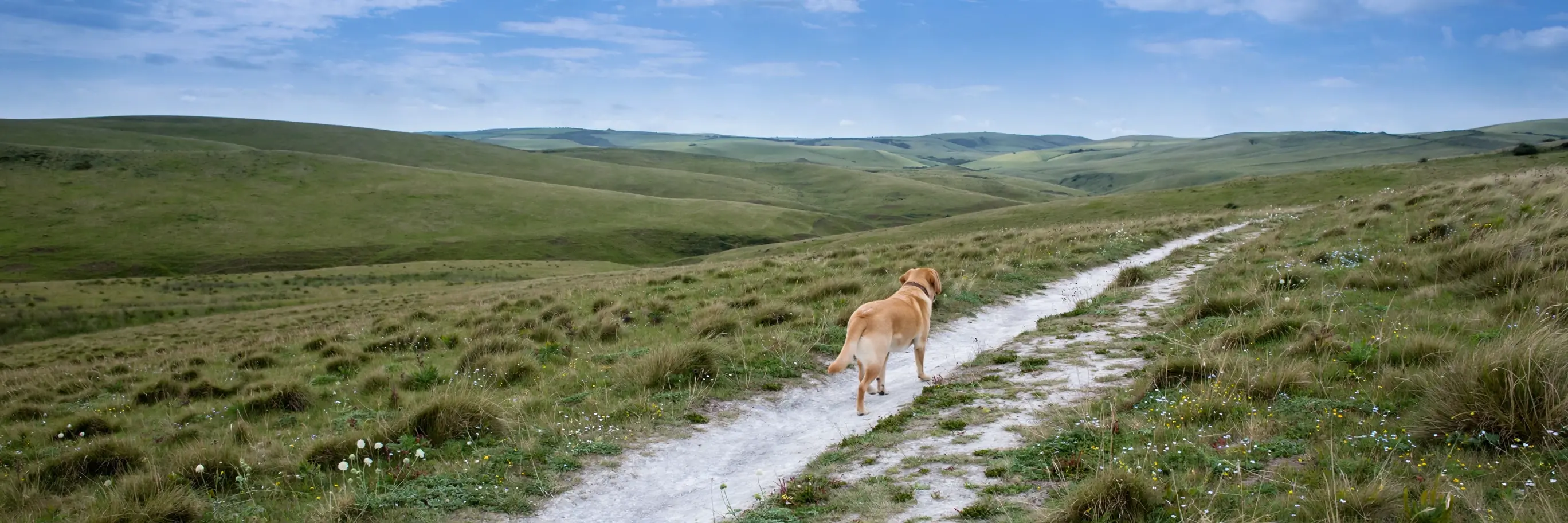
Short, springy turf is what the dog walks on for most of this route — grass kept tight by grazing sheep, threaded with wildflowers, and loud with skylarks in spring and summer. Chalkhill blue butterflies drift over the slopes, and the ground smells of rabbit, sheep and fox. From March to July the same turf hides nests: skylarks and other downland birds lay on the ground, and a loose dog can wreck a nest without its owner ever seeing it. Keep the dog to the marked line in the breeding season. Dry turf is fragile too, so do not cut corners across the grass to save a bend in the path.
The openness of the downland is both a pleasure and a problem. On a clear day the views stretch for miles in every direction, and a dog can run freely on the open grass where the path allows it. On a windy day, the same openness means there is nowhere to shelter, and a small or short-coated dog will feel the wind chill quickly. In summer there is no shade at all on the ridge, and the chalk reflects the sun, so the dog needs water, rest and, for pale-nosed dogs, protection from the sun. A lightweight dog coat is useful in wind and rain, and a sun cream made for dogs is worth packing for a summer walk.
The dry ridge: water planning
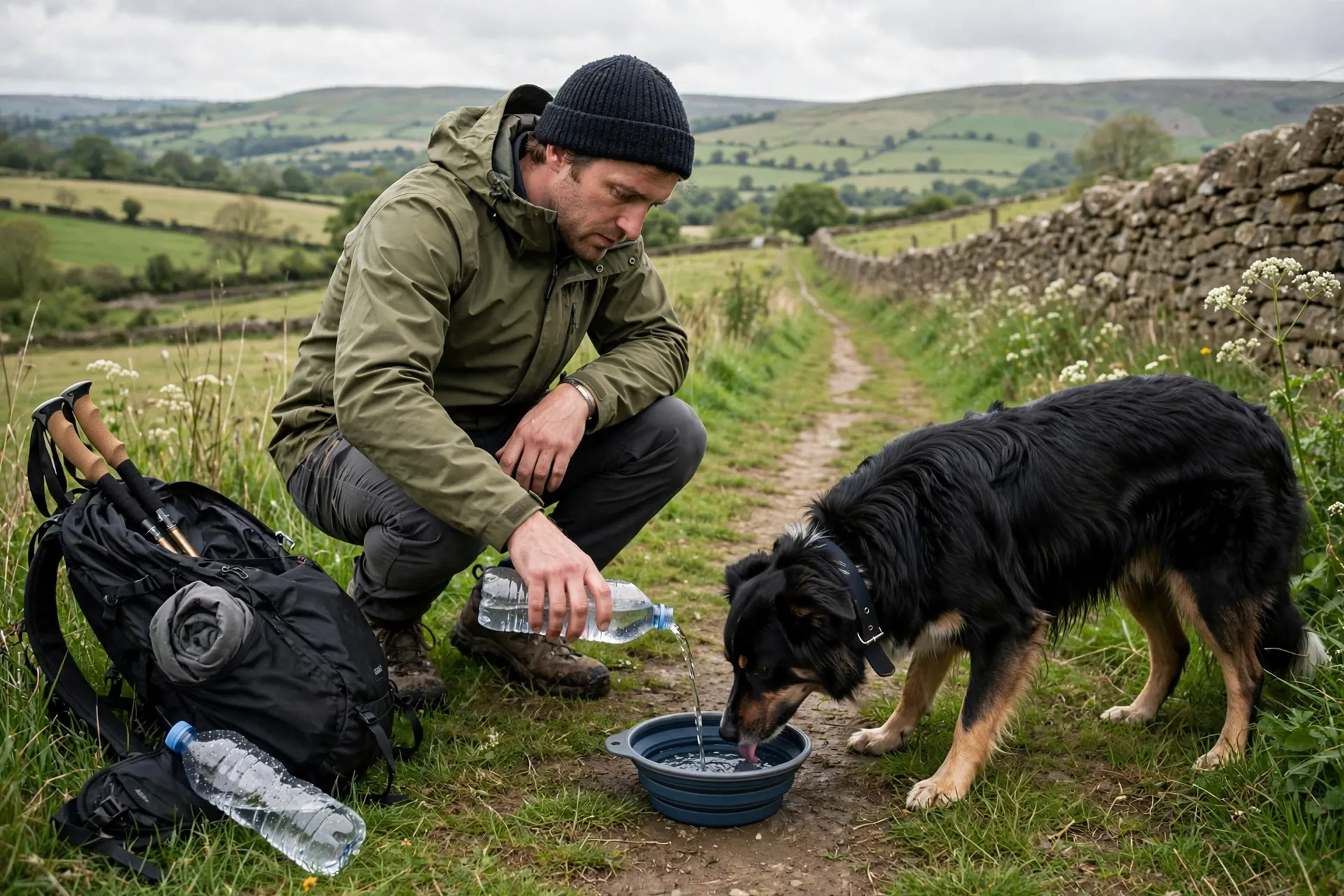
Chalk drains fast, and that single fact shapes every day on this walk. The ridge has few streams, and some stretches of ten miles or more offer no reliable water at all, because the villages and pubs sit in the valleys below the ridge rather than on it. A day can pass with no chance to refill unless you plan for it. Start each morning with a litre of water for the dog as well as your own, and take more when the day looks warm. Refill wherever the day offers it: at the overnight stop in the morning, in a pub at lunch, at a village tap, in a cafe — and carry a bowl the dog drinks from happily. How much a dog actually needs, and how often to offer it, is covered in our guide to dog hydration on long walks, and it is worth reading before this trip above all others.
Do not count on finding water up on the ridge. The dew ponds scattered over the downland belong to livestock, and the water in them can be stagnant and foul. Streams in the valleys are cleaner, but they lie at the bottom of the hill, and a detour down to one and back up again costs time, energy and a climb you will feel in your legs. Some walkers leave water at a road crossing the day before, and some ask their overnight stop to leave a bottle at an agreed point, but the simplest plan is the soundest: carry enough from the morning, fill up at every tap you pass, and never walk past a tap without using it.
On a hot day, give the dog water in small amounts often, rather than a large drink all at once, which can make a hot, tired dog sick. Wet its belly and paws at any water you find — evaporation cools the coat far better than drinking alone — and watch for a mouth gone dry, eyes gone dull, saliva gone thick, and a dog that will not walk on. Those signs mean the day is finished: find shade, cool the dog with water, and be ready to call a taxi to the nearest village or station rather than pushing on.
Section by section: what each stretch is really like
The walk begins in Winchester, a cathedral city with a railway station, dog-friendly pubs and everything a walker needs to start well. The first day follows the River Itchen out of the city and climbs gently onto the downland, with the chalk ridge opening up ahead. It is a gentle introduction, and a good day for the dog to settle into the routine of walking, stopping, drinking and walking again. The villages on this stretch have pubs and shops, so water and food are easy to find, and the walking is on a mix of riverside paths, field paths and chalk tracks.
The middle days are the heart of the walk: long, open ridge walking with big skies and big views, from Exton through Buriton and Cocking to Amberley. The path here runs along the top of the downs, with the Weald spread out to the north and the sea a glimmer to the south. There are few villages on the ridge itself, so the days are long and self-sufficient, and the dog needs to be comfortable walking for hours with only the occasional stop. The viewpoints are busy on a fine weekend — Devil's Dyke, Ditchling Beacon and the car parks along the ridge all attract crowds — so keep the dog on a lead at the viewpoints, where other dogs, children and cyclists are all in close quarters.
The last days drop the route to the coast. From Southease the path climbs onto the final ridge and runs along the cliff top past the Seven Sisters to Beachy Head and Eastbourne. It is the finest and the most exposed part of the walk: chalk cliffs fall straight to the sea, the wind comes straight off the Channel, and for miles there is no shade, no water and no shelter. The lead stays clipped on along the cliff tops, no matter how steady the dog usually is, and keep well back from the edge — the chalk can be undercut, and a dog chasing a gull can be over it before you can react. Eastbourne at the end has a station, pubs that welcome dogs, and a beach where the dog can paddle at last.
Villages, pubs and resupply
The villages of the South Downs are the lungs of the walk, and they sit in the valleys below the ridge rather than on it. Exton, Buriton, Cocking, Amberley, Upper Beeding, Pyecombe and Southease are all small, quiet places with a pub, a church and a handful of houses, and most of them welcome dogs in the pub garden at least, and often inside the bar as well. They are the places to refill water, eat properly, buy dog food and let the dog rest in the shade. The pubs are also the best source of local knowledge: the landlord will know which stretches are dry, which fields have cattle, and whether the path ahead is muddy after rain.
Resupply needs planning, because the villages have few shops. Some have a small village shop, many have none, and the nearest supermarket may be miles away in Petersfield, Lewes or Eastbourne. Carry the dog's food for the stretch between towns, and use the larger towns to restock. Winchester at the start, Petersfield and Lewes in the middle, and Eastbourne at the end all have supermarkets, pet shops and vets, and they are the places to deal with any kit problem, buy more food or see a vet if the dog needs one. Do not plan to buy dog food in a downland village that may not sell it.
The pubs are one of the great pleasures of this walk, and they deserve a mention of their own. The South Downs has a long tradition of dog-friendly pubs, and many keep a water bowl by the door and a biscuit behind the bar. A pub lunch is also the best way to handle a hot day: walk early, eat a long lunch in the shade of a pub garden, and walk the last miles in the cooler evening. Check the opening hours before you lean on a pub, because village pubs in this part of England often close in the afternoon, and a shut pub on a hot, dry ridge is a disappointment you do not need.
Livestock, birds and leads
Sheep graze the downland for most of the route, with cattle in the valley pastures and on some of the lower slopes. The open grass makes it tempting to let the dog run, which is exactly why the lead matters here: treat every field as if stock were in it until you can see that it is empty, and keep the dog on the lead on open downland from March to July, when ground-nesting birds are breeding in the same turf. A dog that chases sheep can do real harm and land its owner in real trouble — the law gives a farmer whose stock is threatened the right to act.
Skylarks nest on the ground in the short turf, and a loose dog quartering the grass can destroy a nest in seconds. The damage never shows: a nest abandoned after a dog passed too close looks exactly the same as grass where no bird ever nested. Keep the dog on the marked path and on a lead through the breeding season, and use the same discipline near the cliff tops, where fulmars and other seabirds nest on the ledges and a dog should be kept well back from the edge in any case.
Horses are part of the South Downs too — the route is popular with riders, and the bridleways that cross it are shared ground. A dog that runs at a horse can cause a serious accident, so shorten the lead when horses approach, step to the side of the path, and let them pass before you carry on. Cyclists use the Way as well, and a long lead stretched across the path can trip a rider coming downhill at speed. On the shared sections, keep the lead short and the dog on your side of the path.
Trains, buses and getting home
For public transport, this is one of the best-served long-distance trails in Britain, and that is a genuine advantage with a dog. Winchester, Petersfield, Amberley, Hassocks, Lewes, Southease and Eastbourne all have stations a short walk or bus ride from the path, so you can cut a day short, skip a section or leave the walk altogether at several points. Most train operators let a dog ride along at no charge, on a lead and off the seats, but the rules belong to each operator, so look them up for the services you plan to use before you travel.
Buses follow the valleys and can link the path to the towns, but in the villages they are thin — some see only one or two services a day — and a Sunday bus cannot be assumed. Read the timetable before you lean on one, and keep a fallback: the number of a local taxi firm, saved in your phone before you set off each day, so a firm can meet you at a road crossing if the dog goes lame or the heat becomes too much.
Winchester station has trains from London Waterloo at the start, and Eastbourne station has trains to London Victoria and to Brighton at the finish. Drivers can park at one end and ride the train back, or leave the car at a station in the middle and use public transport at both ends. The railway is also what makes this trail so easy to walk in sections over several weekends: the getting-there plan deserves as much attention as the walking plan, because the route is linear and the start is a long way from the finish.
Where to stay with a dog
The dog-friendly beds along the South Downs are limited, and the route is busy from May to September, so book early. The stops repeat a familiar pattern: a village pub with rooms, a small bed and breakfast, a farm stay, a campsite — with Winchester, Lewes and Eastbourne adding hotels as well. Most pubs and bed and breakfasts welcome a dog, though usually in just one or two rooms, and many add a small nightly charge per dog. Before you pay, get it in writing: which room the dog sleeps in, what the nightly charge is, whether it can be left while you eat, and where you should put its bed. A friendly yes at a busy bar can mean something much narrower when you turn up with a muddy dog at dusk.
Camping suits a dog that settles well in a tent, and pitches sit close to the path near Amberley, Pyecombe and Eastbourne. A tent gives the dog its own space and takes away the worry of a strange room, but it adds weight, and a dog that yaps at every passer-by will keep the whole field awake. Hostels are unpredictable — some have private rooms that take dogs, others take no dogs at all — so ask each one rather than assuming. Whatever the roof for the night, keep the evening like home: the usual feeding time, the same bed, one last short walk before dark, then quiet until morning.
Bags can be carried along the whole route, and with a dog it is worth using the service. Local firms move bags between overnight stops for a daily charge per bag, leaving you to walk with a light day pack: water, food, waterproofs, the dog's bowl and a first-aid kit. The dog's own essentials stay in the day pack, not in the bag that travels on its own — the day's food, any medicine, a spare lead, waste bags and a towel. The same split — heavy bag carried, light pack on your back — is how our guide to the South West Coast Path with a dog handles a long coastal walk, and it suits the chalk just as well.
Paws, weather and fitness
Chalk paths are firm and kind in dry weather, but after rain they turn to a slippery paste that clogs paws and makes descents treacherous, and the flint in the chalk can cut pads. That is why the evening paw check matters: look for cuts, for sore spots between the toes, and for pads gone red or swollen, then wash the chalk and mud off with clean water, dry the paws properly, and smooth on paw balm if the pads are drying out. A dog that begins to limp should rest rather than push on — a day off in a village is cheap compared with three more days on a worsening limp.
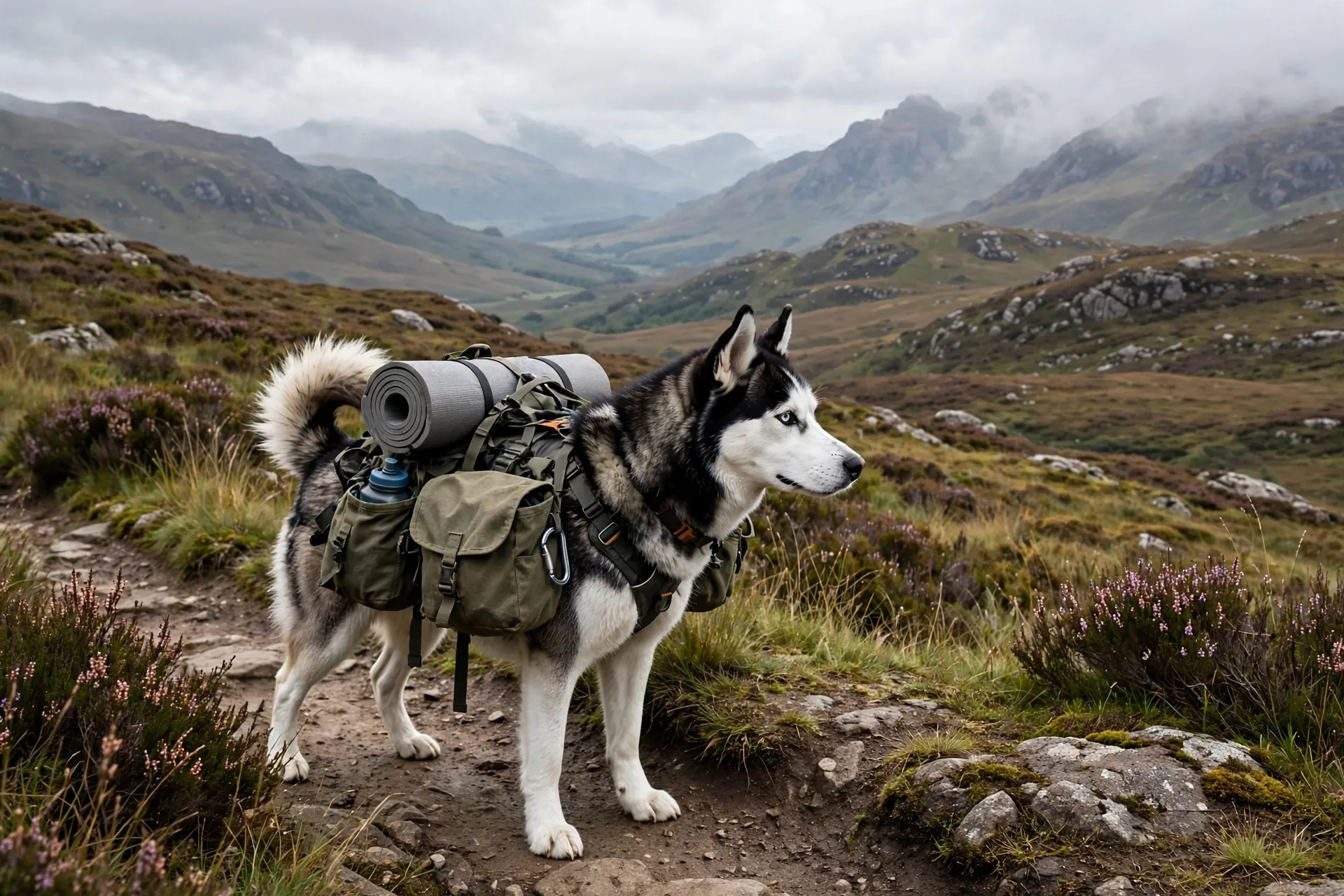
Weather on the ridge turns fast. The downland stands open to wind off the Channel and the Weald, and rain can arrive with little warning. Pack waterproofs for both of you, and a waterproof coat for the dog on a wet week — above all for short-coated, older or small dogs that lose heat quickly. In summer the same bare ridge offers no shade at all, so heat becomes the risk: start early, rest through the middle of the day, and look out for panting that will not settle, or a dog that plants its feet and will not go on. A fit dog can carry some of its own water in a dog backpack for hiking, but keep the load light — a tenth of the dog's body weight at most — and train with it for weeks before the trip.
Build the dog up over five or six weeks, and build it on chalk if you can. Start with the distance your dog already walks happily, then stretch the weekend walks a little further each week, adding hills and long stretches on a lead. Walk long on Saturday, then long again on Sunday before the dog has fully recovered — that second day is the honest rehearsal for a multi-day trail. Practise the daily rhythm as well: breakfast, a long walk with plenty of water stops, supper, and a night in an unfamiliar bed. A dog with sore joints, a heart condition or an old injury needs a vet's opinion before you book, and the vet's word should settle it. For an older dog, walking the Way in sections over several weekends is often the kinder choice, and the downs are not going anywhere.
What to pack for the dog
Three chalk problems shape the kit list: dust, thirst and sun. For the dust and the rough ground, a snug harness with a handle for the steep drops down to the villages, a lead and a spare, and paw balm for pads worn by flint. For the thirst, a bowl that folds flat and water for the dog — a litre at least, more on a hot ridge day — plus the day's food in sealed portions and waste bags for all of it. For the sun and the weather, a rain coat for the dog, a towel for chalk dust and wet grass, and a first-aid kit with tick removers and the dog's daily medicine. In the transferred bag goes the rest of the food, and the dog's bed or blanket so each new room smells familiar. Before you leave, store the number of a vet near the route in your phone, and bring the vaccination record along.
Buy the dog's food in Winchester before you start, because the downland villages sell little of it — some have a small shop, many have none at all. The food travels in the transferred bag, with one day's portion in your day pack, and each evening it is worth checking that tomorrow's bag is ready and the count still works out to Eastbourne. Top up in Petersfield and Lewes, the bigger towns in the middle, where supermarkets and pet shops are easy to reach. Take more waste bags than you expect to need, and carry every used one out: the South Downs is a National Park as well as a working landscape, and a bagged parcel left beside the path is litter. A small dry bag for the food and medicine keeps both dry when rain comes in sideways, and a spare towel packed with the food means the dog can be dried off at the end of a wet day.
Let the dog set the pace. It will want to stop at every gatepost, every dew pond and every patch of sheep-scented grass, and those pauses belong to the walk rather than interrupting it. Allow for them, and eight days along the chalk feels spacious; rush them, and every mile feels twice as long. A chalk ridge, walked slowly with a dog in the right season, is one of the finest slow walks in Britain.
Practical questions
Before you go
Can dogs walk the full South Downs Way?
Yes — dogs can walk the whole 100 miles from Winchester to Eastbourne. Most of the route is open chalk downland, but the lead is required near livestock, through farmland and during the ground-nesting bird season. Look up the current access rules on the official trail pages before you set out.
How long does the South Downs Way take with a dog?
Seven to nine days is the usual span for the hundred miles, at twelve to fifteen miles a day. Eight days gives a dog room to breathe: pauses for water on the dry ridge, a slow day at a village pub, and a shorter day if the weather turns hot or wet.
Is there water on the South Downs Way for dogs?
Water is the biggest planning issue on this route. Chalk drains fast, so the ridge has few streams and some long stretches have no water at all. Carry at least a litre for the dog, refill in villages and pubs, and check where the taps and water points are before each day. Never rely on finding a stream on the ridge.
Which season is best for dogs on the South Downs Way?
May and September are the sweet spot for most dogs: cool air, long daylight and firm chalk underfoot. Summer means heat with no shade on the ridge, and winter means short days and chalk turned to mud. Pick the season that fits your dog, and look up the current conditions before you set out.
Are dogs allowed off lead on the South Downs Way?
Off lead is possible across much of the open downland — where there is no livestock in sight, no birds nesting, and the dog stays close and comes back when called. The lead goes back on for farmland, for sheep and cattle, for roads, and for crowded viewpoints such as Devil's Dyke and Beachy Head.
Can I get home by train if the dog gets tired?
Yes — few long trails are as easy to reach by train. Stations at Winchester, Petersfield, Amberley, Hassocks, Lewes, Southease and Eastbourne all sit a short walk or bus ride from the path, so a day can be cut short or the walk left altogether at several points. Dogs ride on a lead, but the rules belong to each operator, so look them up for the services you plan to use before you travel.