This guide is written independently and contains no paid placement. Tide times, ferry sailings, beach rules and opening hours change with the season, so check the official guidance before you travel.
Appledore is a working estuary village, not a resort beach. Plan around the tide: stroll the quay at low water when the boats rest on the mud, keep your dog on a lead near the quay edge and the shipyard, and save the long, free-running stretches for the flat Tarka Trail and the paths across Northam Burrows. Check tide times before you travel.
Start with the tide, not the map
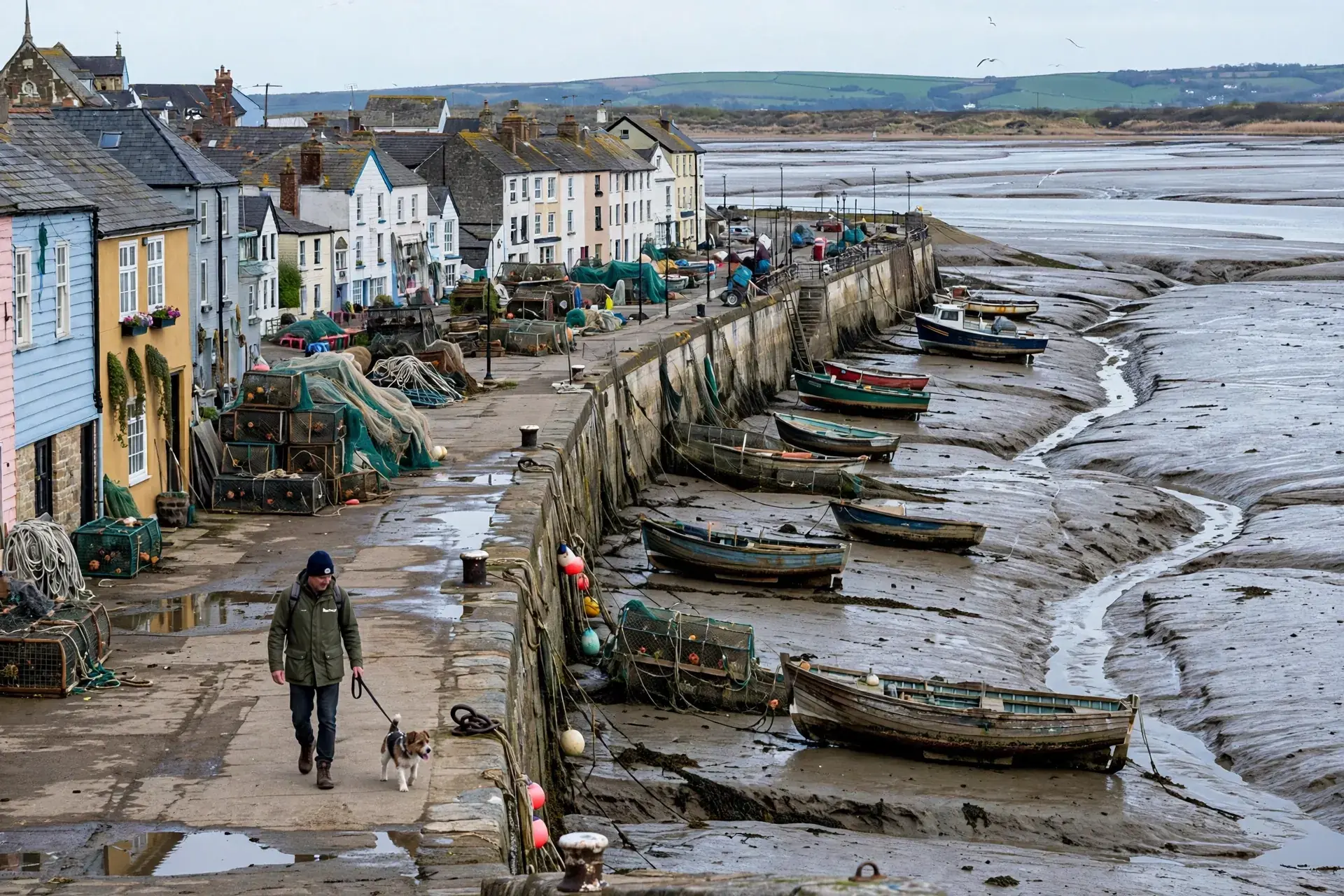
Everything in Appledore runs on the tide, and a dog trip here works far better if you check the tide times before you set off than if you simply turn up and hope. The village sits where the River Torridge meets the River Taw at the mouth of a wide tidal estuary, and the water rises and falls several metres twice a day. At high tide the river fills right up to the quay wall and the cottages seem to float on the water; a few hours later the same stretch is a broad sweep of mud with fishing boats leaning at angles on the shore. Both versions are worth seeing, but they ask different things of you and your dog.
The first rule is about the mud. Estuary mud looks firm from a distance and is anything but: it is deep, soft and sticky, and a dog that charges onto it can sink to its belly and panic before you can reach it. People have needed rescuing from this estuary's mud, and dogs are no exception. Keep your dog on the quay, the paths and the sand, and never let it chase birds or a ball out onto the flats. If your dog does get stuck, do not wade in after it — call the coastguard on 999 and ask for the coastguard, and keep the dog calm from solid ground until help arrives. This sounds dramatic for a village stroll, but it is the single most important safety point in this whole guide, and it is worth settling before you arrive.
The second rule is about the current. The Torridge is a fast river, and the channel past Appledore runs hard on a falling tide, with the added complication of the Bideford Bar — the shifting sandbar at the estuary mouth where the river meets the open sea. Dogs should not swim in the estuary here, however strong a swimmer they are at home. The beaches a short distance away, at Instow and Westward Ho!, are the right places for a paddle, and even there you should watch the conditions and keep a lead on a dog that is likely to plunge straight into surf. Check the official guidance before you travel if you are unsure about local sea conditions.
Timing the tide also shapes what you will enjoy. Low tide is the best time for the quay itself: the boats are down on the mud, crabbers work the harbour wall, and the light across the estuary is at its widest. High tide is the best time to sit with a coffee and watch the water slide past the cottages, or to catch the ferry across to Instow if it is running. The tide turns roughly every six hours, so a morning low tide usually means an afternoon high tide, and you can build a whole day around that rhythm. Tide tables for the Torridge estuary are published online and in local shops; check them the night before, and write the times on your hand or in your phone so the whole group is working from the same plan.
Slipways deserve a mention of their own. The stone slipways that run down from the quay into the water are coated in weed and algae for much of the year and are treacherously slippery underfoot, for dogs as well as people. A dog that trots happily down a dry slipway at low tide can lose its footing in a second on the green lower steps. Keep dogs on the flat quayside and off the slipways, and be careful yourself: a fall on wet stone with a lead in your hand is how wrists get broken. The same goes for the harbour steps, which are often wet and uneven.
The quay: Appledore's working waterfront
The quay is Appledore's main street, its workplace and its front room all at once, and it is where your dog will spend most of its time in the village. Unlike the manicured waterfronts of bigger resorts, this is a working quay: fishing boats tie up alongside, pots and nets are stacked where there is room, and the smell of salt and diesel hangs in the air on a still morning. That is exactly what makes it interesting to walk, and it is also why a lead is not optional here. There is no fence between the quayside and the water along much of its length, and a dog that spots a gull or a crab can be over the edge before you have time to react.
Start at the car park end of the quay and walk slowly towards the village, keeping your dog on a short lead on your landward side, away from the drop. The cottages that line the quay are painted in the soft colours Appledore is known for — pale blues, creams and pinks — and the narrow lanes that run up between them are worth a detour once the dog has had its first sniff of the waterfront. Those lanes are residential, steep in places and barely wide enough for a car, so keep the dog close and do not let it wander into front gardens. The village rewards a slow pace: there are doorways, boat names and small details of a fishing community that you will miss entirely if you hurry through.
Crabbing from the quay wall is one of Appledore's small traditions, and on a summer afternoon you will often see children dangling lines over the edge. Dogs find this riveting and also mildly hazardous: a crab bucket left at ankle height, a bait bag, a tangle of line on the ground. Keep the dog a step back from the wall where people are fishing, and do not let it drink from the buckets or snap at a crab. The same caution applies to the working gear stacked along the quay. Lobster pots, coils of rope and fish boxes are a fisherman's livelihood, not a playground, and a dog tangled in netting or rope can hurt itself and damage equipment in the same moment.
On a warm day, look out for the ice cream van that has become a fixture on the quay — a North Devon institution serving ice cream made to a long-standing family recipe. Dogs are not going to get a cone of their own, and chocolate and sweet toppings are not for them, but a plain vanilla lick is one of those small holiday moments many owners allow, and the van is a natural pause point on a quay walk. Bring a water bowl or use a collapsible one: there is no dog water station on the quay itself, and a dog that has been walking in the sun will want a drink before you head for the longer paths.
The best times on the quay are early morning and early evening. Before the day visitors arrive, the quay belongs to fishermen, dog walkers and the gulls, and the light across the estuary towards Instow and the dunes of Braunton Burrows is at its softest. In the evening, as the tide comes back in, the boats lift off the mud one by one and the village settles into its quietest hour. If you are staying in the village, make the quay your first and last walk of the day; it is short, flat and full of smells, which is exactly what most dogs want from a village walk.
The Torridge estuary walk to Northam Burrows
The finest longer walk from Appledore does not head inland at all. It follows the estuary downstream, past the lifeboat station and out onto Northam Burrows, the great sweep of grassland and dunes between the village and Westward Ho!. This is a walk that changes character three times in a couple of miles: village quay, open estuary shore, and then the wide, windswept burrows, and it suits a dog that likes space and smells more than it suits one that needs a tidy pavement.
From the quay, follow the road and then the shore path towards West Appledore, where the Royal National Lifeboat Institution station stands on the slipway. The lifeboat crew here has been launching into rescues off this coast since 1829, and the station is a landmark worth pausing at, though it is a working station and not a visitor attraction you can wander through with a dog. Keep the dog on a lead around the slipway and the station apron, where vehicles move without much warning, and take a moment to look back towards the village from here: the line of cottages along the water is at its prettiest from this angle.
Beyond the lifeboat station the path opens onto Northam Burrows Country Park, a large area of grassland, dunes and pebble ridge that is managed as a country park and crossed by the South West Coast Path. This is the place for a longer lead or, where it is safe and your dog's recall is reliable, a proper off-lead run. The ground is mostly flat and open, so you can see a long way in every direction, which makes it far easier to manage a dog that likes to range than a wooded path would. The pebble ridge that separates the burrows from the sea at Westward Ho! is a distinctive feature — a long bank of stones thrown up by the sea — and the views from it stretch along the coast in both directions.
There are a few things to manage on the burrows. Grazing animals are part of how the grassland is kept, so keep your dog on a lead whenever livestock is in sight, and be ready to clip the lead back on quickly even on the open ground. The dunes and rough grass are also adder country in the warmer months, as they are on many south-western coasts: keep dogs out of deep bracken and long grass on hot days, stick to the worn paths where you can, and know where the nearest vet is before you set off — the closest practices are in Bideford, about three miles away. In summer the burrows can be hot and exposed, with little shade and no reliable drinking water, so carry more water than you think you need and a bowl to drink from.
A straightforward out-and-back from the quay to the burrows and back is roughly four to five miles depending on how far you wander, and it makes a satisfying half day. If you want a shorter version, walk to the lifeboat station and back, which gives you the estuary views without the full burrows crossing. If you want a longer one, continue over the pebble ridge to Westward Ho! and its long sandy beach, then come back the same way or along the coast path. Either way, check the tide before you go: the shore path near the village can be affected by very high tides, and the beach at Westward Ho! is a different place at high water than at low.
The Tarka Trail to Bideford and Instow
If the burrows walk is Appledore's wild option, the Tarka Trail is its easy one. The trail follows a disused railway line through the estuary landscape, and the stretch from Appledore to Bideford is flat, surfaced and about three miles long, with the river on one side and fields and marsh on the other for much of the way. It is the walk to choose when your dog is older, when the weather has made the burrows paths heavy, or when you simply want a straightforward there-and-back without navigation worries.
The trail is shared with cyclists, and that is the main thing to plan for. Cyclists on a flat, straight railway path travel fast and quietly, and a dog on a long lead stretched across the path is a genuine hazard for everyone. Keep the dog on a short lead on your left, well in from the centre of the path, and train yourself to glance behind you before you let the dog change sides. If your dog is reactive to bikes, this path will be a test; go early in the morning when it is quieter, and be ready to step off the path onto the verge and let a group of cyclists pass. The same courtesy applies in reverse: a well-managed dog on a short lead is welcome here, and most regular users of the trail are used to dogs.
Arriving in Bideford on the trail brings you out onto the town's own quay, a broader and busier waterfront than Appledore's, with a long medieval bridge, a market hall and a good choice of places to sit. It makes a natural halfway point for a drink and a rest before the walk back, and the return journey looks different enough — the light shifts across the estuary as the day goes on — that it never feels like a dull retrace. If three miles each way is too much for your dog, walk part of the trail and turn back at a point that suits you; there is no rule that says a trail walk has to reach its destination.
Instow lies across the estuary from Appledore, and in the summer months a small passenger ferry has run between the two villages, offering a shortcut that turns a long road journey into a short hop across the water. The ferry is seasonal and tide-dependent, and sailings can be cancelled in bad weather, so check the official guidance before you travel rather than building your whole day around it. If it is running and your dog is a calm traveller, it is a lovely way to reach Instow's sandy beach and its own stretch of the Tarka Trail, which continues from there towards Barnstaple. If the ferry is not running, the alternative is the road route through Bideford and across the bridge — about eight miles by car — which is why the ferry matters as much as it does to walkers.
One practical note for the trail: there is very little shade on the open stretches between Appledore and Bideford, and the dark tarmac surface can get hot under a summer sun. Walk in the morning or late afternoon on hot days, carry water, and check the ground temperature with the back of your hand before you set a small or older dog down on it. The estuary breeze helps, but it can also disguise how warm a dog is getting, so watch for heavy panting and offer water often rather than waiting for the dog to ask.
Shipbuilding, lifeboats and maritime heritage
Appledore's history is written in ships. Boatbuilding has been recorded in the village since Elizabethan times, and the sheltered tidal creek at the mouth of the Torridge made it a natural place to build and repair vessels. Over the centuries the yards here launched everything from fishing smacks and coastal traders to ocean-going cargo ships and, in more recent decades, ferries, superyachts and naval support vessels. The scale of that history is easy to miss when you are looking at a quiet row of cottages, which is exactly why it is worth spending an hour on it with the dog in tow — or at least walking the routes that show it.
The most visible reminder is the shipyard itself, which stands on the river just upstream of the village. Appledore Shipbuilders was founded in 1965 and built ships on the site until its closure in 2019, a closure that was felt across the whole estuary community. The yard has since reopened under new ownership, and in January 2025 it was bought by Navantia UK, which now builds large naval support vessels there. The yard is a working industrial site, not a place to visit, and the South West Coast Path is routed around its landward fence rather than through it. That detour is worth taking slowly: you can see the scale of the covered yard and the slipways from the path, and the contrast between the quiet village quay and the working yard is one of the more striking things about Appledore. Keep the dog on a lead here, close to the fence line, and do not let it slip through gaps or under gates.
Richmond Dry Dock, a little further along the shore, is one of the oldest surviving dry docks of its kind in the country, dating from the mid-nineteenth century. It is a scheduled monument, a long stone-walled basin where ships were once hauled out of the water for repair, and it survives as a piece of industrial archaeology you can look at from the path. There is not much to do there with a dog beyond a pause and a look, but it is a good place to explain to children — or to yourself — how a village this small once supported an industry this large.
The North Devon Maritime Museum, in a nineteenth-century merchant's house on Odun Road at the top of the village, tells the whole story properly: model ships, navigation instruments, shipbuilding records, photographs and personal testimony from the yards and the fishing fleet, along with displays on the Newfoundland trade, smugglers and shipwrecks, and the wartime use of the estuary beaches for practising the D-Day landings. The museum is open seasonally, roughly Easter to October, and opening hours are limited — afternoons and Saturdays in the past — so check the official guidance before you travel. Pet dogs are not normally admitted inside, so plan for one person to visit while the other walks the dog, or take turns. The walk from the museum down Bude Street to the quay is itself a pleasant piece of the village, winding between cottages and opening suddenly onto the water.
The lifeboat story runs alongside the shipbuilding one. Appledore's lifeboat crew has been rescuing people off this coast since 1829, and the station at West Appledore is the modern home of that tradition. During the annual Appledore and Instow Regatta, usually held in the summer, the village celebrates its maritime heritage with rowing races, sailing and waterside events, and the quay fills with people in a way it does at no other time of year. If you visit during regatta week, keep the dog on a short lead, expect crowds and noise, and be ready to retreat to the quieter lanes if the dog finds it too much. Outside regatta week, the village is at its best precisely because it is quiet.
Beaches near Appledore
Appledore itself has no sandy beach of its own, and that is worth knowing before you arrive so you are not disappointed on the first morning. What it has instead is a choice of very different beaches within a short walk, ferry ride or drive, and the right one depends on the tide, the season and how your dog behaves around other dogs.
Instow beach, directly across the estuary, is the easiest year-round choice for a dog. It is a broad, sandy beach with a gentle slope into the water, and dogs are generally welcome there throughout the year. The sand is clean and firm enough for a good run, and at low tide the beach stretches a long way, giving even an energetic dog room to tire itself out without crowding anyone. Getting there is the only complication: by car it is the road route through Bideford, about eight miles, while on foot in summer the passenger ferry cuts the journey to a few minutes on the water. If the ferry is not running, Instow still works as a half-day trip by car, and it pairs well with a walk along the Tarka Trail from Instow towards Fremington and Barnstaple.
Westward Ho! is the big, wild beach, and it is reachable on foot from Appledore across Northam Burrows. The main beach is a vast expanse of sand backed by the pebble ridge, with surf rolling in from the Atlantic and a long, flat shoreline that is superb for dogs that like to run. It does have seasonal dog restrictions on parts of the main beach, usually through the summer months, so check the official guidance before you travel and look for the signs at the beach entrances, which show exactly where dogs are allowed and where they are not. The southern end of the beach, towards the burrows, is generally the more dog-friendly stretch. The surf here is real Atlantic surf, with a strong undertow on some tides, so keep dogs out of deep water and watch for the red flags and lifeguard advice during the summer season.
Greysands is the small, local option, a tidal cove just outside the village towards Westward Ho!. It is a pretty place at low tide, with rock pools and a scattering of sand between the rocks, but it disappears almost entirely at high tide and the rocks are slippery, so it suits a steady dog and a careful owner rather than a boisterous puppy. Go at low tide, wear shoes with grip, and keep the dog on a lead on the rocks: a fall onto wet rock is a common cause of cut paws, and the cove is not somewhere you want to be carrying an injured dog back up the slope.
Crow Point, on the far side of the estuary mouth, is the beach for people who like their dog walks empty. It is a long, sandy spit at the tip of the Braunton Burrows dune system, reached by the ferry and a walk, or by a long drive around through Braunton. Dogs generally have a good time there because there is so much space, but it is exposed and remote, with no facilities at all, so bring water, a lead and a plan for getting back. Whichever beach you choose, the routine is the same: rinse salt and sand off the dog afterwards, check paws for cuts and ears for sand, and offer fresh water before the journey home, because dogs that have been swimming in the sea will often drink salt water and then be sick in the car.
Village practicalities: parking, water, vets and toilets
Appledore is a small village with narrow streets, and the single best piece of practical advice in this guide is to leave the car in one place and walk everywhere. The car park at the quay end of the village is the obvious base: from it you are straight onto the quayside, and the museum, the shops and the start of the burrows walk are all within a few minutes on foot. Do not drive into the lanes around the cottages looking for a closer space. The streets are tight, residents need access, and a car wedged in a lane with a dog in the back is a miserable way to start a holiday. In summer, and especially during regatta week, the quay car park fills early, so arrive before mid-morning or be prepared to park further out and walk in.
Public toilets are available near the quay, and there are dog waste bins along the quayside and at the start of the burrows paths, but bins are not everywhere, so carry bags and be prepared to carry a used bag for a while. This matters more than it sounds: the burrows and the coast path are cleaned by nobody in particular, and a bag left hanging on a fence is the signature of a visitor who did not finish the job. Bring more bags than you think you need, and a small sealed pouch to carry them in, which keeps the smell contained in a pocket or a rucksack.
Drinking water needs a little planning. There is no dog water bowl on the quay, and the estuary water is salt, so a dog that laps at it will only get thirstier. Carry a bottle and a collapsible bowl on every walk, including the short ones, and refill at cafes and pubs when you stop. In the village, the shops along the quay sell bottled water and basic supplies, and there is a small supermarket provision for everyday needs, but Appledore is not a place for a big shop: stock up in Bideford on the way in if you need anything more than the basics, and check the official guidance before you travel if you are relying on a particular shop being open, as village opening hours vary with the season.
The nearest veterinary practices are in Bideford, about three miles away, which is close enough to be reassuring but far enough that you should save the number in your phone before you need it. If your dog is on medication, bring more than you need for the trip, and if your dog has a condition that might flare up — a bad back, a heart condition, a tendency to eat things it should not — note the location of the nearest out-of-hours vet as well, because rural practices often run reduced hours at weekends. A small dog first-aid kit is worth packing for any estuary trip: tweezers for ticks and thorns, a paw balm or boot for cut pads, and a towel for drying off after an unexpected paddle.
Mobile phone signal in the village is generally fine, and the estuary paths are well enough used that you are rarely far from another walker, but the burrows and the far end of the beach can feel remote, especially in the evening. Tell someone where you are walking if you are heading out alone with the dog, and keep the dog in sight on the open ground. It is also worth knowing that the village is quiet at night — very quiet, by resort standards — which suits most dogs, but a dog that barks at unfamiliar sounds may take a night or two to settle in a cottage with thin walls and a lane outside. Bring the dog's own bed and a familiar blanket, and keep the first evening calm.
Eating and drinking with a dog in Appledore
For a village of its size, Appledore eats well, and much of the food is built around what comes off the boats. The quay has pubs and restaurants that make the most of locally caught fish, and the village has cafes and a fish and chip shop for simpler meals. Dog policies vary from place to place and change with the season, so treat this section as a guide to how to eat with a dog here rather than a promise about any particular venue: check the official guidance before you travel, and ask at the door before you settle the dog under a table.
As a general pattern, the pubs along the quay are the most dog-tolerant places to eat. Many of them welcome dogs in the bar area and on outside terraces, which is where most dog owners end up anyway, because the terrace puts the dog at the centre of the view rather than under a table in a dining room. The Seagate Hotel, on the quay itself, is the village's most prominent pub and restaurant, and like most harbourside pubs it has traditionally been a place where dogs are part of the furniture in the bar. Policies can change with management and with the season, so ask when you arrive rather than assuming. The same applies to the smaller pubs and cafes tucked into the lanes: a dog that is calm, clean and on a lead under the table is usually welcome in a bar area, and a dog that barks at other dogs is not, wherever you go.
Takeaway food is the simplest option of all, and it suits Appledore particularly well. Buy fish and chips and eat them on the quay wall or on a bench looking across the estuary, with the dog beside you and the gulls kept at a respectful distance by a stern look and a short lead. Do not feed the dog chips and batter, however hopeful the expression, and do not leave food unattended while the dog is on a lead: a gull will take a chip from a paper in seconds, and a dog that lunges after it can pull a lead out of a loose grip. Bring a mat or a blanket for the dog to lie on if you are eating outside for a while, because stone and cold pavement are uncomfortable for a dog that is expected to settle for an hour.
Cafes in the village vary in how they handle dogs, and the most reliable approach is to look for outside seating first. A cafe with tables on the quay or in a small courtyard is usually happy to have a dog lying quietly beside one, and many will bring a bowl of water without being asked. If the weather turns and you need to go inside, ask at the counter; some cafes welcome dogs indoors in the quieter months and restrict them to outside seating in the summer, when the rooms are full. A mid-morning coffee stop after the quay walk, with the dog settled and the estuary in front of you, is one of the best hours of an Appledore day, and it is worth choosing a cafe that makes that easy rather than one that makes it a negotiation.
One last piece of eating advice: do not leave a dog tied up outside a pub or a shop while you go in. It is a small village, but a tied-up dog is a vulnerable one, and it is also an anxious one, which is how barking starts. If a place does not welcome dogs inside and you cannot sit outside, take the food away instead. The quay wall is a better dining room than most restaurants have, and the dog can stay with you, which is the point of bringing it.
Staying overnight with a dog
Appledore is best enjoyed slowly, and an overnight stay turns it from a pleasant stop into a proper break. The village has a good stock of self-catering cottages, many of which accept dogs, and a handful of small hotels, guest houses and bed and breakfasts. What it does not have is a large resort hotel with acres of grounds, so the right choice depends on your dog: a cottage with a small enclosed garden suits a dog that needs a secure toilet area at night, while a dog that is happy to be walked to the quay for every outing will be fine in a flat or a room without a garden.
When you book a cottage, ask the questions that matter for a dog in a village of narrow lanes and old buildings. Is the garden genuinely enclosed, and how high is the fence or wall? Old cottages often have gardens that are enclosed in the sense that there is a wall, but with a gate that a terrier can slip under or a gap where the wall meets the lane. Ask about stairs, because many of the quay cottages are tall and narrow, with steep staircases that an older dog will struggle with. Ask whether the dog can be left alone in the cottage for a short time, and what the policy is if it barks: village neighbours are close, and a dog that howls when left alone will be heard by everyone. Our guide to dog-friendly holiday parks in Devon is a useful comparison if you are weighing a village cottage against a park stay with more space and facilities a short drive away.
Bed and breakfasts and small hotels in the village vary widely in their dog policies, and many accept only one dog, or only dogs below a certain size, or only in ground-floor rooms. Say how many dogs you have and how big they are in the first enquiry, rather than in the confirmation, and ask whether the dog can come into the breakfast room or whether you will be eating separately. A dog-friendly room is not the same as a dog-friendly stay, and the difference shows up at breakfast on the first morning.
If you are staying for a week, consider using Appledore as a base for the wider North Devon coast rather than trying to fill every day in the village itself. Clovelly, the car-free fishing village further along the coast, is a natural next stop, and our guide to Clovelly with a dog covers the steep cobbled street, the harbour and the Hobby Drive walk that make it a very different kind of village day. Westward Ho! and Bideford are minutes away, the Tarka Trail runs in both directions, and the moorland edge of Exmoor is an easy drive inland. A week in Appledore works best as a rhythm — quay walk in the morning, a longer walk or a beach in the afternoon, an evening on the quay — rather than as a checklist of attractions.
Book early for the summer months and for regatta week, when the village's small stock of dog-friendly cottages is snapped up quickly. If you are travelling outside the summer, you will find the village quieter, the cottages cheaper and the dog walks emptier, and the light across the estuary in autumn can be the best of the year. Winter in Appledore is genuinely quiet, with some cafes and the museum closed, but the quay walk and the burrows are still there, and a dog does not care whether the ice cream van is open.
A dog-friendly day in Appledore
A good Appledore day follows the tide, and this plan assumes a morning low tide, which is the most common pattern for a summer visit. Start early, before the day visitors arrive, with a slow walk along the quay while the boats are still on the mud. Let the dog sniff its way from the car park to the far end of the quay and back, keeping it on a short lead near the water and letting it take in the smells of rope, fish boxes and salt. This is the dog's hour, and there is no need to hurry it.
By mid-morning, walk up to the North Devon Maritime Museum on Odun Road, taking the lanes rather than the main road. One person can visit the museum while the other takes the dog for a loop through the back streets and down Bude Street to the quay, then swap if you both want to see it. Afterwards, find a cafe with outside seating for a coffee and a rest: the dog will have earned a lie-down, and you will have earned a sit-down. If the tide is turning, watch the water come back in from your table; it rises faster than you expect, and the boats lift off the mud one by one.
For the afternoon, choose between the two longer walks according to the dog's energy. A fit, adventurous dog will enjoy the estuary walk out to Northam Burrows and the pebble ridge, with a paddle at Westward Ho! if the tide and the beach rules allow. A quieter or older dog will be happier on the flat Tarka Trail towards Bideford, with a stop on Bideford quay and a slow walk back. Both walks are about the same length, and both leave you back in the village in time for an early evening meal.
Finish the day the way it started: on the quay, at high tide, with fish and chips or a pub meal on a terrace. The light at this hour is the best in the village, the boats are afloat, and the dog, tired from a day of new smells, will settle under the table without being asked. If you have a second day, use it for Instow beach and the ferry, or for the drive to Clovelly, which is a different kind of fishing village entirely — steeper, more enclosed, and best approached with the lessons of Appledore's quay already learned. And if the weather turns, remember that a wet day in Appledore is still a good day for a dog: the quay smells better in the rain, the burrows are empty, and the pubs are warmer.
A final word on packing for a day here. Bring a lead you trust, a longer lead for the burrows, a water bottle and a collapsible bowl, poo bags and a sealed pouch, a towel for muddy paws, and a spare lead in the car, because leads break at the worst moments. Bring the dog's own bed if you are staying over, and a drying coat if the weather is unsettled. Appledore does not demand specialist kit, but it does reward the owners who come prepared for mud, tide and changeable weather — which, in the end, is what a North Devon estuary is for.
Practical questions
Before you go
Can my dog walk on Appledore quay at any tide?
Yes, the quayside itself is walkable at any tide, but the experience changes completely. At low tide the boats sit on the mud and there is more open quay to stroll; at high tide the water comes right up to the quay wall, so keep your dog on a short lead near the edge and away from slipways, which get slippery with weed and algae. Never let a dog onto the mudflats: estuary mud can be deep, soft and very hard to escape.
Is the Appledore to Instow ferry dog-friendly?
The seasonal passenger ferry between Appledore and Instow has carried dogs in past seasons, but it is a small open boat and sailings depend on the tide and the weather. Check the official guidance before you travel, confirm dogs are accepted on the day you plan to cross, and keep your dog on a lead and settled beside you for the short crossing.
Which beach near Appledore is best for dogs?
Instow beach, across the estuary, is the easiest year-round choice: a broad sandy beach where dogs are generally welcome all year. Westward Ho!, a short drive or a walk across Northam Burrows, is bigger and wilder but has seasonal dog restrictions on parts of the main beach, so check the official guidance before you travel. Greysands, just outside the village, is a small tidal cove best visited at low tide with a dog that is steady on rocks.
Can dogs go into the North Devon Maritime Museum?
Assistance dogs are welcome, but pet dogs are not normally admitted inside the museum, which is housed in a small nineteenth-century building on Odun Road with narrow rooms and fragile exhibits. Plan for one person to visit while the other walks the dog along the quay, or visit on a cool day when the dog can rest in the car with shade and ventilation. Check the official guidance before you travel, as opening hours are seasonal, roughly Easter to October.
Where can I park in Appledore with a dog?
Use the car park at the quay end of the village rather than driving into the narrow streets around the cottages, which are tight, residential and easy to block. Arrive early on summer weekends and during regatta week, when the quay car park fills fast. From the car park you are straight onto the quayside, so the dog can be out of the car and walking within a minute.
Is the Tarka Trail from Appledore to Bideford suitable for dogs?
Yes, it is one of the easiest longer walks in North Devon for dogs: a flat, surfaced path on a disused railway line, about three miles from Appledore to Bideford quay with estuary views most of the way. Keep your dog on a short lead on the left, because cyclists use the same path and can approach quickly and quietly. There is little shade on the open stretches, so carry water on warm days.
Heading further along the coast? Our guide to Bude with a dog covers the beaches, canal towpath and coast walks of the next big seaside town to the south-west, and it pairs well with a slow drive home along the North Devon and Cornwall coast.