This guide is independent and contains no paid placement. Village rules, entry arrangements and seasonal restrictions can change, so check the official guidance before you travel.
Leave the car at the top, keep the dog on a short lead, and treat the return climb as part of the walk rather than an afterthought. The cobbled street is steep and uneven, the harbour is best enjoyed from the quayside on a lead, and the Hobby Drive offers a softer, shaded woodland alternative above the village.
Arriving car-free: the decision at the top
The most important dog decision at Clovelly is made before a single cobble is stepped on. Visitors leave their cars at the top of the village and walk down, because the historic main street is not a through road for visitor traffic. That single fact shapes the whole visit: the dog will descend a steep, narrow lane to the sea, and then, unless an alternative return route is used, climb all the way back up again. There is no gentle, flat shortcut through the village itself, and no chance to pop back to the car halfway down for water, a coat or a rest. Everything the dog needs for the round trip has to be carried from the start, and the return journey has to be allowed for in time, energy and patience.
Start with an honest assessment at the car park. Is the dog fit for a steep descent and a steep ascent on the same outing, with rests? A young, fit dog that walks hills happily will usually cope well, provided the pace is slow and the surface is respected. A very small dog, an older dog, a dog recovering from injury, a dog with arthritis, a brachycephalic breed that overheats easily, or a dog that pulls hard on the lead is a different case. For those dogs, a shorter outing is wiser: walk partway down, enjoy the view, turn back while the dog is still fresh, and leave the harbour for another day or another plan. There is no prize for reaching the bottom exhausted, and a dog that is tired on the way down will be considerably more tired on the way up.
Use the time at the top well. Offer water before setting off, not only at the harbour, and let the dog toilet on suitable ground near the car park where facilities allow. Fit a well-fitting harness rather than relying on a collar alone, because a harness spreads pressure across the chest on a steep slope and gives better control if the dog slips or lunges. Use a short, non-retractable lead. A long line or an extending lead is a poor choice here: the street is narrow, other walkers pass in both directions, doorways open directly onto the lane, and a dog on a long lead can quickly block the route or tangle around a passer-by, a post or another dog. Keep the lead short enough that the dog stays beside or just ahead of its handler, with room to step aside into a doorway recess or a wider patch of ground when others pass.
Think about timing as part of the arrival decision. Midday in high summer brings the most foot traffic, the warmest stone and the least shade on parts of the street, while early morning and late afternoon are usually quieter and cooler. Wet days make the cobbles slippery and the climb harder, and a dog that is already damp and cold at the top will not warm up on a slow descent. Strong wind at the harbour end can unsettle nervous dogs, and a rising tide changes how much quayside space is comfortable. None of these factors means cancelling the visit, but each one is a reason to shorten the plan, add rests, or choose the woodland walk instead. For visitors who need a less demanding first experience of the area, the riverside and town walks described in the Dartmouth with a Dog guide show how a Devon harbour town can be enjoyed on flatter ground, which is a useful contrast when judging whether Clovelly suits a particular dog on a particular day.
Finally, settle the return plan before descending. Ask at the visitor facilities, where available, about the current return route and any transport or road option for those who cannot manage the climb, and check the official guidance before you travel, because arrangements can change with the season, maintenance work or local conditions. If the return route involves a road walk, it will still involve distance and gradient, so it is not a flat escape route. Pack for the full outing: water and a collapsible bowl, a towel for wet paws, poo bags, a spare lead, a light coat for a small or short-coated dog in cold weather, and a treat pouch for rewarding calm walking and recall to heel at narrow points. A dog that arrives at the top already prepared for the climb back is far more likely to enjoy the harbour when it gets there.
The cobbled street, step by step
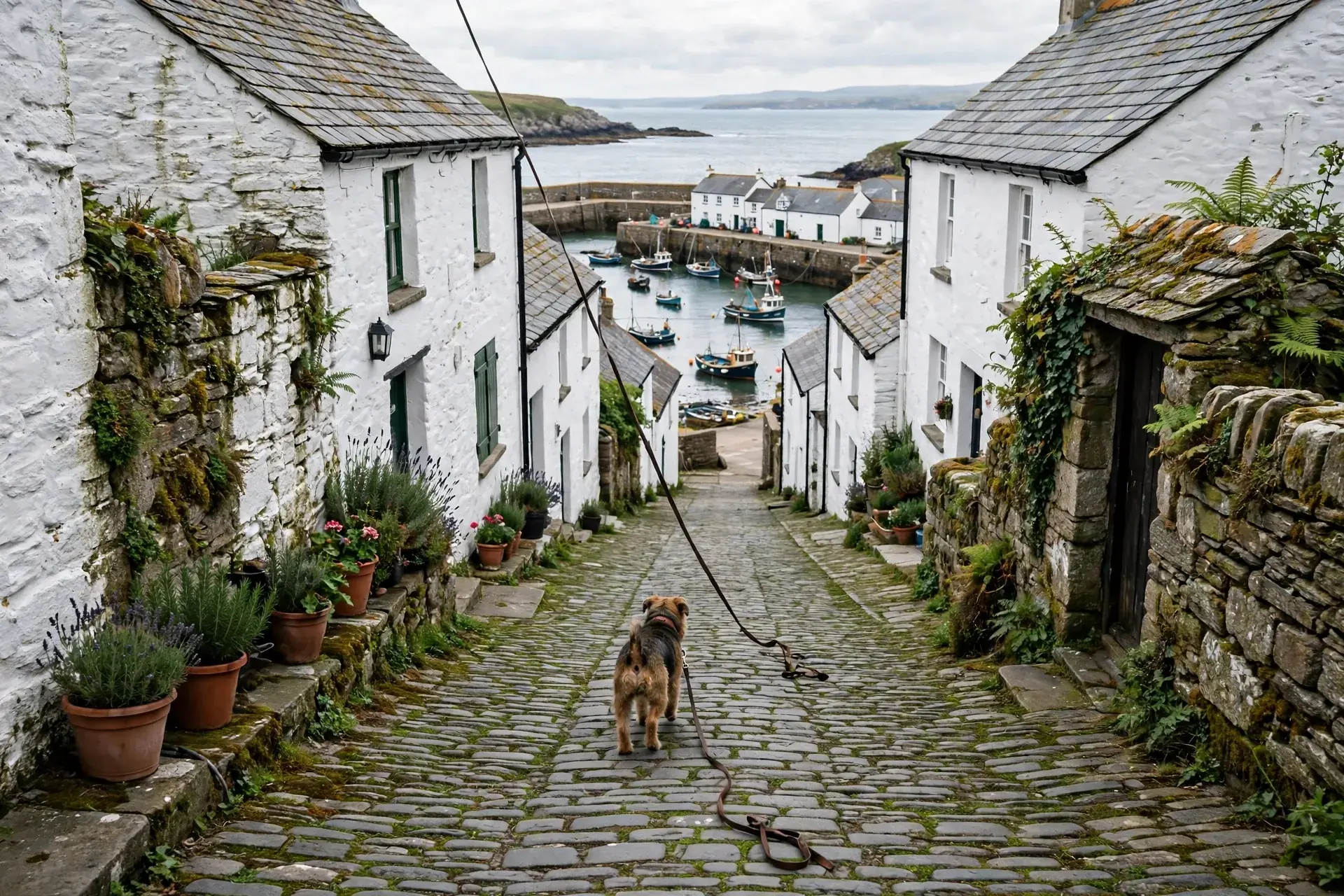
Clovelly's main street is its defining feature and its main challenge for dogs. It drops steeply from the top of the village to the harbour in a series of cobbled slopes, with houses, small gardens, doorways and alleyways pressed close on either side. The surface is not a smooth pavement. It is rounded and uneven stone, laid to shed water and to suit donkeys and foot traffic over centuries, not to suit modern dog paws or hurried walking. Joints between stones vary in depth, some stones sit proud of their neighbours, and the camber of the lane can tilt a dog's feet sideways. In dry weather the stone is grippy but hard; in wet weather it becomes slick, especially where algae, fallen leaves or sea spray have settled; in frost, it can be treacherous and is best avoided altogether for dogs that are unsteady.
Walk the street in stages, not as a single descent. The upper section is steep from the start, so resist the urge to hurry while the dog is still excited. Walk slowly, pause at wider spots, and let the dog sniff and settle. Sniffing is not wasted time: it lowers arousal, gives the dog information about other dogs and people ahead, and prevents the build-up of pulling that makes a steep slope harder to control. If the dog pulls downhill, stop, wait for slack in the lead, and only then continue. Pulling on a descent is doubly tiring, because the handler is braking while the dog is accelerating, and a sudden stop on uneven stone can unbalance both. Short, frequent pauses also protect paws, because continuous pressure on hard, uneven stone for a long descent is more tiring than the same distance walked with breaks.
Paws deserve specific attention on cobbles. Dogs with long hair between their toes can slip more easily as the hair covers the pads, so trim that hair before the trip if the dog tolerates grooming. Nails should be a sensible length: overlong nails catch in joints and change how the foot lands, while freshly cut nails that are too short can make a dog tender on hard stone. Boots or paw wax are worth considering for dogs with sensitive pads, but they should be trialled at home first, not introduced on a steep hill. A dog that is still learning to walk in boots will be distracted and unsteady on cobbles, which defeats the purpose. After the walk, check between the toes for grit, small stones and irritation, and rinse paws if salt, mud or grit has collected there. Salt from sea spray is not the same as road gritting salt, but any dried residue left between toes can still irritate skin, especially after a long day.
Meeting other users of the street is part of the experience and needs a plan. The lane is narrow enough that two groups passing each other must cooperate, and dogs must be kept close and under control at all times. Move to the side, shorten the lead, and ask the dog to sit or stand calmly while others pass if space allows. Do not let dogs greet nose-to-nose in a narrow pinch point, because neither dog has room to move away if the greeting goes wrong, and the slope adds tension to the interaction. Children, donkeys where present, delivery traffic for the village, and visitors carrying cameras or food all share the same route, so a calm, predictable dog on a short lead is the kindest and safest choice for everyone. If the dog is reactive to other dogs, other animals or strangers, consider visiting at a quieter time, keep distances as large as the street allows, and be ready to turn back rather than pushing through a busy bottleneck.
The climb back up deserves as much respect as the descent. Going uphill on cobbles is hard work for the hind legs, the chest and the breathing, and dogs that bounded down will often slow dramatically halfway up. Build rests into the ascent from the start: stop at the same wider spots used on the way down, offer small sips of water rather than a large bowl all at once, and keep the pace at the dog's pace, not the handler's. If the dog sits down, pants heavily, lags repeatedly or refuses to continue, that is information, not disobedience. Rest in shade where possible, cool the dog gradually, and do not drag or rush a tired dog uphill. For older dogs, a plan that descends only partway and returns before fatigue sets in is a successful visit, not a failed one. The village, the views and the harbour from above are still a genuine experience without a full round trip to the water's edge.
Clovelly Harbour with a dog
At the bottom of the street, Clovelly Harbour opens out as a small, working fishing harbour enclosed by stone quays and a pier. It is picturesque precisely because it is not a marina leisure complex: boats are hauled, ropes and fishing gear are part of the working scene, and the sea meets stone with little barrier between a curious dog and the water. That character is the appeal, and also the reason for a careful, lead-on approach. Keep the dog on a lead throughout the harbour area, keep well back from the water's edge, and treat every rope, net, crate, slipway and mooring line as something to walk around, not over or through. A dog that trips on a rope or steps onto a wet slipway can slip into deep water or under a boat very quickly, and rescue from a harbour wall is far harder than rescue from a beach.
Water safety starts with reading the tide and the weather. At high tide, waves can wash over lower parts of the quayside, and spray makes stone slippery underfoot. At low tide, exposed rock, seaweed and pools are tempting for dogs to investigate, but they are also slippery, sharp in places, and can hide fishing hooks, broken shell and discarded line. Do not let the dog drink seawater, however thirsty it seems after the descent, because salt water causes vomiting and diarrhoea and can dehydrate a dog further. Offer fresh water from a bottle and bowl instead, and keep the dog away from rock pools where stagnant water, bait or fish remains may be present. If the dog does get into the water, rinse with fresh water as soon as practical, dry the coat, and check ears and paws afterwards.
Boats and harbour work need distance and respect. Fishing boats may be loading, unloading or being moved, and crew members need clear access to quayside equipment. Keep the dog close, do not allow barking at workers or at other dogs on boats, and do not feed the dog near fish boxes or bait, where smells are intense and food hygiene matters. Seagulls are a constant presence at a fishing harbour and many dogs will fixate on them. A dog that lunges at gulls on a narrow quay can pull a handler off balance near the edge, so keep the lead short and reward attention back to the handler before the gull becomes the focus. The harbour is a place to sit, watch, photograph and rest after the descent, not a place for off-lead play, ball throwing or swimming.
Facilities and comfort at the harbour are limited by the nature of the site, so plan accordingly. Shade may be scarce on a sunny day, and the stone radiates heat; a dog that has just descended in warm weather needs water, shade and rest before any further walking. There may be places to sit and eat nearby, but the dog should remain on a lead, under the table or beside the handler, and not wandering between tables or towards the water. Poo bags must be carried out and disposed of properly: harbour drains and the sea are not disposal routes, and a village that welcomes dogs depends on visitors leaving no trace. If the harbour is busy, consider a shorter stay at the water's edge and a longer rest on a quieter stretch of quay, rather than competing for space at the most crowded viewpoint.
Seasonal changes matter at the harbour as much as on the street. Summer brings more visitors, more boats moving, and warmer stone, while winter brings higher seas, stronger wind and shorter daylight, which makes the return climb harder to judge. Spring and autumn often offer the best balance: fewer crowds, cooler walking conditions, and more room to rest. Whatever the season, check tide times and weather forecasts before descending, because a harbour visit planned around a calm low tide is a different experience from one attempted in a rising wind with waves breaking over the quay. When in doubt, enjoy the harbour from a safe distance, take photographs, and save a closer look for a calmer day. The harbour will still be there, and a dog that returns home safe and unstressed is the measure of a good visit.
The Hobby Drive woodland walk
For many dogs, the Hobby Drive is the most enjoyable walk at Clovelly, and for some dogs it is a better main walk than the cobbled street itself. The Hobby Drive is a woodland route above and around the village, originally created as a carriage drive, which means it follows a more gradual, winding line through trees rather than plunging straight down a hillside. The ground is generally softer than cobbles, with earth, leaf litter, gravel and tree roots in places, and the shade of the canopy makes it cooler in summer and more sheltered in wind. It is a walk for sniffing, steady pacing and looking out to sea through gaps in the trees, rather than a test of stamina on hard stone.
Distance and gradient still need planning. The full Hobby Drive is a substantial walk, not a short loop around a car park, and its length and climbs should be checked against the dog's fitness before setting off. A shorter out-and-back section is perfectly legitimate: walk for twenty or thirty minutes, turn at a viewpoint or a convenient junction, and return the same way while the dog is still comfortable. That approach suits older dogs, puppies that are still building stamina, and dogs that are new to woodland terrain. It also suits handlers who want to combine a gentle woodland walk with a brief look at the village from above, without committing to the full descent to the harbour and back. Carry water even on a shaded walk, because woodland humidity and uphill sections still dehydrate dogs, and there may be no convenient tap along the route.
Woodland hazards are different from harbour hazards, but they still need attention. Tree roots and uneven ground can trip dogs that run ahead, mud after rain can be deep in hollows and on clay sections, and fallen branches after storms may block parts of the path. Keep dogs on a lead where signs request it, and be particularly careful near livestock, wildlife and other walkers, because woodland paths often narrow at gates, stiles and viewpoints. Deer, squirrels, rabbits and ground-nesting birds in season all trigger chase instincts, and a dog that bolts after wildlife in woodland can be injured by roots, fences or a steep bank before the handler can intervene. A long line is sometimes useful on a wide forestry track, but on a narrow woodland path with other users, a standard lead gives better control and is kinder to other walkers.
Seasonal detail changes the Hobby Drive considerably. In spring, bluebells and fresh leaf cover make the walk beautiful, but ground can be soft and paths muddy after rain. In summer, shade is the great advantage, although midges and ticks are more active in woodland and long grass, so check the dog thoroughly afterwards, especially ears, armpits, groin and between toes. In autumn, leaf fall can hide roots, mud and holes, and the path can be slippery underfoot. In winter, daylight is short, the canopy drips long after rain has stopped, and the ground stays wet; a drying coat and a towel in the car make the return journey far more comfortable. Whatever the season, wear footwear with grip, because a handler who slips on mud is no help to a dog on a lead, and carry a torch or phone light if there is any chance of finishing in fading light.
Combining the Hobby Drive with the village visit is often the best structure for a day. A woodland walk first, while the dog is fresh, followed by a shorter descent into the village, gives the dog exercise on forgiving ground before the harder cobbles. Alternatively, a brief village descent first, followed by a gentle woodland section as a cool-down, suits dogs that need to burn off initial excitement before settling into a steady walk. Either way, do not stack a full Hobby Drive, a full village descent and ascent, and a long drive home into a single outing for a dog that is not used to that volume. Dogs, like people, enjoy a day more when the total distance is realistic and there is time to rest, drink and sniff without being hurried from one highlight to the next.
Where dogs are and are not welcome in the village
Clovelly is generally welcoming to dogs on a lead in outdoor public areas, but welcome does not mean unrestricted, and the distinction matters for planning. The main street and the harbour quayside are outdoor routes where a well-behaved dog on a lead is part of everyday village life, provided the dog is kept close, cleaned up after, and not allowed to enter private gardens, doorways or working areas. Private houses line the street, and their thresholds, steps and small front gardens are not public space. Keep the dog on the lane itself, do not allow nosing through gates or into open doorways, and respect any local sign asking visitors to keep to the path or to keep dogs on a lead in a particular area.
Indoor access is where rules vary most, and this is where checking ahead prevents disappointment. Some cafes, pubs, shops and visitor attractions welcome dogs inside, others welcome dogs only in a garden, terrace or specific area, and some do not admit dogs indoors at all. These policies can change by season, by time of day, or by the layout of a particular building, and a policy remembered from a previous visit or read on a third-party listing may no longer be accurate. The safest approach is to check the official guidance before you travel, confirm indoor access on arrival where possible, and always have a backup plan that does not depend on indoor admission. That backup might be a takeaway meal eaten outside, a picnic in a suitable spot, or a shorter village visit followed by a dog-friendly stop elsewhere in North Devon.
Working areas deserve particular respect. The harbour is a workplace as well as a viewpoint, and fishing gear, boats, vehicles and storage areas are not dog exercise space. Similarly, any private land, farm access, or estate woodland beyond the public path should be treated as out of bounds unless signs clearly indicate public access. Dogs should not be allowed to chase livestock, poultry or wildlife, and should be kept on a lead near farm animals even on a public path where livestock are present. In North Devon, sheep, cattle and horses are common on surrounding farmland, and a dog that worries livestock can cause serious harm and legal consequences for its owner. If livestock are visible ahead on a walk, shorten the lead, keep the dog close, and move calmly past without allowing staring, barking or lunging.
Beaches and coastal paths near Clovelly follow their own seasonal rules, and these should not be assumed from village rules. Some beaches restrict dogs in summer months, others allow dogs year-round on a lead, and still others have zoned areas. A dog that is welcome on the village street is not automatically welcome on every nearby beach, and a beach that allows dogs in winter may restrict them in July and August. Check the current seasonal restriction for the specific beach before driving there, and carry a lead even on beaches where off-lead exercise is allowed, because other dogs, children, horses, wildlife and cliff edges all require a quick recall to lead. The same caution applies to gardens, historic houses and paid attractions in the wider area: assume dogs are not admitted indoors unless the attraction states otherwise, and check the official guidance before you travel.
Good behaviour in the village is also a matter of community relations. Clovelly is a small, lived-in village, not a theme park, and residents, workers and other visitors share narrow space. Pick up after the dog immediately, carry bags out to a bin, and do not leave bags on walls, in gardens or by the path. Keep barking to a minimum, especially in quiet residential sections, and do not allow the dog to jump up at passers-by, beg at tables, or drink from decorative water features. A dog that is calm, clean and close on a lead will be welcomed back; a dog that is loose, noisy or uncontrolled makes the next dog owner's visit harder. That social contract is part of what keeps a historic village open and friendly to dogs in the first place.
Eating, drinking and resting with a dog
Eating out with a dog at Clovelly works best when the plan is flexible and the dog's needs come first. After a steep descent, the dog needs water, shade or shelter, and a chance to rest before being expected to settle under a table. Choose a spot where the dog can lie beside the handler, out of the main thoroughfare, with a water bowl available or supplied from a bottle. A dog that is still panting, excited or pulling after the descent will not settle quickly, so allow ten to fifteen minutes of calm-down time, a drink, and a quiet sniff around the seating area before ordering. If the dog cannot settle, a takeaway eaten on a bench or a quieter stretch of quayside is a kinder option than a long indoor meal with a restless dog.
Seating choice matters more than menu choice for dog owners. Outdoor terraces and gardens are often the most dog-friendly option, but they bring their own challenges: sun, wind, rain, passing foot traffic, and other dogs at neighbouring tables. Choose a table away from the main route through the seating area, keep the lead short and tucked under a chair leg or held securely, and bring a mat or blanket for the dog to lie on, because cold stone, wet wood or hot paving are uncomfortable for long periods. Indoors, check the house rules on arrival: some places welcome dogs throughout, others restrict dogs to a bar area or a specific room, and some ask that dogs stay on the floor and off furniture. Respect those rules without argument, even if another venue was more permissive, because each business sets its policy for its own layout and insurance.
Food and drink safety is part of resting well. Do not feed the dog from the table, however tempting the smells after a long walk, because rich food, bones, onions, chocolate, grapes, alcohol and spicy dishes are all harmful or upsetting for dogs, and a dog fed at the table quickly learns to beg at every stop. Bring the dog's own treats and a small portion of its usual food if the outing will span a mealtime, and feed it separately, away from other tables, after it has had water and a rest. Keep the dog's bowl off walkways where staff and other visitors could trip over it, and clean up any spills immediately. For handlers, remember that a hot drink and a snack at the harbour are also a practical rest stop before the climb back: a rested handler makes better decisions on a steep ascent than a hungry, dehydrated one.
Rest stops should be built into the day, not treated as an afterthought. Dogs that walk, climb and cope with crowds need downtime, and a dog that is overtired will be less obedient, more reactive and more likely to pull on the climb home. Plan at least one proper rest of twenty to thirty minutes during a Clovelly visit, longer on hot days, with water, shade and a chance to lie down undisturbed. Puppies and older dogs need more frequent, shorter rests, and brachycephalic breeds need careful monitoring in warmth, with rest in shade and cooling rather than continued walking. If the dog is lying flat, panting heavily, seeking shade constantly or refusing treats it normally enjoys, those are signs to stop, rest longer, or cut the visit short. A good meal with a settled dog is a highlight; a rushed meal with an exhausted dog is a stressor for everyone at the table.
Finally, think about facilities for the handler as well as the dog. Toilets, baby-changing facilities, shelter from rain and a place to refill a water bottle all affect how comfortable a longer stay will be. Carry extra water rather than assuming a refill will be available at the harbour, and carry a spare towel for the dog to sit on if seating is damp. If rain arrives during a meal, a dog that has a drying coat and a mat will settle far more easily than a wet dog on a cold floor. The goal is simple: the dog rests, the handler eats in peace, and both leave the table ready for the climb back, rather than starting that climb already tired and uncomfortable.
Staying overnight nearby
Staying overnight near Clovelly changes the visit from a hurried day trip into a relaxed North Devon break, and it usually suits dogs better. A nearby base means the village can be visited at a quieter time of day, the dog can rest properly between outings, and a wet or windy day does not ruin the only chance to see the village. The surrounding area, including Bideford, Hartland, Bude across the county boundary, and smaller villages inland, offers cottages, bed and breakfast accommodation, campsites and holiday parks, but dog policies vary widely and must be confirmed for the specific property, room and dates, not assumed from a general listing. Budgeting for a week with a dog in Devon, including pet fees, food, fuel and attraction costs, is covered in detail in the Devon dog holiday cost guide, which is worth reading before booking a longer stay.
When choosing overnight accommodation, apply the same practical tests used for the village itself. Ask how many dogs are accepted, whether there is a pet fee and what it covers, whether dogs are allowed in all rooms or only designated ones, and whether dogs can be left alone briefly in the accommodation. A cottage with an enclosed garden is a major advantage after a day of lead walking, because the dog can toilet safely, stretch and relax without another walk. Check the garden boundary carefully on arrival: gaps under gates, low fences, hedges with holes and shared access can all defeat an enclosed garden for a determined dog. For bed and breakfast or hotel stays, ask where the dog sleeps, whether dogs are welcome in breakfast rooms or only in bedrooms, and where the nearest practical evening toilet walk is, especially if the property is on a busy road.
Location matters for overnight stays as much as for day visits. A base close to Clovelly reduces driving on narrow North Devon lanes, which many dogs find stressful, and allows a return visit if the first attempt is cut short by weather or fatigue. A base further inland may be quieter, cheaper and easier for parking, but adds driving time to every coastal outing. Balance those factors against the dog's travel tolerance: a dog that travels calmly for an hour can cope with a base further afield, while a dog that pants, drools or vomits in the car will enjoy a closer base far more. Wherever the base is, plan the first evening as a settling-in evening, with a familiar bed, usual feeding times, a short local walk and no ambitious sightseeing. Dogs that settle well on the first night enjoy the whole holiday more.
Practical overnight details are easy to overlook and hard to fix at midnight. Pack the dog's usual food, measured for the stay plus a spare day, because a change of food combined with travel and new water can upset digestion. Bring the dog's bed or blanket, a familiar toy, medication with clear instructions, vaccination and insurance details, and the number of a local vet saved in a phone before it is needed. Rural vets may close early and may be some distance from a coastal village, so knowing the nearest practice and its out-of-hours arrangements in advance is sensible. Also confirm check-in and check-out times, cleaning expectations for pet hair, and any rules about dogs on furniture, because a misunderstanding at checkout can sour an otherwise good stay.
For longer stays, vary the walking so that Clovelly is one highlight among several, not a daily test of the same steep street. Alternate a village day with a beach day, a woodland day and a rest day, and watch the dog's paws, energy and appetite across the week. A dog that copes well with cobbles on day one may still develop sore pads by day three if every walk is on hard stone, so mix surfaces deliberately: sand, grass, woodland earth and short paved sections, with rest days built in. That variety is also better for handlers, because North Devon offers far more than one village, however beautiful that village is, and a dog that arrives home fit, rested and happy is the best souvenir of a Devon holiday.
Wet weather, paws and older dogs
North Devon weather is changeable, and a Clovelly visit planned only for sunshine will often meet rain, wind or sea mist instead. Wet weather does not have to cancel the visit, but it changes every part of the plan: cobbles become slippery, the Hobby Drive becomes muddy, the harbour becomes windier, and the dog becomes colder and wetter faster. A waterproof coat for the dog is useful in persistent rain, especially for short-coated, small, older or lean breeds that lose heat quickly, but the coat must fit well, allow free movement of the legs, and not rub under the harness. A drying coat for the car journey home is equally valuable, because a wet dog in a cold car after a long walk chills rapidly. Handlers should also dress for rain and wind, with grippy footwear, because a handler who is cold, wet and slipping cannot safely manage a dog on a steep slope.
Paw care in wet weather goes beyond a quick towel dry. After a wet walk, rinse paws in clean, lukewarm water to remove mud, grit, salt and leaf debris, dry thoroughly between the toes, and check for cuts, cracks, redness or swelling. Mud packed between toes can hide small injuries and cause limping the next day, while prolonged dampness between toes can lead to irritation and infection, especially in dogs with hairy feet or allergies. Keep nails trimmed and the hair between toes tidy, and consider paw balm for dogs prone to cracked pads, applied after the walk rather than before a long wet descent, where it can make paws more slippery on stone. If a paw is cut, bleeding, swollen or the dog is persistently lame, rest the dog, clean the wound gently, and seek veterinary advice rather than continuing the holiday walking programme.
Older dogs need a Clovelly plan built around their limits, not around an ideal itinerary. Arthritis, reduced muscle strength, poor vision, hearing loss and slower recovery all affect how an older dog copes with steep, uneven ground. Signs that a walk is too much include repeated sitting, lagging behind, reluctance to start again after a rest, heavy panting that does not settle, stiffness the next morning, or a change in appetite and mood after a long day. For older dogs, shorten the descent, add more rests, use a harness that supports without pulling on the neck, and consider whether a ramp, a dog buggy or a carried lift is appropriate for very small or very frail dogs on parts of the route where carrying is safe and permitted. Never carry a dog on a steep, slippery slope if the handler cannot do so safely with both hands free for balance and the lead secured.
Recovery after the visit matters as much as the visit itself. Give the dog water, a comfortable bed and a quiet rest on return to the car or accommodation, and avoid another long walk immediately afterwards. Check paws, legs and coat again once the dog is dry, and note any stiffness, soreness or reluctance to move the next morning. A dog that is stiff after Clovelly may need a rest day, a gentle flat walk, and veterinary advice if stiffness persists beyond a day or worsens. Keep a simple record across a holiday: which walks were done, how the dog coped, and any paw or mobility issues noticed. That record helps with future planning far more than a vague memory that a particular village was hard or easy, because it separates the effect of gradient, surface, distance and weather, which often combine in a single outing.
Seasonal paw and coat hazards extend beyond rain. In summer, hot stone at the harbour and on sun-exposed sections of street can burn pads, so test surfaces with a hand and walk in cooler parts of the day. In autumn, fallen leaves hide uneven stone and mud, and conkers, acorns and mushrooms in woodland should not be eaten. In winter, frost and ice make cobbles dangerous, and any gritting material on roads near the village should be rinsed from paws. In spring, pollen and grass seeds can irritate ears and paws, and grass awns in particular should be checked for after woodland and meadow walks, because they can migrate into skin and ears and cause painful infections. A thorough post-walk check, every time, is the simplest and most effective habit a dog owner can build on a North Devon holiday.
Combining Clovelly with nearby North Devon walks
Clovelly sits on a dramatic stretch of North Devon coast, and combining it with nearby walks turns a single steep village visit into a balanced coastal holiday. The South West Coast Path runs through this area, offering cliff-top walking with wide views, but cliff paths are not automatically suitable for every dog: they can be narrow, exposed to wind, close to unfenced drops, and physically demanding, with long ascents and descents. Choose a short, well-defined section for a first coastal walk, keep the dog on a lead near cliff edges and livestock, and turn back before fatigue or weather makes the return harder. A short cliff walk combined with a village visit on separate days is usually more enjoyable than attempting both on the same day with the same tired dog.
Hartland Point and the Hartland peninsula, to the west of Clovelly, offer rugged coastal scenery, lighthouse views and quieter paths, but the terrain is exposed and the ground can be rough, so it suits fit dogs with good recall to lead and handlers who are comfortable with wind and uneven ground. To the east, the coast towards Bideford and the Taw and Torridge estuary offers flatter, more sheltered walking, with riverside paths, cycle trails and town parks that suit older dogs, puppies and dogs that prefer level ground. Inland, Exmoor and the Devon countryside offer woodland, moorland and valley walks, but moorland routes need navigation skills, weather awareness and livestock awareness, and should not be attempted without a map, water and a plan for getting back to the car. Mixing one coastal highlight, one woodland walk and one flat riverside walk across a few days gives most dogs a better holiday than repeating the hardest walk daily.
Beaches near Clovelly and across North Devon follow seasonal dog rules that must be checked beach by beach. Some beaches are dog-friendly year-round, some restrict dogs in summer, and some have separate zones or lead requirements. Check the official guidance before you travel for the specific beach and date, and do not rely on a general statement that North Devon beaches welcome dogs. On any beach, keep a lead handy, watch for strong currents, cliff falls, fishing gear and other dogs, and do not allow swimming in rough seas or near harbour entrances. After a beach walk, rinse salt and sand from the coat and paws, check ears for sand and water, and dry the dog before a car journey. A beach day is a good recovery day after Clovelly, provided it is flat, relaxed and not another long, hard walk in disguise.
Towns and villages near Clovelly also offer useful variety. Bideford provides a flatter riverside base with shops, cafes and longer level walks, while smaller villages inland offer quiet lanes, churchyards and pub gardens where a dog can rest after a coastal day. When planning a multi-stop day, remember driving time on narrow lanes, parking availability at each stop, and the dog's tolerance for repeated car journeys. A day with two short stops and a long rest is usually better than a day with four rushed highlights. Allow time for the dog to toilet, drink and settle at each stop, and do not leave a dog alone in a car, especially in warm weather, while visiting a shop or attraction that does not admit dogs. If a stop does not work for the dog, skip it rather than forcing a visit that leaves the dog stressed for the next stop.
A sensible multi-day pattern for a Clovelly-centred break might look like this: one day for Clovelly itself, with the village and Hobby Drive as the main focus and a rest afterwards; one day for a flat estuary or riverside walk and a town visit; one day for a short coastal path section in good weather; and one rest or beach day, depending on the season and the dog's energy. That pattern leaves room for weather changes, for a second, quieter visit to Clovelly if the first was cut short, and for the dog to recover between harder walks. It also leaves room for the unexpected: a closed path, a busy car park, a tired dog or a sudden shower should change the plan without ruining the holiday, because the holiday was never built around a single, non-negotiable walk.
Practical checklist before you go
A short checklist, run through the night before and again before leaving the car, prevents most avoidable problems at Clovelly. Start with the dog: is the dog fit for a steep descent and ascent today, are nails and toe hair tidy, is the harness fitted correctly, and is the lead short, strong and in good condition? Check the weather forecast, tide times and the official guidance before you travel, including any current village, harbour or path restrictions, and confirm where dogs are welcome indoors if a meal is planned. Pack water and a bowl, poo bags, a towel, a drying coat if rain is likely, treats, a spare lead, and any medication the dog needs. Charge a phone, save a local vet number, and tell someone the rough plan if walking alone in woodland or on coastal paths.
- Car and arrival: park at the top, toilet the dog before descending, offer water, and settle the return plan before starting down.
- Lead and harness: use a short, non-retractable lead and a well-fitting harness, keep the dog close on the street and at the harbour, and step aside for other walkers.
- Paws and surface: check paws before and after, avoid the steepest wet or icy sections for unsteady dogs, and rinse salt, mud and grit from paws afterwards.
- Water and rest: carry fresh water, offer small drinks often, build in rests on the descent and ascent, and stop if the dog sits, lags or pants heavily.
- Harbour safety: stay back from the edge, avoid ropes, slipways and deep water, do not let the dog drink seawater, and keep clear of working boats.
- Woodland walk: keep to the path on the Hobby Drive, watch for roots and mud, keep a lead handy for livestock and wildlife, and check for ticks afterwards.
- Food and indoor access: confirm dog policies before relying on indoor seating, bring the dog's own treats, and never feed table food that could harm the dog.
- Weather and seasons: pack a coat for small or older dogs in cold or wet weather, avoid hot stone in summer, and allow extra time in rain, wind or fading light.
- Overnight and onward travel: confirm the accommodation dog policy in writing, check garden boundaries on arrival, and plan a settling-in evening after a long day.
- Emergencies: carry a phone, save a vet number, know the route back to the car, and do not hesitate to cut a walk short for the dog's safety.
If any item on that checklist cannot be ticked, adjust the plan rather than ignoring it. A missing water bottle, a frayed lead, a dog that is already tired before the descent, or a forecast of heavy rain are all reasons to shorten the walk, choose the woodland route, or postpone the harbour descent. Clovelly is best enjoyed slowly, with a dog that is comfortable, hydrated and under control, and with a handler who has time to look around instead of constantly managing a crisis. Plan for the climb back, respect the working harbour and the residents who live along the street, and leave the village as clean and calm as it was found. Done that way, a car-free village that first looks like a challenge becomes one of the most memorable dog walks in North Devon, and a place worth returning to in a quieter season, at a slower pace, with a dog that knows the route and trusts the plan.
Practical questions
Before you go
Is Clovelly suitable for dogs that cannot manage steep slopes?
Clovelly is a difficult match for dogs that struggle with slopes or steps, because the main street is steep and cobbled and the return climb is the hard part. Plan a short descent only, turn back early, or enjoy the views from the top and the Hobby Drive instead, and check the official guidance before you travel.
Can dogs go to Clovelly Harbour?
Dogs on a lead can enjoy the harbour area and the quayside, but keep them clear of boats, ropes, slipways and deep water, and watch for waves and wet stone. Check the official guidance before you travel, because harbour rules and seasonal restrictions can change.
Do dogs have to stay on a lead in Clovelly?
Yes, keep dogs on a lead throughout the village street and harbour. The street is narrow and busy, the surface is uneven, and other visitors, working boats and local animals need space. A short lead gives better control than a long line on the descent.
Is the Hobby Drive suitable for dogs?
The Hobby Drive is a woodland walk above the village and suits many dogs better than the cobbled street, with shade, softer ground and room to move. Keep dogs on a lead where signs ask for it, watch for mud after rain, and allow extra time for the climbs and descents.
Can you drive down to the harbour at Clovelly with a dog?
No, visitors normally leave cars at the top of the village and walk down, because the main street is car-free for visitors. There is a return route by road for those who need it, so check the official guidance before you travel and plan the climb back before you set off.