This guide is independent and contains no paid placement. If affiliate links are added later, they will be clearly marked and will not change our editorial checks.
Pet dogs cannot enter Arundel Castle or its grounds, where only registered assistance dogs are allowed, but the town more than makes up for it. Walk Swanbourne Lake and Arundel Park on a lead, follow the River Arun to the Black Rabbit, and use the old town for a calm, short, lead-only stroll. Keep dogs out of the river, keep them on a lead around livestock and nesting birds, and check the official guidance before you travel, because castle, wetland-centre and pub rules can change.
The castle rule every dog owner needs first
Arundel Castle dominates the town from its hill, and it is the first thing most visitors want to see. It is also the place where dog owners most often get caught out, so start here. Pet dogs are not allowed into Arundel Castle or its grounds. Only registered assistance dogs are permitted, and that rule applies to the castle building and the gardens inside the paid area. It is a firm rule, not a quiet suggestion, and it does not soften if the dog is small, well behaved, carried in a bag or happy to wait at the gate. If your party includes someone who wants to tour the castle, plan for that person to go in while someone else stays outside with the dog, or split the day so the castle visit and the dog walk are separate parts of the plan.
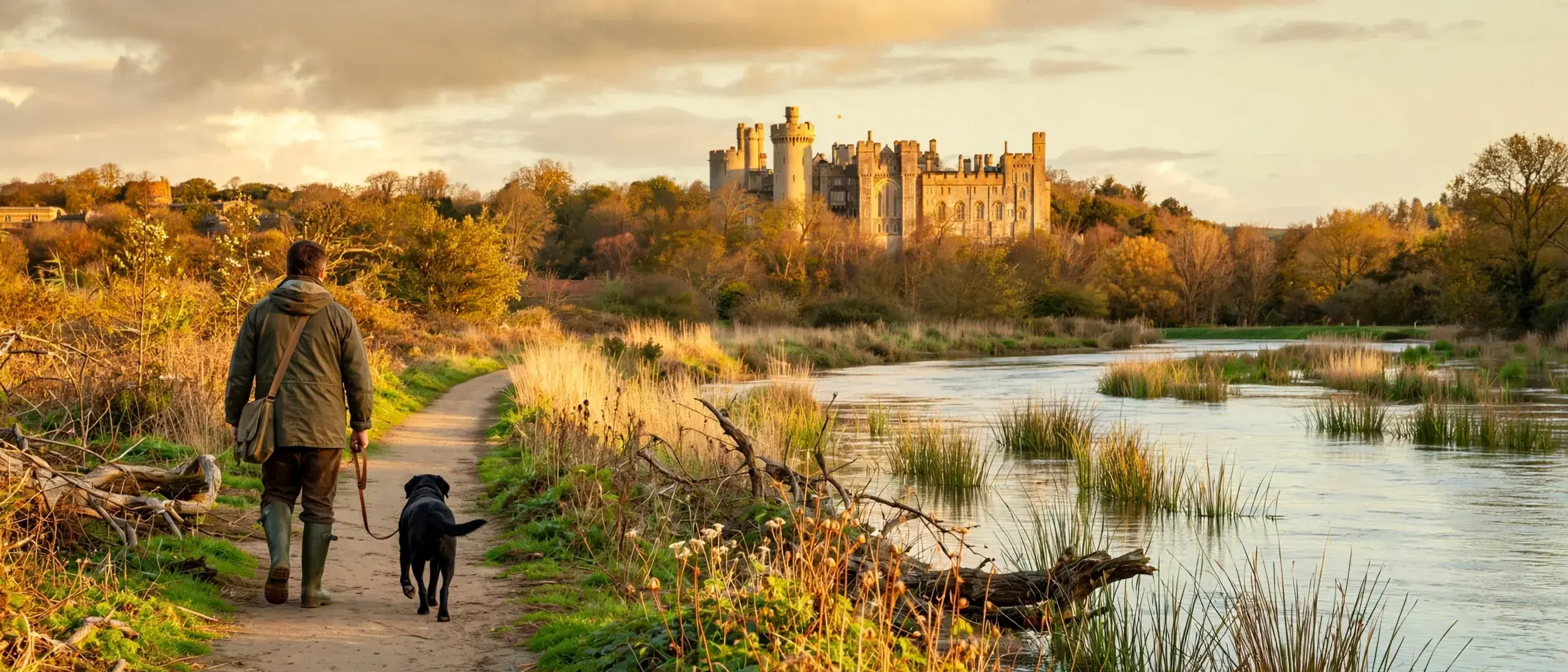
The castle itself is a Norman foundation, established in 1067, and it was restored and remodelled after damage in the English Civil War. That long history is part of why the town feels so complete: the castle, the cathedral on the hill beside it, the steep streets below and the river at the bottom form one compact, walkable picture. You do not need a ticket to enjoy that picture with a dog. Some of the best views of the castle are free, from the town streets, from the riverbank, from the paths in Arundel Park and from the far side of the valley on the longer walks. A dog on a lead can stand beside you for all of those views, and the photographs are often better from outside the walls than from inside them.
Opening arrangements at the castle change with the season, and the castle building and the gardens do not always open at the same time. In general, the gardens open earlier in the day than the castle interior, and the site is closed for part of the winter. Do not build a tight timetable around a single opening time found in an old guide. Check the official guidance before you travel, confirm the date you plan to visit, and allow at least two hours if a member of your party does go inside, with more time if they also want the gardens. If you are travelling as a couple or a family with one dog, agree in advance who goes in and who walks the dog, and where you will meet afterwards. The meeting point matters more than it sounds: the streets around the castle are steep, the pavements are narrow in places, and a dog waiting in a busy spot will be happier in a quieter place, such as the riverside grass or a bench away from the main gate.
There is one useful exception to remember, and it is easy to confuse with the castle rule. The Friends of Arundel Castle Cricket Club ground, which sits in the castle grounds area during cricket events, has welcomed dogs on leads at matches, with dogs kept out of catering areas unless they are assistance dogs. That is an event rule for a specific ground on specific days, not a general right to take a pet dog into the castle. Do not use it to argue your way past the castle gate on an ordinary visiting day. If a cricket match or another special event is on, check the event's own guidance before you travel, and expect a lead-only rule, a clean-up rule and a firm instruction never to leave a dog alone in a car in the car park.
The practical lesson is simple. Treat the castle as a view, not a dog attraction, and Arundel works beautifully. Treat it as a place you expect to enter with a pet dog, and the day starts with a disappointment. The rest of this guide is built around that honest split: the castle for looking at, and the river, the lake, the park and the old town for walking with a dog.
The River Arun, the old bridge and the riverside
The River Arun is the second great landmark of Arundel, after the castle, and it shapes every dog walk in the town. The river runs through the valley below the castle, passes under the old bridge in the town centre, and flows on towards Littlehampton and the sea. At Arundel it is tidal, which means the water level rises and falls with the tide, the current can run fast, and the look of the river changes completely between high and low water. At high tide the river is broad and full, with boats moving under the bridge and the banks close to the water. At low tide the mud shows, the water sits lower in its channel, and the riverside paths feel wider and quieter. Both states are worth seeing, but neither state makes the river safe for a dog to swim in.
The old bridge is the natural centre of a riverside walk. It carries the road across the Arun in the heart of the town, and the pavements beside it give a clear view up and down the river, with the castle above and the water below. Cross it slowly, on a short lead, because traffic, pedestrians, cyclists and dogs all share a narrow space. The bridge is also a good place to judge the river before you walk further. If the water is running fast, if the level is high after rain, or if the wind is pushing across the water, keep the dog well back from the edge and choose the higher, surfaced paths rather than the low, muddy bank. The Arun has a reputation as a dangerous river when it is in full flow on an ebb tide, and that reputation is a reason for caution, not for fear, as long as the dog stays on a lead and out of the water.
Downstream and upstream of the bridge, the riverside grass and the footpaths beside the river give the town its calmest dog-walking space. The riverside meadows near the town are open, flat and easy to read: you can see other dogs, other walkers and the water from a long way off, which helps if your dog is reactive or nervous. In dry weather the grass is firm and pleasant. After rain it softens quickly, and the low ground beside the river can hold water long after the paths in the town have dried. Bring a towel and a spare lead if you plan a long riverside walk in winter, and expect mud on paws, on boots and on the lower part of a long coat. A short lead and a steady pace matter here, because the bank can be slippery, the edge can be undercut, and a dog that lunges at a duck or a passing boat can be at the water in a second.
The river also sets the rules for the longer walks. The popular circular routes from Arundel follow the Arun for a long stretch, then climb into Arundel Park and return through woodland and parkland. The riverside sections are generally flat and easy, but they are not surfaced everywhere, and they can be muddy, waterlogged and slow after wet weather. Stiles appear on some of the longer riverside routes, and several have gaps or small doors alongside them for dogs to pass through, but do not assume every stile will suit your dog. A large dog, an older dog, a puppy or a dog that is nervous about tight spaces may need lifting or a different route. Check the route in advance, carry the dog's usual lead and a longer line for the open sections, and be ready to turn back if a stile, a flooded path or a herd of cattle makes the next section unsuitable.
One more riverside point is worth making plainly. Do not let a dog drink from the river as a matter of routine, and do not let a dog swim, paddle or chase sticks into the water. The Arun is tidal, the current is deceptive, and the banks can be steep and muddy. A dog that slips in may struggle to climb out, especially if the bank is wet and the water is moving. Carry fresh drinking water for the dog, offer it regularly, and keep the dog on the path. The river is there to look at, to walk beside and to photograph, and the walk is better for keeping that distance.
Swanbourne Lake: the easy first walk
If you only have an hour, or if your dog is older, younger, nervous or new to town walks, start at Swanbourne Lake. The lake sits in a steep-sided chalk valley in Arundel Park, just off Mill Road, a short walk from the town centre. It is a small ornamental lake and wildlife area, overlooked by Swanbourne Lodge, a Grade II listed mid-19th-century lodge that now operates as a tearoom. The lake is the centre of the easiest and most forgiving dog walk in Arundel: a circuit that takes about twenty minutes for a quick walker and about an hour at a slow, sniffing pace, with longer options branching off into the park.
The main loop around the lake is well surfaced for much of its length, with trees around the water, views of the castle above the treetops, and plenty of ducks, swans and other waterfowl to watch from the bank. Dogs are welcome, but they must be kept on a lead. That lead rule is especially important between March and September, when birds are nesting around the lake, and it is sensible all year round because of the waterfowl, the other walkers, the children, the boats and the tearoom garden. A dog that is allowed to chase ducks will not only disturb the wildlife, it will also be very hard to recall from the far side of the lake, and the bank is not a safe place for a sudden sprint.
Swanbourne Lodge Tearoom is one of the most dog-friendly stops in the town. Well-behaved dogs are welcome both inside the lodge and outside in its garden, on a lead at all times, and not allowed on tables and chairs. Fresh water is available, homemade dog biscuits are made on site, and dog sausages are sold for dogs that have earned a treat. That makes the tearoom a natural pause point: walk the lake, sit down, let the dog settle under the table, and then decide whether to go further into the park or back to the town. Rowing boats can be hired on the lake in season on a first-come, first-served basis, but dogs do not go in the boats as a matter of course, so do not plan a boat trip as a dog activity. Check the official guidance before you travel if the boats or the tearoom hours matter to your plan, because both are seasonal.
The lake circuit is not fully step-free, and it is not equally easy in every direction. Some sections are rough and bumpy underfoot, some are slippery when wet, and the longer extension up the steep hill into the park is a different walk altogether, with a climb that is hard for a pushchair, a wheelchair or an older dog. If mobility matters, stay on the shorter, flatter lakeside path, take the lake at a slow pace, and use the tearoom as a turning point. If your dog is fit and keen, the lake is the start, not the finish: from the lake you can climb into Arundel Park, join the Monarch's Way, or follow the river towards South Stoke and the Black Rabbit, which is covered in the next section.
Two small practical points complete the lake walk. First, there are not many dog-waste bins around the lake, so carry your own bags and carry the used bags out with you. Second, there is nowhere to sit along much of the route except at the cafe at the end, so do not promise a tired dog a bench halfway round. Plan the lake as a short, steady loop, with water, a bag and a lead, and it will do exactly what a first walk should do: settle the dog, show you the town from its prettiest angle, and leave you with energy for the longer walk that follows.
Arundel Park, Hiorne Tower and the long loop
Arundel Park is the large open downland that surrounds the castle and stretches into the South Downs. It is about 1,200 acres of parkland, woodland and open grass, crossed by public footpaths and open to the public on foot. For a dog owner, it is the place where Arundel stops being a town walk and becomes a proper countryside walk, with long views, open sky, grazing animals and the space for a dog to sniff, explore and settle into a steady rhythm. Dogs are allowed on leads on the public footpaths, and a lead is the right choice for the whole park, not just for the lake section.
The classic Arundel Park loop starts at Swanbourne Lake, climbs through the park, joins a section of the Monarch's Way, heads towards the small village of South Stoke, and then follows the River Arun back to Arundel. The full circular walk is about 9 kilometres, or 5.6 miles, and is generally described as easy in terms of terrain, though the climb out of the lake valley is steep enough to notice. A shorter version, of about 4.5 kilometres or 2.8 miles, takes around one hour and fifteen minutes and stays closer to the lake and the park, with the option to extend along the river. Both versions are best walked with a map or a downloaded route, because the park has many paths, the woodland sections can look alike, and it is easy to take a wrong turn and add an unexpected mile.
Hiorne Tower is the landmark to look for on the park walk. The tower stands in the park above the lake, a tall, narrow, Grade II listed folly built in the 19th century, and it appears suddenly through the trees as you climb. It is a useful navigation point and a good place to pause, look back towards the castle and the town, and let the dog rest in the shade. The tower itself is not a dog attraction, and there is no need to climb or enter anything to enjoy it. The view from the park around the tower, across the Arun valley to Houghton, Amberley and South Stoke and over the rolling South Downs, is the reward, and it is best enjoyed on a clear day when the light is low and the valley is easy to read.
The Monarch's Way is the long-distance footpath that crosses the park. It runs for about 600 miles from Worcester to Shoreham-by-Sea, following the route taken by Charles II after the Battle of Worcester, and the Arundel section is a short, walkable part of that much longer story. You do not need to walk the whole way to enjoy it. A short stretch through the park gives a sense of the open downland, the chalk paths and the long views, and it connects naturally to the river path back to town. The Monarch's Way is waymarked, but the marks can be easy to miss in woodland, so keep the route on your phone, keep the dog on a lead at junctions, and do not rely on memory alone for the return leg.
Livestock is the main reason to keep a lead in your hand in Arundel Park. Cattle and sheep graze the parkland, and they are often close to the paths, especially in the open grassland between the lake and South Stoke. Friendly cattle are still large animals, and a dog that barks, chases or runs between cows and calves can cause a dangerous situation for the dog, for the cattle and for you. Keep the dog on a short lead near livestock, walk calmly and steadily past, do not let the dog approach or circle the animals, and give a wide berth where the path allows. If cattle are blocking the path, wait, take a wider line, or turn back rather than pushing through. The same rule applies to sheep, which are easily stressed by a loose dog even if the dog means no harm. The park is private land open to the public on foot, and the right to walk there depends on walkers behaving responsibly around the animals that live there.
South Downs routes from Arundel
Arundel sits on the southern edge of the South Downs National Park, and that position gives dog owners a choice that many small towns do not offer: a short town walk in the morning, and a proper downland walk in the afternoon, without moving the car. The South Downs Way, the long-distance National Trail that runs for 100 miles from Winchester to Eastbourne, passes close to Arundel, and the paths around the town connect to it through Arundel Park, through the Arun valley and through the villages to the north and east. You do not need to walk the whole trail to use it well. A short out-and-back section from Arundel gives a taste of open chalk downland, with wide views, big skies and a firm, well-drained path that stays usable when the valley paths are muddy.
Amberley is the most useful next village to the north. The riverside path from Arundel towards Amberley follows the Arun through water meadows and past the Wildfowl and Wetlands Trust centre, and it is a beautiful, flat walk in dry weather. In wetter months the same path can be very muddy and waterlogged, and good boots or wellingtons are recommended in winter. The Amberley route also involves stiles, about seven on one published version, most with gaps alongside for dogs to pass through, and a pedestrian rail crossing that needs care. Take the crossing slowly, keep the dog on a short lead, look both ways, and do not let the dog run ahead onto the track. If the stiles or the crossing do not suit your dog, turn back at the point where the path starts to feel difficult, and treat the walk as a riverside out-and-back rather than a forced circular route.
For a longer day, the loop from Arundel to South Stoke and back along the river is the natural South Downs walk, and it is described in detail in the Arundel Park section above. The longer version, of about 7.1 miles, takes you along the River Arun for a significant stretch, through woodland, past a riverside pub, and back through the park. The path can get muddy in places, livestock may be present, and leads are advised throughout. The best times to visit are generally from January through November, but the walk is at its best in late spring, early summer and early autumn, when the paths are dry, the light is good and the valley is green without being overgrown. In high summer, start early, carry extra water, and watch for heat on the open downland, where there is little shade.
Navigation deserves a paragraph of its own, because the South Downs paths around Arundel are not always obvious. The downland is open, the woodland is dense in places, and the valley paths branch and rejoin in ways that are hard to follow from memory. Download the route before you leave, carry a charged phone, and keep a paper map or a saved offline map as a backup if you plan to walk for more than two hours. Tell someone where you are going if you are walking alone, and check the weather before you set out. The South Downs are exposed to wind, and a bright morning in the town can turn into a cold, windy afternoon on the ridge. A dog that is comfortable in the sheltered valley may need a coat, a shorter walk and an earlier return on the open hill.
One final South Downs point is about sharing the paths. The trails around Arundel are used by walkers, runners, cyclists and horse riders, and the South Downs Way is a bridleway in many sections, which means horses and bikes have a right to be there. Keep the dog on a lead when you hear a bike bell or see a horse, step to the side of the path, and let the other user pass before you carry on. A dog that chases a bike or a horse is a danger to itself and to the rider, and a lead is the simplest way to prevent it. The same courtesy applies to other dog walkers: not every dog wants to say hello, and a short lead and a calm pass are kinder than a loose, bouncing greeting.
The old town: streets, cathedral and museum
Back in the town, Arundel rewards a slow, lead-only stroll. The old town is compact, steep in places and full of independent shops, galleries, antique shops and cafes, and it is best explored on foot, with the dog on a short lead and no fixed timetable. The main streets run down from the castle hill towards the river, and the pavements are narrow in places, so keep the dog on the inside, away from the road, and step into a doorway or a wider section to let other people pass. A dog that walks calmly on a loose lead will enjoy the town far more than a dog that is pulled along at a brisk pace, because the town is a place to sniff, to pause and to look, not a place to march through.
Arundel Cathedral, the Roman Catholic Cathedral of Our Lady and St Philip Howard, stands on the hill beside the castle and is one of the most photographed buildings in the town. Its tall spire is visible from the river, from the park and from the South Downs, and it gives the town its distinctive skyline. Dogs do not go inside the cathedral as a matter of course, and the building is best admired from the outside, from the streets around it and from the viewpoints below. The same applies to the castle: admire the exterior, take a photograph from the street, and then move on to the parts of the town where the dog is welcome. The cathedral, the castle and the old bridge together make a short, satisfying loop for a dog that is happy on pavements, and the loop can be done in under an hour if you walk steadily.
Arundel Museum, on Mill Road near the river, is a useful stop for understanding the town, and it sits at the start of several of the walks described in this guide. The museum covers the history of the town, the castle, the river and the people who lived and worked here, and it is a good place to visit if the weather turns or if you want a quieter hour before lunch. Check the official guidance before you travel for the museum's current dog policy, because small museums often allow dogs in some areas and not in others, and the rule can depend on the exhibition, the season and the number of visitors. Do not assume a dog can go inside, and do not leave a dog tied up outside a museum or a shop while you go in. A dog left alone on a busy street is stressed, vulnerable and at risk of being stolen, and it is not a fair way to treat a companion that has walked with you all morning.
Shopping with a dog in Arundel needs the same approach as eating with a dog: ask first, keep the dog on a lead, and be ready to wait outside if the answer is no. Many independent shops welcome a well-behaved dog, especially if the dog is small, calm and happy to sit by the door, but the decision belongs to the shopkeeper, and it can change with the day, the stock and the other customers. Antique shops, with their narrow aisles and breakable stock, are a particular case: a wagging tail can do real damage, and a large dog in a small shop is a poor combination. If you want to browse, take turns with your companion, or choose a shop with a wide entrance and a clear floor, and keep the visit short. The town also has a market, and market days bring crowds, food stalls and dropped food, which are a combination that needs a short lead, a watchful eye and a dog that is comfortable in a busy place.
The old town is also the place to notice the small details that make Arundel feel different from a larger town. The flint walls, the steep lanes, the views between buildings towards the river and the castle, the sound of the river at the bottom of the hill and the smell of the cafes and bakeries in the morning all add up to a town that is best taken slowly. A dog that is allowed to sniff, to pause and to watch the world go by will enjoy the old town more than a dog that is hurried from one landmark to the next. Plan the town as a gentle hour, not as a checklist, and the dog will tell you when it is time to move on to the river or the park.
Getting there: trains, parking and a half-day plan
Arundel is easy to reach by train, by car and on foot, and the right choice depends on your dog. By train, Arundel station is on the Arun Valley Line, with direct trains to London Victoria and connections at Ford or Barnham from Brighton and Chichester. The station is about a mile from the town centre and from the Mill Road walk start, and the walk from the station to the town is on pavements and quiet roads, with a steady climb towards the castle. Allow time for that walk, and do not expect a taxi to be waiting at the station as a matter of course. Book a local taxi in advance if your dog is older, if you have luggage, or if you are arriving late in the day. Dogs are generally welcome on trains in the United Kingdom, but they should be kept on a lead, kept off seats, and kept under control, especially on a busy service. A dog that is nervous on a train will be happier on a quieter, off-peak service, with a seat near the door and a familiar blanket to settle on.
By car, the main car parks are Mill Road, River Road and the station car park, with a smaller car park at Crown Yard on River Road and another on Queen Street. Mill Road Car Park, with the postcode BN18 9PA, has 124 car bays and six coach bays, and is chargeable from 08.00 to 18.00, seven days a week. It is privately operated by Arundel Castle Trustees Ltd, and it is the most convenient car park for Swanbourne Lake, Arundel Park and the Black Rabbit, because it sits on Mill Road between the town and the lake. River Road Car Park, with the postcode BN18 9JL, is close to the river and the town centre, and the station car park, also BN18 9JL, has 156 spaces and is operated by APCOA. Charges, hours and Blue Badge arrangements can change, and Mill Road is privately owned, so free parking is not available for Blue Badge holders there in the same way as in council car parks. Check the official guidance before you travel, and check the signs in the car park itself before you leave the car.
Parking with a dog needs a little extra thought. Do not leave a dog alone in a car, even for a short time, and never leave a dog in a car on a warm day. The car parks in Arundel are open, and a car in direct sun can heat up quickly, even on a day that feels mild. If you need to use a car park toilet, a shop or a cafe, take the dog with you, or take turns with your companion. Park in the shade where you can, leave a window open only if the dog is with you and the car is secure, and carry water for the dog from the start. If you are arriving early, Mill Road is often the calmest choice, because it is close to the lake and the park, and you can start the walk within minutes of parking, rather than walking through the town first.
A simple half-day plan works well for most dogs. Arrive by train or car in the morning, walk from the town or Mill Road to Swanbourne Lake, and do the lake loop at a slow pace. Stop at Swanbourne Lodge Tearoom for a drink and a rest. Then climb into Arundel Park for the shorter loop, or follow the river towards the Black Rabbit for lunch. After lunch, walk back along the river, cross the old bridge, and take a short stroll through the old town before you leave. That plan gives a dog water, shade, a toilet walk, a rest and a meal, without a long drive, a steep climb or a crowded street at the busiest time of day. For a full day, add the longer South Stoke loop in the morning, when the dog is fresh, and keep the town and the lake for the afternoon, when the dog is ready for a slower pace.
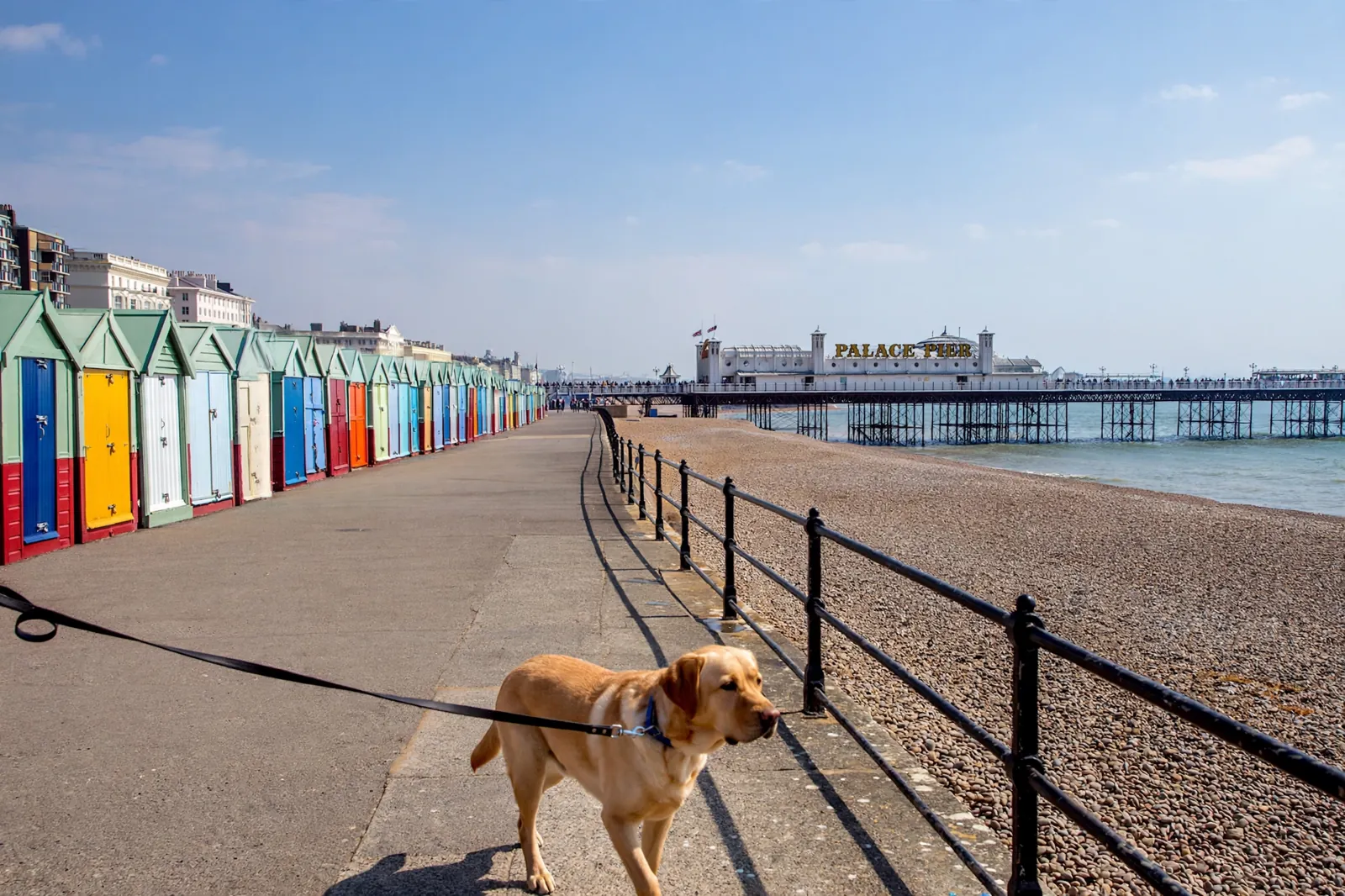
If you are combining Arundel with the coast, the train connection to Brighton is a natural next step. Our guide to Brighton with a dog explains the seasonal beach bans, the promenade and pier rules, and the South Downs walks that link the coast to the hills, and it is worth reading before you plan a two-centre trip. The contrast is useful: Brighton is a busy, open, seaside city, while Arundel is a quiet, enclosed, river town, and a dog that is tired by Brighton will often be happier in Arundel, and vice versa. Plan the two towns as different days, not as a single rushed day, and the dog will get the best of both.
Eating and drinking with a dog
Arundel is a good town for eating with a dog, as long as you choose the right place and mention the dog when you book. The Black Rabbit, on Mill Road at Offham, is the best-known dog-friendly pub in the area, and it is also the natural end point for a riverside walk. The pub welcomes dogs in designated areas and on its terrace, with water bowls and treats provided, and it asks guests to mention a dog in the booking notes so staff can seat them in the best spot. The pub sits beside the River Arun, with views across the water towards the castle, and it is a popular destination for walkers, cyclists and families, so it can be busy at lunchtime on a sunny weekend. Book ahead if you can, arrive a little earlier or later than the main lunch rush if your dog is nervous in a crowd, and keep the dog on a lead under the table.
Swanbourne Lodge Tearoom, at the lake, is the other essential dog-friendly stop. Well-behaved dogs are welcome inside the lodge and outside in its garden, on a lead at all times, and not allowed on tables and chairs. The tearoom makes homemade dog biscuits on site, sells dog sausages, and always has fresh water available. That combination makes it a better choice than a generic cafe for a dog that has just walked the lake, because the staff expect dogs, the space is used to them, and the dog can settle without being stared at. The tearoom is also a good place to ask about the park, the lake and the river, because the staff see the walks every day and know which paths are muddy, which are busy and which are best avoided after rain.
In the town centre, the Norfolk Tap on the High Street is listed as dog-friendly, and it is a useful option for a drink or a meal after a town walk. The pub, part of the Norfolk Hotel, has a Town Bar that is smart and comfortable, and it is worth checking the current policy before you go, because bar and restaurant areas can have different rules. The general pattern in Arundel is the same as in most English market towns: dogs are welcome in the bar and on the terrace, less often in the formal restaurant, and always on a lead. If you are unsure, ask at the door, and be ready to sit outside if the indoor area is not suitable. A dog that is settled on a terrace with a blanket and a bowl of water will be happier than a dog that is squeezed into a busy dining room.
For cafes and tea rooms in the town, the rule is to ask first and to keep the visit short. Many cafes welcome a dog that is calm, clean and on a lead, especially if you sit outside or near the door, but the decision is the cafe's, and it can depend on the time of day, the number of other customers and the space available. Do not bring a wet, muddy dog into a small cafe after a riverside walk without asking, and do not expect a cafe to provide a dog bed, a bowl or a treat as a matter of course. Carry your own water bowl, a small blanket for the dog to lie on, and a few treats, and the dog will settle faster and be welcomed back. If a cafe says no, accept the answer politely, and move on to a place that does welcome dogs. There are enough dog-friendly options in Arundel that a refusal does not need to spoil the day.
A final eating point is about food safety. Do not feed a dog from the table, and do not let a dog eat dropped food in a pub garden or a market. Cooked bones, onions, chocolate, grapes, xylitol and alcohol are all dangerous for dogs, and a pub garden is full of dropped food that is hard to see. Keep the dog on a lead, keep its head away from other tables, and bring its own food and treats if it needs a meal while you eat. A dog that has been fed before you sit down will be calmer, quieter and less likely to beg, and the meal will be better for everyone.
Staying overnight with a dog
Arundel is small enough for a day trip, but it also works as an overnight base for the South Downs, the coast and the Arun valley. If you plan to stay, book a place that is genuinely dog-friendly, not just a place that tolerates dogs, and confirm the dog policy in writing before you pay. The questions to ask are the same as for any dog-friendly stay: how many dogs are allowed, is there a pet fee and how much is it, are dogs allowed in the bedroom and the dining room or only in the bedroom, is there a garden or a toilet area, and what happens if the dog barks. A place that answers those questions clearly, with a fee, a limit and a rule, is a better bet than a place that says only that it is dog-friendly. For a longer comparison of fees, boundaries and booking questions, our guide to dog-friendly holiday parks in the UK sets out the checks that matter before you pay, even if you are booking a hotel or a cottage rather than a park.
Location matters more than luxury for a dog stay in Arundel. A place on Mill Road, near the lake and the park, gives a short, easy toilet walk in the morning and the evening, without a drive or a steep hill. A place in the old town gives a short walk to the river and the shops, but it may mean stairs, narrow pavements and a busy street at night. A place outside the town, in the villages to the north or towards the coast, may give a garden and a quieter night, but it will need a car for every walk. Choose the location that fits your dog's night-time needs, not just the daytime view. An older dog, a puppy or a dog that needs a toilet break at night will be happier with a ground-floor room, a garden and a short, lit path, than with a beautiful room at the top of a steep staircase.
Check the room itself, not just the building. Ask whether the room has a hard floor or a carpet, whether there is space for a dog bed beside your bed, whether the windows open safely, and whether there is a place to dry a wet dog after a walk. A room with a tiled floor, a door to a garden and a towel rail is easier for a wet dog than a carpeted room with a single small window. Bring the dog's own bed, its usual food and water bowls, a spare lead, a towel and a drying coat, and set the room up as soon as you arrive. A dog that finds its own bed, its own bowl and its own smell in a new room will settle faster than a dog that is expected to sleep on a strange bed in a strange place.
Evening and morning routines are the parts of an overnight stay that most often go wrong. Do not leave a dog alone in a hotel room or a cottage while you go out to dinner, unless the property has said in writing that it is allowed and the dog is settled, crated and quiet. Most dog-friendly places expect the dog to come with you, to stay on the terrace, or to be left only for a very short time. Plan dinner as a dog-friendly meal, or take it in turns to eat, or order food to the room if that is allowed. In the morning, give the dog a toilet walk before breakfast, not after, and allow time for a short walk before you check out. A dog that has been walked, fed and settled will travel better than a dog that has been rushed from a room to a car.
If you are staying for more than one night, use Arundel as a base for a wider South Downs trip. The town is within easy reach of Amberley, Pulborough, Chichester and the coast at Littlehampton, and the walks from the town can be varied by direction, by length and by terrain. A second day can be a longer downland walk, a riverside walk to a different village, or a quiet day at the lake and in the town. The dog will benefit from a rest day as much as from a long walk, and a slower second day, with a short morning walk, a long lunch and a short evening walk, is often the best way to end a break. Do not try to do every walk in the guide in one weekend. Choose two or three, do them well, and leave the rest for a return visit.
River, livestock, mud and seasonal safety
Safety in Arundel is mostly about the river, the livestock, the mud and the seasons, and all four are easy to manage if you plan for them. The river is the biggest risk, and it is covered in detail above, but it is worth repeating here: keep the dog on a lead near the Arun, keep the dog out of the water, carry fresh drinking water, and do not let the dog chase sticks, ducks or boats into the river. The Arun is tidal at Arundel, and the Environment Agency gauge at Arundel normally sits between minus 0.70 metres and 3.30 metres, with the highest level on record at 3.65 metres on 6 December 2013. Those numbers do not need to be memorised, but they show that the river can rise quickly after rain and that the low riverside paths can be affected. Check the official guidance before you travel if there has been heavy rain, and check the Environment Agency flood service for the River Arun if you are unsure. If a flood alert or warning is in force for Arundel, River Road or the tidal areas of River Road, choose the higher park paths instead of the low riverside paths.
Livestock is the second risk, and it is present in Arundel Park, on the South Stoke loop and on the riverside paths towards Amberley. Cattle and sheep graze the open grassland, and they are often close to the footpaths. Keep the dog on a short lead, walk steadily past, do not let the dog bark at, chase or circle the animals, and give a wide berth where the path allows. If cattle are on the path, wait, take a wider line or turn back. Do not walk between a cow and its calf, and do not let a dog off the lead in a field with livestock, even if the field looks empty. The law in England and Wales allows a farmer to shoot a dog that is worrying livestock, and the risk to the dog is real, even if that outcome is rare. A lead is the simplest protection for the dog, for the livestock and for you.
Mud, ticks and weather are the quieter risks. After rain, the riverside paths, the woodland paths and the low parkland can be muddy, slippery and slow, and a dog can pick up ticks in long grass and woodland, especially in spring and summer. Check the dog for ticks after every walk, carry a tick remover, and use the tick prevention recommended by your vet. In summer, watch for heat on the open downland, where there is little shade, and carry extra water. In winter, watch for ice on the lake paths, for short daylight and for the early closing of cafes and car parks. In autumn, watch for acorns, conkers and fallen fruit, which can be harmful if eaten, and for fireworks around early November, which can unsettle a nervous dog. A drying coat, a towel and a spare lead are useful in every season, and a small first-aid kit, with a bandage, a tick remover and the number of the nearest vet, is worth carrying on the longer walks.
Two places need a clear warning because they are easy to confuse with dog-friendly attractions. The Wildfowl and Wetlands Trust centre at Arundel, WWT Arundel, does not allow pet dogs on site, with the exception of trained assistance dogs, because the wildlife may become distressed. Trained assistance dogs are welcome on a lead, but pet dogs must not be brought in, and dogs must not be left in a car while you visit. The centre is a wonderful place for people, with ducks, geese, swans, reedbeds and a boat safari, but it is not a dog day out, and the paths past the centre should be walked with the dog on a lead, out of respect for the birds. The castle, as explained at the start of this guide, has the same rule: only registered assistance dogs are allowed in the grounds. Do not try to take a pet dog into either place, and do not leave a dog in a car outside either place while you go in.
Finally, know the basics of dog law and etiquette before you travel. In the United Kingdom, a dog must wear a collar with the owner's name and address when in a public place, and a dog that is dangerously out of control in a public place can lead to a criminal offence. Clean up after your dog, every time, and carry the bag out with you, even if there is no bin nearby. Keep the dog on a lead on roads, near livestock, near nesting birds and in busy places. If your dog is reactive, nervous or in season, choose the quieter paths, walk at quieter times, and warn other walkers in good time. For the wider rules on where dogs can and cannot go, including seasonal beach bans and the fines that can follow, our guide to dog-friendly beaches in the UK explains the 2026 rules, the public spaces protection orders and the assistance-dog exceptions in detail, and it is a useful companion to this guide if you plan to combine Arundel with a coastal day.
Arundel is at its best when it is taken slowly, with a lead in your hand, water in your bag and a plan that leaves room for a pause. The castle will be there tomorrow, the river will still be running, and the lake will still be quiet in the morning. A dog that is walked, rested, fed and kept safe will enjoy Arundel far more than a dog that is hurried through every landmark in a single day. Start with the lake, follow the river, climb into the park if the dog is keen, and end the day in the old town with a drink and a rest. That is the Arundel that works for a dog, and it is the Arundel worth returning to.
Practical questions
Before you go
Can dogs go into Arundel Castle?
No, pet dogs cannot go into Arundel Castle or its grounds. Only registered assistance dogs are permitted. Plan the castle as a human-only visit, or admire it from the town, the river and Arundel Park, where dogs on leads are welcome on the public footpaths.
Where is the best short walk with a dog in Arundel?
For most dogs, the Swanbourne Lake and Arundel Park loop is the best short walk. It is about 4.5 kilometres, or 2.8 miles, takes around one hour and fifteen minutes, and combines surfaced lakeside paths, parkland and castle views. Keep your dog on a lead, especially between March and September when birds are nesting around the lake.
Can dogs swim in the River Arun or Swanbourne Lake?
Do not plan on swimming. The River Arun is tidal at Arundel, with a fast ebb tide and strong currents, and it is not a safe or suitable place for dogs to swim. Swanbourne Lake is an ornamental boating lake with waterfowl, not a dog-swimming lake. Keep dogs on a lead near both, and carry drinking water instead.
Is Arundel Park off-lead?
Treat Arundel Park as a lead walk. Dogs are welcome on the public footpaths on leads, and leads are advised because of livestock, nesting birds, other walkers and the nearby wildfowl centre. Some wider routes may allow more freedom in places, but check the official guidance before you travel and keep a lead in your hand.
How do I get to Arundel by train with a dog?
Arundel station is on the Arun Valley Line, with direct trains to London Victoria and connections at Ford or Barnham from Brighton and Chichester. The station is about a mile from the town centre and the Mill Road walk start, so allow time for a steady on-lead walk, or book a local taxi in advance.
Where can I eat with a dog in Arundel?
The Black Rabbit on Mill Road welcomes dogs in designated areas and on its terrace, and Swanbourne Lodge Tearoom welcomes well-behaved dogs on leads inside and in its garden. Mention your dog when booking so staff can seat you in the best spot, and check the official guidance before you travel, as policies can change.