This guide is independent and contains no paid placement. If affiliate links are added later, they will be clearly marked and will not change our editorial checks.
Aviemore with a dog works in every season, but no two seasons work the same way. Use Loch Morlich and the Glenmore pinewoods for loch-and-forest days, Rothiemurchus and the Green Lochan for quieter measured miles, and the village itself for food, supplies and wet-weather cover. Keep dogs on a short lead in capercaillie woodland in the breeding season, check attraction dog rules before you travel, and in ski season swap slope time fairly rather than leaving a dog waiting in a busy car park.
Aviemore in four seasons: choose your timing first
Most guides open with a walk. This one opens with a calendar, because Aviemore is really four different dog destinations sharing one postcode. The village sits on the River Spey at the northern edge of the Cairngorms National Park, with ancient Caledonian pinewood, a freshwater beach loch and a ski mountain all within a short drive. Which of those dominates your trip — and which rules bite hardest — depends entirely on when you come. Read the table across, pick the row that matches your dog, and only then start planning routes.
| Season | Best dog days | Watch for | Lead notes |
|---|---|---|---|
| Spring (March to May) | Quiet trails, full rivers, pinewood walks before the summer crowds; Green Lochan and Rothiemurchus at their freshest | Lingering snow on high ground, cold loch water, changeable days that start mild and end wintry | Capercaillie lekking and nesting begins — short lead and stay on paths in signed pinewood |
| Summer (June to August) | Loch Morlich beach days, longest daylight, full choice of cafés, attractions and evening walks | Busy car parks and beach, midges in still woods, hot cars, watersports sharing the shore | Short lead near beach users, launches and livestock; breeding-season rules continue into summer |
| Autumn (September to November) | Golden pinewoods, quieter lochs, red deer rut heard in the glens, crisp walking weather | Shortening days, first snow on the plateau, deer and estate activity — follow local diversion signs | Keep distance from deer and livestock; lead on around stalking notices and farm ground |
| Winter (December to February) | Snowy forest walks, ski-season buzz in the village, cosy pub evenings and empty midweek trails | Ice, very short daylight, ski traffic and full car parks on good snow days, bitter plateau wind | Lead near ski areas, roads and reindeer ground; dogs need warmth and paw checks after icy paths |
The pattern underneath the table is simple: Aviemore rewards a flexible plan more than a fixed itinerary. A route that is perfect on a calm September Tuesday can be a poor choice on a snowy Saturday in February or a hot, crowded beach day in July. Build each day from three parts — one main walk, one short leg-stretcher near your base, and one indoor or village hour — and you can shuffle the order as weather and crowds dictate without the dog losing out. Dogs read routine, not itineraries, so a rearranged day still feels complete to them.
Getting oriented helps every season. The main road runs through the village with most stays, shops and eating places close to it, while the road east towards Glenmore and the Cairngorm ski area passes Rothiemurchus, Loch Morlich and Glenmore Forest Park in sequence — a single corridor containing most of the classic dog walks. West and south, the Speyside Way gives level riverside miles, and villages such as Boat of Garten, Nethy Bridge, Carrbridge and Kingussie spread the choice of quieter bases along the valley. For the wider national park picture, including plateau judgement and wildlife seasons, read our Cairngorms with a dog guide alongside this village-level plan.
Loch Morlich and Glenmore: beach, forest and careful swimming
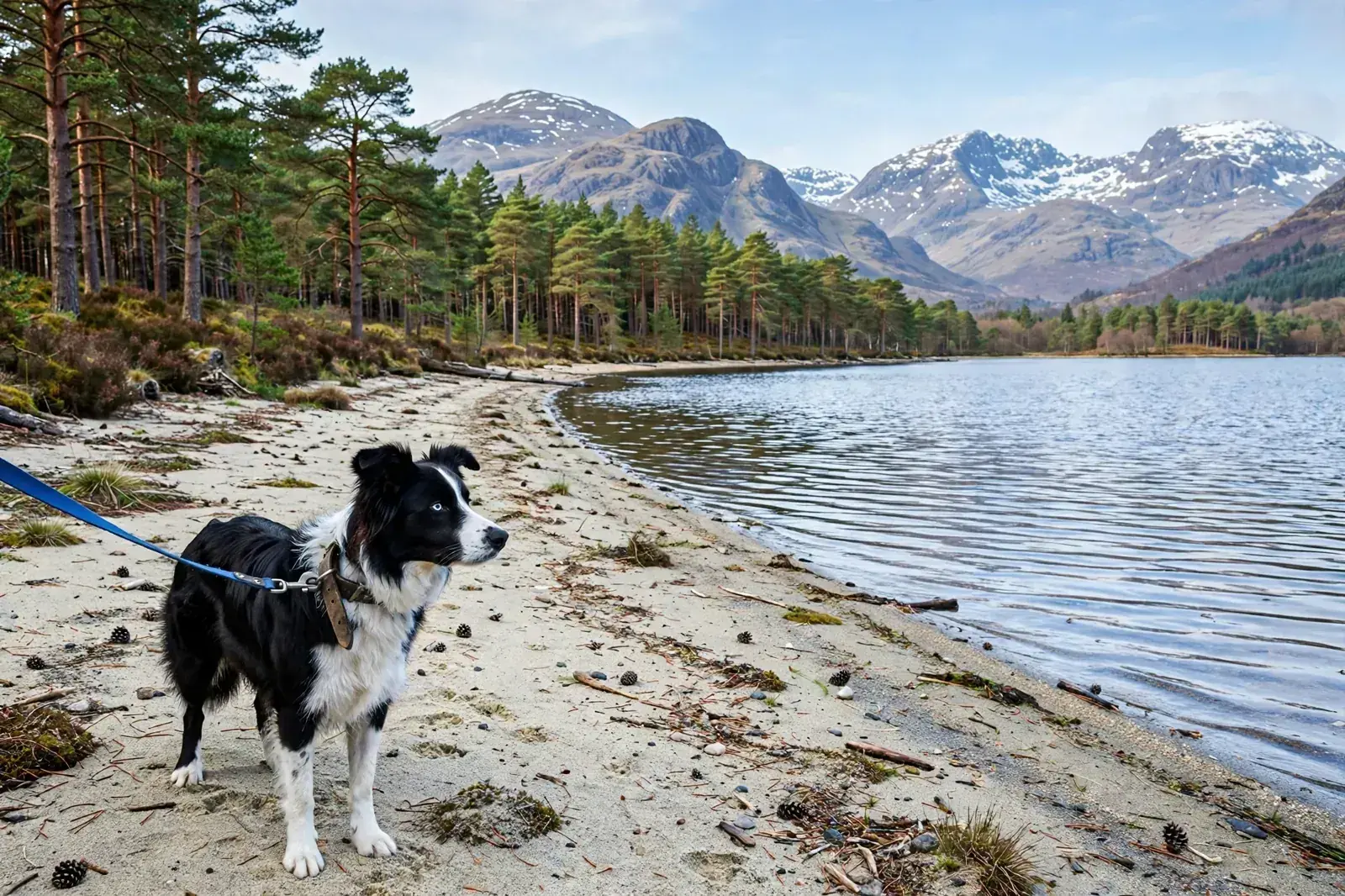
Loch Morlich is the walk most Aviemore dogs remember. A broad crescent of pale sand sits at the edge of a freshwater loch, backed by Glenmore's pine forest and facing the Cairngorm mountains across the water — a beach that happens to be several hundred metres above sea level. The circuit of the loch, using forest tracks and shoreline paths, makes a satisfying half-day of roughly three to four miles depending on the exact line taken, and shorter out-and-back walks from the main car parks and the Glenmore side let you size the day to your dog. Check the latest official guidance before you travel for parking, facilities and any path or forestry works.
Beach manners matter here precisely because the place is shared so intensively. Swimmers, paddleboarders, sailors, picnicking families and other dogs all use the same strip of sand, and a dog that charges through that mixture creates work for everyone. Keep leads on near the watersports areas, the café and busy sections, let a dog off only where it has a reliable recall and clear space, and call it back well before it reaches other people's towels, boats or lunches. If your dog is a committed greeter, the quieter ends of the shore and the forest tracks behind the beach deliver the same smells with a fraction of the diplomacy.
Swimming needs a Highland caveat. Loch water stays cold in every month, cold enough to shock a dog that launches itself in after a hot walk, and entries around launches and moorings mix dogs with kit and ropes. Choose a quiet, gently shelving spot away from activities, keep swims short, and dry and warm the dog afterwards, especially small, old or lean dogs. Watch for blue-green algae notices in warm, still spells at any freshwater loch and keep dogs out of the water entirely if signs warn of it. The forest alternative is always there: Glenmore's waymarked trails give shade, soft surfaces and red squirrel country on days when the beach is either too busy or too bleak.
Practical rhythm transforms a Loch Morlich day. Arrive early in summer and on ski-season weekends, because the corridor car parks fill in a predictable wave; in winter, allow for ice on shaded tracks and for daylight that ends the day by mid-afternoon. Carry water despite walking beside a loch — a dog should drink from your bottle, not from shared shorelines — and bag and remove all waste, using bins at car parks and carrying out from quieter stretches. A dog that ends the day sandy, tired and slightly pine-scented has had Loch Morlich exactly as intended.
Rothiemurchus and the Green Lochan: ancient pines, measured miles
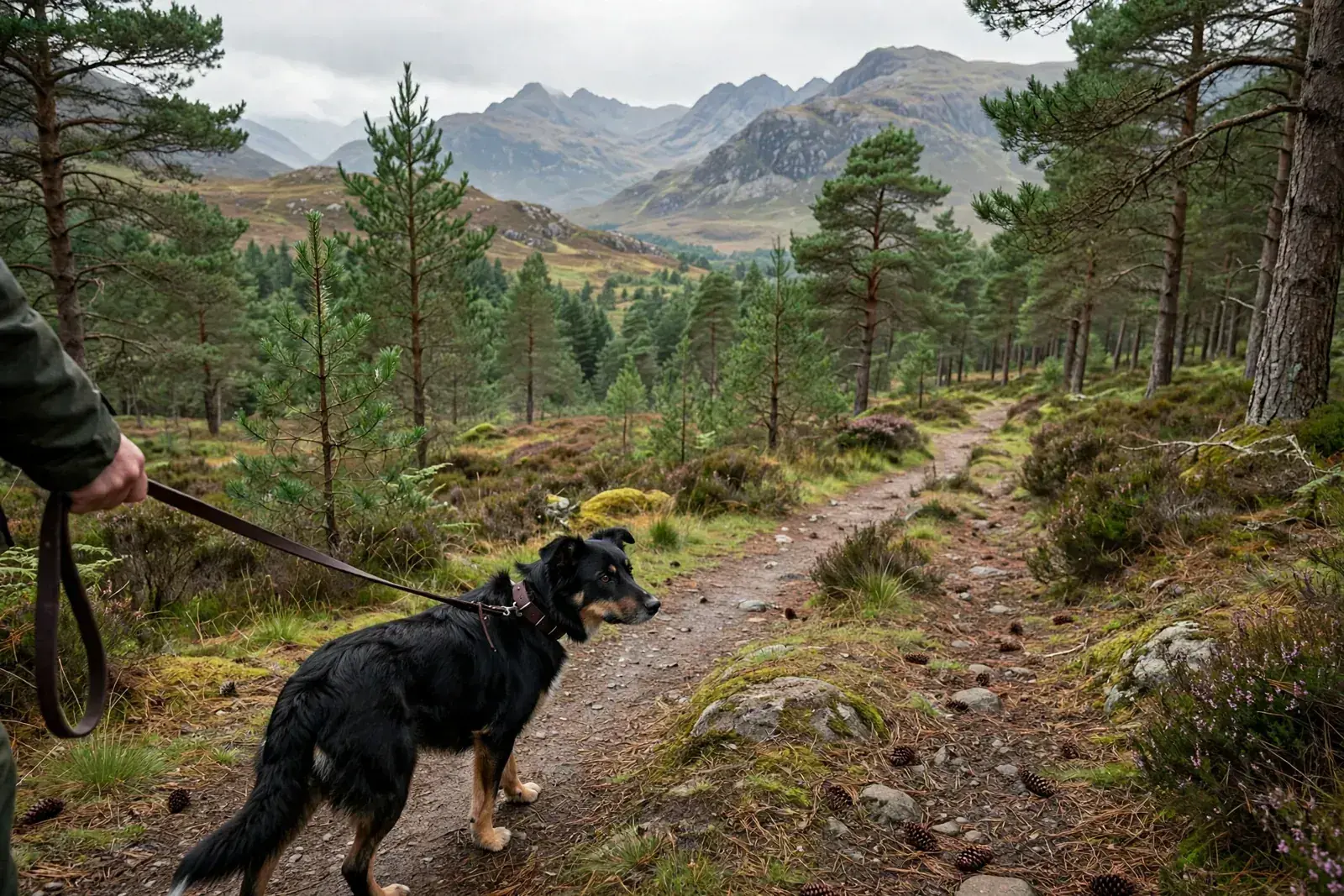
If Loch Morlich is Aviemore's headline, Rothiemurchus is its depth. This large, family-run Highland estate between the village and Glenmore holds some of the finest remnants of Caledonian pinewood in Scotland — old, gnarled Scots pines, juniper, birch and a forest floor of blaeberry and heather — threaded by a network of waymarked trails around Loch an Eilein, Loch Morlich's quieter neighbours and the tracks towards the Lairig Ghru. Loch an Eilein, with its small island castle ruin and a level circuit of around three miles, is the classic Rothiemurchus dog walk: beautiful in every season, manageable for most dogs, and structured enough that distance never surprises you.
The estate is a working landscape as well as a beautiful one, with farming, forestry, conservation and visitor activities sharing the ground, so its rules deserve the same respect as its scenery. Stay on paths where asked, follow activity and diversion signs, keep dogs close around livestock, cyclists, horse riders and estate vehicles, and check the latest official guidance before you travel for trail information, parking and any charges or closures. Dogs that need space often do well here outside peak times, because the trail network lets you choose quieter loops and step aside with long sightlines when others approach.
The Green Lochan — Lochan Uaine — offers the area's most distinctive short walk. Tucked in the pass between Glenmore and the Ryvoan area, this small loch is famous for its green-tinted water, coloured, local tradition says, by the piskies washing their clothes; the more prosaic explanation involves algae and light, but the effect is real either way. The walk from the Glenmore area through the pinewood makes a gentle there-and-back that suits a half-day with an older dog or a second walk after a bigger morning. Add the nearby Ryvoan bothy exterior and the viewpoint stops along the way only as far as your dog's legs suggest, and never leave anything in a bothy or take a dog inside if others are sheltering — check current Mountain Bothies Association guidance before relying on any bothy detail.
Linking these walks builds the best Aviemore walking days. A Rothiemurchus morning, a village lunch and a short Speyside Way evening stretch gives most dogs a complete day without a car marathon, while a Glenmore and Green Lochan day pairs naturally with Loch Morlich if energy remains. Distances here are honest but surfaces are kind — forest tracks rather than mountain paths — which makes this corridor the right place to build a young dog's fitness or protect an older dog's joints across a full week. Save the high tops for a settled forecast and a mountain-ready dog, using our Ben Nevis walk with a dog guide as a reminder of how seriously Highland summits should be taken, even though the Cairngorm plateau is a different mountain in a different glen.
Reindeer, Landmark and days out: what dogs can and cannot do
Aviemore's visitor attractions create the most common dog disappointment in the valley, and it is almost always avoidable with one check the night before. The pattern is consistent: outdoor, ground-level places often have a workable dog answer, while animal encounters, indoor attractions, rides and transport experiences often do not. The error is assuming that a dog-friendly area means a dog-friendly attraction. It does not, and the two headline examples below show why the detail matters more than the headline.
The Cairngorm Reindeer Centre near Glenmore is home to Britain's only free-ranging reindeer herd, and its best-known experience — the guided hill trip to meet and feed the herd — involves livestock on sensitive hill ground. Dogs are not normally part of those hill visits, and a dog left in a car on a warm day, or tied up in an unfamiliar place, is not an acceptable workaround. Treat the reindeer as a human-only excursion within a dog holiday: split the group if you can, time it as the dog's rest period back at your accommodation where that is allowed and safe, or choose the centre's lower-level options only after confirming exactly what is currently offered and whether any of it suits a dog at all. Check the latest official guidance before you travel, because visit formats and seasonal arrangements change.
Landmark Forest Adventure Park at Carrbridge, a short drive north, plays a different register: forest trails, towers, rides and indoor exhibitions in one large site. Its dog position has historically been more welcoming outdoors — dogs on a lead in some outdoor areas — while buildings, rides and indoor attractions remain human-only territory, but policies and the exact areas included can change. Check the latest official guidance before you travel for the current dog rules, any kennel or waiting arrangements and seasonal opening, and plan the day so the dog is never an afterthought at a gate. For many groups the honest solution is again a split day: Landmark for part of the group, a Carrbridge or pinewood walk for the dog team, and a shared evening in Aviemore.
The same checking habit unlocks the rest of the valley. The Strathspey Railway, Highland wildlife attractions, museums, cafés and watersports providers each set their own dog terms — some welcome dogs in specific carriages, gardens or outdoor seating, others not at all — and none of those positions can be guessed from a neighbour's. Build a two-list plan before you arrive: confirmed dog-welcome options for shared days, and split-group options for the experiences that matter to the humans. A holiday built that way contains no gate-side arguments, no hot cars, and no dog learning that Aviemore means being left out.
Capercaillie, red squirrels and lead rules that protect them
The pinewoods around Aviemore hold one of Britain's rarest and most vulnerable birds, and your lead is part of its survival plan. The capercaillie — a huge, turkey-sized grouse of the old pine forest — has declined to critically low numbers in Scotland, with the Strathspey woods among its last strongholds. Males display at communal lek sites in spring, hens nest on the ground and raise chicks through the summer, and every stage of that cycle is easily broken by a dog ranging off the path. A single flushed hen can lose a nest; repeated disturbance in a small, fragile population is not a minor courtesy issue but a conservation one.
The practical rule is refreshingly clear. In capercaillie country — including signed areas of Rothiemurchus, Glenmore, Anagach Woods near Grantown-on-Spey and other Strathspey pinewoods — keep your dog on a short lead during the breeding season, broadly spring into summer, stay on the paths, and follow any signed or ranger request at any time of year. Some places and projects ask for leads for longer periods or on particular trails, and those local requests override any general rule you have read elsewhere, including here. Check the latest official guidance before you travel, read the signs at each trailhead, and treat a lead in these woods the way you would treat a ticket: without it, the experience is not really open to you.
Other wildlife benefits from the same habits. Red squirrels — still strong in Strathspey thanks to the pinewoods and active conservation — feed on the ground as well as in the canopy, and a chasing dog is a genuine threat. Roe deer raise calves in long grass and bracken in early summer, mountain hares and ground-nesting birds use the open moor edges, and ospreys return to Loch Garten and the Spey in summer, viewable from hides and viewpoints where dogs are managed carefully or not admitted. None of this asks you to keep a dog out of the countryside; it asks for close control, a lead where signed or near wildlife, and a recall that works when a squirrel crosses the track — which, in Aviemore, it will.
There is a positive side to walking this carefully: you see more. A dog walking quietly at heel on a forest track does not empty the woods ahead of you, and early mornings on a lead in Rothiemurchus or Anagach can produce squirrel, deer and woodland bird encounters that an off-lead charge would have scattered a field away. Train the behaviour the woods require before the holiday if you can — a settled loose-lead walk, a reliable wait at junctions, and calm watching while you stop — and the conservation rules stop feeling like restrictions and start feeling like the technique of the place.
Ski season with a dog: busy slopes, quiet alternatives
Winter transforms Aviemore's rhythm. On good snow days the village fills with skiers, the Cairngorm road becomes a morning procession, and the mountain car parks operate at a tempo that has nothing to do with dog walking. Cairngorm Mountain's ski area, funicular railway and pistes are built for skiers, snowboarders and sightseeing passengers, not for dogs: a dog cannot join you on lifts or slopes, the base areas are crowded with kit, vehicles and beginners, and a dog waiting in a cold — or, in bright sun, surprisingly warm — car gains nothing from the arrangement. Check the latest official guidance before you travel for current mountain access, parking and any changes to facilities.
The fair solution is the split day, and Aviemore makes it unusually easy. While one part of the group skis, the dog team takes the valley's winter walking: Loch Morlich's shore and forest trails in snow, Rothiemurchus tracks under laden pines, or the level Speyside Way with the river running black between icy banks. Swap at lunchtime or on alternate days, and both skiers and dog collect a full holiday rather than a compromise. Groups where everyone wants to ski every day should arrange proper dog care in advance rather than improvising around car parks, and solo travellers who ski should plan dog-free slope time honestly — the dog's rest day at suitable accommodation, with a substantial walk before and after, beats a day of waiting anywhere.
Winter dog care has its own checklist. Short daylight compresses two walks into a few hours, so headtorches, reflective gear and a planned finish time are essentials, not extras. Ice and gritted roads trouble paws: rinse and dry feet after walks on salted surfaces, check between pads for ice balls on snowy forest days, and use a coat for thin-coated, small or elderly dogs in plateau-strength wind even at village level. Frozen lochs and icy river edges are not play surfaces — keep dogs off ice entirely, however solid it looks, and lead dogs near fast, cold water. Cars need the same thought in reverse: never leave a dog in an unventilated vehicle in winter sun while you queue for a lift pass.
Choose your winter base with the ski traffic in mind. Staying in Aviemore village keeps evening food and supplies walkable when roads are icy, while Glenmore-side stays put you beside the forest walks but on the ski road itself. Book parking-dependent plans loosely, expect the best snow days to be the busiest walking days at Loch Morlich too, and keep one foul-weather village day in reserve — the dog will not mind a pattern of woodland walk, warm café stop where dogs are welcome, and a short evening stretch, and neither, by day four, will you.
Staying in and around Aviemore: bases for every dog
Aviemore village is the default base for good reason. It offers the valley's widest choice of hotels, lodges, self-catering, hostels and campsites, plus supermarkets, outdoor shops, a veterinary practice, cafés and pubs — the full support system of a dog holiday within walking distance of bed. Walks start at the door too: the Speyside Way passes through, Craigellachie National Nature Reserve rises straight behind the village with birchwood trails and a viewpoint over Strathspey, and short riverside stretches handle first and last walks of the day. For a first Aviemore trip, a dog that needs a vet within reach, or anyone travelling without a car using the railway station on the Highland Main Line, the village is the sensible answer.
The alternatives trade services for setting. Rothiemurchus and Glenmore-side stays — including lodges, campsites and bunkhouse-style options around the forest — suit walk-first trips where the day begins on a pinewood trail and the dog's evening walk is a forest track rather than a pavement. Carrbridge, with its famous old packhorse bridge, and Boat of Garten, the osprey village, offer quieter evenings, good local walks and an easy drive back to Aviemore's shops. Grantown-on-Spey adds a handsome small town, Anagach Woods at its edge and a useful base for the eastern Spey, while Kingussie and Newtonmore down the valley suit longer stays combining Aviemore days with quieter southern Strathspey walking.
Wherever you book, ask the dog questions that decide whether a stay actually works. Confirm the total dog charge, how many dogs are accepted and of what size, whether the dog can be left unattended and for how long, whether there is genuinely enclosed outdoor space rather than a shared garden described generously, where the nearest after-dark walk runs, and how mud, wet and snow are handled — a hose, a boot room or a tiled entrance changes a Highland week more than a thread count does. Self-catering with a washing machine and drying space quietly outperforms almost every luxury extra for a pinewood-and-beach holiday.
Eating out follows the same verify-first pattern as attractions. Aviemore and the villages have pubs and cafés that welcome dogs in bars, gardens or specified areas, and others that do not; water bowls on a terrace in summer tell you little about a January evening. Check current dog arrangements when you book a table, carry a settle mat so the dog has a defined place under it, and keep one supermarket-based evening in the plan for the night when weather, tiredness or a soaked dog makes staying in the kindest option. A dog asleep by a stove after Rothiemurchus is not missing out on Aviemore nightlife. It is Aviemore nightlife, correctly understood.
Shorter legs, older dogs and foul-weather plans
Aviemore suits dogs that cannot do big days better than many mountain bases, because its best landscapes include genuinely level, short options. The Loch an Eilein circuit can be shortened with out-and-back sections, Loch Morlich offers beach strolls of any length from the car, the Speyside Way gives flat riverside miles in either direction from the village, and Craigellachie's lower trails deliver woodland without a summit commitment. A senior dog can have a full Aviemore week built from forty-minute walks, long sniffing stops and viewpoint picnics, and will have experienced the pinewoods, the loch and the river as completely as a dog that walked three times as far.
Puppies and dogs returning from injury benefit from the same measured ground. Forest tracks give predictable surfaces and distances you can increase by a loop at a time, and the corridor layout means a walk that turns out to be enough can end at a car park rather than halfway round a mountain. Follow your vet's guidance on exercise for young or recovering dogs, build rest days into the week rather than waiting for stiffness to impose them, and remember that travel itself — new smells, new sounds, a different bed — is exercise for a young dog's brain. A quiet day of village pottering and one short forest walk is a training asset, not a wasted day.
Foul weather, which Aviemore supplies in every season, needs a plan rather than an apology. The reliable pattern is one good walk in the best window of the day — radar and common sense usually find one — plus short, practical outings in the worst of it, with drying, feeding and warmth handled promptly back at base. Choose waterproofs and a dog coat that you have tested before the trip, keep towels and a spare lead in the car, and know which cafés and indoor stops currently welcome dogs for a warm hour; check the latest official guidance before you travel, because those arrangements change. If wind makes forest walking unwise — a real consideration in old pinewood after storms, when branches and whole trees can come down — switch to open, level ground such as the Speyside Way, follow any forestry closure signs without exception, and let the mountain wait for another day.
End the trip the way the valley asks to be left. Take all waste out of the woods and off the beach, close gates, keep the lead habits that protected capercaillie and squirrels all week, and leave your accommodation's floors, gardens and neighbours as welcoming as you found them. Aviemore's dog welcome rests on thousands of unremarkable acts of care by visiting owners, most of them invisible. Joining that tradition is simple, and it is what keeps the pinewoods, the loch shore and the village doors open to the next dog — which, with luck and a good calendar choice, will be yours again in a different season.
Practical questions
Before you go
Are dogs allowed at Loch Morlich beach?
Yes, dogs are generally welcome around Loch Morlich and its sandy beach, but keep them under close control, on a lead near other beach users, watersports launches and livestock, and out of the way of swimmers. Bag and remove all waste, check current Forestry and Land Scotland signs on arrival, and be ready to shorten the lead or move along the shore if the beach is busy.
Can dogs visit the Cairngorm Reindeer Centre and Landmark Forest Adventure Park?
Rules differ and change, so check the latest official guidance before you travel. The reindeer hill visits involve livestock and sensitive ground, and dogs are not normally part of those trips. Landmark at Carrbridge has historically welcomed dogs on a lead in some outdoor areas but not inside attractions and buildings. Confirm the current position for your exact dates before building a day around either visit.
When must dogs be on a lead near Aviemore for capercaillie?
Keep dogs on a short lead in capercaillie woodlands during the breeding and lekking season, broadly spring into summer, and follow signed requests at any time of year in places such as Rothiemurchus, Glenmore and Anagach. Capercaillie are rare, ground-nesting and easily disturbed. Follow local signs and ranger advice on the day, and stay on paths in sensitive pinewood.
Can I take my dog skiing at Cairngorm Mountain?
A dog cannot join you on the pistes, lifts or funicular in any useful way, and ski areas are busy, fast and unsuitable for a waiting dog. Plan ski days in shifts so one person skis while another walks lower-level routes around Glenmore and Loch Morlich, or book a full walking day for the dog instead. Check current Cairngorm Mountain guidance before you travel for access and parking rules.
Where is the best base in Aviemore for a dog?
Aviemore village itself suits most dog owners, with stays, food, a vet, shops and walks from the door, plus the Speyside Way and Craigellachie reserve. Glenmore and Rothiemurchus suit walk-first trips close to Loch Morlich and the pinewoods, while Carrbridge and Boat of Garten offer quieter evenings. Wherever you book, confirm dog charges, enclosed ground and an after-dark walk.