This guide is independent and contains no paid placement. If affiliate links are added later, they will be clearly marked and will not change our editorial checks.
Ayr Beach welcomes dogs all year round, with no seasonal ban — keep your dog under control and on a lead near other people. The best day is simple: beach in the morning, the Esplanade and Low Green at midday, and the Burns sites at Alloway in the afternoon, with the dog on a lead in the museum gardens. Check tide times before a long beach walk, and check the official guidance before you travel for any rule changes.
Why Ayr suits dogs better than most resorts
Ayr is not a polished resort town, and that is exactly why it works for dogs. It is a working town of around 46,000 people on the Firth of Clyde, the largest town in Ayrshire and the county town of South Ayrshire, with a harbour, a railway station, supermarkets, vets and a proper high street — and a long sandy beach a short walk from the town centre. Most British seaside towns make you choose between the beach and the town; in Ayr, the two sit side by side, so the dog is never far from a walk, a water bowl or the car.
The first thing to understand is that Ayr's beach is a year-round beach for dogs. South Ayrshire Council has no seasonal dog ban on its beaches, which means there is no summer exclusion period to plan around, no restricted zone to memorise and no date in the calendar when the rules suddenly change. That alone puts Ayr ahead of many English resorts, where the same stretch of sand can be welcoming in October and forbidden in July. The rule that does apply is the Scottish Outdoor Access Code: keep the dog under control, on a short lead or close at heel near other people, and clear up after them. In practice, that means a quiet weekday morning on the wide south end of the beach feels very different from a crowded August afternoon near the funfair — and the guide below is built around choosing the right time and the right stretch of sand.
The second thing is scale. Ayr Beach runs for roughly two miles from the harbour in the north to the mouth of the River Doon at Greenan in the south, and the sand at low tide is wide enough that even on a busy day there is room to give a reactive dog space. Behind the beach sits the Low Green, a broad grassy park with the Esplanade running along it, and beyond that the town itself. So a single outing can mix sand, grass and pavement without ever getting in the car, which matters for older dogs, for puppies that tire quickly and for anyone travelling with a dog that does not enjoy long drives between stops.
The third thing is what lies around Ayr. Alloway, the village where Robert Burns was born in 1759, is about two and a half miles south of the town centre, linked by the River Doon and by a riverside walk. The Ayrshire Coastal Path runs north to Troon and Prestwick and south towards the Heads of Ayr, Culzean Castle and Girvan. Rozelle and Belleisle parks give the town green lungs. And because Ayr is a real town rather than a seasonal resort, the cafes, pubs and shops that welcome dogs tend to do so all year, not just when the holiday crowds arrive. For a dog owner, that combination — a year-round beach, a town that stays open in winter, and walks in every direction — is hard to beat.
This guide is organised the way a visit actually unfolds: the beach first, because that is why most people come; then the rules, tides and weather that decide whether a beach day goes well; then the Burns trail at Alloway, the river walk, the wilder coast to the south and the long walk north to Troon; then the practical parts — parks, food, parking, staying over and wet days. Where a fact could change — opening times, charges, dog policies at individual businesses — the guide says so and asks you to check the official guidance before you travel.
First walk: the Low Green and the Esplanade
If you arrive in Ayr with a dog that has been in the car for a couple of hours, do not head straight for the sand. Start at the Low Green. This is the broad, flat grassy area between the town and the beach, and it is the town's natural decompression zone: room for a lead walk, a sniff around the edges and a first toilet stop on grass before the excitement of the beach. The Esplanade runs along the seaward side of the Green, a level promenade that is ideal for dogs that are unsure on sand, for older dogs that prefer a firm surface and for pushchairs and wheelchairs in the party.
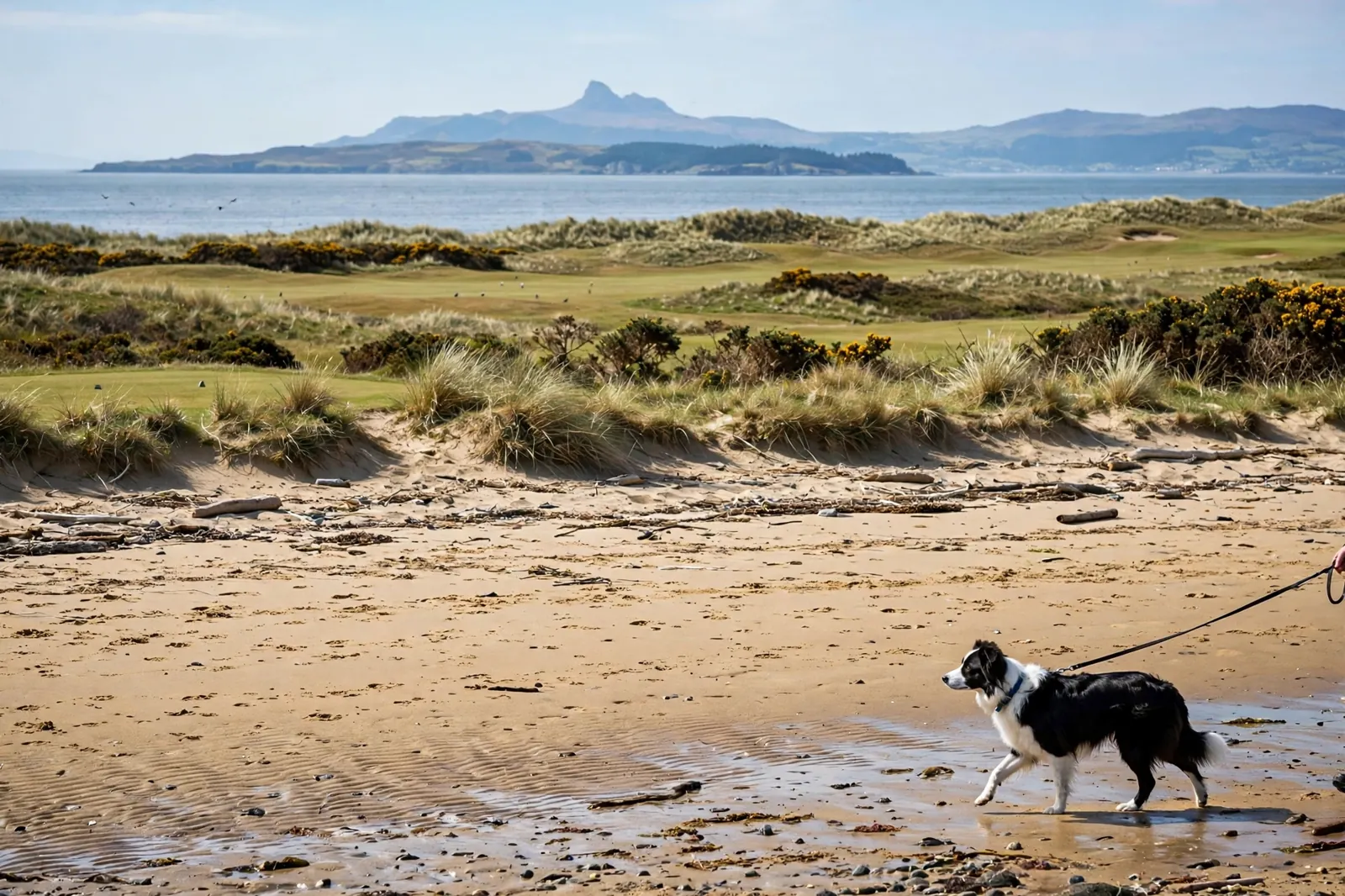
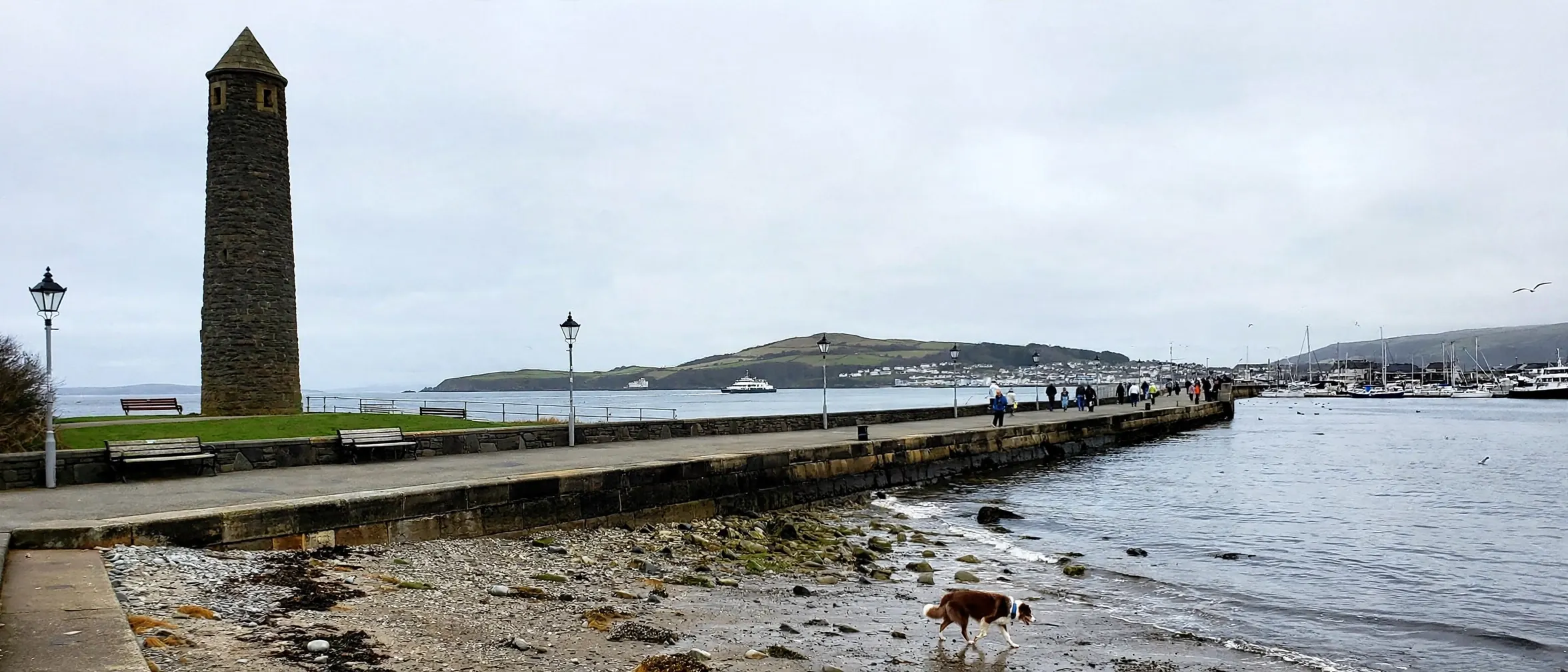
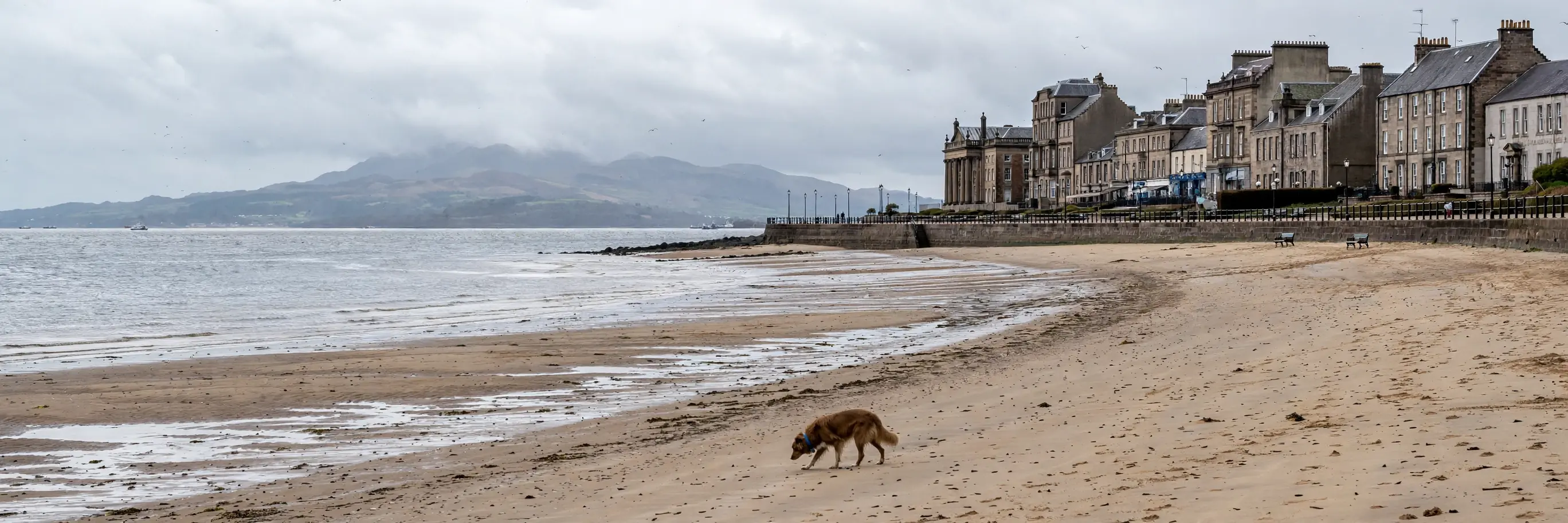
From the Low Green, the layout of the seafront becomes obvious. To the north is the harbour and the mouth of the River Ayr, where fishing boats and pleasure craft sit and where gulls work the water. To the south, the beach stretches away towards the Heads of Ayr, with the Isle of Arran rising across the Firth of Clyde and the unmistakable rocky outline of Ailsa Craig offshore on a clear day. The Esplanade itself is lined with guest houses, flats and a handful of cafes, and there are benches along it — useful for a rest stop with an older dog, and for watching the weather come in across the water, which in Ayrshire it often does.
A good first loop is simple and takes about forty minutes at a dog's pace. Start at the southern end of the Low Green near the beach car park, walk north along the Esplanade to the harbour, then turn back along the beach itself if the tide allows, or along the Green if it does not. The harbour end is busier, with people, boats and traffic, so keep the dog on a lead there and use it as a training opportunity rather than a free run. The southern end is quieter and wider, and that is where most dog walkers naturally drift. If your dog is reactive, walk the Esplanade first and let them watch the beach from a distance before committing to the sand.
There are a few practical points worth knowing before you set off. The beach is sandy but the sand is firm enough near the waterline for most dogs to run on without sinking, while the dry sand higher up the beach is softer and tiring for older legs. There are bins along the Esplanade and the Green, but bring your own bags and carry a spare — the bins at the far southern end are spaced out, and nobody enjoys the walk back carrying a full bag. There is no dedicated dog wash on the seafront, so a towel and a bottle of fresh water in the car are worth their weight on a day when the dog has been in the sea. And in summer, the funfair and amusements near the Green bring noise, music and crowds; a noise-sensitive dog will be happier on the southern stretch, away from the rides.
One more thing about the Low Green: it is also where Ayr's events happen, from summer galas to the fireworks that mark the season. If you are visiting around early November, check whether an event is planned, because a dog that is fine with the beach can still be unsettled by a display. The town's events are usually well publicised in advance, and a quiet evening walk on the beach is a better plan than a front-row seat at a fireworks show.
The beach rules, in plain language
Scotland does not have the seasonal dog bans that cover many English beaches, and Ayr is a good example of how the Scottish system works in practice. There is no dog exclusion order on Ayr Beach, and dogs are welcome all year round. What governs behaviour instead is the Scottish Outdoor Access Code, which gives everyone a right of responsible access to most land and inland water, including beaches, and asks dog owners to keep their dogs under proper control. That sounds vague until you translate it into beach behaviour, and then it is straightforward.
Under proper control means your dog comes back when called, does not chase wildlife or livestock, does not jump up at strangers and does not run through other people's picnics. On a busy beach, that usually means a lead, or at least a long line. The council's own guidance for South Ayrshire beaches asks owners to keep dogs on a lead when others are around, especially children, and to clear up fouling. That is not a ban on off-lead play; it is a reminder that the right to let a dog run free ends where another person's afternoon begins. On a quiet stretch of sand on a weekday morning, an off-lead dog with a reliable recall is entirely in the spirit of the rules. On a packed August beach at midday, the same dog off lead is not.
There are two seasonal points that catch people out. The first is the bird breeding season, roughly April to July, when ground-nesting birds use the shore and the dunes. The Access Code asks owners to keep dogs on a short lead or close at heel near nesting birds, and the same applies on the grassy areas and dunes behind the beach. The second is livestock: parts of the Ayrshire coast pass through farmland, and the coast path south of Ayr runs near fields with sheep and cattle. Keep the dog on a lead near livestock, and never let a dog chase or worry farm animals — it is an offence, and it is also how dogs get hurt.
Fouling is the rule that other beach users notice most, and Ayr's long beach makes it easy to get wrong. Bag it and bin it, and if there is no bin nearby, carry it until there is one. The council provides bins along the Esplanade and the Green, and the bathing water quality that SEPA monitors is affected by dog fouling, which is one more reason to be careful near the water's edge. Leaving a bag on a wall or a fence to collect later is not a solution; other walkers quite reasonably treat it as litter.
Finally, remember that individual businesses and attractions set their own rules, and that those rules can be stricter than the beach. A cafe with a dog-friendly terrace may still ask for dogs to stay outside the building. The Burns museum buildings do not admit pet dogs at all, as the next-but-one section explains. And if you drive south to Culzean Castle, the National Trust for Scotland's rules for that estate are different again — dogs are welcome in the grounds on a lead, but not inside the castle. The pattern is consistent: outdoors, on a lead, Ayrshire is generous; indoors, always check first. Check the official guidance before you travel for any rule that matters to your day.
Tides, wind and the Firth of Clyde
Ayr's beach changes completely with the tide, and the difference between high and low water is the difference between a narrow strip of sand and a vast playground. At low tide the sand stretches a long way out, exposing firm, flat ground that is perfect for a long run, for ball games and for dogs that like to paddle at the water's edge. At high tide the sea comes right up to the seawall and the Esplanade, and the beach all but disappears. Planning around the tide is the single most useful thing a dog owner can do in Ayr, and it takes about a minute.
Check the tide times for Ayr before you travel, and again on the morning of your visit. If low tide falls in the middle of the day, that is your beach window: arrive an hour or two before low water, when the sand is widest, and leave as the tide turns. If high tide falls at midday, use the morning or the late afternoon for the beach and spend the middle of the day on the Esplanade, in the parks or at Alloway. Dogs that swim need particular care: the Firth of Clyde has currents, and the water is cold even in summer. Let a dog paddle and swim only where the water is shallow and calm, keep them in sight, and never throw a ball or a stick into deep water or into a current.
Wind is the other force that shapes an Ayr beach day. The town faces south-west into the prevailing wind, and a fresh westerly can whip sand across the beach at ankle height, which most dogs dislike and which stings bare legs. On a windy day, walk with the wind at your back on the way out and into it on the way home, so the dog is not fighting the wind when it is tired. A strong onshore wind also pushes waves up the beach faster than the tide tables suggest, so keep an eye on the waterline and do not let a dog chase a ball towards a rising sea. In winter, the wind chill on an exposed beach is significant: a short-coated dog will feel it, and a drying coat for the walk back to the car is a kindness, not an indulgence.
After heavy rain, be cautious about letting a dog swim or drink from the water at the mouth of the River Ayr and the River Doon. Run-off after storms can affect bathing water quality, and SEPA advises avoiding the water for a day or two after heavy rain. The same caution applies to the burns that cross the beach further south. If the water looks discoloured or smells unusual, keep the dog out of it and stick to the dry sand. Washed-up jellyfish are a regular sight on Ayrshire beaches, and they can sting a dog's nose or paws even when they look like nothing more than clear jelly on the sand; teach the dog to leave them alone, and check paws after a walk if your dog has been nosing around the strandline.
The strandline itself deserves a word. That band of seaweed, driftwood and shells at the high-tide mark is the most interesting part of the beach to a dog's nose, and also the place where fishing line, hooks, broken glass and food waste collect. A dog that scavenges needs a lead on the strandline, or at least a very good leave-it. Dead birds and seals occasionally wash up on Ayrshire beaches; keep the dog away, do not touch them yourself, and report a dead seal or a large dead bird to the council or to the relevant wildlife authority. It is rare, but it happens, and a dog that rolls in a carcass will ruin the rest of the day for everyone in the car.
Alloway: the Burns trail with a dog
Two and a half miles south of Ayr town centre sits Alloway, the village where Robert Burns was born in 1759, and it is the most rewarding half-day out from Ayr with a dog — provided you plan it around the dog, not around the museum. The National Trust for Scotland runs the Robert Burns Birthplace Museum here, and the site is spread across the village: the museum building with its collection of more than 5,000 Burns objects, Burns Cottage where the poet was born, Alloway Auld Kirk, the Brig o' Doon and the Burns Monument, all linked by the Poet's Path, a level 500-metre walkway.
The dog rules are clear and worth knowing before you go. Dogs on a lead are welcome in the outdoor parts of the site: the Museum Gardens, the Monument Gardens, the Poet's Path and the cottage grounds. They are not allowed inside the museum building or inside Burns Cottage, and only assistance dogs are permitted indoors. That means the Burns trail works best as a shared outing: walk the gardens and the Poet's Path together, cross the Brig o' Doon — the cobbled bridge from Tam o' Shanter, where Tam's horse Meg famously lost her tail — and then take turns going inside while the other person stays outside with the dog. There is a covered outdoor area where you can sit and eat, and water bowls are available at the museum, which suggests the staff are used to dogs and happy to see them in the gardens.
The walk itself is gentle and level for the most part, which suits older dogs and dogs that are not keen on hills. The Poet's Path between the museum and the cottage is flat, the Monument Gardens are accessible, and the cottage grounds have a smallholding with an orchard, vegetable plots and a wildlife pond. The historic parts are a different matter: the Auld Kirk, the Brig o' Doon and the Burns Monument have uneven steps and surfaces, and the Brig o' Doon sits at the bottom of a fairly steep road with narrow pavements, so take care with a dog that pulls or a dog that is unsteady on cobbles. Keep the dog on a lead throughout, particularly in the Museum Gardens, where there are often children, and in the play area, which is for young visitors.
Alloway is also a good place to see how Ayrshire's two rivers shape the town. The River Doon runs through the village and out to sea at Greenan, just south of Ayr Beach, and the riverside walk from the Brig o' Doon down towards the shore is a quieter alternative to the beach when the wind is up. The walk from Ayr to Alloway is about two and a half miles and can be done on foot, but the route follows roads for much of the way, so most dog owners drive or take the bus and start their walk in the village. There are car parks at both the museum and Burns Cottage, with Blue Badge spaces, and the village itself is small enough to explore on foot in an hour.
If you want to make a Burns-themed day of it, pair Alloway with a walk along the beach at Greenan, where the Doon meets the sea, or with a visit to the Auld Kirk and the Monument Gardens at the end of the afternoon, when the light is low and the gardens are quiet. Burns is often presented as a literary figure, but the sites in Alloway are really about a landscape: a small cottage, a kirk, a bridge over a river and a monument on a hill. A dog walking the Poet's Path between them is not an afterthought to the visit; it is the natural way to see the place, at walking pace, with time to stop and look.
Up the River Ayr: the town's other walk
Most visitors to Ayr never walk the river, and that is a shame, because the River Ayr Way gives the town a completely different character from the seafront. The river runs through the town from the east, passing under the town's bridges and out into the harbour, and the riverside paths offer shade, birdsong and a level walk that suits dogs that find the beach too open or too windy. It is also the walk to choose on a hot day, when the beach sand is warm underfoot and the sea breeze has dropped, because the river path is cooler and sheltered.
The full River Ayr Way is a long-distance route of around 40 miles from Glenbuck to the sea, and nobody is suggesting you walk it all with a dog in a day. The useful part for a visitor is the town section, from the harbour upstream through the town's riverside paths, and the lower reaches where the river widens towards the sea. The paths are generally level and surfaced, but they can be muddy after rain, and some stretches pass close to roads, so keep the dog on a lead where the path runs beside traffic. The river itself is fast in places after rain, so do not let a dog swim in it without checking the current, and keep dogs out of the water near weirs and bridge piers.
What makes the river walk worth doing is the wildlife. Kingfishers, herons, dippers and goosanders are all seen along the River Ayr, and the riverside trees hold warblers and woodpeckers in spring and summer. A dog with a strong chase instinct will need a lead here, not just for the birds but for the squirrels and the rats that live along the banks. For a calmer dog, the river walk is a sniffing walk: damp earth, leaf litter, river smells and the occasional otter spraint on a stone, all of which are far more interesting to a dog than a mile of open sand.
The river walk also connects to the town in a useful way. From the riverside you are a few minutes from the high street, the cafes and the railway station, which makes it a good walk to combine with errands: a morning riverside loop, then lunch in town, then the beach in the afternoon when the tide is right. If you are staying in Ayr for several days, the river is the walk to save for a day when the beach is too windy or too crowded, or for an evening stroll when the light is fading and the seafront is busy. It is Ayr's quiet side, and dogs that are overwhelmed by open spaces often prefer it.
Heads of Ayr and the wilder south
South of Ayr, the coast changes. The long flat beach gives way to the Heads of Ayr, a stretch of rocky shore and volcanic cliffs with a very different feel from the town beach: quieter, wilder and more exposed. The beach at the Heads is a long, open bay of sand and rock, backed by cliffs, with views across to Arran that are, on a clear day, among the best on the Ayrshire coast. Dogs are welcome here year round under the same rules as Ayr Beach — under control, fouling cleared up — and the bay is far less busy than the town beach, which makes it a good choice for dogs that need space.
Getting there takes a little planning. The Heads of Ayr is south of Greenan and the mouth of the River Doon, reached by the coast road and by the Ayrshire Coastal Path, and there is a caravan park nearby. Parking is more limited than at Ayr seafront, and the paths down to the shore can be steep and uneven, so this is not the walk for a dog that struggles with steps or a person with limited mobility. Check the tide before you go: the bay is best at low tide, when the sand is exposed and the rock pools are accessible, and parts of the shore can be cut off as the tide comes in. Never let a dog chase a ball towards a rising tide on a rocky shore, and keep the dog away from the cliff edges, which are unfenced in places.
The reward for the extra effort is a beach that feels like a discovery. The rock pools hold crabs, small fish and anemones, and the cliffs hold seabirds, including fulmars and ravens. The sand is mixed with rock and pebbles, so it is harder on paws than the town beach, and dogs that run hard on it can wear their pads; check paws afterwards and carry a basic first-aid kit if your dog is a keen runner. The wind is stronger here than in the town, and there is little shelter, so a windy day can be genuinely unpleasant — save the Heads for a calm day, and use the town beach when the wind is up.
Further south still, the Ayrshire Coastal Path continues towards Culzean Castle, Dunure and Girvan, and the coast becomes progressively wilder. Culzean's grounds are worth a visit in their own right: dogs on a lead are welcome in the castle grounds and the country park, with woodland walks, a swan pond and clifftop paths, though not inside the castle itself. Dunure has a small harbour, a ruined castle and a rocky beach that suits a short, scrambling walk rather than a long run. Each of these is a half-day trip from Ayr, and each is better with a dog that is happy on a lead on uneven ground. For a longer stay, they are the reason Ayr works as a base: the town gives you the beach and the shops, and the coast to the south gives you the wildness.
Walking north: Ayr to Troon
The Ayrshire Coastal Path runs for about 106 miles from Glenapp to Skelmorlie, and the section from Ayr to Troon is one of its most popular day walks — and one of the easiest to do with a dog. It is about 14.2 kilometres one way, mostly along the beachfront and the promenade, with views across the Firth of Clyde to Arran the whole way. Most walkers take around two and a half hours, and the route is generally considered moderate, with very little height gain. Dogs are welcome, but they must be kept on a lead along the path.
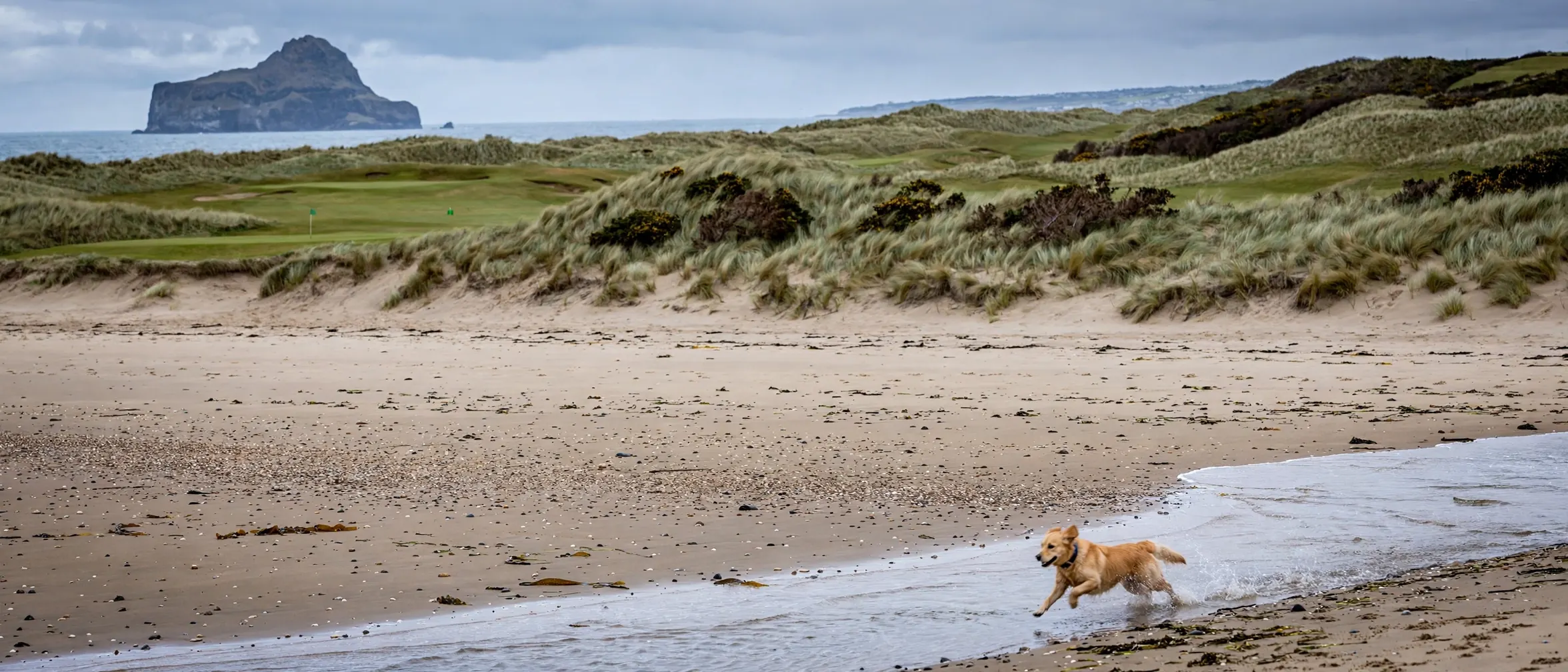
The walk starts at Ayr seafront and follows the beach and the Esplanade north past the harbour, then along the shore towards Prestwick. The first stretch is the busiest, with the airport nearby — Prestwick Airport sits just inland, and planes on the approach can be loud enough to startle a nervous dog. After Prestwick the path opens out again, crossing the long beach at Prestwick and then the wide sands towards Troon, where the golf links begin. The beach at Prestwick, like Ayr's, welcomes dogs all year round, and the sand here is broad and firm at low tide.
Fourteen kilometres is a long way for most dogs, and there is no need to walk it all. The practical way to do it is to walk one way and take the train back: both Ayr and Troon have stations on the Ayrshire Coast Line, with regular services to Glasgow, and Prestwick has stations too. Check the train operator's rules for dogs before you travel — dogs are generally welcome on ScotRail services, but they must be kept under control and off the seats. Alternatively, walk out for an hour and turn back, or walk to Prestwick, which is roughly halfway, and catch a bus or a train from there. The path is well waymarked, but carry water for the dog, because there are long stretches with no shops, and the only reliable water on the beach is the sea, which is not a substitute.
Golf is the other thing to know about this stretch of coast. The Ayrshire coast is famous for its links courses — Royal Troon, Prestwick and Turnberry are all nearby — and the coastal path runs close to, and sometimes across, golf course land. Keep the dog on a lead near the courses, keep them off the greens and fairways, and do not let them chase balls or disturb players. Golfers are generally tolerant of walkers who stay on the path, and the etiquette is simple: stay on the marked route, keep the dog close, and move on. For more on the wider coast, our guide to the Ayrshire coast with a dog covers the beaches, castles and links grass of the whole stretch, and our Troon guide covers the harbour, the long beach and the town at the northern end of this walk in detail.
Green lungs: Rozelle, Belleisle and the parks
Ayr has two large parks that matter to dog owners, and they serve different purposes. Rozelle, in the south of the town near Alloway, is a country park of around 100 acres with woodland, a pond, walled gardens and the Maclaurin Art Gallery in the old Rozelle House. It is a proper green lung: mature trees, winding paths and plenty of shade, and it is the place to go when the beach is too windy or too hot, or when the dog needs a woodland walk rather than open sand. Dogs are welcome on a lead, and the woodland paths are good for sniffing walks, though they can be muddy after rain and the pond attracts ducks, so a dog with a strong chase instinct needs to stay close.
Belleisle Park, closer to the seafront in the south of the town, is a different kind of park: a public park with a golf course, a pond, formal gardens and a conservatory, laid out in the early twentieth century. It is flatter and more open than Rozelle, and it suits a shorter, easier walk, particularly for older dogs. The golf course at Belleisle is a public course, and dogs should be kept on the paths and away from play. The park is also close to the beach, which makes it easy to combine a park walk with a beach walk in a single outing: park at Belleisle, walk the gardens, then cross to the shore for the last stretch of sand before the car.
Smaller green spaces fill in the gaps. The Low Green, covered above, is the seafront park. There are playing fields and recreation grounds around the town, and the riverside paths give the town a green corridor from east to west. What Ayr does not have, as far as a visitor is concerned, is a dedicated enclosed dog field in the town centre — so if your dog needs a secure off-lead run, the beach at low tide on a quiet day is the practical answer, or a longer drive to a secure field outside the town. Check the official guidance before you travel if a secure field is essential to your stay, because facilities change and a field that was open last year may not be open now.
One caution applies to all of Ayr's parks in spring and summer: ground-nesting birds and young wildlife. The Access Code asks owners to keep dogs on a short lead or close at heel where birds are nesting, and the same applies to the grassy areas and the edges of the ponds. It is also worth remembering that parks in a town have their own rhythms — school holidays bring children and picnics, and a dog that is fine with adults may still be startled by a football or a scooter. A lead, a bit of distance and a walk early in the morning will solve most of it.
Where the dog can come in for lunch
Ayr is a working town, and its cafes and pubs are used to dogs in a way that seasonal resorts sometimes are not. That said, dog-friendly in Ayr usually means the terrace, the beer garden or a designated dog-friendly area inside, rather than the whole premises, and policies change with the seasons and with the management. The reliable approach is to look for the signs at the door, ask before you sit down, and have a backup plan — which in Ayr is easy, because there are enough options within a few minutes' walk of the seafront that a polite no is never a disaster.
The seafront is the obvious place to start. The cafes along the Esplanade and around the Low Green are used to walkers coming off the beach, and several have outdoor seating where a dog is welcome, with water bowls on hand in the summer. The town centre, a short walk inland, has a wider choice: coffee shops, bakeries, pubs and restaurants, many of which welcome dogs in at least part of the premises. The harbour area has pubs that serve food and welcome dogs, which makes it a good end point for a morning walk. In Alloway, the Burns museum cafe has a covered outdoor area where you can sit with the dog, and the village has a hotel and a pub that are worth checking for current dog policies before you go.
A few points of etiquette will make the whole thing easier. Bring a mat or a blanket for the dog to lie on, so they are not sprawled across a walkway. Keep the lead short and the dog under the table, not stretched across the aisle. Order at the bar or the counter where possible, so the dog is not left alone at the table. And if the dog is wet from the beach, towel them down before going inside — a wet dog in a cafe is nobody's idea of a good time, least of all the dog's. If your dog barks at other dogs, choose a table at the edge of the terrace rather than in the middle, and consider takeaway instead: Ayr's seafront is a fine place for fish and chips on a bench, with the dog at your feet and Arran in front of you.
For supplies, Ayr's supermarkets and pet shops are a short drive from the seafront, and the town centre has the usual high-street shops. If you run out of dog food, leads, poo bags or towels, you will not be stuck. There are also vets in the town, which is worth knowing before you need one: save the number of the nearest practice in your phone when you arrive, and note the out-of-hours emergency number as well. A dog that eats something on the beach or cuts a paw on a rock will need a vet quickly, and Ayr's position as the largest town in the area means help is closer than it would be on a remote stretch of coast.
Arriving and parking without a fuss
Ayr is easy to reach, and that is part of its appeal as a dog break. By train, Ayr station is on the Ayrshire Coast Line, with regular ScotRail services from Glasgow Central taking about 50 minutes, and the station is a level walk of around ten minutes from the seafront. Dogs are welcome on the train, and the walk from the station to the beach is flat and straightforward, which makes a car-free day trip genuinely practical. By bus, Stagecoach services run from Glasgow and from towns across Ayrshire to Ayr bus station in the town centre. By car, Ayr is about 40 minutes from Glasgow on the A77, and the road is a dual carriageway for much of the way, so the drive is easier than the distance suggests.
Parking near the beach is straightforward but competitive on good days. There is parking along the seafront and at the Low Green, close to the sand and the Esplanade, and the town centre has car parks a short walk from the shore. On sunny weekends and during school holidays, the seafront spaces fill early, and the sensible move is to arrive before ten in the morning or to park in the town centre and walk down. Charges and restrictions vary by car park and can change, so check the official guidance before you travel rather than relying on last year's information. In Alloway, the car parks at the museum and at Burns Cottage are free for visitors, with Blue Badge spaces at both.
For the dog, the journey matters as much as the destination. If you are driving from Glasgow or further afield, plan a stop on the way: a short leg-stretch and toilet break halfway will make the dog far happier on arrival than a non-stop drive. Keep the car cool and ventilated, never leave a dog in a parked car on a warm day, and remember that the car park at the seafront can be hot in summer even with the windows cracked. On arrival, give the dog water and a short walk on the Low Green before the beach, as described at the start of this guide — a dog that has had a chance to settle is a dog that will enjoy the sand rather than explode onto it.
If you are arriving by train with a dog, a few practical points help. The walk from Ayr station to the seafront passes through the town centre, which is busy with people, traffic and other dogs, so keep the lead short and the dog close. There are no luggage lockers at the station that a visitor can rely on, so travel light and keep your hands free for the lead. And if you are walking to Troon and catching the train back, buy your ticket before you board where possible, and check the train times for the return journey before you set out — the last thing you want is a tired dog and a long wait on a platform.
Staying over: choosing a base
Ayr works well as a base for a longer stay, and the choice of accommodation shapes the trip more than most people expect. The town has hotels, guest houses, bed and breakfasts, self-catering cottages and flats, and caravan and holiday parks on the outskirts, including the large park at Craig Tara to the south. The right choice depends on the dog: a dog that settles quietly in a room will be fine in a guest house; a dog that needs a garden, a dog that barks, or a household with two or three dogs will be happier in self-catering with an enclosed outdoor space.
Whatever you book, ask the same questions before you pay. Is there a pet fee, and how much is it per dog per night or per stay? How many dogs are allowed, and is there a size or breed condition? Is there an enclosed garden or a patio, and how high is the fence? Can the dog be left alone in the accommodation, and if so for how long and under what conditions? Where is the nearest practical toilet walk after dark, and is it lit? Are dogs allowed in the breakfast room, the bar or the terrace, or will you be eating alone? Get the answers in writing, with the fee itemised, and keep the reply with your confirmation.
Location matters as much as the property. A place near the seafront means the beach is a five-minute walk, which is ideal for an early-morning run and a last outing at night, but it also means more noise in summer, from the funfair, the traffic and other holidaymakers. A place in Alloway or on the southern edge of the town is quieter, closer to the Burns sites and the Heads of Ayr, but further from the beach and the town centre. A place in the town centre is convenient for shops and cafes but means a walk to the beach every time. There is no single right answer; there is only the answer that fits your dog's routine. A dog that needs a toilet break at six in the morning will be happier near the beach or near a park than in a third-floor flat in the town centre.
For a longer stay, Ayr's position in the middle of the Ayrshire coast is the real advantage. Troon and Prestwick are a short drive or train ride north; Culzean Castle, Dunure and Girvan are a short drive south; the Isle of Arran is a ferry ride from Ardrossan, about forty minutes' drive north, though dogs on the ferry and on the island need their own planning. That means a week in Ayr can include a different walk every day without packing up and moving, which is exactly what a settled dog prefers. Book the accommodation for the dog's needs, and let the day trips take care of themselves.
A wet-day plan that still works
Ayrshire weather is changeable, and a dog break in Ayr needs a wet-day plan, not just a fair-weather one. The good news is that Ayr's rain is usually the passing, showery kind rather than a day-long downpour, and a flexible plan will get you through most of it. The bad news is that a wet dog, a wet car and a wet accommodation are a miserable combination if you have not thought about drying.
Start with the walk. On a wet day, the beach is still walkable, and many dogs prefer it: the sand is firmer when damp, the crowds are gone, and the rain keeps the flies down. What changes is the wind and the cold, so shorten the walk, keep the dog moving, and bring a drying coat for the walk back. The river path is the sheltered alternative, and Rozelle's woodland gives cover from light rain. Avoid the Heads of Ayr and the clifftop paths in heavy rain and high wind, when the ground is slippery and the gusts are strong. And avoid the Burns Monument and the Brig o' Doon in the wet if your dog is unsteady on cobbles and steps.
For the middle of the day, Ayr's indoor options with a dog are limited, and honesty is better than a long list of places that will turn you away. The Burns museum buildings do not admit pet dogs, and most shops and indoor attractions follow the same rule. The practical wet-day plan is therefore a car-based one: a short walk, a drive to a different stretch of coast, a coffee on a covered terrace, and back to the accommodation for a proper dry-off. If you are staying in self-catering with a drying area, a wet day is no problem at all. If you are in a hotel room, it is harder, and that is worth thinking about before you book: ask where you can dry a wet dog, and whether there is an outdoor tap or a boot room.
Drying is the system that makes or breaks a wet week. Two drying coats, a stack of old towels, a waterproof mat for the car boot and a spare set of bedding will do more for your holiday than any amount of sightseeing. Dry the dog thoroughly, ventilate the accommodation, and wash the bedding before it starts to smell. A dog that is dried properly after every walk will be happy to go out again; a dog that is left damp will be reluctant, and a damp dog in a small room will make the whole place smell of wet dog within a day. It is not glamorous advice, but it is the advice that matters most on a wet Ayrshire week.
What to pack for an Ayrshire coast day
A day at Ayr with a dog is not a complicated expedition, but a small amount of preparation makes it much smoother. The list below is built around the realities of this particular coast: wide sand, changeable weather, a river and a harbour, and a town where the shops are close but the beach is exposed.
- Water and a bowl. The sea is not drinking water, and there are long stretches of beach with no fresh water. Carry at least a litre for the dog on a long walk, more on a hot day, and offer it often so the dog is less tempted to drink seawater.
- A long line as well as a lead. The beach is the place for a long line: it gives the dog room to run while you keep control near other people, near the strandline and near the water. A short lead is for the Esplanade, the town, the Burns gardens and the golf course paths.
- Poo bags, and a spare roll. Bins are spaced out along the southern end of the beach, and a spare roll weighs nothing. Bag it, bin it, and carry it until you find a bin.
- Towels and a drying coat. One towel for the beach, one for the car, and a drying coat for the walk back in wind or rain. A wet dog in a car is a smell that lasts the whole drive home.
- A basic first-aid kit. Tick remover, saline for rinsing eyes and paws, a bandage, and the number of the nearest vet saved in your phone. Check paws after a walk on the rocky shore at the Heads of Ayr, and after any walk on the strandline.
- Sun protection and shade. Ayrshire summers are mild, but a pale-coated dog can burn on a bright day on white sand, and there is no shade on the beach. A lightweight coat or a shaded rest on the Low Green will help.
- A mat for cafes. A small blanket or mat gives the dog a place to lie under a table and keeps them out of the walkway. It also signals to staff that you have done this before.
- Treats and a toy that floats. A ball or a floating toy is useful on the beach, but never throw it into deep water or into a current, and never use a stick — sticks splinter and cause injuries that are entirely avoidable.
One last packing note: bring the dog's own food and any medication, and bring enough for an extra day. Ayr's supermarkets and pet shops will cover an emergency, but a dog with a sensitive stomach does not want a sudden change of food on holiday, and a pharmacy run for medication is a waste of a beach afternoon. Pack as if the shops were closed, and then enjoy the fact that they are not.
Practical questions
Before you go
Can dogs go on Ayr Beach all year round?
Yes. South Ayrshire has no seasonal dog ban on its beaches, so dogs are welcome on Ayr Beach all year round, provided they are kept under control and fouling is cleared up. Keep your dog on a lead near other people, especially children, and follow the Scottish Outdoor Access Code. Rules can change, so check the official guidance before you travel.
Can my dog come into the Robert Burns Birthplace Museum?
Not inside the buildings. Dogs on a lead are welcome in the outdoor parts of the site, including the Museum Gardens, the Monument Gardens, the Poet's Path and the cottage grounds, but not inside the museum building or Burns Cottage. Assistance dogs are welcome throughout the site. One person can visit indoors while the other stays outside with the dog, and there is a covered outdoor area for sitting and eating.
How far is the walk from Ayr to Troon, and is it suitable for dogs?
The Ayrshire Coastal Path section from Ayr to Troon is about 14.2 kilometres one way, mostly along the beachfront and promenade, and takes most walkers around two and a half hours. Dogs are welcome but must be kept on a lead. It is a long walk for most dogs, so many people walk part of it and return by bus or train, or walk one way and get the train back from Troon.
Where can I park near Ayr Beach with a dog?
There is parking along the seafront and at the Low Green, close to the beach and the Esplanade, and car parks at the Robert Burns Birthplace Museum and Burns Cottage in Alloway. Seafront spaces fill quickly on sunny weekends and school holidays, so arrive early or park a short walk away in the town centre and walk down. Check the official guidance before you travel for current charges and restrictions.
What should I do if my dog drinks seawater or eats something on the beach?
Carry fresh water and offer it often so your dog is less tempted to drink seawater, which can cause vomiting and diarrhoea. Watch out for washed-up jellyfish, fishing line, hooks and food waste, and keep your dog away from dead birds and seals. If your dog swallows something sharp, eats a large amount of sand or seaweed, or seems unwell after swimming, contact a vet promptly and save the number of the nearest practice before you set out.
Is Ayr a good base for a longer dog-friendly holiday in Ayrshire?
Yes. Ayr is the largest town in Ayrshire, with a railway station, supermarkets, vets and a wide choice of places to stay, and it sits in the middle of the coast: Troon and Prestwick to the north, Culzean and the Heads of Ayr to the south, and the Ayrshire Coastal Path in both directions. That makes it a practical base for a week of different walks without moving accommodation.