This guide is independent and contains no paid placement. If affiliate links are added later, they will be clearly marked and will not change our editorial checks.
The Ayrshire Coastal Path runs about 100 miles from Glenapp to Skelmorlie along the Firth of Clyde. With a dog, plan six to eight days, watch the seasonal beach rules and the tides, keep the dog on a lead across every golf course, and use the coastal railway to split the walk into day sections.
The path in numbers
The Ayrshire Coastal Path is one of Scotland's Great Trails, running roughly 100 miles (161 kilometres) from Glenapp, near the Galloway border, to Skelmorlie, on the edge of the Clyde estuary. It follows the shore of the Firth of Clyde for almost its whole length, which means the Isle of Arran is in view for much of the walk, and the sea is never more than a field away. Height gain is modest, around 1,500 metres in total, and most of it comes in the southern half, where the path climbs over headlands between small bays.
Waymarking uses the path's own thistle-and-wave discs, and the route is generally easy to follow, though the waymarks thin out where the path crosses golf courses and town seafronts. The surface is the most varied of any Scottish coastal trail: sand, grass, cliff-top turf, promenade, tarmac, forestry track and the short, springy grass of the links. A dog that is happy on sand will love this path; a dog that hates wet paws will need a routine, because the beaches are wet twice a day whether it rains or not.
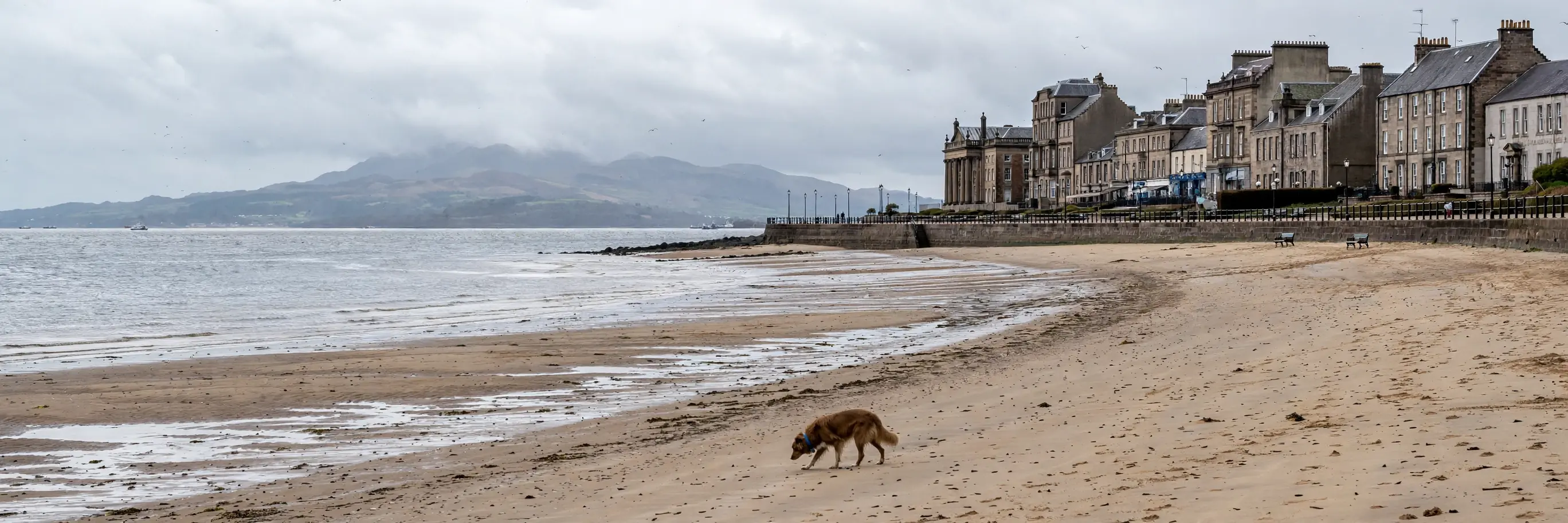
The path divides naturally into a quiet south and a busy north. From Glenapp to Ayr, the walking is rural: small fishing villages, farmland, the grounds of Culzean Castle, and long empty beaches. From Ayr northwards, the coast becomes a string of towns: Troon, Irvine, Ardrossan, Saltcoats, Largs, each with its own seafront, harbour and golf course. The contrast is the walk's charm, but it changes the dog's day completely: a quiet southern morning of empty sand gives way to a northern afternoon of promenades, ice-cream queues and other dogs on leads.
Most people walk south to north, starting at Glenapp and finishing at Skelmorlie, which puts the sun at your back in the morning and saves the easiest, flattest walking for the last days, when legs are tired. Walking north to south works too, and it has the advantage of starting at a railway station, but the southern finish means a long journey home from a quiet lane. Either way, the coastal railway runs parallel to much of the northern half, which makes this one of the easiest long-distance paths in Scotland to walk in day sections.
Glenapp to Girvan: the quiet south
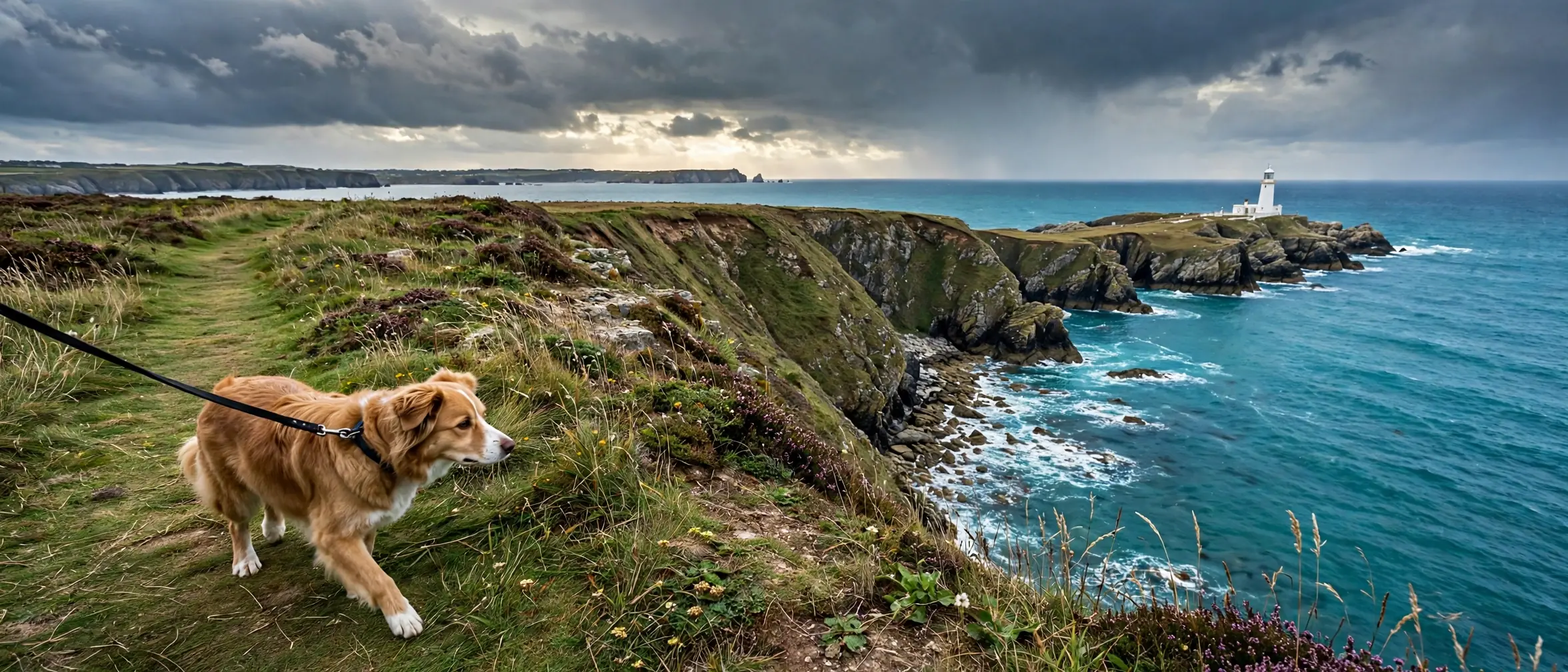
The southernmost stretch is the wildest part of the path and the one that needs the most care. From Glenapp the trail climbs over grassy headlands and drops into small, rocky bays, with the sea below and the Galloway hills behind. There are few facilities here: a farmhouse, a phone box that may or may not work, and a long way between water taps. Carry water for the dog from the start of the day, and do not assume a burn is safe to drink from without treating it, because livestock graze the fields above.
Girvan is the first proper town, and it arrives at just the right moment. It has shops, cafes, a harbour, and a beach that stretches south for miles, and it is the first place on the route where the dog can have a proper off-lead run on sand. The harbour is worth a slow look: fishing boats, gulls, and the smell of the sea that tells the dog the coast is the real thing. Girvan is also where the path's character starts to change, from empty shore to a coast that people live on and work on, and the dog needs to learn the difference: a working harbour is not a beach, and a fishing boat's ropes and nets are not toys.
The ground in the south is the hardest on paws. Rocky bays mean sharp stones and slippery weed, and the grassy headlands hide rabbit holes and uneven turf. Check the dog's paws at Girvan and again at every town, and carry boots for the rocky days. The reward for the hard ground is the wildlife: seals haul out on the rocks south of Girvan, and the dog must be kept on a lead and at a distance whenever they are visible. A seal that is chased into the water loses energy it needs, and a dog that gets close enough to be bitten learns a painful lesson.
Girvan to Ayr: castles and Burns
From Girvan the path runs north past Culzean Castle, whose grounds are one of the great dog walks of the west coast. The castle sits on a cliff above the sea, and the paths through its gardens and woodland are wide, well surfaced and full of smells. Dogs are welcome in the grounds on a lead, though not inside the castle itself, and the cliff-top walk past the castle is one of the finest short stretches on the whole route. Give it time: a dog that is rushed past Culzean has missed the point of the day.
South of Ayr the path enters Burns country. Alloway, the village where Robert Burns was born, sits just inland, and the Brig o' Doon and the Burns cottage are a short detour from the coast. The detour is worth it for the walker, but it adds miles to a day that is already long, so many walkers save Alloway for a rest day in Ayr. The fields around Alloway hold sheep and cattle, and the dog needs to be on a lead through the farmland, however tempting the open grass looks.
Ayr itself is the route's biggest town and its best resupply point. It has supermarkets, outdoor shops, vets, and a long beach that runs south from the town to the Low Green. The beach at Ayr is wide and sandy, and dogs use it year-round, but the town end of the beach has seasonal rules in summer, so check the signs at the entrance and the local council guidance before you travel. The esplanade is a good place for a tired dog to walk on the flat, and the cafes along the seafront vary in how they welcome dogs, so ask at the door and keep the dog on a short lead under the table.
Ayr to Irvine: towns and links
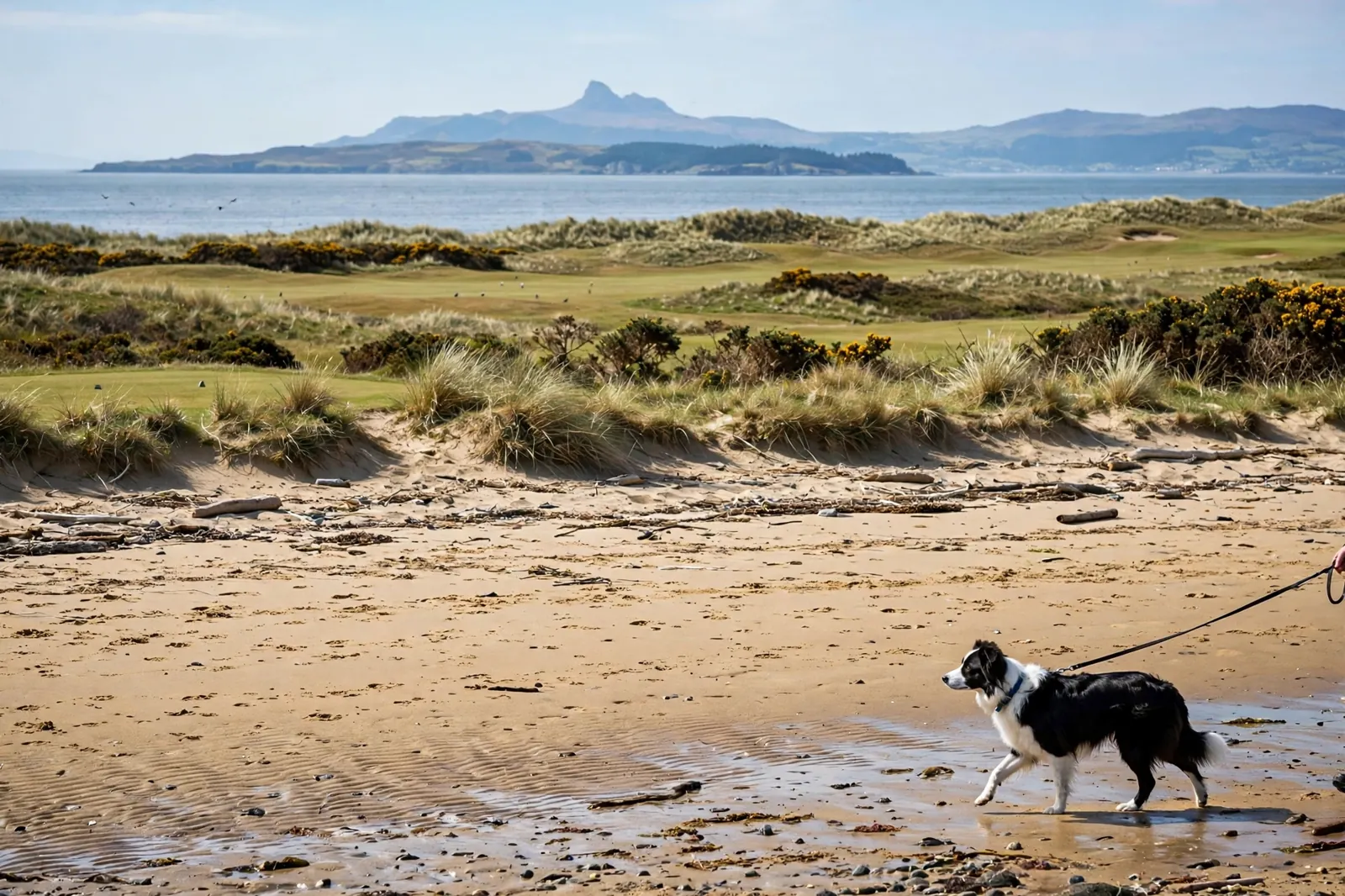
North of Ayr the coast becomes a sequence of golf links, and the path's relationship with golf becomes the day's main theme. Royal Troon, Prestwick and the other courses sit directly on the shore, and the path crosses them on marked routes. This is where the lead rule is absolute: dogs must be on a lead, kept off the greens and tees, and kept on the path. Golfers have paid for a quiet game, and a dog that runs across a fairway is not just a nuisance but a danger if a ball is in the air. Wait if a group is playing through, give them a wide berth, and never let the dog chase a ball.
Troon is a useful overnight stop, with a harbour, a beach, and a railway station that makes it an easy place to start or finish a day section. The beach at Troon is long and sandy, and the dunes behind it hold nesting birds in spring, so keep the dog on a lead in the dunes during the breeding season. Irvine, a little further north, is a bigger town with a harbour, a beach, and the Scottish Maritime Museum, and it is the point where the path leaves the open coast for a while and follows the river and the town's paths.
The walking between Ayr and Irvine is flat and easy, which makes it deceptive: flat miles on tarmac and promenade are hard on paws, and the lack of shade on a sunny day can overheat a dark-coated dog. Carry water, walk early on warm days, and use the beaches for off-lead play where it is allowed, because a dog that has had a run on sand will settle happily for a long, flat afternoon on the lead. The towns also mean more dogs on leads, more smells, and more distractions, so a reactive dog needs a plan for the promenade sections: walk early, keep the lead short, and use the beach rather than the pavement where the rules allow it.
Irvine to Skelmorlie: the busy north
The final stretch from Irvine to Skelmorlie is the most urban part of the route, and it is also the easiest to walk in day sections, because the railway serves Ardrossan, Saltcoats, Largs and Wemyss Bay. The path runs along seafronts and through towns, past harbours, ferry terminals and the beach at Largs, where the Viking history of the town gives the walker something to look at while the dog sniffs the seaweed. The walking is flat, the surfaces are mostly tarmac and promenade, and the distances between cafes and toilets are short.
Largs is the best overnight stop in the north, with a long seafront, a good beach, and a ferry to the Isle of Cumbrae that makes a fine rest-day trip if the dog is happy on a boat. The ferry is short, dogs are welcome on deck, and Cumbrae's circular road is a gentle day out. From Largs the path climbs over the headland towards Skelmorlie, and the finish is a quieter stretch of shore with views across the Clyde to the Cowal peninsula. The end of the path is not marked by a grand monument, which suits the route: it is a walk that ends the way it began, with the sea on one side and a dog that has earned its rest.
The northern towns also bring the route's busiest beaches, and the seasonal rules matter most here. Some town beaches restrict dogs in the summer months, and the restrictions are enforced, so check the signs and the council guidance before you travel rather than assuming the rules from the south still apply. Where a beach is restricted, the path usually offers an alternative along the promenade or the cliff-top grass, and a dog that has walked a hundred miles will not mind a pavement for a mile or two, provided the day ends with a proper run somewhere it is allowed.
Which beaches, which rules, which season
The rules change from town to town, which is why they catch people out. The rural beaches are mostly open to dogs all year, but the town sands at Ayr, Troon, Irvine, Saltcoats and Largs carry summer restrictions, and the dates and the exact stretches vary by council. The only approach that works is to read the sign at each beach entrance, every time, and to check the council guidance before the trip for the current season. A rule that applied last summer may not apply this one, and a beach that was open in the morning may be restricted at the town end by the afternoon.
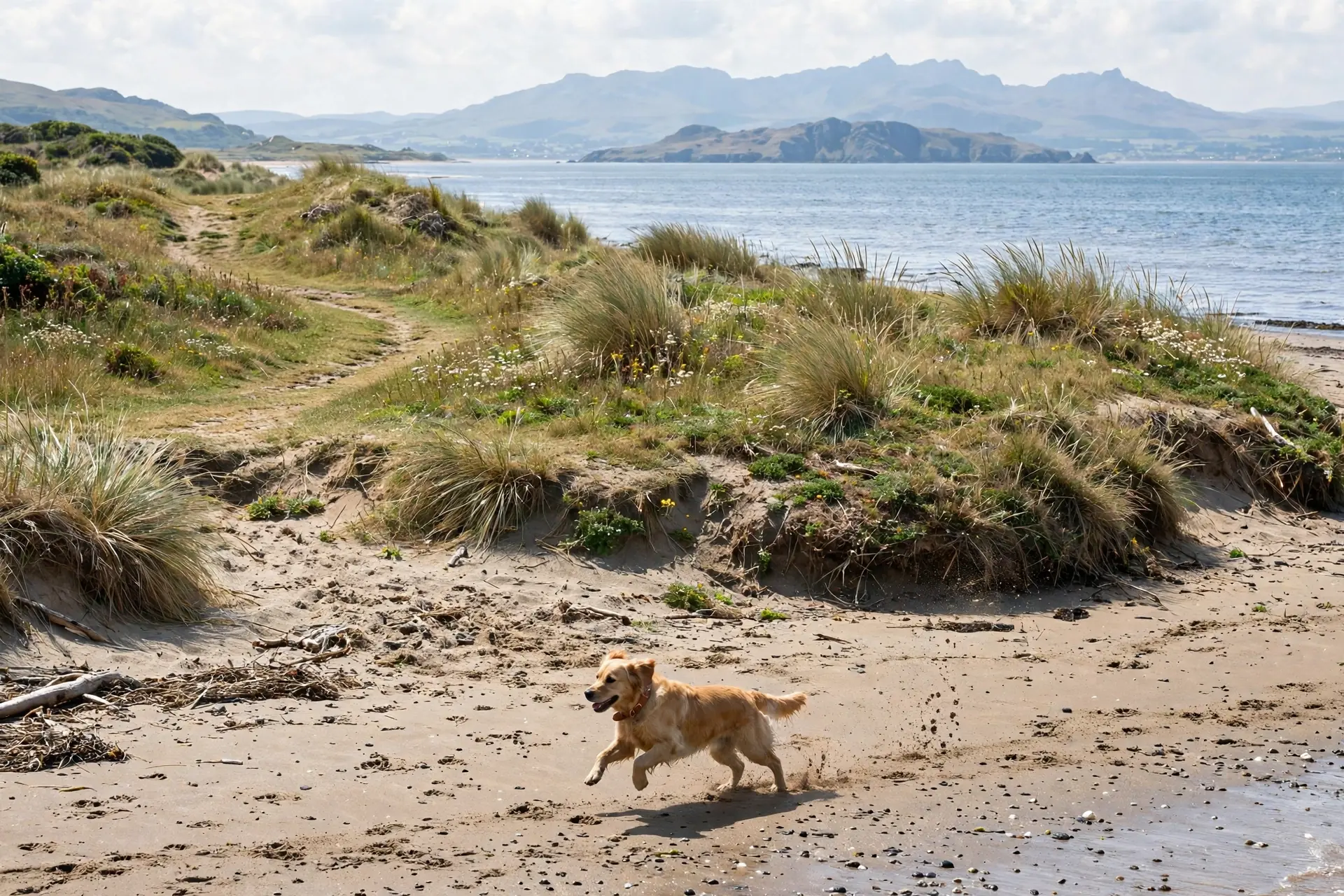
The dunes behind the beaches are nesting country in spring and early summer. Ringed plovers nest on the open sand itself, in little more than a scrape in the shingle, and a dog running free can destroy a nest without its owner ever noticing. The access code asks for dogs to be kept close or on a lead through the dunes, and that is a small price for keeping the beaches open to dogs at all. Skylarks sing over the rough in the same season, and the same care applies to them.
After a beach day, the dog needs a rinse. Dried salt irritates the skin and encourages licking, sand lodges between the toes, and the paws pick up small stones and shell fragments. A bottle of fresh water and a towel in the car will do the job, and a quick check of the ears after a swim goes a long way for dogs with folded ears. Watch for broken glass and fish hooks near the harbours, and stop the dog eating seaweed, which can swell in the stomach. A dog that has had a good swim will sleep well, but a dog that has been drinking seawater will not, so carry fresh water even on the days when the sea is everywhere.
Golf courses: how to walk past them
Ayrshire is the home of links golf, and the path crosses some of the most famous courses in the world. The etiquette is simple and non-negotiable: stay on the marked path, keep the dog on a lead, keep off the greens and tees, and do not let the dog chase balls. Golfers are entitled to a quiet game, and a dog that runs across a fairway can ruin a shot that a golfer has waited a year to play. The path across each course is waymarked, but the waymarks can be hard to spot among the dunes, so check the map at the edge of each course before crossing.
The practical details matter. Carry the lead in your hand, not clipped to a belt, so you can shorten it instantly. If a group is about to play, stand aside and wait; a minute's wait is cheaper than an apology. Keep the dog on the far side of the path from the fairway where the path runs alongside it, and do not let the dog relieve itself on a green or a tee. If the dog does, clean it up immediately and apologise. The golf clubs along the coast are used to walkers and are generally welcoming, but that welcome depends on walkers behaving well, and a single bad encounter can sour a relationship that has taken years to build.
There is a silver lining: the links grass is some of the most pleasant walking on the route, short, springy and well drained, and the dunes behind the courses hold a surprising amount of wildlife. Skylarks sing over the rough in spring, and the views from the dunes across the Firth to Arran are among the best on the path. Walk the courses with respect and they become a highlight; walk them carelessly and they become a story the club tells about walkers for years.
Reading the tide and the harbour
The Firth of Clyde has a wide tidal range, and it shapes the walking day more than the weather does. At low water the beaches are broad and generous; at high water the same sand narrows to a strip, and a few low stretches disappear altogether. The habit that keeps the day smooth is to look at the tide table the night before, and to time the beach miles for a falling tide, so the sand is opening up as the walk goes on rather than closing in. Tide tables are free online, and the hosts in the coastal guesthouses usually know the local quirks well enough to warn about the awkward bays.
Working harbours need a different kind of attention. Girvan, Ayr, Troon, Ardrossan and Largs all have boats, ropes, nets, fish boxes and forklifts, and a dog loose among them is a hazard to itself and to the people working there. Keep the dog on a lead in every harbour, keep it back from the edge where the wall is high and the water deep, and do not let it drink from the harbour, where fuel and fish waste pollute the water. A dog that falls from a harbour wall can be very hard to recover, because the ladders are built for people, not for animals.
Swimming is one of the joys of this path, but the sea here is cold even in August, and a dog that swims too far or too long can cramp or tire badly. Choose a beach that shelves gently, keep the first swims short, and dry the dog afterwards. Folded ears are prone to infection after repeated sea swims, so wipe them dry with a soft cloth each time. A weak swimmer, or a dog that has never swum in the sea, should stay on a long line for the first swims, and no dog should swim near a harbour mouth or a ferry route.
Food, beds and the daily top-up
This path is well supplied by Scottish standards, because a town appears every day or two. Girvan, Ayr, Troon, Irvine, Ardrossan and Largs all have supermarkets, cafes and pubs, and the smaller villages have at least a shop or a tearoom. That takes the pressure off the packing: there is no need to carry days of dog food, and a forgotten lead can be replaced the same evening. Water is still the thing to plan for, because the long beach stretches have no taps, so carry a litre for the dog and fill up at every cafe and pub along the way.
Beds should be booked first, because the dog-friendly rooms in Ayr, Troon and Largs fill early in summer. The choice is wide, from hotels and guesthouses to self-catering cottages, and the rooms that go first are the ones near the beach with an enclosed garden. Confirm the dog rules for the actual room, including any nightly charge and whether the dog may be left alone, and ask about a place to dry a wet dog that is not a hotel carpet. If you are starting from Ayr, our Ayr town guide covers the beaches, the esplanade and the dog-friendly stops in detail, and our Ayrshire coast guide covers the same shore town by town for shorter trips.
Cafes and pubs vary, and the pattern shifts with the season. In summer, places that keep dogs outside in winter will often welcome a calm dog indoors if the weather turns, but never assume it: ask at the door, keep the dog on a short lead beneath the table, and bring a small mat so the dog has its own spot to settle. A dog that has walked fifteen miles will usually sleep through lunch, while a dog that has spent the morning in the car will not, and the difference is visible in the first five minutes. Plan the lunch stop around the dog's mood, not just your own appetite.
The coastal railway and the day-section walk
The railway that shadows the northern half of this path is the reason it is such a good first long-distance walk with a dog. Trains run from Glasgow to Ayr, Troon, Irvine, Ardrossan, Saltcoats, Largs and Wemyss Bay, and the line stays close enough to the shore that most of the northern miles can be walked as day sections from one base. The commitment is a day at a time rather than a week, and a tired dog can always ride home.
Dogs ride free on most Scottish trains, and a large animal may need to travel on the floor rather than a seat. A muzzle is worth packing for a busy carriage even if the dog has never worn one, because a crowded train is a different world from an empty beach. The southern half has no railway, so the day-section approach works less well there: Glenapp to Girvan is best done as a two-day trip with a night in Girvan, or as a long day with a taxi back. Buses serve Girvan, Ayr and the villages between them, but they run less often than the trains, so check the times before setting out and keep enough battery in the phone to call a taxi if the bus has gone.
A baggage service runs along the path and is worth considering for the southern half, where the beds are spread out and the ground is hillier. The benefit for a dog walker is that the food, boots and spare leads travel in the bag, and a wet day can be shortened without the worry of a heavy pack. When booking, confirm the collection times and the drop-off points, and pack the dog's evening food in the travelling bag rather than the day pack, so a late arrival never means a hungry dog.
Practical questions
Before you go
How long does the Ayrshire Coastal Path take with a dog?
Most walkers with a dog take six to eight days for the full 100 miles, walking roughly 13 to 16 miles a day. The southern sections are quieter and hillier, while the northern sections are flatter and pass through more towns, so many walkers plan shorter days in the south and longer ones in the north.
Can dogs go on the beaches along the Ayrshire Coastal Path?
Most of the beaches allow dogs year-round, but a few town beaches have seasonal restrictions in summer, and some stretches are closed to dogs during the bird breeding season. Check the signs at each beach entrance and the local council guidance before you travel, and keep the dog on a lead where birds are nesting.
Do dogs have to stay on a lead near the golf courses?
Yes, on and beside the golf links. Dogs must be kept on a lead and kept off the greens and tees, and walkers should stay on the marked path across the course. Give golfers a wide berth, wait if a group is playing through, and never let the dog chase a ball.
Are there dog-friendly places to stay along the path?
Yes, especially in Girvan, Ayr, Troon, Irvine, Ardrossan and Largs, which all have dog-friendly hotels, guesthouses and self-catering options. The southern stretch between Glenapp and Girvan has fewer options, so book that section first and confirm the dog policy for the specific room.
What is the best time of year to walk the Ayrshire Coastal Path with a dog?
Late spring and early autumn are usually best: the days are long, the beaches are quieter, and the summer dog restrictions on some town beaches have either not started or have ended. Summer brings the warmest weather but also the busiest beaches and the most restrictions, while winter brings short days and exposed coastal wind.