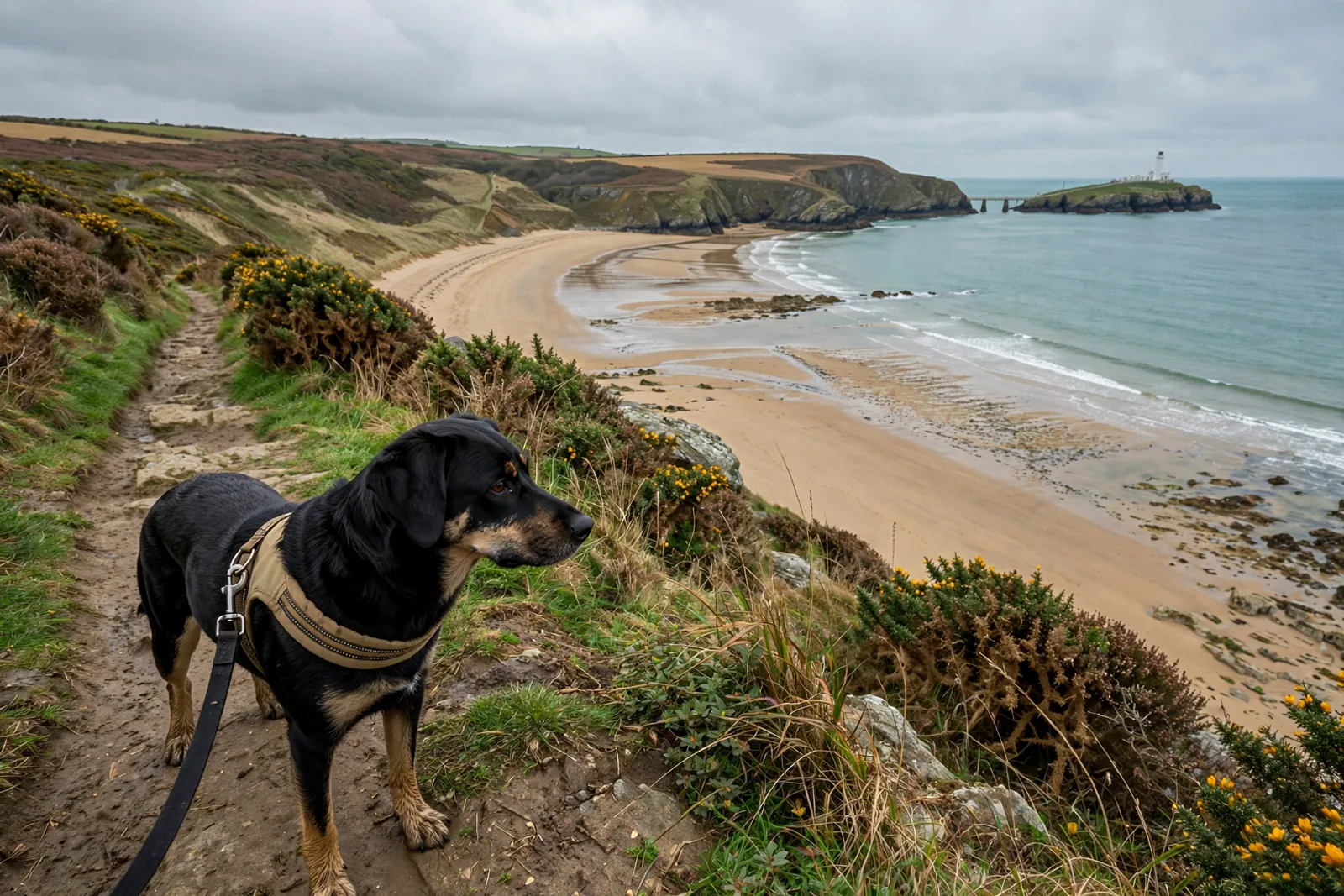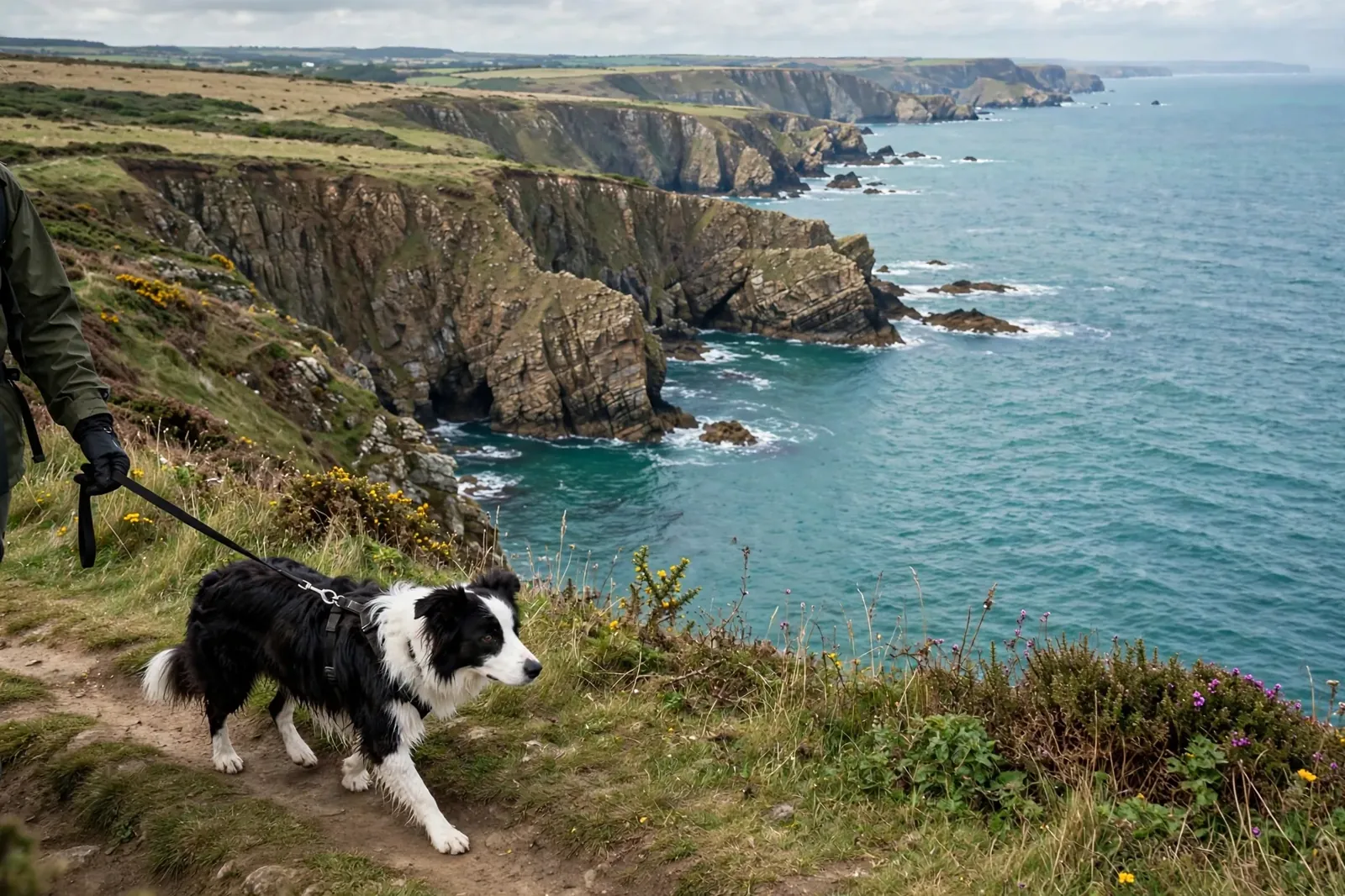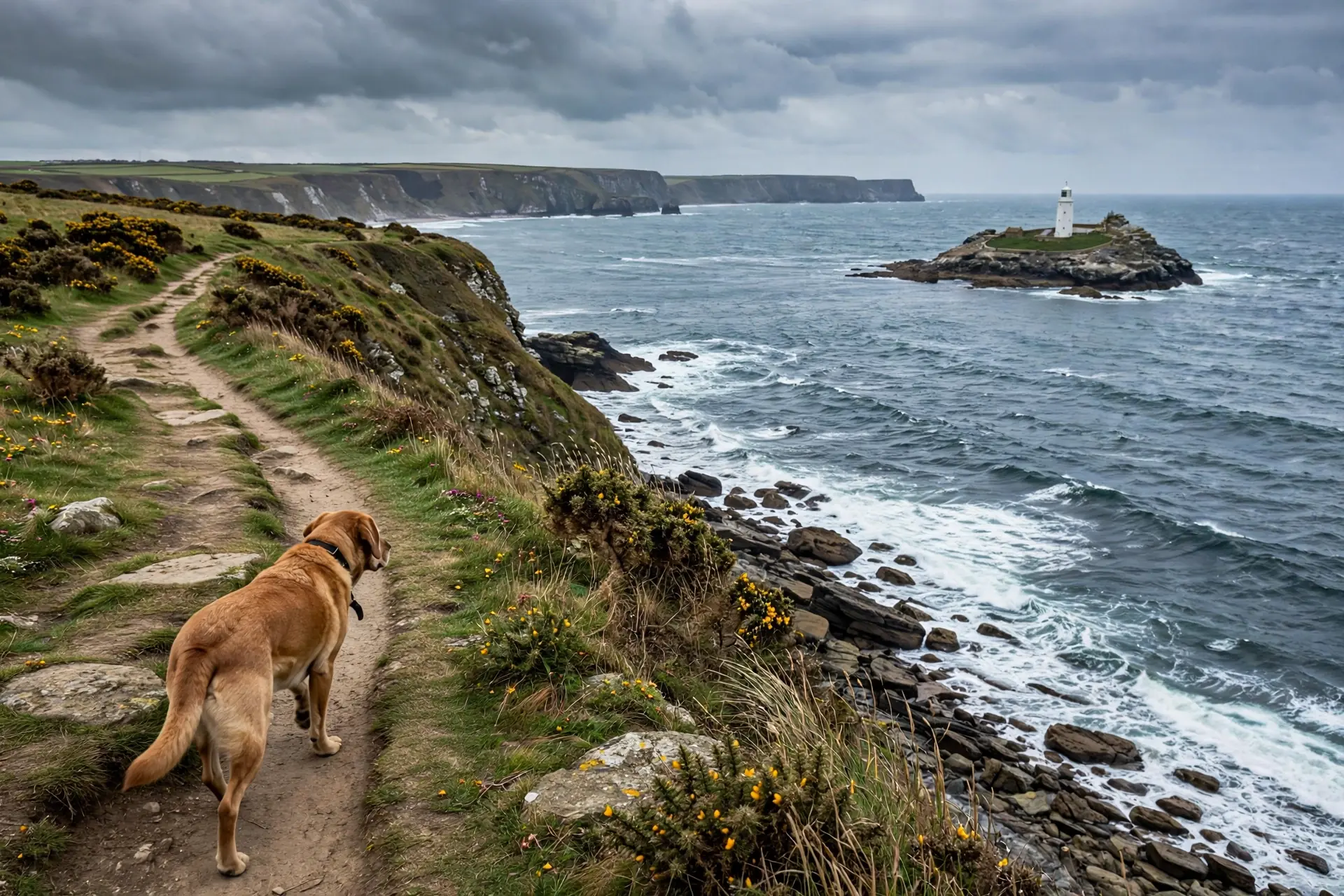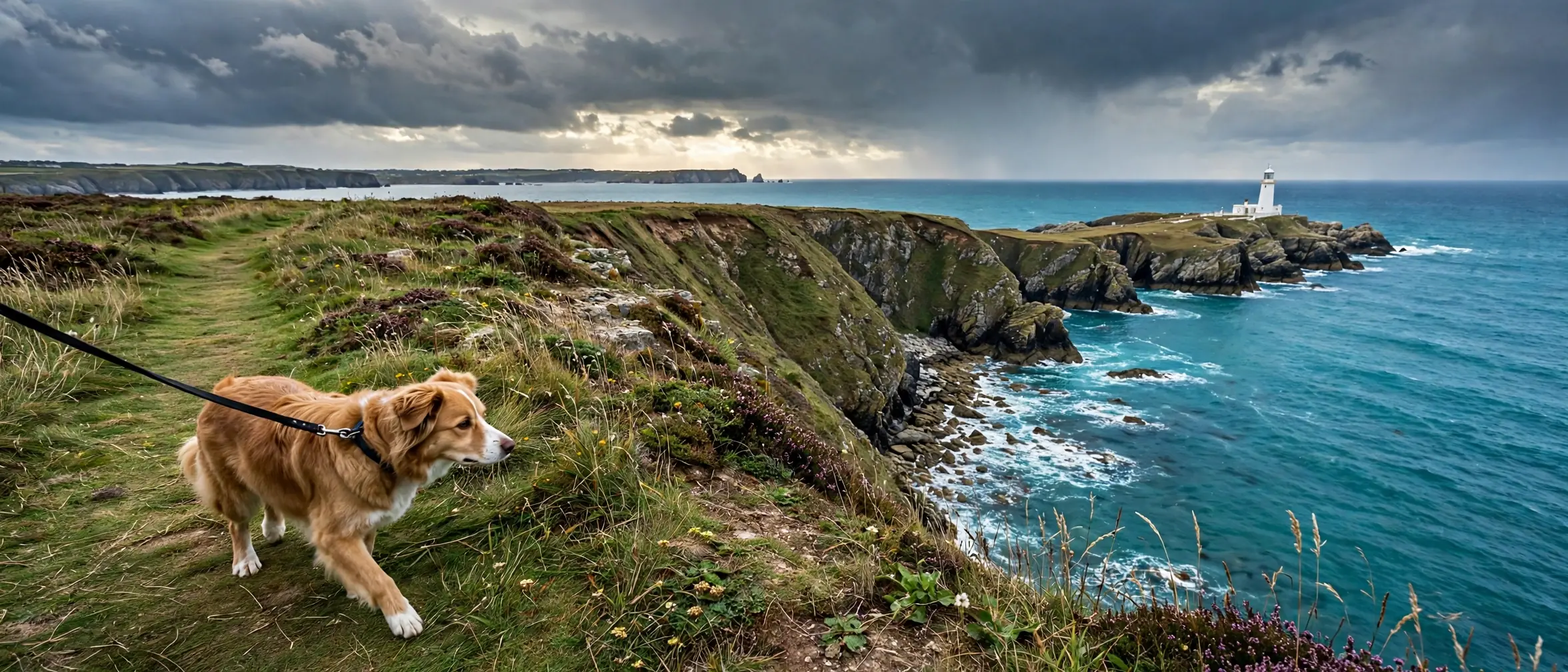
We wrote this guide on our own account, and nobody paid to be featured in it. If affiliate links appear here in future, they will be clearly marked as such, and they will not change the checks we make on the route, the rules or the facilities.
The Anglesey Coastal Path runs about 125 miles around the whole island. Walk it in sections from one or two bases, keep your dog on a lead on cliffs and near livestock, check tide times before any beach or causeway, and use buses or a second car to get back to your start.
The 125-mile loop at a glance
The Anglesey Coastal Path, known in Welsh as Llwybr Arfordirol Ynys Môn, is a waymarked National Trail that circles the entire island of Anglesey off the north-west coast of Wales. The full loop is about 125 miles, or roughly 200 kilometres, and it passes through an Area of Outstanding Natural Beauty for much of its length. Because it is a loop, you can start almost anywhere and finish where you began, which makes it unusually flexible for dog owners who want to walk a few sections at a time rather than committing to a single long expedition.
The character of the walking changes constantly. The south coast looks across the Menai Strait towards Snowdonia, with wooded shores, estuaries and quiet villages. The west coast opens into long sandy beaches at Newborough, Rhosneigr and Trearddur Bay, backed by dunes and pine forest. The north coast is wilder and rockier, with high cliffs, small coves and working harbours at Amlwch and Cemaes. The east coast is gentler, with sandy bays at Red Wharf Bay and Benllech and the resort town of Beaumaris near the Menai Bridge. A dog that enjoys variety will find it here in a single day, sometimes in a single hour.
Most walkers take between ten and fourteen days to complete the whole circuit, walking roughly nine to thirteen miles a day. That pace suits a fit adult dog that is used to long walks, but it is not a target to chase. Cliff climbs, deep sand, strong wind and hot sun all add effort that flat mileage does not capture, and dogs do not recover from a hard day as quickly as their owners sometimes assume. Plan rest days, keep the first two days shorter than you think necessary, and let the dog set the pace on the climbs. If you are walking the path in sections over several trips, the loop format is your friend: finish one stretch, note where you stopped, and pick it up again next time without any complicated logistics.
Follow the acorn. The path is waymarked with the acorn symbol used on National Trails, and it is generally easy to follow, although the marks thin out on open beaches and across farmland. Take a paper map or a downloaded offline map, because the mobile signal is patchy on the north and west coasts. The official trail guide splits the route into sections with distances and notes on the terrain, and it is worth reading before you pick a start point. Look up the current diversions, closures and changes to the route before you travel, especially after winter storms, which can damage cliff paths and beach access steps.
Walking it in sections
The official sections give a useful framework, but dog owners usually do better by thinking in terms of bases and day walks. Holyhead, on the west coast, is the largest town and the best transport hub, with the ferry port, the railway station and bus connections. It also sits beside some of the most dramatic walking on the island, around South Stack and the Breakwater Country Park. A base in Holyhead covers the west and north-west well, while a second base around Beaumaris or Menai Bridge covers the east and south. Rhosneigr and Benllech make good smaller bases if you want to be close to beaches and quieter walking.
The south coast is the gentle end of the island. From Menai Bridge to Newborough you get estuary views, woodland and the long sands of Newborough beach with the forest behind it. It suits older dogs, and first days when legs are still finding their rhythm. The west coast, from Newborough to Holyhead, mixes beaches, dunes and low cliffs, with good swimming for dogs at Trearddur Bay and Rhoscolyn, although the currents and the tide times need checking before any dog goes in the water. The north coast, from Holyhead to Amlwch, is the most exposed and the most demanding, with high cliffs, rocky coves and fewer facilities, so save it for a fit day with good weather and a full water supply.
The east coast is the easy end of the island. From Amlwch back to Menai Bridge the walking comes in short stages, with villages, cafes and bus stops at regular intervals. Red Wharf Bay is a wide sandy bay that is excellent for dogs at low tide, and the stretch from Moelfre to Benllech passes the memorial to the Royal Charter shipwreck and some of the prettiest small coves on the island. For a long weekend, the east coast is the best all-rounder, with scenery, facilities and easy transport in one place, while the west coast has the best beaches and the north coast the wildest walking.
Plan from the far end backwards. A linear walk needs a bus, a taxi or a second car waiting at the finish, and rural buses on Anglesey run less often than town services, especially on Sundays. Look up the current timetables before you travel, and leave a buffer so that a missed bus does not turn into a forced extra few miles with a tired dog. A circular walk from one car park is simpler, and kinder to the dog, because you can turn back early if the weather closes in or the dog tires.
Lighthouses, bays and beaches
South Stack is the postcard of the island. The lighthouse stands on a small island off the south-west tip of Holy Island, reached by a steep staircase of more than four hundred steps down the cliff. Dogs are welcome on the coastal path around South Stack, but the steps and the narrow bridge are not suitable for every dog, and the RSPB reserve around the cliffs is a busy seabird colony in spring and summer. Keep the dog on a lead and take the view from the top; the steps down are optional, not essential. The cliffs here hold guillemots, razorbills, puffins and choughs in season, and the sound and smell of a seabird colony can over-excite even a calm dog.
Other lighthouses punctuate the loop. Point Lynas, on the north-east coast, is a quieter headland with a working lighthouse and wide views across to the Great Orme. Trwyn Du, at the eastern entrance to the Menai Strait, stands on a small island near Penmon and is reached on foot at low tide with care, although the causeway is not a place to hurry a dog. Skerries, off the north-west coast, is visible from Cemlyn Bay but not accessible on foot. Each lighthouse marks a change in the character of the coast, and they make useful waypoints for planning a day's walk around a recognisable landmark.
At low tide, the sand on Anglesey seems to go on for ever, and that is why so many dog owners come here. Newborough is a vast sandy beach backed by dunes and pine forest, with views across to Snowdonia, and one of the best places on the island for a long off-lead run when dogs are allowed. Rhosneigr is a surfer's beach with a wide sandy shore and a village of cafes and dog-friendly pubs. Trearddur Bay is a sheltered sandy cove that suits families and less confident swimmers. Red Wharf Bay and Benllech are sandy and popular, with good facilities, while the smaller coves on the north coast, such as Porth Swtan and Porth Wen, are quieter and rockier. Beach rules vary by beach and by season, and some beaches close to dogs in the summer months, so read the signs at each entrance and look up the current position before you set off. The national rules are explained in our guide to dog-friendly beaches in the UK, which covers seasonal bans, council orders and the fines that can follow.
Anglesey's beaches also include the island's only National Nature Reserve at Newborough Warren, where dunes, salt marsh and pine forest meet. Dogs are welcome on the beach and on the forest trails, but the dunes are a sensitive habitat for ground-nesting birds and rare plants, so keep your dog on the paths and on a lead through the dunes in spring and summer. The forest at Newborough is one of the few places on the island where you can walk a dog in shade on a hot day, and the trails through the pines are a welcome change from open cliff tops. If your dog loves water, the estuary at Malltraeth and the sands at Traeth Llydan offer long, flat walking at low tide, but always check the tide times first, because the tide comes in fast across flat sand.
Tides, cliffs and dog safety
The tide is the first thing to check every morning. The Menai Strait, between the island and the mainland, has famously strong tidal currents, and the strait is not a place for dogs to swim. Around the island, the tide can cut off beaches, cover causeways and turn a pleasant sandy walk into a scramble against the cliff. Always look at the tide times before you set out, know whether the tide is rising or falling, and plan beach sections for a falling or low tide. If you are unsure, stay on the cliff path rather than the beach, and never let a dog chase a ball or a stick into the water near rocks or strong currents.
The cliff edge is the one place on this path where a mistake is not forgivable. Several stretches run close to edges with no fence, and the grass at the top can be hollow underneath, so ground that looks solid may not be. Keep the dog on a short lead on every cliff section, even one that is normally reliable off the lead. A harness with a handle is worth carrying: it gives you something to hold if the dog slips or lunges, and it spreads the load better than a collar if you have to lift or steady the dog. In strong wind, stay well back from the edge, because a gust can unbalance a dog as easily as a person, and a dog chasing a seabird does not check where the edge is.
Wet rock is the quiet hazard after rain. Cliff paths and beach access steps can be slippery, and the limestone and slate underfoot on the north coast stays wet longer than the sandy paths in the south. Look at your dog's paws at the end of each day for cuts, grit and salt irritation, and rinse them with clean water after beach walks. Salt water and sand between the toes cause more discomfort than most owners expect, and a small cut can become sore quickly if it is not cleaned. Rinsing, checking between the toes and treating small cuts are all covered in our guide to dog paw care after the beach.
Tell someone where you are going before you set out on a remote stretch. The mobile signal is unreliable on the north and west coasts, so leave your planned route and the time you expect to be back with someone who will notice if you do not return. Take a charged phone, a small first-aid kit for the dog, and the number of the nearest vet with you. In an emergency the coastguard is on 999, and the RNLI lifeboat stations at Holyhead, Beaumaris and Moelfre cover the island's coast. If a dog falls from a cliff or gets cut off by the tide, leave the rescue to the professionals and call for help early; going in after the dog puts you in danger too.
Ferries, buses and getting back
Holyhead is one of Britain's busiest ferry ports, with sailings to Dublin in Ireland operated by Irish Ferries and Stena Line. Dogs can travel on these ferries, but the arrangements differ by operator and by whether you travel as a foot passenger or with a car. Foot passengers usually need to book the dog in advance, and the dog may need to spend the crossing in a kennel or a designated pet area rather than with its owner. Car passengers can often leave the dog in the car, although that is not suitable on a hot day or for a long crossing. Check the official guidance before you travel, because pet policies, charges and kennel availability change, and book well ahead in school holidays.
Buses on Anglesey are useful if you plan around them, and a nuisance if you do not. They connect the main towns and villages, but services run less often than on the mainland, and Sunday services are limited. The network works for linear walks if you plan around the timetable, and the main routes run between Holyhead, Llangefni, Menai Bridge, Beaumaris and Amlwch. Dogs can usually ride, on a lead and on the floor, if the driver agrees, but it is worth confirming with the operator before you rely on a bus with a large dog. Taxis are available in Holyhead and the larger towns, and some local taxi firms will take dogs if you ask when you book.
The train is the easy way to reach the island without a car. The railway reaches Holyhead from the mainland via the North Wales Coast Line, with trains from Chester, Crewe and London Euston. Dogs usually travel free, on a lead and off the seats, which makes the train a practical way to arrive without driving. If you come by train, base yourself in Holyhead or Menai Bridge, where buses and walking routes start close to the station. If you drive, the A55 expressway crosses the Menai Strait on the Britannia Bridge and runs the length of the north Wales coast, so Anglesey is an easy drive from Chester and the north-west of England.
The return journey is the part people forget to plan. Park at one end, walk to the other, and take a bus or a taxi back. It is the least complicated way to walk a section of this path. A second car left at the far end works well for a group, and some walkers arrange a lift with a local taxi firm in advance. Settle the way back before you start walking, not when you arrive tired at the far end with a dog that has had enough. Save the bus timetable offline on your phone, because the signal is patchy on the coast and you may not be able to look it up when you need it.
Where to base yourself
Dog-friendly places to stay run from campsites and holiday cottages to hotels and bed and breakfasts, and each base suits a different kind of walker. Holyhead has the widest choice and the best transport links, and it suits anyone who wants to be close to the ferry, the railway and the shops. Beaumaris is prettier and quieter, with a castle, a pier and plenty of cafes, and it makes a good base for the east and south coasts. Menai Bridge is the convenient choice for the mainland, with restaurants and supermarkets and easy access to the south coast path. If the beach matters more than the town, Rhosneigr and Trearddur Bay are the picks, with sandy shores a short walk from most places to stay.
The booking site will tell you the room is dog-friendly; it will not tell you whether the dog will be comfortable. Ask where wet coats and leads go to dry overnight, whether there is a tap outside for sandy paws, whether the garden is fully enclosed, what the floors are like after a muddy walk, and how far the nearest sensible toilet walk is once it is dark. A cottage with hard floors and a garden the dog cannot escape from will suit you better than a smarter place with cream carpets and nowhere to wash a dog down, and a host who genuinely welcomes dogs will answer these questions straight away. For beaches, walks, ferries and stays across the whole island, our Anglesey dog guide is the general introduction.
A tent is the cheapest way to walk this path. Campsites suit many walkers here: they cost little, you can come and go as you please, and they sit close to the sea. Several Anglesey sites welcome dogs, though a few keep them to certain pitches or ask for a lead at all times. Caravan parks and holiday parks are common too, especially around Rhosneigr and Benllech, and they often have direct beach access. Book ahead for the school holidays and for August, when dog-friendly places on the island sell out early. In winter some places close or cut their hours, so make sure the place, the pub and the cafe you are relying on will actually be open.
Two bases, not ten, is the way to walk the full loop: one in the west, one in the east. Moving every day adds packing, driving and settling time that eats into walking and rest, and a dog that wakes in a strange house every night sleeps worse for it. Two bases cover the whole loop with manageable drives to each day's start, and the dog comes home to the same bed every night. Bag-carrying services run on some National Trails, but they are thin on the ground on Anglesey, so ask about them before you travel if you want your bags moved for you.
Kit, water and paws
Three things do most of the work on this path: a harness, a lead and water. A well-fitted harness with a handle, a short lead for the cliffs and the livestock, and a longer lead or a long line for the beaches will see you through most days. Take a collapsible bowl and at least a litre of water per dog for every half day on the path: you cannot count on finding a stream or a tap on the coast. Carry more than you think you need on the north coast and around South Stack, where you can walk for miles without a reliable source of water. A small first-aid kit should be in your pack on every walk, not just the long ones: saline, bandages, tweezers for ticks and thorns, and any medicine your dog needs.
A dog walking ten miles a day is an athlete for the week. It burns far more energy than it does at home, and an under-fed dog on a long day flags early and takes longer to bounce back, so food counts for more on a multi-day walk than it does on a day trip. Add a little extra to the evening meal rather than a big breakfast just before a long climb, and carry high-value treats for recall and for rewarding calm behaviour near livestock and cliff edges. If your dog eats a raw or special diet, work out where you will buy or store it in advance, because the village shops may not carry what your dog eats, and the big supermarkets are in Holyhead, Llangefni and Menai Bridge.
Feet are the first thing to fail on a long coastal walk. Sand, salt, sharp rock, cliff steps and hot tarmac in summer all wear the pads down, and a dog that is used to grass and pavements needs time to adjust. Look at the paws each evening, trim the hair between the toes when it collects grit, and rub in a paw balm for pads that are dry or cracked. A limp, a paw licked raw, or a dog that simply will not walk any further means the day is over: stop there. Build a rest day into any multi-day plan, and spend it on a short beach walk and a proper paw check rather than a second long day.
Rain is the default on an Irish Sea coast, not the exception, so a little weather kit for the dog earns its place in the pack. A light waterproof coat helps a short-coated or older dog in rain and wind, and a drying coat or a couple of old towels makes the end of a wet walk much easier. In summer, a cooling mat or a damp towel in the car helps after a hot walk, and a sunshade for the car is essential if the dog waits in it at all. On a warm day, never leave a dog shut in a parked car, even with a window cracked open: the inside heats up far faster than the air outside. Shade, water and rest are what keep a dog safe in summer, and on Anglesey the shade is usually a pine wood at Newborough or a pub garden, not a tree on a cliff top.
Seasons and weather
April and May are the months to aim for. The days are long, the temperatures are mild, the seabirds are back on the cliffs, and the beaches are still empty before the summer crowds arrive. Wildflowers cover the cliff tops and lambs fill the coastal fields, although lambing means dogs must stay on a lead near livestock without exception. The ground is often still sodden after winter, so pack waterproof boots and a towel for the dog, and expect the north-coast wind to feel cold even in sunshine.
July and August are when the island is at its busiest, and when the dog is most at risk from heat. The weather is at its warmest, the beaches fill up, and some of them close parts of the sand to dogs. Get out early, carry extra water, and build the day around shade and swimming stops. Heat is a real risk for a dog on a coastal path, because the cliff tops offer no shade at all and the sun bounces off the water below. Heavy panting, drooling, wobbling or confusion are the signs to watch for: stop at once in the shade with water if you see any of them. The long evenings are the reward, and a late walk once the heat has eased is often the best of the day.
September is when Anglesey gets its paths back. The crowds thin out, the sea stays warm, and the summer beach restrictions come to an end on many beaches, although you should still confirm the exact dates before you travel. The evening light turns softer and the hedgerows fill with blackberries, and the grey seal pups start to appear on the beaches in the autumn, which means extra care around haul-out sites. Winter empties the island out: dramatic seas, empty paths, short days and strong winds, with a risk of cliff path closures after storms. It suits experienced walkers with good waterproofs and a flexible plan, and it is not the season to attempt the full loop for the first time.
The forecast is a starting point, not a promise. Anglesey's place in the Irish Sea means it catches wind and rain from the west, and a morning that looks fine can turn by lunchtime, especially on the north and west coasts. Look at the forecast the night before, and look at it again while you are having breakfast, pack waterproofs whatever the morning looks like, and be ready to cut a walk short or trade a cliff section for a beach or forest walk if the wind picks up. The Met Office forecast for Anglesey is a good place to start, and the staff at a cafe or a campsite will usually know more about the next few hours than any national forecast.
Livestock, wildlife and lead rules
Lambing comes first in the calendar, from roughly March to May, and that is when the lead rule matters most. Sheep graze the cliff tops and the coastal fields, cattle graze the meadows behind the beaches, and horses are kept in fields beside the path in several places. Sheep that are chased can lose their lambs, and a lamb cut off from its mother is in real danger, and a farmer may by law shoot a dog that is attacking sheep. Keep the dog close and the lead short, and if a field has livestock in it, walk calmly through the middle of the path without letting the dog go near the animals.
The birds were here first. The cliffs at South Stack and the headlands on the north coast are important seabird colonies, and the dunes at Newborough and the salt marshes around the estuaries matter for wading birds and ground-nesting species. Keep your dog on a lead through nature reserves and dune systems in spring and summer, and do not let it chase birds on the beach. Grey seals haul out on Anglesey's beaches, especially in the autumn pupping season, and a dog that approaches a seal can injure the seal, injure itself, or separate a pup from its mother. Keep a good distance, keep the dog on a lead, and enjoy the seals through binoculars rather than at close range.
Bins are the exception on this path, not the rule. Dog waste bins stand at the popular beaches and car parks, but they are not provided on the remote stretches, so carry bags and take waste with you until you find a bin. The Countryside Code asks the same of you here as anywhere else: shut a gate behind you if it was shut, leave an open gate open, stay on the marked path across farmland, and carry your litter home. A dog that is under control, on a lead where it should be, and cleaned up after is welcome almost everywhere on the island, and it keeps the path open for the next dog owner who walks it.
The path is busiest where it is narrowest. Families, runners and other dog owners all use it, and the narrow sections near cliffs and stiles can be busy in summer. Keep your dog close when you pass other people, step aside on a narrow path to let faster walkers through, and ask before letting your dog greet another dog, because not every dog wants to say hello. A treat in your pocket and a quiet word will settle most encounters before they become a problem, and a dog that can pass other dogs politely is a dog that can enjoy the whole island.
A realistic walking plan
Ten days, ten stretches, one rest day in the middle: Menai Bridge to Beaumaris and back along the east coast on day one, Beaumaris to Benllech on day two, Benllech to Moelfre and Amlwch on day three, Amlwch to Cemaes on day four, Cemaes to Holyhead on day five, a rest day in Holyhead on day six, Holyhead to South Stack and Trearddur Bay on day seven, Trearddur Bay to Rhoscolyn and Rhosneigr on day eight, Rhosneigr to Newborough on day nine, and Newborough back to Menai Bridge on day ten. That works out at roughly twelve miles a day, and it gives the dog a mix of gentle and demanding walking. Cut short any day with a big cliff climb, and give an older or less experienced dog an extra rest day after the north coast.
Three days is enough for a proper taste of the island. Base yourself in Beaumaris and walk the east coast to Benllech and back over two days, keeping the third day free for a beach afternoon. The Holyhead option is South Stack one day and Trearddur Bay the next, with a slow morning between them. A week gives you the south and west coasts from Menai Bridge to Holyhead, the most varied stretch of the whole loop, with estuaries, forests, beaches and cliffs in a single week. Whatever you choose, book the accommodation first and build the walking around it, because the best dog-friendly places on the island are booked early in summer.
The tide sets the day on Anglesey as much as the sun does, so an early start pays twice over, especially in summer. It means cooler temperatures, quieter paths, better light for photographs and a dog that is still fresh rather than already tired by the heat. Aim to be done by mid-afternoon, leaving time for the dog to rest, eat and sleep before the evening. A short stroll to a beach or a pub garden rounds the day off better than a forced extra mile, and it lets the dog settle before night. If the weather turns, cut the day short without feeling guilty about it: the island is not going anywhere, and a dog that enjoyed the walk will be keen to come back.
Walk it slowly and it repays you. The Anglesey Coastal Path is a National Trail, maintained for everyone who walks it, dogs included. A damaged stile, a fallen waymark or a blocked path is worth reporting to the trail authority, and a temporary diversion is usually there because a cliff has become unsafe. The path is at its best with time to watch the sea, the birds and the lighthouses, and with a dog that is enjoying every mile. Miles on the map are not the measure of a good walk here; a dog that enjoyed every mile is. If you want a longer Welsh challenge after this one, the Pembrokeshire Coast Path is the obvious next step, and the South West Coast Path waits on the mainland with 630 miles of cliffs and coves.
Practical questions
Before you go
How long does the Anglesey Coastal Path take with a dog?
The full 125-mile loop usually takes 10 to 14 days of walking at 9 to 13 miles a day, depending on your dog's fitness and how many rest days you build in. Most dog owners walk it in sections over several trips instead, using one or two bases and returning for the next stretch. A fit, experienced walking dog can manage longer days, but cliff climbs, sand and wind add effort that flat mileage alone does not show.
Are dogs allowed on Anglesey beaches in summer?
It depends on the beach. Some Anglesey beaches close to dogs for the summer, usually 1 May to 30 September, and others stay open all year. The rules are made beach by beach through local orders and they can change, so check the official guidance before you travel.
Is the Anglesey Coastal Path safe for dogs near cliffs?
Yes, with care. Waymarking is generally good, but the route runs close to unfenced edges around South Stack, the north coast and the headlands. Keep your dog on a lead on the cliff sections, on narrow paths and anywhere the ground falls away sharply. A short lead, a harness with a handle and a steady pace matter more than speed, and in strong wind keep well back from the edge.
Can I take a dog on the ferry to Holyhead?
Dogs can travel on the Holyhead to Dublin ferries, but the rules differ by operator and by whether you travel on foot or by car. Foot passengers usually need to book the dog in advance and the dog may need to stay in a kennel or a designated area during the crossing. Check the official guidance before you travel, because pet policies and charges change and kennel places can be limited.
What is the hardest part of the Anglesey Coastal Path for a dog?
The north coast and South Stack are the hardest walking. The cliff climbs there, the long sandy stretches at Newborough and Red Wharf Bay, and the exposed headlands in wind and rain ask the most of a dog. Sand is tiring, cliff steps are hard on older dogs, and there are few water sources on some of the remote stretches. Plan shorter days on those sections, carry extra water, and build in a rest day after the hardest walking.
Do I need to keep my dog on a lead on the Anglesey Coastal Path?
Often, yes. Livestock grazes beside the path in many places, including sheep and cattle on coastal fields, and ground-nesting birds use the dunes and heath in spring and summer. Keep your dog on a lead near livestock, near cliff edges, through nature reserves and wherever signs ask for it. Off-lead time is best saved for wide, quiet beaches where dogs are allowed and you can see clearly in every direction.