This guide is independent and contains no paid placement. If affiliate links are added later, they will be clearly marked and will not change our editorial checks.
Ballater is one of the easiest Royal Deeside villages to enjoy with a dog: the river path starts near the centre, woodland trails climb gently from the village edge, and several cafes and pubs welcome dogs. Keep dogs on leads in the village and around livestock, save the longer hill walks for a dry day, and check Balmoral opening times before you drive west.
Why Ballater works for dogs
Ballater sits on the River Dee in Aberdeenshire, inside the Cairngorms National Park, about 40 miles west of Aberdeen. It is a small, walkable village with a broad main street, granite buildings, a village green and a river that runs along its southern edge. For a dog owner, the geography does most of the work: you can park once, walk to the river in minutes, loop through pine woods without driving, and still be back in time for lunch in a place that welcomes dogs.
The village has a long connection with the royal family and with Balmoral Castle, which lies about eight miles to the west. That history explains the tidy Victorian frontages, the old station building and the sense that Ballater has always been a place people come to for fresh air. It also explains why the village is well served for its size, with shops, cafes, pubs, a visitor information point and a range of places to stay. None of that makes it a theme park. Ballater remains a working community surrounded by farmland, forestry and moorland, and the best dog days here are the quiet ones: an early riverside walk, a slow coffee, a woodland loop and an evening by the river.
Scale is the first advantage. A nervous dog does not have to cope with a busy town centre, and an older dog does not have to walk far to reach grass, water and shade. The second advantage is choice. Short, flat riverside paths suit puppies, older dogs and anyone arriving after a long drive, while the hills behind the village give fit dogs a proper climb with wide views over Deeside. The third advantage is the way the walks connect. The Seven Bridges walk, the old railway line towards the Bridge of Gairn, the Craigendarroch paths and the riverside tracks can be combined into loops of very different lengths, so you can change your plan on the morning without starting again.
There are limits worth knowing before you arrive. Ballater has no railway station of its own, so most visitors arrive by car or by bus from Aberdeen. Mobile signal and card payment are generally reliable in the village, but they can be patchy on the higher hill paths. In summer, midges can be a real nuisance in still, damp woodland, especially at dawn and dusk. In winter, daylight is short and paths can be icy, so a head torch and a realistic turnaround time matter more than extra distance. None of these are reasons to stay away; they are reasons to plan the day around the dog you have, not the walk you imagined.
This guide covers the river walks first, because they are the reason most dogs love Ballater, then the village itself, the woodland and hill options, the places to eat and drink, the practical questions of parking, staying and travelling on to Balmoral, and a simple day plan you can adapt. Opening hours, dog policies and access rules change, so where a detail matters for your trip, check the official guidance before you travel.
Walks along the River Dee
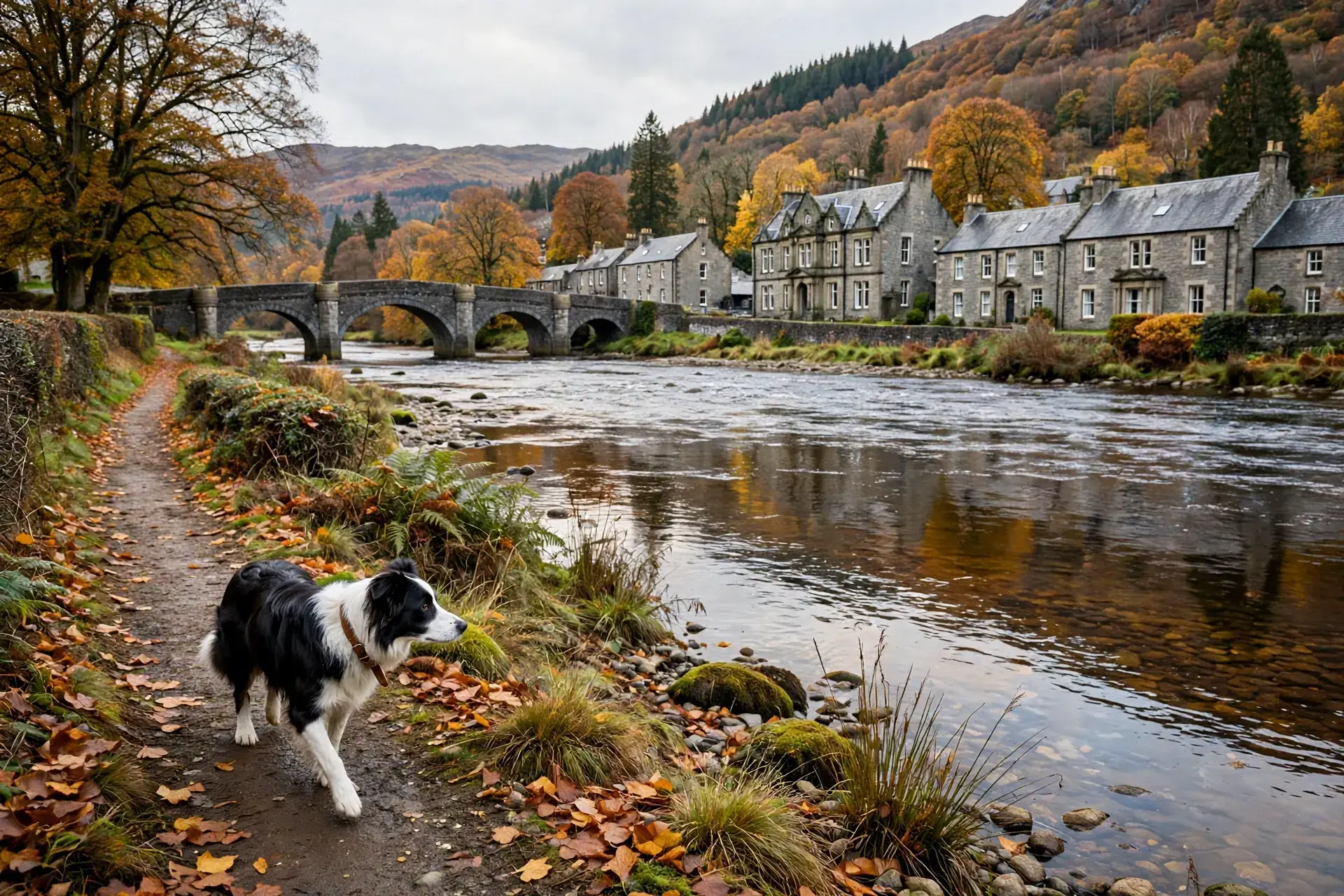
The River Dee defines Ballater. It flows fast and clear past the village, under the road bridge and through a valley of pine, birch and open meadow. The riverside path is the natural first walk for any dog, and it is also the best way to read the village: the river on one side, gardens and stone houses on the other, and a steady stream of walkers, cyclists and anglers sharing the same ground.
Start with the short riverside loop from the village centre. From the main street, head towards the river and the bridge, then follow the path along the bank. The surface is a mix of surfaced path, grass and compacted earth, which is kind on paws in dry weather and can turn muddy after rain. Keep your dog on a lead near the bridge and the road, and watch the current before you let any dog near the water. The Dee is a powerful river, and even a confident swimmer should only paddle at a shallow, slow edge in calm conditions. After heavy rain, the level can rise quickly and the banks can be slippery, so treat a flooded or fast section as a no-swimming day.
The Seven Bridges walk is the best-known longer route from the village. It crosses the Dee and its tributaries on a series of bridges, giving dogs a varied walk with river views, woodland shade and open stretches where a good recall can be used safely. Allow two to three hours for the full loop at a dog's pace, with time for sniffing, water stops and a rest on a bench. The route is waymarked in places, but it is worth carrying a map or a downloaded route, because side paths and forestry tracks can look alike. If your dog is young, older or new to long walks, do the first half and turn back at a bridge rather than pushing on to complete the loop.
East of the village, the old railway line towards the Bridge of Gairn offers a gentler, flatter walk on a former track bed. This is a good choice for a first morning, for a dog recovering from an injury, or for a wet day when hillside paths would be slippery. The line is straight, the gradient is easy, and the views open out over fields and the river valley. It also suits a long line, because there is space to let a dog range ahead without meeting traffic. Keep an eye out for cyclists, who use the same corridor, and for livestock in adjoining fields.
West of Ballater, the river path continues towards Crathie and Balmoral, and the Craigendarroch circuit climbs from the river into woodland above the village. The Craigendarroch loop is shorter than the Seven Bridges walk but steeper in places, with a viewpoint that rewards the climb. On a clear day you can see along the Dee valley and across to the hills beyond. Take water for the dog, because there is no tap on the hill, and be ready for wind at the top even when the village feels calm.
Anglers use the Dee through the fishing season, so give them space and keep dogs from splashing through pools where someone is casting. In spring and early summer, ground-nesting birds use the riverside meadows, so a lead is the kindest choice on open grass even when no sign is visible. Poo bags belong in a bin, not hung from a branch, and the village has bins along the main paths. A small bag for carrying used bags until the next bin saves the awkward choice between littering and carrying them in your hand for a mile.
For a dog that loves water, the Dee is tempting, but it is not a paddling pool. The safest approach is to choose a shallow gravel edge, keep the lead on, let the dog wade rather than swim, and watch for strong flow just a few steps out. Dogs that are poor swimmers, very small, very old or recovering from surgery should stay on the bank. If the water looks fast, brown or high, skip the swim entirely and save the energy for the woodland loop instead.
The old station and the village centre
Ballater's old station is the village's most photographed building and a useful landmark for a dog walk. The station closed to passengers in the 1960s, and the building now houses a museum, a library, a visitor information point and a restaurant. The platform area and the forecourt give a sense of how the village once welcomed royal visitors by train. Dogs are not welcome inside every part of the building, so check the current signs and ask staff before you go in, and plan to enjoy the exterior, the platform and the surrounding streets with the dog on a lead.
The station sits at the eastern end of the village, close to the river and to the start of several walks. That makes it a good meeting point and a good place to get your bearings. From the station, the main street runs west through the village, with shops, cafes, a post office and a small supermarket. The pavements are wide enough for a dog on a short lead, but the main road carries through traffic, so keep the dog on the pavement side and away from the kerb.
The village green is a useful open space for a short toilet break and a sniff, especially for dogs that have just come out of the car. It is not a dedicated dog exercise field, so treat it as a shared space: keep the dog close, pick up promptly, and move on to the river or woods for a longer run. The green works well as a pause point between the station, the shops and the river, and on a quiet morning it is one of the calmest spots in the village.
Ballater's shops are small and local, and many of them are used to dogs waiting outside or, in some cases, coming in on a lead. Do not assume entry is allowed; ask first, and if the answer is no, take turns waiting outside with the dog. A dog that is comfortable waiting tied briefly outside a shop is a great asset in a village like this, but never leave a dog unattended for long, and never in direct sun or where it blocks a pavement.
The church, the war memorial and the granite cottages along the side streets are worth a slow wander, and they give a dog a change of smells and surfaces after the river path. The side streets are quieter than the main road, and they make a good short loop for a puppy or an older dog that needs a gentle outing rather than a hike. Look out for driveways and farm vehicles, and keep the lead short at junctions where a driver may not expect a dog at ankle height.
If you are staying for more than a day, the village centre repays a second look. The first visit is for orientation; the second is for the details: which cafe has the sunny terrace, which bench catches the evening light, which stretch of pavement is quietest at breakfast time. Dogs settle faster in a place they recognise, so a short repeat loop on the second morning often works better than a brand-new route.
Woodland and hill walks
Behind Ballater, the land rises quickly into pine forest, birch wood and open moor. These walks are the reason many fit dogs love the village, and they are also the walks that need the most planning. The forest tracks are well maintained and the gradients are manageable, but the weather can change on the hill, the ground can be boggy after rain, and livestock graze the open ground above the trees.
Craigendarroch is the most accessible hill walk from the village. The path climbs through woodland to a rocky viewpoint, with a short, steep section near the top. The reward is a wide view along the Dee valley, and on a clear day the sense of space is remarkable for such a short climb. Allow about an hour and a half to two hours for the loop, including stops. The path can be slippery after rain, so wear boots with grip and keep a dog that pulls on a short lead on the descent. There is no water on the hill, so carry a bottle and a collapsible bowl, and offer water before the dog looks thirsty.
The forest tracks around Ballater suit a longer, steadier walk. They are wide, the surface is mostly compacted stone or earth, and they give a dog room to trot without meeting traffic. In summer, the canopy keeps the tracks cool, which matters on a warm day, but it also holds midges in still air. A light breeze is your friend. In autumn, the same tracks are carpeted with leaves and the birch turns gold, which makes them beautiful and also hides mud, roots and uneven ground, so watch a dog that runs ahead.
Higher routes towards the hills beyond the village are best saved for a dry day with good visibility. The Cairngorms are serious mountains, and even a lower hill walk can turn cold, wet and windy within an hour. Check the forecast, tell someone your route if you are walking alone, and set a turnaround time before you start. A dog that is fit for a flat riverside loop is not automatically fit for a steep, exposed climb, so build up the distance over the stay rather than doing the hardest walk on the first day.
Livestock is the main reason to keep a lead handy in the woods and on the open hill. Sheep graze the moorland above Ballater, and cattle can be in fields beside the lower paths. A dog that chases sheep is a serious problem for a farmer, and the law in Scotland gives farmers strong powers where livestock are worried. Keep the dog on a lead through any field with animals, and recall the dog well before a gate, not after you have seen the sheep. The same rule applies to deer, which are common in the woods at dawn and dusk and can lead a dog a long way from the path.
Forestry work can close tracks without much warning. If you see signs for harvesting, thinning or tree felling, follow the diversion or choose another route rather than ducking under a barrier. Heavy machinery, falling branches and fresh brash are real hazards for a dog that runs ahead. A short detour on a forestry track is rarely a problem, because the network is dense and another loop is usually close by.
For a dog that needs a gentler woodland walk, choose a lower forest track and walk out and back rather than committing to a loop. That way you can turn at any point, and the dog gets the smells and shade of the woods without a climb. For a dog that needs a proper run, a quiet forest track with good visibility and a reliable recall is better than a steep hill with poor sightlines. The best walk is the one that matches the dog's fitness, age and temperament on that particular day.
Dog-friendly cafes and pubs
Ballater has a small but reliable set of cafes, tea rooms and pubs, and several of them welcome dogs. The pattern is familiar across Scotland: dogs are usually welcome in a bar area, on a terrace or in a designated section, while the main restaurant may be dog-free. The exact rule depends on the business, the season and the layout, so treat any list as a starting point and check the notice at the door or ask a member of staff before you settle in.
For a morning coffee, look for a cafe with a terrace or a quiet corner where a dog can lie under the table. A tired dog after a river walk will usually settle quickly if it has a mat, a drink of water and something to chew, but a young dog that is still learning to settle may do better with a takeaway coffee and a bench outside. The village green and the riverside benches are good takeaway spots, and they let a dog watch the world without the pressure of a busy room.
At lunchtime, pubs are often the most dog-friendly option, especially in the bar area. A pub lunch after a long walk is one of the pleasures of a Deeside break, and many Ballater pubs are used to muddy boots and wet dogs. Keep the dog on a lead at your feet, keep the lead short enough that it does not trip staff, and bring a mat or a blanket so the dog has a defined place to lie. Order at the bar if that is the system, and do not let the dog wander to other tables, however friendly it is. Some people are allergic, nervous or simply eating, and a dog that visits every table is not welcome for long.
Evening meals need a little more planning. Some restaurants welcome dogs in a specific area, while others do not allow dogs indoors at all. If you have a dog that cannot be left alone in your accommodation, book ahead and ask directly whether dogs are welcome, where they sit, and whether there is space for a large dog under or beside a table. A phone call the day before is more reliable than a website that may not have been updated. If the answer is no, a takeaway eaten in your accommodation or on a terrace can still be a good evening, and it avoids a stressed dog in a crowded room.
Water is the simplest test of a dog-friendly place. A bowl offered without asking, a tap pointed out by staff, or a quiet corner for a dog bed all suggest a business that has thought about dogs. If no water is offered, ask. Most places are happy to provide it, and a dog that has drunk will settle better than one that is still thirsty after a hill walk.
Behaviour matters as much as policy. A dog that barks at other dogs, begs at tables or pulls towards the kitchen will shorten its welcome, however dog-friendly the business claims to be. Practise settling in a cafe at home before the trip, and bring a chew or a stuffed toy that keeps a young dog occupied. If the dog is having a bad day, take the food to go rather than forcing a long sit. Ballater is small enough that a takeaway and a riverside bench is a genuine alternative, not a consolation prize.
Finally, remember that dog policies change. A cafe that welcomed dogs last year may have changed hands, refitted, or decided to limit dogs to the terrace in summer. The most reliable check is the sign on the door on the day, followed by a quick question to staff. If a place has changed its rule, accept it gracefully and move on; there is usually another option a short walk away.
Where to stay with a dog
Ballater offers hotels, guest houses, self-catering cottages, lodges and a nearby caravan and camping options, and many of them accept dogs. The choice depends less on the label and more on the details: how many dogs are allowed, what the pet charge is, whether the dog can be left alone, and where the nearest toilet walk is after dark. A hotel with a dog-friendly room on the ground floor and a garden door can be easier than a pretty cottage with a steep staircase and no enclosed garden.
Self-catering is often the easiest option for a dog break. A cottage or apartment with a kitchen, a washing machine and a private entrance lets you keep the dog's routine close to home, cook when you want, and dry muddy paws without negotiating a hotel corridor. Check the enclosed garden carefully: a low wall, a gap under a gate or a shared garden can matter more than the size of the lawn. Ask whether the garden is fully enclosed, how high the fence is, and whether other guests share it. If the listing says "enclosed garden", ask what that means in practice.
Hotels and guest houses suit a shorter stay or a dog that settles well in a new room. Ask for a ground-floor room if your dog struggles with stairs, and ask where the dog can toilet at night. Some hotels have a garden or a quiet side area, while others expect you to use the street. Also ask about breakfast: some places welcome dogs in the breakfast room or on a terrace, while others expect the dog to wait in the room. If the dog cannot be left alone, a hotel that welcomes dogs at breakfast is worth more than a slightly cheaper room.
Pet charges in the Ballater area vary, so get the total in writing before you pay. Some places charge a flat fee per stay, others charge per dog per night, and some include the first dog and charge for a second. Ask whether the fee covers cleaning, whether a damage deposit is taken, and whether there is a limit on the number or size of dogs. A "dog-friendly" listing that allows one small dog is not the same as a listing that allows two large dogs, and the difference is best discovered before you arrive, not at the reception desk.
For longer stays, look at the practical details that only matter after the first day. Is there a washing machine for muddy towels, a drying area for wet coats, a freezer for raw food, or a secure place to store a crate? Is the nearest vet within a reasonable drive, and is there an out-of-hours number saved in your phone? The nearest vet practices are in Ballater and in the surrounding towns, so save the number before you need it, and check the official guidance before you travel if your dog needs regular medication or a specific diet.
If you are comparing Ballater with other bases, our guide to dog-friendly holiday parks in the UK sets out the questions that matter for any dog stay: pet fees, boundaries, unit location and the after-dark toilet walk. The same checklist works for a cottage, a hotel or a park, and it is worth running through it before you book, however familiar the area feels.
Book early for school holidays and for the summer, when dog-friendly rooms in Ballater sell out quickly. Shoulder-season dates in May, September and October are often easier to book and quieter for the dog. Whatever you book, read the cancellation terms, keep the confirmation email, and confirm the dog details in writing so there is no confusion on arrival.
Parking and getting there
Most visitors reach Ballater by car on the A93 from Aberdeen, a scenic drive along the Dee that takes about an hour in good traffic. The road is single carriageway for much of the way, with passing places and slow traffic behind lorries and caravans in summer. Allow extra time, and plan a stop for the dog rather than driving straight through. There are lay-bys and villages along the route where a short leg stretch is possible, and a dog that has had a break will arrive calmer than one that has been in the car for an hour without a stop.
In the village, use the signed public car parks rather than parking on verges, in passing places or in front of farm gates. The main car parks are close to the village centre and to the river, so you can park once and walk everywhere. On summer weekends, school holidays and event days, the car parks fill early, so arrive before late morning or be prepared for a short walk from a quieter spot. Never leave a dog in a parked car on a warm day, even with a window open; a car heats up fast, and a shaded car park in the morning can be in full sun by midday.
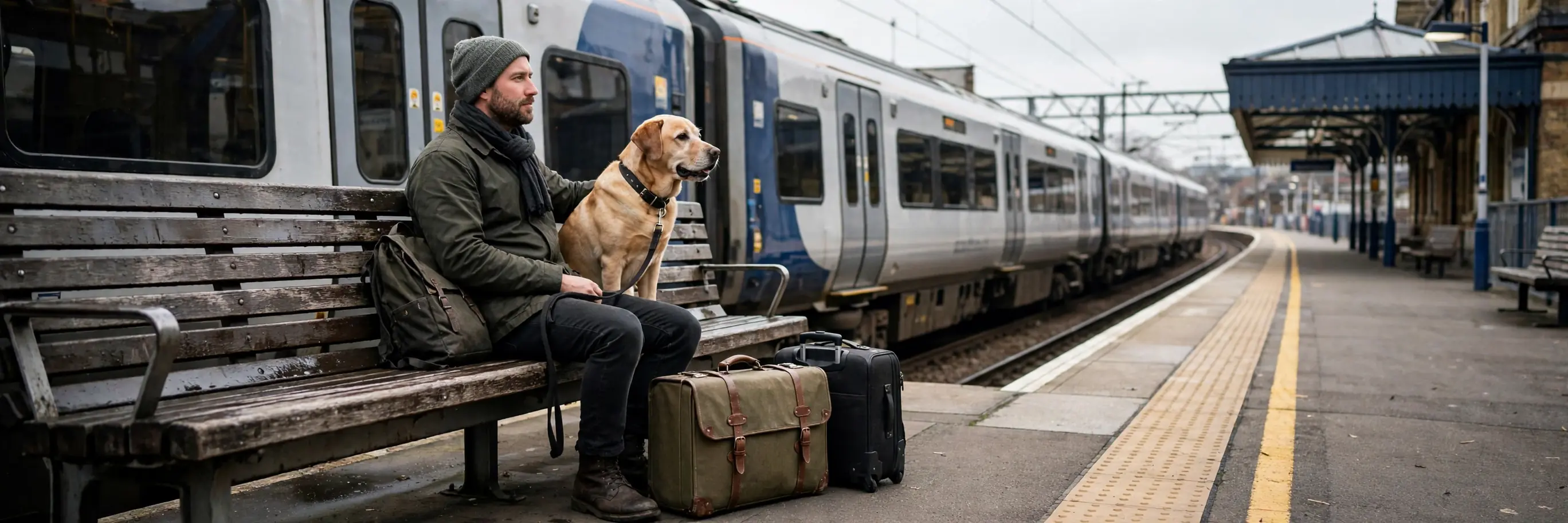
Ballater has no railway station, but buses run from Aberdeen, and the journey is a pleasant way to see Deeside without driving. If you travel by bus, check the operator's dog policy before you travel, because rules for dogs on buses vary and a large dog may need to sit in a specific place. Our guide to dog-friendly train stations in the UK explains the waiting-room, platform and connection habits that also help when you are changing between a train and a bus at Aberdeen. Arriving by public transport is entirely possible, but it needs more planning than driving, especially with luggage, a crate and a dog.
If you are driving from further south, the route through Perth and Blairgowrie to Braemar and then east to Ballater is a spectacular alternative, but it is a mountain road with steep gradients and few services. Check the weather and the road conditions before you set out, and do not rely on a satnav shortcut through a forest track. In winter, the higher roads can be closed or icy, and the A93 through Ballater is usually the safer choice.
Once you are in Ballater, you do not need the car for most days. The river, the woods, the village centre and the lower hill paths are all within walking distance of the centre. That is one of the village's strengths for a dog break: the car can stay parked while the dog walks. Use the car for the longer trips west to Balmoral, east to Aboyne, or south into the hills, and save the village itself for walking.
Electric vehicle charging is available in the wider area, but check the location and the connector type before you rely on it, and do not assume a rural car park will have a fast charger. If you need fuel, fill up in a larger town on the way in, because village filling stations have shorter hours and can be busy at weekends.
A day trip towards Balmoral
Balmoral Castle lies about eight miles west of Ballater, and it is the obvious day trip from the village. The castle and its grounds are open to the public for part of the year, usually from spring to early summer, and the dates and times change annually. Dogs on leads are welcome in the grounds and gardens when they are open, but they are not allowed inside the castle itself. That combination makes Balmoral a good half-day for a dog that is happy to walk in gardens and woodland on a lead, and a poor choice for anyone who wants a full tour of the castle interior with the dog in tow.
Plan the Balmoral day as a walk with a castle, not a castle visit with a walk attached. Drive west from Ballater along the Dee, park in the signed car park, and walk the grounds at the dog's pace. The gardens, the river walks and the woodland paths give a dog plenty to sniff, and the views across the valley are a reminder of why the royal family chose this place. Take water and a bowl, because a warm day in the gardens can be thirsty work, and keep the dog on a lead throughout the grounds, even on quiet paths.
Check the opening times and the dog rules before you travel, because Balmoral closes for part of the year and the grounds may be closed for private events. The official website is the reliable source, and it is worth checking the day before as well as the week before, because a late change can save a wasted drive. If Balmoral is closed, the drive west is still worthwhile: Crathie, the village beside the castle, has a riverside walk and a church with a royal connection, and the road back to Ballater passes some of the most beautiful stretches of the Dee.
Crathie is a good backup plan. The riverside path there is quieter than Ballater, and the walk along the Dee gives a dog a change of scene without a long drive. The churchyard and the village are small, so a short visit is enough, and you can be back in Ballater for lunch. If you want a longer day, continue west to Braemar, a larger village at the head of Deeside with its own castle, shops and walks. Braemar is about 18 miles from Ballater, and the drive takes you through open moorland where red deer are often visible at dawn and dusk.
For a dog that does not cope with formal gardens, skip Balmoral and choose a hill or forest walk instead. A dog that pulls, barks at other dogs or struggles to settle in a busy garden will enjoy a quiet forestry track far more than a crowded castle ground. The best day trip is the one that suits the dog, not the one that looks best in a photograph.
Whatever you choose, leave early enough to be back in Ballater before the light fades, especially in autumn and winter. The roads west are unlit, the deer are active at dusk, and a tired dog will appreciate being back in its accommodation with food and a bed rather than still in the car on a dark road.
Seasons, weather and safety
Ballater changes with the seasons, and the right plan in May is the wrong plan in November. Spring brings long days, lambs in the fields and woodland flowers, but also soft ground and changeable weather. A spring walk needs a lead around lambs, a waterproof coat for the dog if it gets cold when wet, and a towel in the car for the inevitable muddy paws.
Summer is the busiest season, with the longest days and the warmest weather, but also with midges, heat and crowds. Midges are worst in still, damp woodland at dawn and dusk, and they can make a dog miserable. A breezy riverside walk is better than a sheltered woodland track on a midge day, and a dog that is sensitive to bites may need a vet-approved repellent. Heat is a real risk, even in Scotland: a dog in a car, a dog running on a hot pavement, or a dog climbing a hill at midday can overheat quickly. Walk early, carry water, and use shade and the river edge to cool down.
Autumn is often the best season for a dog break in Ballater. The birch and rowan turn gold and red, the paths are firm after a dry summer, the midges fade, and the village is quieter after the school holidays. The light is low and beautiful, and the river is at its most photogenic. The trade-off is shorter days and wetter weather, so a head torch and a waterproof are worth packing, and a walk that was easy in summer may need more time in autumn mud.
Winter in Ballater is quiet, cold and beautiful, with frost on the river, snow on the hills and a village that feels properly remote. It suits a calm, older dog that enjoys short walks and a warm fire, but it is hard work for a young dog that needs a long run. Daylight is short, paths can be icy, and the river can be high after rain. Keep walks short, use a lead on icy ground, and dry the dog thoroughly after a wet walk. A drying coat and a warm bed make a winter stay comfortable, while a wet dog in a cold cottage does not.
Safety in Ballater is mostly about the basics: a lead near roads and livestock, water on hill walks, a phone with charge, and a realistic plan. Adders live in the heath and moorland around Deeside, and while bites are rare, a dog that sniffs in long grass on a warm day can meet one. Keep dogs on paths in adder habitat, and if a dog is bitten, keep it calm, carry it if you can, and get to a vet quickly. Ticks are common in woodland and long grass from spring to autumn, so check the dog after every walk, remove ticks promptly, and use a vet-approved preventative.
Finally, know the nearest vet and save the number before you need it. Ballater has a vet practice, and there are practices in Aboyne and Aberdeen for out-of-hours care. A dog that eats something odd on a walk, cuts a paw on a sharp stone, or shows signs of heatstroke needs a vet, not a search engine. A small first-aid kit with bandages, saline, tweezers and the vet's number is a sensible addition to any dog break in a rural area.
A practical day in Ballater
A good day in Ballater does not need a strict timetable, but a loose plan helps a dog settle. Start early with a riverside walk before the village wakes up. The light is soft, the river is quiet, and a dog that has had a proper morning walk will settle better for the rest of the day. Keep the first walk to 45 minutes to an hour, with time for sniffing and a paddle at a safe edge, and be back for breakfast with a calm dog.
After breakfast, choose the main walk of the day. On a dry day, take the Seven Bridges loop or the Craigendarroch climb. On a wet day, choose the old railway line or a lower forest track. On a hot day, choose a shaded woodland walk early and save the open hill for the evening. Pack water, a bowl, poo bags, a lead and a long line, and a towel for the car. Tell someone your route if you are walking alone, and set a turnaround time.
Lunch is the natural pause. Pick a dog-friendly pub or cafe, or take a sandwich to a riverside bench. Give the dog water, a chew and a mat, and let it rest while you eat. A dog that has walked for two hours does not need another two hours immediately; it needs food, water and a sleep. Use the afternoon for a short village wander, a visit to the old station, or a quiet hour in your accommodation.
In the late afternoon, take a short second walk, ideally a different route from the morning. A gentle riverside loop, a walk around the village green, or a short woodland track is enough. The aim is to tire the dog gently, not to exhaust it. A dog that has had two moderate walks and a rest will sleep better than a dog that has had one very long walk and then been left alone.
In the evening, eat in a dog-friendly pub or cook in your accommodation, and finish with a short toilet walk before bed. Check the dog's paws for cuts, mud and ticks, dry the coat if it has been wet, and lay out the next morning's kit so the early walk is easy. A simple routine, repeated for a few days, turns Ballater from a place you visited into a place the dog recognises, and that recognition is what makes a dog break feel like a holiday rather than a series of walks.
Practical questions
Before you go
Can dogs walk off lead in Ballater?
Some open riverside and woodland stretches suit a reliable recall, but keep your dog on a lead in the village centre, near roads, around livestock and where signs ask for it. Ballater is a working rural village, so sheep, cattle and other dogs can appear without warning.
Is the River Dee safe for dogs to swim in?
The Dee is a fast, cold river with strong currents in places, so it is not a safe paddling spot for every dog. Choose a shallow, slow edge only in calm conditions, keep a lead on in faster water, and skip swimming after heavy rain. Check the official guidance before you travel if conditions are uncertain.
Are dogs welcome in Ballater cafes and pubs?
Several village cafes and pubs welcome dogs, usually in a bar area, on a terrace or in a designated dog-friendly section. Policies change by season and by owner, so check the latest notice at the door or ask staff before you settle in, and keep your dog on a lead at your feet.
Where can I park in Ballater with a dog?
Use the signed public car parks in and around the village centre rather than blocking verges or farm gates. Arrive early on summer weekends and school holidays, allow time for a short walk to the river, and never leave a dog in a parked car on a warm day.
Can I take my dog to Balmoral from Ballater?
Dogs on leads are welcome in the Balmoral Castle grounds and gardens when they are open to the public, but they are not allowed inside the castle itself. Opening dates and times change by season, so check the official guidance before you travel and plan a riverside walk as a backup.
What is the best time of year to visit Ballater with a dog?
Late spring and early autumn usually give the best balance of long daylight, firm paths and fewer midges. Summer is busy and can be warm, while winter is quiet and beautiful but brings short days, ice and mud, so match the season to your dog's age, fitness and coat.