This guide is independent and contains no paid placement. If affiliate links are added later, they will be clearly marked and will not change our editorial checks.
Keep your dog on a lead from the station entrance to the train door, stand well back from the platform edge, and allow far more connection time than the timetable suggests. Station rules vary by station and operator, so check the official guidance before you travel rather than assuming one station works like the last.
The forgotten leg of the journey
Ask a dog owner how a rail journey went and they will usually talk about the train: whether there was floor space, whether the dog settled, whether another passenger objected. Ask what happened before the train arrived and the story often changes. The station is where most rail days with a dog actually go wrong, and it is the part of the trip that almost nobody plans. The dog that was calm at home becomes overstimulated in a crowded concourse. The connection that looked generous on the booking screen evaporates when the lift is at the far end of a long platform. The waiting room turns out to be closed to dogs, the cafe has no outdoor seating, and the only patch of grass is on the far side of a busy road. None of this is dramatic, but it is exactly the friction that turns a pleasant day out into a stressful one, for the dog as much as for the owner.
The reason is simple: a train is a controlled environment with a seat, a timetable and a door that closes. A station is not. It is a public building full of announcements, rolling suitcases, food smells, other dogs, children, bicycles and people in a hurry, all moving in different directions. Dogs read that environment very differently from humans. A person sees a concourse as a route to a platform; a dog experiences it as a sequence of smells, sounds and encounters, each of which costs attention and self-control. A dog that can lie quietly under a table at home may still struggle to hold a down-stay for forty minutes on a cold platform bench while express trains thunder past. That is not bad behaviour. It is a dog coping with a demanding environment, and the owner's job is to make that environment as manageable as possible.
This guide therefore treats the station as a destination in its own right, not as a gap between trains. It starts with the rules that apply almost everywhere, then works through the parts of a station one by one: the platform, the waiting room, the ticket hall, the connection, the cafe and the street outside. It finishes with a practical difference that matters more than any single rule, which is station size. A major city terminus, a medium-sized town station and a small rural halt are effectively three different kinds of place for a dog owner, with different facilities, different risks and different tactics. If you learn to read a station by its size before you arrive, most of the surprises disappear.
One caution runs through everything that follows. Station policies are set by a mixture of national conditions of travel, train operators and station managers, and they are not uniform. The national picture is reassuringly consistent on the basics — dogs travel free in most cases, up to two per passenger, and must be kept under control — but the details of waiting rooms, lounges, cafes and even platform access vary. Where this guide says that policies vary by station, it means it literally: do not assume that because one station welcomed your dog into its waiting room, the next one will. Check the official guidance before you travel, especially for longer waits, first-class lounges and any station you have not visited before.
Station ground rules: leads, carriers and trolleys
The single most important station rule is also the simplest: keep your dog on a lead throughout the station. Under the National Rail Conditions of Travel, dogs must be kept on a lead at all times in stations and on trains, unless they are travelling in a suitable carrier. Several operators repeat the point in their own pet guidance, and some specify a short lead in busy areas. The practical upshot is that the lead goes on before you enter the station building, not at the platform, and it stays on until you are settled on the train. This matters because stations are where dogs are most likely to meet other dogs, and an off-lead greeting in a concourse can escalate quickly in a space with no room to retreat. Staff can ask you to leave the station if your dog is out of control, and an off-lead dog in a crowded terminus is the fastest way to earn that conversation.
Choose the lead for the station, not for the walk. A short, fixed-length lead of around one to one-and-a-half metres gives you real control in a crowd; a long line or a retractable lead is a liability in a concourse, where it can trip other passengers, wrap around luggage trolleys and let a dog reach another dog before you can intervene. A harness with a handle on the back is useful for guiding a dog through a ticket gate or up a lift, and a lead with a second clip or a waist attachment can help if you need both hands for tickets and luggage. If your dog pulls hard when excited, consider a head collar or a front-clip harness that you have already practised with at home, because a station is the worst place to trial new equipment. The goal is a lead arrangement that lets you keep the dog close, visible and calm without a constant wrestling match.
Carriers and trolleys are the other half of the station picture, and they suit different dogs. A small dog in a carrier is usually the easiest station passenger of all: contained, portable, and welcome in places where a loose dog might not be, including some waiting rooms and cafes. A carrier must be large enough for the dog to stand, turn and lie down comfortably, and it must be carried or wheeled rather than dragged along a platform. A dog trolley or pet stroller serves a similar purpose for older, arthritic or very small dogs, and it keeps paws off wet, gritty or salted platform surfaces in winter. Not every station lift fits a large stroller comfortably, though, so check the route in advance if you rely on one. Whatever you use, practise at home first: a dog that has never sat in a trolley will not learn to love it in a busy station.
The national free allowance is worth knowing before you reach the ticket gates. Most operators allow up to two dogs per passenger free of charge, although the exact wording differs: some count all pets together, some specify dogs, and a few cap the free allowance by size or require extra dogs to be paid for. Southeastern, for example, limits its free allowance to small dogs and charges for additional animals. The practical point for station use is that staff at the gate are unlikely to count your dogs, but you should still know your operator's rule, because a third dog or an undeclared pet can become a problem if a conductor or station manager asks. If you are travelling with more than two dogs, check the official guidance before you travel and be ready to pay any extra charge rather than hoping nobody notices.
Finally, remember that a station is also where your dog's manners are most visible. A dog that jumps up at strangers, barks at announcements or lunges at luggage will draw attention from staff and fellow passengers in a way that the same behaviour on a quiet country walk would not. This is not a reason to avoid stations, but it is a reason to train for them: practise settling on a mat in busy places, reward calm behaviour around trolleys and suitcases, and build up the length of waits gradually. A dog that can settle for ten minutes in a quiet waiting room will manage forty minutes in a busy one far better than a dog whose first long wait is also its first station visit.
Platform safety: edges, noise and boarding
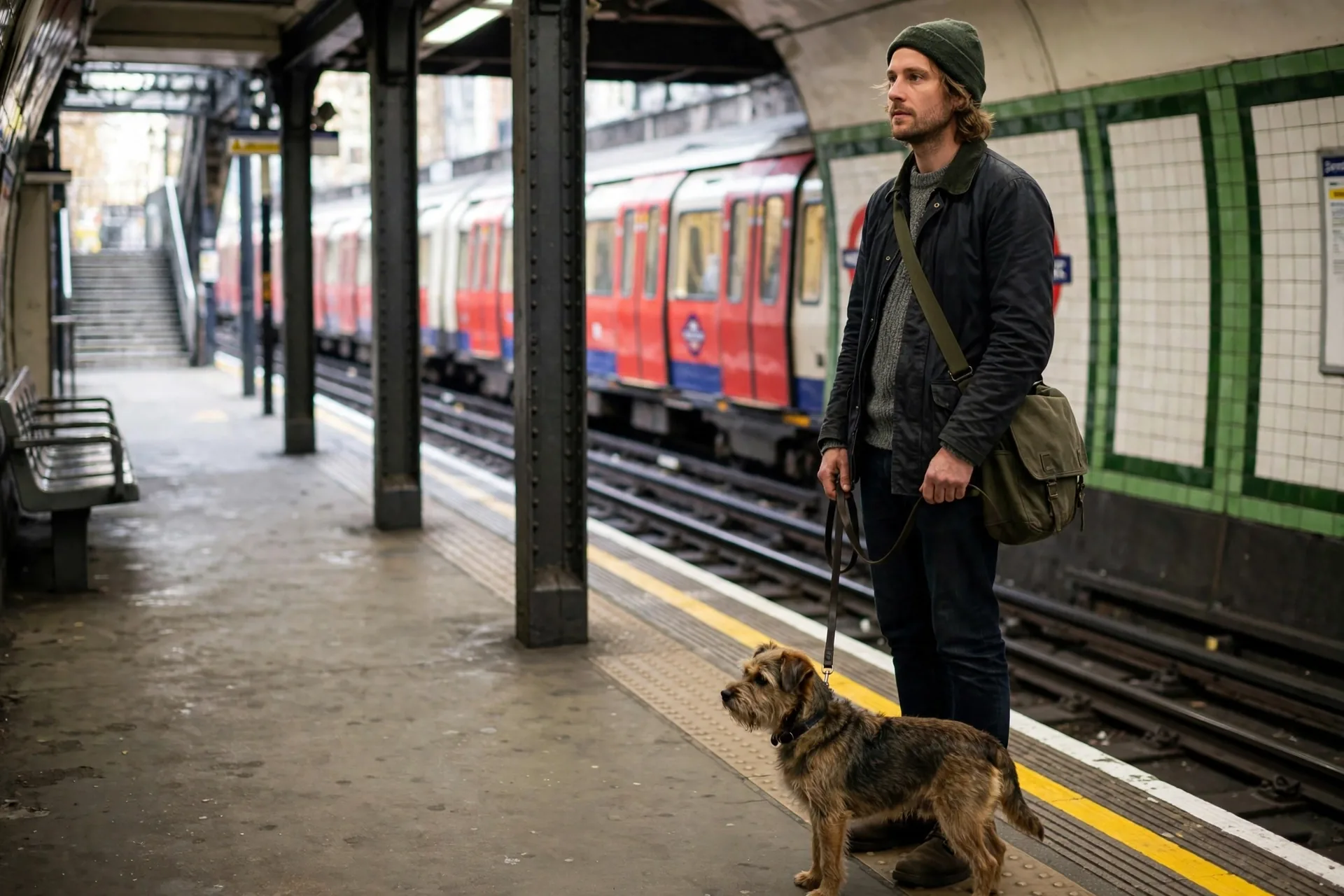
The platform edge is the one place in a station where a moment of inattention can become genuinely dangerous. Keep your dog well back from the yellow line at all times, and keep the lead short whenever a train is arriving or departing. Dogs do not understand the suction and noise of a passing express train, and a dog that lunges towards a moving train, or is startled sideways by one, can pull an owner towards the edge. The safest position is against the platform buildings or the back wall, with the dog between you and the wall, so that you are between the dog and the edge. If the platform is crowded, stand at the quieter end rather than fighting for space near the entrance stairs, where the crush is worst and dogs are most likely to be stepped on.
Noise is the platform's second hazard, and it is easy to underestimate. An express train passing at speed produces a sudden wall of sound, vibration and wind that can frighten even a confident dog. Some dogs react by barking, some by bolting, and some by freezing in place, which is a problem if you need to move. You can reduce the impact by choosing a position away from the fastest through lines where the station layout allows it, by keeping the dog's attention on you with treats as trains pass, and by avoiding the temptation to stand right at the edge for a better view. If your dog is noise-sensitive, consider ear protection designed for dogs, practised at home first, and plan longer waits in a waiting room or concourse rather than on an exposed platform. Puppies and rescue dogs on their first rail trips deserve particular care here: one frightening platform experience can colour every later journey.
Boarding itself deserves a small routine of its own. Wait until the passengers getting off have cleared the doors, then step on with the dog close beside you and the lead short. Avoid the crush near the doors at peak times if you can; boarding at the end of the train is usually quieter, and it also puts you nearer the vestibule space where a dog can lie without blocking the aisle. Once on board, settle the dog on the floor by your feet, not on a seat, and keep the lead looped around your wrist or ankle so the dog cannot wander during the journey. If you are travelling with a dog that needs the toilet, do not board a long non-stop service without a break: use the station facilities and the street outside before you commit to two hours without a stop. Our guide to dogs on sleeper trains covers the overnight version of this problem, where a toilet break before boarding matters even more.
Weather changes the platform picture too. In summer, south-facing platforms can be hot, and dark tarmac radiates heat that burns paws; carry water and seek shade under a canopy, and test the surface with your own hand before asking a dog to lie on it. In winter, platforms are gritted, salted and often wet, which irritates paws and makes surfaces slippery for older dogs; a quick paw wipe after arrival and a towel in your bag are small things that prevent sore feet. In rain, the canopy edge becomes a bottleneck where everyone shelters, so move past it to a quieter spot rather than joining a crush of umbrellas and wet dogs. None of these are reasons to avoid rail travel, but they are all reasons to arrive at the platform with a plan rather than improvising under pressure.
Waiting rooms and the ticket hall
Waiting rooms are the great inconsistency of the British station. Some welcome dogs warmly, some tolerate them quietly, and some exclude them entirely, and there is no single national rule that tells you which kind you are about to meet. The ordinary waiting room on a platform is the most likely to accept a well-behaved dog on a lead, particularly at smaller stations where the room is simply a heated shelter with seats. Larger stations, however, may have waiting rooms run by a particular operator or by a commercial partner, with their own conditions, and first-class lounges are a separate world altogether. Several operators allow dogs into first-class lounges only for passengers holding a first-class ticket, while others exclude dogs from lounges entirely. Because policies vary by station, the only reliable approach is to check the official guidance before you travel and to have a fallback: a quiet bench, a sheltered part of the concourse, or a cafe with outdoor seating.
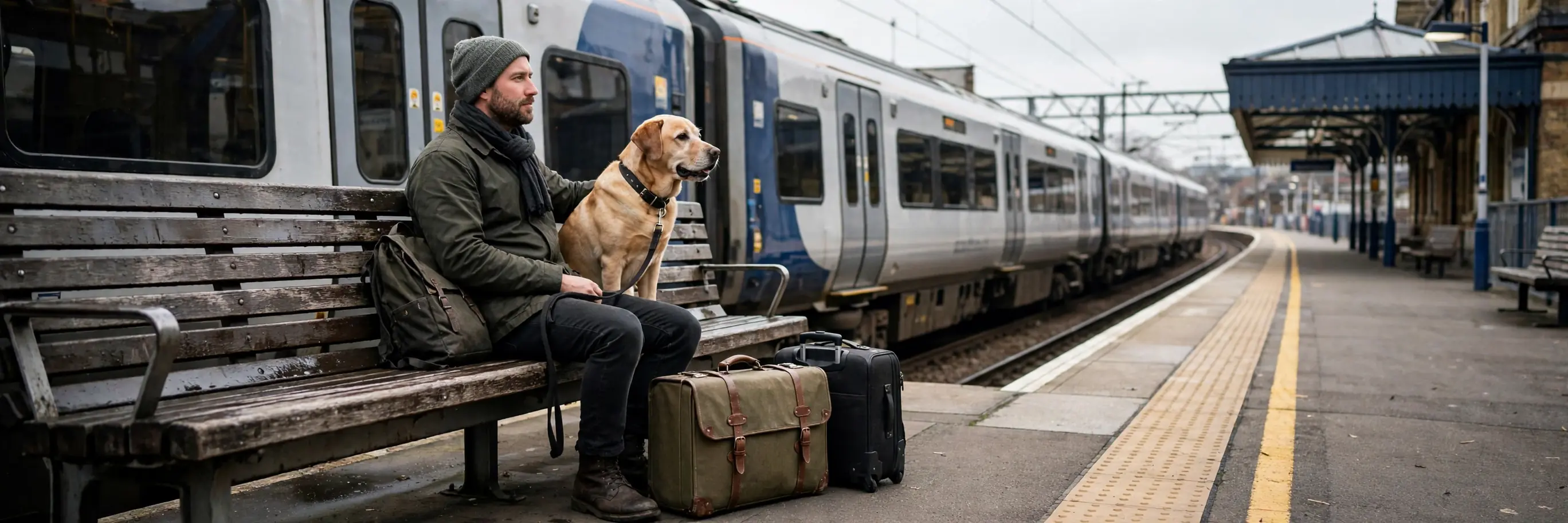
Inside a waiting room, the etiquette is straightforward but worth spelling out. Keep the dog on the floor, on a short lead, and close to you, not wandering between seats or greeting every occupant. Bring a mat or blanket so the dog has a defined place to settle; a familiar mat is one of the most effective calming tools there is, because it tells the dog that this unfamiliar room is a resting place, not a playground. Wipe muddy paws at the door, keep barking under control, and be ready to step outside if your dog becomes restless. A waiting room is a shared space, and a single barking dog can turn the whole room against dogs in general. If your dog is having a bad day, a platform bench in fresh air is often kinder than a confined room full of strangers.
The ticket hall and concourse deserve the same calm approach. Ticket gates are a pinch point: dogs can be nervous about the glass barriers, the beeping and the crowd pressing through, so train your dog to walk through a narrow gap calmly, and carry the dog through or use the wide accessible gate if the standard gate is too tight. Keep the dog on your far side from the gate mechanism, and never let a long lead trail through a closing barrier. At large stations, the concourse itself can be overwhelming, with departure boards changing, announcements overlapping and crowds moving in every direction. Move steadily to your platform rather than lingering in the busiest flow, and use the quieter side corridors where they exist. If you need to buy a ticket at the station, use a machine away from the main queue or buy online before you arrive, so you are not juggling a ticket, a lead and luggage in the middle of a crowd.
One more concourse detail is easy to miss: the departure board. Dogs cannot read, but owners under time pressure can misread, and a misread platform number is how a calm wait becomes a sprint across a station with a dog in tow. Check the board twice, confirm the platform on the station's own screens rather than a third-party app alone, and head to the platform early. A dog that walks to the platform at a relaxed pace is a different animal from one that is dragged through a crowd at a run, and the five minutes you save by lingering in the concourse are rarely worth the stress of the dash that follows.
Changing trains: same station, different operator
Changing trains with a dog is a different skill from waiting for one, because it adds navigation, timing and sometimes a change of rules. The first distinction to make is between a same-station change and a cross-operator change. A same-station change on one operator's network is usually the simplest: the same pet rules apply throughout, the platforms are in one building, and staff can advise on the quickest step-free route. A cross-operator change is where the complications start. One operator may allow dogs in a first-class waiting area that the next operator's service does not, or may have a different view of carriers, numbers or boarding. None of this prevents the journey, but it means you should read both operators' pet guidance before you travel, not just the first one, and you should not assume that a rule you relied on for the first leg automatically carries over to the second.
Timing is the practical heart of a good connection. The timetable's minimum connection time is calculated for a fit adult walking briskly with no luggage, no dog and no need for a lift. Add a dog, and the calculation changes: you need time to find the lift or the accessible route, time to let the dog sniff and settle after the first train, time to check the departure board for a platform change, and a margin for the lift being busy or the footbridge being longer than expected. As a working rule, treat fifteen minutes as a tight minimum at a large station and aim for thirty minutes or more when changing operators, changing levels, or travelling with a nervous, elderly or very young dog. If the only available connection is under ten minutes, it is worth considering a later service, even if that means a longer overall journey. A missed connection with a dog is not a disaster, but a sprint across a station with a frightened dog is an avoidable one.
Route planning inside the station matters as much as the timetable. Before you travel, look at the station map and identify the step-free route between your arrival and departure platforms. At large stations this may mean a lift at the far end of the platform, a subway, or a bridge that adds several minutes; at smaller stations it may simply mean crossing a footbridge or using a barrow crossing, which may not be available to all passengers at all times. If you use a wheelchair, a pushchair or a large dog trolley, the step-free route is not optional, so confirm it in advance and allow extra time for it. Station staff can help, and many stations offer passenger assistance, but assistance usually needs to be booked ahead, so do not rely on finding help at the moment you need it. When you arrive on the first train, head for the lift or the crossing immediately rather than lingering, and keep the dog close through the busiest stretch.
There is also the question of what to do if the connection goes wrong. Trains are delayed, platforms change, and services are cancelled, and each of these is harder with a dog because your options narrow: you cannot easily take a taxi with a large dog at short notice, and a rail replacement bus may not carry dogs at all. If a connection is missed, go to the station information point or find a member of staff and explain that you are travelling with a dog, because the alternative they suggest may assume you can board any vehicle. If you are offered a bus, check whether dogs are carried before boarding, as replacement bus rules are set by the bus operator and are not covered by rail pet rules. Keep water, a chew and a familiar blanket accessible rather than buried in a suitcase, so that an unexpected hour in a station stays manageable. A calm owner with a plan is the best thing a delayed dog can have.
Finally, remember that a connection is also a toilet opportunity, and often the only one for an hour or more. If the connection is thirty minutes or longer, use the first ten minutes for a proper break outside the station rather than waiting until the last minute. Dogs that have had a chance to relieve themselves, stretch and sniff are noticeably calmer on the second train, and the owner boards with one less worry. The exception is a very tight connection, where the toilet break must wait until the destination; in that case, keep the dog's needs in mind when choosing the service, and do not book a tight connection followed by a long non-stop leg if you can avoid it.
Large hub stations
Large hub stations — the great city termini and major interchanges — are the most daunting for a dog owner and, paradoxically, often the best equipped. They have staff, information points, lifts, accessible routes, waiting areas, food outlets and, usually, a patch of outdoor space within a short walk. What they lack is calm. The sheer volume of people, announcements, rolling luggage and food smells can overwhelm a dog that is perfectly well behaved in quieter places, and the distances inside the building are large: changing platforms can mean a ten-minute walk through crowds, and the lift you need may be at the opposite end from where your train arrives. The tactic for a hub is therefore to plan the route in advance, move steadily, and use the station's facilities rather than fighting its crowds.
Start by learning the station's layout before you arrive. Most large stations publish maps online showing platforms, lifts, waiting areas and exits, and a few minutes with the map can save a frantic search with a dog in tow. Identify your arrival platform, your departure platform, the lift or step-free route between them, and the nearest exit to the street for a toilet break. If you have a long wait, identify a quiet corner in advance: the far end of a platform, a less busy waiting area, or a cafe with outdoor seating away from the main flow. Hub stations also have the most staff, so do not hesitate to ask for directions to the step-free route or the quietest waiting area; staff deal with dog owners every day and can usually point you to the route that avoids the worst crowds.
Hubs also have the most variation in their individual rules, which is why the general advice to check the official guidance before you travel matters most here. One terminus may welcome dogs in its main waiting area while another restricts them, and first-class lounges in hubs are the most likely places to have specific conditions. Because policies vary by station, do not rely on your experience at one hub to predict another, even within the same city. If you are changing between a mainline service and a London Underground service, remember that the Underground has its own rules on leads, escalators and carrying small dogs; our guide to dogs on the London Underground explains those in detail, including the rule that dogs must be carried on escalators unless they can use a lift.
The other hub-specific point is the sheer number of other dogs. At a busy terminus you will meet dogs of every size and temperament, often in close quarters on platforms and in waiting areas. Keep your dog close, avoid nose-to-nose greetings in narrow passages, and move past other dogs steadily rather than stopping for a chat in a bottleneck. If your dog is reactive, choose the quietest route even if it is longer, travel outside peak hours where possible, and consider a muzzle that your dog has been trained to accept happily, not as a punishment but as a safety net that lets everyone relax. A hub rewards preparation and punishes improvisation, so the more you plan before you arrive, the easier the dog's experience will be.
Medium stations
Medium stations — the town and suburban stations with several platforms, a ticket office or machines, a waiting room and a small concourse — are often the easiest places to travel with a dog. They are busy enough to have facilities, but not so busy that the dog is overwhelmed. The platforms are shorter, the distances are smaller, and the waiting room is more likely to be a simple shelter that accepts dogs without fuss. The risks here are different: fewer staff, less clear signage, and a greater chance that the facilities you expect are closed, unstaffed or out of order. A medium station rewards a quick check before you travel, but it rarely demands the detailed route planning that a hub does.
The practicalities of a medium station are usually straightforward. Ticket gates, where they exist, are simpler and less crowded, and the wide gate is normally easy to find. Platforms are reached by a footbridge or a subway, and the step-free route, where one exists, is usually signposted, although it may involve a longer way round or a barrow crossing that is only available when staff are present. If you need step-free access, check in advance whether the crossing or lift is available at the time you travel, because at unstaffed times the step-free route may not be usable. Waiting rooms at medium stations are typically open during staffing hours and may be locked outside them, so a winter evening wait may mean standing on the platform rather than sitting indoors; pack a warm layer for the dog, such as a coat for a short-coated breed, and a mat to insulate against a cold bench.
Food and drink at medium stations is limited, which is worth knowing before a long wait. There may be a small cafe or a kiosk, but it may close early, and its dog policy may be no more than the individual server's judgement on the day. Carry water and a snack for the dog, and do not rely on buying either at the station. The same applies to information: if the station is unstaffed, the departure screens and announcements are your only source, so check the platform and time carefully and allow for the possibility that a platform alteration is announced late. A medium station is a good place to build a dog's station confidence, because the stimulation is moderate and the spaces are manageable; if you are introducing a puppy or a rescue dog to rail travel, a medium station with a short wait is an ideal first experience.
Small rural stations
Small rural stations — the unstaffed halts and single-platform stops that serve villages and remote lines — are a different world again, and they suit many dogs very well. There is little noise, few people, and often a quiet lane or field edge right outside for a toilet break. What they lack is everything else: no waiting room, no staff, no cafe, no accessible lift, and sometimes no shelter beyond a small canopy. A long wait at a small station in rain or cold is a test of preparation, not of the dog's manners, and the owner who arrives with water, a mat, a coat and a plan will have a far better time than one who expects facilities that do not exist.
The most important small-station skill is checking the service pattern before you travel. Rural lines often run hourly or less, and a missed train can mean a wait of two hours rather than ten minutes. Build in a generous margin, and if the timetable shows a long gap, plan the wait around it: walk the dog before you arrive at the station, bring a long-lasting chew, and choose a sheltered spot out of the wind. Request stops deserve a special mention: on some rural lines, you must signal clearly to the driver or the train will not stop, and a dog owner distracted by settling the dog can miss the moment. Stand visibly near the platform edge, but well back from the yellow line, with the dog close, and signal in good time.
Safety at small stations has its own quirks. Platforms may be short, unlit or uneven, and there may be no staff to help if something goes wrong. Keep the dog on a short lead at all times, because a loose dog at an unstaffed station can wander onto the track or into a neighbouring field with no one to intervene. Level crossings near small stations are another hazard: keep the dog close and under control when crossing, and never let a long lead trail across the track. On the positive side, small stations are often the most forgiving places for a nervous dog, because there is space to move away from other passengers, and the quiet atmosphere lets a dog settle naturally. Many owners find that their dog's favourite station experiences are at small halts, where the journey feels like a walk that happens to involve a train.
Cafes, shops and lounges
Station cafes, shops and lounges are where dog owners most often meet a polite but firm refusal, and the reason is that these are commercial spaces with their own rules. A station may welcome dogs throughout its concourse while an individual cafe inside it does not, and the distinction is entirely legitimate: a small food outlet with limited space, open food preparation and hygiene requirements may reasonably decide that dogs are not practical. Larger cafes with outdoor seating are usually the most dog-friendly option, because the dog can sit outside with you while you eat, and many chains now have an explicit dog policy for their outdoor areas. Smaller outlets, takeaway hatches and food courts vary widely, and the only reliable way to know is to ask or to look for signage at the entrance. Because policies vary by station and by business, check the official guidance before you travel if a cafe stop matters to your plans, and have a takeaway fallback in mind.
Shops are generally easier. A dog on a short lead that stays close to its owner is usually welcome in station shops, newsagents and convenience stores, although individual retailers can refuse, and a dog that barks or pulls towards food displays will quickly change a shopkeeper's mind. Keep the dog close, avoid blocking aisles with a large dog or a trolley, and do not let the dog sniff open food. If you need to buy supplies for the dog, such as water or treats, a station shop is a convenient option, but do not rely on it for anything specialised: most stock only basic bottled water and a limited range of snacks, and a dog with dietary needs should travel with its own food. If you are buying a coffee, consider a lidded cup and a seat outside rather than a table inside a crowded cafe where the dog will be underfoot.
First-class lounges deserve a separate paragraph because they are the most common source of confusion. Several operators allow first-class ticket holders to take a well-behaved dog on a lead into their first-class lounges, while others exclude dogs from lounges entirely, and the position can differ between stations served by the same operator. LNER, for example, is known for allowing first-class ticket holders to take a dog into its first-class lounges, while other operators take a stricter line. Do not assume that a first-class ticket buys lounge access for your dog; check the official guidance before you travel, and if the lounge is closed to dogs, plan to wait on the platform or in the general waiting area instead. The same caution applies to privately run lounges and to airport-style lounges inside larger stations, which set their own conditions.
A useful habit for all station extras is to keep the dog's needs visible but low-key. A mat on the floor, a chew, and a bowl of water signal that the dog is settled and under control, which makes staff and fellow customers far more relaxed than a dog wandering on a long lead. If a member of staff says dogs are not admitted, accept it gracefully and move on; arguing in a station helps no one and makes life harder for the next dog owner. The station is full of alternatives, and a takeaway coffee drunk on a platform bench with a settled dog is often a better experience than a stressed meal in a crowded cafe anyway.
Outside the station: toilet breaks and facilities
Almost no British station has a dedicated dog toilet area, and this single fact shapes the whole station visit. Dogs cannot be expected to wait indefinitely, and a long wait or a long onward journey without a break is unfair and impractical. The solution is to build a toilet break into the station plan, using the streets outside, a nearby patch of grass, or a small park within a few minutes' walk. Before you travel, look at the area around the station on a map and identify a suitable spot: a quiet side street with grass verges, a public garden, or a residential road where a dog can relieve itself without blocking a pavement. At a large hub, this may mean a five-minute walk from the concourse; at a small station, it may be the lane outside the gate. Either way, plan it before you arrive, because searching for grass with a desperate dog in an unfamiliar town is stressful for everyone.
Carry the equipment for a proper break: bags, water, and a towel for muddy paws. Clean up immediately and completely, because fouling on a station forecourt or a platform is both anti-social and, in many places, an offence that can attract a fine. Never let a dog foul on a platform, in a waiting room or in a ticket hall, and if an accident happens, clean it up at once and tell staff if necessary. If you have a long wait, take the break early rather than late: a dog that has relieved itself at the start of an hour-long wait will settle far better than one that spends the hour growing uncomfortable. For dogs that are reluctant to go in unfamiliar places, a familiar cue word, a longer lead in a quiet spot, and patience all help; do not rush a dog that needs time, or it will simply hold on until the train, where the problem is worse.
Other facilities outside the station are worth noting. Most stations have public toilets, but few have a place to refill a dog's water bowl, so carry enough water for the whole wait and the onward journey, especially in summer. Some larger stations have a left-luggage facility, which can be useful if you want to explore the town during a long break, but dogs are not left-luggage items: never leave a dog unattended in a station, tied to a railing or in a car in the station car park, while you go elsewhere. A dog left alone in an unfamiliar station is at risk from theft, from stress and from the attention of strangers, and it is also against the rules of most stations. If you need to leave the station during a long wait, take the dog with you.
Finally, think about the return leg. If you are arriving at a station after a long journey, the dog will need a break soon after arrival, so plan the first ten minutes after you leave the station as carefully as the wait before it. Identify a green space near the destination station, and give the dog a proper walk before heading to your accommodation or onward transport. A dog that arrives, relieves itself, stretches and sniffs is ready for the next part of the day; a dog that is rushed straight into a car or a taxi will carry the stress of the journey with it. The station is not just a place you pass through; it is the hinge between the journey and the destination, and treating it that way makes the whole trip smoother.
Assistance dogs at stations
Assistance dogs occupy a different legal and practical position from pet dogs, and stations treat them accordingly. Under equality law, assistance dogs must be admitted to places where pet dogs may be refused, including waiting rooms, lounges, cafes and other station facilities, and they travel free on trains without counting against pet limits or attracting cleaning charges. This is not a courtesy; it is a legal requirement, and station staff are trained to recognise it. If you travel with an assistance dog, you should still carry whatever identification the relevant assistance dog organisation provides, because it makes the conversation with staff quicker, but you should not be asked to pay a pet fee, to leave a waiting room, or to use a different route because of the dog.
The practicalities of station travel with an assistance dog are also different. Assistance dogs are trained to work in busy, noisy environments, to settle for long periods, and to navigate obstacles, lifts and ticket gates, so many of the challenges described in this guide are ones they are specifically prepared for. Even so, a long wait at a large hub is demanding for any dog, and handlers should still plan toilet breaks, water and rest, and allow the dog time to relieve itself before a long leg. If you are a handler, the station assistance service is worth booking in advance: staff can meet you, guide you to the step-free route, and help with boarding, which removes much of the uncertainty of a change. Assistance dogs are also exempt from the usual restrictions on escalators and replacement transport, so if a service is disrupted, tell staff that you are travelling with an assistance dog and ask for the appropriate alternative.
For other passengers, the etiquette around assistance dogs is simple: do not distract them. A dog in a harness is working, even if it looks calm, and petting it, calling it, offering food or letting your own dog approach it can break its concentration at a moment when its handler needs it most. Keep your own dog on a short lead and at a distance, and if your dog is reactive, move to a different part of the platform. Stations are shared spaces, and the small effort of giving an assistance dog room is one of the easiest kindnesses in rail travel.
A station checklist for dog owners
Pulling the advice in this guide together, a simple checklist covers most station visits. Before you leave home, check the pet guidance of every operator you will use, not just the first one, and check the official guidance for any station where you have a long wait, a change of operator or a first-class lounge in mind. Look at the station map for the step-free route between platforms, and identify a toilet spot outside each station where you will wait for more than twenty minutes. Pack for the station as well as for the train: water and a bowl, bags, a mat or blanket, a chew, a towel, and a coat for a short-coated dog in cold weather. Charge your phone, because the departure board and the station map are both easier on a screen than on a printed timetable.
At the station itself, keep the lead short from the entrance, stand well back from the platform edge, and head to the platform early rather than lingering in the busiest part of the concourse. Use the waiting room if dogs are welcome there, but have a platform bench as a fallback, and take a toilet break outside at the start of a long wait rather than at the end. For a connection, allow fifteen minutes as a tight minimum at a large station and thirty minutes or more when changing operators or levels, and head for the lift or step-free route as soon as you arrive. If a train is cancelled or a connection is missed, ask staff for help and mention the dog, because the alternative they offer may not carry dogs. Above all, keep the dog's experience in mind: a dog that has had water, a toilet break, a mat to settle on and a calm owner will handle a station far better than a dog that has been rushed, ignored or left to cope alone.
Stations are not the enemy of dog-friendly rail travel. They are simply the part of the journey that rewards a little thought, and the owners who think about them in advance are the ones whose dogs travel happily year after year. A station visit done well is almost invisible: a short lead, a quiet bench, a settled dog, a train that arrives on time. That invisibility is the goal. The more boring the station part of your journey becomes, the more enjoyable the rest of the trip will be, for you and for the dog sitting quietly beside you on the platform.
Practical questions
Before you go
Do dogs have to stay on a lead inside a UK train station?
Yes, as a rule. Under the National Rail Conditions of Travel, dogs must be kept on a lead throughout the station and on the train, unless they are in a suitable carrier. Some operators also require the lead to be short in busy areas. If your dog is off lead anywhere on station property, staff can ask you to leave, so keep the lead on from the station entrance to the train door.
Can dogs go into station waiting rooms and lounges?
It depends on the station and the room. Many ordinary waiting rooms accept well-behaved dogs on leads, but first-class lounges and some privately run waiting areas do not, or only admit dogs travelling on a first-class ticket. Because policies vary by station, check the official guidance before you travel and have a platform-level fallback plan, such as a quiet bench away from the main flow, if the waiting room is closed to dogs.
How much time should I allow for changing trains with a dog?
Allow more than the timetable minimum. A connection that looks comfortable on paper can become a rush once you add lifts, a long footbridge, a toilet break and a dog that needs a moment to settle. As a working rule, treat 15 minutes as a tight minimum at a large station and aim for 30 minutes or more when changing operators, changing levels, or travelling with a nervous, elderly or very young dog.
Where can my dog go to the toilet at a train station?
Most stations have no dedicated dog toilet area, so plan around the streets outside the station or a patch of grass nearby before you go through the ticket gates. Carry bags and clean up immediately, and never let a dog foul on a platform or in a waiting room. If you have a long wait, leave the station in good time for a proper break rather than hoping the dog will hold on until the next stop.
Are dogs allowed in station cafes and shops?
Station cafes vary a great deal. Some welcome dogs throughout, some allow dogs only in an outdoor seating area, and some do not admit dogs at all, especially smaller food outlets with limited space. Shops are usually more relaxed about a dog on a lead that stays close to its owner, but the decision rests with each business. If you need to eat during a wait, look for a cafe with outdoor seating or buy takeaway and eat on a platform bench.
What happens if my train is cancelled while I am waiting with a dog?
The same passenger rights apply, but the practicalities change with a dog. Ask staff about the next service and whether it is run by the same operator, because onboard pet rules can differ between operators. If you are offered a rail replacement bus, check whether dogs are carried on it before boarding, as replacement buses are not covered by the same rules as trains. Keep water, a chew and a familiar blanket to hand so a long delay stays manageable.