This guide is independent and contains no paid placement. Lighthouse rules change by site and by season, so treat this guide as a planning framework and check the official guidance before you travel.
Plan a lighthouse day around the outside, not the staircase. Most towers do not admit dogs, but the grounds, the headland walk and the cafe terrace usually do, and that is where the best part of the day happens anyway.
The tower is the tease, the coast is the day
There is a particular disappointment that only lighthouse visitors with dogs know. You drive down a narrow lane, the white tower appears against the sky, your dog is already bouncing at the window, and then a small sign by the door explains that dogs cannot climb the tower. It feels like the day has been cancelled before it starts. It has not. The truth about dogs at lighthouses in the UK is a useful reversal: the tower is the least dog-friendly part of the visit, and also the smallest part of the day. Everything around it, the headland grass, the cliff-top path, the rocks below at low tide, the cafe terrace with its view, is where a dog actually has a good time.
Understanding this reversal changes how you choose a lighthouse. Visitors without dogs tend to pick towers by height, history or the view from the lantern room. Visitors with dogs should pick by the landscape around the tower: is there a circular headland walk, is the path fenced or open cliff edge, is there a beach nearby for a post-walk paddle, and is there somewhere sheltered to sit when the wind gets up? A modest lighthouse with a superb two-mile headland loop beats a famous tall tower with a car park, a fence and nowhere to walk. The tower is the landmark that gets you there; the coast is the reason to stay.
It also changes how you pace the day. Many lighthouse trips fail not because of the dog rule but because the humans spend too long queuing for a tower tour one person at a time while the dog waits in a hot car or at a fence, getting bored and vocal. A better shape is to walk first, while everyone is fresh and the dog can burn off energy, then visit the grounds and cafe, and only then, if the tower matters to you, take turns while one person stays outside with the dog. Dogs cope far better with a short wait after a good walk than with a long wait before one, and the photographs are better in the softer light later in the day anyway.
This guide works through that shape in full. It explains why towers usually exclude dogs and what the genuine exceptions look like, how to read a headland walk for cliff safety before you set off, how to judge wind and sea fog on an exposed point, what to check before booking a lighthouse cottage, and how to handle the practicalities of parking, buses, photographs and picnics. Rules vary from site to site, and some of the details below are general patterns rather than promises about any single lighthouse, so check the official guidance before you travel whenever a specific rule matters to your plans.
Inside, outside, staying: the three-zone test
Every lighthouse visit with a dog divides into three zones, and each zone has its own rules. Confusing them is how plans go wrong: a site described as dog-friendly may mean only that dogs are welcome in the car park and grounds, while the tower and the holiday cottage have entirely different policies. Before you book or set off, run the three-zone test on your chosen lighthouse and confirm each zone separately.
| Zone | Usually dog-friendly? | What to check |
|---|---|---|
| The tower itself | Rarely | Stair width, open gratings, working equipment, and whether one person can wait outside with the dog |
| Grounds, paths and terraces | Often, on a lead | Lead rules, livestock on the headland, cafe terrace policy, and whether the grounds are fenced |
| Overnight stays in keepers cottages | Sometimes, with conditions | Pet fee, number of dogs, alone-time rules, enclosed garden, and storm access |
The table is deliberately blunt. If a website says "dogs welcome" without saying where, assume it means the grounds only until you have evidence otherwise. Email the site and ask three separate questions: may dogs enter the tower, may dogs use the cafe and terrace, and may dogs stay in the accommodation? A reply that answers all three is worth more than a badge on a listings page. Keep that reply with your booking confirmation, because the person on the gate on the day may not know the accommodation policy, and the cottage housekeeper may not know the tower policy.
The three-zone test also helps you compare lighthouses honestly. A site that scores well in two zones, generous grounds plus a dog-friendly cottage, is a better dog day than a site with a famous tower but a tiny car park and no walk. Rank your shortlist by the outside zone first, because that is where the dog spends the day, then by the stay if you are sleeping over, and treat tower access as a bonus rather than the deciding factor. Families often find this reordering liberating: once the tower stops being the point, the whole coastline opens up, and the lighthouse becomes the excuse for a walk rather than the destination that limits one.
Why dogs usually cannot climb the tower
The reasons dogs are kept out of lighthouse towers are practical rather than hostile, and understanding them makes the rule easier to accept and easier to plan around. A working lighthouse tower is an industrial building dressed up as a tourist attraction. The staircase is usually a steep, narrow spiral, sometimes with open treads or metal gratings that are uncomfortable and frightening for paws. Landings are small, passing places are rare, and a dog coming down meets a queue coming up in a space barely wider than one person. Add a working optic, electrical equipment and, in some towers, a sheer drop beside an open stairwell, and the safety case for excluding dogs becomes clear.
Museum towers add a second set of concerns. Exhibits are often fragile, rooms are small, and visitor numbers are controlled by timed entry. A dog in a crowded lantern room is a trip hazard, a stress risk for the dog, and a problem for other visitors, including children and people with limited mobility who need the handrail and the full width of the stair. Some towers also operate as working aids to navigation under the care of a lighthouse authority, which means access is restricted for operational and security reasons that no amount of good behaviour from a dog can override. None of this reflects badly on your dog; it reflects the shape of the building.
Exceptions do exist, and they tend to fall into a few patterns. A lighthouse that has been fully converted into a visitor centre with a wide modern staircase and large rooms may admit dogs on a lead, particularly outside peak hours. Ground-floor exhibitions and former engine rooms are more often dog-friendly than the tower climb itself, so a site may honestly advertise dogs welcome while still barring the stairs. Assistance dogs are a separate matter: they are generally admitted where pet dogs are not, because the law treats them differently, but even assistance dogs may be restricted from certain working areas for safety, in which case staff should explain the alternative arrangements. If tower access matters to your group, ask the exact question rather than the general one: "Can a dog climb to the lantern room?" is a much better question than "Are you dog-friendly?"
When the answer is no, plan the tower visit as a relay. One person climbs while the other walks the dog around the grounds, then you swap, and the dog gets two short walks instead of one long wait. Bring something to make the waiting stretch pleasant: a long line for a sniff around the headland grass, a chew for the car only if the weather is cool and the car is safe, or simply a seat on the terrace with a coffee. Never leave a dog alone in a car at a lighthouse car park in warm weather, even for a short tower tour, because exposed headland car parks heat up quickly and help can be a long way away. If the queue is long and the dog is already restless, skip the tower without guilt: the walk was the day, and the tower will still be there in the photographs.
Grounds, gardens and cafes: where dogs are welcome
The grounds are where lighthouse dog policy is usually at its most generous, and they deserve more attention than they normally get. Many lighthouses stand in walled compounds, former keepers gardens or open headland owned by a conservation body, and dogs on leads are welcome to explore these spaces. The grounds often include the most photogenic angles of the tower, the old foghorn building, the keepers cottages and the sea beyond, so a slow lap of the grounds with a camera can be more rewarding than a hurried climb. Look for the details: the red-and-white paintwork, the old machinery, the boundary wall with the sea behind it, and the way the light changes across the tower as clouds move.
Cafes at lighthouses vary more than grounds. A terrace or outdoor seating area is very often dog-friendly, while the indoor cafe may or may not admit dogs depending on the operator, the size of the room and the food hygiene arrangements. The pattern to expect is that dogs are welcome outside and sometimes inside, with water bowls provided and a dog biscuit offered at the counter. The polite move is to ask on arrival rather than assume, and to settle the dog under the table with a mat if you go inside, so that staff and other customers see a calm visitor rather than a disruption. A dog that lies quietly through a cream tea does more for the reputation of dog visitors than any campaign.
Gardens attached to keepers cottages can be a hidden treat. Some are planted with hardy coastal species that survive salt wind, and they often have a sheltered corner out of the prevailing wind where a dog can rest while the humans eat. Others are working spaces with machinery, stores or uneven ground, and dogs may be restricted to a path. Watch for the small hazards that grounds present: open drains, low walls with drops on the far side, slippery painted surfaces after rain, and the temptation of a boundary wall that looks climbable to an athletic dog. Keep the lead short near walls and drops, even in a place that feels enclosed, because a lighthouse compound is rarely as dog-proof as a garden at home.
Some lighthouse sites also run small museums, shops and exhibition rooms at ground level, and these are worth asking about separately. A shop that welcomes dogs is a useful shelter in a sudden shower, and a ground-floor exhibition gives the non-climbing half of the party something to do while the other half climbs. If you are visiting with children, the grounds often have the space for a game or a picnic that a tower queue does not, and a dog that has had a run around the grounds is far more likely to settle for the cafe stop afterwards. Treat the grounds as the main event and the tower as the optional extra, and the whole visit relaxes.
Headland walks and cliff safety
The walk is the reason to bring a dog to a lighthouse, and headland walks reward a little preparation. Most lighthouse paths follow the coast path along a cliff top, sometimes on a surfaced track, sometimes on open grass, and sometimes on a narrow trodden line between gorse and the edge. Before you set off, look at the whole route rather than just the distance. A two-mile flat loop on a wide grass headland suits almost any dog; a two-mile out-and-back along an unfenced cliff edge with steep steps suits only confident dogs on short leads with attentive owners. Distance alone tells you almost nothing about difficulty on a headland.
Cliff safety starts with the lead. Keep dogs on a lead wherever the path runs near an unfenced drop, however well trained the dog is, because headlands combine the three things that override training: smells, movement and sudden wind. A rabbit bolting from gorse, a seabird rising from a ledge, or a gust catching a dog off balance can all end the same way. Use a short lead rather than a long line near edges, and keep the dog on the inland side of the path so that you are between the dog and the drop. If the path narrows to less than a metre with a drop on one side, walk single file with the dog behind you, and stop to let other walkers pass at a wide spot rather than squeezing past on a narrow section.
Watch the ground as well as the edge. Cliff-top grass can hide rabbit holes, uneven rock and boggy patches after rain, and coastal paths are often muddy or slippery where they cross a slope. Dogs with short legs or older joints cope better on a surfaced track than on a scramble, and all dogs benefit from a pause for water on a warm day, because headlands offer almost no shade. Carry water for the dog even on a short walk: the sea breeze makes humans feel cool while a dog in a coat is still working hard, and there may be no fresh water between the car park and the tower. A collapsible bowl weighs nothing and prevents the dog drinking from rock pools, which can contain salt water, algae or fuel residue.
Livestock is the other headland hazard that catches dog owners by surprise. Many lighthouse headlands are grazed by sheep or cattle, sometimes under conservation grazing schemes, and the rules are strict: dogs must be on a lead near livestock, and in some areas dogs must be kept on a short lead at all times during the grazing season. A dog that chases sheep can cause serious harm and can be shot legally in some circumstances, which is a risk no walk is worth. Read the signs at the start of the path, keep the lead on through grazed sections, and if your dog has a strong chase instinct, choose a headland without grazing or walk the dog on a lead for the whole route without exception.
Finally, think about the return journey. Headland walks that start at a lighthouse often end at a beach, and the combination makes a superb day: a cliff-top walk out, a beach paddle back, and a cafe stop to finish. This is where a little route research pays off, because beach dog rules change with the season. Our guide to dog-friendly beaches and their UK rules explains seasonal bans, restricted zones and fines, so check it before promising the dog a beach at the end of the walk. A headland walk that finishes at a beach with a summer dog ban is a disappointing end to a good day, while the same walk planned around an all-year dog beach is a perfect one. If the tide is rising, check tide times before dropping to the beach, because some lighthouse beaches are cut off at high water and the cliff steps back up are steep.
For dogs that cannot manage a cliff path, look for the accessible alternative. Some lighthouses have a surfaced approach road or a level loop around the compound that gives a dog a satisfying walk without any cliff exposure. Others sit beside a village with a flat promenade or a park. There is no shame in choosing the level option: a dog that enjoys a gentle mile on grass beside a lighthouse has had a better day than a dog dragged along a cliff edge that frightened it. The best lighthouse walk is the one your particular dog enjoys, not the one that looks most dramatic in a photograph.
Wind, sea fog and reading the day
Lighthouses are built where the weather is at its most dramatic, which is exactly why they are exciting and exactly why they demand respect. A headland that is pleasant in a sheltered village can be brutally windy at the point, because there is nothing between the lighthouse and the sea to slow the air down. Wind affects dogs more than people realise: a strong gust can unbalance a small dog, blow grit into eyes, and make a dog anxious on an exposed path. Check the forecast for the headland itself, not just the nearest town, and look at gust speeds rather than average wind speed, because a forecast of 25 mph with gusts to 45 mph feels entirely different on a cliff top.
As a rough guide, winds below 20 mph are comfortable for most dogs on a headland, winds of 20 to 35 mph call for a shorter walk, a lead at all times and a sheltered route inland of the edge, and winds above 40 mph with strong gusts are a reason to postpone the cliff walk and enjoy the grounds and cafe instead. Dogs with long ears, light builds or anxiety in wind cope worse than sturdy, confident dogs, and puppies and older dogs should be given shorter exposure. If your dog is leaning into the wind, squinting, or reluctant to move forward, that is the dog telling you the conditions are too much, and the sensible response is to turn inland. There will be calmer days, and the lighthouse is not going anywhere.
Sea fog, sometimes called haar on the east coast, is the other headland weather to respect. It can roll in from the sea in minutes, cutting visibility to a few metres, and it behaves differently from ordinary mist: it is cold, damp and disorientating, and it can sit on a headland while the village a mile inland stays sunny. In sea fog, cliff edges disappear, path junctions become guesswork, and a dog off the lead can vanish into white within seconds. The rule is simple: if fog arrives, keep the dog on a lead, retrace the path you came on rather than pressing on towards the tower, and use a phone map or GPS to confirm each turn. Do not rely on following the sound of the foghorn, because sound carries strangely in fog and the horn may belong to a different point.
Rain brings its own headland problems. Rock steps become slippery, grass slopes turn treacherous, and a wet dog on an exposed point loses heat fast, especially small or short-coated breeds. Pack a drying coat for the dog and a towel for the car, and plan a warm stop after the walk. Thunder is a reason to leave a headland entirely: a lighthouse is a tall metal structure on an exposed point, and a dog that is frightened by thunder should never be walked near one during a storm. Lightning, hail and sudden squalls are all more common on exposed coasts than inland, so check a rainfall radar as well as a forecast before setting off, and be willing to change plans at the car park if the sky looks wrong.
Sunshine has its own cautions on a headland. There is almost no shade on a cliff top, and a dark-coated dog can overheat while the humans enjoy the breeze. Carry water, offer it often, watch for heavy panting that does not settle in the shade, and plan the walk for the morning or late afternoon in hot weather rather than midday. Salt water is not drinking water, and a dog that swims or paddles should be rinsed with fresh water afterwards if possible, because salt dries on the coat and irritates skin, and drinking sea water causes stomach upsets. A lighthouse day in good weather is one of the best dog days in Britain, but it is good because you prepared for the coast, not because you ignored it.
Sleeping at a lighthouse with a dog
Staying overnight at a lighthouse is a different experience from visiting one, and the dog rules are different too. Former keepers cottages, converted engine rooms and nearby holiday lets marketed as lighthouse stays often welcome dogs, but the conditions vary widely and the details matter more than the headline. Start with the pet fee and the number of dogs allowed: some cottages charge per dog per night, others a flat weekly fee, and some cap the stay at one or two dogs. Confirm whether the fee covers cleaning or whether a separate damage deposit applies, and get the total in writing before paying, because lighthouse lets are often remote and rebooking elsewhere at short notice is difficult.
Ask about the alone-time rule, because it shapes the whole stay. Many lighthouse cottages prohibit leaving dogs unattended, which means the dog comes to every meal, every walk and every trip to the shop, or one person stays behind. This is manageable if the cottage has a dog-friendly pub nearby and the surrounding walks are good, but it becomes a problem if the plan was to visit a nearby attraction that does not admit dogs. Some cottages allow a dog to be left for a short period if crated and quiet, but the walls of old keepers cottages are thin and neighbours are close, so a barking dog will be noticed quickly. Be honest about your dog's alone-time tolerance when booking, and choose a cottage whose rule you can actually keep.
The garden question matters as much as the bedroom question. A lighthouse cottage with a genuinely enclosed garden gives a dog a safe toilet area at night and a place to relax while the humans cook; a cottage with an open garden on a cliff edge gives a dog a hazard. Ask whether the garden is fenced, how high the fence is, and whether the gate closes properly, and check on arrival before letting the dog off the lead. Also ask about the ground floor: many cottages have steep internal stairs, and an older dog may need to sleep downstairs. A cottage that suits a young spaniel may be entirely unsuitable for a stiff old labrador, and the listing photographs rarely show the stairs.
Storms and access deserve a specific question. Some lighthouse cottages sit at the end of a single-track road that can be closed in high winds or flooded at high tide, and a small number are reached by footpath only. Ask what happens if the access road closes during your stay: is there an alternative route, a local contact, or a refund policy? Also ask about heating and drying, because a wet dog in a stone cottage with slow heating is a miserable combination. A cottage with a boot room, an outdoor tap and a washing machine is worth more than a prettier cottage without them, especially on a coast where rain is a normal part of the week. For a wider comparison of coastal accommodation, our guide to dog-friendly holiday parks in Cornwall shows the kind of layout, beach-rule and booking checks that transfer well to any coastal stay, including a lighthouse cottage.
Finally, consider the night-time experience itself. A lighthouse cottage at night is dark, quiet and sometimes eerily still, which suits some dogs and unsettles others. Dogs that are nervous in new places may need their own bed, a familiar blanket and a night light, and the first night in a strange stone building is not the time to try a new routine. Keep feeding times, walk times and bedtime as close to home as possible, and plan a good morning walk so the dog wakes up to something enjoyable. The magic of sleeping beside a working light, the beam sweeping past the window through the night, is real, and a dog that sleeps soundly through it has had a genuinely special stay.
Parking and public transport
Getting to a lighthouse with a dog is often the least glamorous part of the day and the part most worth planning. Many lighthouses sit at the end of a narrow single-track lane with passing places, a small car park that fills by late morning in peak season, and no alternative parking for a mile. Arrive early, drive slowly on the lane, and be ready to reverse into a passing place for oncoming traffic. Check whether the car park is pay-and-display, whether it takes cards or only coins, and whether there is a height barrier that would exclude a tall campervan. Some lighthouse car parks are owned by a conservation body and free to members, which is worth knowing before you pay twice.
Never leave a dog in a parked car at a lighthouse while you visit the tower, except in genuinely cool, overcast weather with shade, ventilation and a very short absence, and even then with caution. Headland car parks are exposed: they heat up in sun, they are far from help, and a dog that barks in a car attracts attention from other visitors. The relay system described earlier, one person climbs while the other stays with the dog, is the safe and simple solution, and it works better if the waiting person has a walk planned rather than a wait endured. If the car park is full and you must park further away, factor the extra walk into the day rather than rushing the dog along a road with no pavement.
Public transport to lighthouses is patchy but often possible, and it suits dogs better than many visitors expect. Rural buses usually accept dogs at the driver's discretion, often free or for a small fare, and a bus to a nearby village followed by a coastal walk to the lighthouse can be a better day than driving, because the walk becomes part of the experience. Check the bus timetable carefully, because rural services may run only a few times a day and the last bus back may leave before you are ready. Trains to a coastal town followed by a bus or a long walk are another option, and some lighthouses are deliberately promoted as car-free destinations with a waymarked trail from the nearest station.
For cyclists and walkers, lighthouses make excellent destinations on the coast path, and dogs that are used to running beside a bike or walking long distances will enjoy the journey as much as the arrival. Check whether the coast path section is suitable for dogs, because some stretches cross nature reserves with seasonal dog restrictions to protect ground-nesting birds, particularly in spring and early summer. A dog on a lead through a reserve is usually fine, but an off-lead dog in a nesting area can cause real harm and may attract a fine. The pattern is consistent across lighthouse days: the journey needs the same checking as the destination, and the official guidance for the route matters as much as the official guidance for the tower.
Photographs and picnics
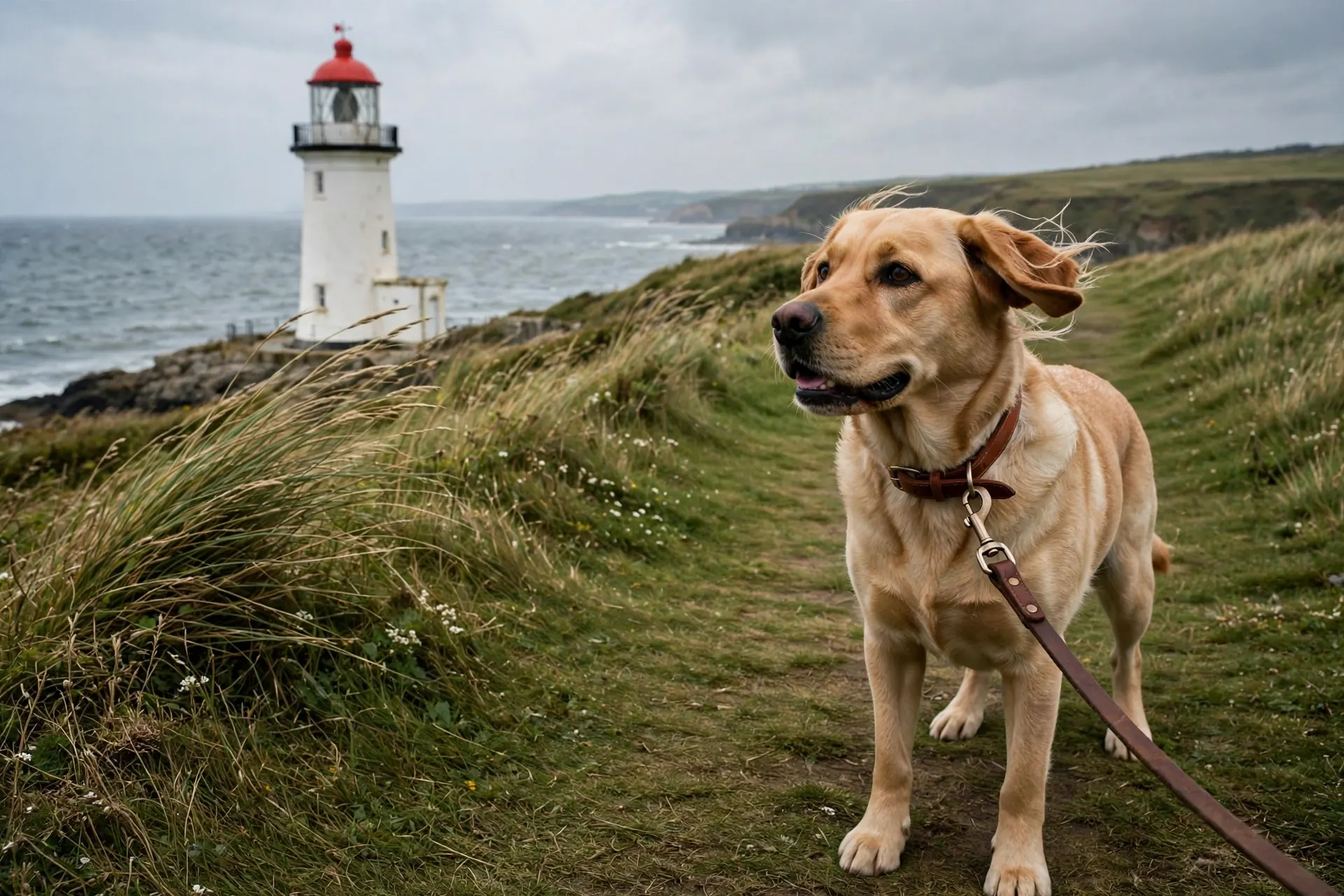
Lighthouses photograph beautifully with dogs, but the best photographs need a little patience. The classic shot is the dog sitting on the headland grass with the tower behind, and it works best when the dog is looking towards the camera rather than at a passing gull. Bring treats, ask the dog to sit, and take the photograph from the dog's eye level rather than standing height, because a photograph taken from above makes the dog small and the tower distant, while a photograph taken low makes both the dog and the tower feel present. Early morning and late afternoon give warmer light and fewer crowds, and a cloudy day gives softer light that flatters both white paintwork and a dog's coat.
Safety comes before the photograph. Never pose a dog on a cliff edge, a low wall with a drop, or a slippery rock for the sake of a picture, and never use a long line that could tangle around the dog's legs near a drop. If the dog will not sit still, accept a walking photograph instead: a dog trotting along a headland path with the tower behind tells the story of the day better than a forced pose. Keep the lead in the photograph or edit it out later; a photograph of a dog apparently loose on a cliff edge encourages other owners to do the same, and the dog in the photograph may not be as steady as yours. Drone photography near lighthouses needs care too, because some sites restrict drones and a drone can frighten livestock and nesting birds, so check the rules before flying.
Picnics suit lighthouse days perfectly, because the grounds and headlands usually have grass, views and a breeze, but they need the same planning as the walk. Choose a spot sheltered from the wind, ideally on the landward side of a wall or a hollow, because eating on an exposed cliff top in a strong wind is miserable and food blows away. Bring a blanket rather than sitting on damp grass, pack food that does not need heating, and bring a separate portion for the dog so the dog is not begging for picnic food that may contain bones, onions or chocolate. A dog that has its own chew or stuffed food toy during a picnic is a dog that lets the humans eat in peace.
Leave no trace, and be particularly careful with picnic waste on a headland. Food wrappers blow easily in coastal wind, and dropped food attracts gulls that can become aggressive around dogs and children. Take a bag for rubbish, pack it out, and check the grass before leaving for small items such as bottle tops or cling film that a dog might swallow. If the lighthouse has a cafe, consider buying hot drinks there and eating your own food on the headland: it supports the site, gives the dog a water bowl, and provides a sheltered fallback if the weather turns. A picnic eaten slowly in a sheltered spot, with a dog asleep on a blanket beside you and a lighthouse in the background, is the quiet heart of a lighthouse day, and it costs nothing.
The lighthouse day checklist
Pack for the coast, not for the car park. Water and a bowl for the dog, a lead and a spare, a drying coat and a towel, poo bags and a bag for rubbish, treats and a chew for waiting times, a phone with a charged battery and an offline map, and a layer of clothing for the wind even on a sunny morning. Add sun protection for the humans, because a headland sunburns fast, and a first-aid basics kit for paws, because coastal paths can cut pads on sharp rock or flint. If the dog is prone to car sickness on winding lanes, plan a stop before the final approach and keep the journey calm.
Before you leave home, confirm the three zones: tower, grounds and any overnight stay. Check the forecast for gusts and fog, check tide times if a beach is part of the plan, and check the bus timetable if you are travelling without a car. Tell someone your route if you are walking a remote headland alone with a dog, and carry a phone that works in that area, because mobile signal on remote headlands can be patchy. A lighthouse day rewards the owner who checks twice and packs once, and the dog that benefits is the one trotting happily along a headland path while the tower stands white against the sky behind them.
Practical questions
Before you go
Can dogs go inside a UK lighthouse tower?
Usually not. Most working and museum lighthouses keep dogs out of the tower itself because of narrow spiral stairs, open gratings and working equipment, but dogs are often welcome in the grounds, gardens and outdoor seating areas. Always check the official guidance for the individual lighthouse before you travel, because rules vary site by site.
Are lighthouse coastal walks safe for dogs?
They can be excellent, provided you respect cliff edges, keep dogs on a lead near unfenced drops and livestock, and watch for steep steps and slippery rock. Headland paths are often exposed to strong wind, so check the forecast and choose a shorter inland loop if gusts are high or sea fog is rolling in.
Can I stay overnight in a lighthouse with my dog?
At some sites, yes: former keepers cottages and lighthouse holiday lets often accept dogs, but the tower itself is almost never part of the stay. Confirm the pet fee, the number of dogs allowed, whether dogs may be left alone in the cottage, and what happens to the booking if high winds close the access road.
What should I do if sea fog arrives during a lighthouse walk?
Turn back along the path you came on rather than pushing on towards the tower, keep your dog on a lead and close, and use a map or phone GPS to confirm the route. Sea fog can cut visibility to a few metres in minutes on a headland, and cliff edges that were obvious in sunshine become very hard to judge.
Where can I park for a lighthouse visit with a dog?
Many lighthouses sit at the end of a narrow single-track lane with a small car park that fills early, so arrive before late morning in peak season and check whether the car park is pay-and-display. Some remote lights are reached only on foot or by bus, so check the official guidance before you travel and plan the walk from the nearest stop.