This guide is general information, not veterinary advice. If you suspect exposure, contact a vet immediately. For current local warnings, check the Environment Agency, the relevant devolved environment agency and the site operator before you travel, and follow the latest official guidance.
Blue-green algae can produce toxins that kill dogs within hours. Keep your dog on a lead near lakes, reservoirs and slow rivers in warm weather, never let them drink or swim where there is scum, discolouration or a warning sign, and treat any suspected exposure as an immediate vet emergency — do not wait for symptoms. Emergency treatment can be expensive, which is why checking the vet-fees cover in your dog travel insurance belongs on the pre-trip list.
What blue-green algae is
Blue-green algae is a misleading name. It is not a true algae or a plant at all: it is a group of bacteria known as cyanobacteria that occur naturally in freshwater across the United Kingdom. In small numbers they are a normal part of many lakes, ponds, reservoirs, canals and slow-moving rivers and usually cause no visible problem. The danger comes when conditions allow them to multiply rapidly into a dense growth known as a bloom.
Some cyanobacteria can produce powerful toxins, sometimes called cyanotoxins. Different species produce different toxins, and those toxins can affect the liver, the nervous system, the skin and the gut. Crucially, you cannot tell by looking whether a bloom is producing toxins or how strong they are. Laboratory testing is needed, and results take time. That uncertainty gives the core safety rule of this guide: treat every suspected bloom as toxic until an official source says otherwise.
A bloom also does not have to be obvious for the water to be risky. As blooms die and break down, toxins can be released into the surrounding water, so water that looks better than it did a few days earlier is not automatically safe. Wind can concentrate scum along one shoreline, so one end of a lake can look very different from the other. This is not a reason to avoid waterside walks — Britain's lakeside and river trails are superb dog walks — but it is a reason to change the routine around the water itself: lead on near the edge, no drinking from the lake, and no swimming on trust.
What blooms look like
Blooms are often described as looking like green paint, pea soup or a bright green, blue-green or turquoise scum on the surface. You may see flakes, strands or jelly-like blobs, a thick mat along the shoreline, or foam where water laps against rocks and slipways. Colours vary: blooms can be green, blue-green, brownish-green or dark streaks just below the surface, and the water may look cloudy or discoloured even where there is no obvious surface scum.
Look at the edges first. Scum collects where the wind pushes it — in corners, bays, reed beds, boat launches and the shallow margins where dogs are most likely to paddle and drink. A bloom that is obvious in one sheltered bay may be almost invisible fifty metres away in open water, so scan the exact spot your dog would enter, not just the view from the main path.
There are lookalikes, and the honest answer is that most owners cannot reliably distinguish them on the bank. Duckweed forms a carpet of tiny leaves, harmless algae can grow in long silky strands, and pollen can leave a yellow-green film in spring. None of that helps in the moment, because a toxic bloom can grow alongside harmless growth in the same water. If you cannot confidently identify what you are seeing, the safe decision is the same: keep your dog out. Do not use smell as a test either — some blooms produce an earthy odour and some produce none you will notice. Warning signs matter more than your own identification: treat council, landowner or operator notices as current until they are removed, and remember that the absence of a sign does not mean the water has been tested and cleared.
Where and when in the UK
Blooms are most often reported in still or slow-moving freshwater: lakes, lochs, llyns, reservoirs, ponds, gravel pits, canals and the sluggish reaches of rivers. They favour water that is warm, shallow, sunlit and rich in nutrients, which is why sheltered bays and the margins of popular lakes are common trouble spots. Blooms have been reported across England, Scotland, Wales and Northern Ireland, in rural waters and urban park lakes alike, so no region should treat this as somebody else's problem.
The highest-risk period is usually late spring to early autumn, roughly May to October, and especially during and after warm, settled, sunny spells. Heavy rain can wash nutrients into water, and a hot, still period afterwards can trigger rapid growth. That said, blooms are not confined to heatwaves: mild autumns can extend the season and a sheltered pond can bloom outside the dates you expect. Use the calendar as a prompt for vigilance, not as an all-clear for the rest of the year.
Before any waterside trip, check for current warnings for that specific water body. Start with the site operator, council or landowner, look for notices on site, and check Environment Agency information in England or the equivalent environment agency and local authority sources in Scotland, Wales and Northern Ireland. Check the date on anything you find: an article from last summer is background, not a current clearance. Where official information is thin or out of date, default to caution. If you are planning a coastal trip instead, our guide to dog-friendly beaches in the UK and their rules explains seasonal restrictions and local bylaws, though sea water brings its own separate checks, as the safer-swimming section below explains.
Why dogs are at risk
Dogs are more vulnerable than people for simple behavioural reasons. A person may wade briefly and shower afterwards; a dog will plunge in, swim with its mouth open, bite at the surface, retrieve a ball through scum, drink deeply at the edge, and then lick a large quantity of water off its coat in the car park. Every one of those habits increases the dose swallowed, and with cyanotoxins the dose matters enormously. Even a dog that only paddles can be exposed if it then grooms wet paws and fur thoroughly.
Body size compounds the problem. A small dog drinking the same mouthfuls as a large dog receives a far higher dose relative to its weight, and puppies that mouth everything are at particular risk. Dogs with a strong retrieve drive are a special worry: a ball thrown repeatedly into marginal water produces repeated mouthfuls, and an excited dog will ignore your first call. The time to decide is before the ball leaves your hand, not while the dog is already swimming.
Exposure is not limited to drinking. Skin contact can cause irritation, dried scum on the bank can be investigated and eaten, and mats washed up at the shoreline remain hazardous while they break down. Keep your dog away from discoloured shoreline material as firmly as you keep them out of the water itself. It is worth being blunt about outcomes: some cyanotoxins can cause severe, rapid liver damage, while others can cause tremors, seizures and breathing failure, and UK veterinary reporting has recorded dog deaths linked to blue-green algae, sometimes very soon after a swim. There is no home remedy. Prevention and speed — keeping the dog out, and getting to a vet immediately after any suspected exposure — are the two things that genuinely help.
Signs to watch for
Signs depend on the type of toxin, the amount swallowed and the individual dog, and they can develop within minutes to a few hours of exposure. Early signs can include vomiting, diarrhoea, drooling, foaming at the mouth, loss of appetite, lethargy, weakness and appearing disoriented or unsteady. A dog may pant heavily, seem distressed, or collapse. Skin exposure may add redness, itching or hives, though the absence of skin signs says nothing about what has been swallowed.
More serious signs need emergency care without any further delay: muscle tremors, twitching, seizures, difficulty breathing, pale or jaundiced gums, abdominal pain, blood in vomit or stool, and loss of consciousness. Liver-acting toxins may produce signs that evolve over hours, while nerve-acting toxins can progress frighteningly fast. Do not try to sort one category from the other on the bank — that is the vet's job, with tests and monitoring you cannot do in a car park.
The trap to avoid is waiting. Early signs can look like ordinary post-swim tiredness or a mild stomach upset, and owners can lose the window in which treatment is most effective. Any dog that has swum in, drunk from or licked its coat after contact with suspect water should be treated as an emergency case even if it currently looks bright. Phone the vet, describe the exposure clearly, and follow their instruction on where to go — which may be an out-of-hours emergency clinic rather than your usual practice. Note the water's name and location, the time of the swim and when signs began, if someone can do so safely while you travel. Our dog travel first aid guide covers what to keep in the car for exactly these moments.
Immediate actions: this is a vet emergency
If you suspect exposure, act in this order. First, get your dog out of the water and away from the shoreline, on a lead, and stop them licking their coat or paws. Preventing further swallowing matters immediately. If there is scum on the coat, handle it with care and do not let other dogs investigate the wet coat.
Second, phone a vet at once. Say clearly that you suspect blue-green algae exposure, where it happened and when. If your usual practice is closed, use its out-of-hours number or the nearest emergency veterinary clinic. Do not wait for symptoms, do not drive home first to monitor, and do not spend critical minutes searching online for reassurance. If the vet advises you to travel in, go immediately.
Third, while travelling, keep the dog warm, quiet and as still as is practical, and stop them grooming. A quick rinse with clean water — from a bottle or tap, not back in the lake — is reasonable only if it does not delay departure; a thorough bath can wait until after veterinary assessment. Never induce vomiting, give human medicines or attempt any home treatment unless a vet specifically instructs you to do so for your dog in that moment. Expect the vet to want the full picture and possibly to keep your dog in for observation, fluids, blood tests and monitoring even if signs seem mild on arrival. That is not overcaution: toxin effects can develop after a deceptively quiet interval. Afterwards, report the bloom as described below so other owners get a warning.
Prevention on every walk
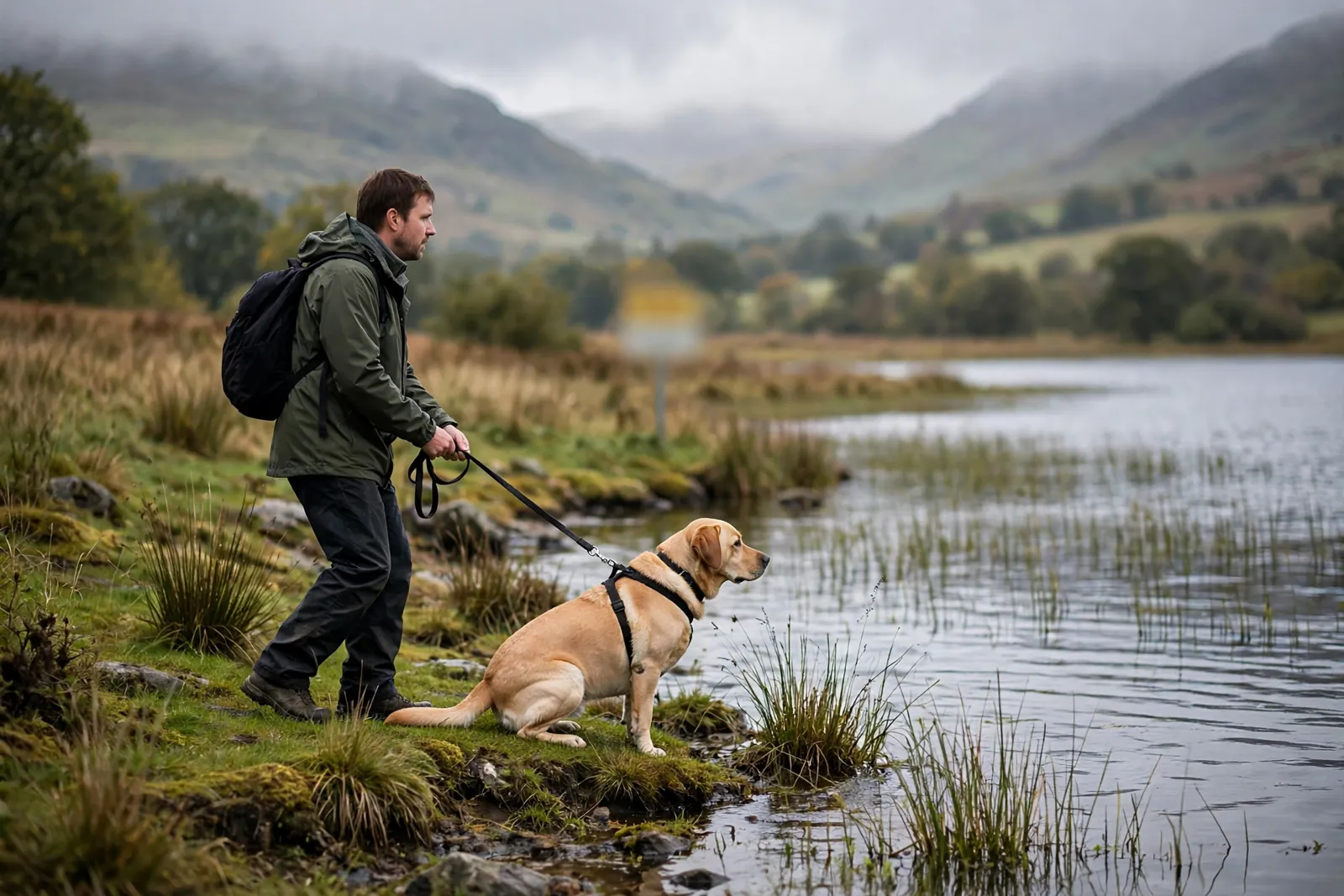
Prevention is mostly habit. Keep your dog on a lead near any lake, reservoir, pond or slow river until you have walked the edge yourself and checked the exact entry points. Make no-drinking a trained default: carry clean water and a travel bowl, offer it before you reach the shore, and interrupt any attempt to drink from the lake with a recall and a reward. Dogs that arrive thirsty after a hot walk are far more likely to drink deeply, so plan water breaks on the approach, not just at the destination.
Check before you throw. No ball, stick or retrieve toy should go into water you have not inspected, and if there is any scum, discolouration, official warning or doubt, the swim is cancelled — not shortened, not moved ten metres along the bank, cancelled. Have a replacement plan ready so the decision does not feel like a punishment: a shaded lead walk, a sniff-heavy detour or a game on dry ground away from the shore. Dogs accept a changed plan easily when the alternative starts immediately.
Read the signs and respect closures even when other dogs are swimming. Other owners may not have seen the notice or may accept risks you would not. Equally, pass information on: if a warden or local owner tells you a bloom was reported last week, treat that as a live warning until an official source confirms otherwise. After any swim in freshwater, rinse your dog with clean water at home, dry them thoroughly, and watch for the signs above over the following hours. Build the habit into trip planning too: a lakeside property looks very different if its jetty is under an algae warning, so ask about the current local position before booking a water-focused weekend break with your dog in the UK.
Safer swimming choices and reporting blooms
No natural water is risk-free, but some choices are clearly safer than others. Flowing, cool, clean-looking streams and rivers away from any warning are generally a better bet than warm, still, enclosed water in high summer, provided you still check the entry point, the current and the exit route. Purpose-built, well-managed dog swimming facilities and hydrotherapy pools offer controlled, treated water and are the most predictable option for dogs that live to swim. At the coast, a clean, well-flushed beach with no local warnings avoids the freshwater bloom problem but brings different checks — tides, currents, jellyfish, sewage alerts after heavy rain and seasonal dog restrictions — so read local signage and our beach rules guide before assuming the sea is the easy answer.
Whatever you choose, apply the same decision rule every time: check official information beforehand, inspect the exact entry point on arrival, keep the first swim short, rinse afterwards and stay alert for signs. If any part of that chain fails — out-of-date information, a closed gate, scum in the bay, an undated warning sign — choose the dry alternative. A missed swim costs your dog an afternoon; a misjudged one can cost far more.
Reporting a suspected bloom protects the next dog. In England, report it to the Environment Agency incident hotline and tell the landowner, council or site operator so signs can go up quickly; in Scotland, Wales and Northern Ireland, follow the current reporting route for the relevant environment agency and local authority. Give the exact location, the date and time, and a description or photo taken safely from the bank. Do not collect samples yourself unless an official body asks you to and explains how. Before any waterside walk between spring and autumn, spend two minutes checking for warnings, pack clean water, and decide your no-swim alternative in advance. Where guidance in this article is uncertain or may have changed, check the Environment Agency, local warnings and the latest official guidance before you travel, and follow that advice over anything written here.
Practical questions
Before you go
Can clear-looking water still contain blue-green algae toxins?
Yes. Toxins can remain in the water after a visible bloom has dispersed, and a bloom can be patchy, blown to one shore or present below the surface. Clear water is not a safety guarantee. If there is an official warning, a recent bloom report or any doubt about a lake, reservoir or slow river, keep your dog out and choose a different walk.
How quickly can blue-green algae make a dog ill?
Very quickly — signs can appear within minutes to a few hours of swallowing contaminated water or licking it from the coat, and some toxins can be fatal the same day. That speed is why any suspected exposure is a veterinary emergency. Do not wait to see whether signs develop: phone a vet immediately and travel in while you take advice.
Should I make my dog sick or wash them at home first?
No. Never induce vomiting unless a vet specifically instructs you to, and do not delay the journey to bath your dog thoroughly at home. Prevent further licking, rinse only if you can do so quickly with clean water without delaying travel, keep the dog warm and quiet, and get to a vet or emergency clinic at once. Tell the vet you suspect blue-green algae exposure.
Can a dog be poisoned just by licking its fur after swimming?
Yes. Dogs groom and shake after swimming, and toxins trapped in a wet coat can be swallowed during licking. That is why a dog that only paddled or splashed can still be at risk, and why you should stop licking straight away, towel with care, avoid letting the dog clean itself in the car, and seek urgent veterinary advice after any suspected exposure.
How do I report a suspected blue-green algae bloom in England?
In England you can report a suspected bloom to the Environment Agency incident hotline and notify the landowner, council or site operator so warning signs can be put up. In Scotland, Wales and Northern Ireland, follow the current reporting route for the relevant environment agency and local authority. Check the latest official guidance before you travel, as reporting routes and local warnings change.