This guide is independent and contains no paid placement. If affiliate links are added later, they will be clearly marked and will not change our editorial checks.
Boston suits a slow, flat day out: start on the riverside, look up at the Stump, walk the Market Place on a Wednesday or Saturday, then finish in a park or on the Witham Way paths. Keep the dog on a lead by the water and in the market, and check the official guidance before you travel for opening times and dog rules.
Boston at a glance: a market town built around water
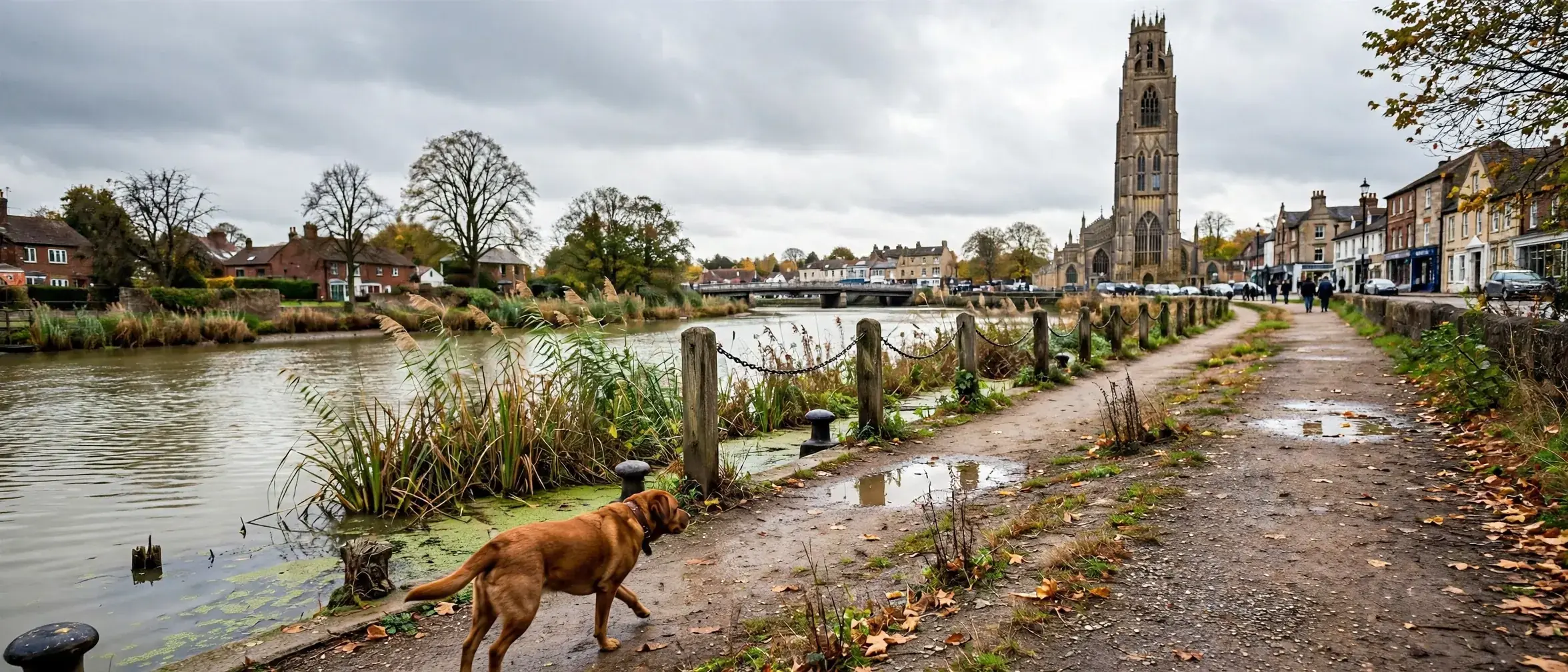
Early morning on the riverside path in Boston is quiet in a way that sets the tone for the whole day. The River Witham moves slowly past the quays, gulls call over the water, and the tower of St Botolph's Church — the Boston Stump — stands over everything, visible long before the town itself comes into view across the flat Fenland. A dog on a lead trots ahead, nose down, reading the overnight news in the grass while the town wakes up behind it. That first view, water in front and tower behind, is the simplest way to understand Boston: this is a market town that grew up around a river, and the river still shapes how a day here should be planned.
Boston sits in Lincolnshire, on the River Witham close to The Wash. It was once a major medieval port, second in importance to London for trade with Europe in its heyday, and the scale of its parish church still shows that wealth. The town is not a seaside resort and it does not try to be one. It is a working market town with a very large Market Place, Georgian and earlier buildings, independent shops, a windmill, a guildhall and a network of flat riverside and drain-side paths. For a dog owner, that combination is genuinely useful: the centre is compact, the ground is level, the sights are close together, and there is almost always a green space or a stretch of water within a short walk.
The flatness matters more than it sounds. Boston and the surrounding Fens are famously level, which makes the town kind to older dogs, small dogs, dogs recovering from injury and owners pushing a pram or using a wheelchair. There are few hills to climb and few steps to negotiate in the open spaces, although individual buildings, bridges and church towers are a different matter. The trade-off is exposure: with little high ground and few sheltered valleys, wind runs straight across the Fens, rain arrives without much warning, and summer sun has little shade on open riverside paths. Plan the route with that in mind, and Boston becomes an easy, honest day out rather than a tiring one.
What Boston is not is a place for a dog to run free all day. The centre is busy with traffic, market stalls, cyclists and other dogs, and the river is a real hazard for a dog that loves water a little too much. The pleasure here comes from a different rhythm: a short riverside walk, a pause to look at the tower, a wander through the market, a coffee on a pavement or in a dog-friendly cafe, and then a longer, greener walk in a country park where the dog can properly stretch its legs. Visitors who arrive expecting a beach town or a countryside village will be disappointed; visitors who arrive expecting a historic market town with good walking nearby will find plenty to enjoy.
This guide follows that rhythm. It starts with the overall impression and a one-day route, then works through the Stump and its surroundings, the Witham and Haven riverside paths, the Market Place and the independent shops, the parks and woods, and finally the practical questions of parking, arrival, stays, food, rain and seasons. Where a rule could change — opening times, tower climbs, dog policies inside a building, market dates — the guide says so, and you should check the official guidance before you travel.
A one-day route that works with a dog
A good Boston day with a dog has three parts, and the order matters. Start with the river, when the town is still quiet and the dog is fresh. Move into the centre for the market and the tower in the middle of the day, when there is the most to see and the most shade and shelter to duck into. Finish with a park or a country-park loop in the afternoon, when the dog needs space and the centre starts to feel busy. That shape keeps the dog's energy matched to the surroundings at each stage, and it avoids the two most common mistakes: spending the freshest hour of the day in a car park, and trying to do a long walk after a long, stimulating morning in the market.
Begin at the riverside near the town centre. Walk along the Witham towards the bridges and the quays, with the Stump ahead of you, and let the dog settle into the day with sniffing time rather than distance. This is not the moment for a forced march. Ten or fifteen unhurried minutes along the water, with pauses to watch the boats and the birds, tells you more about how your dog is feeling than a brisk half-hour loop would. If the dog is pulling, anxious or over-excited, slow down here; the rest of the day will be easier for it. If the dog is calm and loose on the lead, you have a good base for the market later.
From the river, cross into the Market Place and the streets around St Botolph's Church. This is the historic heart of the town, and it rewards a slow wander rather than a checklist. Look at the tower from the churchyard, walk the edge of the Market Place, and follow one or two of the lanes off it to see the independent shops. On a market day, Wednesday or Saturday, the square fills with stalls and the atmosphere changes completely; on a non-market day the same space feels spacious and much easier with a nervous dog. Either version works, but they are different days, so choose deliberately rather than by accident.
Stop for a proper break before the afternoon walk. Dogs that have been asked to stay calm through a busy market need water, a rest and a toilet break before being asked to walk again. Use a dog-friendly cafe or pub terrace, or find a bench in Central Park, and give the dog at least twenty minutes of doing nothing. Owners often skip this pause because the day feels short, but it is the pause that makes the afternoon enjoyable instead of fractious. A tired dog in a new place is not the same as a settled dog, and the difference shows up in recall, in lead manners and in how the dog copes with other dogs.
Finish the day in green space. Witham Way Country Park on the western edge of town, the Sir Joseph Banks Country Park to the south, or Central Park in the centre all offer a different kind of walking from the riverside and the market: trees, grass, ponds and paths where the dog can move more freely. Choose the one that fits the time and energy left, not the one that sounds best on paper. A short, happy loop that ends with the dog still keen is worth far more than a long loop that ends with a dog dragging its feet back to the car. Leave Boston the way you arrived — slowly, along the water if you can — and the day will feel complete rather than merely completed.
For a half-day visit, cut the middle, not the ends. Keep the riverside start and the park finish, and shorten the market wander to a single circuit. For a two-day stay, use the second day for the longer walks — the Boston Waterways route, the town walk, or a trip towards the coast — and keep the first day to the centre. The town is small enough that nothing on this route needs rushing, and that is part of its appeal.
St Botolph's Church and the Boston Stump
The Boston Stump is the town's landmark, its compass and its postcard in one. The tower of St Botolph's Church rises about 272 feet, or 82.9 metres, above the flat Fenland, and on a clear day it can be seen for miles in every direction. It is often described as one of the tallest parish church towers in England, and the church itself is one of the largest parish churches in the country — a reminder of how wealthy and important medieval Boston was as a port. The tower was built in stages from the fifteenth century into the early sixteenth century, and its lantern top gives it the distinctive silhouette that gave it the nickname "Stump", because the tower looks as if it ends abruptly, without a spire.
For a dog owner, the best way to enjoy the Stump is from outside. The churchyard and the streets around it give the clearest views, and the tower changes character as you move around the town: from the riverside it rises over the water, from the Market Place it dominates the square, and from the bridges it frames the town in a single view. Early morning and late afternoon light suit it best, when the stone warms and the tower throws a long shadow across the churchyard. Dogs on a lead are a normal sight in the churchyard, and it is a good place for a calm pause, provided the dog is kept on a lead, kept off graves and memorials, and kept away from any service or event taking place.
Going inside is a separate question, and it needs a separate plan. St Botolph's is a working parish church, open for worship, visitors and community use, and dogs are not automatically welcome inside in the way they are in the churchyard. Assistance dogs are excepted, as they are in almost every public building, but other dogs are admitted only at the discretion of the church team, and that discretion can depend on the day, the event and the behaviour of the dog. Check the official guidance before you travel, and do not assume that a quiet dog will be allowed in. The practical approach for most visitors is to take turns: one person looks inside while the other stays outside with the dog, then swap. That way nobody has to leave the dog tied up outside, which is not a safe or kind option in a busy town centre.
The Tower Experience, the climb to the top, is not a dog activity at all. It involves 209 steps up a narrow spiral staircase, and dogs are not taken up the tower. Even for people, the climb is steep, narrow and not suitable for anyone with mobility problems, vertigo or a fear of enclosed spaces. If someone in your party wants to climb, plan for it as a separate outing while another person walks the dog along the river or in Central Park. The views from the top are widely praised — across the town, the Fens and towards The Wash — but the climb should be booked or checked in advance, as times and charges can change, so check the official guidance before you travel.
Around the church, look for the details that make Boston's history concrete. The church is dedicated to St Botolph, a seventh-century saint associated with travellers and trade, which fits a port town well. The Market Place beside it has hosted markets for centuries, and the statue of Herbert Ingram, the founder of the Illustrated London News and a former Member of Parliament for Boston, stands in the square as a reminder of the town's nineteenth-century life. The Guildhall, a fourteenth-century building a short walk away, tells another part of the story, and the Pilgrim Fathers Memorial on the north bank of The Haven marks the place where a group of religious dissenters tried to leave England for Holland in 1607, a chapter that later connects Boston in Lincolnshire to Boston in Massachusetts. None of these need a long visit with a dog; all of them are best appreciated as pauses on a walk, with the dog beside you.
One practical note: the ground around the church and the Market Place is mostly paved, and in summer the stone can get hot underfoot. Check the surface with your hand before asking a dog to stand on it for a long time, and move into shade or onto grass in the churchyard or Central Park when you can. In winter the same paving can be slippery after rain or frost, so keep the lead short and the pace slow. The tower will still be there when the dog is comfortable; there is no need to rush the photograph.
The Witham and the Haven: riverside walks
The River Witham is the reason Boston exists where it does, and the riverside is where a dog walk in Boston feels most natural. The river runs through the town as The Haven, the tidal stretch that connects Boston to The Wash, and the paths beside it give the town its best easy walking. The water is wide, the banks are mostly flat, and the views open out towards the Fens in a way that the town centre streets never do. For a dog, the riverside offers what the Market Place cannot: space, moving air, birds to watch, and a long, straight path that suits a steady, sniffing pace.
The simplest riverside walk starts in the town centre and follows the Witham south past the quays, the Swing Bridge and the docks, on the waymarked Macmillan Way and the Boston Waterways route. This is a long, flat circular walk in its full form — one listing gives the Boston Waterways Circular as about 19 kilometres — but nobody needs to walk the whole thing to enjoy it. Walk out for twenty minutes, turn back when the dog is ready, and the walk is still a proper riverside outing. The path is shared with cyclists and other walkers, so keep the dog on a lead, keep to one side, and be ready to step aside for a bike. The river itself is tidal and the banks can be steep or slippery in places, so do not let a dog swim here, and keep a firm hold on the lead near the water's edge.
Further south, the same route leads towards Havenside Country Park, where the river meets the wider landscape of The Wash. At high tide the views open out across the water, and boats move in and out of the port. This is a good destination for a longer walk, but it is exposed, so check the weather and the tide before setting off, and carry water for the dog. There is little shade on the open stretches, and the wind off The Wash can be strong even on a day that feels calm in the town centre. If the dog is small, old or heat-sensitive, this is a morning walk, not a midday one.
For a shorter and greener riverside experience, Witham Way Country Park on the western edge of town is a better choice. It covers about 38 acres and is a designated Local Nature Reserve, with the River Witham running through woodland, grassland and scrub. The site has marked trails, a picnic orchard, a wildflower meadow, play areas and dog bins, and the paths are surfaced in places, which helps after rain. It is a popular spot for local dog walkers, so expect to meet other dogs, and keep yours on a lead where signs ask for it and near the river. The park is also a good place to practise recall on a long line, because there is space to move away from other dogs if you need to.
The Grand Sluice, at the southern end of the town's waterways, is worth a look on a riverside walk, although it is a working piece of water infrastructure rather than a picnic spot. Built in the eighteenth century, it controls the flow of the Witham and the drainage of the surrounding Fens, and it helps explain why the landscape around Boston looks the way it does: straight drains, flat fields and a river that has been managed for centuries. Walk past it, look at the water, and keep the dog on a lead — the structures, the moving water and the traffic nearby are not a place for an off-lead dog.
Two safety points apply to every riverside walk in Boston. First, the water is not a paddling pool. The Witham is tidal, the current can be strong, the banks can be muddy and undercut, and the water quality is not suitable for dogs to drink or swim in. If your dog loves water, give it a drink from a bottle and a paddle in a safe place elsewhere, not here. Second, livestock and wildlife share these paths. Herons, kingfishers, swans and geese are common along the Witham, and grazing animals can appear on nearby fields. Keep the dog on a lead near birds and livestock, and do not let it chase. The birds will still be there tomorrow; the dog's recall may not be.
If you want to extend a riverside day, the wider area offers more walking, but it needs a car and a separate plan. The coast towards The Wash, the villages of the Fens and the longer trails around Boston all reward a full day, and the rules for dogs on beaches and in nature reserves vary by site. Our guide to dog-friendly beaches in the UK explains how seasonal bans, public space protection orders and fines work, and how to check a beach before you go — read it before adding a coastal walk to a Boston trip, because the rules at the coast are stricter than the rules on a town riverside path.
Market Place, lanes and independent shops
Boston's Market Place is one of the largest market squares in England, and on a market day it is the liveliest place in town. The main markets are held on Wednesdays and Saturdays, with a farmers' market on the third Wednesday of each month, and the square fills with stalls selling food, plants, clothing, household goods and local produce. The market has run in some form for centuries — some accounts put it at more than 450 years in its current tradition, and the site has been a trading place for far longer — and that history is visible in the scale of the square and the buildings around it. For a visitor with a dog, the market is both the best and the busiest part of a Boston day, so it needs a little planning.
Go early if you can. The first hour of the market is calmer, the stalls are still being set up, the aisles are wider, and the dog has room to move without being stepped on or jostled. By late morning on a Saturday the square can be crowded, with trolleys, pushchairs, dogs on long leads and children running between stalls. A short lead, held close, is essential. A long lead in a market is a trip hazard for everyone, and it gives a reactive dog too much room to get into trouble. Keep the dog on your inside, away from the stall fronts where food is displayed at dog height, and watch for dropped food, which is the most common reason a market visit ends early.
Not every dog enjoys a market, and there is no shame in cutting the visit short. Signs to watch for are a tucked tail, yawning, lip-licking, trying to pull away from the crowd, or freezing in place. If you see them, do not push through to the far side of the square. Step into a side street, find a quieter lane, and let the dog decompress. Boston's centre has plenty of quieter streets just off the Market Place, and a five-minute pause in a calm lane is worth more than a forced circuit of the stalls. If your dog is generally anxious in crowds, visit on a non-market day instead, when the square is open and spacious and the same buildings and shops can be enjoyed without the press of people.
The streets around the Market Place are where Boston's independent shops live. Look for the lanes and the Georgian shopfronts, the bookshops, the delis, the cafes and the small retailers that give the town its character. Dog policies in shops vary widely: some welcome dogs inside, some welcome them at the door, and some do not admit dogs at all. There is no town-wide rule, so ask before entering, keep the dog close, and do not assume that a dog-friendly cafe next door means the shop beside it has the same policy. If a shop does not admit dogs, one person can look inside while the other waits outside with the dog — the town is compact enough that this is a minor inconvenience, not a ruined plan.
Street food and market food need the same care as any food at dog height. Keep the dog away from hot grills, cooking oil and dropped food, and do not feed the dog from market stalls unless you know the food is safe for dogs. Many market foods contain onion, garlic, grapes, chocolate, xylitol or high levels of salt and fat, all of which can harm a dog. Carry the dog's own treats and use them to reward calm behaviour in the market; that turns a busy square into a training opportunity instead of a source of stress.
The Guildhall, a short walk from the Market Place, is worth including in a centre wander. The fourteenth-century building, thought to be one of the earliest brick buildings in Lincolnshire, has been restored as a museum, and it tells the story of Boston's medieval trade, its guilds and its civic life. Dogs are not generally admitted inside museums of this kind, so treat it as a look-from-outside stop with a dog, and check the official guidance before you travel if you hope to go in. The building's exterior, its setting and its place in the town's history can be appreciated from the street, and the walk to it takes you through some of the most attractive parts of the old town.
Maud Foster Windmill, to the north of the centre, is another landmark that works best as an outside stop with a dog. Built in 1819, the seven-storey, five-sailed tower mill is one of the tallest working windmills in England, and it stands on the Maud Foster Drain, a straight waterway that gives a good flat walk back towards the town centre. The mill itself is open at certain times and for tours, and dogs are not taken inside the mill. Walk to it, look at the sails and the drain, and use the flat path beside the water for a calm stretch of walking away from the market crowds. The route from the mill back into town, along the drain and through the streets, is one of the pleasantest short walks in Boston, and it shows the town's waterways at their most peaceful.
Central Park, Witham Way and the woods south of town
Central Park is Boston's town-centre green space, and it is the easiest place to give a dog a break from paving. The park has lawns, trees, paths and benches, and it sits close enough to the Market Place and the river that it can be used as a pause in the middle of a centre day rather than a separate destination. Dogs should be kept on a lead here, and the park is shared with families, children and other dogs, so keep the lead short near the play areas and the paths. It is not a place for a long off-lead run, but it is an excellent place for a dog to rest on grass, drink water and watch the world go by after a busy morning.
Witham Way Country Park, already mentioned for its riverside paths, deserves a fuller note as a walking destination in its own right. The park's mix of woodland, grassland, scrub and river makes it more interesting for a dog than a single open field, and the marked trails give a clear structure to a walk. The site is managed as a Local Nature Reserve, which means wildlife matters here: ground-nesting birds in the breeding season, wildflower meadows and ponds all need dogs to be under control. Keep to the paths where signs ask for it, keep the dog on a lead near the ponds and the river, and use a long line rather than a free run if you are unsure about recall. The park has dog bins, which is a small detail that makes a real difference on a longer walk.
South of the town, the Sir Joseph Banks Country Park and the Boston Woods offer a different kind of green space: young woodland, wildflower meadow and all-weather paths, on a site of about 80 acres between West End Road and Old Hammond Beck. The Sir Joseph Banks Country Park Loop is a short circular route of about 3.1 kilometres through the country park and the surrounding woodlands, and it is popular with dog walkers and families. The route passes through Jenny's Woods, Westgate Wood and the meadows and ponds of the wider site, with wood-carved statues, an owl tower in the wildflower fields and a refreshment van at the entrance that offers hot drinks, snacks and treats for dogs. The paths are surfaced in places, which helps after rain, and the trees give shade in summer. The site is close to traffic in places, so keep the dog on a lead near the roads, and be aware that some open areas are breeding grounds for birds in summer, when dogs may need to stay on a lead.
The Boston Town Walk, a waymarked route of about 6 kilometres, ties many of these green spaces together. It starts in the town centre, follows the River Witham to the Grand Sluice, goes up through the Old Cemetery — now a quiet, overgrown place preserved for wildlife — and returns to the town centre along the Maud Foster Drain, passing Central Park and the windmill on the way. The Old Cemetery is a surprisingly peaceful part of the walk, with mature trees and a sense of being away from the town, but dogs should be kept on a lead and kept to the paths, out of respect for the graves and the wildlife. The full town walk is a good half-day outing for a fit dog and owner, but it can also be walked in sections: the riverside stretch, the cemetery stretch and the drain stretch each work as a shorter walk on their own.
For dogs that need a proper off-lead run, the country parks are the best bet, but the rules still vary by area and by season. There is no single off-lead area in Boston that suits every dog, and the safest approach is to ask locally, read the signs at the entrance to each park, and use a long line until you know the ground. A secure field or a quiet stretch of woodland path is a better choice than an open riverside bank, where a dog can be in the water before you have time to react. If your dog has poor recall, a long line is not a failure; it is the tool that lets the dog enjoy the park safely, and it keeps other walkers, wildlife and livestock safe too.
One more practical point about the parks and woods: the ground in the Fens can be wet long after the rain has stopped. Paths that look dry from the car park can be muddy a hundred metres in, especially on clay soil and on unpaved tracks. Carry a towel and a drying coat, and check the dog's paws after a woodland walk for mud, thorns and ticks. Ticks are a year-round risk in woodland and long grass, so check the dog after every walk in the parks and woods, and remove any ticks promptly. The parks are at their best in late spring and early autumn, when the ground is firmer, the trees are in leaf or colour, and the paths are less crowded than in the school holidays.
Getting there and parking
Boston is reached by road on the A16 and the A52, and by rail on the Poacher Line, which runs between Nottingham, Grantham, Boston and Skegness. The town is not on a motorway, and the roads into it are long, straight Fenland roads that run beside wide drainage ditches. That is part of the character of the area, but it also means the drive can feel long, especially in summer traffic or in poor weather. Allow more time than the map suggests, and plan a stop on the way if the dog is not a happy traveller. A tired, carsick dog does not enjoy a market town, however good the walk at the end is.
By train, Boston station is in the town centre, a short walk from the Market Place and the river. Dogs are allowed on trains in the UK, usually without a ticket, provided they are on a lead or in a carrier and do not occupy a seat. Check the official guidance before you travel, as train operators set their own rules, and book assistance or check step-free access in advance if you need it. The station is a useful option for a day trip from Nottingham, Grantham or Skegness, because it removes the parking question entirely and puts you straight into the centre on foot.
By car, the practical question is where to park, and the answer depends on what you want to do first. The town centre has several car parks, and the streets around the centre have on-street parking, but charges, time limits and availability change, so check the official guidance before you travel. A good rule is to park once and walk everywhere: the centre, the river, the Market Place, Central Park and the windmill are all within a short walk of each other, and moving the car between them wastes the dog's patience and your time. If you plan to finish in a country park, drive to that park's car park at the end of the day rather than trying to walk there and back from the centre.
On arrival, give the dog a proper break before starting the day. A dog that has been in a car for an hour or more needs water, a toilet break and a few minutes to stretch its legs before being asked to walk through a busy town. Use a quiet street or a patch of grass near the car park, not the Market Place, for that first break. The same applies at the end of the day: a short, calm walk before the drive home helps the dog settle in the car, and it is kinder than loading a wound-up dog straight into a hot or cold vehicle.
Summer heat in a car is a serious risk in Boston, as it is everywhere. The Fenland sun is strong on open ground, and a car parked in the sun heats up quickly, even with the windows open. Never leave a dog in a car on a warm day, even for a few minutes, and plan the day so the dog is with you or in proper accommodation at all times. In winter, the opposite problem applies: a wet dog in a cold car after a riverside walk will chill quickly, so carry a drying coat and a towel, and dry the dog before the drive home. If the dog is wet and the car is cold, a short stop in a dog-friendly cafe to warm up is worth the time.
For visitors with mobility needs, Boston's flat centre is helpful, but not every pavement, bridge and building is step-free. Check the official guidance before you travel for step-free routes, accessible parking and accessible toilets, and ask at the car park or the visitor information point if you are unsure. The riverside paths are mostly level, but some stretches are narrow, uneven or shared with cyclists, so a wheelchair or a mobility scooter needs a little more planning than a walk on foot. Central Park and the country parks have surfaced paths in places, but not everywhere, and wet weather can make unsurfaced paths difficult. Plan the route with the surfaces in mind, not just the distance.
Where to stay and eat with a dog
Boston is a small town, and its accommodation is modest in scale: hotels, bed and breakfasts, guest houses and self-catering cottages in the town and the surrounding villages, rather than large resorts. That suits a dog stay well, because smaller places are more likely to have a clear, personal dog policy and a named person to ask. The trade-off is that dog-friendly rooms can be limited, especially on market Saturdays and in the summer, so book early and confirm the dog policy in writing before you pay. A listing that says "dog-friendly" can mean anything from "dogs welcome everywhere" to "one small dog allowed in one room, on the ground floor, for a fee", and the difference matters.
When you book, ask the questions that actually affect the stay. Is there a limit on the number or size of dogs, and is there a pet fee or a refundable deposit? Which rooms accept dogs, and are they on the ground floor with easy access to outside? Is there a secure garden or a nearby toilet area for a late-night or early-morning break? Can the dog be left alone in the room, and if so, for how long and under what conditions? Are dogs allowed in the breakfast room, the bar or the restaurant, or only in the bedroom? The answers to those five questions tell you more about a stay than any number of photographs, and a place that answers them clearly is usually a place that has thought about dogs properly.
Self-catering is often the easiest option with a dog in a market town. A cottage or an apartment with its own entrance, a kitchen and a garden gives the dog a routine that is close to home, and it removes the question of whether the dog can be left alone while you eat out. Look for a secure garden or yard, a hard floor that is easy to clean, and a location that is a short walk from a green space. Check the rules about dogs on furniture and beds, and bring the dog's own bed and blankets so the dog has a familiar place to settle. If you are staying for more than one night, a self-catering base also makes it easier to do the longer walks — the Boston Waterways route, the town walk and the coastal paths — without worrying about hotel meal times.
Eating out with a dog in Boston follows the same pattern as in most English market towns: pubs and cafes are often more welcoming than formal restaurants, and outdoor seating is usually easier than indoor seating. Many pubs welcome dogs in the bar area or on a terrace, and some cafes welcome dogs inside, but policies change, and a pub that welcomed dogs last year may have changed its policy. Check the official guidance before you travel, or ask when you arrive, and do not assume that a dog-friendly sign on the door means the dog can sit at the table while you eat a full meal. Bring a mat for the dog to lie on, a chew or a lick mat to keep the dog settled, and water for the dog. A dog that can settle under a table is welcome almost anywhere; a dog that barks, pulls or begs is not, however friendly the pub is.
Goodbarns Yard, mentioned by local walking guides as a post-walk refreshment stop with a dog-friendly garden area, is an example of the kind of place to look for: a yard or garden where the dog can be outside with you, with space to settle and water available. The town has other cafes and pubs with similar outdoor areas, and the Market Place itself has places to sit outside on a fine day. Use those outdoor spaces in summer, when the dog will be cooler and calmer outside, and use indoor dog-friendly rooms in winter, when the dog needs warmth and shelter. If the weather turns, a takeaway eaten on a bench in Central Park or beside the river can be a better option than a crowded indoor room with a restless dog.
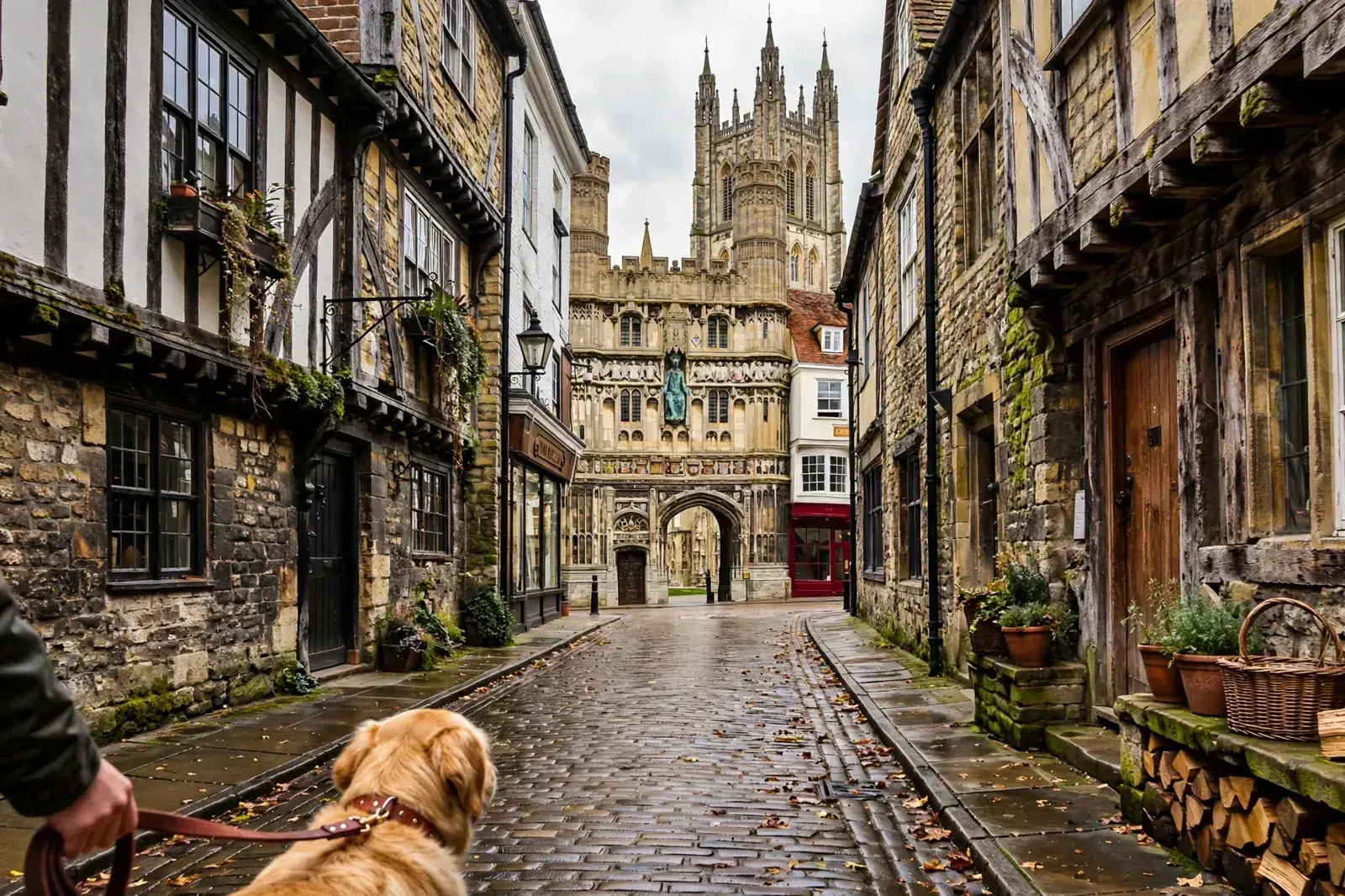
For a longer stay, Boston also works as a base for the wider area, and that is where the accommodation choice matters most. A base in Boston puts the Lincolnshire Wolds, the coast at Skegness and the Wash, and the historic towns of Lincoln and Stamford within a day trip, but each of those trips needs its own dog plan. Our guide to Canterbury with a dog shows how a historic city with a cathedral precinct and medieval lanes can be planned around a dog in a similar way — outside the restricted areas, inside the city — and the same approach applies here: enjoy the historic centre on foot, use the green spaces for the dog's exercise, and check the rules for each building before you go in. If you are planning a longer tour of historic towns with a dog, that guide is a useful companion to this one.
One last note on staying and eating: keep the dog's routine as close to home as you can. Feed at the usual time, walk at the usual time, and give the dog the same bed, the same food and the same last walk before bed. A new town is stimulating enough without a changed routine, and a dog that knows what is happening next will settle faster in a new bedroom, a new pub and a new park. The goal is not to fit the dog into a holiday; it is to build the holiday around the dog, and Boston's compact, flat centre makes that easier than most towns of its size.
Rain, seasons and Fenland weather
Boston's weather is Fenland weather: changeable, windy and often wetter than the forecast suggests. The flat landscape gives the weather nowhere to hide, and rain can arrive quickly from The Wash, driven by a wind that feels stronger on an open riverside path than it does in a sheltered street. The best approach is to assume the weather will change during the day, and to plan a route that has shelter built into it. A day that starts in sunshine on the riverside can end in rain in the Market Place, and a day that starts in rain can clear by the afternoon walk. Flexibility is more useful than a perfect forecast.
In spring, Boston is at its most hopeful. The market fills with plants and spring produce, the trees in Central Park and the country parks come into leaf, and the riverside paths dry out after the winter. This is a good season for a first visit, because the town is quieter than in summer, the days are getting longer, and the dog can walk further without overheating. Watch for mud on the woodland paths and the drain-side tracks, and for ground-nesting birds in the country parks, when dogs should stay on a lead and on the paths. Spring is also the season when ticks become active, so check the dog after every walk in long grass and woodland.
Summer is the busiest season, and the one that needs the most care with a dog. The Market Place on a Saturday in August is crowded, the paved surfaces get hot, and the riverside paths have little shade. Walk early in the morning and late in the afternoon, rest in the middle of the day, and carry water for the dog at all times. Check the pavement with your hand before asking the dog to walk on it, and use grass and shade wherever you can. The country parks are cooler than the town centre, because the trees give shade, but even there the open meadows can be hot at midday. Summer is also the season for the longest days, which means a late riverside walk in the evening light is one of the best experiences Boston offers — the tower against a pale sky, the river quiet, and the town cooling down.
Autumn is, for many dog owners, the best season in Boston. The crowds thin, the market sells autumn produce, the trees in the parks turn colour, and the air is cooler for walking. The town walk and the Boston Waterways route are at their best in September and October, when the ground is firmer than in winter and the light is softer than in summer. Rain becomes more frequent, so carry a drying coat and a towel, and check the paths after heavy rain, because the Fenland drains can fill quickly and the riverside paths can become muddy. Fireworks around early November can unsettle noise-sensitive dogs, so check whether there are displays in the town or nearby, and keep the dog indoors in the evening if it is anxious.
Winter in Boston is quiet, cold and often beautiful in a stark Fenland way. The tower stands out against a grey sky, the market is smaller but still lively, and the riverside walks are empty. This is a good season for a short, brisk visit, but it needs warm clothing for both dog and owner, and a plan for warming up indoors. Short-coated dogs, older dogs and small dogs may need a coat, and all dogs need to be dried thoroughly after a wet walk. The days are short, so start early and finish before dark, and be careful on icy pavements and bridges. Some attractions, cafes and accommodation reduce their hours in winter, so check the official guidance before you travel, and do not assume that a summer opening time still applies.
Rain deserves its own plan, because it is the most likely weather to affect a Boston day. A wet day in Boston is not a wasted day, but it is a different day. Use the Guildhall, the shops and the arcades around the Market Place, and the dog-friendly cafes and pubs, for the indoor parts of the day. Keep the outdoor walks short and on surfaced paths — the town centre, Central Park and the surfaced parts of Witham Way — and save the long riverside and woodland walks for a drier day. Carry two towels and a drying coat, and dry the dog before going indoors or into the car. A wet dog in a warm pub is a happy dog; a wet dog in a cold car is a miserable one.
A practical checklist before you set off
A Boston day out is easy to pack for, because the town is compact and the walks are flat, but a few items make the difference between a smooth day and a frustrating one. Start with the basics: a lead and a spare lead, a harness that fits, poo bags, water and a collapsible bowl, the dog's usual food and treats, a towel and a drying coat, and any medication the dog needs. Add a long line for the country parks, a mat for the dog to lie on in a cafe or pub, and a chew or a lick mat for settling in a busy place. If the dog is reactive, nervous or newly adopted, add a muzzle if the dog is trained to wear one, and a yellow "I need space" lead or vest if you use one — it will not solve every interaction, but it helps other owners give you room.
Before you leave home, check the three things that change most often: the market days, the opening times for the places you want to visit, and the dog rules for any building you hope to enter. Market days are Wednesdays and Saturdays, with a farmers' market on the third Wednesday, but dates can change for bank holidays and special events, so check the official guidance before you travel. The Tower Experience, the Guildhall and the windmill all have seasonal hours, and the dog policies inside them can change, so do not build the day around an indoor visit that may not be possible. A quick check the night before saves a disappointed dog and a frustrated owner.
On the day, keep the dog's routine as normal as you can. Feed at the usual time, walk at the usual time, and give the dog a toilet break before the drive and on arrival. In the town, keep the dog on a short lead in the Market Place, on the riverside paths, near roads and near livestock. Use the parks and the country parks for longer walks and for off-lead time where it is allowed, and use a long line where recall is uncertain. Clean up after the dog everywhere, including in the parks and on the riverside paths, and use the dog bins provided. Boston's parks and paths are shared spaces, and the way dog owners behave in them affects whether dogs remain welcome.
Think about the dog's health before and after the walk. Check the dog for ticks after woodland and long-grass walks, and remove any ticks promptly. Check the paws for mud, thorns and cuts, especially after a riverside walk, and wash them if the dog has been in muddy water. In summer, watch for signs of overheating — heavy panting, drooling, lethargy or vomiting — and move the dog to shade and water immediately. In winter, watch for signs of cold — shivering, lifting paws or reluctance to walk — and warm the dog up indoors. Know where the nearest vet is before you need one, and save the number in your phone. Boston has veterinary practices in the town, but their hours vary, so check the official guidance before you travel and know the nearest out-of-hours service as well.
Finally, leave Boston as you found it. Take your litter home, clean up after the dog, keep the dog on a lead where signs ask for it, and be courteous to other walkers, market traders and shopkeepers. The town welcomes dog owners who are considerate, and the best way to keep it welcoming is to be one of them. If you have had a good day, a quiet word of thanks to a cafe or pub that welcomed the dog, or a positive review for a dog-friendly stay, helps the next dog owner too. Boston is a working market town, not a tourist attraction, and it rewards visitors who treat it as a place where people live and work, not just as a backdrop for a photograph of the tower.
Boston will not give you a beach, a mountain or a wilderness. It will give you a tower that has stood over the Fens for five centuries, a river that still shapes the town, a market square that has traded for longer than most visitors can imagine, and a set of flat, honest walks that suit a dog at almost any age. Walk the riverside in the morning, look up at the Stump, wander the market, rest in a park, and let the day unfold at the dog's pace. That is the Boston that works with a dog, and it is worth a day of your time.
Practical questions
Before you go
Can dogs go inside St Botolph's Church in Boston?
Dogs are generally welcome in the churchyard and the open ground around St Botolph's, where the tower is best appreciated from outside. Entry to the church itself is at the discretion of the church team, and assistance dogs are excepted. Check the official guidance before you travel, and plan on one person staying outside with the dog if you want to look inside.
Is Boston a good day trip with a dog, or does it need an overnight stay?
Boston works well as a day trip because the centre, the riverside and the main sights sit close together on flat ground. An overnight stay is worth it if you want a slower market morning, a longer walk at Witham Way or the Sir Joseph Banks Country Park, or a trip out towards the Wash coast. Choose the overnight option if your dog needs a midday rest in proper accommodation rather than a long stretch in the car.
Where is the best riverside walk with a dog in Boston?
Start on the paths beside the River Witham and The Haven near the town centre, then follow the waymarked Boston Waterways route south towards Havenside Country Park for a longer walk. For a shorter, greener loop, use Witham Way Country Park on the western edge of town or the Sir Joseph Banks Country Park south of the centre. Keep dogs on a lead beside the water, on shared paths and near livestock, and check the official guidance before you travel.
When is Boston market, and is it dog-friendly?
Boston's main markets are held on Wednesdays and Saturdays in the Market Place, with a farmers' market on the third Wednesday of the month. Dogs on a short lead are a normal sight in the open-air market, but the aisles get busy, so go early, keep the lead short, watch for dropped food and hot surfaces, and step into a quieter side street if your dog starts to struggle. Check the official guidance before you travel, as market dates can change.
Are dogs allowed off the lead around Boston?
There is no single rule for the whole town. Dogs are commonly walked off the lead in suitable open areas of the country parks, but they should stay on a lead on riverside paths, in the Market Place, in Central Park, near roads, near livestock and wherever signs ask for it. Use a long line where recall is uncertain, and check the official guidance before you travel.
What should I do if it rains in Boston with a dog?
Use the covered and indoor options in the town centre: the Guildhall, dog-friendly cafes and pubs, and the shops and arcades around the Market Place. Keep riverside and woodland walks short, because Fenland paths can turn muddy quickly, and carry a drying coat and towels. Check the official guidance before you travel, as opening times and dog policies change.