This guide is independent and contains no paid placement. If affiliate links are added later, they will be clearly marked and will not change our editorial checks.
Bourton-on-the-Water is a river village first and a honey-stone village second: the River Windrush runs right through the centre, crossed by low stone bridges and flanked by wide greens. Walk the riverside early, keep your dog on a lead through the busy middle, paddle only where the water is shallow and calm, and save the quieter footpath to Lower Slaughter for the middle of the day when the village green is at its fullest.
Walking the Windrush: bridges and the riverside route
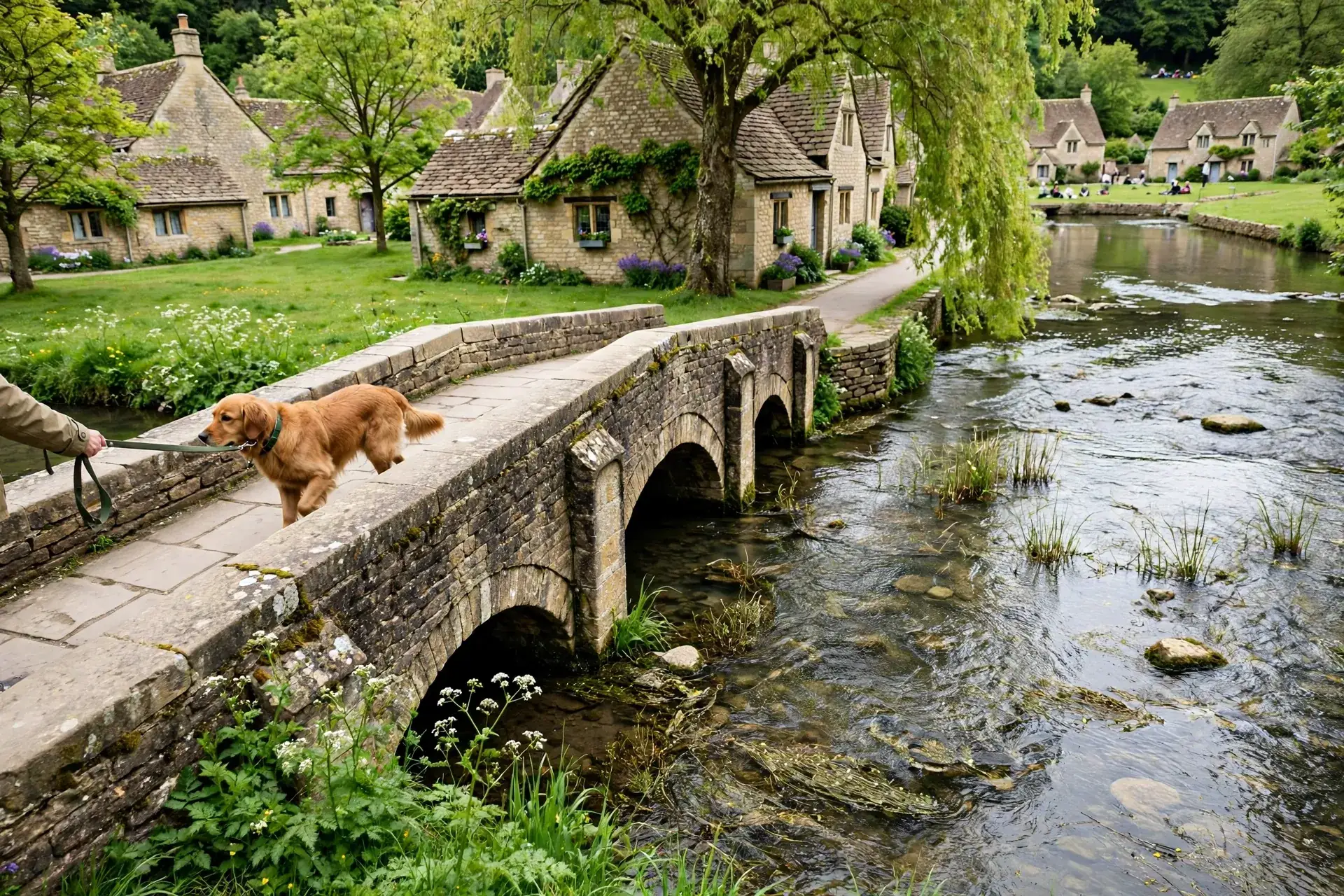
Most Cotswolds villages ask you to admire the stonework and then go looking for a walk. Bourton-on-the-Water reverses that order. The River Windrush flows straight through the middle of the village, shallow and clear in its central stretch, and the walk practically plans itself: follow the water, cross from one bank to the other on the low stone bridges, and let the village unfold on both sides. For a dog, this is an unusually generous arrangement. There is almost always something to sniff, somewhere to pause, and a new angle on the same pretty scene every few minutes, without ever needing to cross a main road or climb a hill.
Start at one end of the central green and work along the river rather than marching straight down the middle of the green. The banks are grassy and open, and the low bridges — small, arched, stone-built crossings that sit barely above the water — are the village's signature feature. Dogs tend to treat each bridge as a small event: a change of surface underfoot, a view up and down the stream, and the sound of water running underneath. Keep a lead on through this stretch. The bridges are narrow, other visitors stop in the middle of them to take photographs, and a dog that darts across a bridge into a group of people, or off the side towards the water, can cause a tumble that ruins everyone's morning.
The most rewarding way to walk the centre is slowly, in a loop. Walk one bank in one direction, cross at a bridge near the end of the green, and come back along the opposite bank. This doubles the sniffing opportunities and halves the sense of being funnelled through a crowd, because the two banks rarely feel equally busy at the same moment. If your dog is nervous around other dogs, the loop also gives you an escape valve: when one bank fills with a large group, cross over and carry on in relative peace. Watch the bridge surfaces after rain, as worn stone can be slippery for paws, and take particular care with older dogs or small breeds on the steeper little arches.
Beyond the central green, the character of the river changes quickly. Upstream and downstream of the village centre the Windrush feels less like a village feature and more like a proper Cotswolds stream, with quieter banks, overhanging trees and fewer people. These outer stretches suit dogs that need space to decompress after the bustle of the centre. Let the dog set the pace here. A riverside walk that ends with a calm dog is worth far more than a longer route that ends with an overstimulated one, and Bourton's compact centre means you can always return to the car or your accommodation for a rest and come out again later.
If you are planning a wider Cotswolds trip, Bourton works well as the gentle, watery counterpoint to hillier or busier stops. Our Cotswolds dog guide puts the village in context with the region's commons, waymarked trails and pub stops, which helps if you want to pair a riverside morning here with a wilder afternoon elsewhere. The contrast is the point: Bourton is where you come for flat ground, shade, water and easy walking, not for a strenuous hike.
One practical note about route-finding: the village centre is small enough that getting lost is almost impossible, but that also means there is little shade-free or crowd-free alternative once you are in the middle of it. If the green is packed, do not try to push a reluctant dog through the thickest part. Slip out along a side lane, follow the river away from the centre, and return when the coach parties and lunchtime crowds have thinned. The river is still there, the bridges are still there, and your dog will enjoy both far more without a hundred strangers stepping around them.
River safety and paddling: what to check first
The Windrush through Bourton is famously shallow in the village centre, and on a warm day the sight of dogs paddling in it is part of the village's charm. Shallow, however, is not the same as safe in all conditions, and a responsible paddling stop starts with a two-minute check before the dog ever gets a paw wet. Look at the water first: how fast is it moving, how deep does it look at the point where your dog would step in, and is the bed visible? After heavy rain the same stretch can run faster, deeper and murkier than it did the day before, and a current that looks gentle from the bank can still unbalance a small dog or sweep a ball downstream.
Choose your entry point with the same care. The best paddling spots are where the bank slopes gently into the water, the bed is gravel or firm stone rather than soft silt, and you can stand beside your dog without blocking the path. Avoid places where the bank drops steeply, where the water disappears under a bridge arch with a strong pull, or where other visitors are crowded together, because a dog shaking off beside a stranger's picnic rarely improves anyone's day. Keep the lead on until you are sure of the spot, and keep it in your hand or pocket rather than tied to a bridge rail while the dog is in the water.
Water quality deserves the same attention as depth. Rivers can carry agricultural run-off after rain, and warm, slow-moving water in summer can develop algal growth. If the water looks discoloured, smells unusual, or carries a local warning notice, keep the dog out entirely, and check the official guidance before you travel if you are unsure about water quality or local notices. Dogs that drink large amounts of river water can pick up stomach upsets, so carry fresh drinking water and offer it regularly; a dog that is already hydrated is less likely to gulp from the river. After paddling, rinse muddy paws if you can, and check between the toes for small stones or grit, which are a common cause of limping after a riverside day.
Ducks, swans and other water birds are part of the Windrush scene, and they change the safety calculation. A dog with a strong chase instinct should stay on a lead anywhere near nesting or feeding birds, and all dogs should be kept at a distance from swans, which can be defensive, particularly in spring. The same applies to other dogs in the water: not every paddling dog wants company, and a crowded entry point is a flashpoint for misunderstandings. If the water is already busy with other dogs, wait for a gap or walk a little further along the bank to a quieter spot.
Finally, think about the exit as well as the entry. A wet dog in a village full of shops and tea rooms needs a plan: a drying towel in your bag, a quick towelling-down on the green before you move on, and a car blanket if you are heading home. Wet stone and wet paws are a slippery combination on the bridges, so towel the paws before crossing back over, and give an older dog a moment to shake off and steady itself. The paddling is the highlight of a Bourton visit for many dogs, but it is the unglamorous two minutes afterwards that keep the rest of the day comfortable.
The village green and beating the crowds
The village green at Bourton-on-the-Water is not a single patch of grass but a long, open strip running alongside the river, and that shape matters for dog owners. It means there is almost always somewhere to stand that is not in the middle of the flow of people, even on a busy day. The crowds concentrate where the bridges are most photographed and where the tea rooms and shops open onto the green; a few dozen metres in either direction, the same green feels noticeably calmer. Learning to read that pattern is the single most useful skill for a dog visit here.
Timing is the other half of the trick. Early morning, before the day visitors arrive, the green belongs to dog walkers, joggers and the ducks, and it is the best time for a nervous or reactive dog to experience the village at all. Weekdays outside school holidays are the next best option. Summer weekends, bank holidays and school holiday afternoons are the peak, when the green can feel more like a festival site than a village, with children paddling, picnics spread across the grass and queues outside the busiest cafes. If a busy day is your only option, treat the green as a place to pass through rather than a place to linger: walk it once, enjoy the bridges, then escape to the footpaths described below.
On-lead etiquette matters more here than on an open common, because the green is shared with people who may be nervous around dogs, with small children at dog-nose height, and with picnics at dog-nose level too. A short lead through the centre is simple courtesy and it also protects your dog: dropped food, chicken bones from a picnic, and the sudden appearance of another dog around a bridge parapet are all everyday hazards on a busy green. Teach or refresh a solid "leave it" before the trip if you can, and keep treats in a pocket for rewarding calm behaviour when another dog passes at close quarters.
Toilet stops need a plan as well. Bring bags, use them, and use the bins provided rather than leaving bags on walls or bridge parapets, a habit that rightly irritates residents. If your dog needs a longer toilet break away from the crowds, the quieter stretches of riverbank outside the centre are a better bet than the middle of the green. The same logic applies to rest: a dog that has walked the green, paddled, and met a dozen strangers is a tired dog, and a tired dog on a busy green is more likely to bark or lunge. Build in a proper break — back at the car, at your accommodation, or on a quiet bench at the edge of the village — rather than pushing on to the next attraction.
Children and dogs deserve a special mention, because Bourton's paddling shallows attract families with young children, and the combination of excited children and excited dogs in shallow water can escalate quickly. Keep your dog close when children are playing in the water, even if your dog is friendly, because a large dog bounding into a group of toddlers is frightening even when it is meant playfully. If your dog is not comfortable with children, the green at peak times is simply the wrong place for them, and the footpath to the Slaughter villages is a kinder choice for that day.
Walking to Lower Slaughter and Upper Slaughter
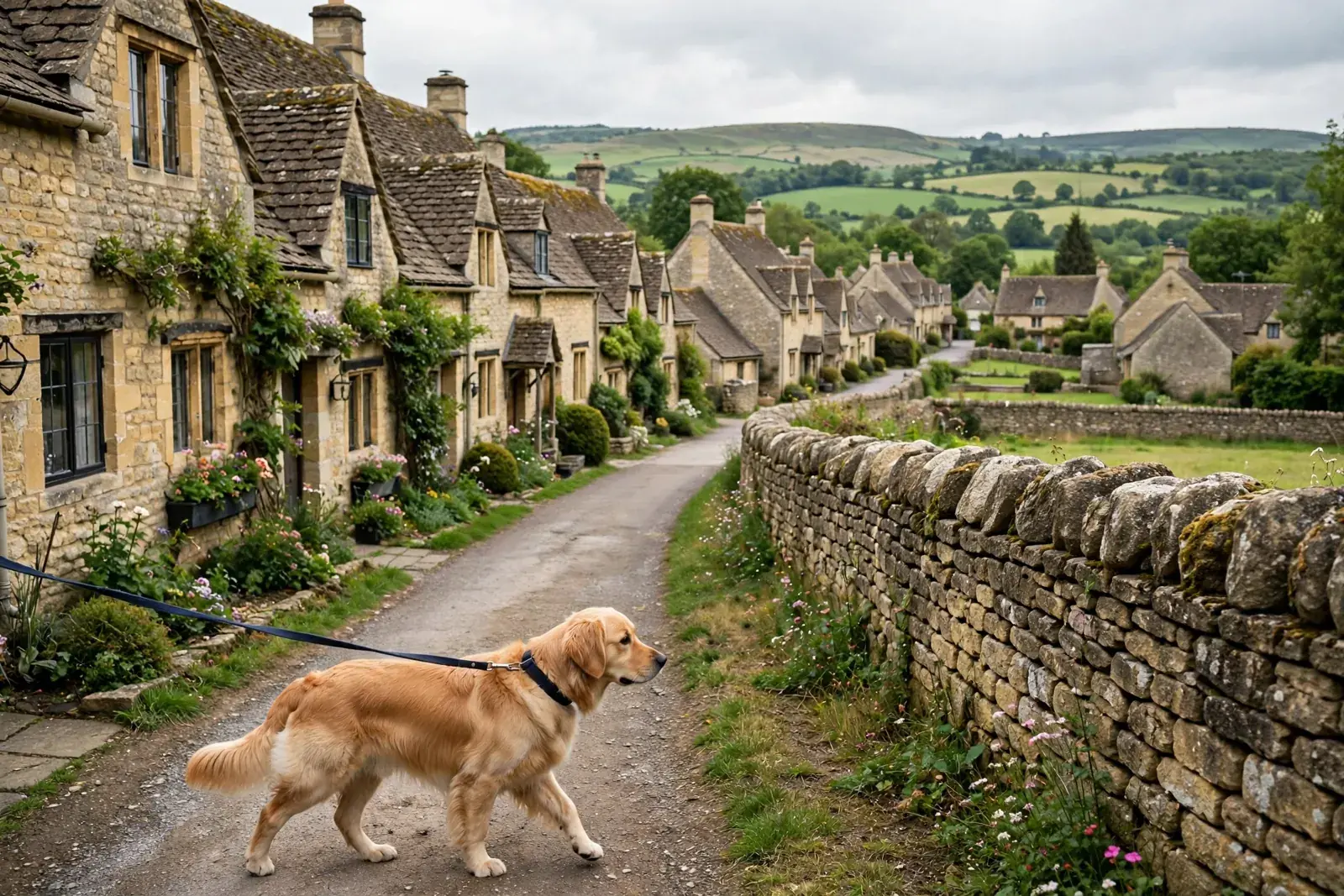
When the village green is at its busiest, the best move is to leave it. The footpath from Bourton-on-the-Water to Lower Slaughter is one of the gentlest and most rewarding short walks in the Cotswolds, and it is the walk that turns a Bourton visit from a pretty hour into a proper half-day out. The route follows the water meadows and the course of the little River Eye, running through flat, open countryside with honey-stone cottages waiting at the far end. It is well used, easy to follow, and kind to dogs that prefer level ground to hills.
Allow a relaxed pace rather than a fixed time. The path is about a mile to Lower Slaughter, and most dogs will want to stop repeatedly: to investigate field edges, to watch the stream, and to greet the occasional passing walker. Carry water, especially on warm days, because there is little shade on parts of the route and no guarantee of a dog-friendly water stop at the far end. A long line can work well on the open stretches if your dog's recall is not yet reliable, but switch to a short lead near livestock, near the road sections at either end, and whenever you pass other walkers on a narrow stretch.
Lower Slaughter itself is famously quiet — a small, almost traffic-free village gathered around a ford, a mill and a stream, with stone cottages that look barely changed in a century. That quiet is exactly why it suits dogs that found Bourton's green too much. The ford and the stream are photogenic, but the same paddling rules apply as on the Windrush: check depth and flow, keep a lead on near the water, and keep dogs away from any livestock that may be grazing nearby. Do not assume that a cottage garden or a mill courtyard is open to dogs; admire from the path and keep to the public route.
From Lower Slaughter, the more ambitious can continue to Upper Slaughter, a still smaller and more secluded village set on higher ground. The walk between the two Slaughters climbs gently, so it suits fitter dogs and owners who want a longer outing, while older or less mobile dogs may prefer to turn back at Lower Slaughter and retrace the flat path to Bourton. Either way, the return leg deserves respect: dogs that bounded out full of energy often flag on the way back, so save some water and some treats for the second half, and watch for tiredness in hot weather.
Livestock is the main thing to check before you set off. The fields around the Slaughters are working farmland, and sheep and cattle may be grazing close to the path. Keep dogs on a lead wherever livestock is visible, even if your dog has never chased anything, and remember that the legal and practical expectation in England is that dogs are kept under close control around farm animals. If a field looks freshly grazed or a gate is tied in an unusual way, take it as a sign to stay on the marked path and move through calmly. If you are unsure about the current route conditions, check the official guidance before you travel, and be ready to shorten the walk if the ground is waterlogged.
For dogs that cannot manage the full walk, Bourton still offers a scaled-down version of the same pleasure. Walk part of the way out of the village along the footpath, enjoy the open fields and the quieter water, and turn back when the dog tells you to. There is no prize for reaching Lower Slaughter, and a dog that comes home happy after a twenty-minute meadow walk has had a better day than one dragged over a distance it did not enjoy. The Slaughters will still be there for a return visit.
Nearby attractions: check the rules before you go
Bourton-on-the-Water packs an unusual number of attractions into a small village, and that concentration creates a planning problem for dog owners: the rules are not uniform, and assuming one venue's policy applies to the next is the fastest way to a disappointed afternoon. The Model Village, a miniature replica of Bourton itself built in the 1930s, and Birdland Park and Gardens, with its flamingos, penguins and other birds, are the two best-known names, and both sit close to the river and the green. Other small attractions, gardens and museums come and go in popularity, and each sets its own terms.
The honest approach is to treat every paid attraction as a separate check. For the Model Village, Birdland and any other venue on your list, check the official guidance before you travel, and do it close to your visit date rather than relying on a blog post or a review from a previous year. Policies on dogs can differ between indoor and outdoor areas, between peak and off-peak days, and between assistance dogs and pet dogs, and the venue's own website or ticket page is the only source that counts. If the guidance is unclear, contact the venue directly before you travel; a two-minute message can save a wasted journey and an awkward wait outside.
When a venue does not admit dogs, a split visit is often the kindest solution. One person explores inside while the other walks the dog along the river or around the quieter lanes, then you swap. This works best if you plan it in advance rather than discovering the rule at the ticket desk, because the dog-walking half of the party needs a route and a time limit. In summer, never leave a dog waiting in a parked car while you visit an attraction, and do not tie a dog up outside an unfamiliar venue for a long period. A short, shaded wait with a familiar person is fine; an hour alone by a busy entrance is not.
There is also a case for skipping the paid attractions entirely and letting the village itself be the attraction. Bourton's river, bridges, green and lanes are free, open and dog-friendly in a way that no ticketed venue can match, and many dogs will be happier with an extra hour on the footpath to Lower Slaughter than with an hour waiting outside a garden centre. If your itinerary already includes a busy morning on the green, a quiet afternoon on the riverside may be the better use of the day, and it costs nothing.
One final caution applies to gardens and bird collections in particular. Even where dogs are admitted to outdoor areas, the presence of free-flying or free-roaming birds changes the behaviour expected of your dog. A dog that is calm on a village street can become intensely excited around flamingos or waterfowl, and the venue may require a short lead and close control throughout. Read the conditions for the specific area you will enter, not just the headline policy, and be prepared to leave promptly if your dog cannot settle. The birds live there; your dog is the visitor.
Eating out with a dog in Bourton
Eating out in Bourton-on-the-Water is easiest if you plan around terraces, takeaways and flexibility rather than assuming a particular room will welcome your dog. The village has a good range of tea rooms, cafes, pubs and takeaway spots clustered around the green and the main streets, and many of them offer outdoor seating where a dog can settle beside the table. Outdoor seating is the most reliable option in a busy village: it avoids the question of indoor access altogether, gives the dog fresh air and something to watch, and makes a quick exit easy if the dog becomes restless.
Indoor rules, by contrast, vary from place to place and can change with the season, the time of day or the layout of the room. A venue that welcomes dogs in a bar area may not welcome them in a formal dining room, and a venue that is relaxed on a quiet weekday may tighten up when it is full. Do not rely on a general reputation or an old review. Check the venue's own current information before you go, or ask politely on arrival, and have a backup plan ready. The backup plan is what separates a smooth lunch from a stressful one: a takeaway eaten on the green, a picnic brought from home, or a second venue a short walk away.
Whatever you choose, set the dog up to succeed. Feed and toilet the dog before you sit down, bring a blanket or mat so the dog has a defined place to lie, and bring water and a chew or a quiet enrichment toy to occupy them while you eat. Order food that arrives quickly if your dog is new to eating out, and keep the lead short and under your chair leg or foot so the dog cannot wander into the path of waiting staff. If the dog starts barking, whining or pulling towards other tables, it is kinder to finish quickly and leave than to persist in the hope that they will settle.
Picnics deserve a mention because Bourton suits them so well. The green, the quieter riverbanks and the meadows towards Lower Slaughter all make natural picnic spots, and a picnic removes every access question at once. Bring bags for rubbish and dog waste, keep food out of reach of other people's dogs as well as your own, and remember that a picnic on a busy green still needs a short lead and attention to passing dogs and children. For many dog owners, a well-packed picnic beside the Windrush is not a fallback but the best lunch in the village.
If you are travelling further afield after Bourton, the same approach scales up. A city break, for example, brings a different set of access questions — grand streets, crowded pavements and indoor attractions with stricter rules — and our Bath dog guide works through those trade-offs in detail. The principle stays the same everywhere: check the current rules, favour places where the dog has space and a job to do, and always keep a takeaway or picnic option in reserve.
Staying over and parking
Bourton-on-the-Water is compact, popular and best enjoyed slowly, which makes an overnight stay worth considering. Staying over turns the crowd problem on its head: you can walk the green early in the morning and late in the evening, when day visitors have gone, and spend the busy middle of the day on the footpaths or in a quieter neighbouring village. Accommodation in and around Bourton includes cottages, guest houses, inns and rooms in pubs, with more options in nearby villages for those who prefer a quieter base and a short drive in.
When you book, confirm the dog policy in writing for the specific room or cottage, not just for the property in general. Ask how many dogs are accepted, whether there is a pet charge and what it covers, whether the dog can be left alone in the room and under what conditions, and whether there is an enclosed garden or a nearby toilet walk for last thing at night. A property that accepts dogs but has no garden and a busy road outside the front door is a different proposition from one with a walled garden and a field gate at the back, and the difference matters most at eleven o'clock at night in the rain.
Pack for the accommodation as well as for the walk. A familiar bed or blanket, a crate if your dog uses one, food and water bowls, a drying towel and a spare lead all help a dog settle in an unfamiliar room. Keep the first evening quiet: a short walk, a familiar routine and an early night will do more for the next day's behaviour than an evening spent exploring. If the dog barks when left alone, plan around that honestly rather than hoping the neighbours will not mind; a dog that cannot settle alone needs a sitting plan, a split evening, or a venue where the dog can come too.
Parking is the other practical question, and in Bourton it is a question of timing. The village has signed car parks, and on quiet days parking is straightforward, but on summer weekends, bank holidays and school holiday days the car parks fill early and the surrounding streets become congested. Arrive early if you can, use the signed car parks rather than blocking residential streets or narrow lanes, and read the signs for charges, time limits and any restrictions before you set off walking. Note the location of your car park relative to the river: a car parked at the far end of the village means a long walk back through the crowds with a tired, wet dog.
On warm days, parking safety becomes a welfare issue. Never leave a dog in a parked car on a warm day, even for a few minutes and even with a window open, because a car heats up far faster than most people expect. Plan your arrival so that someone is always with the dog, or so that the dog comes with you from the moment you park. In winter the calculation reverses: a car parked in an exposed spot can be cold and damp on return, so bring a dry blanket and towel the dog down before the drive home.
Seasons, rain and the river after wet weather
Bourton-on-the-Water changes character with the seasons, and the best time to visit with a dog depends on what your dog finds easiest. Spring brings lambs in the surrounding fields, blossom on the village trees and a river that is usually full and clear, but also muddy field paths and livestock that demand a short lead. Summer brings the warmest paddling weather and the longest evenings, but also the largest crowds, the hardest parking and the most competition for a quiet stretch of bank. Autumn brings colour, quieter greens and softer light, with the caveat that fallen leaves can hide uneven ground and the river can rise after autumn storms.
Winter is the connoisseur's choice for a calm dog visit. The village is quiet, the car parks are empty, and the green and bridges can be enjoyed without weaving through crowds. The trade-offs are shorter days, colder water, muddier paths and the possibility that some cafes and attractions run reduced hours. Check opening times before a winter visit, dress for standing around on a damp green, and bring a drying coat for the dog if you plan a riverside walk. A winter Bourton visit rewards preparation in a way that a summer visit rewards early arrival.
Rain deserves its own paragraph because the Windrush is a rain-fed river and its mood changes after wet weather. After heavy or prolonged rain, the river runs higher, faster and murkier, the banks become slippery, and the meadow footpath towards Lower Slaughter can turn muddy or waterlogged in places. This does not mean cancelling a visit, but it does mean adjusting it: keep paddling for another day, keep the dog on a lead near the water, choose surfaced paths through the village over field paths, and carry a towel and a change of footwear. If the river looks high or the current looks strong, keep the dog out of the water entirely and check the official guidance before you travel if local notices mention flooding or water quality.
Wet-weather kit for a Bourton trip is simple but worth packing properly. A drying coat or a large microfibre towel, a waterproof mat for the car boot, spare bags, and a lead that is comfortable to hold when wet will cover most situations. Avoid retractable leads near the river and the bridges: a wet, busy, bridge-filled village is exactly where a fixed short lead gives you the control you need. After a wet walk, dry the dog thoroughly, check the paws for grit and small cuts, and give the coat time to dry before the drive home, because a damp dog in a cold car is a miserable end to an otherwise good day.
Whatever the season, the rhythm that works best in Bourton is the same: arrive early or stay late, walk the river first, use the green in the quiet hours, escape to the Slaughter footpath when the centre fills, and finish with a calm, dry, unhurried hour. The village rewards dogs that are given time and space, and it punishes rushing. Plan a day with slack in it, and Bourton-on-the-Water will give you and your dog one of the gentlest outings in the Cotswolds.
Practical questions
Before you go
Can my dog paddle in the River Windrush at Bourton-on-the-Water?
In the village centre the Windrush is usually shallow, and many dogs do paddle there, but depth and flow change quickly after rain. Check the water yourself before letting a dog in, keep a lead on in busy stretches, and check the official guidance before you travel if you are unsure about water quality or local notices.
Are dogs allowed in the Model Village and Birdland at Bourton-on-the-Water?
Attraction rules change, and they are not the same from one venue to the next, so do not assume a dog can go in. Check the official guidance before you travel for the Model Village, Birdland and any other paid attraction, and plan a split visit if one member of the party needs to wait outside with the dog.
How long is the walk from Bourton-on-the-Water to Lower Slaughter with a dog?
The footpath from Bourton-on-the-Water to Lower Slaughter is a gentle walk of about a mile, and most dogs manage it comfortably with time to sniff and rest. Allow extra time for the return leg, carry water on warm days, and check the official guidance before you travel if recent rain has made the path muddy.
When is Bourton-on-the-Water least crowded for a dog walk?
Early mornings and weekday visits outside school holidays are usually the calmest times, while summer weekends and bank holidays bring the biggest crowds to the village green and the bridges. If you can only visit at a busy time, walk the riverside first, use the quieter footpaths out of the village, and keep a short lead on through the centre.
Where should I park for a dog walk in Bourton-on-the-Water?
Use the signed village car parks rather than blocking residential streets, arrive early on busy days because spaces fill fast, and read the signs for charges and time limits before you set off. Park in shade where possible, never leave a dog in a parked car on a warm day, and keep the first walk short if the dog has just had a long car journey.