This guide is independent and contains no paid placement. If affiliate links are added later, they will be clearly marked and will not change our editorial checks.
Braunton works best as a base, not a single walk. Use the flat Tarka Trail for easy miles, the marsh for quiet birdwatching on a lead, the Burrows for dune paths with strict wildlife rules, and Saunton Sands for a proper beach run — and check the official guidance before you travel for current dog rules, tides and parking charges.
Braunton is a village first
Braunton is not a seaside resort, and that is exactly why it suits many dogs. It is a large, working village in North Devon, set back from the coast on low, flat land between the River Taw estuary and the dunes of Braunton Burrows. The main street, Caen Street, is lined with ordinary village shops — a butcher, a baker, a small supermarket, a hardware shop, a post office and a handful of cafes and pubs — rather than with arcades and souvenir stalls. People live here, farm the marshes around it, and walk their dogs on the same lanes you will use. That everyday feel matters: the village is calm on weekday mornings, busy at school-run times, and practical in a way that a purpose-built resort rarely is.
The geography is the whole point of a stay here. From the village centre you can reach four completely different landscapes without a long drive: the flat grazing marsh to the south and east, the dune system of Braunton Burrows to the west, the traffic-free Tarka Trail running south towards Barnstaple and north towards Ilfracombe, and Saunton Sands, a long, open beach a short drive or a long walk away. Each one asks something different of your dog, so it helps to think of Braunton as four walks sharing one base, rather than as one walk with four names. A stiff-legged older dog will love the Tarka Trail and hate the soft dune sand. A young spaniel will adore the Burrows and need firm handling on the marsh, where birds and livestock are everywhere. A dog that cannot settle near cyclists will struggle on the trail at a sunny weekend lunchtime and be perfectly happy there at eight in the morning.
Start by learning the village layout on foot, with the dog on a lead. Caen Street runs roughly north to south through the centre, with the parish church of St Brannock and the village green near its northern end, and the River Caen crossing the village as a small, often unremarkable stream before it widens towards the marsh. The lanes off the main street are narrow, with pavements that appear and disappear, so a short lead and good road awareness are more useful here than a long line. Walk the main street once without any plan to buy anything: note where the pavements are widest, where the cafes put their outdoor tables, which shops have a water bowl outside, and where the busier junctions are. That ten-minute reconnaissance saves a lot of tangled leads later, especially if your dog is reactive to other dogs, because Braunton is a village where local dogs walk the same pavements every day.
One more thing about the village first: Braunton is low-lying. The marsh, the river and the estuary mean that heavy rain changes the ground underfoot quickly. Paths that are firm in July can be standing water in January, and the lower lanes can flood after sustained rain. That is not a reason to avoid a winter visit — the village is quieter, the light is good, and the trail stays usable — but it is a reason to pack wellingtons, check the forecast, and have a dry, flat alternative in mind for every walk you plan. The Tarka Trail is usually that alternative, because its surfaced, raised line drains better than the marsh tracks and the dune paths.
Braunton Burrows: dunes with rules
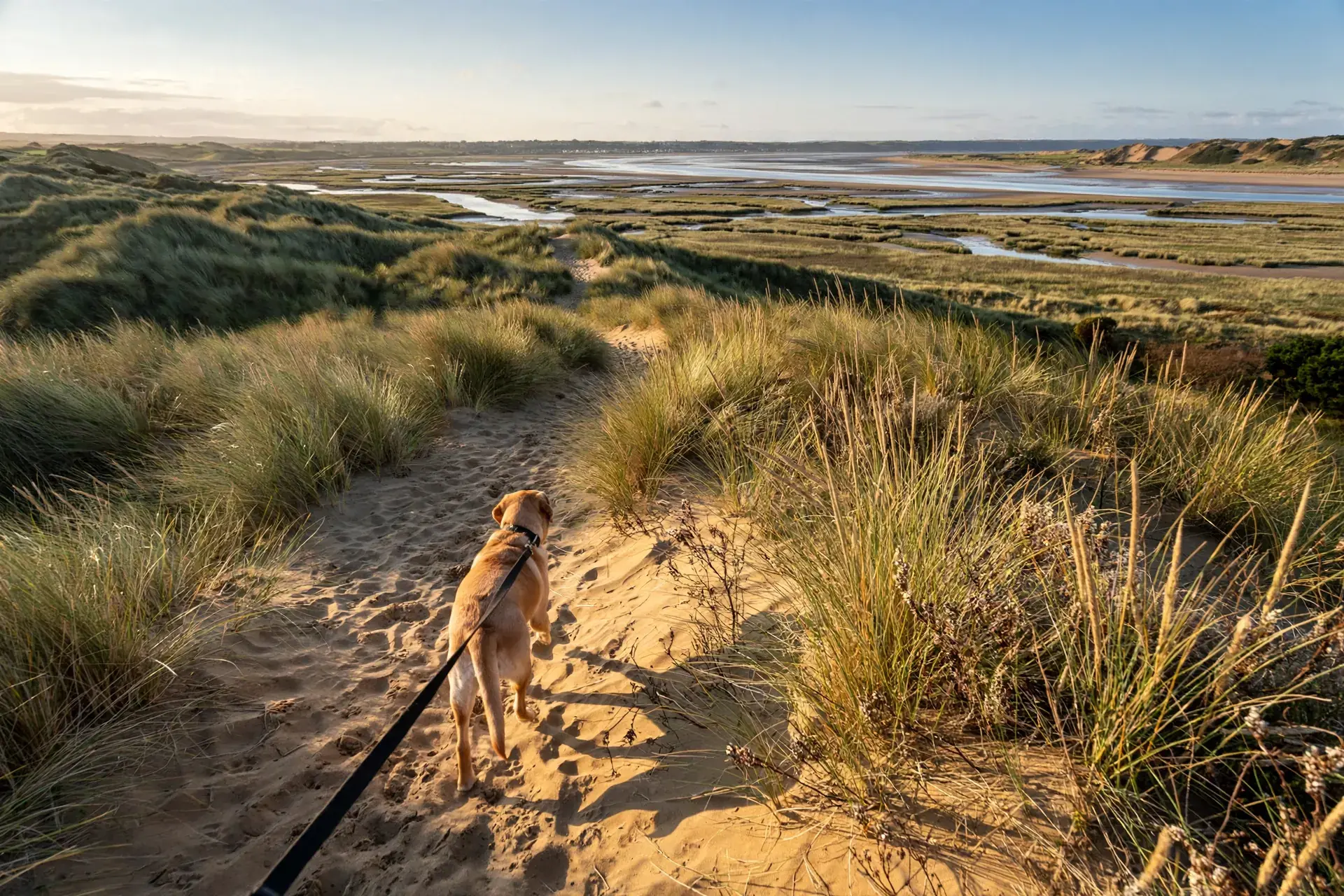
Braunton Burrows is the large dune system between the village and Saunton Sands, and it is the landscape most visitors picture when they think of Braunton. It is also a protected place. The Burrows form one of the largest sand dune systems in Britain, with tall marram grass, damp dune slacks, scrub and open sand, and they support rare plants, insects and ground-nesting birds. That status is why the rules here are stricter than on an ordinary beach, and why the best way to enjoy the dunes with a dog is to treat them as a place to walk through carefully, not as a free-running playground.
Keep your dog on a lead where the signs ask for it, and under close control everywhere else in the Burrows. In practice that means a short lead on the main paths through the dunes, no chasing, no digging in the dune faces, and no letting the dog crash through the tall grass where birds nest on the ground. Skylarks sing over the Burrows through the spring and summer, and their nests are on the ground, invisible in the grass — a dog running loose through marram can destroy a nest in seconds without meaning to. Grazing animals are part of how the dunes are managed, so expect cattle and ponies in some areas, keep well back, and never let your dog approach or chase them. If your dog is the sort that fixates on livestock, the Burrows are a lead walk from start to finish, and that is a perfectly good way to see them.
The walking itself is harder work than it looks. Dune paths are soft sand, and soft sand is tiring for dogs as well as people: a route that looks like a gentle mile on a map can feel like two miles in deep sand, especially for a small dog, an older dog, or a brachycephalic breed in warm weather. Plan shorter loops than you would on a firm path, carry water for the dog as well as yourself, and watch for the signs of a dog getting tired in sand — slowing down, lying down in the shade of a dune, panting heavily. There is very little shade in the open dunes, and on a sunny day the sand itself gets hot underfoot, so test it with your own hand before you set off. Early morning and late afternoon are the kindest times, and they are also when the light on the dunes is at its best.
Navigation in the Burrows deserves respect. The dune ridges all look similar, the paths braid and split, and it is easy to lose your bearings if you wander off the main routes. Stick to the waymarked paths, note where you entered the dunes, and keep a phone with a charged battery and an offline map if you plan anything longer than a short loop. The main access points are from the Saunton Sands end and from the village side along the road through the Burrows, and the most useful habit is to pick a single, simple loop — out along one path, back along another — rather than improvising a figure of eight in the middle of the dune field. If the weather turns, with wind driving sand across the paths, turn back: a dune walk in a sandstorm is miserable for a dog, and grit in the eyes is a real risk.
Adders live in the dunes, as they do in many British dune and heath systems. They are shy and will move away if they can, but a dog nosing through warm, dry grass on a sunny day is exactly the sort of encounter that can end badly. Keep your dog on the path, out of dense scrub and bracken, and on a lead in warm weather. Know the signs of an adder bite — sudden yelping, swelling, pain and distress — and know that a bite is a veterinary emergency: keep the dog as still as you can, carry a small dog if you are able, and get to a vet as quickly as possible. Do not try to suck the wound or apply a tourniquet. The risk is low, but it is worth knowing before you go, not discovering on the path.
After the walk, check your dog thoroughly. Sand gets everywhere — between the toes, in the ears, in the coat — and marram grass seeds can work their way into paws. A quick rinse of the paws and a brush-through back at the car or the cottage prevents most of the irritation. Take a towel, a bottle of fresh water and a spare lead: the Burrows are not a place to rely on finding a tap, and a dog that has rolled in a dune slack will need a clean-up before it is allowed back into a car or a holiday cottage.
Braunton Marsh: flat, wet and full of birds
Braunton Marsh is the flat, low grazing land that stretches south and east of the village towards the River Taw. It is a working landscape of fields divided by ditches, known locally as rhynes, with cattle grazing, wading birds feeding, and wide skies that make the whole place feel bigger than it is. For a dog owner, the marsh offers something the dunes and the beach do not: long, flat, quiet walking where the ground is level and the views are open, so you can see other dogs, livestock and birds from a long way off. That openness is a gift for a reactive dog, because you can change direction early and give other walkers a wide berth.
The marsh is also the place where a lead is most often the right choice, even where no sign demands it. The ditches are the first reason: they are deep in places, steep-sided, and full of still, brackish water that a dog should not drink. A dog that loves water will look at a ditch the way other dogs look at a ball, and the safest answer is to keep the dog on a lead near the water and to carry fresh water so the dog is never thirsty enough to drink from a ditch. The second reason is the birds. Lapwings, redshanks, curlews and ducks use the marsh through the year, and in spring the fields hold nesting waders. A dog running loose across a field can flush birds off nests and scatter feeding flocks, and once a flock has been disturbed it may not return to that field for hours. The third reason is the cattle. Grazing cattle on the marsh are often curious, and a dog that barks at them or runs towards them can startle a whole herd. Keep your distance, keep the dog close, and if cattle block the path, go around them with a wide margin rather than pushing through.
Walk the marsh in the right season and with the right expectations, and it is one of the calmest dog walks in North Devon. Winter is often the best time: the fields are quiet, the light is low and clear, and the waders and wildfowl are at their most numerous. Summer brings longer grass, more insects and more livestock, and the ditches can smell stagnant in hot weather. After heavy rain, parts of the marsh flood and the lower tracks become impassable, so check conditions before you set out and be ready to turn back. Waterproof boots are not optional here — the tracks are often muddy even when the fields look dry — and a dog that comes back from the marsh will usually come back muddy, so pack towels and a drying coat.
There is one more marsh habit worth building: look at the ground, not just the horizon. Ticks are present in the long grass and scrub around the marsh, particularly from spring to autumn, so check your dog after every marsh walk, paying attention to the ears, the armpits, the groin and between the toes. Carry a tick remover and know how to use it. If you find a tick, remove it promptly and watch the area for redness or swelling over the next few days. The same check matters after the Burrows and the trail, but the marsh, with its long grass and livestock, is where ticks are most likely.
The Tarka Trail from Braunton
The Tarka Trail is the easiest serious walk in Braunton, and for many dogs it will be the walk you do most. It follows a former railway line, so it is flat, wide and surfaced, with no steep climbs and no road traffic. From Braunton the trail runs south towards Barnstaple, across the marsh and along the River Taw estuary, and north towards Ilfracombe, climbing gently through wooded cuttings. Both directions are worth doing, but they feel different, and choosing the right one for your dog is half the planning.
The southern stretch, towards Barnstaple, is the flatter and more open of the two. It runs across the marsh with big skies, estuary views and long sightlines, which suits dogs that need space and owners who want to see cyclists coming. It is also the stretch where you are most exposed to wind and rain, and where there is least shade on a hot day. The northern stretch, towards Ilfracombe, is more sheltered, with trees, cuttings and a sense of enclosure that some nervous dogs prefer, but it also has more blind bends, so cyclists can appear suddenly. Either way, the rule is the same: keep your dog on a short lead, keep to one side of the path, and step off the surfaced track early when you hear a bicycle bell or see a cyclist approaching. A long line on a shared path is a hazard — it can trip a cyclist, tangle another dog, or pull your dog into the path of a bike — so save the long line for the beach or a field, not the trail.
Distance on the Tarka Trail is easy to control, which is its great advantage. Because the trail is linear and flat, you can walk out for twenty minutes and back for twenty minutes, and you have had a proper walk without committing to a loop. That makes it ideal for a puppy that needs short, frequent outings, an older dog that needs a gentle hour, or a dog recovering from an injury that needs flat ground. It is also ideal for a first walk on arrival day, when the dog is stiff from the car and you want something predictable. Walk out, watch how the dog moves, and turn back at the first sign of tiredness. There is no shame in a short trail walk: a calm, flat forty minutes beats a heroic three-hour dune slog that leaves the dog lame the next day.
Cyclists are the main thing to manage on the trail, and they deserve a fair hearing. The Tarka Trail is a popular cycle route, and on a sunny weekend it can be busy with families, hire bikes and faster riders. Most cyclists are considerate and will ring a bell or call out, but some will not, and a dog that lunges at wheels is a danger to itself and to the rider. Teach your dog a simple routine before you go: when a bike approaches, move to the side, shorten the lead, and reward the dog for standing still. Practise it on a quiet stretch first, so that by the time you meet a group of cyclists your dog already knows what to do. If your dog cannot cope with bikes at all, use the trail early in the morning or on a weekday, when it is much quieter, and choose the marsh lanes instead at busy times.
The trail also gives you practical things the dunes and the marsh do not: benches, signposts, a predictable surface for a dog with sore paws, and a straightforward route back to the village if the weather turns. In winter, when the marsh is flooded and the dunes are windswept, the trail is often the only walk that is still comfortable. In summer, it is the walk to do before ten in the morning or after five in the afternoon, when the sun is lower and the path is quieter. Carry water even on a short trail walk, because there are stretches with no shade and no water source, and a dog that has been walking in the sun for an hour will need a drink long before you do.
One useful detail: the trail passes close to the village at its Braunton end, so you can join it without driving anywhere. That matters if you are staying in the village without a car, or if you want to leave the car parked and walk from your door. A dog that can walk from the front door to a traffic-free trail is a dog that gets more walks, and more walks are what a holiday in Braunton is for. If you are staying outside the village, the same logic applies in reverse: drive to the village, park, and use the trail as your first walk, rather than driving to a different start point every day.
Saunton Sands: the big beach
Saunton Sands is the beach that makes Braunton worth the trip, and it is a beach on a scale that surprises first-time visitors. It is a long, straight stretch of sand — roughly three miles from the dunes at the Braunton end to the cliffs at the far end — backed by the Burrows and facing the open Atlantic. At low tide the sand seems to go on forever, and at high tide it narrows to a much smaller strip. That tidal range is the first thing to understand, because it changes everything about a dog walk: the same beach can be a vast, empty playground at low tide and a crowded, narrow strip at high tide, with the sea close to the dunes and nowhere for a dog to run.
Check the tide times before you go, and check the official guidance before you travel for the current dog rules, because beach rules can change and this guide cannot promise that a rule in force today will still be in force next year. Saunton Sands is generally open to dogs all year, which is one of the reasons dog owners love it, but seasonal notices, lifeguard zones and local bylaws can still apply, so read the signs at the beach entrance and follow them. Keep your dog under close control near the water, and be honest about your dog around the surf: the Atlantic swell at Saunton can be strong, with a shore break that knocks a small dog over and a rip current that is not visible from the beach. Let a confident swimmer paddle at the edge, keep a nervous dog on a lead near the water, and never let a dog chase a ball into deep water.
The beach is also a place where the wind matters. Saunton faces west, so the prevailing wind blows straight off the sea, and on a windy day the sand stings and the dog's eyes water. A dog that loves the beach in calm weather may hate it in a force six, and there is no point in forcing the issue: a short walk along the firm sand at the water's edge, a few minutes of play, and then back to the car is a better plan than an hour of battling the wind. In hot weather the opposite problem applies: the sand gets hot, there is no shade at all on the open beach, and a dog can overheat quickly. Walk early or late, carry plenty of fresh water, and bring a windbreak or a beach shelter if you plan to stay for a few hours. A dog that has shade and water will enjoy the beach for far longer than a dog that has neither.
Parking at Saunton is straightforward but busy. The main beach car park sits at the Braunton end of the sands, close to the beach entrance, the toilets and a cafe, and it fills up early on sunny weekends and school holidays. Arrive early, read the signs for charges and time limits, and be prepared to walk a little further from an overflow area rather than circling for a space close to the beach. Keep your dog on a lead in the car park and on the path to the beach: car parks are where most beach-day accidents happen, because dogs are excited, owners are carrying bags, and cars are reversing. Load and unload the dog with care, and do a final check of the car before you leave — leads, water, towels, a spare lead, and a bag for rubbish.
Once you are on the sand, the walk itself is simple: walk along the firm sand near the water, let the dog run in the open space away from other groups, and keep an eye on the tide. The tide at Saunton comes in fast across the flat sand, and it is easy to find yourself cut off from your exit point if you walk a long way along the beach without checking. A good habit is to walk out against the tide and back with it, or simply to walk for half the time you plan to spend and then turn around. Watch for other beach users too: surfers, families with small children, and other dogs. A dog that charges up to a stranger's picnic or a surfer's board will not be popular, so call your dog back early and reward the recall before the dog reaches the other group.
After the beach, rinse the dog. Salt water, sand and seaweed are irritating to skin and paws, and a dog that licks salt water will drink too much of it and may be sick. Offer fresh water first, then rinse the paws and the coat, and check between the toes for sand and small stones. A dog that has been swimming in the sea should be dried and warmed up, especially in cooler months, because a wet dog in a car with the air conditioning on can chill quickly. Keep a towel and a drying coat in the car at all times when you are visiting Saunton, and do not leave a wet dog in a cold car while you have a coffee.
The River Caen and the lower village
The River Caen is a small river that runs through Braunton and out across the marsh towards the Taw estuary, and it is easy to overlook — until your dog finds it. In the village itself the Caen is a narrow, shallow stream, often little more than a trickle between banks, and it is the sort of water that a dog will want to paddle in on a hot day. Lower down, towards the marsh, it widens and becomes tidal, with muddy banks and brackish water. The two stretches need different handling, and the distinction is worth knowing.
In the upper village, the Caen is mostly harmless, but it is still a watercourse running through a built-up area, so do not let your dog drink from it as a matter of routine, and do not let a dog that is inclined to chase ducks or moorhens run loose along its banks. The lower, tidal stretch is a different matter: the banks are soft mud, the water is brackish, and the tide can cover the mudflats quickly. A dog that runs onto the mud can get stuck, and a dog that drinks brackish water can be unwell. Keep your dog on a lead near the lower Caen, keep well back from the mud, and carry fresh water so the dog has no reason to drink from the river. If your dog does get covered in estuary mud, rinse it off promptly: the mud is sticky, it smells, and it can irritate skin if it is left to dry in the coat.
The lower village, around the southern end of Caen Street and the lanes towards the marsh, is also where the village meets the farmland. Expect farm traffic, tractors and trailers on the lanes, and expect gates that need to be closed behind you. The rule for gates on a dog walk is simple and non-negotiable: leave every gate as you found it, and if a gate is closed, close it after you. Livestock, and the farmers who own them, depend on it. If you meet a farmer on a lane, a friendly word and a dog held close will get you much further than a dog running ahead around a bend.
The main street, parking and pubs
Caen Street is the spine of Braunton, and a dog walk through the village is really a walk along Caen Street and its side lanes. The street is narrow in places, with pavements that are sometimes only just wide enough for a person and a dog, so a short lead is essential. Walk on the inside, away from the road, keep the dog close at junctions, and be ready for the ordinary hazards of a village high street: delivery vans pulling out, cars reversing from driveways, cyclists, pushchairs, and other dogs coming out of shops. The village is not dangerous, but it is not a pedestrian zone either, and a dog on a long lead across a pavement is a trip hazard for everyone.
Parking is best handled by using the village car parks just off the main street and walking from there, rather than by trying to park on Caen Street itself or on the narrow residential streets. The car parks are close to the shops, the trail and the lanes to the marsh, and they save you the stress of finding a space on a busy street with a dog in the car. Read the signs when you arrive for charges, time limits and any height or vehicle restrictions, because these can change — check the official guidance before you travel if you need to be certain about charges on a particular date. Arrive early on market days and in the summer holidays, when the village is at its busiest, and leave plenty of time to get back to the car. Never leave a dog in a parked car in warm weather, even with the windows open: a car heats up far faster than most people expect, and a dog can overheat in minutes.
Shopping with a dog in Braunton is a matter of planning, not luck. Many of the village shops are small, with narrow aisles and goods at dog-nose height, so a large dog in a small shop is a recipe for a knocked-over display. The practical approach is to take turns: one person stays outside with the dog while the other goes in, or leave the dog settled in the car in cool weather for a short shop — never in warm weather, and never for long. Some shops welcome dogs and will say so on the door; others do not, and the sign at the door is the rule. Do not assume, and do not argue with a shopkeeper who says no: the village has enough to offer that a single closed door should not spoil the day. Buy what you need for the walk — water, snacks, a spare poo bag — before you set off, so you are not trying to shop with a muddy dog afterwards.
Pubs and cafes on the main street are one of the pleasures of a Braunton stay, but they need the same planning as the shops. Dogs are often welcome in Braunton's pubs and cafes, especially in outdoor seating areas and in the bar area of a pub, but policies vary from venue to venue and from season to season, and a place that welcomed dogs last year may have changed its rules. Check the sign at the door or ask a member of staff before you settle in, and do not take a dog into a restaurant area unless you have been told it is welcome there. Bring a mat for the dog to lie on, a water bowl, and something to keep the dog occupied — a chew or a stuffed toy — so the dog can settle while you eat. Choose a quiet corner away from the main walkway if your dog is nervous, and keep the lead short and under your chair, not stretched across the floor where a waiter can trip over it.
Lunchtime is the busiest time for pubs and cafes, and it is also the hardest time for a dog that is tired, muddy or overexcited after a walk. If you want a relaxed meal, go early or late, or choose a cafe with outdoor seating where the dog has space and fresh air. A dog that has just come off the beach or the marsh will be wet, sandy or muddy, and most venues would rather you cleaned the dog up first than brought a wet dog into a dining room. A quick towel-down in the car park, a brush of the paws, and a dry coat make the difference between a welcome guest and an unwelcome one. If your dog barks, paces or cannot settle, the kindest thing is to take the food away or cut the meal short: a pub lunch is not worth a stressed dog.
Finally, remember that Braunton is a village where people know each other, and where a polite dog owner is remembered. Pick up after your dog everywhere, including on the lanes, the trail and the beach, and carry more bags than you think you will need. Use the bins provided, and if there is no bin, take the bag with you — do not leave it by a gate or hang it on a fence. The marsh, the dunes and the trail are all used by local dog walkers every day, and the way visitors behave determines how welcome dogs are in the village as a whole.
Staying in and around Braunton
Braunton makes a good base for a dog holiday because it has the shops, the trail and the beach within easy reach, and because there are dog-friendly places to stay in the village and in the surrounding countryside. The right choice depends on your dog, and it is worth being honest about what your dog needs before you book. A dog that needs a garden to toilet in at night will not be happy in a first-floor flat with no outdoor space. A dog that barks at passers-by will not be happy in a cottage on Caen Street with a window onto the pavement. A dog that needs a long, flat walk first thing will be happiest in a place with a direct route to the trail or the marsh, not in a place where every walk starts with a drive.
Ask the same questions of every place you consider, whether it is a cottage, a bed and breakfast, a campsite or a holiday park. How many dogs are allowed, and is there a charge per dog? Is there a secure garden or an enclosed outdoor space, and how high is the fence? Where is the nearest practical toilet walk after dark, and is it lit? Are dogs allowed in all of the rooms, or only in some? Is there somewhere to wash a muddy dog — an outdoor tap, a utility room, a dog shower? And what happens if the dog barks? Get the answers in writing, with the pet fee itemised, before you pay a deposit. A place that answers these questions clearly has usually thought about dogs properly; a place that answers with a vague reassurance has usually not.
If you are considering a holiday park as your base, our guide to dog-friendly holiday parks in Devon covers the questions to ask about boundaries, fees and nearby walks, and many of the same checks apply to a cottage or a campsite. The principle is the same everywhere: the headline price is not the whole cost, and the prettiest listing is not always the most practical. A slightly plainer place with a secure garden, a muddy-dog wash and a five-minute walk to the trail will give you a better week than a beautiful place where every walk starts with loading a reluctant dog into the car.
Think about the practicalities of a stay as well as the booking. Bring the dog's own bed, food, bowls and a familiar blanket, and set up the sleeping area exactly as it is at home. Keep the feeding routine the same, and keep the last walk of the day at the same time. If the dog is used to a crate, bring it. If the dog is not used to being left alone in a strange place, do not start now: plan as if the dog is coming with you everywhere, and choose pubs, cafes and beaches that allow that. A dog that settles in its own bed in a quiet corner will sleep well, and a dog that sleeps well will walk well the next day.
For a longer stay, Braunton also works as a base for exploring further afield. The coast to the north, towards Ilfracombe and Woolacombe, and the coast to the south, towards Barnstaple and the Taw estuary, are both within a short drive, and each has its own dog rules, tides and parking. Our guide to Bude with a dog covers a different stretch of the same coastline further south, with its own beaches, canal walk and safety notes, and it is a useful comparison if you are planning a longer tour of the South West. But do not try to do everything in one week: Braunton alone has enough walking for a fortnight, and a dog that is driven to a new beach every day is a dog that spends its holiday in a car.
Seasons, livestock and safety
Braunton changes with the seasons more than most visitors expect, and the right plan in July is the wrong plan in January. Summer is the busiest season: the village is lively, Saunton Sands is crowded, the car parks fill early, and the sun is strong on the open beach and in the dunes. It is also the season when the dog rules are most likely to be enforced, the lifeguards are on duty, and the pubs are at their busiest. Walk early, carry water, use shade, and accept that a summer day in Braunton is a day of short walks and long rests, not a day of marching from dawn to dusk.
Autumn is often the best season for a dog holiday in Braunton. The crowds thin, the light is golden, the sea is still warm enough for a paddle, and the trail and the marsh are at their quietest. The ground can be wet after rain, and the wind can be strong on the beach, but a dog in a drying coat on a quiet autumn beach is a happy dog. Winter is quieter still, and the village feels like itself again, but the days are short, the marsh can flood, and the wind off the sea is cold. Pack for the weather you will actually get, not the weather you hope for: waterproofs, a warm layer, a drying coat for the dog, and a towel in the car at all times.
Spring brings the birds back to the marsh and the Burrows, and with them the strictest wildlife rules. Ground-nesting birds are at their most vulnerable from spring into early summer, so keep your dog on a lead on the marsh and in the Burrows, keep to the paths, and do not let the dog run through long grass or reed beds. The same season brings ticks, adders and the first of the year's insects, so the post-walk check — paws, ears, coat, belly — becomes a daily habit rather than an occasional one. Spring also brings lambs and calves to the fields around the village, and a dog that chases livestock is a danger to itself and to the animals: keep the dog close, keep the lead short, and give every field of livestock a wide berth.
Livestock deserve a section of their own, because they are the single most common cause of trouble on a Braunton dog walk. Cattle on the marsh and in the Burrows are generally calm, but they are large, they are protective of their calves, and they can be unpredictable if a dog runs at them or barks at them. Never let your dog off the lead near cattle, never walk between a cow and her calf, and never try to push through a herd that is blocking the path. If cattle approach you, stay calm, keep the dog close to your side, and walk steadily away. If you are ever charged by cattle, let the dog go — a dog can outrun a cow, and a person holding a lead cannot. That advice sounds dramatic, but it is the advice that keeps people and dogs safe, and it is worth knowing before you need it.
Water safety is the other constant. The sea at Saunton, the tidal River Caen, the estuary and the marsh ditches are all water that a dog should be kept away from or handled with care. Never let a dog drink seawater — it causes vomiting and dehydration — and never let a dog swim in a strong current or in water you cannot see the bottom of. After any swim, rinse the dog with fresh water and dry it off, and watch for signs of illness over the next day or two. If your dog swallows a lot of water, seems lethargic, or vomits repeatedly after swimming, contact a vet. Know where the nearest vet is before you need one, and save the number in your phone on arrival day, not on the day you need it.
Finally, keep the basics in the car and in your day pack: fresh water and a bowl, poo bags, a lead and a spare, a towel, a tick remover, a basic first-aid kit, and the number of a local vet. That kit, plus a phone with a charged battery, covers almost everything that can go wrong on a Braunton walk. The rest is judgement: turn back early, shorten the walk when the dog is tired, and remember that a good day with a dog is a day the dog comes home happy, not a day you ticked off the longest possible route.
A dog-shaped day in Braunton
A good day in Braunton starts early, and it starts with the dog, not with the plan. Feed the dog at the usual time, give it a short toilet walk on the lead around the village lanes, and then decide what the day will be. If the weather is fine and the tide is out, Saunton Sands is the morning walk: arrive early, park easily, walk the firm sand for an hour, let the dog run in the open space, and be back in the village before the beach gets busy. If the tide is in, or the wind is up, the Tarka Trail is the morning walk instead: flat, sheltered in its northern stretch, and easy to shorten if the dog is stiff.
Midday is for resting, not for walking. The sun is at its strongest, the village is at its busiest, and a dog that has had a good morning walk will be happy to sleep in a cool room or a shady garden. Use the middle of the day to shop on Caen Street, to have lunch in a dog-friendly cafe, or simply to sit with the dog and let it recover. If you do go out at midday, keep it short, keep the dog on a lead, and carry water. A dog that is forced to walk in the heat of the day is a dog that will be too tired to enjoy the evening.
The afternoon is for the marsh or the Burrows, when the light is softer and the air is cooler. A marsh walk on a lead, with time to watch the birds and let the dog sniff the hedgerows, is a calm way to spend an hour. A Burrows walk, kept to the paths and kept short in soft sand, is a different kind of calm: tall grass, open sky, and the sound of the sea in the distance. Either way, keep the walk shorter than the morning's, and finish with time to clean the dog up before dinner. A dog that comes back muddy from the marsh or sandy from the dunes needs a rinse and a brush, and a dog that is clean and dry will settle far more easily in a pub or a cottage in the evening.
The evening is for the village. A short walk along Caen Street, a drink in a dog-friendly pub, a quiet dinner with the dog settled on its mat — that is the Braunton evening at its best. Keep the last walk short and familiar, on the lead, along a route the dog already knows. Give the dog water, a final toilet break, and a comfortable bed, and the day is done. A dog that has had a beach in the morning, a rest at midday, a quiet walk in the afternoon and a calm evening will sleep well, and will be ready to do it all again tomorrow. That is the rhythm that makes Braunton work: not one heroic walk, but a day shaped around the dog.
If you are staying for a week, vary the days rather than repeating the same one. One day for Saunton, one day for the trail south to Barnstaple, one day for the trail north, one day for the marsh, one day for the Burrows, and one day for doing very little at all. A rest day is not a wasted day: it is the day the dog recovers, the day you explore the village properly, and the day you remember why you came to Braunton in the first place. The village, the marsh, the dunes, the trail and the beach will all still be there tomorrow, and they are all best enjoyed by a dog that is not exhausted.
Practical questions
Before you go
Can my dog go on Saunton Sands all year?
Saunton Sands is generally open to dogs all year, but seasonal notices, lifeguard zones and local bylaws can change, so check the official guidance before you travel. Keep your dog under close control near the water, watch the tide, and carry fresh water because there is little shade on the open sand.
Do dogs have to stay on a lead in Braunton Burrows?
Braunton Burrows is a sensitive dune system with grazing animals and ground-nesting birds, so dogs should be on a lead where signs ask for it and under close control everywhere else. Keep to the paths, keep your dog out of the fenced enclosures and away from livestock, and check the official guidance before you travel for the current rules.
Is the Tarka Trail from Braunton suitable for a nervous dog?
The Tarka Trail from Braunton is flat, wide and surfaced, which suits many nervous dogs, but it is shared with cyclists and other walkers, so use a short lead and step aside early when bikes approach. Early mornings and quieter weekdays are calmer, and a long line is not a good idea on a busy shared path.
Where can I park in Braunton with a dog?
Use the village car parks just off the main street and walk from there, rather than trying to park on narrow residential streets. Read the signs for charges and time limits when you arrive, because they can change, and keep your dog on a lead for the walk from the car park to the trail or the beach.
Are there dog-friendly pubs and cafes on Braunton's main street?
Braunton's main street has pubs and cafes where dogs are often welcome, especially in outdoor seating areas, but policies vary by venue and by season. Check the sign at the door or ask staff before you settle in, bring a mat and water bowl, and choose a quiet corner if your dog needs space.
What should I do if my dog drinks from the marsh ditches or the River Caen?
Discourage drinking from marsh ditches and the lower, tidal stretches of the River Caen, and carry fresh water on every walk. If your dog drinks stagnant or brackish water and later seems unwell, contact a vet promptly and describe where the water was. Check the official guidance before you travel for any local water-quality notices.