This guide is independent and contains no paid placement. If affiliate links are added later, they will be clearly marked and will not change our editorial checks.
Choose Broadford if you want a quiet south Skye base: a wide bay that opens into easy low-tide walking, Red Cuillin hills on the doorstep, and a village with shops, food and a vet. Skip it only if you need Portree's bigger choice of restaurants and evening bustle — Broadford trades that for space, calm and shorter drives to the south of the island.
Why choose Broadford over Portree
Most visitors to Skye head straight for Portree, the island's main town, and that is exactly the problem. In summer the harbour town fills up: car parks overflow, pavements are crowded, and every popular viewpoint comes with a queue. For a dog, that means lead-short pavements, stressed encounters with other dogs on narrow streets, and a base that feels hectic before the day has even started. Broadford, about 24 miles south of Portree on the main road, offers the opposite deal. It is a working village rather than a tourist hub, and the difference shows in the first ten minutes: you can park, walk to the shore, and let your dog settle into a proper sniffing walk without negotiating a crowd.
The case for Broadford rests on three things. First, the bay. Broadford Bay is a broad, shallow sweep of sand and rock that empties dramatically at low tide, giving dogs a huge flat walking area right beside the village. You do not need to drive anywhere for the morning walk, which matters more than it sounds on a trip where every day trip already involves driving. Second, the hills. The Red Cuillin — the rounded, grassy range that contrasts with the jagged Black Cuillin further west — rises directly behind the village, so a hill walk starts from your doorstep rather than from a distant car park. Third, the practical stuff: Broadford has a supermarket, a petrol station, places to eat, accommodation, a vet practice and a hospital, which is an unusually complete set of services for a village of its size. That combination is rare on Skye, where many beautiful spots have no services at all.
There are honest trade-offs. Broadford is quieter in the evening, with fewer restaurants and no harbour-front buzz, and the village itself is spread along the main road rather than gathered around a picturesque centre. If your idea of a holiday is wandering between busy cafes and shops after dinner, Portree will suit you better. But if your trip is built around your dog — long walks, calm mornings, and a base that does not add stress — Broadford is the stronger choice. Many dog owners use it as a first-night or last-night base too, because it sits close to the Skye Bridge and the road south to the mainland, which makes arrival and departure days much less rushed.
Think of the decision this way: Portree is where you go to see Skye's most famous sights, and Broadford is where you stay while you do it. The famous sights are all day trips from here — the Old Man of Storr, the Quiraing and the Fairy Pools are all reachable — while the village itself gives you the two things a dog trip needs most: a walk you can do without the car, and somewhere calm to come back to. That is the whole argument of this guide, and the sections below work through it in practical detail.
Getting to Broadford
Broadford sits on the A87, the main road that runs from the Skye Bridge at Kyle of Lochalsh up through the island to Portree and on to Uig. If you are driving from the mainland, you cross the Skye Bridge — free to use — and Broadford is roughly a fifteen-minute drive from the bridge, which makes it the first proper village you reach on Skye. That short hop from the mainland is one of the village's quiet advantages: on arrival day, when the dog has already spent hours in the car, you can be parked, walked and settled within minutes of crossing onto the island instead of facing another hour of driving north.
Drivers coming from further afield usually reach Skye by one of two routes. The most common is the A82 from Glasgow or Fort William to Invergarry, then the A87 through Glen Shiel to the bridge. The alternative is the ferry from Mallaig to Armadale in the south of Skye, which lands you about forty minutes' drive from Broadford via the A851 and the A87. The ferry is worth considering if you are travelling up the west coast, and it is generally dog-friendly — dogs usually stay in the car or in designated areas on board, so check the official guidance before you travel for the current rules. Whichever route you take, fill up before the bridge if you can; fuel is available in Broadford itself, but rural petrol stations can have limited hours and the island's filling stations are further apart than mainland drivers expect.
Public transport is possible but needs planning. Buses run along the A87 between Kyle of Lochalsh, Broadford and Portree, and the nearest railway station is Kyle of Lochalsh, just across the bridge on the mainland. Dogs are generally allowed on buses and trains in Scotland, usually on a lead and at the driver's discretion, but check the official guidance before you travel because rules vary between operators. If you arrive without a car, Broadford is actually one of the better places to be car-free on Skye: the bay walk, the village shops and the lower hill paths are all within walking distance, although the famous sights further north will need a bus, a taxi or a tour.
For the drive itself, a few Skye-specific habits help. Single-track roads with passing places are common once you leave the A87, so be ready to reverse into a passing place and to let oncoming traffic through — and remember that a dog in the car needs the same care on these roads as anywhere else, with regular stops and water. Midges are the other seasonal reality: from late spring to early autumn, especially on calm, damp evenings, they can be intense around the bay and the hills. Pack repellent, and plan your longest walks for breezy days or the middle of the day when midges are least active. Our wider Isle of Skye with a dog guide covers single-track driving, midges and ferry rules in more detail.
Broadford Bay at low tide
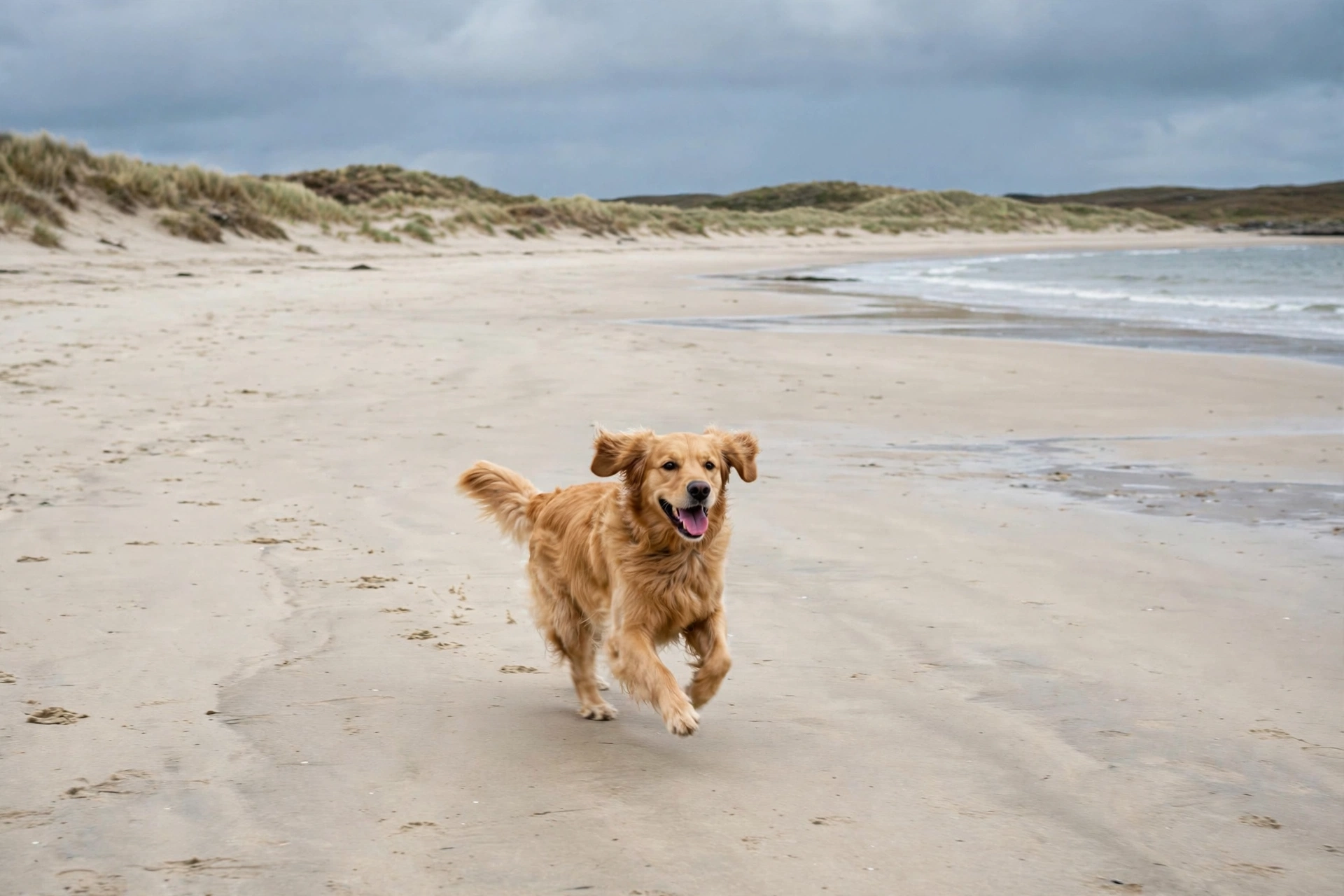
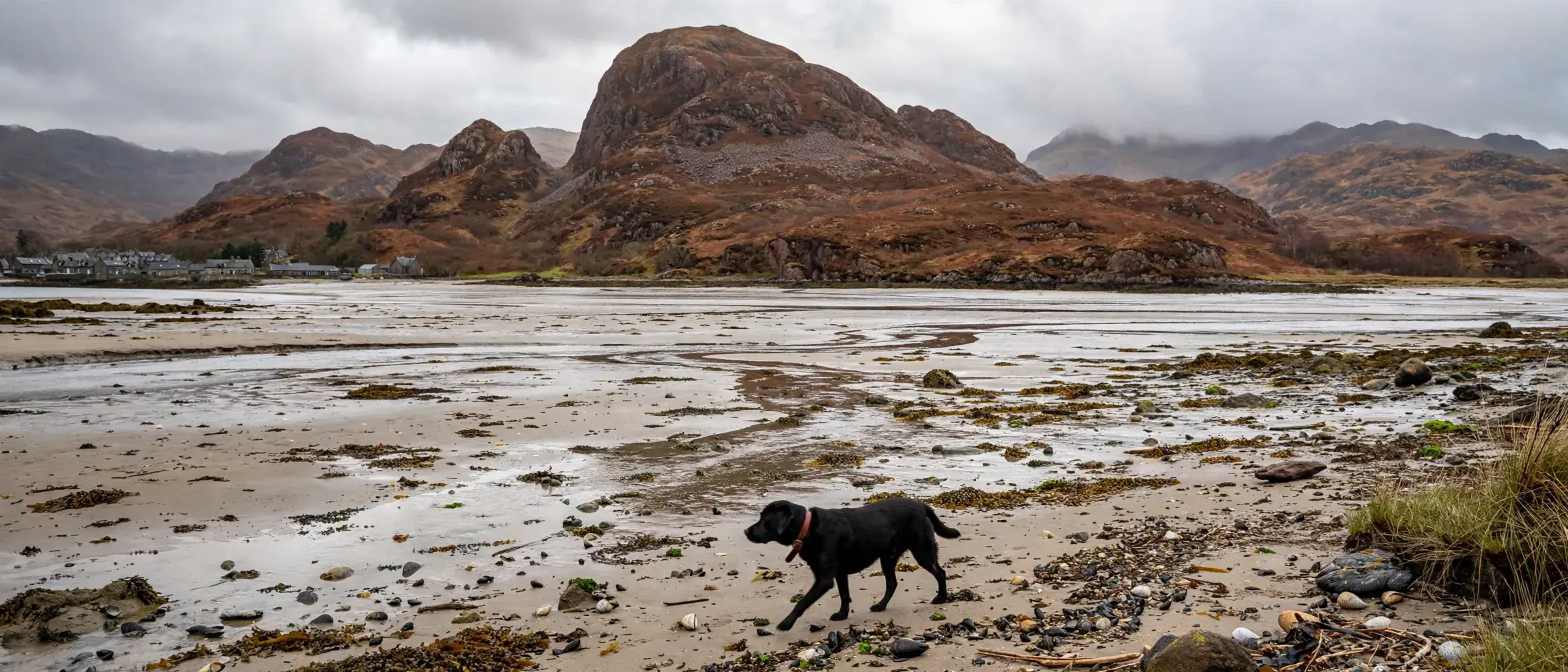
Broadford Bay is the walk that sells the village, and it costs nothing. At high tide the bay is a broad stretch of water lapping close to the road, pretty but not much use for a dog walk. At low tide it transforms: the water pulls back a long way, exposing wide flats of sand, scattered rock pools and ribbons of seaweed, and the whole bay becomes a huge, flat, open walking area. The change is dramatic enough that first-time visitors often walk the shore twice in one day — once at high water to look, and once at low water to actually use it.
The practical way to walk it is simple. Park in the village and walk down to the shore near the bay, then follow the sand as far as feels comfortable, keeping the tide in mind at all times. The surface underfoot is mostly firm sand with patches of shingle and rock, which suits most dogs, but check paws afterwards: barnacle-covered rocks and broken shells can cut pads, and seaweed can hide sharp objects. Older dogs and small dogs will appreciate the flat ground — there are no steep climbs and no stiles on the main shore walk — while energetic dogs get the space to run, chase a ball and burn off energy before a longer day. Keep your dog within sight and under control, because the bay is shared with other walkers, children, and occasionally livestock grazing nearby.
Timing is everything, and it is the one thing you must get right. Check the tide times for Broadford before you set out — tide tables are available online and from local noticeboards — and plan to be back on dry land well before the tide turns. The incoming tide on a wide flat bay can cover ground faster than it looks, and the sand that seemed endless an hour ago can narrow quickly. A good rule is to start your walk at or just after low water and to turn back while the tide is still well out. Never walk out onto the far sand if the tide is already coming in, and do not let your dog chase birds or seals out towards the waterline where the tide could cut you off.
The bay also rewards the quieter hours. Early morning, before the village is properly awake, the shore is often empty except for wading birds — oystercatchers, curlews and herons are regulars — and the light across the water towards the mainland is at its best. Evening is similar, with the sun setting over the water and the hills behind the village turning warm colours. Both are lovely times for a dog walk, but both need the same tide check and the same care: take a torch in winter, when daylight is short, and keep your dog on a lead near the road end of the walk, where traffic passes close to the shore.
One more thing the bay is good for: washing off. After a muddy hill walk, the shallow water at the shore edge is a handy place to rinse sandy paws and salty coats, although you should still give your dog a proper rinse with fresh water back at your accommodation. Salt water and sand are not a substitute for a wash, and dogs that drink seawater can become unwell, so carry fresh water and a bowl on every bay walk, even a short one.
Walking the Red Cuillin from Broadford
The hills behind Broadford belong to the Red Cuillin, the older, rounder half of Skye's famous Cuillin range. Unlike the Black Cuillin — dark, jagged gabbro peaks that demand scrambling and, for most walkers, a guide — the Red Cuillin are built of granite, grass-covered and rounded, with broad ridges and slopes that a fit dog and a reasonably fit walker can enjoy on a clear day. The contrast matters for dog owners: the Red Cuillin offer real hill walking without the exposure and technical ground that make the Black Cuillin unsuitable for most dogs.
The best-known route from the village is the walk towards Beinn na Caillich, the rounded summit that rises directly above Broadford and gives the village its backdrop. The usual approach starts from the village and climbs steadily through moorland and grassy slopes to the summit, where the reward is a wide view across the bay, the mainland hills and the rest of Skye. It is a proper hill walk rather than a stroll — allow several hours, expect steep sections and boggy ground after rain, and treat it as a half-day outing rather than an add-on to a bay walk. Dogs that are used to hills will love it; dogs that only ever walk on pavements will find it hard work, so build up to it with shorter walks first.
Other Red Cuillin options spread out from the same area. The lower slopes above Broadford offer shorter out-and-back walks that still deliver the views, and the glens between the hills — notably the broad valley of Strath — give flatter walking along tracks and paths with the hills rising on both sides. For a gentler day, a walk up the valley floor is a good compromise: your dog gets a long, interesting walk with streams and open moorland, and you get the Cuillin scenery without the climb. Whichever route you choose, keep your dog on a lead whenever sheep are in sight. The Red Cuillin slopes are grazed, and a dog chasing sheep is not only dangerous for the animals but can also put you in breach of access rules and damage relations with local farmers.
Preparation is what separates a good hill day from a miserable one. Check the weather forecast for the hills, not just the village — conditions on the tops can be very different from the bay, with wind, cloud and rain arriving fast. Carry water for the dog as well as for yourself, because the burns and streams on the hills are not always safe to drink from, and pack a lead, a towel, and a basic first-aid kit including something to deal with a cut pad. Footwear matters too: the ground is a mix of grass, rock, peat and bog, and after rain it can be slippery and wet underfoot, so wear boots with a good grip and gaiters if you have them. Tell someone where you are going and when you expect to be back, and carry a charged phone — mobile signal can be patchy on the hills.
Finally, be honest about your dog's fitness. A hill walk in the Red Cuillin is a serious outing: several hours of climbing, uneven ground, and exposure to wind and weather. Older dogs, very young dogs, brachycephalic breeds and dogs with joint problems may be happier with the bay and the valley walks, and that is a perfectly good trip. The hills will still be there next time, and a dog that enjoys the holiday is worth more than a summit photograph.
A day in the village with your dog
Broadford works as a base because the ordinary parts of a holiday are easy here. Start the day with the bay walk, then come back to the village for supplies: the supermarket stocks the basics, including dog food, and there is a petrol station, a pharmacy and a handful of shops along the main road. That sounds unremarkable, but on Skye it is a genuine advantage — many of the island's prettiest places have no shop at all, and a forgotten bag of dog food can mean a forty-minute drive. In Broadford, the forgotten item is a five-minute walk.
Food and drink with a dog is straightforward if you plan ahead. Several places in the village welcome dogs, often on a terrace or in a specific area, and the local hotel and cafes are used to walkers arriving with muddy boots and a dog in tow. Policies change, so check the official guidance before you travel or ask at the door rather than assuming — and always bring a mat or blanket for your dog to settle on, plus a chew or a stuffed Kong to keep them occupied while you eat. A dog that can settle quietly under a table is welcome almost everywhere; a dog that barks at every passing stranger is not, so practice the settling routine at home before the trip.
The village also has a small beach and shore area near the bay that works for a short evening walk, and the road south towards Torrin and Elgol is one of the prettiest drives on Skye, with the Cuillin on one side and the sea loch on the other. If the weather turns — and on Skye it will, probably more than once — Broadford's indoor options are limited, which is the honest truth about a small village. A wet afternoon is best spent with a book, a board game, or a short drive to somewhere with more cover, such as the shops and cafes of Portree or the distillery at Talisker. Pack for rain as a matter of course: waterproofs for you, a drying coat for the dog, and twice as many towels as you think you need.
One of Broadford's quiet pleasures is how quickly the village empties after the day-trippers leave. By early evening the bay is quiet, the main road is calm, and the walk to the shore feels like a local walk rather than a tourist activity. If you are staying for several days, that rhythm becomes the trip: a long morning walk, a slow afternoon, and a short evening stroll before dark. Dogs thrive on routine, and Broadford makes it easy to build one.
Where to stay with a dog in Broadford
Broadford has a good range of dog-friendly accommodation for a village of its size: hotels, bed and breakfasts, self-catering cottages, a campsite and holiday lodges in the surrounding area. The right choice depends on your dog. A self-catering cottage with an enclosed garden is the easiest option for most dog owners, because it gives you a private toilet area, a kitchen for preparing the dog's food, and no worries about leaving a dog alone in a hotel room. Ask specifically whether the garden is fully enclosed and how high the fence is — "enclosed" means different things to different owners, and a low stone wall is not a fence for a determined terrier.
Hotels and B&Bs can work well too, especially for shorter stays, but check the details before you book. Ask whether dogs are allowed in the room, whether there is a charge, whether dogs can be left alone in the room, and where the nearest toilet walk is after dark. Some places welcome dogs in the bar or lounge, which makes evenings much easier; others restrict dogs to the bedroom, which means you will be eating apart. A place that allows dogs in the dining area or on a terrace is worth paying a little more for, because it changes the whole shape of the evening.
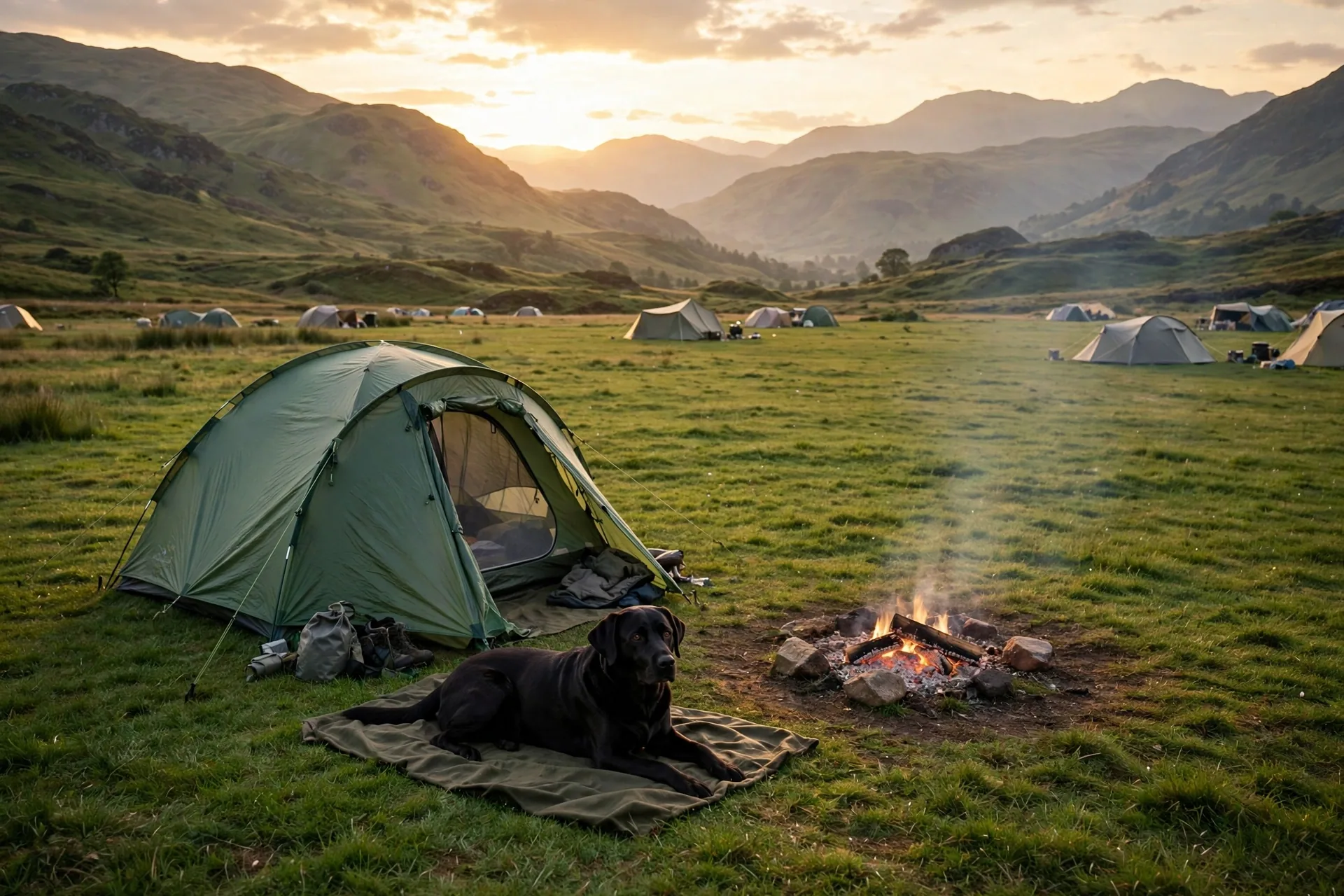
Camping is another strong option in Broadford, and the village campsite is well placed for the bay and the hills. Camping with a dog needs a bit more kit — a long line, a stake or a secure tie-out, a dog sleeping mat, and a plan for wet weather — but it suits dogs that like being outdoors and owners who want a cheap, flexible base. Our camping with a dog guide covers site choice, tent setup and the first-night routine in detail. Whatever you choose, book early: Skye accommodation fills up months ahead for summer, and dog-friendly rooms and cottages are always the first to go.
A few booking questions are worth asking every time. How many dogs are allowed, and is there a charge per dog? Is there a secure area for the dog, and what happens if the dog barks? Is there a vet nearby, and is there somewhere to wash a muddy dog? What is the cancellation policy if the weather or the dog's health forces a change of plan? Get the answers in writing with your confirmation, and keep the confirmation email until you are home. And when you arrive, do the same settling routine you would anywhere: walk the boundary, check the gates, find the water bowl spot, and give the dog a familiar bed before you unpack anything else.
Day trips from Broadford
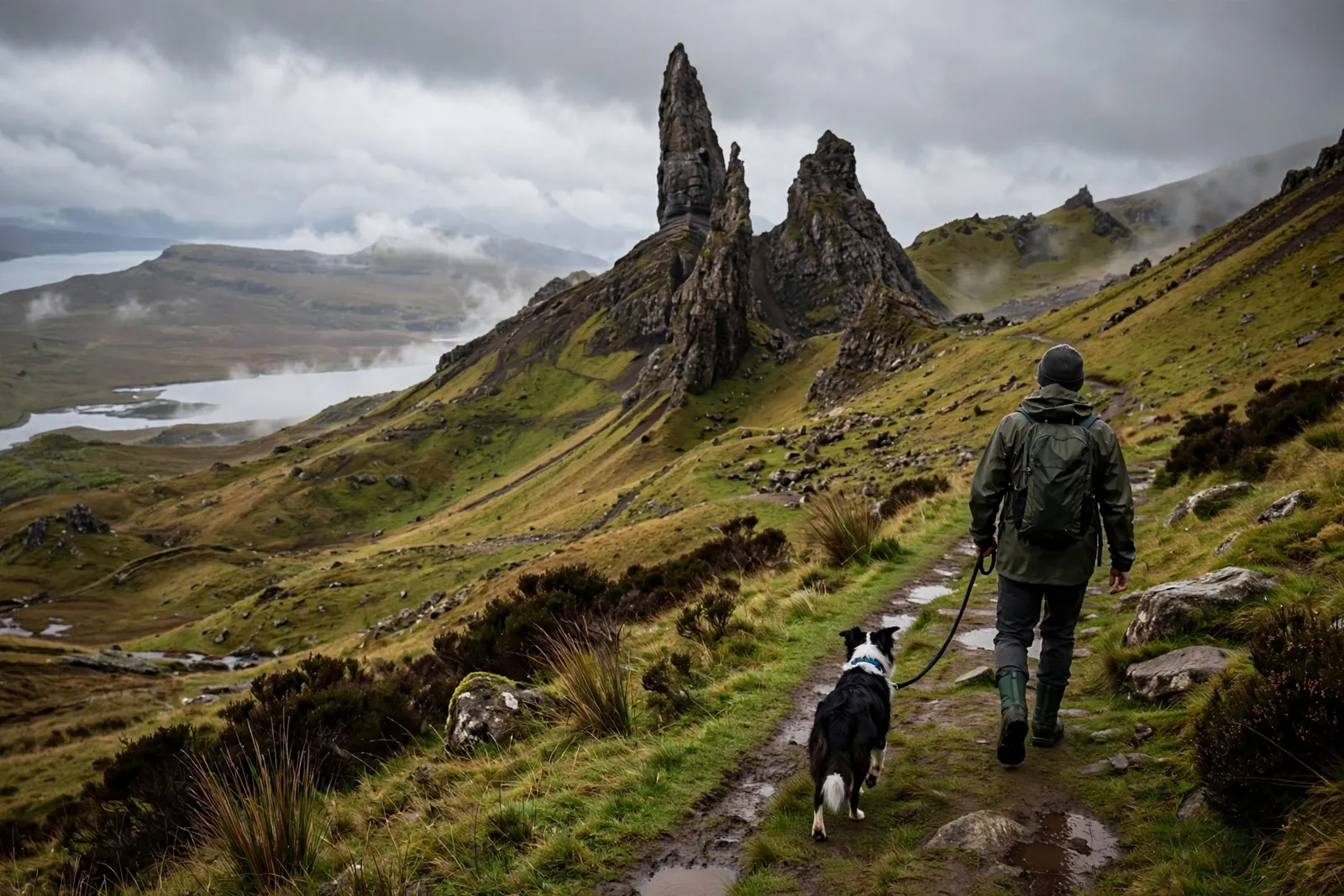
Broadford's position in the south of Skye makes it a good hub for the whole island, with most of the famous sights within an hour or so by car. The classic north-island day takes you up the A87 to Portree, then on to the Old Man of Storr and the Quiraing — two of Skye's most photographed landscapes. Both are popular, and both need care with a dog: the Storr path is steep, rocky and crowded, with loose scree that is hard on paws, and the Quiraing has cliff edges and sudden drops, so keep your dog on a lead throughout and be ready to turn back if the crowds or the ground make it unsafe. Go early in the morning if you can; by midday in summer the car parks are full and the paths are busy, which is stressful for dogs and owners alike.
A second classic day goes west, to the Fairy Pools at Glen Brittle and the Talisker area. The Fairy Pools are a series of clear blue pools and small waterfalls at the foot of the Black Cuillin, and they are beautiful — but they are also one of the busiest spots on the island, with a car park that fills early and a path that can feel like a procession in peak season. Dogs are welcome on a lead, and many enjoy paddling in the pools, but the water is cold and the rocks are slippery, so keep your dog close and do not let them jump into pools from height. If the crowds put you off, the nearby Glen Brittle beach and the quieter paths around Loch Brittle offer a calmer alternative with the same mountain backdrop.
South from Broadford, the road to Elgol is a day trip in itself. Elgol is a small fishing village at the end of a winding single-track road, with views across Loch Scavaig to the Black Cuillin that many people rate as the finest on Skye. The drive is slow and narrow, with passing places and sheep on the road, so allow plenty of time and drive carefully — and expect your dog to be unimpressed by the scenery but very interested in the sheep. From Elgol, boat trips run to Loch Coruisk in summer, although dogs are not always allowed on board, so check the official guidance before you travel if a boat trip is part of your plan. The shore at Elgol is rocky and uneven, so it suits a confident dog better than an older one.
Closer to home, the Sleat peninsula — often called the garden of Skye — is an easy half-day from Broadford. The road south through Sleat is gentler and greener than the north of the island, with woodland walks, gardens and sea views, and the ferry port at Armadale is a useful landmark. Sleat suits a slower day: a woodland walk, a beach, a cafe, and an early return to Broadford for the evening bay walk. It is also a good bad-weather option, because the woodland paths give some shelter when the wind is up and the hills are in cloud.
Whatever day trips you plan, build in a rest day. Dogs, like people, get tired on a driving holiday, and a day with only the bay walk and a short village stroll is not a wasted day — it is the day your dog recovers, settles, and enjoys the trip properly. The best Skye holidays with a dog are not the ones that tick off the most sights; they are the ones where the dog is still happy on the last day.
Tides, weather and safety
Skye's weather is the single biggest factor in how your trip goes, and Broadford is no exception. The island's climate is mild but changeable: rain can arrive at any time of year, wind is a constant companion on the coast, and the hills make their own weather. The practical approach is to dress for rain every day, carry waterproofs even when the morning is sunny, and treat the forecast as a guide rather than a promise. A walk that is pleasant in a light breeze can become unpleasant in a sudden squall, so always have a shorter alternative in mind and be willing to turn back.
Tides deserve their own warning. Broadford Bay is wide and flat, which is what makes it such a good walk — and what makes the tide dangerous if you ignore it. The tide comes in across flat sand faster than most people expect, and channels and pools can cut off the route back to shore. Always check the tide times before a bay walk, start at or just after low water, and leave plenty of margin. If you are unsure, ask locally: the village shops and your accommodation host will know the tide pattern, and a five-minute question is worth more than a risky guess. The same caution applies to any shore walk on Skye, including the beaches covered in our dog-friendly beaches in Scotland guide.
Wildlife and livestock are part of the landscape. Sheep graze on the hills and sometimes near the shore, and dogs must be kept under control around them — on a lead wherever sheep are present, and at all times during lambing season. Seals haul out on the rocks around the bay, and a dog that chases a seal can be bitten or can drive the animal into the water, so keep your dog away from hauled-out seals and from nesting birds on the shore. Adders are present in Scotland, including on Skye, and are most active on warm days; they are shy and bites are rare, but keep your dog on paths in bracken and heather and know the signs of a bite — swelling, pain and lethargy — so you can get to a vet quickly if it happens.
Water safety matters too. The sea around Broadford is cold all year, and the currents and tides are stronger than they look from the shore. Do not let your dog swim far out, and do not throw a ball into deep water. Streams and burns in the hills can be fast after rain, and a dog that is swept off its feet in a spate burn is in real danger, so keep dogs out of fast-moving water and cross burns at shallow, slow points. After any swim, rinse your dog with fresh water and dry them off, especially in cold weather — a wet dog in a cold wind loses heat fast.
Practical checklist for a Broadford trip
A short checklist saves a lot of trouble on Skye, where the nearest big shop is a long drive away. Start with the dog's paperwork and health: make sure vaccinations are up to date, that your dog is microchipped and wearing a tag with your mobile number, and that you have enough of any medication for the whole trip plus a few days extra. Pack the vet's details for Broadford and the nearest out-of-hours cover, and save them in your phone before you travel, because signal can be patchy and you do not want to be searching for a number in an emergency.
For the car, pack a dog seat cover or crate, a non-spill water bowl, and a towel for the inevitable wet dog. For the walks, pack a lead and a long line, a harness, poo bags (more than you think you need, because rural bins are scarce), a first-aid kit, a torch for winter evenings, and a drying coat. For the accommodation, pack the dog's bed or blanket, their usual food measured out for the trip, a familiar toy, and a chew to help them settle in a new place. If your dog is on a special diet, bring all their food with you — the Broadford supermarket stocks the basics, but specialist diets are not guaranteed.
Parking in Broadford is generally easy outside peak summer, with car parks in the village and spaces near the bay, but it does fill up on busy days, so arrive early for the popular walks and be prepared to walk a little further. Never leave a dog in a parked car in warm weather, even with the windows open — cars heat up fast, and on Skye the sun can be strong even when the air feels cool. Check local signs for time limits and charges, because parking rules can change, and avoid blocking passing places, farm gates or driveways on the single-track roads outside the village.
Finally, respect the village you are staying in. Broadford is a working community, not a theme park: people live and work here, and the quiet that makes it attractive is something visitors should protect. Keep noise down in the evening, pick up after your dog everywhere, keep dogs on leads near the road and around livestock, and support the local shops and cafes. The best compliment you can pay a place like Broadford is to leave it as you found it — and to come back.
A relaxed two-day plan
If you only have a weekend, Broadford still works, and a simple two-day plan shows how the pieces fit together. Day one is arrival and the bay: arrive over the bridge, check in, and take the dog straight down to the shore for a low-tide walk. Let the dog stretch, sniff and decompress after the journey, then pick up supplies in the village and cook or eat locally. In the evening, take a short stroll along the bay as the light fades, then settle in early — the first night in a new place is when a dog needs routine most, so keep feeding times and the last outing the same as at home.
Day two is the hills. After breakfast, drive or walk to the start of the Beinn na Caillich route or the Strath valley walk, depending on your dog's fitness and the weather. Take your time: the point is not the summit but the hours on the hill, the views and the tired, happy dog at the end of it. Come back to the village in the afternoon, wash the dog down, and spend the rest of the day quietly — a short bay walk, a cafe, and an early night. If the weather turns, swap the hill day for the Sleat peninsula or a drive to Elgol, and keep the bay walk as the anchor of the day.
For a longer stay, the pattern repeats with variety: a north-island day to the Storr and Quiraing, a west day to the Fairy Pools, a south day to Elgol, and rest days built in between. The bay walk stays the constant — the morning walk that needs no planning, no driving and no decisions — and the Red Cuillin stay the backdrop to all of it. That is Broadford's real gift to a dog trip: it makes the easy days easy, so the big days feel like a bonus rather than a chore.
One last note on leaving. On your final morning, give the dog a last bay walk at low tide if the timing works, then check the accommodation carefully for anything left behind — a lead, a bowl, a favourite toy — and leave the place tidy. Fill up with fuel before the bridge, check the traffic, and take the slow road home. Skye has a way of pulling people back, and Broadford, with its wide bay and its quiet hills, is one of the places that does it best.
Practical questions
Before you go
Is Broadford a good base for a dog-friendly trip to Skye?
Yes, for many dog owners it is the calmer alternative to Portree. Broadford has shops, places to eat, accommodation and a wide bay for low-tide walks, and it sits on the main road so day trips north, south and west are all straightforward. It suits travellers who want a quiet village base rather than a busy town centre.
Can dogs go on the beach at Broadford Bay?
Broadford Bay has a broad sandy and rocky shore that dogs can enjoy, especially at low tide when the exposed sand gives plenty of room to walk. There is no general dog ban on the bay, but always check the official guidance before you travel, keep your dog under control near livestock and other walkers, and clean up after your dog.
What is the best time to walk Broadford Bay with a dog?
Low tide is the best time: the bay opens up into wide flat sand and the walk is easy underfoot. Check the tide times for Broadford before you set out, allow plenty of time to return before the tide turns, and avoid walking out onto the far sand if the tide is already coming in.
Can dogs walk in the Red Cuillin from Broadford?
Yes, the lower Red Cuillin slopes above Broadford offer rewarding walks for fit dogs, including the popular route towards Beinn na Caillich. These are hill walks on open, sometimes steep and pathless ground, so keep your dog on a lead near sheep, carry water, and check the official guidance before you travel for current access and weather conditions.
Where can I park in Broadford with a dog?
Broadford has car parks in the village centre and near the bay, plus on-street parking along the main road. Arrive early in summer, as the village is small and parking fills up on busy days. Never leave a dog in a parked car in warm weather, and check local signs for any time limits or restrictions.
Is there a vet near Broadford?
Broadford has a veterinary practice in the village, which is one of the practical advantages of basing yourself here rather than in a more remote part of Skye. Save the practice number and opening hours before you travel, and note the nearest out-of-hours cover, because rural practices can have limited evening and weekend hours.