This guide is independent and contains no paid placement. Dog rules at individual venues can change, so where a rule matters to your day, check the official guidance before you travel.
Broadway suits a dog best when you treat the village green as your base and the hill as your main walk. Settle on the green first, climb to Broadway Tower and Fish Hill when the dog is ready, keep the museum and shop visits flexible, and save the longer lane and field walk toward Buckland or Snowshill for a fit dog on a dry day. Arrive early on busy weekends, keep dogs on a lead around livestock and roads, and check the official guidance before you travel for any indoor venue.
Start on the village green
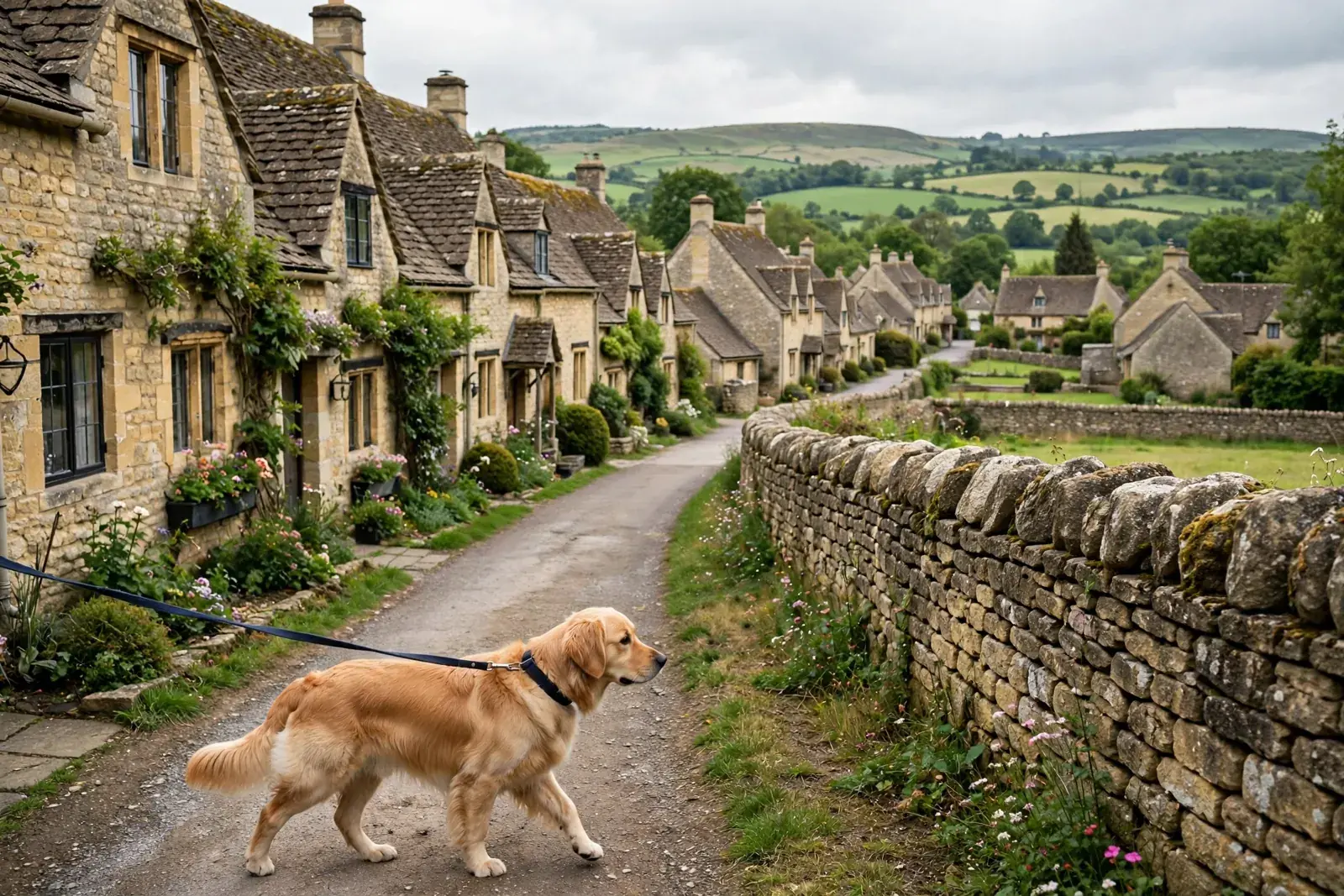
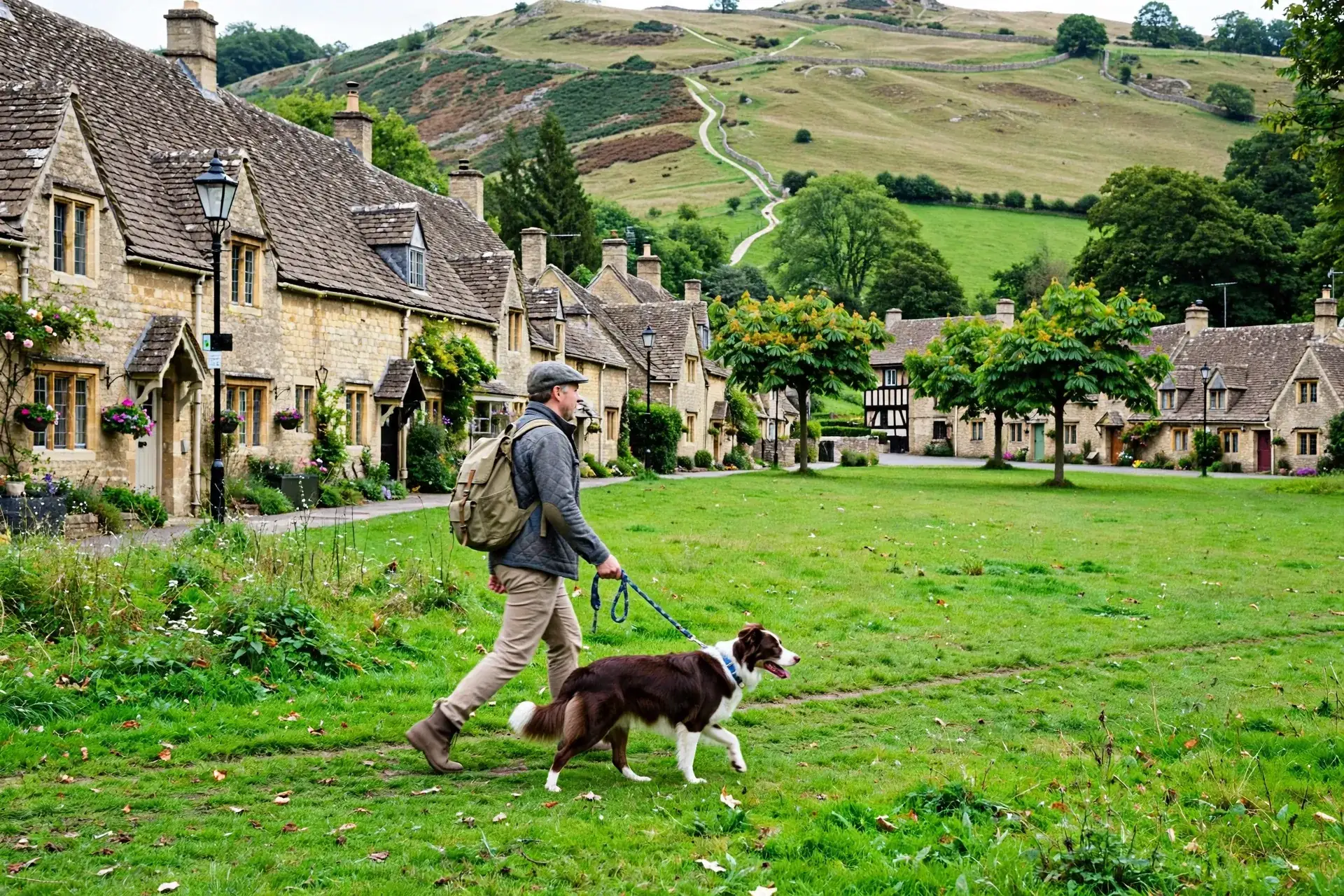
Broadway is often described as one of the prettiest villages in the Cotswolds, but for a dog owner the more useful description is simpler: it is a long, wide, honey-stone village with a broad green at its heart and a steep hill rising behind it. That shape decides how a good dog day works here. The green gives you space to arrive, settle and read your dog before you choose anything harder. The High Street runs past it, lined with stone cottages, shops, galleries and places to eat, and the views open out at both ends of the village rather than being hidden behind a single viewpoint. If you start here, you are not rushing a just-out-of-the-car dog straight onto a hill path or into a crowded street.
Use the first twenty minutes deliberately. Walk the length of the green slowly, let your dog sniff, offer water, and watch how they react to other dogs, children, cyclists and the traffic on the High Street. A dog that pulls hard, barks at every passer-by or will not settle is telling you to keep the day short and level. A dog that relaxes, toilets and walks loosely is ready for a longer route. This is also the practical moment to sort out waste bags, a spare lead, a long line for quieter ground if you use one, and a towel for later. Broadway rewards a slow start because the village itself is the attraction: stone walls, wide grass, chestnut trees in season, and enough room for a dog to move without being pressed against shop fronts.
The green is not a fenced dog park, and it should not be treated as one. Keep your dog on a lead near the road, even if the grass looks inviting, because the High Street carries through traffic and parked cars limit sight lines. Pick up waste promptly and use the bins provided. On a busy day, other dogs will be on leads too, and the green becomes a meeting place rather than a running ground. If your dog is reactive, walk the quieter edges, cross to a side lane early, or start before the main crowds arrive. The goal of this first walk is not distance. It is a calm dog, a known toilet stop, and a clear sense of whether the hill, the lanes or simply another slow lap of the village is the right next step.
Orientation matters here because Broadway is a linear village. From the green, one direction leads you back into the main shopping stretch of the High Street, while the other leads toward quieter houses, lanes and the routes out toward the fields. Take a note of where you parked, where the nearest water point or shop is, and which side streets feel calmer for a nervous dog. A dog that knows the way back to the car is a dog that can be walked in short loops rather than committed to a long linear route with no easy exit. That flexibility is worth more than any single viewpoint, especially with an older dog, a puppy or a rescue still learning new places.
For families, the green also solves the classic Broadway problem: half the group wants to browse, half wants to walk the dog. Split the time. One person can take the dog for a settling loop while the others look at shops, then swap. Nobody has to drag a tired dog through every gallery, and nobody has to miss the village because the dog needs a walk. Keep the dog's day in blocks — green, hill or lane, rest, food, short evening loop — and Broadway feels spacious even on a day when the High Street is busy.
Broadway Tower and Fish Hill
From the village, the land rises sharply to Broadway Tower, the stone folly that stands on the hill above Broadway. The climb is the walk most visitors remember, and it is also the walk that needs the most honest planning for a dog. The route combines lanes, footpaths and open hillside, with views that open out over the Vale of Evesham and the wider lowland beyond. On a clear day the sense of height is immediate: the village drops away below, the fields patchwork out in front, and the wind is stronger than it was on the sheltered green. That contrast is the point of the walk, but it also means a dog that was comfortable in the village may need a lead, a slower pace and more water on the hill.
Fish Hill is the name most closely associated with the steep road and hillside climb on this side of Broadway, and the tower stands on the high ground above it. Walkers often talk about the two together because the road, the footpaths and the tower grounds form one linked area of high ground rather than two separate attractions. For planning, think of it as one hill outing with three phases: the climb out of the village, the open top around the tower, and the descent back down. Each phase has a different surface, a different level of exposure and a different set of other users, from cars on the road to walkers, runners and other dogs on the paths. Keep your dog close on the road sections, and give more room on the open top where sight lines are long and other dogs may appear suddenly over a rise.
Fitness and footing deserve a frank check before you climb. The ascent is steady and, in places, steep, and the descent can be harder on joints than the climb, especially for older dogs, small breeds and dogs carrying extra weight. If your dog hesitates on slopes, pants heavily early in the climb or struggles on uneven ground, turn back and enjoy a shorter section rather than pushing on to the tower. A good compromise is to climb part of the way, enjoy the first wide view, and return by the same path while the dog is still fresh. There is no prize for reaching the top with an exhausted dog, and a shorter hill walk done well beats a long one that ends with a dog being carried or coaxed down a steep path.
Livestock is a real consideration on Cotswold hillsides. Sheep graze on open ground in this area, and even a normally reliable dog can behave differently when sheep move, lambs are present or a dog is off the lead and excited by open space. Keep your dog on a lead where livestock are visible or where signs ask for leads, and shorten the lead on narrow paths. The same rule applies near field boundaries and gates: close every gate behind you, do not let a dog push through a gap in a hedge, and check that a long line cannot tangle around another walker or a fence post. If you are unsure whether livestock are in a particular field, treat the field as if they are there and keep the dog close until you can see clearly.
At the top, the tower itself needs a separate check. Rules for the tower grounds, any cafe or shop, and access inside the tower can change with the season and with events, so check the official guidance before you travel rather than assuming a dog can go everywhere you can. Plan for the possibility of a split visit here too: one person goes inside while the other stays outside with the dog on the open ground, or the whole group enjoys the outside views and skips the interior. The views from the hillside are the main reward for a dog walk in any case, and a dog gains nothing from being squeezed into a narrow tower stair. Bring water for the dog, a collapsible bowl, and a windproof layer for yourself, because the top is exposed and a sunny village morning can turn into a cold, windy hilltop in minutes.
Timing changes the hill walk more than any other part of a Broadway day. Early morning and late afternoon are usually calmer, cooler and better for dogs, while midday on a fine weekend brings the most foot traffic on the narrow paths. In summer heat, climb early, carry more water than you think you need, and watch for a dog slowing, seeking shade or panting heavily. In winter, the same paths can be muddy, slippery and dark early, so choose a shorter route, wear proper footwear and carry a light. The Cotswold Way passes through this high ground, so waymarks can help with navigation, but a current map or offline route is still worth carrying because phone signal and battery cannot be relied on in every dip and wooded section.
Museum, shops and the stable yards
Back in the village, Broadway's High Street is a browsing street as much as a walking street. The village museum sits in a historic building on the High Street and tells the story of the village, its coaching past and its artistic connections, while galleries, antique shops and small independent shops fill the neighbouring stone frontages. Behind and beside the main street, stable yards, courtyards and narrow passages give the village its working character: old stable blocks, carriage entrances and quiet corners that are easy to miss if you only walk the centre of the pavement. For a dog owner, this is the part of the day that needs the most flexibility, because indoor rules are the least predictable part of any Cotswold village visit.
Start with a simple principle: do not assume a dog can enter. Museums, galleries and many shops set their own rules, and those rules can depend on the size of the dog, whether the dog is carried, how busy the building is, and whether an exhibition has special conditions. The safest approach is to check the official guidance before you travel for the museum in particular, and to ask staff on arrival for any shop or gallery you want to enter. A polite question at the door takes seconds and avoids the awkward moment of being asked to leave a dog tied outside or to cut a visit short. If you are travelling as a group, the split-visit plan works well here: one person explores inside while another walks the dog around the green or a side lane, then you swap and share what you saw.
The stable yards and courtyards deserve a slower look on foot, with the dog on a short lead. These are working spaces as well as pretty ones: deliveries, parked cars, uneven cobbles or stone setts, low doorways and other dogs coming out of doorways can all appear without warning. Keep the dog close, watch for dropped food, glass or small objects on the ground, and do not let a dog investigate open doorways or private courtyards. The charm of these yards is in their detail — stone troughs, old ironwork, stable doors and planting — and that detail is best enjoyed at walking pace, with the dog settled beside you, rather than on a long lead that swings across a narrow passage.
Shopping with a dog also works better in short bursts. Choose one or two places that matter most, rather than trying to enter every shop with a tired dog. Leave bags and purchases in the car between stops if you can, so you are not juggling shopping, a lead and a doorway at the same time. On a warm day, never leave a dog in a parked car while you browse, and on a busy day, remember that a dog standing in a narrow shop doorway blocks other visitors. If the dog is showing signs of tiredness — lagging, yawning, lying down in doorways or pulling toward the car — that is the signal to stop shopping and return to the green for a rest, a drink and a toilet break before the next walk.
For visitors interested in Broadway's history, the museum and the village architecture reward a little background reading before you arrive. Knowing that Broadway grew as a coaching and wool village, and later became a centre for artists and writers, helps you notice the details that make the High Street more than a row of pretty houses: the wide street built for coaches, the stone houses with their different periods, and the yards that once served horses rather than cars. You do not need to memorise dates to enjoy it, but a short read beforehand turns a walk past stone facades into a walk through a working village history. For a wider sense of how Broadway fits into the region, our Cotswolds dog guide places the village among neighbouring honey-stone villages, commons and longer walking routes, which helps if you are choosing between several villages for a longer break.
Walking toward Buckland and Snowshill
If the green has settled the dog and the hill has not tired them out, the next step is the quieter countryside beyond the village: the lanes and field paths toward Buckland and Snowshill. These are not extensions of the High Street. They are proper Cotswold walking country, with field edges, bridleways, stiles and gates, occasional road sections, and villages that feel smaller and quieter than Broadway itself. That quiet is the reward. After the bustle of Broadway on a busy day, a lane toward Buckland or a path toward Snowshill can feel like a different trip altogether, with fewer people, more birdsong and more room for a dog to sniff without constant passing traffic.
Buckland lies in the countryside near Broadway, a small village with a church and a cluster of stone houses that makes a natural turning point for a shorter walk. Snowshill lies further on, a hilltop village known for its manor and gardens and for the lavender fields in the surrounding area in season. Do not treat either village as a guaranteed dog-friendly destination with a fixed set of facilities. Instead, treat them as walking goals: places to aim for, pause, offer water, and turn back from if the dog is tired or the weather changes. If you want to visit a particular house, garden or attraction at Snowshill, check the official guidance before you travel, because historic houses and gardens set their own dog rules and those rules are often different for the house, the garden and the wider estate.
Route planning matters more on these walks than it does in the village. Use a current Ordnance Survey map or a reliable walking app, and check the route before you leave Broadway rather than relying on memory or on a single waymark. Field paths can be diverted, ploughed, overgrown or muddy, and a path that looks clear on a map may cross a field with livestock or a busy farm track. Plan an exit at every stage: a lane that leads back to Broadway, a road section where you can be picked up, or a shorter loop that avoids the furthest point. Tell someone your rough plan if you are walking alone, carry a charged phone, and keep the dog on a lead on roads and near livestock even if the lane looks empty.
Distance and time need honest estimates. A walk to Buckland and back, or a longer route toward Snowshill, will take considerably longer with a dog than the same distance on a map suggests, because gates, stiles, sniffing, toilet stops, water breaks and livestock checks all add time. Older dogs and puppies should not be pushed to match an adult dog's pace, and a dog that has already climbed Fish Hill in the morning may not have a second long walk left in the afternoon. A better pattern for many visitors is to choose one main walk per day: either the tower hill or the Buckland and Snowshill direction, with the green and the High Street as the other half of the day. That pattern leaves the dog fresh for the evening loop and avoids the tired, footsore dog that spoils the last part of a holiday.
On the paths themselves, the usual Cotswold courtesies apply and they matter more with a dog. Close gates, keep to the marked path across crops, do not let a dog chase birds or livestock, and pick up waste even on remote paths, carrying it out to a bin rather than leaving a bag by a gate or stile. If you meet horses, give them wide room and keep the dog close and quiet. If you meet another dog off the lead, recall yours early and step to the side of the path rather than letting a greeting happen on a narrow stile or bridge. These small habits keep a quiet lane quiet, and they are the reason landowners continue to allow walkers and dogs through working farmland.
If the weather turns or the dog tires, the lanes back toward Broadway are part of the walk, not a failure. A shorter out-and-back section toward Buckland still gives you stone walls, field views and a proper countryside feel without committing to the full route to Snowshill. Likewise, a walk that starts toward Snowshill and turns back at the first good viewpoint is still a good dog walk. The villages will still be there for another visit, and a dog that finishes a walk happy and willing is a dog that will enjoy the next day too. For a contrasting town walk on another day of the same trip, the Stratford-upon-Avon dog guide covers riverside paths and a busier historic town, which helps you judge whether your dog prefers a quiet village lane or a livelier town centre.
Eating out and staying over with a dog
Eating out in Broadway with a dog is possible, but it works best when you plan it as a dog decision rather than an afterthought. The village has pubs, cafes, tea rooms and restaurants along and around the High Street, and their dog policies differ in ways that matter: some welcome dogs in a bar area or on a terrace but not in a formal dining room, some welcome dogs throughout, and some cannot accept dogs inside at all. Because this guide does not name individual venues as dog-friendly, the rule is simple and worth repeating: check the official guidance before you travel for any place you particularly want to visit, and confirm again on arrival if you are unsure. A venue that welcomed dogs last year may have changed its policy, and a venue that allows dogs on a quiet weekday may restrict them on a busy Saturday lunchtime.
When you do eat out, choose the setting that suits your dog rather than the setting that suits the menu alone. A calm dog that settles under a table can enjoy a quiet bar corner or a sheltered terrace, while a young, excitable or reactive dog will do better with a short, early meal on a terrace with space around the table, or with a takeaway eaten on the green. Bring a blanket or mat for the dog to lie on, a water bowl, and something to chew or lick quietly, and order promptly so the dog is not waiting hungry and restless for a long meal. If the dog cannot settle, do not force a long lunch: cut the meal short, walk the dog, and return later or choose a takeaway instead. A short, calm meal is a better memory than a long meal spent managing barking or pulling.
Staying over in Broadway needs the same careful check. Dog-friendly accommodation in and around the village includes hotels, inns, bed and breakfasts, cottages and campsites, but the details vary widely: a pet fee per night or per stay, a limit on the number or size of dogs, a requirement that dogs are not left alone in the room, a ground-floor room, a garden or enclosed area, and cleaning rules for muddy paws. Ask for all of it in writing before you pay, and check the exact room or cottage you are booking rather than assuming the whole property has the same policy. A property that accepts dogs in a cottage with a garden may not accept them in a first-floor hotel room, and a property that allows one small dog may charge extra or refuse a second dog.
Practical details make an overnight stay work. Pack the dog's own bed, food, bowls, lead, towel, drying coat and any medication, and keep the feeding and last-outing routine close to home. On arrival, walk the dog around the property first: find the toilet area, the nearest bin, the garden gate and any gaps in a fence before you unpack. If the accommodation has a garden, check it for gaps, toxic plants and neighbouring dogs before letting your dog off the lead. If dogs are not allowed to be left alone, plan your evenings accordingly, either by eating where the dog can join you, by taking turns, or by choosing a shorter evening out. Never leave a dog alone in an unfamiliar room if the property forbids it, and never leave a dog in a car overnight or during a meal.
Booking timing also matters. Broadway is popular, and the most suitable dog-friendly rooms and cottages — ground-floor rooms, rooms with direct garden access, cottages with enclosed gardens — are often booked first. If you are travelling in school holidays, at weekends or during events, book early and confirm the dog details at the same time as the room, not as an afterthought. If you are travelling with more than one dog, say so at the first enquiry, because a property that accepts one dog may not accept two, and discovering that on arrival leaves you with no good options. A clear, early conversation about the dog saves a difficult conversation at check-in.
Parking and the busiest times
Parking in Broadway is straightforward on a quiet weekday and a genuine planning task on a busy weekend. The village has signed car parks, and on-street parking is available in places, but spaces fill early on fine weekends, in school holidays and during events. The best strategy is unglamorous and effective: arrive early, use a signed car park rather than circling the High Street, read the signs for charges, time limits and height or length restrictions, and walk the short distance into the village from the car park rather than trying to park directly outside a shop. Circling a busy village with a dog in the car wastes the coolest part of the day and starts the walk with a stressed driver and a restless dog.
When you park, think about the dog before you think about the shop you want to visit. Park where you can unload safely, away from fast traffic, with room to open doors without the dog stepping into the road. On a warm day, never leave a dog in a parked car, even for a short errand, and on a cold day, do not assume a car is a safe waiting place while you browse for an hour. If you need to return to the car during the day for water, food or a rest, choose a car park close enough to the green that the return trip is a short walk rather than a long detour. Note the car park location and the route back to it before you set off on a hill or lane walk, because Broadway's lanes and footpaths can be confusing on the return leg.
Crowds change the village more than the weather does. On a busy Saturday, the High Street pavements narrow with shoppers, the green fills with families and other dogs, and the tower paths become a steady stream of walkers. Dogs that are fine in a quiet village can become overwhelmed by that density, especially if they are approached by strangers, crowded by other dogs on leads, or asked to wait in a queue outside a shop. If your dog is nervous or reactive, the answer is not to avoid Broadway altogether, but to change the timing: arrive before the main crowds, walk the green and the hill early, eat early or late, and leave the busiest shopping hours for a quieter lane walk or a rest back at your accommodation. An early start is the single most effective crowd strategy for a dog owner in Broadway.
Coaches, events and seasonal attractions can also change parking and foot traffic without warning, so check local information before a weekend visit if you are travelling a long way. If the main car parks are full, do not park on grass verges, in field entrances, across driveways or on narrow lanes where you block farm traffic or emergency access. A badly parked car creates a problem for the village and for other visitors, and it can leave you with a fine or a blocked-in car at the end of the day. If Broadway is full when you arrive, a calmer alternative is to park in a nearby village and walk in, or to delay the visit to a quieter time, rather than squeezing into an unsuitable space.
Finally, plan the end of the day as carefully as the start. A tired dog, a car parked a long way from the last walk, and a busy High Street at going-home time is a recipe for a difficult last half hour. Finish with a short, calm loop on the green, offer water, clean muddy paws before the dog gets into the car, and check that the dog has had a final toilet stop before a long drive. That last loop also gives you a chance to notice anything the dog picked up on the walk — a burr, a tick, mud between the toes or a sore pad — while you are still near the village rather than discovering it on the motorway.
Seasons, livestock and wet weather
Broadway changes with the seasons, and a dog walk that is perfect in May can be a different walk in November. Spring brings lambing, nesting birds and fast-growing paths, which means leads around livestock, extra care near hedgerows, and muddy gateways after rain. Summer brings heat, longer days and the busiest village, which means early starts, shade, water and a shorter hill climb. Autumn brings fallen leaves, wet stone, harvest traffic on lanes and the first frosts, which means careful footing and a drying routine after every walk. Winter brings short days, mud, cold wind on the hill and quieter streets, which means a shorter route, a visible lead and coat for a short-coated dog, and a warm, dry place to finish.
Livestock seasons deserve particular attention. During lambing, ewes with young lambs are easily stressed by dogs, even by dogs that would never chase, and many farmers and footpath signs ask for dogs on short leads throughout this period. Ground-nesting birds in spring and early summer are also vulnerable to disturbance on open hillsides and field edges. The rule that covers all of these cases is simple: if you cannot see clearly what is in the field or on the hillside ahead, keep the dog on a lead until you can. A long line is not a substitute for a short lead around livestock, because a dog on a long line can still reach a sheep or a nest before you can react.
Rain is not a reason to cancel a Broadway visit, but it is a reason to change the plan. The village green and the High Street work well in light rain, with short loops, a waterproof coat for the dog if they wear one, and a cafe stop where the dog can wait under cover. The hill paths and field paths toward Buckland and Snowshill become a different proposition in heavy rain: clay and chalk paths turn slippery, field gateways become deep mud, stiles become slick, and a dog that slips or struggles on a stile can be injured. On a wet day, choose the shorter, surfaced option, keep the hill for a drier day, and save the long field walk for a day when the ground has had time to drain.
A wet-weather kit makes the difference between a miserable day and a manageable one. Pack two towels or a drying coat, a spare lead, waste bags, a waterproof mat for the car, and a change of socks for yourself. Dry the dog's paws and belly as soon as you finish a walk, check between the toes for mud and grit, and give the dog a warm, dry bed to settle in rather than leaving them damp in a draughty hallway. If your accommodation has a garden or a utility area, use it for drying before the dog goes into a carpeted room. If you are staying in a hotel, ask where you can dry a wet dog on arrival rather than discovering a no-wet-dogs rule in the lobby.
Seasonal events and opening times also affect a dog day, because museums, gardens, cafes and attractions change their hours through the year and may close on certain weekdays in winter. Check the official guidance before you travel for anything you particularly want to visit, and build a flexible plan with a village option, a hill option and a wet-weather option rather than a single fixed itinerary. Broadway rewards that flexibility: on a fine day the hill and the lanes are the highlight, on a wet day the green, the courtyards and a slow High Street browse are still enjoyable, and on a busy day an early start turns the same village into a calmer place. The dog does not care which version of Broadway you choose, as long as the walk fits their fitness, the lead fits the livestock, and the day ends with a dry bed and a calm evening.
Practical questions
Before you go
Is the village green a good first walk for a dog in Broadway?
Yes, for most dogs it is the easiest place to start. The green is open, level and close to the High Street, so you can judge energy, toilet needs and reactions to other dogs before committing to a hill walk. Keep your dog on a lead near the road, pick up waste, and use the green as a settling walk rather than an off-lead free-for-all, especially on busy days.
Can dogs go to Broadway Tower and Fish Hill?
The hill paths are the main attraction, but the rules for the tower grounds, cafe and tower itself can change, so check the official guidance before you travel. On the open hill, expect livestock, steep sections, exposed wind and other walkers. Keep dogs on a lead around sheep and on narrow paths, carry water, and plan a shorter route if your dog is older or less fit.
How hard is the walk from Broadway toward Buckland and Snowshill?
It is a proper countryside walk rather than a village stroll. Expect field paths, lanes, stiles or gates, mud after rain and steady climbs and descents. Fit adult dogs usually manage it well, but older dogs, puppies and dogs with joint problems may do better with a shorter out-and-back section. Check a current map before you set off and allow extra time for sniffing, gates and livestock.
Are dogs welcome inside the Broadway museum and the shops along the High Street?
Do not assume indoor access. Rules vary by venue and can change with exhibitions, staffing and the time of year, so check the official guidance before you travel. Many visitors plan a split visit, with one person going inside while the other waits with the dog outside, and then swapping over. Ask staff politely on arrival rather than assuming a dog can enter.
When is Broadway busiest, and where should dog owners park?
Weekends, school holidays and fine-weather afternoons are the busiest times, when the High Street, the green and the tower paths fill quickly. Arrive early, use a signed village car park, read the signs for time limits and charges, and avoid blocking lanes or field entrances. An early start also gives a reactive or nervous dog a calmer first walk before the crowds arrive.