This guide is independent and contains no paid placement. Venue and event rules change, so where this guide flags a check, please confirm the latest official information before you travel.
Buxton with a dog centres on the Pavilion Gardens and the spa town's elegant streets: level, on-lead promenading, trains and lakes in miniature, the Crescent and the Devonshire Dome as outdoor spectacles, and a climb to Solomon's Temple for the view. Poole's Cavern does not admit pet dogs, so treat it as a split visit and give the dog the woodland above it instead. Buxton is high and its weather is famously its own — pack a layer more than the forecast suggests, and check venue and cavern rules officially before you go.
Begin in the Pavilion Gardens, the town's drawing room
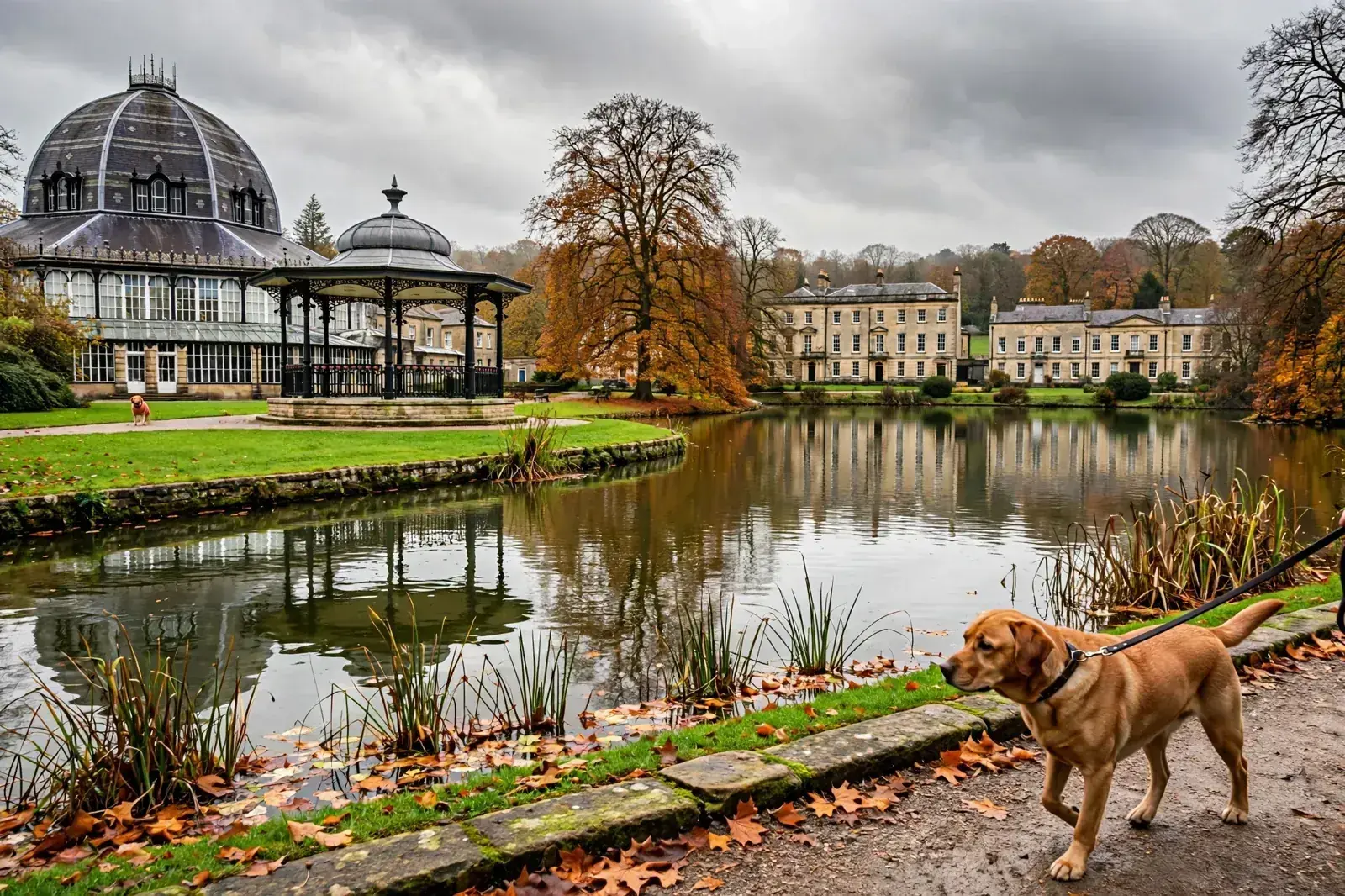
Start a Buxton dog day where Buxton itself starts: the Pavilion Gardens, the Victorian pleasure gardens that run from the town centre along the River Wye. For dogs this is close to perfect formal walking — broad paths, lawns, ornamental water, mature trees and a bandstand, all on the level, all sociable, all requiring the lead that gardens like these reasonably demand. Dogs should stay on leads in the formal gardens, off the flower beds and out of the ornamental water, and a dog who can promenade calmly here can handle anything else the town asks.
Work the gardens as a circuit rather than a crossing. The miniature railway, the boating and ornamental lakes, the conservatory buildings and the Octagon concert hall frontage give the loop a sequence of small events, and benches arrive at civilised intervals for dogs who pace themselves and humans who people-watch. In the morning the gardens belong to local dog walkers, which is the best intelligence service in any town: if you want to know where the dog-friendly café queue forms and which hill path is a bog this week, the gardens at eight are where to ask.
Children and dogs divide the gardens' pleasures neatly: play areas and the train for one, long sniffing borders and dignified squirrels — viewed, never chased — for the other. Keep picnic food as controlled here as anywhere, because formal gardens concentrate dropped ice cream and cake with scientific precision, and keep dogs clear of the waterbirds that regard the lakes as their own drawing room and are correct to do so.
Spa streets: the Crescent, the Dome and walking the set piece
Buxton's second dog walk is architectural. This is England's highest market town, a Georgian and Victorian spa built around its thermal waters, and its set pieces — the Crescent, modelled on Bath's and recently restored to grandeur, the vast Devonshire Dome, once a stable block and hospital beneath one of the largest unsupported domes of its age, the Pump Room and St Ann's Well — are best appreciated exactly as a dog experiences them: from outside, at walking pace, in a loop.
Build that loop into a town circuit linking the gardens, the Crescent and the wide streets of the higher town, with the market place and its cafés as the working centre. Dogs will not be admitted inside most of the spa attractions themselves, and St Ann's Well's waters are for human visitors filling bottles, not for dogs to drink from or paddle in; carry your dog's water as always. But architecture from the pavement is free, unhurried and entirely dog-compatible, and Buxton's scale means the loop satisfies without exhausting.
Shops and cafés along the circuit vary in their dog welcome, with many cafés and pubs in a walking town practised at it and most small shops not. Our guide to dog-friendly cafés in the UK sets out the door-checking routine that works here as everywhere: read the signage, ask cheerfully, towel muddy paws, and take a no as information rather than insult. The takeaway-and-gardens fallback in Buxton is, once again, hardly a fallback at all.
Poole's Cavern: the honest version, and the wood above it
Poole's Cavern, Buxton's show cave on the edge of town, is a guided underground attraction of chambers and stalactites, and pet dogs are not admitted to it — the same honest rule as Castleton's caverns, for the same practical reasons of steps, groups and confined passages. Assistance arrangements are the operator's to confirm, and every visitor should check the official latest guidance before you go, because opening patterns and tour arrangements are seasonal. Plan a cavern visit as a split: one human underground, one human and the dog in the country park above.
That consolation, unusually, is the better half of the ticket. The cavern sits beneath Buxton Country Park's woodland, a substantial area of mature woods with waymarked trails climbing the hill above the cave. A dog on a lead among beech and ash, on paths that stay interesting in every season, will not feel like a waiting room. The woods also set up the town's best viewpoint walk, because the trails connect naturally towards Solomon's Temple on the hill above.
Never leave a dog in the cavern car park while you take a tour, in any weather, for any duration — the rule that runs through every guide on this site applies with full force in a woodland car park on a still day. If you are a solo traveller, take the woods and the temple and let the cavern wait for a dog-free trip. Buxton has more than enough above ground, which is this guide's recurring and genuine conclusion.
Solomon's Temple and the high town weather
Solomon's Temple, properly Grin Low Tower, is the folly on the hill above the country park: a small, sturdy tower built in the nineteenth century over an ancient burial site, reached by a steady climb through the woods and across open grass. It is Buxton's perfect dog-walk summit — substantial enough to feel earned, modest enough for most dogs, and crowned with the definitive view back over the town's roofs, domes and gardens, with the Peak District arranged around it.
Manage the climb as hill walking in miniature. Sheep and cattle graze the open ground around the tower at times, so the lead goes on before the woods end, not after the dog has seen the livestock. The exposed top catches every wind going, the grass slopes are slippery after rain, and the tower itself is a viewpoint to stand beside rather than a dog attraction to climb — check conditions and any access information on site. Fit the walk into the middle of the day in winter, when Buxton's altitude shortens the useful light further.
Altitude is the fact to internalise about Buxton generally. At around a thousand feet, the town is famously cooler, wetter and windier than the lowland Peak District an hour's walk away, with a local saying about its weather for every month. Pack the extra layer, expect the forecast to understate the wind, and let the dog's comfort set the pace on exposed ground: short-coated and older dogs feel a Grin Low wind in November exactly as you do, and a drying coat or jacket for the dog is sensible kit here rather than indulgence.
Wider walks: the Wye, the trails and the Goyt direction
Beyond the town circuit, Buxton connects to serious walking. The River Wye, which threads the gardens, runs west into its limestone dale, and valley paths follow it into classic White Peak scenery of the kind our Bakewell with a dog guide describes at the river's other end. Former railway trails around the town and towards the Goyt Valley offer the flat, surfaced, shared-use walking that suits older dogs, pushchairs and post-lunch energy levels, with the usual shared-trail courtesies: short lead near cyclists, step aside at pinch points, carry water where the route leaves the river behind.
The Goyt Valley, a short drive or a longer walk away, adds reservoirs, woodland and moorland edges to the Buxton menu, with its own livestock, ground-nesting bird and lead requirements in season, and car parks that fill on fine Sundays. Treat it as a planned expedition rather than an extension of a town stroll: map downloaded, weather checked, water carried, and the dog's return energy honestly budgeted, because reservoir circuits are always longer than they look from the dam.
Wherever you walk from Buxton, limestone and gritstone meet in this country, and underfoot conditions swing between them within a single route. After heavy rain, prefer the trails and the gardens to cross-field paths, and in a dry spell the dales will reward you with some of the finest easy walking in England. That range — formal gardens at breakfast, a folly by lunch, a dale or a reservoir trail by afternoon — is Buxton's real claim as a dog base.
Staying in Buxton: bases, parking and practicalities
Buxton has the deepest accommodation bench of any Peak District town: grand hotels in the spa tradition, inns and guest houses, self-catering across the town and villages, and sites and parks in the country around it. Dog policies span the full range from genuinely welcoming to a reluctant single room, so confirm the specifics in writing — dog numbers and charges, where dogs may go in the building, whether they may be left alone, and what the late-night toilet walk consists of, because a town hotel's answer may be a pavement circuit rather than a garden, which suits some dogs and not others.
Town bases change the dog maths in your favour for one thing: services. Buxton has the shops, vets and supplies of a real town, which simplifies the self-sufficiency problem that governs villages like Edale and Castleton. Save your vet's details anyway, note the out-of-hours arrangement, and remember that a town full of visitors still empties its dog-friendly tables fast on event weekends — the opera house, festivals and markets fill Buxton on a calendar worth checking before you book a quiet break.
Parking in the centre is a mix of pay-and-display car parks and on-street limits, busy around the gardens and events; read current charges and restrictions on site rather than trusting any guide. Arrive by train if you can — Buxton's station, terminus of the line from Manchester, sits helpfully near the town's upper streets — and build the walk downhill into your arrival. However you arrive, the town rewards a base-and-stroll pattern: stay central, walk everywhere, and let the car, if you brought one, earn its keep on Goyt and dale days only.
A Buxton day in order, and the evenings that follow
Buxton's compact geography makes it ideal for a day built in rings. Begin with the early gardens circuit, when local dogs are doing their dignified rounds and the lakes are still, then move outward to the spa streets while the town is waking and the pavements are empty enough to appreciate the Crescent properly. Coffee belongs after architecture, in a café you have checked rather than assumed, with the dog settled under the table and the day's one indulgence — a plan for the hill — made over the map rather than improvised at the hill's foot.
Late morning is the moment for Solomon's Temple: late enough for any mist to have made up its mind, early enough to leave the afternoon uncommitted. Walk up through the country park woods, take the view at whatever pace the dog sets, and come down with no obligation more serious than lunch. If Poole's Cavern is on the human list, its tour fits naturally into this same circuit, with the dog party taking the woodland shift and both parties comparing notes afterwards over the picnic or pub table. Done this way, the cavern's dog rule costs the day nothing at all.
Afternoons in Buxton scale to the dog in front of you. Ambitious parties can take a railway trail or head for the Goyt direction with a properly planned circuit. Everyone else has the town's second, slower pleasures: the gardens again in different light, the shops and market at a browse, the museum and gallery visits split between adults while the dog enjoys a second, shorter promenade. That is not a diminished afternoon. A spa town was designed, over two centuries, precisely for promenading without purpose, and dogs are the only modern visitors who still do it correctly.
Evenings deserve a word of their own, because Buxton after dark is a theatre and festival town, and its cultural calendar is a genuine human pleasure of staying here. Performances are people-only, which puts them in the same category as caverns and castle interiors: a question of honest rotation for couples, or of accommodation where a dog may legitimately and safely be left under its rules — and where that is not explicitly allowed, the evening out is not available, and the gardens at dusk plus a good pub are the correct consolation. Build that expectation into the booking conversation rather than discovering it at the box office, and a Buxton stay keeps every promise it made in the brochure.
Practical questions
Before you go
Can dogs go into Poole's Cavern in Buxton?
No, pet dogs are not admitted to Poole's Cavern, which is a guided underground attraction. Plan it as a split visit: one person takes the tour while the other walks the dog in Buxton Country Park's woodland above the cavern, and never leave a dog in the car park. Check the operator's official information before your visit, as tour patterns are seasonal.
Are dogs allowed in Buxton's Pavilion Gardens?
Dogs are welcome in the Pavilion Gardens on leads. Keep them off flower beds and out of the ornamental water, clear of waterbirds, and under close control around the miniature railway, play areas and other visitors. The gardens' broad, level paths make them one of the best formal dog walks in the Peak District.
How do I walk to Solomon's Temple with a dog?
Solomon's Temple, or Grin Low Tower, is reached by waymarked trails through Buxton Country Park above Poole's Cavern, climbing through woodland to open grass. Put the lead on before leaving the woods, as livestock graze around the tower, expect wind and slippery grass at the top, and fit the walk into the middle of the day in winter.
Is Buxton a good base for Peak District dog walks?
Yes. Buxton combines a real town's services and accommodation with formal gardens, spa streets, woodland and folly walks, the Wye valley and railway trails, and the Goyt Valley nearby. Its altitude means cooler, windier weather than lowland towns, so pack extra layers for you and, for short-coated or older dogs, consider a coat.
Can I get to Buxton by train with a dog?
Yes. Buxton station is the terminus of the line from Manchester, and dogs travel on UK trains under national conditions — check the latest official guidance before you travel. The station is close to the town's upper streets and gardens, making a car-free, stroll-based stay practical for many dog owners.