This guide is independent and contains no paid placement. Venue dog rules change, so where this guide flags a check, please confirm the latest official information before you travel.
Dog friendly Bakewell in the Peak District rewards an early start: walk the River Wye before the town fills, join the Monsal Trail for a flat, traffic-free leg-stretch, visit the Monday market early and on a short lead, and save Chatsworth's parkland — not a house tour — for the dog-friendly part of a grand day out. Keep dogs on leads around sheep, deer and ground-nesting birds throughout the limestone dales.
Market morning by the river
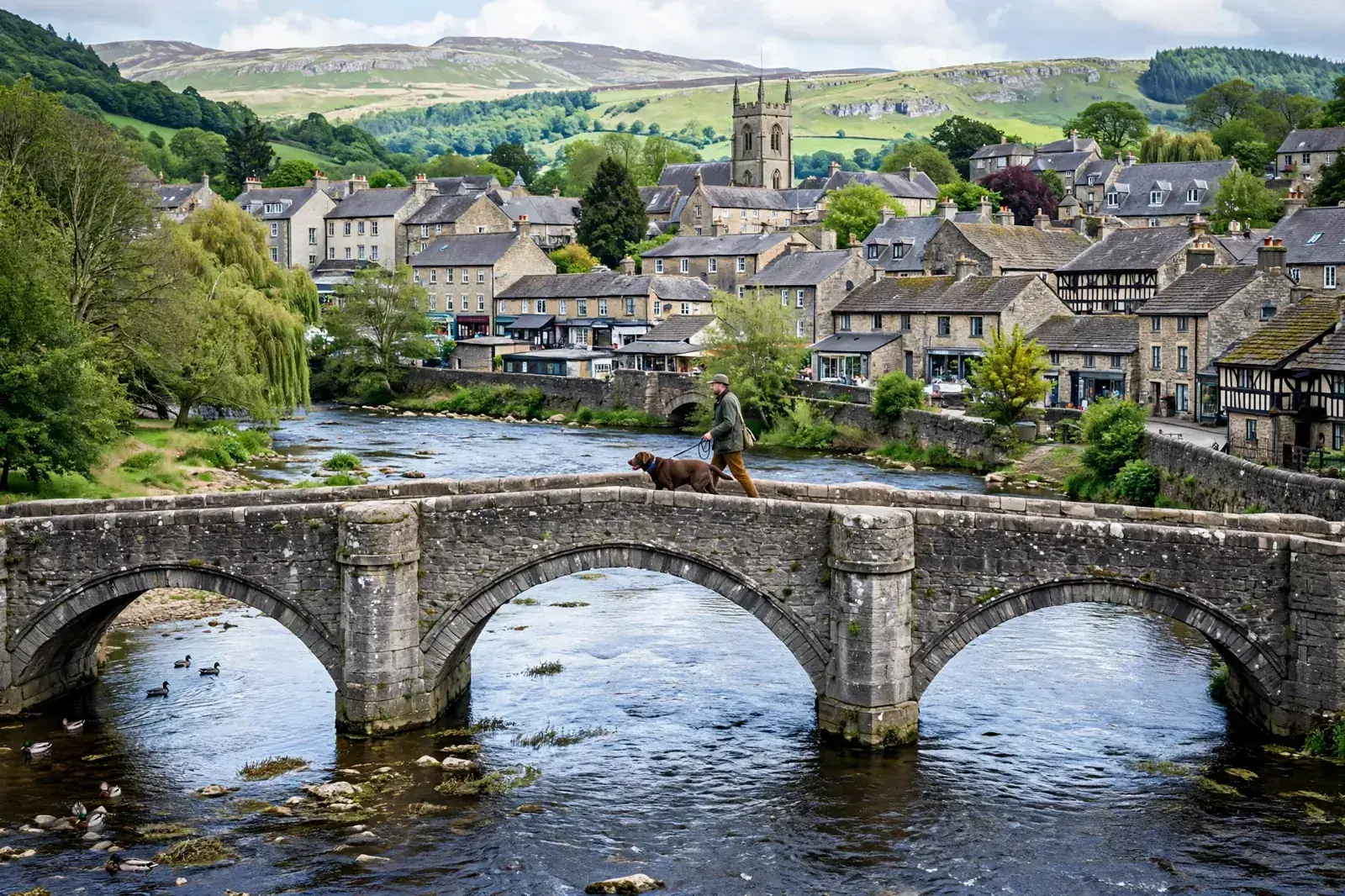
Start a Bakewell day down by the water, not in the car park queue. On a market morning the town wakes in stages: stallholders first, then the first walkers on the river path, then, quite suddenly, everyone at once. If you arrive in that middle stage, with a dog who has already had twenty unhurried minutes of sniffing along the River Wye, the whole day changes character. The dog has done the important business of the morning. You have seen the town at its calmest, stone bridge, slow green water and rooftops behind, and you can face a busy market square as a choice rather than an ambush.
That opening walk is the secret to Bakewell with a dog. This is a small town that receives a very large number of visitors, and most of its pleasures — the market, the pudding shops, the cafés, the riverside — sit within a few streets of each other. A dog who arrives already exercised and settled can enjoy that compact centre. A dog who is lifted straight out of a car into a crowd of shoppers, mobility scooters, dropped sausage rolls and other dogs on extending leads will reasonably conclude that Bakewell is stressful, and will tell you so for the rest of the day.
So treat the river as your arrival ritual wherever you have parked or stayed. Walk first, shop second, sit down third. The sections below follow that same order: water and trail walks, then the market and the food, then the two great houses nearby — one of which, Chatsworth, can be a superb dog day out in its parkland, and one of which, Haddon Hall, honestly cannot — and finally the lead discipline that the surrounding limestone dales demand from every visitor with a dog, however well behaved that dog believes itself to be.
The River Wye walks: the town's front garden
The River Wye is Bakewell's greatest dog asset. It runs right through the town, broad, clear and famously rich in trout, with paths and grassy banks that give dogs legal, pleasant, largely level walking without needing a car. The medieval stone bridge in the centre is the natural starting point, and from either bank you can build walks of almost any length, from a ten-minute toilet loop before breakfast to a gentle hour out and back before lunch.
For a short, reliable walk, follow the riverside downstream and back on the obvious paths, keeping to made surfaces after wet weather when the meadows soften. For something longer, work upstream and link the river path into local footpaths towards the surrounding villages, checking your route on an up-to-date map rather than relying on memory, because riverside paths occasionally divert after flooding or bank repairs. After heavy rain the Wye rises quickly for a limestone river, banks can be slippery, and sections close to the water should be treated with respect rather than optimism.
Water discipline matters here. This is a prized fishing river, with anglers, fly-fishing beats and private banks along its length. Keep dogs out of the water where signs ask you to, never let a dog swim across to the far bank among fishing lines, and call your dog away from anglers' equipment, which is expensive, sharp-hooked and entirely uninterested in being investigated. Ducks, swans and other waterbirds nest and feed along the edges in spring and summer, so a dog who chases birds should stay on a lead near the banks even where other dogs are loose. A long line gives a young dog freedom to sniff without rehearsing a chase you will spend years untraining.
Practical details make the river walks easy to repeat. There are bins in and near the centre, but carry bags with you rather than assuming one will appear at the exact moment required, and take litter home from the outer paths. In summer the town-side stretches get busy by mid-morning, so dogs who need space should walk early or head for the quieter outer sections. In winter, daylight is short and the paths can freeze, so build the long walk into the middle of the day rather than saving it for dusk.
The Monsal Trail from town: flat, famous and shared
If the river is Bakewell's front garden, the Monsal Trail is its long corridor into the dale. The trail follows a former railway line for about eight and a half miles through the Wye valley, running close to Bakewell and continuing through tunnels, over the celebrated viaduct at Monsal Head and on through limestone country towards the Buxton end of the line. Because it is a former railway, the gradients are gentle and the surface is largely made, which makes it one of the most accessible longer walks in the Peak District for older dogs, pushchairs, wheelchairs and anyone whose knees dislike hills.
Access from Bakewell is straightforward: the former station area on the edge of town is the usual joining point, with the trail running in both directions. Head one way for a shorter town-and-valley loop, or commit to the longer run towards Monsal Head and the viaduct for the classic scenery. Plan your distance honestly. A railway path tempts people to walk a long way out in a straight line and then discover that the return leg is exactly as long, into the wind, with a tired dog. Out-and-back arithmetic has ended more pleasant days than bad weather ever has, so turn around earlier than feels necessary, especially with older dogs and puppies whose joints should not be doing marathon distances in any case.
The trail's great strength is also its main management issue: everybody uses it. Expect cyclists, sometimes travelling quickly and quietly, runners, horse riders in places, families, mobility scooters and a great many other dogs. The sensible default is a short lead or genuinely close control near other users, stepping aside on bridges, at tunnel entrances and at the narrow viewing points where everyone stops at once. If your dog is frightened of bikes, train that problem somewhere quieter first rather than using a busy Sunday on the Monsal Trail as exposure therapy.
Tunnels deserve a specific note. The longer tunnels are lit, but they are cool, echoing and strange for some dogs, and sound carries oddly inside them. Keep your dog close, walk steadily through rather than stopping in the middle, and carry a small torch in winter when light levels drop early. Carry water as well: the valley looks lush, but there is little shade on parts of the trail in high summer, and a dog cannot drink from the river far below a viaduct. Finally, check for temporary closures or diversions before a long planned walk, because maintenance and rock work do occasionally reroute sections, and discovering that at mile five is nobody's idea of a holiday.
Monday market with a dog: timing is everything
Bakewell's Monday market is one of the reasons the town is famous, a proper outdoor market taking over the centre at the start of the week, with a livestock market tradition in the town as well. For a dog owner it is entirely doable and potentially enjoyable — provided you treat timing and lead length as the whole game. Our wider guide to dog-friendly markets in the UK makes the same point nationally: markets reward handlers who arrive early, keep moving and know when to leave.
Arrive early and the market is a rich, sniffy, sociable experience that many dogs genuinely enjoy. Arrive at the peak of the day and the same aisles become narrow, hot and crowded, with trolley wheels at dog height, dropped food at dog nose height, and very little room for a nervous dog to create distance. Keep the lead short between stalls, position your dog on the side away from the busiest flow, and step out of the aisles regularly — to the square's edges, a side street or, best of all, back down to the river for a decompression loop. Five minutes of grass resets a dog who has done twenty minutes of crowd work.
Food discipline is the other half of market craft. Markets drop things: chips, batter, cake crumbs, raw ingredients near food stalls and worse near bins. Train and use a reliable leave-it, watch the ground ahead rather than the stalls at the exact moments you pass food traders, and never let a dog scavenge around waste areas, where cooked bones and discarded packaging are real veterinary risks. If your dog is a committed scavenger, a market at peak time is not the place to test your training; walk the river instead and send a human in for the shopping.
Be fair to stallholders too. Individual traders set the rules at their own stalls, and shops around the square set theirs independently: some welcome dogs inside, some allow them at the door, and some, particularly food shops, cannot. Read the door, ask cheerfully, and accept a no without debate — the next shop along may well say yes. And if your dog finds the whole thing too much, that is information, not failure. Bakewell gives you an unusually good alternative sitting two minutes away, and it is called the River Wye.
Pudding shops, cafés and eating with a dog
No Bakewell guide can avoid the pudding, and no dog needs to miss out on the ritual entirely, even though the pudding itself should stay firmly on the human side of the table. The town is home to several shops and bakeries selling Bakewell puddings and tarts, each with its own claim and its own queue. Talked about in general terms, because individual dog policies change: some pudding shops are takeaway only, which suits dog owners perfectly, some cafés in town welcome dogs inside, some offer outdoor seating where dogs are welcome, and some food premises do not admit dogs at all beyond assistance dogs. The reliable method is the one we recommend in our guide to dog-friendly cafés across the UK: check the door signage, ask before you settle, and have a takeaway-and-riverside plan ready, because in Bakewell that fallback is genuinely lovely rather than a punishment.
A takeaway pudding eaten on a bench by the river, with the dog settled on a mat and the ducks kept at a respectful distance, is arguably the best version of the experience anyway. If you do eat inside or on a terrace with your dog, apply the standard courtesies that keep cafés dog friendly for the next visitor: dog on the floor, never on seats, lead short and out of walkways, no feeding from the table, and a settled dog rather than one doing meet-and-greet tours of neighbouring tables. Muddy Peak District paws are understood in Bakewell better than in most towns, but a quick towel-down before entering is still appreciated.
Two food warnings belong in every Bakewell dog plan. First, the famous local baking involves almonds, currants, raisins in some recipes and plenty of sugar and butter, and raisin-containing foods are toxic to dogs even in modest quantities. Keep all of it out of reach, including bags left beside a bench and crumbs under a café table. Second, market and festival days multiply dropped food across the whole centre, so the pavement scan you do on a market morning should continue all day. A dog who has spent the afternoon hoovering dropped cake is a dog at risk of a miserable, and occasionally dangerous, night.
Chatsworth as a day trip: go for the parkland
Chatsworth, a short drive or bus ride from Bakewell, is the big day out — and for dog owners it needs framing correctly from the start. The house itself is not the dog-friendly part. The glory, with a dog, is the parkland: a vast, Capability Brown-shaped landscape of grass, mature trees, the River Derwent and long views back to the house, where a dog on a lead can have one of the finest walks in Derbyshire while the humans get the full Chatsworth postcard for free or for the cost of parking, depending on where and how you visit.
Be honest and current about the formal rules, because they are the part of this guide most likely to change. Dogs on leads are welcome in the parkland, and under the estate's recent published rules dogs on a short lead have also been welcomed in the garden, while dogs are not admitted inside the house other than assistance dogs. Seasonal closures, garden maintenance, events and ticket arrangements all shift the detail, so treat that as the shape of the policy rather than a promise, and check the estate's official dog information before you set off on the day. Anyone who tells you an unchanging rule for a working estate is guessing.
In the parkland, the lead is not a formality. Chatsworth's landscape is a working one, with sheep, cattle and a famous herd of deer moving through it, and dogs must stay on leads and under close control around livestock at all times. Deer in particular change the stakes: a chase here is not a minor embarrassment but a serious welfare and safety incident, for the deer, for your dog and potentially for you. Give herds and flocks a wide berth, cross the park on the obvious paths, and save off-lead energy burning for somewhere enclosed and stock-free back near your base.
Structure a Chatsworth dog day around the outdoors and let the house fit around it, rather than the other way round. A workable pattern for two adults is to split the house visit — one person tours inside while the other walks the dog through parkland or garden, then swap — with a shared picnic or café stop in the middle, using the estate's outdoor seating where dogs are welcome. Solo travellers should skip the house interior without resentment and take the parkland, garden where permitted, farm shop area courtyards and riverside instead; it is not a consolation prize, it is most of what makes the place magnificent. Never, under any circumstances, leave a dog in a car in the car park while you tour the house: not in shade, not with a window cracked, not for a quick look. That rule has no Chatsworth exception and no quick-visit exception anywhere.
Practicalities: Chatsworth gets extremely busy on bank holidays, event days and sunny weekends, and parking and entry arrangements vary by date, so book what can be booked and arrive early. Carry water for the dog, because parkland distances are deceptive and a full circuit is a serious walk. And build in time simply to stand still: the view across the Derwent to the house, with a tired dog sitting on your foot, is the photograph everyone takes home from this part of Derbyshire, and it costs nothing but patience.
Haddon Hall: the honest version
Haddon Hall, just outside Bakewell, is one of the most romantic medieval houses in England, and this guide is going to be straightforward with you: it is essentially a people-only visit. Dogs are not generally admitted inside the hall, and dog access to the grounds has been limited and subject to change, so unless the hall's official website states clearly that dogs are welcome in a specific area on your date, plan Haddon on the assumption that your dog cannot join you. Check before you travel, because opening itself is seasonal and patterns vary across the year.
That honesty is more useful than the vague optimism you will find in some round-ups, which list every great house near a town as dog friendly because a dog once walked in its car park. A hall visit takes hours, not minutes, which rules out the car entirely as a waiting place, and Haddon's setting does not offer an equivalent of Chatsworth's vast public-feeling parkland to absorb a dog and a second human happily for half a day. The workable options are the same split-visit pattern as Chatsworth if you are a pair who both want to see inside, a dog-free half day if your dog can be left legitimately and safely at your accommodation under its rules — many cannot and do not allow it — or simply choosing Chatsworth for this trip and saving Haddon for a visit without the dog.
None of that is a criticism of Haddon, which protects fragile interiors and gardens exactly as it should. It is a planning fact, and Bakewell is strong enough as a dog destination that you do not need to pretend otherwise. The river, the trail and the dales will fill the day Haddon would have taken, and your dog will vote for that itinerary every time.
Sheep, limestone dales and lead discipline
Everything around Bakewell comes with one non-negotiable condition, and it is the section of this guide to read twice. The limestone dales of the White Peak are sheep country, stitched together with drystone walls, small fields and footpaths that pass directly through grazing land. Dogs must be kept on a lead or under the closest possible control around livestock — the law and common decency agree on this, as our guide to dogs on leads and the law in the UK explains in full — and the only safe working assumption is that there are sheep in the next field even when you cannot see them in this one.
Limestone country has its own specific texture. The dales are beautiful and deceptively gentle, but the ground is hard, pale and sharp in places, paths cross stiles of many ingenious and dog-unfriendly designs, and some routes involve ladder stiles, squeeze stiles and gated gaps that a large, elderly or anxious dog may not manage. Check a route description before committing, carry a plan for how you will get your dog over or through each barrier, and be willing to turn back: a stile you cannot cross safely is a full stop, not a challenge. After rain, limestone paths and grassy slopes become remarkably slippery, and in hot weather those same pale paths reflect heat and offer little shade, so walk early and carry more water than the modest mileage suggests you need.
Spring adds ground-nesting birds to the picture across the wider Peak District, and seasonal requests or requirements to keep dogs on short leads in sensitive areas should be followed exactly as signed. Adders are present in parts of the Peak District in warm months, favouring sunny banks and walls; keep dogs out of long grass and bracken edges on hot days and know your nearest vet's location before you need it. Finally, close every gate you pass through, whether or not you opened it, and keep dogs out of troughs and away from farmyards. The dales are a workplace that tolerates visitors generously. The lead, the closed gate and the taken-home poo bag are the rent.
Stays, parking and practicalities
Bakewell makes a strong base as well as a day trip. The town and its surrounding villages offer the usual Peak District mix of inns, bed and breakfasts, self-catering cottages, holiday parks and campsites, many of them advertising dogs welcome — which, as always, means checking the specifics rather than trusting the label. Confirm how many dogs are allowed, whether there is a per-dog charge, whether dogs may be left alone in the room or cottage and under what conditions, and what the nearest after-dark toilet walk actually is. A cottage on a village lane with a field gate opposite is worth more to a dog owner than a smarter address on a road with no verge.
Ask about enclosed space with unusual care in this area. Stone-walled gardens look secure and often are, but walls have gaps, gates open onto lanes, and a garden that contains a spaniel may not contain a terrier with a PhD in escape. Check flooring too: stone flags and washable floors are a blessing after dale walks, while pale carpets in a wet October are a deposit negotiation waiting to happen. Bring your own dog bedding, towels and a drying coat, and ask where a muddy dog can be rinsed before entering — good Peak District hosts usually have an answer ready, because they have been asked a thousand times.
Parking in Bakewell itself needs a plan on busy days. The town has several pay-and-display car parks in and around the centre, including larger sites on the showground and agricultural centre side of town and smaller, faster-filling central car parks. On Mondays and in high summer, arrive early or expect a hunt. Charges, time limits and payment methods change, so read the signs and the operator's current information when you arrive rather than relying on any guide's numbers, including this one. Coaches, market vehicles and event traffic compress the centre further on peak days. And repeat the rule that outranks every parking convenience: a dog never waits in the car while you shop, eat or tour a house, whatever the weather appears to be doing when you lock the door.
For supplies and emergencies, Bakewell is better equipped than many small towns, with pet supplies available locally and veterinary cover in the area, but save the exact practice details and out-of-hours arrangements in your phone before a long dale walk rather than searching with cold hands on a hillside. Mobile signal in the dales is patchy. Download maps for offline use, tell someone your route on longer walks, and carry the unglamorous kit that makes small problems stay small: bags, water, a spare lead, a towel, and a charged phone.
A one-day plan that actually works
Put it together and a good Bakewell dog day has a clear rhythm, built around crowds rather than distance. Arrive early and go straight to the river for the settling walk described at the start of this guide, while the town is still waking up. Follow it with the market if your day is a Monday, early, on a short lead, with a river reset halfway through if your dog needs one. Late morning is pudding time: takeaway to a riverside bench, or a café that has confirmed it welcomes your dog, with every crumb treated as contraband.
The middle of the day belongs to the Monsal Trail, when town-centre dogs are at their most numerous and the trail, for all its popularity, gives everyone more room. Walk out for a defined time rather than a defined distance, turn around while the dog is still fresh, and let the tunnels and the viaduct viewpoint be the highlights rather than the halfway point of an accidental expedition. Alternatively, swap the afternoon to Chatsworth's parkland on a day when you have booked what needs booking and checked the current dog rules that morning; do not try to do Monsal and Chatsworth properly in the same day, because both deserve better and so does the dog.
Finish back in town in the early evening, when day visitors thin out and Bakewell becomes a small Derbyshire town again. A last slow circuit of the river, a pub garden or terrace where dogs are welcome if you have confirmed it, and an early night in a cottage, inn room or on a nearby site: that is the whole recipe. Bakewell does not ask much of dog owners — an early start, a short lead in the right places, and respect for sheep, anglers and other people's puddings — and in return it gives you one of the easiest, prettiest, most repeatable dog days in the Peak District. For another historic town that rewards the same early-and-riverside approach in a different landscape, compare our Cotswolds dog guide before your next trip.
Practical questions
Before you go
Can dogs go into Chatsworth gardens and parkland?
Dogs on leads are generally welcome in the Chatsworth parkland and, under the estate's current rules, in the garden on a short lead, but they are not allowed inside the house except for assistance dogs. Rules, seasonal closures and ticket arrangements change, so check the estate's official dog information on the morning you plan to go and keep your dog on a lead around livestock and deer at all times.
Is Bakewell market dog friendly on Mondays?
The Monday market is outdoors in the town centre, so a dog on a short lead can walk through it with you, but it gets busy, narrow and noisy at peak times. Go early, keep the lead short between stalls, watch for dropped food and trolleys, and step out to the quieter river path whenever your dog needs space. Individual stallholders and nearby shops set their own rules for going indoors.
Can dogs walk the Monsal Trail from Bakewell?
Yes. The Monsal Trail is a shared-use former railway path and dogs are welcome, but it is busy with cyclists, walkers, pushchairs and horses in places. Keep your dog on a short lead or under very close control near other users, give way on bridges and in tunnels, carry water because there is little shade in summer, and check for any temporary diversions before you set off.
Are dogs allowed inside Haddon Hall?
No, not as a rule. Dogs are not generally admitted inside Haddon Hall itself, and access to its grounds for dogs has been limited and subject to change. Treat Haddon as a people-only visit unless the hall's official website says otherwise for your date, and do not plan to leave a dog unattended in a car while you go inside.
Where can I park in Bakewell with a dog?
Bakewell has several pay-and-display car parks in and near the centre, including larger sites by the showground and agricultural centre side of town and smaller central car parks that fill quickly on Mondays and in summer. Arrive early on market day, check the current charges and time limits on the council or operator signs when you arrive, and never leave a dog alone in a parked car, especially in warm weather.